
Mets Sign Starling Marte
The Mets have landed the market’s top center fielder, announcing agreement with Starling Marte on a four-year, $78MM deal. The star outfielder will lock in a $14.5MM salary in 2022 to go with a $5MM signing bonus, then receive $19.5MM salaries from 2023-25. Marte is represented by Rep 1 Baseball.
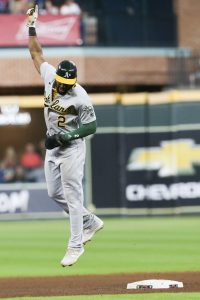
It’s the culmination of a shocking evening for the Mets, who have also agreed to terms with Eduardo Escobar and Mark Canha within the past few days. Marte was the prize of this offseason’s free agent center field class, easily the top option in an otherwise thin market. A 2016 All-Star and two-time Gold Glove award winner, he’s coming off perhaps the best season of his ten-year big league career. Marte split the 2021 campaign between the Marlins and A’s, posting a .310/.383/.458 line with 12 home runs and an MLB-best 47 stolen bases in just 120 games.
A rib fracture cost Marte more than a month of action between April and May, but he was as productive as ever upon returning. After adjusting for the pitcher-friendly home parks in which he played, Marte’s hitting alone was 34 percentage points better than league average, by measure of wRC+. That’s the best mark of his career, and the speedy outfielder added significantly more offensive value on top of that with incredible baserunning. Not only was he the game’s most prolific base-stealer, he was successful on 90.4% of his attempts — an incredible rate considering opposing pitchers were well aware of the threat he posed every time he reached base.
While Marte might be coming off his best season, he’s been a consistently above-average player for the bulk of his career. His 2021 campaign was the most extreme version of a generally steady skillset: plenty of balls in play, high-end baserunning, and an all-fields approach that makes him difficult to defend. Marte’s .372 batting average on balls in play this past season was one of the league’s higher rates, but he’s consistently had a knack for turning batted balls into hits. So while that BABIP may take a bit of a step back in 2022, it’s likelier he’ll regress closer to his career .344 mark as opposed to the .292 league average.
Marte’s an aggressive hitter, and he’s never had a season with an above-average walk rate. His 8.2% walk percentage in 2021 was a personal best, and his patience tailed off significantly after he was traded from Miami to Oakland midseason. His free-swinging ways also keep his strikeouts down, though, as the Dominican Republic native hasn’t punched out in more than 20% of his plate appearances in a season since 2014. So while Marte doesn’t take many free passes, he nevertheless typically manages solid on-base numbers based on batting averages that regularly push (or, in 2021’s case, exceed) .300.
Defensively, Marte broke in as a left fielder with the Pirates in deference to Andrew McCutchen. One of the game’s top corner outfield defenders, he kicked over to center field in 2018 after Pittsburgh traded McCutchen away. He’s spent the past four seasons playing almost exclusively up the middle, drawing mixed reviews. Defensive Runs Saved has pegged Marte as a bit below-average over each of the past three seasons. Statcast’s Outs Above Average typically rates him a bit above par with the glove.
However one falls on Marte’s glovework, it seems the Mets view him as a defensive upgrade over incumbent center fielder Brandon Nimmo. Signing Marte will allow New York to kick Nimmo into right field, where he’ll replace free agent Michael Conforto (who almost certainly will wind up elsewhere after today’s transactions). They’ll be joined in the regular outfield by Canha, the culmination of a drastic shakeup on the grass that unfolded within the span of a few hours.
How long Marte will be capable of manning center field remains to be seen. He signed an early-career extension with the Pirates that delayed his first trip to the free agent market by a few seasons. Marte turned 33 years old last month, and it’s possible he’ll need to move to a corner spot at some point over the course of this deal. He’s not yet shown an appreciable drop-off in sprint speed, according to Statcast, and the Mets are counting on his speed and defense holding up for at least the next couple seasons.
A four-year guarantee for a player at this age whose game is so reliant on athleticism isn’t without risk. Between Marte’s great platform season and the lack of obvious center field alternatives, that always seemed likely to be the price a team would have to pay to bring him aboard, though. Entering the offseason, MLBTR projected a four-year, $80MM guarantee and ranked Marte this winter’s #13 free agent.
Marte is the highest-ranked player of this winter’s class to sign to date, and he’s also secured the largest guarantee of any player so far (edging out Eduardo Rodríguez’s deal with the Tigers by $1MM). In the span of a day, the Mets have become the offseason’s most active club — the kind of spending spree fans in Queens envisioned when Steve Cohen purchased the franchise from the Wilpon family last offseason.
The club opened Cohen’s first season as owner with a payroll in the $195MM range, per Cot’s Baseball Contracts. It’s clear they’re prepared to shatter that mark in year two, as Jason Martinez of Roster Resource estimates that spreading the Escobar, Canha and Marte deals evenly would push the Mets’ 2022 commitments to $225MM. The organization’s estimated luxury tax bill, meanwhile, now sits above $229MM.
That’s including projections for arbitration-eligible players, some of whom will be non-tendered or traded. Speculatively speaking, Dominic Smith, J.D. Davis and/or Jeff McNeil could be flipped elsewhere, as today’s series of acquisitions could inhibit the path to everyday reps for that trio (particularly Smith and Davis). Yet it’s also apparent that Cohen is giving general manager Billy Eppler wide leeway to bolster the roster in hopes of snapping a five-year playoff drought, and further moves could be on the horizon. All three of today’s additions are position player pickups, and Eppler is already on record about the team’s desire for rotation help.
While the Mets’ roster is the main story of today’s transactional barrage, their agreement with Marte has trickle-down reverberations for the rest of the league. As the only clear everyday center fielder available in free agency, he’d drawn wide interest over the offseason’s first couple weeks. Teams like the division-rival Phillies, crosstown Yankees, Marlins, Giants, Astros and Rangers had all been rumored to have interest in his services. Having missed out on Marte, a few of those clubs might now have to pivot to the trade market.
Arizona’s Ketel Marte, Pittsburgh’s Bryan Reynolds and Baltimore’s Cedric Mullins stand out as the top potential targets, but it remains to be seen how attainable any of those players may be. The D-Backs have been resistant to moving any of their core controllable stars; the Pirates were reportedly disinclined to consider deals involving Reynolds at the trade deadline, viewing him as a long-term building block. The O’s are at least willing to field offers on Mullins, but it’s not clear that’s anything more than due diligence at this point.
Jon Heyman of the MLB Network first reported the Mets had agreed to terms on a four-year, $78MM guarantee with Marte. MLB.com’s Anthony DiComo of MLB.com first reported the salary breakdown of Marte’s contract.
Image courtesy of USA Today Sports.
Mets Sign Mark Canha
The Mets continue to bolster their position player mix, announcing agreement Tuesday with free agent outfielder Mark Canha. It’s reportedly a two-year, $26.5MM guarantee for the CAA Sports client. The deal also contains a 2024 club option. A Bay Area native, Canha had previously spent his entire big league career with the A’s.
Canha’s contract will see him collect $12MM in 2022 along with a $2MM signing bonus and then $10.5MM in 2023. The 2024 club option is valued at $11.5MM and has a $2MM buyout attached.
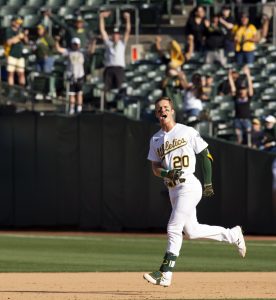
Canha becomes the second big addition of the day for the Mets, who also agreed to terms with infielder Eduardo Escobar on a two-year guarantee this afternoon. Canha will step into the club’s outfield mix, with the bulk of that time presumably coming in the corners. While he has experience in all three outfield spots, he’s never rated highly as a center fielder and has logged the plurality of his career innings in left field.
Public metrics like Statcast’s Outs Above Average and Defensive Runs Saved have been mixed on Canha’s corner outfield work over the past few seasons. There’s little question about his bat, though, as Canha has been an above-average hitter in each of the past four years by measure of wRC+.
Since the start of the 2019 season, the Berkeley product owns a .249/.377/.438 line over 1365 plate appearances. While he doesn’t have an eye-catching batting average, the right-handed hitter has walked in a fantastic 13.3% of his trips to the dish. That’s the 14th-highest rate among the 159 players with 1000+ plate appearances in that time. As a result, Canha’s on-base percentage is nearly sixty points higher than the league-wide mark over that span.
That ability to reach base may be Canha’s only standout skill, but it’s a highly valuable one for a Mets’ club that ranked sixteenth with a .321 mark this past season (excluding pitchers). And while Canha may not be elite at anything else, he’s a generally solid all-around player. His strikeout rates over the past few years have typically been a bit lower than the league marks. He owns a .189 ISO (slugging percentage minus batting average) since the start of 2019, which is slightly above par. Canha has done all that in one of the game’s more pitcher-friendly home environments, and his overall offense over the past three seasons checks in 29 percentage points above league average after accounting for park effects.
Canha was off to an especially promising start in 2021. In 325 plate appearances through June 25, he hit .255/.375/.450 with 11 homers. He suffered a left hip strain that landed him on the injured list at that point, an injury from which he didn’t seem to fully recover. While Canha returned in mid-July, he slumped to a .206/.340/.319 line over his final 300 plate appearances. A glance at his batted ball metrics seems to support that narrative. Canha’s average exit velocity before his IL stint sat at a solid 89 MPH; over his final few months, that mark dropped to 85.5 MPH.
The Mets are clearly of the belief that Canha’s power and overall offensive output will return to peak levels after an offseason to recover. His reported $13.25MM average annual value comes in a touch higher than MLBTR’s two-year, $24MM projected guarantee. Still, it’s a reasonable price for a player of Canha’s caliber and the Mets aren’t taking on much long-term risk. Canha turns 33 years old in February, capping the length of offers teams were willing to put forth.
Canha joins Brandon Nimmo as locks for regular playing time in the New York outfield next season. The Mets have various others who could play their way into the mix. Jeff McNeil and J.D. Davis could get bumped from a crowded infield mix into outfield work, while Dominic Smith, Khalil Lee and recent big league signee Nick Plummer could also see action. Still, there are enough moving parts that new GM Billy Eppler and his staff could continue to look for upgrades. Jon Heyman of the MLB Network tweets that New York still isn’t ruling themselves out of the market for free agent center fielder Starling Marte, for instance.
The specific breakdown of Canha’s deal has yet to be reported, but it’s likely to be another fairly significant addition to the Mets’ 2022 books. If both the Escobar and Canha deals were paid out evenly over the next two seasons, New York’s 2022 payroll would be pushing $207MM in the estimation of Jason Martinez of Roster Resource. The Mets’ estimated luxury tax commitments, meanwhile, are now up around $210MM (both figures including projected salaries for arbitration-eligible players).
It’s not entirely clear how far owner Steve Cohen is willing to push payroll, but it seem very likely they’ll at least be above this past season’s $195MM mark. Both Cohen and Eppler have talked about having ample financial flexibility, and the Mets remain on the hunt for additions to a rotation that has already lost Noah Syndergaard and could see Marcus Stroman depart. It’s already been an active first few days for Eppler in Queens, and it seems likely the Mets will continue to be busy as they try to snap a five-year playoff drought.
As for Canha’s former club, the A’s never seemed especially likely to make a strong run at bringing him back. Oakland is expected to conduct a significant roster overhaul this winter, with ownership seemingly mandating a drastic reduction in payroll. The A’s didn’t make Canha an $18.4MM qualifying offer, and shelling out a multi-year deal at an eight-figure annual salary would’ve registered as a major surprise.
Jeff Passan of ESPN first reported the Mets and Canha were nearing an agreement. Joel Sherman of the New York Post reported a two-year, $26.5MM guarantee had been agreed upon. Sherman also reported the presence of a 2024 option, which Jon Heyman of the MLB Network specified was a club option. MLB.com’s Anthony DiComo reported the salary breakdown of Canha’s contract.
Image courtesy of USA Today Sports.
Angels Sign Michael Lorenzen
The Angels announced the signing of right-hander Michael Lorenzen to a one-year contract on Tuesday. It’s reportedly a $6.75MM pact for the CAA Sports client.
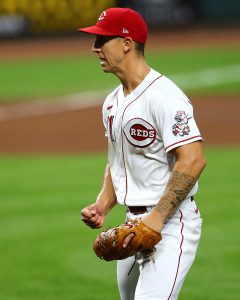
After already signing Noah Syndergaard, the Angels will add another notable pitcher to their rotation on a one-year contract, as Lorenzen will reportedly function as a starting pitcher. Lorenzen went into free agency hoping to get an opportunity to again work as a starter, following six years of almost exclusively being used as a reliever out of the Reds bullpen. Cincinnati was open to stretching Lorenzen out last spring, before Lorenzen was sidelined with a shoulder strain that put him on the injured list for the entire first half of the season.
Lorenzen (who turns 30 in January) indicated that he was open to signing a shorter-term contract in order to prove himself in a rotation, and thus set himself up for a more lucrative free agent deal next winter when he can market himself as a full-fledged starting pitcher. For an Angels team that needs starting pitching and is generally wary of long-term commitments to starters, Lorenzen represented a solid fit, and since Lorenzen is also an Anaheim native, he’ll now get to start this new chapter of his career in his hometown.
Anaheim is also a particularly interesting landing spot for considering the presence of Shohei Ohtani, and Lorenzen’s own status as a two-way player. In addition to working out of the Reds’ bullpen, Lorenzen also appeared in 34 games as an outfielder, with most (29) of those appearances coming during the 2019 season. Lorezen has hit .233/.282/.429 over his 147 career plate appearances, which is well above average for a pitcher, if unspectacular for a position player.
It is easy to imagine a scenario where Lorenzen continues to get regular work in the rotation and in the outfield, since the Angels know better than any team now to manage a two-way player. The Halos have already adjusted their rotation to a six-man unit to accommodate Ohtani, and that rotation now consists of Ohtani, Lorenzen, Syndergaard, Jose Suarez, Patrick Sandoval, and one of Reid Detmers or Jaime Barria.
Considering how the Angels have been linked to so many notables on the free agent and trade markets, it wouldn’t be a surprise to see another pitcher acquired, in order to add even more depth to this group. It remains to be seen, of course, whether Lorenzen can actually thrive as a starter, and Syndergaard is only returning to regular action after Tommy John surgery caused him to miss miss virtually all of the 2020-21 seasons.
If Lorenzen doesn’t work out as a starting pitcher, he can always fall back on relief pitching, which would also provide a boost for the Angels. There is a big hole at the back of the bullpen since closer Raisel Iglesias may depart in free agency, which is a little ironic considering how Lorenzen spent much of his time in Cincinnati working as Iglesias’ setup man. Lorenzen posted a 3.48 ERA over 331 innings from 2016-2020, also delivering a 5.59 ERA over 29 frames in 2021, though that performance is hard to gauge given all of Lorenzen’s injury problems.
Lorenzen didn’t fit the usual profile for a reliever, as he delivered below-average strikeout rates and middling walk rates but relied on a lot of soft contact and strong grounder rates to get outs. Between this skillset and a very good spin rate on his fastball, there is some sense that Lorenzen can translate well to rotation work. If the experiment doesn’t pan out, Lorenzen can pick up where he left off in the pen, and might well still score a solid multi-year contract next winter if he pitches to his usual standard as a reliever.
Robert Murray of FanSided first reported the Angels were in agreement with Lorenzen on a one-year deal worth around $7MM, and reported Lorenz’s role as a starter. Rhett Bollinger of MLB.com reported the guarantee was $6.75MM.
Marlins Designate Lewis Brinson For Assignment
The Marlins have designated outfielder Lewis Brinson for assignment, per a team announcement. His spot on the 40-man roster will go to infielder Joey Wendle, whose previously reported acquisition from the Rays has now been formally announced.
Brinson, 27, was the centerpiece of Miami’s return in the blockbuster trade that sent Christian Yelich to the Brewers. Brinson joined the Marlins organization alongside, infielder Isan Diaz, outfielder Monte Harrison and right-hander Jordan Yamamoto. At the time, it was a strong-looking return given that both Brinson and Diaz were regarded as high-end prospects, with Brinson in particular being vaunted as one of the game’s most promising all-around farmhands. As most fans are well aware, however, the deal didn’t pan out for the Fish.
There was always some risk to Brinson, a toolsy first-round pick of the Rangers back in 2012 who found his way to Milwaukee by way of another prominent trade (Jonathan Lucroy). Brinson made a brief MLB debut with the Brewers in 2017, tallying 55 plate appearances and struggling quite a bit as a 23-year-old getting his feet wet in the big leagues. That rough debut didn’t dim his prospect status much at all, but he never really made many strides in parts of four seasons with the Brewers.
From 2018-21, Brinson logged 1056 plate appearances in the big leagues but mustered only a .203/.248/.376 batting line with a 28% strikeout rate against just a 4.6% walk rate. He continues to rate as one of the fastest players in MLB, per Statcast’s average sprint speed, but Brinson doesn’t rate as a premium defender in the outfield by most publicly available metrics. He’s also seen his exit velocity and hard-hit rates drop since 2017-18, and this year’s penchant for popping the ball in the air was particularly concerning; 13 of Brinson’s 75 fly-balls were pop-ups.
Brinson is out of minor league options, so any team that acquires him will have to carry him on the MLB roster next season or else attempt to pass him through waivers before sending him to Triple-A.
Rays Trade Joey Wendle To Marlins
A busy offseason for the Marlins continued Tuesday, as Miami has announced the acquisition of infielder Joey Wendle from the Rays in exchange for outfield prospect Kameron Misner.
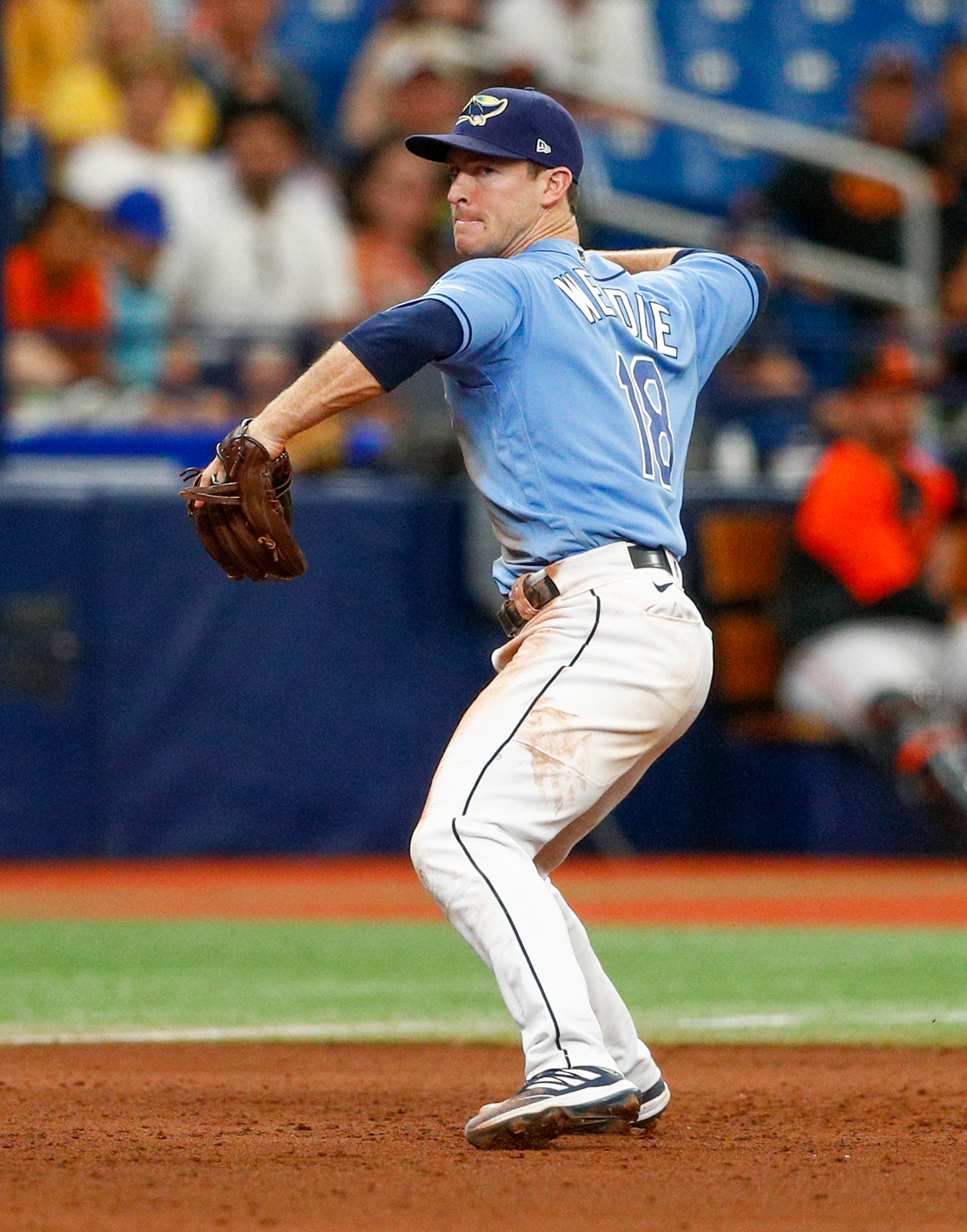
Wendle, 31, gives the Marlins an option at any of second base, shortstop or third base both in 2022 and in 2023, as he’s controlled another two seasons via arbitration. The lefty-swinging Wendle provides quality defense at all three of those positions and will bring a largely contact-driven offensive approach to the plate for Miami. He’s spent the past four seasons with the Rays, hitting at a combined .274/.330/.414 clip — six percent better than the league average, by measure of wRC+ — with 25 home runs, 86 doubles, 14 triples and 40 stolen bases (in 55 tries) through just shy of 1500 plate appearances.
The Marlins, according to SportsGrid’s Craig Mish (Twitter link), plan to utilize Wendle as a super-utility player who’ll bounce between second, short, third and perhaps the outfield or first base. Jazz Chisholm and Miguel Rojas have second base and shortstop largely locked down (respectively), while Brian Anderson has been the team’s primary third baseman in recent years. Anderson, however, has been beset by shoulder troubles and spent considerable time on the injured list. He’s also capable of playing in the outfield corners, so it’s at least feasible he could move to the grass in order to accommodate Wendle at the hot corner at times. The advent of a designated hitter in the National League could also lead to some reps for Anderson (or Wendle) there.
The good news for Miami is that they don’t have to set anything in stone just yet. Adding Wendle unquestionably improves the roster but does so while creating enough agility for general manager Kim Ng and her staff to cast a wide net in their further offseason pursuits. The Marlins are still seeking a center field option but could also pivot to add a corner bat if there’s a chance for an opportunistic strike in left field or at third base.
Wendle’s addition is the latest in an increasingly active offseason for the Marlins, who in the past week have signed Avisail Garcia to a four-year contract, acquired catcher Jacob Stallings from the Pirates, and signed rotation leader Sandy Alcantara to a five-year contract extension with a team option for a sixth season.
On the other side of the deal, Tampa Bay has reportedly been exploring the trade market for Wendle in advance of tonight’s deadline to tender contracts to arbitration-eligible players. Wendle is projected by MLBTR contributor Matt Swartz to earn $4MM in 2022, and the Rays needed to open a spot on the roster to accommodate their recent one-year, $8MM agreement with veteran right-hander Corey Kluber. The Rays are also deep in terms of infield options; Brandon Lowe, Wander Franco, Yandy Diaz and prospects Taylor Walls and Vidal Brujan give them ample cover at second, third and short.
The addition of Misner, who’ll turn 24 in January, is nothing to scoff at from the Rays’ vantage point, either. The No. 35 overall draft pick back in 2019, Misner split the 2021 campaign betweenthe Class-A Advanced and Double-A levels, hitting a combined .253/.355/.433 with a dozen homers, 29 doubles, three triples and 26 steals (in 30 tries).
Scouting reports on Misner tout the lefty hitter’s plus raw power, plus speed and solid defensive tools — which make for a tantalizing package were it not for a substandard hit tool. Misner fanned at a 29.4% clip in 462 of his minor league plate appearances this season, and while he offsets those punchouts (to an extent) with a stout 12.3% walk rate, more advanced pitchers will carry greater potential to expose holes in his swing.
The blend of power, speed and defense makes Misner a relatively high-upside name to add to an already deep stockpile of prospects. Misner ranked 10th among Marlins farmhands at FanGraphs, 15th on Baseball America’s midseason list and 21st on MLB.com’s midseason rankings. The fact that Misner briefly reached Double-A this past season at least opens the door for a potential MLB debut at some point in 2022, though it seems likelier that he’d make an impact in 2023 — assuming he continues to produce in the upper minors.
Craig Mish of SportsGrid and the Miami Herald first reported (via Twitter) that Wendle was headed to Miami. Marc Topkin of the Tampa Bay Times reported that Misner was going back to Tampa Bay in return.
Photo courtesy of Imagn/USA Today Sports.
Rangers Sign Kole Calhoun
The Rangers announced an agreement with veteran outfielder Kole Calhoun on Tuesday. It’s reportedly a one-year, $5.2MM guarantee that comes with a $5.5MM club option for 2023. The option doesn’t contain a buyout. Calhoun is represented by PSI Sports Management.
Calhoun hit the open market after the Diamondbacks declined their $9MM club option following the season, instead paying him a $2MM buyout. Calhoun originally signed a two-year, $16MM deal with Arizona in the 2019-20 offseason and hit a strong .226/.338/.526 with 16 home runs over 228 plate appearances in 2020 before battling injuries this past year. Calhoun underwent surgeries on both his right knee and left hamstring, with that hamstring leading to another injured list stint late in the 2021 season. All told, Calhoun had only 182 PA in 2021, and he batted just .235/.297/.373.
The 34-year-old will now get a chance to bounce back in Arlington, returning to the AL West after playing with the Angels from 2012-19. Calhoun has long been a very solid defensive right fielder, and since breakout star Adolis Garcia acquitted himself pretty well defensively in part-time action in center field last year, Texas might opt to give Garcia more time in center with Calhoun taking over the bulk of right field duty.
Considering how Calhoun struggled in 2021, however, the Rangers might well see Calhoun as more of a part-time or platoon option rather than an everyday regular in the outfield. Since Texas clearly has some major spending in mind this winter (as evidenced by today’s agreement with Marcus Semien), we also shouldn’t rule out more additions to the outfield mix. For now, at least, Calhoun will join Garcia as a starter in the 2022 outfield.
Ken Rosenthal of the Athletic was first to report the Rangers were in agreement with Calhoun. Mark Feinsand of MLB.com reported it was a one-year, $5.2MM guarantee and contained a 2023 club option. Levi Weaver of the Athletic reported the option was valued at $5.5MM and didn’t contain a buyout figure.
Pirates Release Cody Ponce To Pursue NPB Opportunity
The Pirates have released right-hander Cody Ponce, according to the team’s transactions log at MLB.com. The right-hander is pursuing an opportunity in Japan’s Nippon Professional Baseball, reports Kevin Gorman of the Pittsburgh Tribune-Review. Reports out of Japan have suggested he’ll be signing with the Hokkaido Nippon-Ham Fighters.
Ponce has appeared in the majors in each of the past two seasons, combining to work 55 1/3 innings over 20 outings. Most of that work has come as a multi-inning reliever, but Ponce did make a more traditional five-inning start against the Cubs in May. Altogether, he’s managed a 5.86 ERA. Ponce has only punched out 19.6% of opponents and struggled with home runs, but he’s also been quite stingy with walks (6.9%).
Transactions of this ilk aren’t uncommon, as players on the fringes of a 40-man roster can often make more in foreign professional leagues than they’d stand to earn as up-and-down players with a big league club. It’s not out of the question Ponce returns to the majors at some point down the line, particularly if he settles in as a productive member of the Fighters’ rotation over the next season or two.
The move clears a space on Pittsburgh’s 40-man roster. That’ll be needed for the signing of Roberto Pérez, who reportedly agreed to terms on a $5MM guarantee this afternoon.
Red Sox Sign Christin Stewart, Rob Refsynder To Minor League Deals
The Red Sox have inked a pair of recent big leaguers to minor league deals. Rob Bradford of WEEI reported (on Twitter) that former Tigers corner outfielder/DH Christin Stewart was landing in Boston; meanwhile, Chris Cotillo of MassLive reported this morning (Twitter link) that utilityman Rob Refsnyder was signing with the Sox.
Stewart, 28 next month, appeared in the majors with Detroit each season from 2018-20. The left-handed hitter tallied 587 plate appearances all told (the bulk of them coming in 2019) and hit .225/.300/.376 with 15 home runs. That kind of offensive output wasn’t enough to compensate for Stewart’s lack of defensive value as a below-average left fielder, and Detroit outrighted him off their 40-man roster in April.
To his credit, Stewart bounced back after clearing waivers. He took 343 trips to the plate with the Tigers’ Triple-A affiliate in Toledo, hitting .254/.339/.538 with 21 homers. That’s in line with Stewart’s career-long track record of hitting well in the minors, but it wasn’t enough to earn another big league look in Detroit. He’ll try to play his way back to the majors with the Red Sox next spring.
Refsnyder has appeared in the majors in each of the past six seasons, albeit without ever tallying 200 trips to the plate in a given year. He’s bounced around the league, suiting up for the archrival Yankees, Blue Jays, Rays, Rangers and Twins. His most recent stop was in Minnesota, where he posted a .245/.325/.338 line with a pair of homers over 157 plate appearances.
The 30-year-old’s greatest appeal lies in his defensive versatility. Refsnyder has appeared at every position excepting shortstop and catcher over the course of his big league career, adding center field to his resume while Byron Buxton was on the injured list this past season. He’ll look to earn a big league roster spot with the fourth AL East team of his career come Spring Training.
Braves Sign Orlando Arcia To Two-Year Guarantee
The Braves announced an agreement with utilityman Orlando Arcia on a two-year, $3MM contract. He’ll earn successive salaries of $1.6MM and $1.3MM over the next two seasons, per the team. The deal also contains a 2024 club option valued at $2MM that comes with a $100K buyout.
The contract extends the Braves’ window of club control by a season, as Arcia had been controllable through 2023 via arbitration. It’s a bit of a surprise to see the Braves commit any long-term money to Arcia at first glance. He only tallied 78 MLB plate appearances after Atlanta acquired him from the Brewers in April, with a poor .214/.282/.343 line to show for it. Arcia has been a below-average hitter in all five of his MLB seasons, with a .260/.317/.416 showing during the truncated 2020 campaign the best line of his career.
Arcia is coming off a very strong showing with Triple-A Gwinnett, though. Over 322 plate appearances at the minors’ top level, he hit .282/.351/.516 with 17 homers, only striking out in 11.8% of his tallies at the dish. By measure of wRC+, that offensive output was 29 percentage points better than the Triple-A East league average. And Arcia’s a valuable defensive player who generally posts decent numbers at shortstop and began to expand his versatility this past season.
Clearly, the Atlanta front office believes in his ability to contribute over the coming seasons, even if just off the bench. The $1.5MM average annual value is a minimal investment, and it’s actually a bit less than the $2.1MM MLBTR contributor Matt Swartz had forecasted Arcia making in 2022 via arbitration.
That’s not to say Arcia and his representatives at World Sports Agency made a mistake in signing the deal. At that previous figure, he’d look like a non-tender candidate. The Venezuela native instead locks in some guaranteed money over the coming two seasons. Arcia is out of minor league option years, but it seems likely he’ll stick on the active roster out of camp given the team’s investment in him.
Jon Heyman of the MLB Network first reported the Braves and Arcia were in agreement on a two-year, $3MM guarantee with a 2024 club option.
Twins Claim Trevor Megill, Outright Jake Cave
The Twins announced Tuesday that they’ve claimed righty Trevor Megill off waivers from the Cubs and sent outfielder Jake Cave outright to Triple-A St. Paul after he went unclaimed on waivers.
Megill, 28 this weekend, was hammered for 22 runs in 23 1/3 innings with Chicago during his MLB debut last season, but he posted a strong 26.1% strikeout rate against a 7.0% walk rate. Megill averaged 96.5 mph on his heater while showing high-end spin rates on both that four-seamer and his breaking ball. The 6’8″ righty has also whiffed 32% of his opponents in Triple-A and has a pair of minor league option years remaining — both of which surely appealed to Minnesota.
The corresponding subtraction of Cave from the 40-man roster comes not two weeks after he agreed to an $800K contract for the upcoming season. Of course, arbitration deals of that nature aren’t fully guaranteed, and the Twins could potentially cut Cave loose anytime between now and the halfway point of Spring Training and be on the hook for only 30 days’ salary (about one sixth of the contract). That number would jump to 45 days’ pay in the second half of camp and would become fully guaranteed if Cave made the Opening Day roster.
That would require Cave being added back to the 40-man roster, however, which doesn’t appear likely without a big showing in Spring Training. The 28-year-old Cave was productive in his first two years with the Twins, 2018-19, hitting at a combined .262/.329/.466 clip through 537 plate appearances while playing all three outfield slots. He’s dealt with repeated back injuries, including a fracture, in the two seasons since that time, and the resulting .202/.263/.332 output is underwhelming, to say the least.
Cave could have rejected the assignment and opted to become a free agent, but doing so would’ve required forfeiting the salary on that contract. Darren Wolfson of 1500 SKOR North tweets that Cave’s contract was a split deal with an $800K salary in the Majors and $300K in the minors.