
Tigers Select Enmanuel De Jesus, Place Troy Melton On 60-Day IL
The Tigers announced Tuesday that they’ve selected the contract of left-hander Enmanuel De Jesus. Righty Troy Melton, who’s been slowed in camp due to elbow inflammation, was placed on the 60-day injured list to open a spot on the 40-man roster. Efraín Zavarce of IVC and 107.3 La Mega first reported De Jesus would be added to the 40-man roster. Daniel Alvarez Montes of El Extra Base reports that De Jesus had been in talks with a team in Asia, so it seems the Tigers had to choose between adding him to the 40-man roster and cutting him loose to sign in NPB, the KBO or the CPBL. Jason Beck of MLB.com adds that there’s been no setback with Melton, but his expected debut had been pushed into May already by this point.
Adding De Jesus to the 40-man roster doesn’t guarantee that he’ll make the major league club on Opening Day. The 29-year-old has only limited major league experience and thus has a full slate of three minor league option years remaining. Now that he’s on the 40-man, however, he’s a clear candidate to break camp with the team or be among the first arms summoned to the majors in the event of an injury.
De Jesus, who pitched briefly with the 2023 Marlins, tossed 6 1/3 shutout innings this spring and held opponents to four hits and a walk with seven strikeouts before joining Venezuela’s team in the World Baseball Classic. He’s started one game in the Classic so far, holding Israel to one run on a pair of hits and no walks with eight punchouts through five terrific innings.
A stint in Asia wouldn’t have been surprising for De Jesus. He’s spent the past two seasons in the Kiwoom Heroes’ rotation in the Korea Baseball Organization, working to a combined 3.81 ERA in 343 innings. He’s fanned 23.8% of his opponents there against a 6.1% walk rate. Detroit scooped him up on a minor league deal and non-roster invite this winter, but it’s common for such deals to have foreign interest clauses that permit the player to ask for his release if an Asian club comes calling with a guaranteed offer. De Jesus seems to have had such a clause this time around, but his strong spring performance both with the Tigers and in the WBC has prompted his current MLB organization to keep him around.
De Jesus could open the season as a swing option on the big league roster, although righty Drew Anderson may have first dibs on that role. Like De Jesus, he’s returning to the majors after a strong run in the KBO — although Anderson’s dominance with the SSG Landers was enough to land him a $7MM guarantee on a major league contract. There’s no room for either Anderson or De Jesus in a Detroit rotation that will feature Tarik Skubal, Framber Valdez, Jack Flaherty, Casey Mize and a returning Justin Verlander.
Starters Jackson Jobe (Tommy John surgery last June), Reese Olson (shoulder surgery last month) and Melton are all opening the season on the 60-day IL. In addition to a potential Melton return in late May, Jobe could be back in the season’s second half. Recently optioned Keider Montero had been the top depth option still on the 40-man roster, joining Sawyer Gipson-Long and Ty Madden in that regard. De Jesus provides some more cover and a possible southpaw arm for the bullpen, where Tyler Holton, Brant Hurter and Drew Sommers are the club’s other options on the 40-man roster.
Nationals Sign Zack Littell
The Nationals have formally added a second veteran starter in free agency, announcing the addition of righty Zack Littell on a one-year deal with a mutual option for the 2027 season. Littell, a client of CAA, will reportedly be guaranteed $7MM with another $2.5MM available to him via innings-based incentives. Left-hander Richard Lovelady was designated for assignment to open roster space, per the team.
Littell’s deal reportedly pays him a $3MM salary but also includes a $4MM buyout on that mutual option. Since mutual options are never exercised, that amounts to little more than an accounting measure; the Nats are kicking $4MM of his $7MM commitment to the 2027 books rather than the 2026 books. The contract is also said to contain $100K bonuses for every tenth inning pitched from 100 through 140. Littell can earn $250K for reaching each of 150 and 160 innings, and the deal has $500K bonuses upon reaching 170, 180 and 190 innings.
Heading into the offseason, we ranked Littell 35th among the offseason’s top 50 free agents, predicting a two-year deal. He’ll have to settle for just a one-year pact, and the righty could be on the move again relatively soon if the rebuilding Nationals move him at the trade deadline.
The 30-year-old Littell is a veteran of eight big league seasons but spent most of that time in a bullpen role. In the first five seasons of his MLB career, Littell posted a 4.08 ERA (104 ERA+) with lackluster peripherals in 169 2/3 innings of work. After the 2022 campaign, Littell rode the DFA and waiver carousel throughout the 2022-23 offseason. He eventually wound up with the Red Sox to start the season, but he made just two appearances in the majors before being once again designated for assignment. That led him to the Rays, with whom he managed to transform himself from a fringe member of the 40-man roster into a solid rotation arm.
 Upon arriving in Tampa, Littell moved into a swing role for the remainder of the 2023 campaign. He posted a 3.93 ERA with a nearly matching 3.99 FIP in 87 innings split between 14 starts and 12 relief appearances. Littell’s 19.8% strikeout rate in those outings was hardly exciting, but he made up for it with pinpoint command that allowed him to post a 2.5% walk rate and an 8.2% barrel rate.
That control and command style was enough to earn him a full-time rotation job headed into the Rays’ 2024 season, and he rewarded the team with a career year. In 29 starts for the Rays in 2024, Littell posted a 21.5% strikeout rate against a 4.7% walk rate while pitching to a 3.63 ERA (110 ERA+) with a 3.81 FIP. His 156 2/3 innings of work made him just one of just 71 pitchers to throw more than 150 innings that year, and only 15 of those pitchers surrendered fewer runs than Littell.
Littell remained generally effective in terms of run prevention last year, logging a 3.81 ERA (111 ERA+) in a career-high 186 2/3 innings across 32 starts for the Rays and Reds. The bottom-line results were similar, but Littell’s rate stats took worrying steps in the wrong direction. His strikeout rate plummeted to just 17.1%, while his barrel rate jumped to 9.8% as he allowed the second-most homers in all of baseball last season. Perhaps some of that can be explained by Littell pitching his home games at the hitter-friendly Steinbrenner Field and Great American Ballpark, but a 4.40 SIERA suggested that Littell was more of a back-end starter than his results may have indicated.
The result was a soft free agent market for Littell this offseason. A reunion with the Rays once seemed to be on the table, but Tampa Bay instead brought in Steven Matz and Nick Martinez. KSTP’s Darren Wolfson reports that the Twins at least checked in late in the offseason, but weren’t inclined to match the Nationals’ offer.
The Nationals were the ones to ultimately bring Littell into the fold, with some past connections possibly helped complete the deal. New president of baseball operations Paul Toboni formerly worked in the Red Sox front office, new manager Blake Butera spent years managing in Tampa’s farm system, and new pitching coach Simon Matthews was the Reds’ assistant pitching coach in 2025, so all three have direct familiarity with Littell’s work.
D.C. is unlikely to compete for a playoff spot this year as they reboot their rebuilding efforts under Toboni. As such, the team has pursued just short-term and relatively inexpensive veteran signings like Littell and Miles Mikolas, and made another move for the future in trading MacKenzie Gore to the Rangers. The Gore trade diminished an already questionable Washington rotation, so Littell will reinforce a starting five that seems set to include Mikolas and another new signing in Foster Griffin. The last two spots in the rotation figure to go to some combination of Cade Cavalli, Brad Lord, Josiah Gray, Jake Irvin, and Mitchell Parker.
ESPN.com’s Kiley McDaniel and Jeff Passan were the first to report the agreement between the two sides. The Baltimore Banner’s Andy Kostka (multiple links) had the details about the one-year term and mutual option. The Banner’s Andrew Golden first reported the financial guarantee. Jon Heyman of The New York Post and Spencer Nusbaum of The Athletic added specifics about the breakdown and incentives.
Inset photo courtesy of Joe Puetz — Imagn Images
Phillies Sign Jesús Luzardo To Extension
March 10: The Phillies have formally announced Luzardo’s extension. According to Dan Gelston of the Associated Press, the $32.5MM club option converts to a $10MM club option if Luzardo spends 130 consecutive days on the injured list.
March 9: The Phillies and left-hander Jesús Luzardo have agreed to an extension, according to various reports. He was previously slated for free agency after 2026. It’s reportedly a five-year pact starting in 2027, which guarantees the Roc Nation Sports client $135MM. There is also a $32.5MM club option, though Luzardo can boost that by $2MM with each top five Cy Young finish, giving him a chance to potentially raise it as high as $42.5MM. He will receive a $1MM assignment bonus each time he is traded until he reaches 10-and-5 rights.
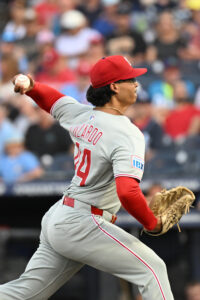
Luzardo, 28, was once one of the top pitching prospects in baseball and he has established himself as a legit big league arm in the past few years. With the Marlins in 2022 and 2023, he made 50 starts and logged 279 innings, allowing 3.48 earned runs per nine. His 7.9% walk rate and 40.1% ground ball rate were close to league average as he struck out a strong 28.7% of batters faced. His four-seamer and sinker both averaged in the upper 90s while he also made good use of a mid-80s changeup and slider.
He had a bit of a dip in 2024. He missed time due to some elbow tightness and also due to a lumbar stress reaction. He only made 12 starts on the year and had a flat 5.00 ERA. The Phils still liked the player enough to take a chance on him going into 2025. They sent prospects Starlyn Caba and Emaarion Boyd to the Marlins in exchange for Luzardo and Paul McIntosh.
The bet paid off, as Luzardo returned to form in 2025. He made 32 starts and threw 183 2/3 innings with a 3.92 ERA, 28.5% strikeout rate, 7.5% walk rate and 42.8% ground ball rate. He also made two postseason appearances with a 2.35 ERA. He finished seventh in National League Cy Young voting.
As mentioned, 2026 was slated to be Luzardo’s final arbitration season before he would become a free agent. He and the Phils avoided arbitration by agreeing to an $11MM salary for this year. He could have played out the campaign and would have been in position for a strong contract if he had another good season. He’s currently 28 years and old, turning 29 in September.
The top free agent deals for starting pitchers have been around $200MM in recent years, with Max Fried, Corbin Burnes and Dylan Cease all getting to that range. Fried got $218MM. The latter two got $210MM, both with notable deferrals.
Luzardo hasn’t quite put up the same kind of results as those guys. Burnes and Fried have posted ERAs under 3.00 pretty regularly. Cease has had a more wobbly ERA but with comparable strikeout and walk rates to Luzardo with greater availability. Luzardo would have been younger than everyone in that group, however. Cease and Burnes signed their deals going into their age-30 seasons, while Fried was going into his age-31 campaign.
Players who sign extensions a year from the open market generally sacrifice a bit of upside in exchange for the security of locking in a deal that is still quite large. Dating back to 2017, the top extension for a pitcher with service time between five and six years was $131MM over seven years for José Berríos.
Like Luzardo, Berríos was going into his age-28 season and would have been a free agent ahead of his age-29 campaign. Berríos was also generally a guy with an ERA in the 3.50 range, though with greater durability. Berríos agreed to his deal before working out a salary for his final arbitration season. When considering the $11MM Luzardo is getting in 2026, he will make $146MM over the next six years.
Waiting until after 2026 to sign could have led to an even greater contract, but it also would have come with risk. In addition to his aforementioned 2024 injuries, Luzardo also missed a few months due to a forearm strain in 2022. A notable injury in 2026 could have led to him heading into the winter with significantly less earning power, so he is taking the proverbial bird in the hand with this deal.
For the Phils, they have not been shy about spending money on starting pitching. Going into the 2020 season, they signed free agent Zack Wheeler via a five-year, $118MM deal. Ahead of the 2023 season, they gave Taijuan Walker $72MM over four years. Going into 2024, they brought back Aaron Nola with a seven-year, $172MM pact. They then extended Wheeler for $126MM over three years. They also recently locked up Cristopher Sánchez, who was still in his pre-arbitration years, with a four-year deal worth $22.5MM.
Going into 2026, Wheeler may start the season on the injured list but could be back fairly early. For the 2026 season, health permitting, the four primary starters will be Wheeler, Nola, Sánchez and Luzardo. The fifth could be Walker but also could be prospect Andrew Painter.
Looking ahead to 2027, Luzardo was slated for free agency and Walker as well. That would have left the Phillies with a core of Wheeler, Nola and Sánchez. Wheeler is signed through 2027 and plans to retire after that. Painter could theoretically fill one spot but he’s a big question mark right now. Tommy John surgery wiped out his 2023 and 2024. He was back on the hill in 2025 but posted a 5.40 ERA in Triple-A.
Rather than waiting until next winter to address the 2027 rotation, they have proactively signed Luzardo to stick around. Since this appears to be a new contract, it shouldn’t impact the 2026 competitive balance tax. Luzardo will still have an $11MM hit this year. For the five years from 2027 to 2031, he’ll have a $27MM hit, the average annual value of his $135MM guarantee for those years.
The long-term books have a lot on them. As far out as 2030, the Phils have Nola, Luzardo, Kyle Schwarber, Bryce Harper and Trea Turner all signed to deals with CBT hits of over $24MM. RosterResource already projects the club for a CBT number of almost $160MM for that 2030 season, before factoring in arbitration players or any other deals signed between now and then. But the Phils have generally been fine spending on the guys they like as they keep this core going.
For any club who was hoping to make a run at Luzardo next winter, they will have to consider other options. The 2026-27 free agent class already feels a bit light and will now have one fewer marquee name. Tarik Skubal will headline the group of starting pitchers, followed by guys like Freddy Peralta, Kevin Gausman and others. Burnes, Sonny Gray and Tatsuya Imai and others could shake things up by opting out of their deals.
Jeff Passan of ESPN first reported the two sides had agreed to a five-year deal starting in 2027. Jim Salisbury of NBC Sports Philadelphia first reported the $135MM guarantee. Robert Murray of FanSided reported the option details. Jon Heyman of The New York Post reported on the assignment bonus. Photos courtesy of Brett Davis, Jonathan Dyer, Imagn Images
Nationals Designate Richard Lovelady For Assignment
The Nationals have designated left-handed reliever Richard Lovelady for assignment, per a club announcement. His roster spot goes to righty Zack Littell, whose previously reported one-year deal with the Nats is now official.
Washington claimed Lovelady off waivers from the Mets back on Jan. 29. He’d signed a split major league deal with the Mets back in October, which the Mets hoped would help him to pass through waivers so he could be stashed in Syracuse as Triple-A depth. That didn’t work out, at least not on their initial attempt, as the Nats quickly scooped him up. Lovelady will now either be traded within the next five days or placed back on waivers, which are a 48-hour process. His DFA will be resolved within a week’s time.
Lovelady has had a solid showing with the Nats so far in camp. He’s allowed a run on four hits and three walks in four innings while fanning seven batters. He allowed 11 runs in 11 2/3 big league innings between the Blue Jays and Mets in 2025 but posted a a terrific 1.66 ERA with a 26.3% strikeout rate, 8.6% walk rate and 52.6% ground-ball rate in 38 Triple-A frames.
Lovelady is no stranger to posting strong numbers in the upper minors but running into some MLB struggles. He’s logged 111 MLB frames in his career and posted a 5.35 ERA but thrived with a 2.61 ERA, 26.9% strikeout rate and 7% walk rate in 175 2/3 Triple-A innings across parts of seven seasons. Although Lovelady hasn’t had consistent success in the majors, he did log a solid 4.25 ERA with quality strikeout, walk and grounder rates in 78 1/3 big league frames from 2022-24.
Since he’s out of minor league options, Lovelady couldn’t simply be sent back to Triple-A. The Nats will hope he clears waivers and can be stashed in the upper minors within their system, just as the Mets tried to do. He cleared waivers on several occasions last year but was also selected to a major league roster five different times between Toronto and New York, including that major league deal with the Mets in October. He’s ping-ponged on and off MLB rosters of the Royals, A’s, Cubs, Jays and Mets dating back to 2022, so it’s certainly possible another club with a need for some bullpen depth takes a low-cost flier via waivers or a cash swap.
Padres Outright Daison Acosta
The Padres announced they’ve outrighted pitcher Daison Acosta. The team hadn’t previously designated the right-hander for assignment. That opens a spot on their 40-man roster, which is now at 39. San Diego also reassigned catching prospect Ethan Salas to minor league camp.
Acosta, 27, has never pitched in the big leagues. He divided most of last season between the top two minor league levels in the Washington system. Acosta qualified for minor league free agency at year’s end. He impressed the Padres enough to command a big league contract and a 40-man spot throughout the offseason.
The Dominican-born reliever has not appeared in any Spring Training games. The Padres evidently placed him on waivers over the weekend. He went unclaimed and will remain in the organization. Acosta should begin the season with Triple-A El Paso. He struggled at that level last year, posting a 4.71 ERA while walking 15% of opponents. He had dominated Double-A opposition, firing 30 innings of 0.90 ERA ball with a strikeout rate above 40%.
It’s not clear if San Diego plans to replace Acosta on the 40-man roster in the coming days. They may simply have been confident that he’d clear waivers. The Padres already had essentially one free spot on the 40-man roster, as they can transfer Yu Darvish to the 60-day injured list as a corresponding move. They have a number of non-roster invitees battling for jobs, with righty Logan Gillaspie among those impressing the club in camp.
Salas received his first invitation to MLB camp this year. The 19-year-old obviously wasn’t under consideration for the Opening Day roster after spending most of last year in High-A. He went 2-9 with a trio of walks. He’ll likely begin the season at Double-A San Antonio.
Giants To Re-Sign Joey Lucchesi
The Giants have agreed to bring left-hander Joey Lucchesi back on a minor league deal, Jon Heyman of the New York Post reports. The CAA client will head to big league camp and be paid $1.55MM if he makes the roster. He has another $300K available via incentives.
Whether the Lucchesi signing was already in the works when fellow left-hander Reiver Sanmartin suffered an injury or whether this signing comes in response to that injury isn’t clear. However, via Susan Slusser of the San Francisco Chronicle, Sanmartin’s recent MRI revealed a severe hip flexor strain that’s expected to sideline him for at least three months. Sanmartin, Erik Miller and Matt Gage were the only left-handed relief options on the Giants’ 40-man roster, and Miller has been slowed by a back injury in camp.
Lucchesi, 32, was effective for the Giants in a middle relief role last season. He appeared in 38 games and tossed 38 1/3 innings of 3.76 ERA ball. His 18.8% strikeout rate was well below average, but Lucchesi’s 7.3% walk rate was strong and his 53% ground-ball rate was excellent. In 433 big league innings between the Padres, Mets and Giants, Lucchesi has a 4.07 ERA with roughly average strikeout, walk and ground-ball rates. He worked primarily as a starter before last year’s bullpen success. The Giants chose to non-tender him in November.
Sanmartin, 29, came to the Giants via waiver claim back in November. He’d spent his entire big league career with the Reds, appearing in parts of four seasons from 2021-25. In that time, Sanmartin pitched to a 5.66 ERA with plenty of grounders (53.6%) but a strikeout rate, walk rate and average fastball that were all worse than league average.
Despite that modest track record, Sanmartin was one of the Giants’ only bullpen additions of the offseason. San Francisco signed relievers Jason Foley, Sam Hentges and Rowan Wick to major league deals knowing none were likely to be healthy for Opening Day. Sanmartin was claimed off waivers, and the Giants signed Michael Fulmer to a minor league deal. Outside of that, their bullpen had gone largely untouched this winter — despite trading Camilo Doval and Tyler Rogers back in July and losing Randy Rodriguez to Tommy John surgery in September.
Assuming the Lucchesi deal is finalized soon, he should have enough time to build up and be a candidate to break camp in a similar single-inning relief role to the one he had last year.
Rangers Claim Dairon Blanco
The Rangers have claimed outfielder Dairon Blanco off waivers from the Royals, according to Francys Romero of Beisbol FR. Blanco was designated for assignment by the Royals last week to make room for Starling Marte on the club’s 40-man. The Rangers transferred southpaw Jordan Montgomery to the 60-day injured list to make room for Blanco on their own 40-man.
Blanco, 33 next month, played in the Cuban National Series through his age-22 season but didn’t make it to stateside ball until he was 25 years old back in 2018. Then a member of the Athletics, he was traded to the Royals the following year and eventually made his big league debut during the 2022 season with a five game cup of coffee. The following year he got a much larger role with Kansas City, however, and over the next two seasons he slashed a solid .258/.316/.422 in 270 plate appearances across 157 games. That’s slightly above league average production at the plate, though the vast majority of his production comes against left-handed pitching. Blanco sports a 137 wRC+ for his career against southpaws, compared to a 70 wRC+ against right-handers. It’s also worth noting that he gets a lot of value from his work on the base paths, where he went 55-for-67 (82.1%) in stolen base attempts in 2023 and ’24.
That makes Blanco a useful bench or depth option to be sure, but he ultimately found himself squeezed off the Royals’ roster after the team brought in Marte and Isaac Collins during the offseason to shore up an outfield mix that had rated out as among the worst in the majors in recent years. The Royals already had a crowded bench mix, and Blanco has yet to prove he’s capable of handling more than part-time duties at the big league level. That’s unlikely to be as much of a problem with the Rangers, who are relatively thin on outfield depth (especially when looking for players who can play center field capably) and have plenty of lefties in the lineup like Evan Carter, Joc Pederson, and Josh Smith who could benefit from being spelled against fellow southpaws.
Of course, that isn’t to say Blanco is guaranteed a spot on the team’s bench entering the season. He’ll have stiff competition from veteran Andrew McCutchen for a spot as a right-handed bat, while Sam Haggerty, Michael Helman, and Ezequiel Duran all offer more versatility than Blanco. With that being said, Blanco does have options remaining and could simply start the season in the minor leagues before waiting to get an opportunity in the majors at some point this year. At the very least, Blanco’s wheels should give him a strong argument to join the team when rosters expand in September and perhaps into the postseason if Texas manages to make it that far.
Blue Jays Re-Sign Max Scherzer
TODAY: Scherzer’s contract also contains full no-trade protection, Jon Heyman reports.
MARCH 2: The Blue Jays officially announced they’ve re-signed Max Scherzer to a one-year contract. The Boras Corporation client is reportedly guaranteed $3MM and can earn up to $10MM in incentives. He’d earn his first $1MM bonus at 65 innings and reach another $1MM bonus for every tenth inning, up through 155 frames overall. Toronto cleared a 40-man roster spot over the weekend by waiving infielder Ben Cowles, who was claimed by the Cubs.
It’s the future Hall of Famer’s second season in Toronto. The three-time Cy Young winner signed a $15.5MM deal with the Jays during the 2024-25 offseason. He was coming off an abbreviated season in which he’d been limited to nine starts for the Rangers. Scherzer had undergone back surgery the previous offseason, and a nerve issue in his throwing arm limited him once he recovered from the back procedure.
The arm remained problematic last season. Scherzer left his team debut after three innings because of thumb soreness. That had been traced to the nerve issue and ultimately led the Jays to shut Scherzer down for a couple months. He didn’t return to an MLB mound until late June.
Scherzer was able to avoid the injured list after that point but didn’t perform to his usual level. He allowed more than five earned runs per nine innings for the first time in his career. He closed the season with a 5.19 mark over 85 innings. Scherzer only once allowed more than four runs in a start, but he only went beyond five innings on seven occasions. He had six quality starts in 17 appearances.

The 17-year veteran is still capable of missing bats at a league average level. He struck out a slightly above-average 23% of batters faced against a tidy 6.4% walk rate. The issue is the damage hitters have done when they make contact. Scherzer allowed more than two home runs per nine innings for the first time in his career. It was the fourth-highest homer rate in MLB among pitchers who threw 70+ innings.
Scherzer’s fastball averaged 93.6 mph last season. That’s a tick higher than his 2024 mark, reversing a slight downward trend in his velocity during his late 30s. He nevertheless had a tough time getting hitters to chase his breaking pitches outside the strike zone. Scherzer obviously doesn’t have the same caliber of stuff he did at his peak, which makes him more hittable when he’s forced to challenge hitters. He has allowed a higher than average home run rate in three straight seasons.
At age 41, Scherzer profiles as a back-end starter on paper. Yet he has a wealth of big game experience and showed he’s still capable of getting outs on the biggest stage. The Jays left Scherzer off the roster for their Division Series matchup with the Yankees. They brought him back for the AL Championship Series against Seattle and the World Series showdown with the Dodgers.
Scherzer tossed 5 2/3 frames of two-run ball to get the win in ALCS Game 4. He struggled a bit in Game 3 of the World Series before coming back with one run allowed in 4 1/3 innings in Game 7. Scherzer left the mound with a 3-1 lead in a performance that would have been etched into Toronto sports history if the bullpen had held the lead.
They’ll aim to get over the hump in 2026. Assuming Scherzer builds up in time for Opening Day, he’ll probably slot into a six-man rotation to begin the season. Shane Bieber will begin the year on the injured list after experiencing forearm fatigue during the playoff run. Toronto had been slated to open the season with a starting five of Dylan Cease, Kevin Gausman, Trey Yesavage, José Berríos and Cody Ponce.
Yesavage is entering his first full MLB season. Ponce is a bit of a wild card in his return from Korea. Scherzer presumably isn’t going to log 150+ innings at this stage of his career. Opening with a six-man rotation would allow the Jays to take some of the burden off a rotation that shouldered as heavy a load as possible into October.
That comes with a trickle-down impact on the bullpen, however. The 13-pitcher limit means the Jays would be down to a seven-man bullpen if they go this route. That increases the importance of having a quality long reliever like Eric Lauer to handle multiple innings.
At the same time, this makes it less likely that Lauer will have a chance to win a rotation spot. The left-hander is an impending free agent and said he’d prefer a starting opportunity. There hasn’t been any indication that Lauer would seek a trade if the Jays keep him in a relief role, though the southpaw told Mitch Bannon of The Athletic he believes that pitching out of the bullpen last season cost him money in arbitration. Lauer lost his hearing, meaning he’ll make the team’s desired $4.4MM salary rather than his camp’s $5.75MM filing figure.
That could be a situation worth monitoring if everyone remains healthy closer to Opening Day. For now, this looks like the ideal outcome for the Jays and Scherzer alike. The $3MM base salary will push their franchise-record luxury tax payroll to approximately $319MM, according to RosterResource. The Jays are taxed at a 90% rate on spending above $304MM. This signing comes with a $2.7MM base tax. Earned performance bonuses are part of a team’s CBT calculation, so the Jays would also pay that 90% fee on any dollars that Scherzer unlocks by hitting innings milestones throughout the year.
Jon Heyman of The New York Post first reported the agreement. Shi Davidi of Sportsnet had the $3MM base and $10MM in incentives. Heyman reported the incentive structure. Image courtesy of Jay Biggerstaff, Imagn Images.
Joey Krehbiel Signs With Mexican League’s Guerreros De Oaxaca
The Guerreros de Oaxaca of the Mexican League announced that they have signed right-hander Joey Krehbiel to a contract for the 2026 season. Krehbiel (who turned 33 in December) elected to become a minor league free agent in November after spending the 2025 season pitching with the Rays’ and Royals’ Triple-A affiliates.
A veteran of four MLB seasons, Krehbiel made his big league debut in the form of a two-game cup of coffee with the Diamondbacks in 2018, then didn’t return to the majors until 2021. Of his 70 career appearances and 74 career innings, the big majority of that work came in 2022, when Krehbiel posted a 3.70 ERA, 18.4% strikeout rate, and 7.4% walk rate over 56 games and 57 2/3 innings out of the Orioles’ bullpen. He only pitched in six games with Baltimore in 2023 (posting a 1.80 ERA across five innings), however, as the O’s shuttled him back and forth from Triple-A multiple times and twice designated Krehbiel for assignment and outrighted him over the course of the year.
This marked Krehbiel’s last bit of Major League action, as minor league contracts with the Mariners and Rays over the last two offseasons didn’t result in another call-up. The Royals also never called the righty up after acquiring him from Tampa in a trade last July. Krehbiel pitched pretty well with Triple-A Tacoma in 2024 but struggled last year to the tune of a 5.34 ERA over 57 1/3 IP in the Tampa and K.C. farm systems, though that ERA was inflated by some bad batted-ball luck — Krehbiel’s 50% grounder rate was counteracted by a .346 BABIP.
The right-hander will now look to get back on track with the Guerreros in the new environment of Mexican League ball. Because Mexican League contracts generally have out clauses, some solid work early in the season could get Krehbiel some attention from another MLB team on another minors deal.
Astros Sign Christian Vazquez To Minor League Deal
The Astros announced that catcher Christian Vazquez was signed to a minor league contract. The deal contains an invitation for Vazquez (an MDR Sports Management client) to attend Houston’s big league Spring Training camp. Vazquez will presumably head to the Astros’ camp after the World Baseball Classic, as the veteran backstop is playing for Puerto Rico’s team.
This is the second stint for Vazquez in a Houston uniform, after being acquired as a trade deadline pickup during the 2022 season. Vazquez hit only .250/.278/.308 over 108 plate appearances during the rest of the regular season and then .235/.316/.235 over 19 postseason PA, but he ended up winning a ring as a member of the World Series title team. Vazquez was also part of some particularly memorable baseball history when he was behind the plate for the Astros’ combined no-hitter in Game 4 of the World Series, which was just the second no-no in Series history and the third in postseason history.
Despite his lackluster numbers at the end of the 2022 campaign, Vazquez still landed a three-year, $30MM free agent deal from Minnesota that offsesason. Unfortunately for Vazquez and the Twins, the struggles at the plate continued, as he hit just .215/.267/.311 over 884 PA over his three seasons with the team. While Vazquez was signed more with defense in mind, delivering only a 60 wRC+ eventually slated him into a backup role behind Ryan Jeffers.
The combination of Vazquez’s poor numbers and hefty salary made him difficult to trade, though his name surfaced in a few rumors over the last couple of years. Minnesota traded a ton of veterans and impending free agents at last year’s deadline, but Vazquez stayed put, as he finished out his entire three-year term with the team. Perhaps understandably, there wasn’t a lot of buzz about his free agent market, apart from one report from January linking Vazquez to the Astros.
It took more than a month for the two sides to reach an agreement, but Vazquez did indeed end up putting pen to paper with Houston, and he’ll now compete with Cesar Salazar for the backup catching job behind starter Yainer Diaz. Salazar has all of 36 MLB games on his resume over three seasons with the Astros, plus he is out of minor league options. Carlos Perez is in camp on another minors deal, and while Perez has appeared in parts of five big league seasons, he hasn’t played in the Show since 2023.
An opening therefore exists for Vazquez to break camp with the Astros as Diaz’s understudy. The 35-year-old’s bat may not be very productive, but Vazquez remains a strong defender, logging +5 Defensive Runs Saved over 519 innings at catcher in 2025. Statcast wasn’t quite as favorable in giving Vazquez’s an even 0 in its overall Catching Runs metric, but his blocking and throwing (Vazquez tossed out 14 of 56 base-stealing attempts in 2025) were gauged as above average.
Vazquez’s WBC duties leave him with relatively little time to make an impression in Spring Training, but obviously the Astros have some familiarity with what Vazquez brings to the table. The fact that the Astros are making this signing indicates they aren’t entirely satisfied with their current backup catching situation, and there’s no risk for the club in committing just a minor league deal to Vazquez to take a look at him in camp.