
Pirates Sign José Urquidy
February 11: Pittsburgh officially announced Urquidy’s one-year deal on Wednesday evening. Jones was placed on the 60-day injured list in a corresponding move. He’ll miss at least the first two months of the regular season but could be back before the All-Star Break as he rehabs from the elbow procedure. Pittsburgh will need to make another 40-man roster move — likely designating someone for assignment — once they finalize their agreement with DH Marcell Ozuna.
February 5: The Pirates and right-hander José Urquidy are reportedly in agreement on a one-year, $1.5MM contract. Urquidy, an Octagon client, can boost that salary further via incentives.
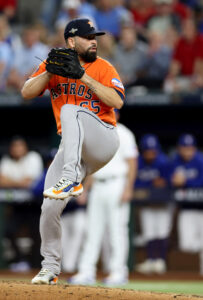
Pittsburgh generated headlines yesterday when they jumped in as a late entrant in the Framber Valdez bidding before he ultimately went to the Tigers last night. They’ll still add a former Astros hurler to reunite with new pitching coach Bill Murphy, though on a much smaller scale. Murphy coached Urquidy with Houston from 2021-24.
From 2021-22, Urquidy was an unheralded but quality member of the Houston rotation, starting 48 games and pitching to a solid 3.81 ERA with a 20.3% strikeout rate and a tiny 5.2% walk rate. Injuries began to slow him down in 2023. He missed three months with a shoulder injury that season, and his entire 2024 campaign was wiped out by an elbow injury that ultimately required Tommy John surgery over the summer. The 2025 season had been scheduled to be Urquidy’s final year of club control, so the Astros unsurprisingly cut him loose following the season.
Urquidy latched on with the Tigers on a one-year, $1MM contract that included a 2026 club option valued at $4MM. He returned from the injured list in September but pitched only 2 1/3 innings in the majors before consenting to be optioned. He pitched well in the minors last year (2.91 ERA, 22.2 K%, 6.2 BB% in 21 2/3 frames) but was hit hard in his small big league sample. The Tigers opted to decline their 2026 option and send Urquidy back to the open market.
With the injury troubles ostensibly behind him, Urquidy heads to the Pirates as an interesting buy-low candidate with some upside. Because he favors a changeup as his go-to offspeed pitch, he has substantial reverse splits in his career. Lefties have posted an awful .203/.257/.362 slash against him, whereas righties — with some help from the short left-field porch in Houston — have tagged him for a .267/.314/.468 batting line. Moving from one of the best environments for right-handed home runs to perhaps the worst in MLB will surely benefit his skill set.
Exactly what role the Pirates have in store for Urquidy, who turns 31 in May, remains to be seen. The Bucs are as deep as nearly any team in the sport when it comes to starting pitching but seem to add a low-cost veteran around this time of the offseason every year. In the past, that’s meant short-term pickups of Tyler Anderson, Jose Quintana, Martín Pérez and Andrew Heaney. Urquidy isn’t a lefty like that quartet but still seems to meet general manager Ben Cherington’s annual bargain starter quota.
Reigning NL Cy Young winner Paul Skenes will, of course, be the Pirates’ Opening Day starter. He’ll be followed in some order by veteran Mitch Keller and young flamethrowers Bubba Chandler and Braxton Ashcraft, both of whom impressed as rookies in 2025. Urquidy will join a competition for the fifth spot that includes Carmen Mlodzinski, Hunter Barco, Thomas Harrington and Jared Jones, who’ll be returning from 2024 Tommy John surgery. Mlodzinski fared better as a reliever than a starter last season, so this move could push him to the ‘pen. If Urquidy is outshined by Jones, Barco or Harrington in camp, he could open the season in a swingman capacity.
Will Sammon of The Athletic first reported that the sides had an agreement. Jon Heyman of The New York Post reported that it was a $1.5MM base with incentives.
Nationals Sign Miles Mikolas
The Nationals added an innings eater on Wednesday, announcing a one-year contract with veteran right-hander Miles Mikolas. It’s reportedly a $2.25MM base salary for the Octagon client, who can earn another $750K in bonuses. Mikolas would collect $100K apiece for every 10 innings between 100 and 120, $200K at 130 frames, and $250K at 140 innings. DJ Herz has been placed on the 60-day injured list to open a spot on the 40-man roster. Herz underwent Tommy John surgery last April.
Mikolas, 37, became a workhorse in his mid-thirties. He began his career with the Padres and Rangers before spending three years with the Yomiuri Giants in NPB. During the 2017-18 offseason, he signed with the Cardinals and made 32 starts in each of the next two years, but forearm issues kept him off the field for most of 2020-21. Since 2022, he has started at least 31 games each year, including a league-leading 35 in 2023. Only one pitcher, Logan Webb, has made more starts than Mikolas over the last four seasons, and only four have thrown more innings.
Unfortunately for Mikolas, the quality of those innings has declined as he has aged and his stuff has diminished. In 2025, he pitched to a 4.84 ERA and a 4.83 SIERA. While the righty has never been one to rack up strikeouts, his strikeout rate and strikeout-to-walk ratio dropped to 14.9% and 2.70, respectively, the lowest either has ever been since before he left for Japan. The only pitcher to throw at least 150 innings last year with a worse strikeout rate was Mikolas’s new Nationals teammate Mitchell Parker. Meanwhile, no pitcher (min. 150 IP) gave up barrels at a higher rate than Mikolas; according to Statcast’s xERA, he ranked among the bottom 9% of pitchers in MLB. Pitch models that evaluate raw stuff, such as Stuff+ and PitchingBot, also suggest that the veteran took a big step back in 2025. Overwhelming batters with nasty stuff was never how he succeeded, but his stuff metrics went from poor to some of the worst in the game this past season.
As negative as all that sounds, it’s important to keep in mind that Mikolas still took the mound 31 times in 2025, tossing 156 1/3 frames. He made eight quality starts and finished five innings in all but seven of his outings. The Nationals badly needed an innings eater for a woefully inexperienced rotation set to include names like Josiah Gray, Cade Cavalli, Foster Griffin, Jake Irvin, Brad Lord, and Parker. Of those arms, only Irvin and Parker have pitched so much as one qualifying major league season, while Gray is the only other to have a 30-start campaign under his belt. It’s a group replete with injury concerns, consistency issues, and limited track records. The dependable Mikolas will boost the floor of what projects to be one of the worst starting rotations in the league.
TalkNats first reported the Nationals and Mikolas had conversations. Jake Mintz of Yahoo Sports! was first on the agreement. Mark Zuckerman of Nats Journal confirmed it was a major league deal, while Jon Heyman of The New York Post had the $2.75MM base plus incentives. The Associated Press reported the incentive specifics. Image courtesy of Jeff Curry, Imagn Images.
Kris Bubic Wins Arbitration Hearing
Left-hander Kris Bubic won his arbitration hearing against the Royals, reports Mark Feinsand of MLB.com. He’ll be paid the $6.15MM salary figure he and his reps at Apex Baseball submitted rather than the $5.15MM figure submitted by the team.
Bubic, 28, looked well on his way to a breakout in 2025 before a strained rotator cuff ended his season in late July. He’s shown flashes off a new gear upon returning from Tommy John surgery in 2024, when he posted a 2.67 ERA with eye-popping strikeout and walk rates (32.2%, 4.1%) in a small sample of 30 1/3 frames of relief work. He wasn’t quite that dominant in 2025 but still gave reason to buy into the prior season’s results; in 116 1/3 innings back in the Kansas City rotation, Bubic logged a terrific 2.55 ERA with a 24.4% strikeout rate, an 8.2% walk rate and a strong 47.2% ground-ball rate.
Put those two seasons together, and Bubic carries a stout 2.58 ERA, 26% strikeout rate, 7.4% walk rate and 48.8% ground-ball rate in his past 146 2/3 innings. He’s locked into a spot in manager Matt Quatraro’s rotation, and with a full, healthy season will position himself as one of the more desirable arms on next year’s free agent market. This is his final season of club control, given his 5.135 years of big league service time.
Bubic will join Cole Ragans, Seth Lugo, Michael Wacha and Noah Cameron in what should be a formidable Royals rotation. His proximity to free agency prompted the Royals to at least consider the idea of trading him to acquire help on other areas of the big league roster this winter, but obviously no deal came together. The Mets and Red Sox were both linked to Bubic at various points this winter as they scoured the trade market for rotation upgrades.
If the Royals fall out of contention in the season’s first half, Bubic’s name could once again surface on the trade market. However, provided he’s healthy and anywhere close to his 2024-25 form, he’ll be a qualifying offer candidate, so Kansas City would likely seek a fairly notable return to pry him loose. That’s a down-the-road consideration anyhow; the Royals enter the 2026 season with a very similar club to the one they trotted out in 2026, though they’ll hope that better health and newcomers Isaac Collins, Lane Thomas, Matt Strahm and Nick Mears can help them contend in a perennially thin American League Central.
Eric Lauer Loses Arbitration Case Against Blue Jays
Eric Lauer lost his arbitration case against the Blue Jays, according to Sportsnet’s Shi Davidi and Ben Nicholson-Smith. He will make $4.4MM this season instead of the $5.75MM he was seeking.
Lauer’s case was particularly interesting. He earned $2.425MM from the Brewers in 2022, his first year of arbitration eligibility. Following a strong season (158 2/3 IP, 3.69 ERA, 4.07 SIERA), he more than doubled his salary, collecting $5.075MM in year two. Then, however, he struggled so badly in an injury-shortened 2023 (46 2/3 IP, 6.56 ERA, 5.31 SIERA) that the Brewers removed him from their roster at the end of the season, and the southpaw elected free agency.
Lauer did not pitch in the majors in 2024; he signed unfruitful minor league contracts with the Pirates and Astros before landing a deal with the KBO’s Kia Tigers. His late-season work in Korea earned him a minor league deal from the Blue Jays last offseason. On April 30, 2025, Lauer returned to the majors. Over the rest of the season, he was a key role-player for the eventual AL champions, pitching to a 3.18 ERA and a 3.88 SIERA in 104 2/3 innings as a hybrid starter/reliever. Unlike many players who return from pitching overseas, Lauer was still eligible for arbitration after 2025, and given his success, it was not surprising when Toronto tendered him a contract.
According to Cot’s Baseball Contracts, the rules of the CBA stipulate that, “In tendering a contract to a player (or renewing the contract of a player not yet arbitration-eligible), a club’s salary offer may not be less than 80% of the player’s salary and performance bonuses the previous year or less than 70% of his salary and performance bonuses from two years earlier. The 80% requirement does not apply if a player won an arbitration award the previous year increasing his salary 50% or more.”
Technically, Lauer’s salary in 2025 was only $2.2MM (which was prorated to just under $1.8MM). However, his salary in his previous year of arbitration eligibility was $5.075MM. Of course, that $5.075MM figure represented more than a 50% increase over his year-one arbitration salary. So, either way, there wasn’t anything wrong with the Blue Jays’ $4.4 million offer – they won the case after all.
However, Lauer was presumably banking on the fact that it’s extremely rare for a player’s salary in his third year of arbitration eligibility to be lower than his salary in his second year of arbitration eligibility. What’s more, as Nicholson-Smith and The Athletic’s Mitch Bannon both recently pointed out, players who exit the arbitration system still typically earn raises when they return. Precedents are important in arbitration hearings, and, evidently, Lauer and his agents thought history would be on their side. In the end, the panel disagreed. The Blue Jays, who filed at $4.4MM – the exact figure predicted by MLBTR contributor Matt Swartz’s model – won the case. This will save the team $1.35MM in payroll and another $1.215MM in luxury tax penalties.
Lauer is expected to fill a swingman role for Toronto once again in 2026. While he currently projects to open the season in the bullpen, Nicholson-Smith notes that he will be stretched out as a starter during spring training.
Marlins Sign John King
The Marlins announced the signing of left-handed reliever John King to a one-year contract. It’s reportedly a $1.5MM guarantee. King was non-tendered by the Cardinals back in November.
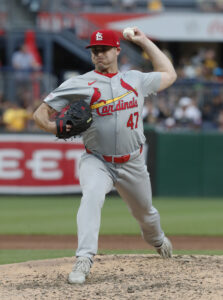
King, 31, spent three and a half seasons with the Rangers from 2020-23 before being traded to St. Louis at the ’23 deadline. He spent the next two and a half seasons in the Cardinals’ bullpen. The 6’2″ ground-ball specialist has a 3.70 ERA over his past 243 big league innings but is coming off a rough season in which he worked to a 4.66 earned run average with a career-low 12.6% strikeout rate in 48 1/3 innings.
While King has never been one to miss many bats, that 12.6% mark was still three percentage points south of his career mark entering the 2025 season. Last year’s 6.3% walk rate was a strong mark but still up from the prior season’s 5.6%. King’s 93 mph average sinker velocity was also its lowest since the 2022 season.
What King lacks in strikeouts, he at least partially makes up for in ground-balls. Opposing batters have an extremely difficult time elevating against the lefty’s arsenal. He sports a massive 61.5% ground-ball rate in his career and has run that number up as high as 66.9% (in 2023). As one might expect for an extreme ground-ball pitcher, King has done a nice job keeping the ball in the yard, with just 0.89 homers per nine frames in his major league career.
King has been more effective against fellow lefties than righties, holding same-handed opponents to a .251/.291/.337 slash in his career. Right-handers have hit him well, slashing .302/.353/.430 in 682 plate appearances.
The Marlins have been on the lookout for a lefty to join manager Clayton McCullough’s bullpen. Miami already had Andrew Nardi, Cade Gibson and Josh Simpson, but each comes with some degree of red flag. Nardi missed the 2025 season due to injury. Gibson logged a 2.63 ERA in 51 2/3 innings as a rookie last year but did so with sub-par strikeout and walk rates; metrics like SIERA (4.08) and FIP (3.76) weren’t nearly as bullish. Simpson posted decent minor league numbers but was rocked for a 7.34 ERA in 30 2/3 big league frames.
King, like each of the other three lefty relievers on Miami’s 40-man roster, has some question marks of his own. He has more of a big league track record than any of his new southpaw teammates, however — enough to give the Marlins some veteran experience but not so much that he’s a pure one-year rental. King enters the 2026 season with 4.148 years of major league service time, meaning he’s still controllable through the 2027 season via arbitration. He’ll need to pitch well enough this year that his team feels he’s worth giving a raise and keeping for an additional year, but if he can bounce back to 2021-24 form, he’ll likely do just that.
Jeff Passan of ESPN reported the agreement and salary.
Blue Jays, Juan Yepez Agree To Minor League Deal
The Blue Jays are in agreement on a minor league contract with first baseman/outfielder Juan Yepez, per Aram Leighton and Eric Treuden of Just Baseball. He’ll presumably be in big league camp as a non-roster invitee later this month.
Yepez, 27, has appeared in parts of three big league seasons with the Cardinals and Nationals — most recently with Washington in 2024. He’s a .258/.307/.423 hitter (103 wRC+) in 588 plate appearances as a major leaguer. The righty-swinging Yepez has fairly neutral platoon splits in his MLB time and carries a 6.5% walk rate against a 20.9% strikeout rate.
The 2025 season was a struggle for Yepez. He didn’t appear in the majors and struggled badly in Triple-A while also spending nearly two months of the season on the minor league injured list. He appeared in 75 minor league games overall (62 in Triple-A, plus 13 rehab games in High-A) and posted a combined .220/.292/.358 batting line in 284 turns at the plate.
It was a year to forget, but Yepez has a track record as a well above-average hitter in Triple-A and a solid, roughly league-average producer in about one season’s worth of plate appearances. He has below-average speed (31st percentile in 2024, per Statcast) and doesn’t bring much defensive value to the table, with poor marks from Defensive Runs Saved and Outs Above Average at first base and in both outfield corners.
Yepez joins the Blue Jays just one day after they revealed outfielder/designated hitter Anthony Santander will miss five-plus months due to shoulder surgery. With Santander sidelined, the Jays will likely go with Nathan Lukes, Daulton Varsho and Addison Barger in the outfield, with George Springer mixing in occasionally but spending most of his time at designated hitter.
Yepez joins the mix for a bench spot behind that group, though there’s not much space for a non-roster player to force his way in. Tyler Heineman will take one spot as the backup catcher, while speedster Myles Straw is in line for backup outfield work. Infielder Leo Jimenez is out of minor league options and is the primary backup to Andres Gimenez at shortstop (though second baseman Ernie Clement can certainly handle shortstop as well). Infielder/outfielder Davis Schneider has minor league options left, as do outfielders Joey Loperfido and Jonatan Clase. Yepez will try to leapfrog Schneider, Loperfido and Clase for the final bench spot, but there’s a good chance he simply heads to Triple-A Buffalo to serve as depth in the upper minors.
Dodgers Re-Sign Evan Phillips, Designate Ben Rortvedt
The Dodgers announced Wednesday that they’ve re-signed reliever Evan Phillips to a one-year deal worth $6.5MM. Catcher Ben Rortvedt was designated for assignment to open a spot on the 40-man roster. Phillips, a client of Apex Baseball, was non-tendered by the Dodgers in November after undergoing Tommy John surgery late last May but will return on a new one-year deal.
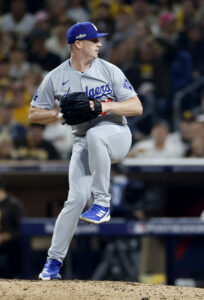
Phillips, 31, came to the Dodgers via a 2021 waiver claim out of the Rays organization. He pitched well enough down the stretch in ’21 to stick on the roster throughout that offseason, but Phillips didn’t immediately look like a waiver heist in the initial months following his claim.
That changed in 2022. A then-27-year-old Phillips erupted for 63 innings with a microscopic 1.14 ERA. He set down 33% of opponents on strikes and walked only 6.4% of the batters he faced, averaging better than 96 mph on his four-seamer and sinker alike. Phillips picked up 19 holds that year, but by 2023 he’d stepped into the closer’s role in L.A. — a job he handled with aplomb. Phillips turned in another dominant season, recording a 2.05 ERA with 24 saves, six holds, a 28.2% strikeout rate and a 5.6% walk rate.
For three full seasons from 2022-24, Phillips was a wipeout late-inning reliever. He combined for a 2.21 ERA with 44 saves, 34 holds and only nine blown saves, whiffing 29.6% of opponents with a 6.5% walk rate. His 2025 campaign got out to a strong start as well, with 5 2/3 shutout frames and six strikeouts. Phillips hit the injured list early in the year, however, and by late May the team announced that he’d require a Tommy John procedure, sidelining him for what’ll likely be 13 to 14 months.
Phillips figures to aim for a return around the All-Star break, give or take a couple weeks. If he’s able to do so, he’ll be a prominent midseason boon to the bullpen — effectively the same as picking up a prominent reliever ahead of the trade deadline. There’s risk in any pitcher coming back from major surgery, but if it works out, he’ll be healthy for October, which has been the Dodgers’ primary concern (relative to the regular season) with all their higher-end pitchers in recent seasons.
The Dodgers are an annual luxury tax payor and are well into the top bracket of penalization. Phillips will come with the maximum 110% tax on his salary, meaning he’ll cost the Dodgers $13.65MM overall. It’s a steep price to pay, particularly relative to the risk, but the Dodgers’ spending knows virtually no bounds.
As for Rortvedt, he’ll likely head back to the waiver wire on the heels of his latest DFA. He ended the season on the Dodgers’ 40-man roster and quickly inked a $1.25MM deal to avoid arbitration. The Dodgers then placed him on waivers, hoping he’d clear and could then be stashed in Triple-A Oklahoma City as upper-level depth. Ideally, the $1.25MM salary would’ve dissuaded other clubs from claiming him while also giving Rortvedt a reason to accept the minor league assignment; he has enough service time to reject an outright in favor of free agency but not enough to do so while retaining his guaranteed salary.
The Reds scooped Rortvedt up anyhow and carried him on the 40-man roster for much of the offseason. When he was designated for assignment earlier this month, the Dodgers placed a claim to bring Rortvedt back to the organization. They’ll now hope to pass him through waivers, as they initially planned.
It’s easy to see why clubs would be happy to have the out-of-options Rortvedt in the upper minors but might be wary of carrying him on the big league roster. He’s a plus defender behind the plate whose keen eye typically lends itself to strong walk rates. Rortvedt is strikeout-prone and consistently hits for a low average, however, and he has little in the way of in-game power. He’s a career .190/.279/.270 hitter in 633 MLB plate appearances and a .239/.328/.412 hitter in 574 Triple-A plate appearances.
The Dodgers can trade Rortvedt or place him on waivers at any point within the next five days. Waivers are a 48-hour process, so his DFA will be resolved within a maximum of one week.
Padres Sign Miguel Andujar
Feb. 11: The Padres formally announced Andujar’s one-year deal and 2027 mutual option this morning. He’s passed his physical and is in camp with his new team.
Feb. 4: The Padres reportedly have an agreement with free agent corner infielder/outfielder Miguel Andujar on a one-year deal with a mutual option for 2027. It’s a $4MM guarantee that includes a $1.5MM salary for the upcoming season. That suggests there’s a $2.5MM option buyout. The CAA client can earn another $2MM+ via incentives. San Diego has a couple openings on the 40-man roster and won’t need to make any corresponding moves.
It’s a tidy bit of business for the Padres, who add a strong right-handed bat on a modest contract. Andujar, 31 next month, put together an excellent .318/.352/.470 slash line over 94 games a year ago. He split the year between the A’s and Reds, so he was certainly the beneficiary of favorable home parks, but that’s above-average production in any stadium.
It was Andujar’s best season since his 2018 Rookie of the Year runner-up campaign when he played for the Yankees. He has been a part-time player for the majority of his career and didn’t get to 200 plate appearances in any season from 2019-23. He tallied 319 trips to the plate while putting up a league average .285/.320/.377 mark for the A’s in 2024. Andujar weathered a pair of injuries that year, undergoing an early-season meniscus repair on his right knee and a season-ending core procedure in August.
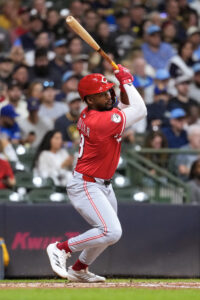
The A’s nevertheless tendered Andujar a $3MM contract for his final season of arbitration. He hit .298/.329/.436 in 60 games before being traded to Cincinnati. He really turned things on upon landing with the Reds, running a .359/.400/.544 line over 110 plate appearances to close the season. He hit well against pitchers of either handedness but particularly teed off on left-handers. The righty-swinging Andujar has been a plus against southpaws throughout his career, batting .297/.332/.475 in 521 plate appearances with the platoon advantage.
It’s somewhat surprising that strong finish didn’t result in a better market. Although teams obviously weren’t going to expect him to keep up the pace he showed with the Reds, his track record against lefties and plus contact skills make him a strong bat to have on the bench. There are enough red flags in the profile that clubs seemingly still view him as a lower-end utility piece. Andujar has an aggressive approach and isn’t going to take many walks. He doesn’t have huge exit velocities and is largely dependent on an elevated average on balls in play to carry the offensive profile.
Andujar also has an extensive injury history going back to the 2019 labrum repair in his right shoulder that wiped out his second season in the majors. He had the aforementioned pair of surgeries in ’24 and missed five weeks last year with a right oblique strain. He also doesn’t have a clear defensive fit. He’s a subpar defender at third base and in the outfield. Andujar has a strong arm but isn’t a good runner or athlete.
That’s probably not a huge concern for San Diego, who projects to use him mostly as a first baseman or designated hitter. Manny Machado is locked in at third, while Ramón Laureano and Fernando Tatis Jr. have the corner outfield spots. Andujar should be a good complement to lefty hitters Gavin Sheets and Sung-mun Song, who had been lined up as the primary options at first base and designated hitter. He can step in for Sheets at first base against southpaws while still getting a decent amount of playing time at DH versus righty pitching, as Song is expected to bounce around the diamond to keep other players fresh.
The lower salary and mutual option is a common tactic for San Diego. It allows them to kick a little over half the contract back to the end of the season. RosterResource calculates their cash payroll around $221MM. Their luxury tax estimate is much higher, landing around $266MM. They’ll be paying the luxury tax for a second straight season. They’re taxed at a 30% rate on spending between $244MM and $264MM, which comes out to a $6MM hit. That jumps to 42% for their next $20MM. Andujar’s salary is low enough that it won’t much impact their CBT ledger, as they’re only paying around $1.25MM in taxes to add him. The Padres could still look for a bench bat and a back-end starter as Spring Training approaches.
Jon Heyman of The New York Post was first on the agreement. ESPN’s Jeff Passan had the one-year, $4MM terms. Heyman reported the mutual option and salary. Will Sammon of The Athletic reported the upwards of $2MM in bonuses.
Image courtesy of Jeff Hanisch, Imagn Images.
Braves Place Spencer Schwellenbach On 60-Day Injured List
Feb. 11: Schwellenbach details (video link via Chad Bishop of the Atlanta Journal-Constitution) that he felt strong throughout the offseason and had thrown off a mound four or five times without issue before experiencing discomfort right at the end of a 20-pitch bullpen session about ten days ago. He’s since undergone imaging that led to his diagnosis and 60-day IL placement. Schwellenbach says he might require arthroscopic surgery — nothing is scheduled yet — and isn’t sure what the recovery period would be from that procedure.
Feb. 10: The Braves opened camp this morning with an unwelcome update on talented young righty Spencer Schwellenbach. He’s been placed on the 60-day injured list due to inflammation in his right elbow, per Mark Bowman of MLB.com.
The team’s hope is that the 25-year-old is dealing with bone spurs and not something more nefarious. Regardless, since the “60-day” term begins on Opening Day (and can only be backdated a maximum of three days), Schwellenbach will miss at least two months of action to begin the season. His IL placement should open space on the roster for catcher Jonah Heim, who agreed to a one-year deal with Atlanta earlier today.
Injuries to the pitching staff were the hallmark of Atlanta’s 2025 season, and their 2026 campaign isn’t starting out much differently. The Braves have already been on the lookout for rotation help — perhaps already knowing that Schwellenbach would be sidelined — with reported interest in Chris Bassitt and Lucas Giolito, among others. Atlanta has already had to make one late-offseason pivot, signing Jorge Mateo and Kyle Farmer (the latter on a minor league deal) after Ha-Seong Kim suffered a torn tendon in his hand when he slipped on some ice and fell in a fluke off-field injury. He’ll need four to five months to recover from the subsequent surgery. Schwellenbach’s injury seems to set the stage for another late addition.
The Braves had already been facing workload and health concerns in the rotation. Chris Sale missed significant time with a ribcage fracture last season and has a lengthy injury history. Spencer Strider‘s return from UCL surgery produced results that were nowhere close to his star-caliber performance prior to injury. Schwellenbach missed months due to an elbow fracture. Reynaldo Lopez only made one start last year due to shoulder surgery. Promising young righty AJ Smith-Shawver was shelved after a handful of starts due to his own Tommy John procedure.
Entering the year, the Atlanta rotation figured to include Sale, Strider, Schwellenbach, Lopez and one of Hurston Waldrep, Grant Holmes, Bryce Elder, Didier Fuentes or an external addition such as Giolito or Bassitt. The Braves are down to three established veterans (Sale, Strider, Lopez), none of whom is coming off a peak season in terms of both health and performance. There ought to be a fair bit of urgency to add another starter to help keep pace in a perennially competitive National League East.
How much space the Braves do or don’t have to make that rotation addition happen isn’t fully clear. RosterResource projects an actual cash payroll around $268MM and a CBT payroll about $10MM less than that. That puts the Braves around $6MM shy of the second tier of luxury tax penalization. They’d owe a 20% tax on any dollars up to the $264MM luxury mark and a 32% tax on anything from $264MM to $284MM. That’s presumably the point at which Atlanta would prefer to halt its spending, given that crossing the $284MM third-tier threshold is the point at which a team’s top draft pick is dropped by 10 places.
Rangers To Sign Jordan Montgomery
The Rangers are bringing back old friend Jordan Montgomery, according to a report from Evan Grant of the Dallas Morning News. Montgomery will make $1.25MM on a one-year, MLB deal. The deal also includes performance bonuses. Montgomery is represented by Wasserman. Texas will need to create a 40-man roster spot to accommodate Montgomery once the signing becomes official.
Montgomery, 33, missed the entire 2025 season after undergoing Tommy John surgery last March. He’ll open the season on the 60-day injured list, according to Grant, but the lefty figures to factor into the team’s rotation later this year once he’s finished his rehab process. Grant suggests that could come at some point in the second half, though it’s at least plausible the lefty could return before that if he avoids any setbacks in his rehab. Nathan Eovaldi, Jacob deGrom, MacKenzie Gore, and Jack Leiter all appear to be more or less locked into rotation spots for Texas to open the year, with Jacob Latz and Kumar Rocker among the options to kick off the season in that fifth rotation spot.
As pitching injuries become more and more common around the league, it’s impossible to say what the state of the Rangers rotation will look like once Montgomery is healthy enough to rejoin the staff. If everyone is healthy, Montgomery take over that fifth starter job if Latz and/or Rocker has struggled, or could simply expand the Rangers’ rotation to six men depending on the needs of the club at the time. Of course, both Eovaldi and Gore missed significant time due to injuries last year and deGrom has a lengthy injury history of his own. A fully healthy rotation all year long can’t be assumed, and that could leave Montgomery to serve in a pivotal role for the Rangers by providing reinforcements at some point.
Whenever Montgomery does wind up returning to the big league mound, the quality of his performance will be a source of considerable intrigue. It wasn’t all that long ago that Montgomery was a World Series hero in Texas who hit the open market coming off a stretch of seasons with the Rangers, Cardinals, and Yankees where he looked like a high-end #2 starter. It seemed likely he’d get a free agent contract to match that pedigree, but he lingered on the market during the 2023-24 offseason and became one of the oft-discussed “Boras Four” alongside Blake Snell, Cody Bellinger, and Matt Chapman. All four wound up signing pillow contracts late in the year, and while the other three all went on to have success and sign much larger deals in the years afterwards, the same did not happen for Montgomery.
The lefty’s career has taken a tumble since signing that pillow contract with the Diamondbacks. He struggled badly in 2024 with a 6.23 ERA in 117 innings for the Snakes. He changed his representation and accused Boras of having “butchered” his free agency, while Diamondbacks owner Ken Kendrick publicly expressed frustration with having signed Montgomery, calling it a “horrible decision.” That acrimonious relationship came to an end at the trade deadline last year, when the Diamondbacks dumped what little remained of Montgomery’s contract on the Brewers in a trade that also sent righty Shelby Miller to Milwaukee. Montgomery, of course, did not pitch for the Brew Crew as he rehabbed and found himself back in free agency this offseason.
Given Montgomery’s disastrous 2024 campaign and lost season in 2025, it would be fair to consider the fact that the Rangers offered him a big league contract a notable vote of confidence in his ability to get back to being an above-average starter, even in spite of the relatively small base salary that the deal comes with. Signing a player like Montgomery who won’t be ready to contribute on Opening Day doesn’t necessarily prevent the Rangers from adding more to their rotation, especially if injuries crop up early in the season. With that being said, however, choosing to add a player like Montgomery rather than someone who could be ready to start games when the season begins could signal that the team is comfortable having Latz or Rocker open the season in the rotation and doesn’t feel much pressure to put additional competition into the mix for that particular camp battle.