
Royals Release Sebastian Rivero
The Royals announced Wednesday that they’ve requested unconditional release waivers on catcher Sebastian Rivero, whom they designated for assignment last week. He’d be a free agent upon clearing.
Being placed on release waivers surely isn’t how Rivero wanted to spend his 24th birthday, but that’s the position in which he finds himself. The Venezuelan-born backstop has appeared briefly in each of the past two big league seasons with the Royals but struggled to a .167/.236/.197 batting line in a tiny sample of 73 plate appearances. Rivero has had more success in Triple-A, albeit in a similarly small number of plate appearances. In 171 trips to the plate there, he’s slashed .266/.322/.380.
Rivero was optioned to the minors the maximum five times during the course of the 2022 season, plus another three times in 2021. The up-and-down nature of his time with the Royals over the past two seasons, coupled with the canceled 2020 minor league season, have played a role in limiting his overall experience in the upper minors. Despite debuting as a teenager back in 2016, Rivero has appeared in just 383 games as a professional. He sports an above-average 29% caught-stealing rate but has posted sub-par framing marks in the minors, per Baseball Prospectus. He’ll likely land with a team in need of some catching depth on a minor league deal this offseason.
Angels Sign Tyler Anderson
The Angels have made a notable addition to their starting staff, announcing agreement Wednesday on a three-year contract with free-agent lefty Tyler Anderson. It’s reportedly a $39MM guarantee with $13MM salaries paid out annually. Anderson had received a one-year, $19.65MM qualifying offer, but his deal with the Halos means he’s turning that down for a more lucrative pact. Anderson is represented by the Beverly Hills Sports Council.
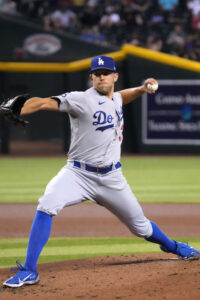
Anderson, 33 in December, turned in a career-best season with the Dodgers in 2022, pitching to a 2.57 ERA in a career-high 178 2/3 innings. Along the way, he punched out 19.5% of his opponents against a 4.8% walk rate and 40.1% ground-ball rate.
A former first-round pick of the Rockies (No. 20 overall, in 2011), Anderson showed promise as a rookie in 2016 (3.54 ERA in 114 1/3 innings) before beginning to struggle at Coors Field and eventually incurring a fairly serious knee injury that derailed some of his prime years. Anderson was diagnosed with a chondral defect in the cartilage of his left knee, which sidelined him for the better part of a year and led to the end of his tenure with the Rockies.
Since leaving Colorado, Anderson’s climb back to big league relevance has been impressive, to say the least. Signed to a one-year, make-good deal by the Giants heading into 2020, Anderson did just that in the Covid-shortened season. A 4.37 ERA in 11 starts/13 total appearances wasn’t exactly eye-popping, but it earned him another big league deal with the Pirates the following season. Both the Phillies and Mariners went hard after Anderson at the ’21 trade deadline, with the lefty ultimately landing in Seattle. His 31 starts of roughly league-average pitching netted him a late one-year deal with the Dodgers.
As they so frequently do, the Dodgers found a way to coax a new level of performance out of Anderson in 2022. Anderson didn’t overhaul his pitch repertoire but did rely more heavily on his changeup than he has in all but the shortened 2020 season. R.J. Anderson of CBS Sports points out that Anderson also abandoned a changeup grip he’d been using in recent years and went back to an old grip that wound up generating more drop and limiting hard contact more effectively than ever before. Anderson ranked in the 98th percentile of MLB pitchers in terms of average exit velocity and opponents’ hard-hit rate, and he sat in the 95th percentile in terms of opponents’ chase rate on pitches off the plate.
It’ll now be incumbent upon the Angels to help Anderson sustain the 2022 version of himself even as he pitches into his mid-30s. It’s the first multi-year contract of Anderson’s career, and, more surprising, the first multi-year contract the Angels have given out to a free-agent starting pitcher since signing Joe Blanton ten years and three general managers ago. Owner Arte Moreno has seemingly been averse to multi-year pacts for free agent starters in all but a few special cases — the Halos pursued Gerrit Cole, for instance — and it’ll be Anderson who bucks that trend at a time when Moreno is exploring a potential sale of the franchise. It’s also the second straight winter in which Moreno and general manager Perry Minasian have jumped the market to sign a pitcher who’d received a qualifying offer; the Angels signed Noah Syndergaard to a one-year, $21MM contract last year before his QO decision was formally due.
Anderson will step into a rotation that’s fronted by two-way superstar Shohei Ohtani, giving manager Phil Nevin a fourth lefty to follow his ace in the rotation. The Angels’ trio of Patrick Sandoval, Reid Detmers and Jose Suarez enjoyed, in somewhat under-the-radar fashion, a very productive 2022 season.
Adding Anderson gives the Angels a strong quintet on which to lean, and the Halos have a handful of in-house options to round out a six-man rotation if they prefer to get Ohtani an extra day of rest. Righties Chase Silseth, Griffin Canning, Chris Rodriguez, Janson Junk, Touki Toussaint and Davis Daniel are all on the 40-man roster, as are southpaws Tucker Davidson, Jhonathan Diaz and Kenny Rosenberg. That certainly doesn’t preclude further additions, and it’s possible that some of those depth options won’t even last the entire offseason on the 40-man roster.
The deal pushes the Halos to a projected $173MM for the 2023 season, per Roster Resource’s Jason Martinez. For luxury-tax purposes, the Anderson deal pushes the Angels to a projected $187.5MM.
The Angels opened the 2022 season with a franchise-record $188.6MM payroll, so by signing Anderson they’re already vaulting themselves up to about $15MM from their highwater mark. With several holes to fill around the roster — infield, perhaps corner outfield, bullpen — they’re likely ticketed for what will be a third consecutive season of pushing to a new franchise record.
Because the Dodgers paid the luxury tax in 2022, their compensation for losing Anderson will be a pick between the fourth and fifth rounds of next year’s draft. The Angels, meanwhile, as a team that neither received revenue sharing nor paid the luxury tax, will surrender their second-highest draft selection and see their league-allotted international bonus pool reduced by $500K.
Jon Heyman of the New York Post first reported Anderson and the Angels were in agreement. Joel Sherman of the New York Post first reported it was a three-year deal in the $40MM range, while Mark Feinsand of MLB.com specified the $39MM guarantee. Jeff Fletcher of the Orange County Register reported the even annual salary disbursement.
Blue Jays Trade Teoscar Hernandez To Mariners
Mariners president of baseball operations Jerry Dipoto wasted little time making his first big splash on the trade market this offseason, as the Mariners announced Wednesday that they’ve acquired All-Star right fielder Teoscar Hernandez from the Blue Jays in exchange for setup man Erik Swanson and pitching prospect Adam Macko.

Hernandez, who turned 30 a month ago, will give the Mariners a heart-of-the-order slugger who’s posted a stout .283/.333/.519 batting line with 73 home runs and 71 doubles through 1337 plate appearances over the past three seasons. Hernandez has been a Statcast darling since the time of his big league debut, regularly posting top-of-the-scale exit velocity and hard-hit rates; that was no different in 2022, when Statcast ranked him in the 94th percentile or better in hard-hit rate, average exit velocity, max exit velocity, barrel rate and expected slugging percentage.
That penchant for elite contact and plus power output from Hernandez comes at something of a cost. While he’s curbed his once-sky-high strikeout totals to an extent, Hernandez still fanned in 28.4% of his plate appearances last season. He got the strikeout rate all the way down to 24.9% in 2021, so there’s perhaps hope for some further gains, but as of right now that number is an outlier with regard to the rest of his career. His walk rate, meanwhile, has steadily clocked in between six and seven percent over the past few seasons — a good bit shy of league average.
Beyond the huge power, Hernandez possesses deceptive speed. He’s only tallied 24 steals (in 32 tries) over the past three seasons, including just six in 2022, but Hernandez’s sprint speed ranks in the 84th percentile of MLB players, per Statcast. With slightly larger bases expected to perhaps spur a bit more running in 2023, Hernandez is among the many players who could conceivably begin to take off with a bit more frequency. Hernandez is also known for having one of the game’s strongest throwing arms. Despite that speed and arm strength, however, he draws consistently below-average grades for his glovework in right field; Defensive Runs Saved and Outs Above Average have pegged him as a negative defender in each of the past four seasons. In 2022, he tallied minus-3 DRS, minus-5 OAA and a minus-3.1 Ultimate Zone Rating.
Even if his speed and arm don’t translate to plus right field defense, Hernandez has been a well above-average all-around player in recent years, when looking at the sum of his parts. Both FanGraphs and Baseball-Reference peg him right at eight wins above replacement in his past 324 games. Those 324 games have come across three seasons, though one was the shortened 2020 campaign. Generally speaking, Hernandez has avoided major injuries. He missed three weeks this season due to an oblique strain and was sidelined in 2021 by a positive Covid test (plus three games on the paternity list). Overall, however, he’s played in 84.3% of his team’s possible games since 2020.
Barring an extension, Hernandez will be a one-year rental for the Mariners — and a relatively pricey one, at that. Hernandez will reach six years of service time in 2023 and become a free agent next winter. MLBTR contributor Matt Swartz projects a sizable $14.1MM salary for him this season.
Dipoto said at last week’s GM Meetings that he sought at least one outfield upgrade this winter, if not two. Hernandez should slot into right field alongside center fielder and AL Rookie of the Year Julio Rodriguez, but his presence in Seattle creates some additional questions. The club opted not to make a qualifying offer to Mitch Haniger, for instance, and while Hernandez’s acquisition doesn’t squarely rule out Haniger returning to rotate through the outfield corners and DH, today’s trade inherently makes a reunion feel less likely.
The Mariners will have to determine whether they’re comfortable with a combination of former top prospects Jarred Kelenic, Kyle Lewis and Taylor Trammell in left field. Jesse Winker is another left field/DH option, though as of yesterday, the Mariners were discussing trade packages involving Winker. It’s easy enough to envision that group, with some help from utilitymen Dylan Moore and Sam Haggerty, holding down the fort in the corners and at DH, but further additions shouldn’t be ruled out.
The Mariners, after all, are squarely in win-now mode. And even with Hernandez aboard, they have ample payroll capacity; acquiring Hernandez is an approximate $12.7MM net add to the payroll, as Swanson had been projected by Swartz to be paid $1.4MM. They’re projected by Roster Resource for a $143.5MM payroll following the swap, and that’s a ways shy of the $162MM peak they trotted out in 2018. A return to the playoffs has likely boosted revenue a bit, and MLB has agreed to various lucrative streaming deals that afford each team considerable annual payouts in the five years since that previously established record payroll.
Turning to the Blue Jays’ side of the deal, they’ll simultaneously add a much-needed power arm to the bullpen and shed that aforementioned (and approximate) $12.7MM in payroll. They’re still projected for what would be a franchise-record Opening Day payroll in the $176MM range, but the trade gives them some more flexibility while adding a crucial arm to the relief mix. Swanson, originally acquired by the Mariners in the trade that sent James Paxton to the Yankees, struggled as a starter but has broken out as a powerhouse in the Seattle bullpen.

The 3.31 ERA, 24.3% strikeout rate and 6.9% walk rate Swanson logged in 35 1/3 innings during the 2021 season were a step in that direction, but it wasn’t until this past season that he became a dominant late-inning force. Swanson’s 2022 campaign resulted in 53 2/3 innings of 1.68 ERA ball with a massive 34% strikeout rate against just a 4.9% walk rate. In all, since establishing himself in 2021, Swanson owns a 2.33 ERA in 89 innings of relief — a mark that is largely supported by fielding-independent metrics (2.59 FIP, 2.87 SIERA).
Swanson is an extreme fly-ball pitcher, so some may have concern about his transition from a pitcher-friendly setting at T-Mobile Park to the homer-happy confines of Toronto’s Rogers Centre, but the fact is that very few of the fly-balls he yields are hit with authority. Among the 385 pitchers with at least 80 innings over the past two seasons, Swanson has induced infield pop-ups at the sixth-best rate in MLB.
Swanson was also a batted-ball deity on the mound in 2022, ranking near the top of the league in terms of average exit velocity (98th percentile), hard-hit rate (96th), expected ERA and wOBA (97th), expected slugging percentage (94th), overall strikeout rate (96th) and opponents’ chase rate on pitches off the plate (93rd). He may not be a household name, but for the 2022 season at least, Swanson can lay claim to legitimately being one of MLB’s most dominant relievers.
Unlike Hernandez, who’ll be a free agent next winter, Swanson is a relatively long-term piece for the Blue Jays. With three-plus years of Major League service time under his belt, he’s controllable through the 2025 season. And, because his breakout was of the “late blooming” variety, he didn’t build up the type of long track record that would reward him handsomely in his first trip through the arbitration process. The Jays will almost certainly pay Swanson less over the next three seasons than they’d have paid Hernandez in 2023 alone.
It’s the same timeline to free agency shared by Toronto closer Jordan Romano, who’s also controlled through 2025. Swanson figures to serve as the primary setup option to Romano, though he’ll be joined by veterans Yimi Garcia, Anthony Bass, Adam Cimber and Tim Mayza in what already looks like a deeper and more formidable relief corps.
Also heading to Toronto in the trade is the left-handed Macko, a significant addition to the team’s prospect base. Baseball America and FanGraphs both rated the 21-year-old as Seattle’s eighth-best prospect, touting his curveball as anywhere from a plus pitch (60-grade, FanGraphs) to a plus-plus (70, Baseball America) offering on the 20-80 scale. His fastball is another above-average offering, climbing as high as 98 mph, and his slider gives him the potential for a third average or better pitch.
Injuries — most notably a shoulder issue — and spotty command have been red flags in Macko’s development thus far. He pitched just 38 1/3 frames at High-A in 2022, logging a 3.99 ERA with a massive 35.9% strikeout rate but also a concerning 12% walk rate. It’s a pair of major “ifs,” but if Macko can get healthy and refine his command to even just shy of league average, the potential for a quality big league starter is present. Failing that, the fastball velocity and wipeout breaking pitch have obvious late-inning relief potential. Baseball America’s scouting report on Macko notes that he was one of the Mariners’ most sought-after targets in recent trade talks, too, and the Jays themselves could very well be asked about him in talks with other teams moving forward.
Overall, trading a popular and gregarious middle-of-the-order hitter for a reliever, even an ostensibly excellent one, could be a tough pill for Jays fans to swallow. That said, there’s clear potential to come out ahead in the gambit, as they’ll add three years of a bargain-priced, high-end reliever and a prospect with potential to quickly rise up national rankings with some better luck in the health department. The $12MM+ in payroll savings figures to be reallocated to free-agent pursuits or perhaps to additional targets on the trade market, too, so this will be but one step in a layered process that could ultimately benefit both teams.
As for the Mariners, they’ll add a thunderous bat to the heart of a lineup that also includes Rodriguez, Ty France and Eugenio Suarez. Dipoto and his charges, however, figure to continue to add to the lineup as they seek to take the Mariners beyond the ALDS heights they reached in 2022. Parting with Swanson thins out the bullpen, though Seattle is deep in that regard. Parting with Macko subtracts yet another quality prospect from a farm system that has been depleted, but not emptied, by recent trade activity (Luis Castillo, most notably). That said, even if the M’s can’t extend Hernandez, he’ll be a clear qualifying offer candidate next offseason, so they could potentially recoup a 2024 draft pick in the event that he proves to be a one-and-done case in Seattle. And for the time being, there’s no denying that the team’s 2023 lineup looks decidedly more formidable with Hernandez aboard.
ESPN’s Jeff Passan first reported that Hernandez had been traded to Seattle (Twitter link). TSN’s Scott Mitchell reported that the Jays were getting bullpen help, and Ryan Divish of the Seattle Times first reported the specific names involved.
White Sox To Sign Nate Fisher To Minor League Deal
The White Sox have an agreement with left-hander Nate Fisher on a minor league deal, reports Robert Murray of FanSided. Fisher will receive an invite to next year’s Spring Training.
As mentioned by Murray, Fisher is known as “The Banker,” a reference to his unusual journey to the big leagues. He was released by the Mariners in May of 2020 and took on a job with the First National Bank of Omaha until re-signing with the Mariners in June of 2021. He was able to throw 37 1/3 innings that year, posting a 2.89 ERA along with a 31.8% strikeout rate and 7.4% walk rate. Though he reached free agency at the end of the year, he intrigued the Mets enough to get a minor league deal with them.
He continued getting good results in the minors this year, enough to get selected to the Mets’ roster and make his MLB debut in August, though he was designated for assignment and outrighted after one scoreless, three-inning appearance. In the minors, he eventually logged 84 2/3 innings with a 4.15 ERA, 22% strikeout rate and 9.3% walk rate.
After reaching free agency again, he already has a new deal in place with the Sox. The club has five lefties on the roster, with all of those having question marks to some degree. Aaron Bummer has posted strong results in recent years but missed about half the 2022 season due to a lat strain. While he was out, the club acquired Jake Diekman from the Red Sox, who posted a 6.52 ERA after the trade. Garrett Crochet underwent Tommy John surgery in April and will miss at least part of the 2023 campaign. Then there’s Tanner Banks and Bennett Sousa, who both just debuted in 2022 and could potentially be optioned and recalled throughout the season. The club could add to this mix throughout the offseason via free agency or trade, but have bolstered the depth for now by bringing in Fisher.
Nationals Sign Derek Hill To Minor League Deal
The Nationals announced that they have signed outfielder Derek Hill and right-hander Hobie Harris to minor league deals with invites to Spring Training. Jesse Dougherty of The Washington Post reported on the Hill deal before the official announcement.
Hill, 27 next month, is a former first round draft pick, having been selected by the Tigers 23rd overall in 2014. At that time, he was considered to be an exciting talent due to his speed and defense, with his ultimate ceiling to be determined by the development of his bat.
Unfortunately, the offensive part of his game never really caught up with the other parts. He cracked the majors in 2020 and got into 95 games over the past three seasons. His batting line in that time is .240/.291/.339, production that’s 24% below league average by measure of wRC+. He’s struck out in 29.9% of his plate appearances, well above the league average rate, with this year’s being 22.4%.
His time in the minors this year wasn’t great either, as he hit .220/.294/.386 for a wRC+ of 73. That included time in the Tigers’ system as well as that of the Mariners, who claimed him off waivers in August. Seattle designated him for assignment and outrighted him in October.
For the Nationals, they are deep in the rebuilding process and not expected to be competitive in 2023, meaning they are one of the teams best-suited to take a shot on a former prospect like Hill. His baserunning and glovework give him a decent floor, meaning even a slight improvement at the plate could turn him into a decent piece for the club. He’s out of options and can’t be sent back down if he cracks the roster, but he has less than two years of service time and can be retained cheaply for years to come if he has a breakout. The Nats have Victor Robles penciled into center field for now, though he’s struggled at the plate for years and is in line for a $2.5MM salary via arbitration, per the projections of MLBTR contributor Matt Swartz.
As for Harris, 30 in June, he was a 31st round draft pick of the Yankees in 2015. He stayed in their system until December of 2019, when the Blue Jays grabbed him in the minor league phase of the Rule 5 draft. He spent the next couple of years in the Jays’ system before reaching minor league free agency and signing a minor league deal with the Brewers for 2022.
In each of the two past two seasons, he’s been in Triple-A, getting decent amounts of strikeouts and grounders but struggling with the free passes. In 2021, he registered a 3.92 ERA over 43 2/3 innings with a 27.9% strikeout rate, 11.5% walk rate and 48.1% ground ball rate. This year, his peripherals trended in the wrong direction yet his ERA dropped, likely due to a .203 batting average on balls in play. In 53 frames, he had a 2.04 ERA while striking out 27.1% of batters faced, walking 13.5% of them and getting grounders on 40.5% of balls in play. As mentioned with Hill, the Nats are likely going to be cycling through various players on their roster throughout 2023, looking for hidden gems as part of their rebuild. That means Harris has a chance to make his MLB debut if he keeps putting up decent Triple-A results next year.
Astros Select J.P. France
The Astros announced this evening they’ve selected right-hander J.P. France onto the 40-man roster. The move keeps him from being eligible for the Rule 5 draft.
A 14th-round pick from Mississippi State in the 2018 draft, France spent all of this year at Triple-A Sugar Land. He worked in a swing capacity for the Space Cowboys, starting 15 of his 34 outings. France pitched to a 3.90 ERA across 110 2/3 innings, punching out an above-average 28.3% of opponents against a slightly elevated 10.6% walk rate.
France turns 28 years old in April, putting him on the older side for a prospect. However, that he’s carved out a 40-man roster spot clearly indicates the Astros view him as a viable rotation or long relief depth option going into next season. Houston already has one of the league’s top rotations — even with Justin Verlander in free agency — but France could return to Sugar Land to provide some cover against injuries in the starting staff.
Yankees Select Randy Vasquez
The Yankees announced this evening they’ve selected right-hander Randy Vásquez onto the 40-man roster. The move keeps him from being eligible for the Rule 5 draft.
Vásquez signed as an amateur free agent out of the Dominican Republic during the 2018-19 international signing period. A curveball specialist, he recently ranked as the #9 prospect in the New York farm system at Baseball America. The outlet credits him with a low-mid 90s fastball and suggests he could develop into a back-of-the-rotation starter if he makes some strides with his control.
The 24-year-old spent this past season at Double-A Somerset. He made 25 starts and worked 115 1/3 innings, pitching to a 3.90 ERA with a 24.2% strikeout rate and a 48.3% ground-ball percentage. Those are both solid marks, as is his 8.3% walk rate. He figures to start next season at Triple-A Scranton/Wilkes-Barre but has a good chance at debuting in the majors at some point in 2023.
Twins Select Four Players
The Twins announced this evening they’ve selected four players onto the 40-man roster to prevent them from being eligible for the Rule 5 draft. Joining the roster are infielder Edouard Julien and pitchers Matt Canterino, Brent Headrick and Casey Legumina.
Julien was an 18th-round draftee out of Auburn in 2019. He’s hit very well in the minor leagues the last two years, including a .300/.441/.490 line with 17 home runs across 508 plate appearances at Double-A Wichita. The Quebec native walked in a stellar 19.3% of his plate appearances against a manageable 24.6% strikeout rate. He’s played each of second, third and first base and gotten some time in left field. Better suited for a corner, Julien’s a bat-first utility prospect. He checked in 10th on Minnesota’s midseason farm rankings at Baseball America.
Canterino went in the second round of the same draft coming out of Rice. The right-hander has an intriguing four-pitch mix but hasn’t logged many professional innings after spending time on the injured list in each of his seasons. He tossed 34 1/3 innings through 11 outings with Wichita this year, posting a 1.83 ERA with a huge 34.7% strikeout rate but walking 15.3% of opponents.
Headrick, 25 next month, was a ninth-rounder in 2019 from Illinois State. The 6’6″ left-hander split the year between High-A Cedar Rapids and Wichita. He combined for a 3.32 ERA through 108 1/3 innings, fanning just under 31% of opponents with only a 5.7% walk percentage.
Legumina was an 8th-rounder in that class out of Gonzaga. The 25-year-old joined Headrick in splitting his season between Cedar Rapids and Wichita. He posted a 4.80 ERA while working primarily in multi-inning relief. Legumina struck out roughly 24% of opponents with a 9.4% walk percentage.
Dodgers Select Four Players
The Dodgers have selected catcher Diego Cartaya, infielder Michael Busch and outfielders Andy Pages and Jonny DeLuca to the 40-man roster, per a team announcement. That quartet is now protected from being taken in next month’s Rule 5 Draft.
It’s a notable group to join the 40-man roster. Cartaya, Busch and Pages, in particular, all rank among Baseball America’s top 100 prospects in the game, with Cartaya drawing a particularly impressive placement at No. 9 overall.
The 21-year-old Cartaya split his 2022 season between Class-A and High-A, where he was notably younger than the league average at both levels. The age gap didn’t deter him, however, as he turned in a combined .254/.389/.503 batting line with 22 home runs and doubles alike. Cartaya is considered a work in progress with the glove but boasts huge raw power and a keen eye at the plate, evidenced by a walk rate north of 14% in 2022.
Busch, meanwhile, is a second baseman who slugged 32 home runs, walked at an 11.5% clip and struck out in 26% of his plate appearances between Double-A and Triple-A in 2022. His combined .274/.365/.516 batting line shows plenty of promise, even though scouting reports question his overall defensive value. BA lists him 46th on its top 100.
Pages, ranked 72nd by BA, hit .236/.336/.468 in 132 games as a 21-year-old in Double-A, more than holding his own against more advanced pitching. He also fared well in the Arizona Fall League, batting .296/.398/.506 in his 98 plate appearances there. He swatted 26 home runs in Double-A this year and 31 in High-A a year ago, and BA notes that Pages has some of the best raw power of any prospect in baseball.
As for DeLuca, the 24-year-old doesn’t draw the same fanfare as today’s other three additions, but his .260/.347/.541 batting line, 25 homers, 22 doubles, five triples and 17 stolen bases were convincing enough for the Dodgers to protect him. DeLuca fanned in just 14.3% of his 119 plate appearances in Double-A this year, and while that’s a small sample from a late-in-the-year promotion, it likely tickets him for a return effort there to begin the 2023 season. With a strong showing, he could be in Triple-A before long, and a look in the Majors next season is certainly plausible now that he’s in the upper minors and on the 40-man.
Padres Select Tom Cosgrove
The Padres have selected the contract of left hander Tom Cosgrove and added him to the 40-man roster.
A 12th round pick in 2017, Cosgrove initially worked as a starting pitcher in the Padres system, but was moved to a relief role last year. He split time this season between Double-A and Triple-A. His promotion to the top level of the minor leagues came after he tossed 25 2/3 innings of 2.45 ERA ball, striking out 38.2% of batters and walking 12.7%. While the strikeout rate was impressive, he certainly benefited from an 88.2% LOB rate and a .205 BABIP.
He struggled a bit at Triple-A, although he still managed to strike out 33.6% of batters faced. However, his walks remained an issue and he gave up a home run every five innings. On the whole, he finished with a 4.80 ERA across 30 innings at the higher level.
While Cosgrove hasn’t exactly dominated the minor leagues, the Padres 40-man roster stands at 34 after this addition, so it certainly didn’t hurt to add Cosgrove and avoid losing him in the Rule 5 draft. As a lefty with strong strikeout numbers, Cosgrove could provide some helpful bullpen depth next season.