
You can find all the published entries in our Offseason in Review series here.
The D-backs had perhaps the most surprising, aggressive offseason of any club in baseball in an effort to make a run at the NL West crown.
Major League Signings
- Zack Greinke, RHP: Six years, $206.5MM
- Tyler Clippard, RHP: Two years, $12.25MM
- Total Spend: $218.75MM
Notable Minor League Signings
- Brett Hayes, Kyle Drabek, Joaquin Arias, Wesley Wright, Sam LeCure, Rickie Weeks, Matt Capps, Scott Rice, Tim Stauffer, Jason Bourgeois
Trades and Claims
- Acquired RHP Shelby Miller and LHP Gabe Speier from Braves in exchange for CF Ender Inciarte, SS Dansby Swanson and RHP Aaron Blair
- Acquired SS Jean Segura, RHP Tyler Wagner and $4MM from Brewers in exchange for 2B Aaron Hill, RHP Chase Anderson and SS/2B Isan Diaz
- Acquired C/OF Chris Herrmann from Twins in exchange for 1B/OF Daniel Palka
- Acquired RHP Sam McWilliams from Phillies in exchange for RHP Jeremy Hellickson
- Acquired RHP Cody Hall from Giants in exchange for cash considerations
Extensions
- A.J. Pollock, CF: Two years, $10.25MM
Notable Losses
- Ender Inciarte, Chase Anderson, Jeremy Hellickson, Oliver Perez, David Hernandez, Aaron Hill, Jarrod Saltalamacchia, Allen Webster, Jhoulys Chacin
Needs Addressed
Entering the offseason, the rotation was known to be Arizona’s greatest need, but for financial reasons, the expectation was more that the D-backs would pursue second-tier arms like Kenta Maeda and Mike Leake than the names at the very top of the market. That, of course, changed in a matter of about 12 hours, which is reportedly the length of time it took the D-backs to sign Zack Greinke to a staggering six-year, $206.5MM contract after owner Ken Kendrick called his front office and gave the green light.
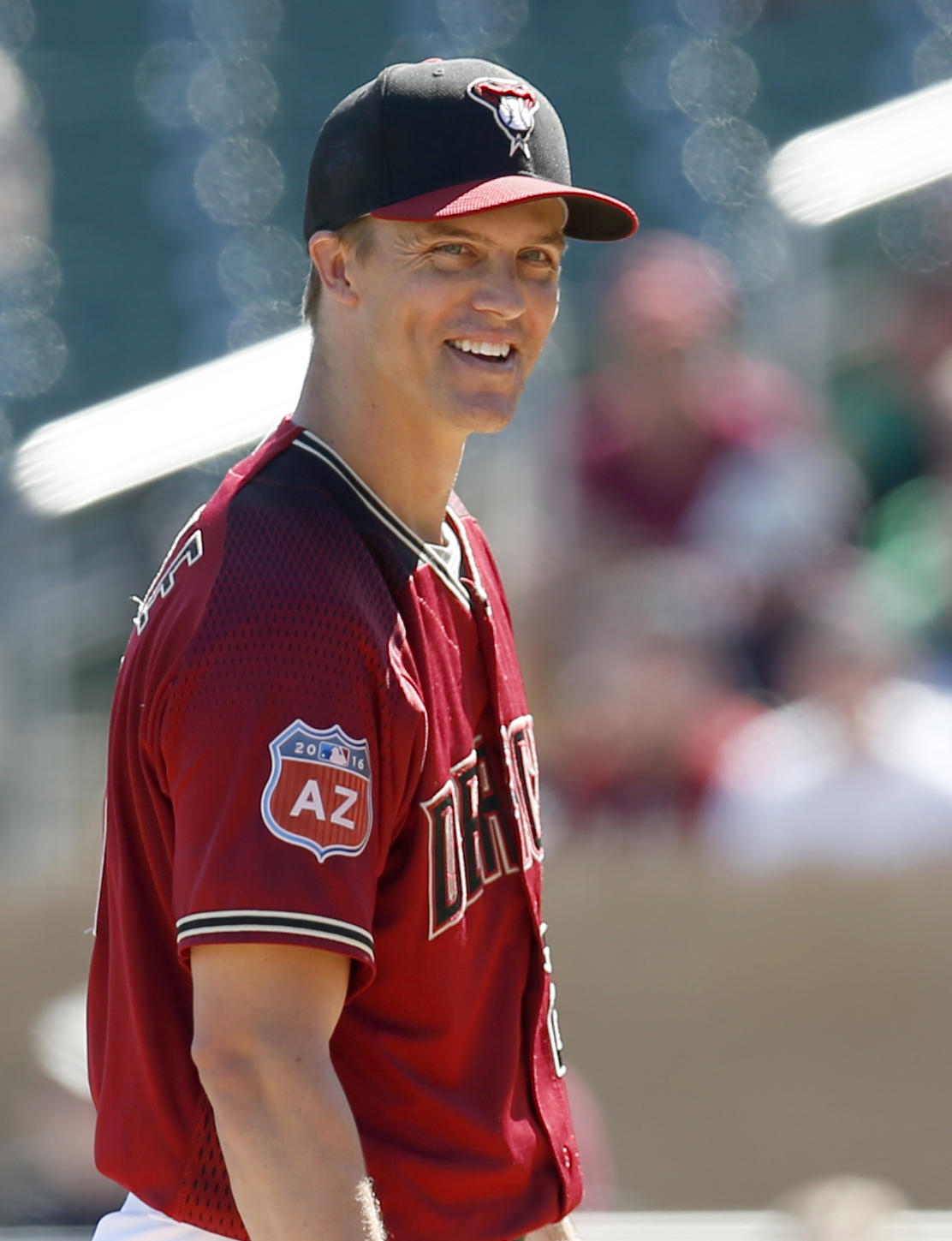
Unlike Greinke’s previous deal, this new contract doesn’t contain an opt-out. While a few million dollars of that sum is deferred, the Diamondbacks are paying Greinke more than $31MM annually, and the actual $34.4MM annual value of the deal (before deferrals) is the largest in Major League history. That represents a huge percentage of the spending capacity of an organization that has only once topped $100MM in Opening Day payroll. The Diamondbacks are betting that Greinke will not only age well, but continue to produce at an elite level — one near the collective 2.30 ERA that he posted over the life of his three years with the division-rival Dodgers. At the very least, they’re counting on him to perform over the life of the next three years, which is the amount of time for which the club controls standout center fielder A.J. Pollock and the team’s other blockbuster offseason addition: right-hander Shelby Miller.
In order to acquire three years of Miller, the D-backs parted with 2015 breakout Ender Inciarte, 2015 No. 1 overall draft pick Dansby Swanson and top prospect Aaron Blair. The price paid was astounding to most, and I’ll look at the Miller deal in full later in this review, but there’s little doubt that the D-backs have overwhelmingly improved upon the collection of starters with which they entered the 2015 season. Greinke, Miller and a full season of the excellent and underrated Patrick Corbin (who missed half of the ’15 campaign recovering from Tommy John surgery) give the club one of the more impressive rotation trios in the big leagues.
Joining that group will be right-hander Rubby De La Rosa and left-hander Robbie Ray. While De La Rosa hasn’t yet cemented himself as a high-quality big league starter, he proved durable last season by racking up 188 1/3 innings and carries further upside. (If nothing else, his velocity and dominance over right-handers suggests that he could be converted to a successful reliever if he continues posting upper-4.00 ERAs.) Ray, acquired in the three-team deal that sent Didi Gregorius to the Yankees, somewhat quietly delivered a strong season, posting a 3.52 ERA and solid peripheral stats in 127 1/3 innings. Although they traded a near-MLB-ready arm in Blair, the D-backs still have Archie Bradley and Braden Shipley on the cusp of the Major Leagues, so there’s depth beyond the starting five should a need arise.
The Diamondbacks have also long been connected to bullpen help — most notably, Aroldis Chapman — but they instead brought in the highly durable Tyler Clippard on a two-year deal late in the offseason. Clippard has been baseball’s iron man in the pen. Dating back to the 2009 season, his 524 1/3 lead all big league relievers, and it’s not even close. Luke Gregerson ranks second on that list but is 44 1/3 innings behind; essentially, Clippard has thrown two-thirds of a season’s worth of innings more than any other reliever since establishing himself in 2009.
There are varying ways to interpret that durability, of course. MLBTR’s Jeff Todd and I discussed the deal this offseason on our podcast, with Jeff viewing the deal as a solid value and a sensible move given the organization’s other acquisitions. I’m more skeptical, particularly in light of last year’s results. While Clippard delivered an excellent 2.92 ERA in his age-30 season, his strikeout rate, walk rate, swinging-strike rate and velocity all trended in the wrong direction, and he posted a 21.2 percent ground-ball rate. If the innings have begun to catch up to Clippard and/or he posts a fly-ball rate near 60 percent at the homer-friendly Chase Field, the return on Arizona’s investment could be marginal. The D-backs were already burned once by acquiring an extreme fly-ball reliever in Addison Reed, and Clippard is an even more pronounced fly-ball arm. If, on the other hand, last year was an anomaly and Clippard pitches more like his 2010-14 self, the Diamondbacks will have deepened their ‘pen at a very reasonable price.
Continued analysis after the break …
Questions Remaining
For as much as they improved the pitching staff, the D-backs’ infield (beyond the elite Paul Goldschmidt) is suspect. Arizona got out from underneath a portion of the remaining Aaron Hill contract (and used the savings to sign Clippard, it should be noted), and in doing so added shortstop Jean Segura from the Brewers. Adding Segura would seem to displace defensive standout Nick Ahmed at shortstop, but it’s not clear that Segura is an upgrade. The 26-year-old looked like a star in the making back in 2013, when he turned in an All-Star first half with Milwaukee, but outside of those three months he’s never hit Major League pitching. Segura has a collective .250/.282/.328 batting line in 1,367 plate appearances dating back to the All-Star break that year, and his fielding can’t stack up with that of Ahmed. Barring a sudden offensive resurgence for Segura, the D-backs might well be better off playing Ahmed’s glove every day. And parting with the interesting Isan Diaz could sting down the line.
Second base is somewhat unsettled due to shoulder injuries that have sapped Chris Owings‘ production. Owings is young enough to still deliver on the promise he showed when he was first breaking into the Majors — he was the 2013 Pacific Coast League MVP — but the Snakes also looked at signing Howie Kendrick and trading for Brandon Phillips this winter. Phillips reportedly wouldn’t have waived his 10-and-5 rights, so the D-backs had little say in the matter, but Arizona could have and arguably should have signed Kendrick late in the offseason. ESPN’s Jayson Stark polled a number of big league execs on the best deals of the offseason, and Kendrick’s two-year, $20MM pact with the Dodgers routinely came up as one of the best value signings. Arizona had interest in Kendrick, but GM Dave Stewart flatly said to the media that he couldn’t part with his Competitive Balance Round A draft selection (No. 39 overall). That’s a puzzling stance for an organization that not only gave up its first-round pick to sign Greinke, but traded two former first-round picks (Swanson and Blair) to land Miller in addition to sending 2014 first-rounder Touki Toussaint to the Braves this past summer in order to shed Bronson Arroyo‘s contract. The Diamondbacks’ decision to prioritize the No. 39 pick over adding Kendrick at a bargain rate seems at odds with the exceptionally aggressive “win-now” stance taken over much of the winter.
Third base, too, is a question mark, but the D-backs have a potential regular in Jake Lamb. Should either Lamb or Owings falter this season, top prospect Brandon Drury is ready for big league action and is capable of playing third base and second base. Ahmed, too, seems more than capable of handling any of the three spots from a defensive standpoint — as could Segura, if he’s overtaken at short — so the club does have several young options.
The Diamondbacks must also determine which players are going to flank Pollock at the outfield corners. David Peralta is a good bet to man one corner spot after a brilliant 2015 season, but it seems unlikely that he’ll replicate last year’s .312/.371/.522 batting line. Peralta posted that outstanding slash with the aid of a likely-unsustainable .368 average on balls in play. That’s not to say that he won’t hit at all, as there’s plenty of evidence to suggest that he is indeed a weapon against right-handed pitching, but tempered expectations and a platoon partner are probably in order.
The other corner will have to be filled by one of Yasmany Tomas or Socrates Brito. Tomas was a flop in his first year of a $68.5MM contract, and the D-backs will need him to begin to produce now that Inciarte has been traded. Neither Tomas nor Peralta can match Inciarte’s defensive value, but a step forward in the power and on-base department for Tomas would recoup some of the lost value in the outfield. If he continues to struggle, the 23-year-old Brito has followed up a terrific 2015 season with a strong Spring Training and could be given a chance to win the job (perhaps relegating Tomas to a platoon-mate for Peralta).
Deal of Note
The Miller trade is probably the most talked-about swap of the offseason, due in large part to the three quality assets that the Diamondbacks gave to acquire the right-hander’s arbitration years. Miller was long projected to be a potential front-line starter as a prospect and posted a strong 3.02 ERA over 205 1/3 innings with the Braves last season. He’s absolutely a quality big league pitcher, but the price the Diamondbacks paid is one that most would expect to yield an ace-caliber pitcher. Miller’s ERA last season suggests that he could be near that level, but his strikeout rate was average, and his swinging-strike and walk rates worse than those of a league-average starter. The most appreciable gain made by Miller was in his ground-ball rate, which soared from 39 percent in 2013-14 to 47.7 percent last year. However, switching out Ahmed for Segura weakens the infield defense quite a bit and diminishes some of the value that would come from a sustained increase in grounders.
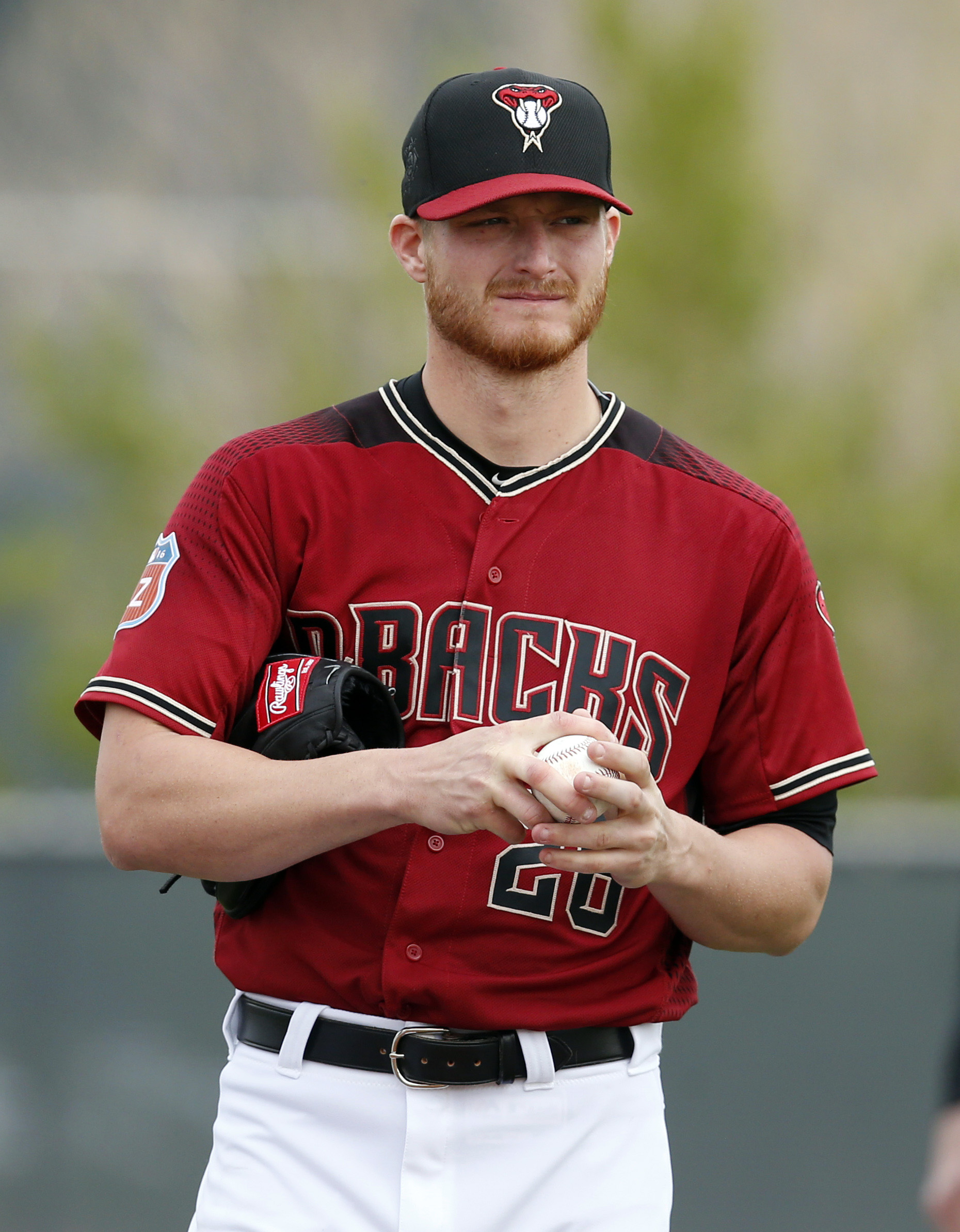
Fielding independent pitching metrics pegged Miller’s 2015 season anywhere from 3.45 (FIP) to 4.16 (SIERA). Miller has outpitched those metrics in two of his three big league seasons, but he did so in 2015 with the aid of a minuscule and unsustainable .203 average on balls in play over the first two months of the season. Miller’s ERA in that time was an incredible 1.48, but he posted a 3.77 ERA over the final four months of the 2015 campaign. That stacks up with what Miller provided the Cardinals in 2014, and if that’s the pitcher that Miller is, then the Diamondbacks overpaid considerably.
In fact, even if Miller replicates his 2015 season, it’s not entirely clear that Arizona got decidedly better. Inciarte was outstanding last year, hitting .303/.338/.408 to go along with some of the game’s best outfield defense and plus value on the bases. The club doesn’t have a clear-cut replacement in line for him, with Tomas, who played well below replacement level in 2015, and the untested Brito as the likeliest candidates to step into Inciarte’s vacated spot. Inciarte may not repeat his own offensive success, but his glove and value on the bases give him a relatively high floor, and he has five years of club control (two of which are inexpensive pre-arbitration years) to Miller’s three.
I’d prefer Miller to Inciarte in a given season, but three years of the former for five years of the latter carries comparable value, and the D-backs also surrendered a highly-regarded, near-MLB ready starter in Blair along with a premium talent in Swanson — a potential starting shortstop who was the first overall pick just six months prior. The pressure is on Arizona to win now and for Miller to be a significant component of their success, because the trade has the potential to look like a coup for the Braves in fairly short order.
Overview
Adding Greinke, Miller and a fully-rehabbed Corbin to the rotation in front of returning young arms De La Rosa and Ray unequivocally gives the D-backs a better rotation than they had at any point last season. The question for the Snakes is whether adding Miller at the expense of Inciarte is a net gain for the 2016 season and whether the complementary pieces around the lynchpins of their lineup (Goldschmidt and Pollock) can produce enough to take this club to the playoffs. D-backs supporters are quick to point to all the additions that were made to a roster that already won 79 games last year. However, Inciarte was no small part of the club’s 2015 success, and it’s certainly possible that the incumbent outfielders (Peralta in particular) will struggle to perform at such a high level in 2016. That’s not to say that Pollock’s success was a mirage — I’ve long contested that he is among baseball’s most unheralded stars — but repeating a roughly seven-WAR season is no small feat even for a truly elite talent, and he’s been slowed by elbow issues this spring.
The fact remains that the D-backs look like an improved club, and steps forward from young talent like Lamb, Owings and Drury as well as a breakout from a player like Tomas or a resurgence by Segura would go a long way toward catapulting the team up the ranks of the National League West. For an organization with such a clear desire to win now, however, there are a lot of players that need to prove themselves up and down the lineup in order to support what should be a strong pitching staff. And, if the club doesn’t realize its championship aspirations in the coming years, the sacrifice of controllable assets that yielded the present roster could be increasingly painful in retrospect.
How would you rate the Diamondbacks’ offseason work? (Mobile app users can click here to access the poll.)
How would you grade the D-Backs' offseason?
-
B 34% (543)
-
A 27% (435)
-
C 19% (312)
-
D 13% (213)
-
F 7% (115)
Total votes: 1,618
The only deal they made that I actually liked was dumping Hellickson, but they could have just nontendered him.
I didn’t mind the Segura deal, as long as he replaces Owings and not Ahmed. Ik he’s not the player he was in 2013, but a change of scenery and position could do him well, and I think he could settle in as an average player, rather than as one of the worst in the league, and they had no room for Anderson anyways, so unless Diaz becomes a good player, I think that move was alright. They definitely overpaid for Greinke, but as long as Ken Kendrick is willing to boost payroll consistently, then I’m fine with a slight overpay. The Shelby Miller trade, on the other hand, was obviously a head-scratcher to say the least.
Giving up Anderson just to realize a $4 million savings in moving Hill was a bitter pill to swallow. Unfortunately, Segura is one of the only regulars in MLB that has even worse plate discipline than Chris Owings. Granted, he doesn’t stike out as much, but he walks even less.
Meanwhile, the Snakes shocked the baseball world by signing Greinke, only to have ownership . then turn around and decide it wasn’t going to expand payroll one iota, meaning the Greinke acquisition essentially consumed the entire budjet. If Clippard hadn’t taken so long to sign, they wouldn’t have been able to land him.
F – none of their deals seem to coalesce with their other deals. I loved Dave Stewart on the mound, but he’s destroying the D-Backs and Larussa seems to be okay with it. In 5 years Grienke could very easily earn 20% of the D-Backs Payroll while Goldy is in LA.
A little harsh, though i agree that overpaying for greinke could bite them in the endand would most likely cause them to lose goldy. He prolly wouldn’t end up in L.A. though. If i had to guess he would end up in a hitters park on an opt out.
The problem is less Greinke’s contract than it is a combination of Tomas’ contract and three of the foundational pieces to this team all hitting FA in the same season. Mix in with that, the fact that the Diamondbacks just traded away Blair, and Bradley starting to look like a possible bust, and the team is left with few cost-controlled options to absorb much of the impact.
The complete lack if caring about the farm system at all is crazy. I can’t see this ending well. They better make a couple good runs over the next 2 years, it’s going to be a bumpy road after that.
Arizona was terrible last year… Adding a frontline starter won’t nearly be enough, they’re gonna miss the playoffs again this year. I give them a C-
Ok now we officially know you are just trolling us and dont actually believe what you say. Arizona did MORE than what Boston did and is going to be bad again while bostons gonna win over 100 games? And if one front line starter cant turn Arizona around, why are you so confident Price can in Boston.
How’d they do more? They got Grienke and Clippard.
Sox got Price, Kimbrel, Smith, and Young.
Price > Grineke
Kimbrel + Smith >>>>>>>>>>>>>>>>>>>> Clippard
And Young is the cherry on top.
its pretty convenient how you left out Shelby Miller. Miller would instantly be Bostons second best pitcher, where hes Arizonas third after Corbin. While Bostons bullpen got better, it is way more important to have a good rotation (Well, for the regular season at least). And you do realize Greinke had one of the best sesons in over 20 years last year right.
And Seguras the cherry on top
6-17 Shelby Miller is pretty overrated. If rather have Erod or Buchholz than him.
Did u forget Shelby Miller? I’m a big price fan bc I’m a Rays fan but was season better than greinke’s
If we ignore him, he’ll go away.
Just think about the time we all got past the JBJ for Cole Hamels guy, and the guy who made trade proposals that had about 5 teams and 30 players on each side.
Please tell me your rebuttal isnt a pitchers win-loss record. Miller just pitched a 3.02 ERA on a bad team. Hes thrown at least 31 starts in each of his seasons and has never had an ERA over 4. You cant say the same about either of the pitchers you just mentioned. I guess you do know a thing or two about overrated things though, you are a fan of the Boston Red Sox, the king of overrated teams for the past decade.
No one judges any pitcher by their records anymore…he played on the Braves last year remember. Not sold
on Miller but you’re talking stupid by judging him by his record.
We’ll have to agree to disagree
Won – loss records and batting average are no longer considered as indicators of how valuable a player is except during contract negotiations. How bad were the braves last year. I can tell you bc I live in Atlanta. Price would have had a bad year here also. Again, I’m a huge price fan but his postseason record has to be concerning since the rest of the sox rotation is merely average.
Too bad there aren’t ways of rating starting pitchers other than their record!
Lol good ol Trademeister. I saw one of his proposals the other day and it wasn’t too bad. Wish I could remember what it was.
LOL The thing is guy EVERY ONE DISAGREES WITH YOU. LOL Even your fellow Red Sox fans agree you are a homer. You always gonne be just a red sox fan. When you become a baseball fan them come on the threads and have a normal conversation. Until then you should stick to comics Pokemon cards.
There is no way this clown made a sensible trade proposal LOL. NO WAY WHAT SO EVER. Trolls do not use there brains.
Here, I’ll spell it out for you:
1. Every opinion you’ve ever had is wrong.
2. Stop talking.
3. Thanks.
Grienke ‘s era was nearly a run lower than price’s, and yes I know he pitched in a better ballpark but it’s not like price pitched in Coors… I’m not knocking price by any means but to say he’s better than friends is false. I’ll give you equal, even though I’m not so sure. And yes, obviously the Sox had a better bullpen upgrade, but Shelby Miller solidifies the rotation for the D’backs. And his record is no indication of how good he is. He played on one of the worst offensive teams in baseball and had the worst run support of any pitcher. He would definitely surpass buchholz as the Sox 2nd starter, which is something they are lacking. Their rotation is an ace followed by 4 number 4 starters. Buchholz at his best is an ace but if you’re expecting that then I’m sorry but you’re delusional. The Sox’s pen was already pretty good, and now it’s stacked. But they didn’t do enough for the rotation. And since the D’backs already had a better record last year than the Red Sox, I think it stays that way. Their offseason’s were probably equal in terms of the assets they brought in.
cjh? I really miss him.
Yes! Thank you!!
“6-17 Shelby Miller” light cringe
I love how this writer talks up Ender Inciarte like he’s a future star and talks down Peralta like he is declining. From a guy who actually watched the dbacks last year, I can tell you, Peralta is a great hitter. Why would he struggle? You also fail to mention that Segura is one of the hottest hitters this spring. This writer doesn’t know what he’s talking about, I’m feeling good this year.
Spring stats are irrelevant. Jbj lead spring training hitters a couple years ago, then hut under the mendoza line in the regular season. Combo of small sample size, pitchers working on things.
Blah. Blah. Blah. Both the article and the commenters are so tired. I’ve heard this babble hundreds of times. I look forward to the 2016 D’backs winning the NL West and playing in the World Series.
You seem to keep up with the D-backs. Do you think Peter O’Brien makes the team this year? I have been a fan of his since his AA days in Trenton. I was hoping to read something about him here fighting for atleast a platoon spot but got Brito (never heard of him) instead.
O’Brien’s power is legit. If the D’backs needed a power bat off the bench, he’d be ideal. But there’s a roster crunch, so I think he gets squeezed out. Because of Tomas’ big contract, he will be at least a platoon at one corner probably with Peralta. Brito may be the NL ROY, he’s looked that good as a late season call up last year and built on it in Spring Training. He’ll be the 2016 Inciarte for the D’backs, with a breakout year. The first ML call up will be the versatile Evan Marzilli, who can play all 3 outfield positions and is having a great Spring. He’s really opened some eyes. Next up would be O’Brien.
My guess is that the 25th man job comes down to Weeks vs. O’Brien. I’m pulling for O’Brien as I think he’ll be much more of a weapon off the bench.
Would be an amazing feat to top the Cubs to make the World Series.
Agreed. Cubs look great. They’d be my second pick. D’backs improved by 15 games from 2014 to 2015. They had the best offense and the best defense in the NL and MLB respectively in 2015. But their starting pitching sucked, and they had to overtax the bullpen as a result. So, they added Greinke and Miller to the top of their rotation, and Corbin is now back for a full season. Corbin will be as good as or better than Greinke, so with Corbin, Greinke and Miller at the top of the rotation, and two solid back of the rotation arms in Ray and De La Rosa, plus depth everywhere to fill in for injuries or underperformance, there really aren’t any weaknesses this year. That’s why I’m predicting the D’backs will represent the NL in the World Series this year.
I agree with your analysis there and hope the overpays show to be worth it. As a Braves fan, I have appreciated the Diamondbacks front office the past few years. Regardless, if they do make the NLCS vs. the Cubs as you predict, that will be one hell of a series I think. Cannot wait for the season to start.
If you put together a team good enough to win the thing, how can it be an overpay? AZ is riding the rollercoaster that the financing of MLB requires of small and mid-market teams. They can afford to be competitive only within brief windows. They just opened up a window for a couple of seasons, and if nothing else became the team to beat in the NLW. So what if in 2018 they are weighted down by some big contracts and a barren farm system? If they’re brought a championship home during those years then the local fans will have no complaints. In fact what the D-backs are doing now could well work out better from a fan perspective than the big experiment currently running in LA.
Only reason I state overpay is San Diego did the same thing recently and did not turn it into a contender.
The point is, “overpaying” doesn’t matter half as much as many insist it does. Most franchises do not have the financing to support competitive teams year after year, so they have to go all-in when they see a competitive window opening. San Diego swung and missed last year. So what? They will reboot and try again in a few more years. That’s the problem I have with the Dodgers’ current strategy. Nothing about what they’ve said or done to date suggests that they will ever be motivated to go all-in. Yet they will always be facing one or two teams in their division who are putting all their chips on the table just as AZ is doing now.
I love everything they did. For one reason there my SECOND favorite team and all the moves BUT ONE made them A LOT better… And two, my first favorite team is the Braves and I’m going to really enjoy seeing Swanson, Albies and Inciarte up the middle for years to come. Lol.
I think Stewart must be getting a pretty large cheque from the braves as well lol. Toussant, Swanson, and Blair for Miller and a little money off the books. I like Arizona as well as a secondary team and hope them and Greinke do well. But in 4 years you guys should call Stewart and see what you can get if you take on his full contract. Youre just a prospect dumping ground for him
Respectfully, it is more likely that you will see Swanson, Albies and M. Smith up the middle, because the Braves will probably trade Inciarte for another quality prospect or two prior to the start of 2017.
They made some splashy moves. They overpaid for Grienke. They over-traded for Miller. Two solid pitchers could have been acquired for less, without strangling future payroll, or emptying the farm system. If they were closer last year, I could see this, but I think they were too far away for two splashy moves to be enough. The other moves really didn’t make much of an improvement over what they had last year.
Agreed. Leake really wanted to play there as well. Is Miller really a better option than Leake, Swanson, Blair, and Inciarte?
Clearly not. But Leake might have cost $70-80 million over six years. I would have traded multiple years of Inciarte straight up for a year of Andrew Cashner – Pads would have even thrown in a minor prospect. More importantly, D-backs would keep Swanson and Blair.
They did not over-pay for Greinke. They sniped Greinke from the dodgers and Giants and that was the cost. And, from someone who watches over 150 D-backs games every year, they were much closer last season than you give them credit for. Their rotation was a kiss-of-death. This team knows how to score runs. Their bullpen is much better than the numbers as the rotation was so bad that they were forced to throw a ridiculous number of innings. Their defense was one of the best in all of baseball. Last year there was exactly one glaring weakness and that was the rotation. Now it’s being held up as one of the best. This team is much better than anyone is giving them credit..
Some of us are giving them credit.
While I still pick the D-backs for 3rd place, Greinke is no B.J. Upton. I like the Braves deals much better than the ones by the Phillies or Brewers.
Signing Greinke changes the Division, so its a big win Arizona. Miller isnt elite so I cant agree to trading Inciarte, Blair and Swanson for 3 years of his services, when there was still similar pitches available on the free agency market. Clippard is a good signing, so all in all I gave a Grade B. I still can’t see the D’Backs pushing the Giants for the division however, thus no Grade A.
If Clippard would have pitched in Arizona last year his numbers would have been shockingly high. His modest contract and past performance will keep him trade-able for awhile though.
Id gave them an A for 4 huge reasons: Swanson, Inciarte, Blair, and Tussiant…. In all honesty though I gave them a C.
Who cares if they overpaid. The D- Backs will be better and more exciting. Enjoy the year!!
An exciting 3rd place. Oh yeah.
From a fans’ perspective, it is more fun to spend money and come close than to pinch pennies and finish far out. Greinke was an overpay but I am sure that most D-backs fans are quite happy with it. I question trading Swanson and Inciarte for Miller, when Inciarte alone could have obtained a decent pitcher in return. Swanson and Blair would have helped the team in 2017 or 2018, whereas while Inciarte was very good, the D-backs have other outfield options like Brito, Tomas and O’Brien.
This was padres fans exact sentiment last year.
If it wasn’t for the unprecedented amount of talent they gave up for a #3 starter in Miller I would have given them a B.
Think they would have been better off signing two second tier starters like Leake and Samardzija or similar guys and keeping all the guys they gave up for Miller. I’ll be curious to see how the Greinke contract effects them when it is time to pay Goldshmidt and Pollock. But there is something to be said for going all in to at least show the fans you aren’t content always being mediocre.
Greinke was an overpay, but makes the team much better. Segura was a low risk deal, so I like it. The deal for Shelby Miller was the worst deal this off-season. Dansby Swanson, Aaron Blair and Ender Inciarte – all three of them – is just too much for Shelby Miller. I believe that they could traded Inciarte straight up for a decent pitcher like Andrew Cashner (Padres), Chris Heston (Giants), Joe Ross (Nationals), or Zack Wheeler (Mets).
I just believe the only move I did not liked it was giving up Inciarte. I understand that the approach to win and to acquire such a high caliber arm as MIller requires the team to give up a very talented and controllable player, but still I will miss him. Hope he does well in Atlanta. As for the Dbacks, now we are in a true position to contend, if all the pieces perform at expected level. Can’t wait for opening day!