
3 Twins Prospects Could Be “Off Limits” In Trade Talks
With July 31 approaching, the AL Central-leading Twins have reportedly shown interest in an array of pitchers who are potential trade candidates. The club has been connected to Madison Bumgarner, Will Smith, Marcus Stroman, Ken Giles and Kirby Yates in the rumor mill over the past few weeks. However, if the Twins are going to make win-now moves this month, it doesn’t appear they’ll come at the expense of any of their absolute best prospects. Shortstop Royce Lewis, outfielder Alex Kirilloff and right-hander Brusdar Graterol are “off limits” in trade talks, according to LaVelle E. Neal III of the Star Tribune.
It’s especially unsurprising the Twins don’t seem to want to give up the 20-year-old Lewis, whom they drafted first overall in 2017 and then signed to a record bonus for a high schooler. Two years later, FanGraphs (No. 2), MLB.com (No. 7) and Baseball America (No. 10) all regard Lewis as a top 10 major league prospect. ESPN’s Keith Law, who just released his latest top 50 (worth checking out in full), is somewhat less bullish on Lewis. In ranking Lewis 34th, Law explains that “massive” mechanical changes the player has made at the plate haven’t benefited him. Lewis, for what it’s worth, has only hit .239/.288/.373 (95 wRC+) in 358 plate appearances at the High-A level this season. Beyond that, Law’s skeptical of Lewis’ ability to stick at short, writing he’s likely a better fit to play center field.
In Law’s estimation, Kirilloff (No. 15) is a superior prospect to Lewis. The other prospect gurus are similarly high on Kirilloff – BA ranks him 11th, MLB.com 13th and FanGraphs 26th. The 15th overall pick of the Twins in 2016, Kirilloff has made a 216-PA debut with Double-A Pensacola this season and slashed .283/.366/.429 with four home runs. That doesn’t look like a world-beating line, but by wRC+, the 21-year-old Kirilloff’s production has been 33 percent better than the Southern League average. Furthermore, even though Kirilloff hasn’t been particularly powerful this year, there aren’t many concerns over him developing into a solid power hitter in the majors, according to Law.
Graterol, meanwhile, didn’t crack Law’s rankings, though he’s in the top 50s of Baseball America (No. 36) and MLB.com (No. 50). FanGraphs places him just a few spots outside (53rd). BA credits Graterol, 20, with possessing “wipeout stuff,” adding there’s room for him to improve his command. Like Kirilloff, Graterol’s in the midst of his first Double-A action. He owns a superb 1.89 ERA/3.28 FIP with 8.69 K/9, 3.59 BB/9 and a 52.1 percent groundball rate in nine starts and 47 2/3 innings thus far.
Although the Twins don’t look willing to move any of Lewis, Kirilloff or Graterol, that shouldn’t necessarily preclude them from adding impact MLB talent before the deadline. The club does boast FanGraphs’ seventh-ranked farm system, two more top 100 prospects at MLB.com (93rd-rated outfielder Trevor Larnach and 99th-ranked righty Jordan Balazovic), and likely plenty more farmhands who’d pique the interest of other teams in negotiations.
Mitch Moreland Starts Rehab Assignment
Injured Red Sox first baseman Mitch Moreland started a rehab assignment at the Triple-A level on Thursday, Chris Cotillo of MassLive.com reports. Moreland, who has been out for several weeks, may be in for a somewhat “lengthy” stint in the minors as he works his way back to the bigs, per Cotillo.
Moreland got off to a fine start this season, slashing .225/.316/.543 (116 wRC+) with 13 home runs and an eye-opening .318 ISO in 174 plate appearances, but multiple ailments have derailed his year since late May. The 33-year-old landed on the 10-day IL with a lower back strain May 29, and though he made a quick return, Moreland went back to the shelf June 8 after suffering a right quad strain.
The lefty-hitting Moreland and righty Steve Pearce opened the season in a timeshare at first base for the Red Sox. Pearce has been down since June 1, though, and knee troubles will prevent him from returning in the near future. The long-term absences of Moreland and Pearce have left first almost exclusively to Michael Chavis, who has enjoyed a respectable rookie year. Chavis had been Boston’s primary second baseman before the injuries to its first basemen. Brock Holt and Marco Hernandez have offered good production there in Chavis’ stead, so it’s unclear how the club will divvy up playing time between first and the keystone once Moreland returns.
Moreland’s comeback figures to have negative consequences for either the optionable Hernandez or veteran infielder Eduardo Nunez, who Cotillo suggests could become a DFA candidate at that point. Although the Red Sox would owe Nunez the balance of his $4MM salary in getting rid of him, he hasn’t justified a roster spot this season. A .233/.249/.313 line (40 wRC+) in 170 PA has relegated Nunez to a bench role.
Dodgers, Braves, Rays Interested In Matthew Boyd
The Padres, Cubs, Red Sox and Astros are reportedly among teams with interest in breakout Tigers left-hander Matthew Boyd as the July 31 trade deadline creeps closer. Add the Dodgers, Braves and Rays to the clubs involved in the derby, according to Chris McCosky of the Detroit News.
The 28-year-old Boyd has evolved from average starter to potential front-end arm since the season began, and with the Tigers in a rebuild, they may decide to cash him in this month. Boyd’s 3.87 ERA over 107 innings isn’t befitting of an ace, but he has managed a more impressive 3.56 FIP/3.34 xFIP while emerging as one of the majors’ preeminent strikeout artists. With a sky-high 11.94 K/9 against a measly 1.68 BB/9, Boyd ranks top 10 among starters in those categories and top five in K/BB ratio (1.68).
Home runs have recently haunted Boyd, who has allowed at least two in three straight outings and a total of 10 in six starts since the beginning of June. But Boyd’s sudden gopher balls issues don’t look as if they’ll be enough to dampen teams’ enthusiasm in the affordable, controllable hurler. His $2.6MM salary this season and three remaining years of arbitration eligibility would make him a long-term piece for an acquiring team, though they’ll also help drive up Detroit’s asking price. The Tigers are holding out for a lofty return for Boyd, as you’d expect, with McCosky reporting they initially sought a major league-ready hitter and one or more “top” prospects at or above the Double-A level.
For the Dodgers, Boyd would add to a team that already seems to have everything. The back-to-back National League pennant winners own the majors’ best record (60-32) thanks in part to their starting staff. Potential Cy Young candidate Hyun-Jin Ryu, Clayton Kershaw and Walker Buehler have all been good to brilliant, while Kenta Maeda and Ross Stripling have performed well in complementary roles. The same applies to Rich Hill, though he has been on the injured list since June 20 with a left flexor tendon strain and, having gone on the 60-day IL, won’t return until at least late August. It’s also worth noting this could be the last season in Los Angeles for Hill, a soon-to-be free agent who’s pushing 40, so Boyd would fit nicely in his spot in the team’s rotation in 2020.
The Braves are the NL’s second-ranked team at 54-37, and there’s an obvious connection between their front office and Boyd. General manager Alex Anthopoulos held the same position in Toronto when the Blue Jays spent a sixth-round pick on Boyd in 2013. Boyd debuted up north in 2015, Anthopoulos’ last year as Toronto’s GM, but the championship-contending club traded him that July to the Tigers to acquire ace David Price.
Anthopoulos fell short of his World Series goal four years ago, but his current employer has a realistic chance to vie for a title this season. The Braves, though, do have needs in their rotation even after signing Dallas Keuchel to a one-year, $13MM contract in June. Keuchel and rookie sensation Mike Soroka are locked into spots. After that, while Julio Teheran has logged a 3.75 ERA in 100 2/3 innings, it’s much harder to trust his shaky peripherals. Max Fried‘s secondary numbers are better than Teheran’s, but he has been inconsistent of late. Meanwhile, 2018 No. 1 starter Mike Foltynewicz got off to a miserable start before the team demoted him to the minors June 23, and hasn’t come back since. Kevin Gausman, likewise, hasn’t taken the mound for the Braves in weeks – he went to the IL on June 11 with a plantar fasciitis in his right foot – and has joined Foltynewicz in struggling mightily when he has started this year.
Tampa Bay isn’t the mortal playoff lock LA and Atlanta appear to be in the NL, but the Rays are very much in the AL hunt. The club’s 52-39, a half-game up on its league’s No. 1 wild-card spot and 6 1/2 behind the AL East-leading Yankees. Boyd, who’s easily affordable for the low-budget Rays, would join Cy Young possibility Charlie Morton, reigning Cy Young winner Blake Snell and Yonny Chirinos to give the opener-using team four traditional starters. The team’s also continuing to await the return of Tyler Glasnow, who was enjoying what looked like a breakthrough campaign before forearm troubles forced him to the shelf May 10. Glasnow still believes he’ll factor in again this season even after having suffered setbacks, but the Rays may not be able to bank on that occurring.
Rockies Sign Yonder Alonso
The Rockies have signed first baseman Yonder Alonso to a minor league contract, Jon Heyman of MLB Network reports. Alonso unofficially announced the move himself earlier today on his Instagram page, and debuted tonight for the Rockies’ Triple-A affiliate.
Alonso was released by the White Sox last week, bringing to end a short and disappointing tenure for the 32-year-old in the Windy City. Alonso was acquired in a trade from the Indians last December, with Chicago somewhat surprisingly agreeing to take on all of the $8MM owed to the first baseman in 2019, plus the $9MM club option ($1MM buyout) on his services for 2020. At the time, much of the speculation focused on Alonso as a possible harbinger of a Manny Machado (Alonso’s brother-in-law) signing for the Sox, though Machado’s eventual decision to join the Padres got Alonso’s time with the Pale Hose off to something of an awkward start.
After a big 2017 season, Alonso was a slightly below-average offensive producer in 2018 (97 wRC+, 97 OPS+) and his bat went ice-cold in a White Sox uniform. The veteran hit just .178/.275/.301 with seven homers over 251 plate appearances, putting him on pace for what would be easily the worst full-season performance of his ten years in the majors. While his expected outcomes (xBA, xSLG, xwOBA) significantly outpaced his real-world numbers, his expected slash line of .235/.376/.311 was also far from impressive.
That 2017 performance was generated largely by Alonso retooling his swing to become an extreme fly-ball hitter, and though his ability to keep the ball in the air has diminished over the last two years, the Rockies are undoubtedly intrigued by what a revived Alonso could potentially do in the thin air at Coors Field. Since the White Sox are covering Alonso’s salary (minus the prorated MLB minimum if Alonso makes the big league roster), there’s no risk for Colorado in seeing if a change of scenery will get Alonso on track.
The Rockies already have another left-handed hitter in Daniel Murphy holding down the first base, so without a DH spot in the National League, Alonso would likely be limited to bench duty if he did crack the 25-man roster. It’s worth noting that the Rox had some mild interest in Edwin Encarnacion prior to the slugger’s trade to the Yankees last month, so Colorado gave at least some vague thought to shifting Murphy back to second base. Such move might have only been seriously considered to accommodate a player in the midst of a strong season like Encarnacion, however, rather than a struggling veteran like Alonso.
The Constant Gardner
Raise your hand if you thought Brett Gardner would lead Yankees outfielders in fWAR at the All-Star break. Weeks-long, injury-forced absences to starting outfielders Aaron Judge, Giancarlo Stanton and Aaron Hicks helped Gardner ascend to the top of the heap in the season’s first three-plus months, but the long-productive 35-year-old has been legitimately good yet again. With 2.1 fWAR through 323 plate appearances, Gardner is tied for 46th among all qualified position players, having notched the same total as Juan Soto, Anthony Rizzo, Josh Donaldson and others. He’s also continuing to make a case as one of the most valuable Yankees ever in the eyes of that metric, which places him 24th among the storied franchise’s all-time position players.
Even though Gardner is enjoying his latest quality season, there is a chance it’ll be the last in pinstripes for the soon-to-be free agent and career-long Yankee. The club brought Gardner back last offseason for $7.5MM after declining its $12.5MM option over him. At that point, Gardner didn’t look as if he’d be in line for his typical amount of playing time. The team had Judge, Stanton and Hicks, after all, and while they (especially Stanton) have each sat out significant time this year, all three will reprise starting roles next season. The club could also have Edwin Encarnacion, Miguel Andujar (yet another 2019 injury case), Clint Frazier (if he’s still with the organization by then) and an out-of-options Mike Tauchman further clouding the outfield and/or DH mix.
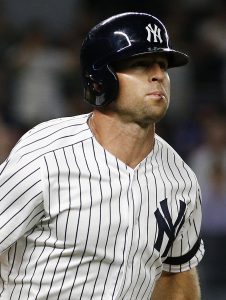
Of course, if you’re Yankees general manager Brian Cashman, there are more important matters at hand than worrying about 2020. He can map out Gardner’s future then. As of now, Cashman’s choice to retain Gardner last winter has proven to be a shrewd decision for a team that has jumped out to the American League’s leading record (57-31).
A roughly league-average offensive player since his career started in 2008, Gardner has posted a 109 wRC+ so far this year. If the season ended now, it would go down as the fourth-best figure of his career. Gardner’s more conventional output – his triple-slash line – checks in at .246/.328/.470. While Gardner has usually derived a sizable portion of his offensive value from his ability to get on base, having done so at a .343 lifetime clip, he’s one of countless major leaguers whose uptick in power has ruled the day in 2019.
Gardner has already piled up 15 home runs, six fewer than the high-water mark of 21 he hit in 2017, with a .225 ISO that comes in 90 points above his career mean. Unlike many other hitters, though, Gardner hasn’t needed to sell out for power by upping his strikeouts. In fact, Gardner has gone down on strikes a meager 15.5 percent of the time – his lowest since 2009 – and is tied with Mike Trout for the game’s eighth-ranked swing-and-miss rate (5.3 percent). Plus, having walked in better than 10 percent of trips to the plate, Gardner’s 0.66 BB/K ratio almost doubles the league average (0.37).
Gardner’s sturdy output this year has come in spite of a .248 batting average on balls in play, down 59 points compared to his .307 lifetime BABIP. Still one of the majors’ fastest runners, Gardner looks like a good bet on paper to see his BABIP skyrocket. That’s not a lock, though, if Gardner’s new approach holds up. He’s hitting more fly balls and fewer ground balls/line drives than usual. That’s not conducive to a high BABIP, and it’s worth noting that hitting the ball out of the park doesn’t count toward the stat.
The question is whether Gardner’s newfound power is here to stay. The fact that he’s pulling the ball at a career-high rate and going opposite field at a personal-low percentage bodes well in that regard. Furthermore, FanGraphs indicates Gardner’s hard-hit rate is his highest since 2012. It also may help that the left-handed Gardner plays his home games at Yankee Stadium, but the venue surprisingly has been a difficult one for lefties to amass HRs at this season, according to Baseball Prospectus. For his part, Gardner has been better on the road (114 wRC+) than at home (102) this year, though he has totaled eight of his homers in the Bronx. Historically, Gardner has offered league-average or better numbers both home and away.
Sticking with Gardner’s history, he has typically been usable, albeit unspectacular, versus same-handed pitchers (88 wRC+). But they’ve stifled Gardner this season, having limited him to a woeful .206/.260/.324 (53 wRC+) in 73 PA. Moreover, Gardner has been far from great in general in the estimation of Statcast, which puts his expected weighted on-base average (.314) significantly below his real wOBA (.339). It also indicates his expected slugging percentage, hard-hit rate, exit velocity and expected batting average are all worse than mediocre.
Elsewhere, however, Gardner remains a defensive and base running stalwart in spite of his advanced age. In almost 700 innings divided between left and center, he has accounted for 4 Defensive Runs Saved and a 3.8 Ultimate Zone Rating. And while Gardner’s no longer the 40-steal threat he once was, the speedster has swiped eight of 10 bags this year and rated as one of FanGraphs’ top base runners.
The overall package has almost always been effective for Gardner, who has quietly been one of the Yankees’ greatest draft picks in recent memory after going in the third round in 2005. Fourteen years later, Gardner remains a legitimate major league regular and someone who could help the franchise to the second World Series title of his career this fall. Whether Gardner will stay with the lone organization he has ever known once its season ends will be one of the Yankees’ main questions when the offseason rolls around.
Photo courtesy of USA Today Sports Images.
The Anti-Gerrit Cole
Astros right-hander Gerrit Cole is currently on pace to join the prestigious 300-strikeout club, a group with no shortage of Hall of Fame-level talent. Cole leads the majors with a dazzling 13.11 strikeouts per nine innings, whereas Athletics left-hander Brett Anderson resides on the opposite end of the spectrum. Anderson places dead last among qualified starters in K/9 at 4.56. His K/BB ratio (1.58) ranks a similarly unappealing fourth worst in the game. Nevertheless, in a season filled with setbacks for the A’s rotation, Anderson has been one of the unit’s few stabilizing forces.
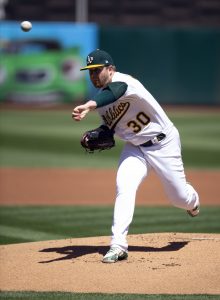
The 31-year-old Anderson’s 2019 success has come at a nominal fee. After Anderson inked a minor league deal entering 2018 and helped pitch the Athletics to the playoffs, he re-signed on an MLB pact worth $1.5MM during the offseason. Now, for the second year in a row, Anderson may aid in a postseason berth for Oakland.
Injuries have been an all-too-common occurrence for Anderson, who began his career with the Athletics in 2009 and later spent time with the Rockies, Dodgers, Cubs and Blue Jays before circling back to the A’s a year ago. This season, though, Anderson has stayed healthy in a season chock-full of poor fortune for Oakland’s pitching staff. Not only haven’t the A’s gotten a single inning from the injured quartet of Sean Manaea, Jesus Luzardo, A.J. Puk, Jharel Cotton, but they lost their ace, Frankie Montas, to an 80-game performance-enhancing drug suspension June 21.
Anderson’s first start after Montas’ ban – a three-inning, seven-run performance in a June 23 loss to the Rays – was a nightmare. However, since then, Anderson has yielded a meager two earned runs on seven hits over 14 innings in a pair of starts – both wins for a playoff-contending A’s team that needs every victory it can get. Anderson now owns an above-average 3.86 ERA through 102 2/3 frames on the season. Known throughout his majors tenure for inducing ground balls, Anderson has done so at a 53.1 percent clip this year. As always, Anderson’s worm-burning tendencies have enabled him to limit home runs to a respectable extent. The average starter has surrendered HRs on 15.2 percent of fly balls in 2019, but Anderson’s at just 11.1.
Despite the laundry list of injuries Anderson has contended with throughout his time in the majors, his velocity remains in line with career figures. He’s averaging approximately 90 mph on his four-seam fastball and sinker, and has thrown the latter pitch 10 percent more than he did last season, according to Statcast. The results haven’t been great, though, as hitters have posted a .353 weighted on-base average/.382 expected wOBA against it. Anderson has stifled hitters with his slider, on the other hand, though his usage of it has decreased by 6 percent since 2018. In the 19.8 percent of the time Anderson has leaned on the pitch this year, batters have logged a non-threatening .286 wOBA/.298 xwOBA against it.
Perhaps Anderson would be well-served to turn to his slider more often, especially considering he has benefited from quite a bit of luck with his overall arsenal thus far. Anderson’s expected wOBA (.350) portends trouble compared to his real wOBA (.302). The same applies to Anderson’s 4.54 FIP – which ranks 21st from the bottom among qualified starters. Likewise, Anderson’s .268 batting average on balls in play against may be tough to maintain for someone who has surrendered a .309 BABIP during his major league career.
For now, the A’s are enjoying the inexpensive ride with Anderson, who might be on his way to another major league contract in the offseason. But while the strikeout-happy Cole could score $200MM-plus in free agency over the winter, the contact-heavy Anderson may be fortunate to net much more than the sub-$2MM guarantee he secured coming into the season.
Photo courtesy of USA Today Sports Images.
Chris Archer Revamping Repertoire
We’re nearing the one-year anniversary of Pittsburgh acquiring right-hander Chris Archer from Tampa Bay in a whopper of a trade. The Pirates, under the impression they were getting back a front-line starter, sent high-caliber prospects Tyler Glasnow and Austin Meadows to the Rays in exchange for Archer last July 31. Unfortunately for the Pirates, the deal has been a catastrophe to this point. Archer has flopped, while Glasnow and Meadows may be turning into core pieces for the Rays.
With two-plus months left in his first full season as a Pirate, Archer’s on pace for a career-worst campaign. The 30-year-old has offset an impressive strikeout rate (10.07 K/9) with control problems (4.69 BB/9) and home run issues (2.29 HR/9) en route to a 5.49 ERA/5.91 FIP in 78 2/3 innings. Stunningly, among 110 pitchers who have thrown at least 70 frames in 2019, the once-excellent Archer ranks sixth from the bottom in ERA and second last in FIP.
Now, Archer’s in the process of trying to turn around his fortunes, as he explained to Jason Mackey of the Pittsburgh Post-Gazette. Archer will hope to do a 180 with a different repertoire. He dumped his two-seam fastball in a June 22 start against the Padres and plans to rely more heavily on his signature slider. Archer told Mackey batters’ “slugging percentage on my two-seamer was extremely high. One way to eliminate the damage is just to not throw the pitch that has the most damage. It’s not a complex thing. It was just getting banged. I got rid of it.”
Archer’s right. Hitters own a ludicrous .867 slugging percentage against the pitch – one Statcast classifies as a sinker and says he has turned to 15.8 percent of the time this season. Archer didn’t throw a sinker in any of the three full seasons before the Pirates acquired him, but it became a prominent part of the mix last year. While Archer told Mackey that “I probably tried to change too much” upon relocating to Pittsburgh, he and pitching coach Ray Searage insist the hurler – no one else – determines what he throws. Searage indicated he and Archer have a great relationship.
Whereas Archer’s two-seamer was a disaster before he scrapped it, his slider has been eminently effective throughout his career. That includes this season, during which hitters have mustered a toothless .290 weighted on-base average/.293 expected wOBA against it. Archer believes it’s “one of the best pitches in baseball.” And yet, he has leaned on it far less than usual this season, having tossed it at a 35.1 percent clip. That’s down 6.6 percent from last season and 9.5 percent compared to 2017.
Simply throwing more sliders and fewer sinkers won’t be the solution alone, according to Searage, who told Mackey that Archer also must improve his four-seam fastball command. In Searage’s estimation, that will lead to a decrease in homers against Archer, who had never allowed HRs on more than 16.2 percent of fly balls in a season until 2019. This year, he’s giving them up at a 23.8 percent rate. Only two starters have been worse in that department. Archer has had enough.
D-backs’ Mike Hazen On Upcoming Trade Deadline
When Diamondbacks general manager Mike Hazen looked ahead to the July 31 trade deadline in mid-June, he called for more consistency from his up-and-down club. A month later, he hasn’t gotten it. The Diamondbacks owned a 36-33 record at the time and closed the first half of the season with a 10-12 mark. Although the 46-45 D-backs have hovered around .500 for a large portion of the year, they’re still just 1 1/2 games out of playoff position.
The general mediocrity of Arizona and the rest of the National League wild-card contenders is setting up for what Hazen told Nick Piecoro of the Arizona Republic will be “a complicated decision.” Three weeks before the deadline, Hazen’s preparing to buy, sell or even do some of both.
“I don’t think it has to be as drastic as buy/sell,” Hazen said. “Like in this offseason, there may be some creative things we need to do to help us now and in the future and I think those possibilities exist.”
Rewinding to the offseason, the Diamondbacks traded the face of their franchise – superstar first baseman Paul Goldschmidt – but got back the major league-ready duo of right-hander Luke Weaver and catcher Carson Kelly from the Cardinals. Weaver and Kelly have been instrumental in the Diamondbacks’ success this year, but the hurler hasn’t pitched since late May because of a forearm strain. Thanks to injuries to Weaver, Jon Duplantier and Taijuan Walker, the rotation’s the prime place the Diamondbacks figure to upgrade if they do any buying this month. They’ve had difficulty finding answers in their starting staff behind Zack Greinke, Robbie Ray and Merrill Kelly, though Alex Young has been almost spotless through his first couple appearances.
Speaking of Greinke and Ray, they may be among the Diamondbacks’ trade chips if the club goes the other way. Dealing Greinke would be complicated because of the money left on his contract (he’s owed around $15MM more this year and $32MM per annum over the next two seasons), not to mention a 15-team no-trade clause. And the 35-year-old Greinke happens to remain a fantastic starter, so moving him would also seemingly weaken the D-backs’ near-term outlook. At the same time, however, it would presumably give the mid-payroll team a chance to wipe a lot of his money off its books.
Meanwhile, finding a taker for Ray wouldn’t be complex – he’s making $6.05MM and controllable for another season. Whether giving him up would hurt the D-backs from a competitive standpoint is another matter. The club also has relievers Greg Holland and Andrew Chafin; outfielders David Peralta, Adam Jones, Jarrod Dyson; shortstop Nick Ahmed and catcher Alex Avila among other potential trade pieces who are affordably priced and under control through either this season or next. Peralta is currently on the injured list for the second time this season because of right shoulder problems, but he has nonetheless drawn interest from the Cubs and possibly other clubs.
If the Diamondbacks were to trade any of those players away, the front office’s mission would likely be to acquire “young talent that can help the roster now,” as team CEO Derrick Hall said this week. Ultimately, the path the organization chooses in the coming weeks will be up to Hazen. Whatever Arizona does, it’s not “going to behave irresponsibly,” Hazen told Piecoro. Hazen suggested an NL West crown is likely out of reach because of the Dodgers’ stranglehold on the division, so the Diamondbacks’ best hope is to earn a spot in a one-game playoff. With that in mind, they’re not in go-for-broke mode.
Jake Arrieta To Pitch Through Injury – For Now
Phillies right-hander Jake Arrieta may be facing season-ending surgery on a bone spur in his elbow, but he’ll continue to pitch while the team evaluates his health. The plan is for Arrieta to take the ball sometime during Philadelphia’s series against the Nationals this weekend, Phillies manager Gabe Kapler told SportsRadio 94WIP on Wednesday (via ESPN.com).
While Kapler admitted the injury has hampered Arrieta, he added that “it’s always worth considering if Jake at 85 percent of himself is a better option than what we have at Triple-A.”
Three members of the Phillies’ 40-man roster – Enyel De Los Santos, Cole Irvin and Drew Anderson – are on Triple-A Lehigh Valley’s pitching staff. Santos, Irvin and Anderson have all spent some time in the majors this year, but they’ve each struggled over limited sample sizes. While De Los Santos and Irvin have put up mid-3.00s ERAs in the minors this year, their effective run prevention has come with less enticing peripherals. Anderson, meanwhile, owns a near-6.00 ERA with Lehigh Valley in 2019. The 22-year-old JoJo Romero is Philly’s seventh-ranked prospect at MLB.com (one spot behind De Los Santos, nine ahead of Irvin), but he isn’t on the 40-man and hasn’t earned a promotion anyway. Romero sports an ERA a tad south of 10.00 in seven Triple-A starts.
Not only do the Phillies lack starting options they’re fully comfortable with below the majors, but their big league rotation hasn’t lit it up. The team’s starters rank 19th in the majors in K/BB ratio, 24th in ERA and 25th in FIP, owing in part to Arrieta’s disappointing performance. Now in the second season of a three-year, $75MM contract, the 33-year-old has pitched to a 4.67 ERA/5.07 FIP with 7.08 K/9 and 3.33 BB/9 in 108 innings. Arrieta’s contract gives him the right to opt out after the season, while the Phillies could void his opt-out and opt into two more years and $40MM. Neither one of those things will happen, though, so the Phillies will end up owing him another $20MM in 2020.
Despite the Phillies’ pricey commitment to Arrieta, they’ll run the risk of having him continue to pitch through injury for the time being. Regardless of whether he holds up, the Phillies seem like shoo-ins to fortify their rotation from outside before the July 31 trade deadline. In the meantime, the club will start the second half of the season Friday at 47-43 and a half-game up on the NL’s second wild-card spot.
Dodgers Sign Second-Rounder Jimmy Lewis
The Dodgers have signed supplemental second-rounder Jimmy Lewis to an above-slot deal, according to Jim Callis of MLB.com. Lewis, the 78th selection, will earn $1.1MM. The right-hander’s pick called for a $793K value.
The draft-related heavy lifting is now complete for the Dodgers, who have reached agreements with all of their top picks. They chose three times in the first 100, landing Lewis, third baseman Kody Hoese (No. 25) and second baseman Michael Busch (31st). The club received the pick it used on Lewis as compensation for losing qualifying offer recipient Yasmani Grandal in free agency over the winter.
While the Dodgers mostly chose college players this year, they switched gears in tabbing Lewis – a high schooler from Texas. The 6-foot-6, 200-pounder had committed to LSU, but he’ll turn pro instead. Entering the draft, ESPN’s Keith Law (No. 31), Baseball America (56), and MLB.com (64) all ranked Lewis higher than where he ultimately came off the board. Lewis’ offerings include a 95 mph fastball, a potentially “plus” curveball and a changeup, per Callis and Jonathan Mayo.