
Options In MLB Contracts: Overall Trends
We often speak of contracts in terms of years and total guaranteed money. And, of course, that shorthand tells us most of what we need to know about a given deal. But every deal is individually negotiated, and most contain additional terms that can have a substantial impact on the risks and rewards applicable to both parties.
In particular, option years -– of varying type, duration, and value -– are a critical component of many contracts. While the function of options is fairly well understood, it seems worth taking a broad view of their employment across the league. To that end, I have compiled* and categorized (as best I can) every single contract containing an option that was entered into between the 2007-08 and 2012-13 “signing seasons.”
It was relatively easy to determine a signing season for free agency, which begins at the point at which exclusive negotiating rights end for a player's former team. For extensions, which are defined as new contracts entered with players that are not free to negotiate with other teams, I determined that a signing season would begin at Opening Day for a given season. While this is a somewhat arbitrary demarcation, it seemed unwise to attempt the subjective task of determining when a player had accrued enough innings or at-bats in a new season for a team to reassess that player. And this approach allows ready comparison to the free agent figures. While the resulting lines that I drew can skew the results somewhat, I hope that this breakdown will be sufficient for a preliminary analysis.
Overview
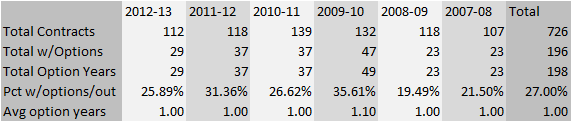
For starters, we’ll consider the overall use of options of all kinds. Between the 2007-08 and 2012-13 signing seasons, 726 guaranteed MLB free agent contracts were agreed upon, 196 (27.00%) of which came with options. Only two of those, so far as my research could identify, contained more than one option year: the deals signed by Kevin Gregg and Scott Atchison in the 2009-10 season. This table shows the figures by season for free agent contracts:
Of the 301 extensions that were reached in that same time frame, 160 (53.16%) included options. Those 160 deals included a total of 202 option years, meaning that there were 1.26 option years for every deal that included some kind of option. This table shows the figures by season for extensions:
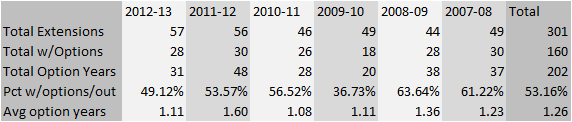
Clearly, and unsurprisingly, extensions are much more likely to come with options attached. Twice as likely, as it turns out. (And, as we'll see in a later installment, options in extensions are almost always straight club options.) Primarily, no doubt, that is a reflection of the fact that teams have much stronger bargaining positions with respect to players who have yet to qualify for free agency. The strongest motivations for teams guaranteeing future money for players who have yet to reach the open market are extending control, achieving cost savings, and obtaining cost certainty. In exchange for achieving such goals, teams often demand the right to achieve upside and retain flexibility in the event of injury or performance decline.
The 2009-10 Confluence
Of course, as the astute observer will note, there is one very interesting exception to the overall distribution: the 2009-10 season. As this chart shows, the sudden equalization of the use of options between free agent and extension contracts is quite out of line with the surrounding seasons:
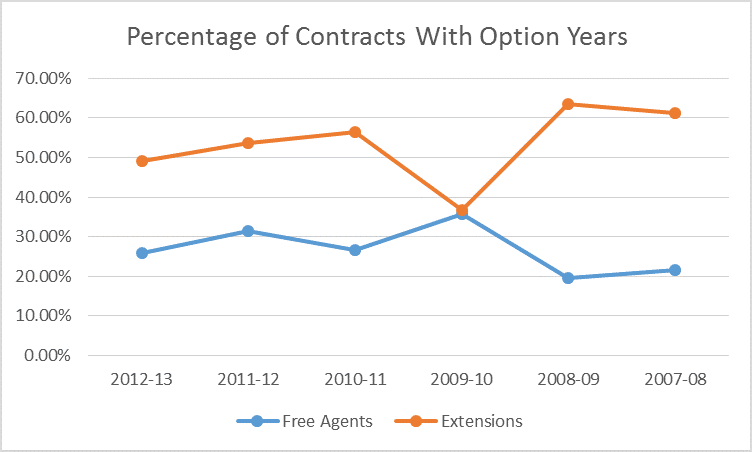
So, what is the explanation for that shift? The most obvious explanation would seem to be the broad international economic downturn, which added an element of uncertainty to all of baseball’s dealings. Prying an option year from a free agent can be expensive, and teams may have been less willing to commit cash to get the upside of an option. On the other hand, the risk and uncertainty hit players as well, which may have increased club leverage to demand options in the extension context.
Alternatively, or additionally, it could just be that early, market-setting deals paved the way for an odd year. Utilizing comparable contracts to set parameters for other deals can lower the transaction costs and even the perceived risks for parties. If the most relevant models for contract structures tended not to include options, there may have been a copycat effect.
The 2011-12 Multi-Option Boom
One other figure that stands out from the above tables is a seemingly aberrational year in terms of the number of option years per option contract in the extension bucket. Take a look:
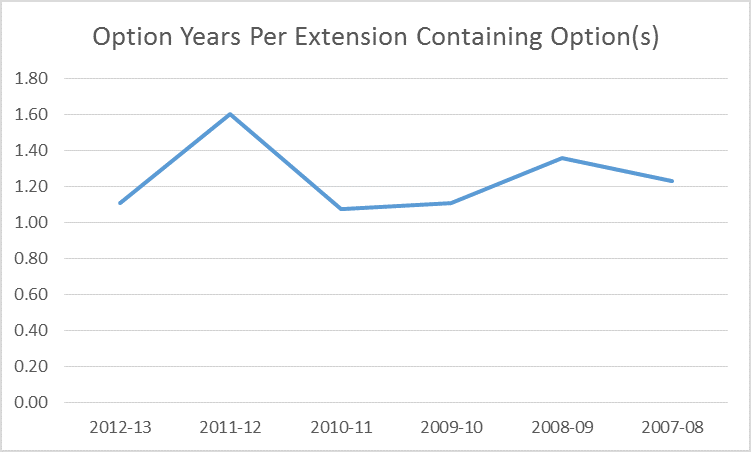
For the 2011-12 signing season, the average option deal suddenly included over 1.5 option years. Three option years were agreed to with Salvador Perez, Sergio Santos, Jose Tabata, and Wade Davis. And a host of players, including Gio Gonzalez and Clay Buchholz, gave up two option years.
Once again, I am far from certain of the proper explanation for the shift. It could be (as noted above) that a few teams and agents simply followed early trend-setting deals. Once the extension market was established, players with around one service year tended to give up three option years while those with around two service years generally signed deals with two options.
Alternatively, industry financial trends may be the cause. Teams may have aggressively worked to extend control before anticipated TV revenue inflows changed market perceptions, choosing to make substantial guarantees in exchange for option years that cover free agent-eligible seasons. Or, somewhat alternatively, teams may have decided to commit portions of their expected new cash before it started to flow, utilizing it to lock up option years.
Whatever the reasons for it, the 2011-12 boom in lengthy option terms may have lent to the general industry perception that teams are increasingly locking up younger players to longer-term deals that enhance team control. But, as the graph shows, the numbers returned to approximately historical levels in the 2012-13 signing season. It will be interesting to see where things head moving forward.
—
Of course, it could be that options are such a negotiation-specific element that seeming patterns really tell us relatively little about how the market is moving. Either way, I hope that this broad look at recent option usage provides a reasonably useful descriptive account.
In the next installment on options, we will break things down by option type to look at how varying forms of options are utilized in the market.
*Starting from the MLBTR transaction and extension trackers, I built out the dataset by mining Cot's on Contracts, Cot's data on non-active players from Baseball Prospectus player cards, and ESPN.com's free agency tracker. I then supplemented those results with internet searches to resolve any conflicts among the various sources and to identify, to the extent possible, any missing information that may have fallen through the cracks. The MLBTR trackers will be updated to reflect the complete information utilized in this and future posts.
Poll: The Best Transaction Of 2013
As baseball fans around the world mark the end of 2013, let's take one more look back before plowing ahead to 2014. As always, all manner of different MLB transactions went down this past year, and each and every one was documented by MLB Trade Rumors. Signings, extensions, trades, and more — every move took place in a different context and was subjected to public scrutiny.
So, now that we have the benefit of looking back at the year as a whole, which single move was the best, considering the particular situation and what we now know? Was it a wise extension, a nifty trade, or a big free agent signing? I browsed through the MLBTR Transaction Tracker and came up with a (highly subjective) list of my favorite moves over the past year. Though the some moves have already begun to bear fruit, while others await a new season, each still has years to go until it can be evaluated in its entirety. Nevertheless, I think it will be interesting to see how MLBTR readers view things.
Here are the nine candidates I chose, along with a brief synopsis of the reasons why they merit consideration. (Needless to say, feel free to disagree with my choices in the comments.)
Extensions
- White Sox extend LHP Chris Sale for five years, $32.5MM — Chicago locked up a young ace-caliber pitcher for the same type of contract that has been used to secure other good young arms. But Sale may be the best of the bunch, and he signed his deal just before new money and spending patterns may have broken the mold of young starter extensions.
- Brewers extend CF Carlos Gomez for three years, $24MM — Talk about buying low. Milwaukee locked up Gomez for his first three free agent-eligible seasons, right before the center fielder broke out with a stellar 8.4 rWAR campaign. While I won't proffer a guess as to what he'd ultimately have commanded in free agency this offseason, I think it is safe to say it would be multiples of his actual deal.
- Diamondbacks extend 1B Paul Goldschmidt five years, $32MM — This one does not require much explanation. Goldschmidt signed his extension with Arizona after a very promising run in his first season of full-time action. Then, he nearly won an MVP award.
- Red Sox extend 2B Dustin Pedroia for eight years, $110MM — The heart of the Sox has been worth at least three wins above replacement in every season he has seen regular action (and even reached that mark in the 75 games he played in 2010). His $13.75MM average annual value looks quite affordable compared to the $24MM guaranteed on average annually to Robinson Cano for the next decade.
Trades
- Nationals acquire RHP Doug Fister for LHP Robbie Ray, IF Steve Lombardozzi, and LHP Ian Krol — Fister has been one of the best ten pitchers in the game over the last three years, by fWAR, and has two seasons of reasonably-priced arbitration eligibility still to come. Yet the Nats were able to bring him in for a good-but-not-great prospect and two players with seemingly limited ceilings.
- Tigers acquire SS Jose Iglesias for OF Avisail Garcia — Even if you think that this was an even-value deal, it must be counted as a win for Detroit. Why? Just look at the haul that Matt Garza brought to serve as a short-term rental. GM Dave Dombrowski not only filled a sudden and unexpected hole during a key part of the season, but managed to adapt to Jhonny Peralta's suspension in a way that arguably enhanced the club's long-term health as well.
- Braves acquire LF Justin Upton and 3B Chris Johnson for UT Martin Prado, RHP Randall Delgado, SS Nick Ahmed, RHP Zeke Spruill, and 1B Brandon Drury — The signature trade of the 2013 offseason was a coup for Atlanta, in ways expected and not. Upton provided a strong season, even if he did not keep up his torrid start over the course of the year. But the real stunner was the huge campaign from Johnson; he was more productive than Prado, the main piece that the Braves gave up.
Signings
- Red Sox sign 1B Mike Napoli for one year, $5MM — While the limited guarantee came only after Napoli's original three-year deal fell apart over health concerns, GM Ben Cherington still deserves kudos for holding together the relationship. Even as he limited the club's exposure with a minimal $5MM promise, Cherington got his man into Fenway and held onto the upside. Needless to say, it worked out well for Boston, which was happy to pay Napoli his $8MM in earned incentives (and to lock him up to another seemingly solid deal for the club).
- Yankees sign C Brian McCann for five years, $85MM — No, we don't know how this deal will turn out. And yes, there have been other big-money signings to consider. But, to me at least, this contract stands out amongst recent major free agent signings for its value potential. Not only does McCann take over a spot that had been filled essentially at replacement level, but the limited length of the deal lowers the risk compared to other top-flight players that have signed. And it comes with upside, as the slugging lefty could reach new heights at Yankee Stadium and can take plenty of at-bats at DH to preserve his legs.
—
So, which move do you think was the best of 2013? (Response order will be randomized.)
What Was The Best MLB Transaction Of 2013?
-
Diamondbacks extend 1B Paul Goldschmidt 14% (2,858)
-
Red Sox extend 2B Dustin Pedroia 13% (2,597)
-
Yankees sign C Brian McCann 13% (2,575)
-
Nationals acquire RHP Doug Fister via trade 13% (2,569)
-
White Sox extend LHP Chris Sale 12% (2,416)
-
Braves acquire LF Justin Upton and 3B Chris Johnson via trade 11% (2,206)
-
Other 8% (1,667)
-
Red Sox sign 1B Mike Napoli 6% (1,166)
-
Tigers acquire SS Jose Iglesias via trade 5% (1,019)
-
Brewers extend CF Carlos Gomez 4% (801)
Total votes: 19,874
NL Notes: Zimmerman, Morales, Pirates
As the clock ticks down to the start of a new year across North America, here's hoping that all of MLBTR's readers have a safe and happy end to 2013. Here are a few notes from the National League to round out the 2013 hot stove season:
- Though Ryan Zimmerman will begin to see some time at first base in Spring Training, he remains entrenched at the hot corner, writes MASNsports.com's Pete Kerzel. But Anthony Rendon is the organization's only other current big league option with a real track record at third, and he is widely expected to serve as the club's regular second baseman. In the immediate term, Kerzel says that the Nats may look to trade or claim a player who can back up at third. But looking into the future, the expiration of first baseman Adam LaRoche's deal after 2014 (assuming his mutual option is not exercised) will likely require Washington to make more definitive moves towards settling its infield alignment.
- Kendrys Morales could make some "theoretical" sense for the Pirates on a "very team-friendly contract," writes ESPN.com's Buster Olney (Insider subscription required). But, says Olney, the club would be loath to part with its first round pick and the slot money that comes with it. I recently took a look at the market for Morales, assuming that an NL team would not be willing to sign him without a DH slot to park his bat. If clubs believe that he could handle a substantial workload at first, however, he may find additional suitors.
- Olney ranks the Bucs as the tenth best team in baseball entering the new year. With a solid roster already in place, Olney posits that the club may wait until next year to make significant new additions. Of course, one major unresolved situation in Pittsburgh is the status of starter A.J. Burnett, who could still be brought back to provide a major boost to the club's rotation in 2014.
Quick Hits: Depth, Park Factors, Competitive Balance
Over at Fangraphs, Eno Sarris poses an open question: how can analysts and fans better understand how the dynamics of roster construction — in particular, depth — impact wins? Otherwise, it is unsurprisingly a slow night for hot stove news on New Year's Eve. (Though over 6,400 MLBTR readers — and counting — have weighed in with their vote for the best transaction of 2013.) Here are a few other notes …
- Also on Fangraphs, Jeff Sullivan explores PNC Park's unique capacity to limit the game's three true outcomes: walks, strikeouts, and home runs. Sullivan wonders whether the Pirates may be able to leverage this fact, which could theoretically occur in the club's player acquisition and/or development approaches. Indeed, as Huntington recently told Charlie Wilmoth of MLBTR and Bucs Dugout, his organization is always looking for "the next edge."
- While commissioner Bud Selig is proud of the game's financial prosperity, he tells Mike Bauman of MLB.com that his favorite achievement is "competitive balance." Bauman cites revenue sharing and the luxury tax as mechanisms that have, in Selig's words, brought "hope and faith" to more major league fanbases.
Yankees Will Not Sign Stephen Drew
Yankees GM Brian Cashman says that the club will not sign Stephen Drew, reports Peter Gammons of GammonsDaily.com (via Twitter). After missing out on Omar Infante, New York had been rumored to be considering a run at the free agent infielder.
As MLBTR's Charlie Wilmoth recently explained, Drew is far and away the most attractive middle infielder left on the open market. For New York, then, choosing to pass on his services means that the club will not further supplement its infield mix through a significant free agent signing. A trade may still be possible, but having re-signed Derek Jeter and Brendan Ryan while adding Brian Roberts and Kelly Johnson, the Yanks have already been quite active in adding players who can man short, second, or third.
If the Yankees are indeed out on Drew, relatively dry demand figures to remain the major impediment to a substantial, multi-year deal for the 30-year-old. Last we heard, Drew was still in discussions with the Mets. And, of course, Drew could still fit in Boston. But as Gammons notes, it will be "delicate" for the Red Sox to bring him back on a pillow contract after he turned down the club's qualifying offer.
Goold On Cardinals: Taveras, Martinez, Mozeliak
In a chat yesterday, Derrick Goold of the St. Louis Post-Dispatch covered a series of topics with his readers, many of which implicated the hot stove. Here are a few highlights:
- Top prospect Oscar Taveras will have a shot at winning a roster spot in the spring, Goold writes. He may start out coming off of the bench, as Matt Adams did last year, though service time considerations will certainly weigh in the equation. Meanwhile, Carlos Martinez could still begin the year as a starter in Triple-A or as a key part of the big club's bullpen. To hold him in the minors as starting depth, however, the Cards would need to feel confident in another relief option, Goold explains. If injuries do not intervene, big springs from Taveras and Martinez could force other roster moves to clear way.
- When it comes time to make those decisions, Cards' GM John Mozeliak will surely utilize the club's value-based approach to comparing players and making personnel decisions. As Goold explains, the team puts a premium not only on years of control, but also the availability of options that allow the club to maintain that control even if a player struggles (or is supplanted) at the big league level. The organization has also ensured depth by holding onto higher-level minor leaguers that appear blocked, rather than flipping them for younger, more speculative talent.
- Mozeliak could always be wooed by an organization like the Rockies, says Goold, but all indications are that he remains committed to St. Louis. Mozeliak has interest in the game's broader business aspects, and could continue to expand his role in that respect with the Cardinals. If Mozeliak were to climb in the organization and move out of a baseball operations role, he has indicated that he would like to have a succession plan in place. Goold notes that several internal candidates to fill his shoes would be assistant GM Michael Girsch, director of player personnel Matt Slater, and director of amateur scouting Dan Kantrovitz.
- Putting aside the Cards, Goold opines that the Nationals are the N.L. club that has made the most improvement over the off-season to date. He views Doug Fister as a "big addition" for D.C.
- The Cardinals figure to join other MLB clubs in expanding the use of defensive shifts next season, Goold advises.
Rangers Sign Shin-Soo Choo
4:05pm: ESPN Dallas' Richard Durrett reports that Choo will earn $14MM in 2014 and 2015, $20MM annually from 2016-18 and $21MM in 2019 and 2020 (Twitter link).
3:15pm: With an outstanding rotation locked up for the foreseeable future, the Rangers have focused on re-shaping their offense this winter, and Shin-Soo Choo is the next piece of the puzzle. The Rangers have officially announced the signing of Choo to a seven-year contract that is reportedly worth $130MM. Reportedly, $5MM of the first year's salary will be shifted to 2016-17, creating more flexibility in 2014. The 31-year-old Scott Boras client does not have an opt-out in his contract but did receive a limited no-trade clause.
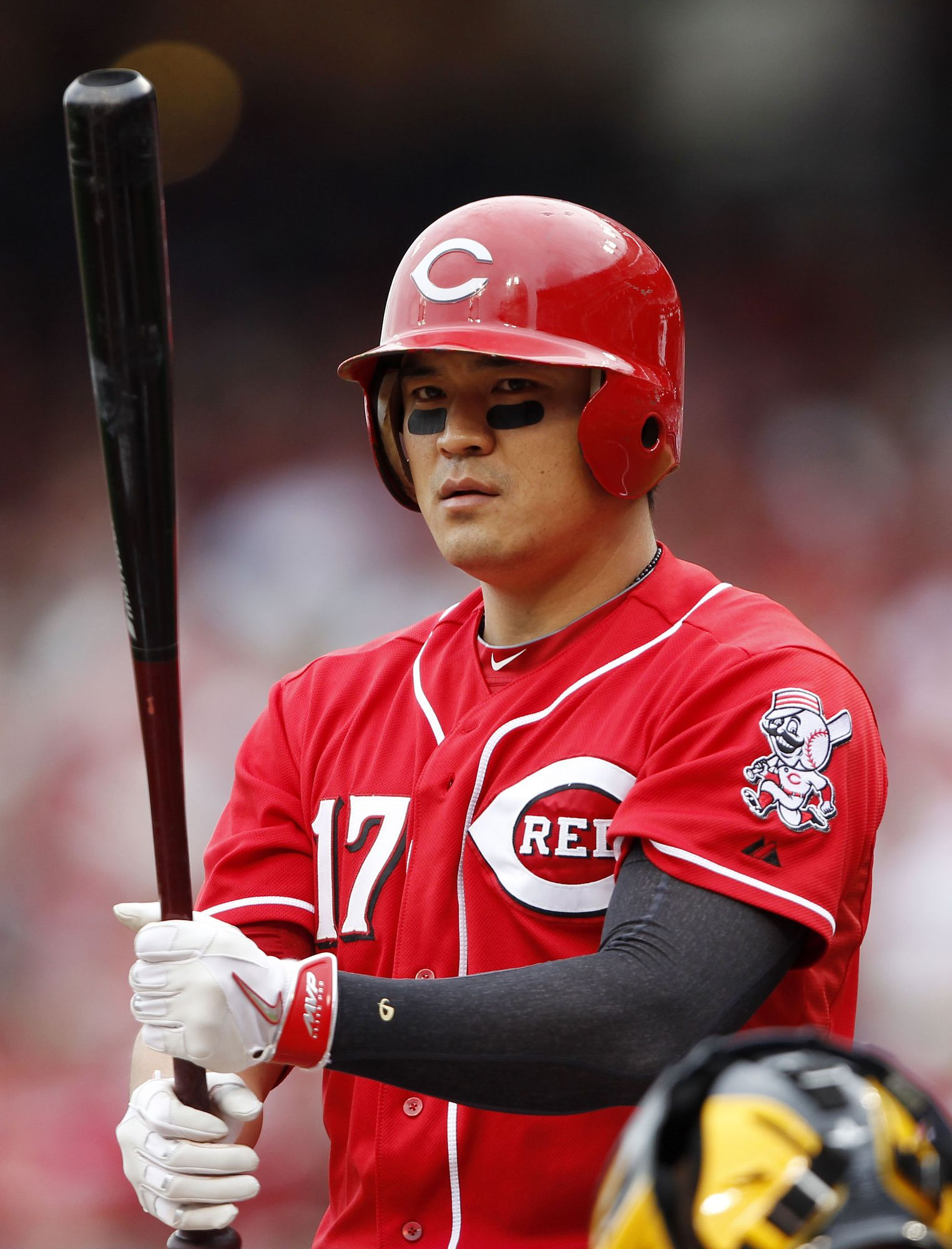
As MLBTR's Tim Dierkes wrote in his profile of Choo, who ranked third on Dierkes's list of the top fifty free agents, the South Korean on-base machine hit the open market at an optimal time. Having never seen his OBP drop below a .373 mark, Choo reached another level last year with a .285/.423/.462 line (over 712 plate appearances) in his first and only season with the Reds. (Of course, as Dierkes explained, Choo's biggest weakness — his struggles against left-handed pitching — could force him into a platoon role in the later years of his deal.) Choo also knocked twenty home runs in 2013 for the third time in his career. Batting atop the lineup in Cincinnati, Choo also swiped over twenty bags for the fourth time, though he was also tagged out eleven times in the process.
Though Choo played in center last year for the Reds, the expectation is that he will man a corner position in Texas. If the Rangers indeed intend to go with Leonys Martin up the middle, it would seem likely that the club would be out of the mix for Nelson Cruz. (Alex Rios is already penciled into one corner spot.) Though it certainly doesn't preclude anything, Choo will wear No. 17 in Texas (as he did in Cincinnati) — the same number that Cruz donned while with the Rangers. The Rangers said at today's press conference today that the current plan is for Choo to serve as their new leadoff hitter.
Texas GM Jon Daniels has not been shy in adding lengthy and substantial contracts to his club's books of late. He added dollars and years through trades for Rios and Prince Fielder (offset only in part by the departure of Ian Kinsler in that deal). And Daniels has done the same via extension, with Martin Perez (four years, $12.5MM), Elvis Andrus (eight years, $120MM), and Matt Harrison (five years, $55MM) all getting new deals in the last year. Add it all up, and the Rangers have added nearly $400MM in future obligations in the 2013 calendar year. That would seem likely to take the club out of the mix for Masahiro Tanaka (in the event that he is posted).
At seven years and $130MM, Choo will receive an average annual value of just over $18.5MM. His deal slots in $23MM shy of that inked by Jacoby Ellsbury with the Yankees over the same length of time, but comes with a $40MM larger guarantee than that achieved by Hunter Pence in the five-year deal he reached with the Giants just before hitting the open market.
The Rangers were willing to go to seven years and a big sum of money, says Passan, in part due to the weak set of hitters available via free agency next year. Of course, new candidates could emerge; one year ago, it would have seemed quite unlikely that Choo would command this kind of payday. The Yankees may have been willing to reach the $140MM level in a seven-year pact with Choo, tweets Joel Sherman of the New York Post. But the lack of state income tax in Texas boosted the value of the Rangers' offer, and Choo apparently also preferred to join Texas.
Since Choo turned down a qualifying offer from the Reds, his former club will receive a compensatory pick. Texas, meanwhile, stands to lose its first-round draft choice, though it could regain a choice in the sandwich round if Cruz signs elsewhere.
Jon Heyman of CBSSports.com reported that an agreement had been reached (via Twitter). Evan Grant of the Dallas Morning News first reported (via Twitter) that the deal was expected to be worth $130MM. Ken Rosenthal of FOX Sports reported that $5MM of Choo's 2014 salary was shifted to 2016-17 (via Twitter), and Jeff Passan of Yahoo Sports tweeted that Choo's contract does not contain an opt-out but has a limited no-trade clause.
Photo courtesy of USA Today Sports Images.
Dodgers To Sign J.P. Howell
DEC. 24: The Dodgers officially announced the signing.
DEC. 20: Joel Sherman of the New York Post reports (Twitter links) that Howell will receive a $3MM signing bonus and be paid $4MM in both guaranteed years of the deal. The option is a $6.25MM club option with a $250K buyout, but Howell can void the option when exercised, if he's willing to forfeit the buyout. The option becomes a player option if he pitches 65 games in 2015 or totals 120 games between 2014-15 and is not on the disabled list at the end of the season.
DEC. 17: The Dodgers have agreed to re-sign left-handed reliever J.P. Howell, reports Jon Heyman of CBSSports.com (via Twitter). The deal includes two years at a guaranteed $11.25MM, plus a mutual option for 2016 that would convert to a player option if it is "triggered," Heyman reports. (Twitter links.)
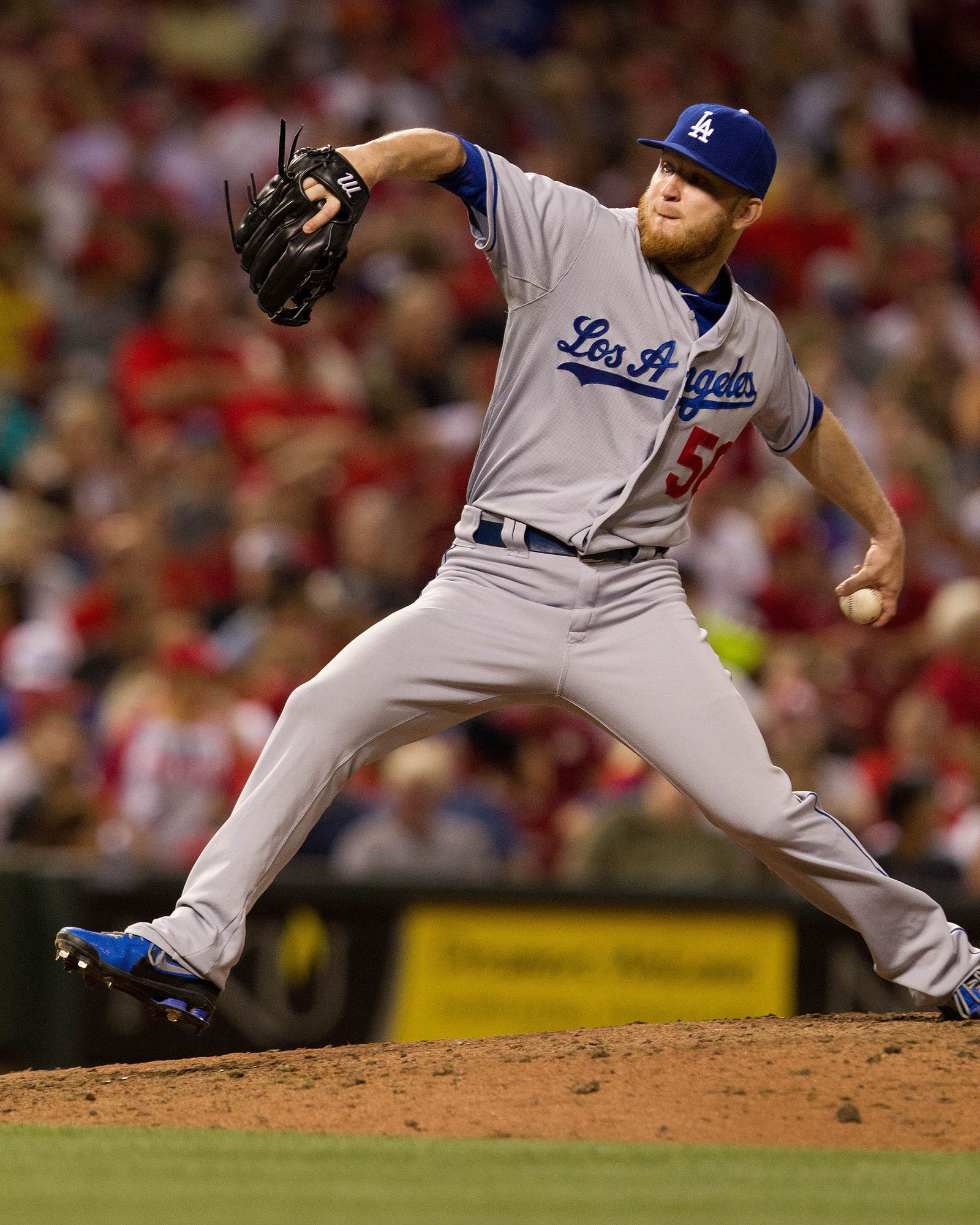
Ken Gurnick of MLB.com reported earlier this evening that Howell was close to a two-year deal for $11.25MM with a $6.25MM third year option that would vest with 120 appearances over 2014-15. Though final details on the option remain unknown, it could be that the mutual option would vest to become a player option at an appearance threshold.
Howell, 30, gets a significant raise on last year's $2.85MM salary. His $11.25MM guarantee falls shy of those received by Javier Lopez (Giants, $13MM) and Boone Logan (Rockies, $16.5MM), but Howell's representatives at the Legacy Agency secured their client a higher average annual value on his deal. And, if he makes good on the contract, Howell will presumably either trigger the vesting option, have the club pick it up anyway, or hit the market at 32 in good position to land another payday.
Last year, Howell registered a 2.03 ERA in 62 innings for the Dodgers, including 7.8 K/9 and 3.3 BB/9 and just 6.1 hits per nine innings. Advanced metrics were a fan of his work in 2013 as well, with his FIP landing at 2.89 and xFIP at 3.48.
In spite of Howell's excellent 2013 campaign, there were issues that may have held down his value to some extent. Low HR/9 and BABIP numbers last year drove his stellar results to some extent, and anticipated regression in those areas lead Steamer and Oliver (via Fangraphs) to project Howell's ERA in the mid-3.00 range for 2014. Going further back, moreover, though he managed a 3.04 ERA in 2012, it was accompanied by a 4.78 FIP and 4.17 xFIP. And in 2011, similarly unfavorable analytical marks resulted in a 6.16 ERA.
MLB.com's Ken Gurnick first reported that the sides were closing in on a two-year, $11.25MM deal with a third-year option.
Photo courtesy of USA Today Sports Images.
Minor Moves: Lin, Sanchez, Sosa, Ni, Burriss
We'll keep tabs on the day's minor moves right here …
- The Rangers have inked Taiwanese outfielder Che-Hsuan Lin to a minor league deal, Baseball America's Matt Eddy tweets. Signed by the Red Sox as an amateur free agent in 2007, Lin got his only 12 major league plate appearances in 2012 with Boston, swatting three singles in 12 plate appearances. He's hit .253/.349/.339 in his seven minor league seasons.
- The Dodgers have signed two right-handed pitchers, Romulo Sanchez and Henry Sosa, and lefty Fu-Te Ni to minor league deals, according to Eddy (via Twitter). Sanchez spent 2013 in the Mexican League, while Sosa pitched for a Korean team last year. Ni last pitched in 2012, when he amassed a 4.56 ERA in 23 2/3 innings for the Tigers' Triple-A affiliate.
- Eddy tweets that the Nationals have signed three minor league free agents: shortstop Emmanuel Burriss, catcher Mitch Canham and first baseman Brock Peterson. Burriss, 28, has seen 801 plate appearances in parts of five MLB seasons, but has struggled to a .243/.304/.269 line. He last appeared in the majors in 2012 with the Giants. The 29-year-old Canham has never appeared in the majors, but has seven minor league seasons under his belt and a lifetime line of .255/.340/.364. Now 30, Peterson got 28 plate appearances with the Cardinals in 2013, his first taste of the big leagues, managing just a .077 batting average. His career minor league triple slash of .274/.354/.464 is much better, however.
- The Nationals have also signed backstop Chris Snyder to a minor league deal with an invitation to Spring Training, the club announced via Twitter. The soon-to-be 33-year-old Snyder should have a chance to compete for the club's backup job with younger options Jhonatan Solano and Sandy Leon. Snyder's last substantial MLB action came in 2012 with the Astros, when he put up a .176/.295/.308 line in 258 plate appearances. Snyder did, however, post an OPS over .800 last year in his time at Triple-A with the Orioles and Angels. His career MLB line stands at .224/.328/.382 in 2,459 plate appearances. The Steamer and Oliver projection systems (via Fangraphs) both like Snyder to put up an 84 wRC+ at the plate next year while adding solid defense. Snyder spent part of the spring with the Nationals last year, but requested his release when he failed to make the big league roster. Snyder would earn $1MM plus incentives if he makes the roster out of the spring, reprots ESPN.com's Jerry Crasnick (via Twitter).
- The Brewers have released righty Cody Scarpetta, tweets Eddy. As Eddy notes, Scarpetta was twice ranked among the ten best prospects in the Milwaukee organization, and occupied a 40-man spot for three seasons. The 25-year-old posted a 3.85 ERA in 117 innings at Double-A Huntsville in 2011 before missing the 2012 season to undergo Tommy John surgery. Scarpetta mustered only a 7.15 ERA in 34 innings at the High-A level last year, including an ugly 9.5 BB/9.
- As always, MLBTR's DFA Tracker is your guide to players currently (or previously) facing DFA limbo. At the present, seven players have been removed from their clubs' 40-man rosters while they wait to learn their fate: Eric Surkamp of the Giants, Brett Marshall of the Yankees, Trey Haley of the Indians, Chance Ruffin of the Mariners, Ryan Reid and Jerry Sands of the Pirates, and Alex Castellanos of the Red Sox. Decisions are due today on Castellanos and tomorrow on Reid and Sands, but the others could be forced to sweat things out over Christmas.
Aaron Steen contributed to this post.
Latest On Masahiro Tanaka Posting Situation
We learned earlier today that MLB and Nippon Professional Baseball have formally agreed upon modifications to the inter-league posting system. Of course, the most immediate ramifications of that agreement relate to whether and when star Japanese pitcher Masahiro Tanaka will be posted by his current club, the Rakuten Golden Eagles. The lack of clarity as to his MLB availability seems to have held up the upper-level starting pitching market. Indeed, as MLBTR's Charlie Wilmoth explained yesterday, five of the top ten players still free on the open market are starters.
Here's the latest on Tanaka:
- Tanaka told reporters that he had expressed his desire to pitch in the majors next season in a meeting with team president Yozo Tachibana, Sanspo reports. (Japanese language link; thanks to MLBTR's Aaron Steen for the translation.) However, the team hasn't made a decision yet, the righty said. "I'd like to show what I can do on a new stage," Tanaka said. "[Rakuten] graciously listened to what I had to say."
- A final decision on posting Tanaka could come down as soon as tomorrow, Dylan Hernandez of the Los Angeles Times reported earlier this evening. Tanaka "is expected to learn his fate Tuesday," according to Hernandez, who reported that club officials were scheduled to meet with the 25-year-old hurler. As Hernandez also explained, an earlier report from Sanspo said that Rakuten will, in fact, post Tanaka. But, as Hernandez notes, that report did not provide any quotes from owner Hiroshi Mikitani or other top club officials. And, of course, the more recent report noted above raises further questions as to whether a resolution is imminent.
- Given the $20MM cap on posting fees provided under the new agreement, a relatively meager sum compared to prior fees paid for top-level arms like Tanaka, it is not unreasonable to consider him a virtual free agent if posted. Indeed, as ESPN's Buster Olney tweets, there is little reason for any team not to throw its hat in the ring since the posting fee is refundable to any club that does not sign him. As Olney explains, that makes for a risk-free chance at signing Tanaka which probably carries some public relations benefits.
- Given his age and essentially open-market availability, if posted, Tanaka would fit the Cubs' plan of building around young players, Jesse Rogers of ESPN Chicago writes. "We wish there was a free-agent market for young players," team president Theo Epstein said in November. Given Tanaka's situation, just that opportunity could be at hand for Chicago (along with the rest of the league, of course).
Aaron Steen contributed to this post.