
Blue Jays, First-Rounder Trey Yesavage Agree To Deal
The Blue Jays are in agreement with first-round pick Trey Yesavage on a $4.1775MM bonus, reports Shi Davidi of Sportsnet. The East Carolina righty was one of just two unsigned first-rounders left on the board with the deadline to sign 2024 draftees looming at 5pm ET today. His bonus checks in slightly north of the No. 20 selection’s $4.07MM slot value.
Yesavage, who turned 21 earlier this week, went from a reliever with 4.50 ERA and pronounced command troubles as a freshman at ECU to obliterating opposing lineups in his sophomore and junior seasons. He pitched 93 innings this past season, logging a minuscule 2.03 ERA with a 40.4% strikeout rate against an 8.9% walk rate. Listed at 6’4″ and 225 pounds, he sports a prototypical starter’s frame and was considered one of the top pitching prospects in this year’s draft class.
Each of MLB.com (No. 11), Baseball America (No. 11), The Athletic (No. 13), ESPN (No. 14) and FanGraphs (No. 19) ranked Yesavage among the top 20 talents in this summer’s draft. He draws praise for a fastball that sits comfortably in the 93-95mph range and tops out at 98mph when he needs it. Yesavage’s secondary offerings are headlined by a splitter and a slider, the former giving him a clear weapon against lefties and the latter giving him a second breaking pitch to show righties.
Yesavage underwent a frightening medical scare late in the season when he was hospitalized with a partially collapsed lung. (ECU coach Cliff Godwin posted a video detailing the situation at the time.) The Athletic’s Melissa Lockard spoke with Yesavage after the draft and wrote that the lung issue was “most likely caused by an accident during a dry needling session.” right-hander remarkably was cleared to return to the mound just a couple weeks later and made his final start of the season opposite eventual No. 2 overall pick Chase Burns and Wake Forest.
Jordan Westburg Suffers Fractured Hand
Orioles infielder Jordan Westburg suffered a fractured right hand when he was hit by a pitch in the fifth inning today, O’s skipper Brandon Hyde announced following the game (X link via Matt Weyrich of the Baltimore Sun). There’s no immediate timetable for his return. Hyde said he hopes Westburg will be able to return before the end of the regular season, but that’s not a certainty for now.
The loss of Westburg, 25, is a gut-punch for the Orioles. The former No. 30 overall pick (2020) has produced a .269/.317/.497 batting line this season with 18 homers, 25 doubles, five triples, six steals and quality glovework as Baltimore’s primary third baseman. Westburg has hit from the moment the season began and hasn’t at any point gone into a lengthy slump. He’ll head to the 10-day injured list tomorrow, though the O’s could move him to the 60-day IL if they need a roster spot and if they expect the injury to sideline him for the remainder of the regular season.
Fortunately for the O’s, they’re exceptionally deep in infield talent — even after yesterday’s trade of Connor Norby to the Marlins (in return for lefty Trevor Rogers). Baltimore called top prospect Jackson Holliday back to the majors today — he hit a grand slam for his first big league homer — and fellow top prospect Coby Mayo and his powerful bat are looming in Triple-A Norfolk. Holliday could see time at either third base or second base, though the latter feels more likely. If the O’s don’t want to turn to Mayo just yet, utilityman Ramon Urias at least provides surehanded defense at the hot corner and a roughly league-average bat to slot into the bottom of the order.
That said, all eyes figure to turn to Mayo until the O’s decide on their course of action. The 22-year-old slugger was selected just 73 picks after Westburg back in 2020 and has clobbered Triple-A pitching so far in 2024. Mayo touts a .293/.366/.578 batting line with 20 homers and doubles alike, in addition to a pair of triples. His walk rate has dipped from 15.7% in 267 Triple-A plate appearances last year to 9.7% in 331 plate appearances this season, but that’s still a strong mark, particularly when coupled with what many scouting reports feel is 70-grade raw power.
Alternatives down in Norfolk include the just-optioned Terrin Vavra and just-acquired Livan Soto, both of whom have experience at third base. Neither would be expected to come anywhere close to Westburg’s production, but both could hold down a utility role if the Orioles want Mayo to continue developing. If it is indeed time for Mayo to make his big league debut, Baltimore will need to make a move to get him on the 40-man roster.
How To Acquire Players After The MLB Trade Deadline
Not long ago, every August at MLBTR kicked off by reminding longtime MLB fans (or explaining to new fans) how the dizzying rules regarding August trade waivers worked. It was a convoluted process — one that saw nearly every player in the league placed on revocable trade waivers at some point (heavy emphasis on “revocable”) — but one that front offices increasingly used as creative means to pull off significant acquisitions after the supposed “deadline.”
In reality, under the old rules, the first “trade deadline” was never the actual deadline — it just wasn’t as catchy to use the full term, “non-waiver trade deadline.” As time progressed, the month of August increasingly served as a means of swapping out higher-priced talents in waiver trades that were still quite noteworthy. If you’re seeing Justin Verlander, Andrew McCutchen, Josh Donaldson and others change hands in late August, just before the deadline for postseason eligibility — was the non-waiver deadline really a trade “deadline” at all? Not so much.
Back in 2019, Major League Baseball opted to quash the ever-growing process of August roster reconstruction. The league put an end to waiver trades that often served as a means of teams hitting the “eject” button on notable contracts and saw larger-payroll clubs take on those deals simply because they possessed the financial wherewithal to do so. MLB implemented a more concrete “true” trade deadline that prohibited players on Major League contracts — or any who had previously been on Major League contracts earlier in the season (i.e. since-outrighted players) — from being traded after the deadline.
Does that mean teams can no longer acquire new players or address injuries as they arise? No, but their avenues to do so are substantially narrower. Here’s a look at how Major League front offices can still augment their roster now that the “true” trade deadline has passed:
1. Trades!
Wait, what? I thought we just–
Yes, we did. But it turns out that the “true” trade deadline is really only the “true” trade deadline for Major League players! Fun how that works, right? In all likelihood, you’ll still see several players change hands this month, they just won’t be very exciting. But, veterans who’ve been playing the entire season on a minor league contract and haven’t at any point been added to the 40-man roster or been on the Major League injured list are still fair game to be traded.
Will you see any huge, blockbuster names flipped? Of course not — but there are still some recognizable names eligible to be traded. Among the position players in Triple-A who have been enjoying above-average production are Tim Locastro (Padres), Jake Marisnick (Angels), Mike Brosseau (Mets), Yuli Gurriel (Braves), Rylan Bannon (Twins), Nick Solak (Mariners), and Jerar Encarnacion (Giants)– just to name a few.
There are several pitchers enjoying nice years in generally hitter-friendly Triple-A environs as well. Ken Giles (Braves), Chasen Shreve (Yankees), Kyle Barraclough (Rangers), Anthony Gose (Guardians) and Adam Plutko (Twins) all have ERAs of 4.40 or lower over notable samples of innings. It’s obviously not a star-studded collection of talent, but it’s feasible enough that a team could get some big league value from someone in this group (or from one of the numerous other former big leaguers who has yet to appear on a 40-man roster).
Those are just some of the former big leaguers who are eligible to be traded, so long as any player(s) going back the other way have also not been on a 40-man roster or Major League injured list. It’s common for August deals to be simple cash swaps, as well.
There weren’t many post-deadline swaps in 2023. The White Sox landed a pair of minor leaguers from the Dodgers in exchange for international bonus allotments. The Brewers traded Tyler Naquin to the White Sox for cash, but he never got a big league look. The A’s and Giants swapped outfielder Trenton Brooks and lefty Sean Newcomb, both of whom played in the majors with their new club. Oakland even signed Newcomb to a contract for the 2024 season, though injuries limited him to 10 innings before he was released in June. In 2022, the Giants acquired Lewis Brinson for cash and gave him a look down the stretch.
Just to speculate a bit — and we haven’t really seen this in the past, but it’s technically possible — teams technically can engineer minor league trades, so long as the players involved have not been on the 40-man roster at any point in a given season. It’s doubtful we’ll see any top prospects change hands in this regard, but it’s not expressly forbidden, either.
And, just to rain on your parade, no — teams cannot game the system using players to be named later. The rules pertaining to the “true” trade deadline made sure to include the following language:
“The Commissioner’s Office will prohibit any transaction (or series of transactions) that, in the judgment of the Commissioner’s Office, appears (or appear) designed to circumvent the prohibitions of Rule 9(b).”
Nice try, folks, but don’t get your hopes up.
Just remember, anyone acquired after Aug. 31 isn’t postseason-eligible with his new club, so minor swaps of any relative note will likely take place before the calendar flips to September.
It won’t lead to any exciting trades, but we’ll likely still see some trades this month. You’ll just have to wait until the offseason for the chatter on Garrett Crochet, Brent Rooker, Mason Miller, Luis Robert Jr., Jesus Luzardo and others to pick back up in earnest.
2. Outright and Release Waivers
Revocable trade waivers are no longer a thing, but regular old outright waivers and release waivers are alive and well. Any time a player is designated for assignment now, the team’s only recourse will be to place him on outright waivers or release waivers. At that point, the other 29 teams will have the opportunity to claim that player … and the entirety of his remaining contract. Of course, a team doesn’t need to announce a DFA or even announce that a player has been put on waivers. It’s fairly common for a team to just announce that a player cleared waivers and was outrighted to a minor league affiliate without ever publicly declaring a DFA.
An important reminder on waivers now that it’s the primary means of acquiring talent from another organization: waiver priority is determined based on overall record (worst record to best record) and, unlike the now-retired “revocable trade waivers,” is not league-specific. If the White Sox want righty Darius Vines or lefty Cole Irvin — designated for assignment by the Braves and Orioles, respectively, prior to the deadline — they’ll have first crack. Next up would be the Rockies, Marlins, A’s, etc. — all based on the reserve order of the MLB-wide standings at the time (which is to say… the 27-83 White Sox are going to have first dibs all month long).
Teams who didn’t find sufficient interest in veteran players prior to the trade deadline and thus held onto them could eventually place those players on outright waivers in August, hoping another club will claim said player and simply spare the waiving team some cash. This is likelier to happen late in the month — when there’s less cash owed on those veteran contracts.
Last year, we saw the Angels undergo a mass sell-off in hopes of dipping under the luxury tax. The Halos placed more than a quarter of their roster on waivers, with Lucas Giolito, Reynaldo Lopez, Matt Moore, Randal Grichuk, C.J. Cron, Hunter Renfroe, Dominic Leone and Tyler Anderson all hitting waivers. Giolito, Lopez, Moore, Renfroe and Leone were all claimed by new teams. That’s an extreme example, but it’s feasible that a current fringe contender who’s not far over the luxury tax (or who simply wants to save some money) could do so again late this month. Again, speculatively speaking, the Rangers or Giants are “only” about $13MM over the luxury threshold and could try to dip underneath if they fade in the standings.
As with any minor league trades, players claimed off waivers will only be postseason-eligible with their new club if claimed before 11:59pm ET on Aug. 31.
3. Sign Free Agents
Same as ever. Anyone who gets released or rejects an outright assignment in favor of free agency will be able to sign with a new team and, so long as the deal is wrapped up prior to Sept. 1, they’ll be postseason-eligible with a new team. It’s certainly feasible that a once-productive veteran enjoys a hot streak with a new club or fills a useful part-time role.
There’s also one notable veteran name who’s likely to sign and could make an impact with a postseason club. Ageless Rich Hill opted not to sign this past offseason despite receiving offers, instead preferring to wait until the latter portion of the season. Hill has spoken about the choice in the past, suggesting that now in his mid-40s, this offers him the best chance to stay healthy and productive. It also affords him more time with his family early in the year and, importantly, the opportunity to choose a clear postseason contender when he selects his new team. Hill is throwing off a mound and has reportedly had some interest from the Dodgers and Yankees.
At this point, Hill isn’t likely to be a major difference-maker, but he could eat innings at the back of an injury-depleted rotation. He posted a 5.41 ERA in 146 1/3 MLB frames last year, with much of the damage coming against him in the final three months of the season. Hill posted a 4.23 ERA through his first 13 starts in Pittsburgh last season, with fielding-independent marks that largely matched that number. It’s anyone’s guess whether he can replicate that production in ’24, but the cost to find out will be relatively minimal.
The same postseason eligibility date applies to incoming free agents as well.
4. Scour the Independent Leagues
Roll your eyes all you want, but the Atlantic League, Frontier League and American Association (among other indie circuits) are all teeming with former big leaguers. Need a speedy fourth outfielder who can provide some late-game defense and baserunning during September roster expansion? A platoon bat off the bench? An extra southpaw to stash in the bullpen? There will be experienced names to consider.
Look up and down the Atlantic League leaderboards and you’ll find former big leaguers like Frank Schwindel (.332/.405/.582, 15 homers), Mike Montgomery (71 innings, 4.31 ERA) and plenty of others. It’s unlikely anyone finds a true impact player on the indie scene, but then again, people cracked jokes when the 2015 Red Sox signed the aforementioned Hill away from the Long Island Ducks as a 35-year-old. He’s earned nearly $80MM and tossed more than 900 innings in the majors since joining the Red Sox under similar circumstances to the ones described here.
5. Look to Foreign Leagues
We don’t often see players return from the KBO, NPB or CPBL to sign with big league clubs midseason, but there’s precedent for it happening. There are also quite a few former big leaguers playing down in the Mexican League, creating another area for front offices to scout as they mine for depth options. Interest won’t be limited solely to former big leaguers, either. In 2022, the Mariners signed lefty Brennan Bernardino after a strong nine-start run in Mexico, watched him dominate through 12 2/3 innings in Triple-A Tacoma, and selected him to the Major League roster by the end of July. He made his MLB debut with Seattle in ’22, was claimed off waivers by he Red Sox earlier in ’23, and now carries a combined 3.13 ERA in 86 1/3 innings for the Red Sox in the 2023-24 seasons. You never know!
Diamondbacks To Acquire Dylan Floro
The D-backs and Nationals agreed to a last-minute trade sending right-handed reliever Dylan Floro to Arizona, reports John Gambadoro of Arizona Sports 98.7 FM. Arizona is sending corner infielder Andres Chaparro back to the Nats, per Nick Piecoro of the Arizona Republic.
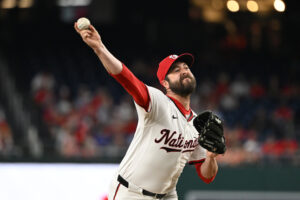
Floro, 33, is on a one-year, $2.25MM contract and will be a free agent at season’s end. He’s pitched to a pristine 2.06 earned run average this season, albeit with a rather pedestrian 19.6% strikeout rate and tepid 90.3 mph average fastball. That said, Floro has walked only 6.4% of his opponents and kept the ball on the ground at a strong 47.6% clip. He’s not going to continue to see this level of fortune on his fly-balls — only 2.2% of them have become homers, compared to the 7% mark he carried into the season — but it’s been a nice rebound effort for a veteran reliever who struggled to keep his ERA under 5.00 last year between the Marlins and Twins.
Since cementing himself as a viable big league reliever in 2018, Floro touts a 3.11 ERA in 361 1/3 innings. He’s had a below-average strikeout rate nearly every season along the way, but never egregiously so, and has offset that with strong command. Floro also regularly avoids loud contact, evidenced by a career 87.4 mph average exit velocity, 3.7% barrel rate and 38.4% hard-hit rate.
Floro adds an affordable middle-relief arm to a D-backs bullpen that already picked up one of the most impactful relievers moved at this year’s deadline: lefty A.J. Puk. That pair of newcomers will join late-inning arms Ryan Thompson and Kevin Ginkel to help bridge the gap between an injury-marred rotation — currently missing both Merrill Kelly and Eduardo Rodriguez — and closer Paul Sewald.
Chaparro, 25, is a longtime Yankees farmhand who became a minor league free agent this past offseason and signed a minors contract with the D-backs. He’s had a big first year in an overwhelmingly hitter-friendly Triple-A Reno setting, batting .332/.403/.563 with 19 homers — good for a 137 wRC+. Listed at 5’11” and 200 pounds, Chaparro has well below-average speed and grades out poorly as a defender, but he’s posted above-average offensive numbers throughout his minor league tenure. He could eventually emerge as a right-handed corner bench bat/DH option for a rebuilding Nationals club.
Orioles Acquire Eloy Jimenez
The Orioles and White Sox pulled off a trade sending outfielder/designated hitter Eloy Jimenez and cash from Chicago to Baltimore for minor league reliever Trey McGough. Chicago is reportedly kicking in $4MM to cover almost all of the approximate $4.26MM remaining on his contract. The Sox would also pay down $1.5MM of the $3MM buyout on Jimenez’s 2025 club option, which the O’s are virtually certain to decline.
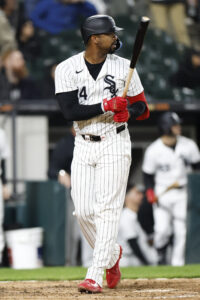
Jimenez, 27, was one of the highest-profile international signings in recent memory and one of the top-ranked prospects in all of baseball prior to his big league debut. He signed a then-record six-year, $43MM deal before ever playing a big league game. He’s earning $13MM this season in the final guaranteed season of that contract, which also contains club options valued at $16.5MM and $18.5MM for the next two seasons. The O’s should pay the $3MM buyout on his 2025 option, making Jimenez a free agent.
In the early stages of his career, Jimenez largely delivered on the hype, hitting .276/.327/.504 with 71 homers in his first 316 games. That includes a down year in 2021, but the Cuban-born slugger was well above-average in 2019, 2020 and 2022 — including a monster .295/.358/.500 slash with 16 homers in only 84 games in ’22.
Injuries have derailed Jimenez’s career, however. He’s been on the injured list for multiple hamstring strains — including a tear that sent him to the 60-day IL — an adductor strain, an appendectomy procedure, an ulnar nerve injury and a high ankle sprain. His once-potent bat has produced only a .240/.297/.345 output in 2024. Jimenez’s 18.9% strikeout rate is actually a career-low, however, and he’s averaging 92.4 mph off the bat with a huge 50.8% hard-hit rate. The O’s will hope that a change of scenery and those underlying metrics can bring about improvement of some degree, if not a return to peak form.
If that type of turnaround is to come to fruition, Jimenez will need a radical overhaul in his swing, however. He’s posted an astonishing 59.6% ground-ball rate this season — far and away the highest in baseball among active players. (Tim Anderson, released by the Marlins this year, technically leads him at 62.4% but isn’t with a team.) For a player that ranks in the sixth percentile of MLB players in terms of average sprint speed, pounding the ball into the ground that often is never going to yield much benefit — regardless of how hard the ball is put into play.
The Orioles, having moved Austin Hays in last week’s trade bringing reliever Seranthony Dominguez over from the Phillies, were reportedly on the hunt for a right-handed bat. Jimenez will fill that role to some extent, and it’s worth noting that he’s posted a strong .304/.360/.370 batting line against lefties in 2024. Again, however, he’s simply been far too prone to grounders whether facing lefties (59%) or righties (59.7%).
McGough, a 26-year-old lefty, came to the Orioles from the Pirates via the minor league phase of the 2022 Rule 5 Draft. He recently moved to the bullpen after recovering from Tommy John surgery and owns a sparkling 1.99 ERA in 54 1/3 frames between Double-A and Triple-A. He’s fanned 25.5% of his opponents and walked 9.7% of them. FanGraphs’ Eric Longenhagen recently listed him 37th among O’s prospects, calling him a potential low-leverage reliever whose best pitch is an above-average slider.
ESPN’s Jeff Passan first reported the Orioles were finalizing a deal for Jimenez. USA Today’s Bob Nightengale reported the White Sox were receiving McGough. Ronald Blum of the Associated Press reported the cash breakdown.
Padres To Acquire Tanner Scott, Bryan Hoeing
3:37pm: The Padres are sending left-hander Robby Snelling and right-hander Adam Mazur to Miami, reports ESPN’s Alden Gonzalez. Mish adds that infielder/outfielder Graham Pauley is also part of the return, and Daniel Alvarez Montes of El Extra Base reports that infielder Jay Beshears is the fourth and final player in the return. It’s a major haul that’ll send three of the Padres’ top remaining prospects (Snelling, Mazur, Pauley) to Miami in exchange for the pair of relievers.
3:32pm: The Padres are finalizing a deal to acquire closer Tanner Scott from the Marlins, ESPN’s Jeff Passan reports. Craig Mish of SportsGrid and the Miami Herald adds that righty Bryan Hoeing is also going to San Diego in the deal.
It’s the latest trade market strike for a Padres club that has already added righty Jason Adam in a deal with the Rays and that picked up Luis Arraez in another early-season blockbuster with Miami. The Scott trade is still pending the medical review of the players involved.
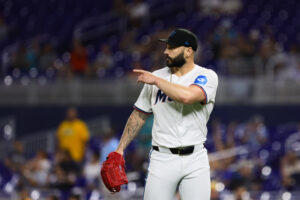
Scott, 30, has one of the lowest ERAs in the majors this season, with a pristine 1.18 mark in 45 2/3 innings of work. He’s averaged 97.1 mph on his heater, fanned 29.1% of his opponents and induced grounders at a hearty 49% clip. The flamethrowing lefty has picked up 18 saves for Miami on the season and tacked on another 12 saves in 2023, when he tossed 78 innings of 2.31 ERA ball.
Impressive as Scott’s earned run average has been, he’s seen a resurgence of the command troubles that plagued him for his entire career prior to the 2023 campaign, when he went from a lifetime 14.2% walk rate to a tidy 7.8% mark. Scott has issued a free pass to a glaring 14.8% of his opponents this season, although a good portion of his command troubles came in the season’s first few weeks. He’s posted a 0.49 ERA, 32.6% strikeout rate and more manageable (but still too high) 10.9% walk rate dating back to April 20. At this point, last year’s strong walk rate looks like an aberration.
Scott is playing the season on a one-year, $5.7MM contract. He’s a pure rental for the Friars, barring an extension, and won’t net them any draft compensation, as his midseason trade renders him ineligible for a qualifying offer. The Padres are ponying up on a big offer in hopes of building a dominant bullpen that can help them navigate short postseason series with off-days baked in throughout the schedule. Scott and Hoeing join the aforementioned Adam, Robert Suarez (1.51 ERA in 41 2/3 innings), Jeremiah Estrada (2.92 ERA in 39 2/3 frames), Adrian Morejon (2.74 ERA in 42 2/3 innings) and Yuki Matsui (3.45 ERA in 47 2/3 frames) to round out a formidable relief corps.
Also joining the revamped bullpen is the 27-year-old Hoeing. He’s not nearly as established as Scott and the majority of his new bullpen-mates but is nevertheless enjoying a strong 2024 campaign. In 30 frames, he’s logged a 2.70 ERA with a below-average but respectable 20.2% strikeout rate against a 7.3% walk rate. Hoeing has kept the ball on the ground at a 48.9% clip in part because of a sinker that averages a solid 93.7 mph. He throws that pitch just over half the time and pairs it with a slider-splitter combo — and a rarely-used four-seamer — that helps keep both lefties and, to a lesser extent, righties off balance.
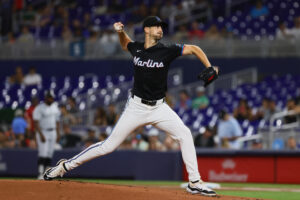
Although Hoeing will turn 28 in October, he’ll finish the season with just two years of MLB service time. That’ll make him controllable for the Padres not only for the stretch run in ’24 but for four additional seasons thereafter. He won’t be arbitration-eligible until the 2025-26 offseason at the earliest, and he still has a pair of minor league option years remaining. That gives them a potential long-term piece in the ‘pen, which the Friars surely coveted in exchange for giving up what looks like an impressive collection of young talent that’ll continue to beef up a rapidly improving Marlins system.
Among the names going to the Marlins in the deal, the 23-year-old Mazur and 23-year-old Pauley have both made their big league debuts. Mazur is the more highly regarded of the two, having been a second-round pick back in 2022. He’s struggled to a 7.49 ERA through his first five big league appearances but has posted a 4.39 ERA with a 24.7% strikeout rate and outstanding 5% walk rate in 55 1/3 innings between Double-A and Triple-A this season.
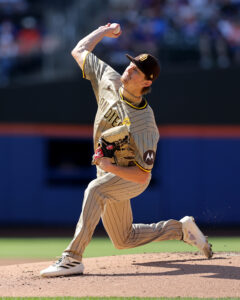
Both Baseball America and MLB.com ranked Mazur as the Padres’ No. 4 prospect, calling him a potential mid-rotation starter on the back of 60- or 70-grade command. FanGraphs’ Eric Longenhagen offered a more measured approach recently, noting that Mazur’s command struggles in the majors and some lost life on his heater have him looking more like a potential reliever. There’s some variance in potential outcomes, as is to be expected with a 23-year-old starter who’s rapidly climbed the minor league ranks, but Mazur has the potential to be a rotation piece for several years in Miami.
Pauley went 4-for-32 in a tiny cup of coffee with the Padres earlier this season and has struggled through a down year in Triple-A, hitting just .228/.342/.390. Even as he’s stumbled there, however, he’s drawn walks at a 13.9% clip and played all over the diamond, logging innings at first base, second base, third base and in both outfield corners.
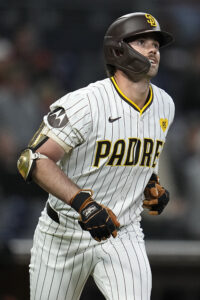
Again, both BA and MLB.com are more bullish on Pauley, ranking him inside the Padres’ top-six prospects, while FanGraphs pegged him at 13th earlier this month. He raked at a .308/.393/.593 clip across three minor league levels in 2023, and his versatility adds value to his profile.
Pauley was primarily a third baseman early on but began moving around the field as the Padres looked to make him more versatile (understandable with Manny Machado entrenched at the hot corner in San Diego). He won’t face that type of permanent roadblock in Miami — Jake Burger could move across the diamond following the trade of Josh Bell — giving Pauley a potential audition as an everyday third baseman or at least a bat-first utilityman.
While Mazur and Pauley have both reached the majors, it’s arguably Snelling who’s the headliner of the deal. The 20-year-old has struggled in the minors this year, but that’s in large part due to an aggressive assignment to Double-A, where he’s one of the league’s youngest players.
The No. 39 overall pick in 2022, Snelling breezed from Low-A to Double-A last season, posting 103 2/3 innings of 1.86 ERA ball with a combined 28.4% strikeout rate and 8.2% walk rate as a 19-year-old. He’s been roughed up for a 6.01 ERA in his second shot at Double-A — he only pitched 17 innings there last year — with strikeout and walk rates that have trended in the wrong direction (20.2% and 10%, respectively). Still, Snelling ranks as the game’s No. 44 prospect at MLB.com (though he’s fallen off top-100 lists at FanGraphs and BA).
Rounding out the Marlins’ return is Beshears, a 22-year-old Duke product whom the Padres selected in the sixth round of last year’s draft. He’s hitting .261/.373/.377 between Low-A and High-A this season, with a gaudy 13.6% walk rate against just an 18.7% strikeout rate. He’s a power-over-hit infielder who ranked near the back of the Padres’ top 30 on most publications, in part due to questionable arm strength that makes him a tough fit for the left side of the infield.
The Padres have held firm on their reluctance to trade top-ranked prospects like catcher Ethan Salas and shortstop Leodalis De Vries, but the remainder of their system has been picked over in the past four months thanks to acquisitions of Scott, Hoenig, Adam, Arraez and (in spring training) Dylan Cease. They’re a Wild Card team at best in all likelihood, but president of baseball operations A.J. Preller has never encountered a star player he didn’t love on the trade market and isn’t deviating from old habits in 2024. With Salas and De Vries still in tow, the Padres have the firepower to make another blockbuster add if they soften their stance on that pair, and the timing of this trade gives Preller a bit more than an hour to survey the remainder of the trade market.
Rangers Acquire Andrew Chafin
The Rangers announced they’ve acquired lefty reliever Andrew Chafin from the Tigers. Pitching prospects Joseph Montalvo and Chase Lee are going to Detroit. Texas designated righty Jonathan Hernandez for assignment in a corresponding move.

The 34-year-old Chafin is in the midst of yet another solid season. He’s pitched 37 innings of 3.16 ERA ball with a big 30.9% strikeout rate, a 9.9% walk rate and a 35.8% grounder rate. He’s been particularly dominant of late, rattling off 17 innings of one-run ball with a 26-to-5 K/BB ratio dating back to early June.
That 35.8% grounder rate is an uncharacteristically low mark for Chafin, who’s changed up his pitch usage this year. He’s throwing more sliders than ever before (46.4%) and missing more bats as a result but also yielding more balls in the air and a few more walks than in recent years. Chafin’s velocity is down a bit from its 93-94 mph peak, however, sitting around 92 mph on average this year with both his four-seamer and sinker. It’s possible the change in repertoire was borne out of the diminishing life on those harder offerings. Regardless, it’s been an effective recipe for the well-traveled southpaw, who’ll now suit up for the sixth team of his 11-year career.
Chafin is playing on a one-year, $4.75MM contract, although the Rangers are picking up another year of possible control over him in the form of a 2025 club option valued at $6.5MM (a net $6MM decision after factoring in a $500K buyout). He’s owed about $1.42MM of his $4.25MM base salary but has a handful of incentives approaching that could boost the value of that contract. Chafin would earn a $125K bonus for pitching in his 50th game — he’s at 41 appearances — before taking home $250K bonuses for reaching 55 and 60 games, a $300K bonus for 65 games and a $325K bonus for reaching 70 appearances. The last of those milestones could be hard to reach, but the Rangers will be on the hook for some additional incentives of note, which will all come with a 30% tax given their luxury-tax status.
With Chafin’s acquisition and Cody Bradford‘s return from a 60-day IL stint, a Rangers bullpen that has lacked an established left-handed option for much of the season will suddenly have two quality options in that regard. Chafin will join a late-inning mix including Kirby Yates, David Robertson and Jose Leclerc. He’s held lefties to an awful .180/.261/.213 batting line this season, and while righties are enjoying more success at .293/.366/.390, they’re not managing much power against the southpaw. In his career, Chafin has yielded only a .234/.313/.361 line to right-handed opponents, though much of that came with a more vibrant fastball and different mix of his three pitches.
The trade for Chafin underscores the fact that yesterday’s trade of Michael Lorenzen to the Royals was less about selling off in the midst of a disappointing season and rather opening space for the return of several other veteran starters (e.g. Max Scherzer, Tyler Mahle, Dane Dunning and, further down the road, Jacob deGrom). Much of the cost-savings from that trade of Lorenzen — earning $4.5MM with incentives of his own — will now be reallocated to the comparably priced Chafin.
Montalvo is the more highly regarded of the prospects headed to Detroit. Baseball America ranked him 19th on their most recent update of the Texas system, crediting him with a plus changeup and the ability to spin his low-90s fastball. He’s dominating lower minors opponents, striking out nearly 30% of batters faced with a 2.44 ERA in High-A. Lee is an upper minors reliever who’ll be eligible for the Rule 5 draft next offseason if he’s not added to the 40-man roster. He lost the first couple months of this season to injury but had a 3.98 ERA in Triple-A last year.
ESPN’s Jeff Passan first reported the Rangers were finalizing a deal for Chafin. The Athletic’s Ken Rosenthal confirmed an agreement was in place. Evan Grant of the Dallas Morning News reported the Tigers would receive Montalvo and Lee.
Guardians To Acquire Alex Cobb
The Guardians and Giants are in the process of finalizing a trade that will send veteran right-hander Alex Cobb from San Francisco to Cleveland, reports ESPN’s Jeff Passan. Zack Meisel of The Athletic reports that there’s an agreement in place, with Cleveland sending minor league lefty Jacob Bresnahan and a player to be named later to San Francisco in the swap.
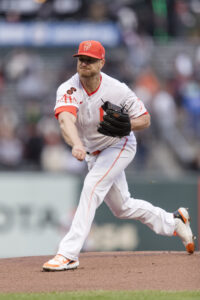
Cobb has yet to pitch this season after opening the year on the injured list while rehabbing from offseason hip surgery. He was expected back sooner in 2024, but multiple setbacks — including a shoulder issue and blister troubles — slowed his recovery. He’s on the cusp of being reinstated from the injured list at this point, however, and could pitch within the next week. Joel Sherman of the New York Post tweets that the Guardians’ plan for Cobb is to make one final rehab start before his reinstatement. He last pitched on the 26th and should be on turn to throw again tomorrow.
The 36-year-old righty is in the final season of what was originally a two-year, $20MM deal but became a three-year, $28MM contract after the Giants chose to exercise a $10MM club option rather than pay a $2MM buyout. He’s still owed $3.333MM of this year’s salary between now and season’s end.
Though Cobb has yet to pitch in 2024, he’s been a rock-solid rotation arm for the Angels and Giants over the past three seasons, pitching to a combined 3.79 ERA with a 22.8% strikeout rate and 6.9% walk rate in 394 1/3 innings. He’s started 74 games in that time, averaging about 5 1/3 frames per outing.
The Guardians, who’ve lost Shane Bieber for the season and had to option Triston McKenzie and Logan Allen due to notable struggles, have been relying on a patchwork staff including veteran Carlos Carrasco and journeyman Ben Lively. Lively has exceeded expectations, but Carrasco has struggled to a 5.68 ERA in 95 innings (19 starts). The Guards recently called on rookie southpaw Joey Cantillo for his MLB debut as well. The only steady presences in the rotation at the moment are righties Tanner Bibee, Gavin Williams (who opened the season with a monthslong IL stint) and Lively.
In return for Cobb, the Giants will add Cleveland’s 13th-round pick from the 2023 draft (Bresnahan) and a PTBNL. The 19-year-old Bresnahan was an over-slot add for Cleveland in the 13th, signing for a $375K bonus ($225K of which counted against the Guardians’ pool). That’s the equivalent of a signing bonus near the tail end of the fifth round in the draft.
Baseball America ranked Bresnahan as the No. 491 prospect in last year’s draft. He’s not considered to be among the Guardians’ top prospects but has had a nice start in the low minors after getting hit hard in last summer’s pro debut. He’s pitched 50 innings between Cleveland’s Rookie-level ACL and Class-A affiliates, logging a 2.70 ERA with a 32.5% strikeout rate and 8.9% walk rate. BA’s scouting report on Bresnahan from the draft notes an upper-80s/low-90s heater (which could add velocity as he continues to mature) and a changeup that has the potential to be an above-average pitch.
With Cobb now out of the fold in San Francisco, the Giants will likely go with young Hayden Birdsong to follow Logan Webb, Blake Snell, Robbie Ray and Kyle Harrison. The Giants surely wanted to get Birdsong a look after he’s impressed in six big league starts (2.97 ERA, 30 1/3 innings, 30.2 K%, 11.9 BB%) and shown well in the upper minors as well. With Cobb out of the mix, that’s now easier to accomplish.
That said, the Giants could easily have gone to a six-man rotation. They’ve been anything but adherent to the conventional five-man rotation under the watch of president of baseball operations Farhan Zaidi, after all. The Cobb trade was very likely as much about the modest return and an opportunity for Birdsong as it was shedding the remainder of Cobb’s contract once a taker presented itself. The Giants shed the remainder of Jorge Soler‘s contract in last night’s deal with the Braves, and adding Cobb to the pile trims more than $30MM off the books in total — all while dropping the Giants down a tier in terms of luxury-tax penalization.
The Giants will be hard-pressed to actually duck beneath the $237MM threshold, barring a trade of a major contract like Snell or Ray, but the Cobb trade alone will spare them a bit shy of $4MM when factoring in his remaining salary and their 20% tax on his contract’s AAV.
Cards, Nats Have Discussed Dylan Carlson, Dylan Floro
1:11pm: The Cards and Nats have indeed had ongoing talks on a swap of the two Dylans and could complete a deal this afternoon, tweets Mark Feinsand of MLB.com. It’s not yet clear if other players are involved.
11:17am: The Cardinals crossed a pair of big items off their wishlist yesterday when they acquired right-hander Erick Fedde and outfielder Tommy Pham from the White Sox, but they’re still hoping to add to the bullpen, Derrick Goold of the St. Louis Post-Dispatch reports. The Cardinals are openly shopping outfielder Dylan Carlson in a related pursuit, and MLB.com’s John Denton tweets that Nationals right-hander Dylan Floro is a name to watch if St. Louis indeed moves on from Carlson. The Nats are known to have some interest in Carlson.
A few years ago, the notion of trading Carlson for a middle-relief rental would’ve been unfathomable (though it’s of course possible that a theoretical Dylan-for-Dylan swap would also include additional minor league players to balance out the scales). Carlson isn’t all that far removed from ranking among the game’s top 10 to 20 overall prospects. The former first-rounder’s bat has wilted since a solid 2021 showing.
Dating back to 2022, Carlson has batted just .225/.310/.345 in 881 big league plate appearances. That’s come in scattered playing time — in part due to injuries — so the Nats could well view him as a buy-low option with two-plus seasons of club control remaining who could benefit from a change of scenery. (The last controllable outfielder they pried from the Cardinals in exchange for a rental pitcher — Lane Thomas for Jon Lester — worked out nicely, after all.)
Floro, 33, is on a one-year, $2.25MM contract and will be a free agent at season’s end. He’s pitched to a pristine 2.06 earned run average this season, albeit with a rather pedestrian 19.6% strikeout rate and tepid 90.3 mph average fastball. That said, Floro has walked only 6.4% of his opponents and kept the ball on the ground at a strong 47.6% clip. He’s not going to continue to see this level of fortune on his fly-balls — only 2.2% of them have become homers, compared to the 7% mark he carried into the season — but it’s been a nice rebound effort for a veteran reliever who struggled to keep his ERA under 5.00 last year between the Marlins and Twins.
Since cementing himself as a viable big league reliever in 2018, Floro touts a 3.11 ERA in 361 1/3 innings. He’s had a below-average strikeout rate nearly every season along the way, but never egregiously so, and has offset that with habitually strong command. Floro also regularly avoids loud contact, evidenced by a career 87.4 mph average exit velocity, 3.7% barrel rate and 38.4% hard-hit rate.
Floro is surely just one of many bullpen arms the Cardinals have looked into in the final hours leading to today’s 5pm CT trade deadline. Concurrently, they’re looking for trade partners for Carlson and the already-designated-for-assignment Giovanny Gallegos. The Cards may not have another blockbuster along the lines of yesterday’s three-team swap in them, but they could still have multiple trades in store today.
Marlins “Closing In” On Trevor Rogers Trade; Multiple Teams Still Involved In Bidding
11:42am: The Marlins are “closing in” on a trade of Rogers, Craig Mish of SportsGrid and the Miami Herald reports. At this point, there are still multiple teams bidding for his services, but it seems the Fish are close to selecting an offer and then turning their focus to the wide array of relievers they could move today.
10:10am: The market for Marlins left-hander Trevor Rogers has picked up some steam this morning, Jon Heyman of the New York Post reports. He’s among a slew of Marlins who could potentially be moved before this evening’s trade deadline. SNY’s Andy Martino adds that the Mets are one team that’s been talking to Miami about a deal for the 26-year-old Rogers.
Rogers, the 2021 National League Rookie of the Year runner-up, has had a healthy 2024 season after missing the majority of the 2023 campaign with a biceps strain and considerable time in 2022 due to both back spasms and a lat strain. He hasn’t been the same pitcher after navigating those health troubles, pitching to a 4.53 earned run average with diminished velocity (92.2 mph average fastball), strikeout (18%) and walk (9.7%) rates in 105 1/3 innings this season.
That said, Rogers was legitimately excellent as a rookie. The former No. 13 overall pick (2017) burst onto the scene with 133 innings of 2.66 ERA ball, a 28.5% strikeout rate and an 8.4% walk rate. His fastball was averaging a much more encouraging 94.6 mph at the time, but Rogers has some track record, some pedigree as a former top pick and, perhaps most importantly, plenty of affordable club control remaining.
The silver lining to those injuries (for the Marlins anyway) is that they limited Rogers’ time on the field and thus weighed down his price tag in arbitration. He’s earning just $1.525MM this season and is under club control for an additional two years. If a club feels they can coax another level out of Rogers — even if it’s not all the way back to his 2021 form — he’s a highly appealing option. Even if another club is simply looking at him as a controllable and affordable back-of-the-rotation arm with a full slate of three option years remaining, however, there’s some value in that as well.
The Mets are a fit for just such a depth option in the rotation. Veterans Luis Severino, Jose Quintana and Sean Manaea lead a staff that also includes homegrown arms Tylor Megill and David Peterson. It’s not long ago that there was some thought to the Mets actually trading away a veteran arm like Quintana even as they looked to remain in contention, but the outlook has changed dramatically in Queens with likely season-ending injuries to both Kodai Senga (high-grade calf strain) and top prospect Christian Scott (UCL sprain).
Rogers isn’t necessarily a concrete upgrade over Megill and Peterson at the back of Carlos Mendoza‘s staff, although it’s always fair to wonder how a change of scenery might impact a talented but struggling arm like Rogers. But even if Rogers is indeed viewed as a pure depth play for the Mets, there’s good reason to land that type of arm. With Scott and Senga now on the shelf and with veteran Adrian Houser‘s recent DFA, the Mets don’t have any other rotation options on the 40-man roster. Southpaw Joey Lucchesi and righty Max Kranick are depth candidates in Triple-A after they both cleared waivers earlier this season, but that’s not sufficient for a team targeting a postseason berth.