
Padres Acquire Garrett Cooper
The Padres have acquired first baseman Garrett Cooper and minor league lefty Sean Reynolds from the Marlins in exchange for left-hander Ryan Weathers, per an announcement from both teams. San Diego designated outfielder Preston Tucker for assignment in a corresponding roster move.
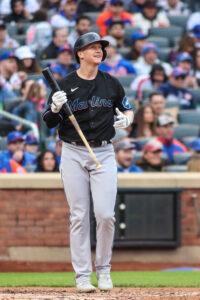
Cooper, 32, will give the Padres a seasoned bench bat with a productive track record at the big league level. He’s picked up five-plus years of MLB service to this point in his career, making him a free agent at season’s end and a pure rental for San Diego, but one who has more often than not been a quietly strong offensive performer.
Although Cooper’s .256/.296/.426 batting line in 2023 doesn’t stand out, it’s only narrowly been worse than league average, by measure of wRC+ (97). Moreover, Cooper’s bat has picked up as the season has worn on. Dating back to June 1, he’s posted a far more palatable .276/.319/.468 batting line with eight big flies and six doubles. That’s good for a 115 wRC+ (i.e. about 15% better than league-average production, after weighting for home park) — which is right in line with Cooper’s career output.
Since making his MLB debut with the Yankees back in 2017, Cooper owns a .271/.338/.437 batting line in nearly 1700 trips to the plate. He’s been particularly productive with the Marlins in the past few seasons, batting .271/.352/.443 from 2020-22. Cooper has never had massive over-the-fence power but hits plenty of doubles and from 2018-22 drew walks at a healthy 9% clip.
Perhaps “healthy” is a dicey word to use in any regard when describing Cooper, as the primary knock against him as been a penchant to land on the injured list. Since 2018, Cooper has been on the injured list due to a wrist sprain, a calf strain, a lumbar strain, an elbow sprain, a concussion and an inner ear infection, among other maladies. Productive as his bat has been, he’s never logged more than 119 games or 469 plate appearances in a single season.
Cooper is healthy right now, however, and the Padres have gotten little to no production out of their bench this year. Veterans Rougned Odor (recently released), Nelson Cruz (released) and Matt Carpenter have provided no help, and the Friars have relied on a combination of journeymen and organizational depth pieces (e.g. Brandon Dixon, Matthew Batten, Taylor Kohlwey) in the other spots. Cooper’s above-average track record at the dish will be a significant boost, and he can slide in at first base if the Padres need to push Jake Cronenworth to second base to accommodate Ha-Seong Kim‘s recent injury.
In addition to Cooper, the Padres will pick up the 25-year-old Reynolds — a 2016 fourth-round pick and converted first baseman/outfielder who’s emerged as an interesting bullpen prospect. The 25-year-old Reynolds made the move to the mound full time in 2021 and has found a good bit of success in the upper minors. Through 48 2/3 innings between Double-A and Triple-A this season, the 6’8″ left-hander has pitched to a 2.77 ERA with a 26% strikeout rate, 11.2% walk rate and just two homers allowed. Reynolds features a four-seamer in the mid-to-upper 90s, a mid-80s slider and a changeup.
In exchange for the final couple months of Cooper’s services and a potential six seasons of control over Reynolds, the Marlins will pick up the 23-year-old Weathers — a former first-round pick and top Padres prospect who’s long looked like a change-of-scenery candidate. He’s seen action in each of the past three seasons, but other than his rookie campaign when injuries forced him to the Majors as a 21-year-old, Weathers has never received a particularly long look.

In 143 big league innings, Weathers has a 5.73 ERA. He’s fanned just 16.8% of his opponents but sports a respectable 8.3% walk rate and 42.9% ground-ball rate in that time. He’s also pitched decently in 40 2/3 Triple-A innings this season — 4.20 ERA, 29.2% strikeout rate, 13.5% walk rate in eight starts — and has a minor league option remaining beyond the current year. The Marlins’ vaunted pitching depth has been thinned out by the trades of Pablo Lopez and (earlier today) Jake Eder, as well as injuries to Trevor Rogers, Max Meyer and Sixto Sanchez. Weathers will add a former No. 7 overall pick to the stockpile, and the Marlins can take this year and next to try to coax some better performance out of the lefty.
As for the 33-year-old Tucker, he’ll lose his 40-man spot before appearing in a big league game with the Padres. The older brother of Astros star Kyle Tucker, Preston was once a well-regarded prospect himself but has never found sustained success in the minor leagues. He had a nice three-year run with the Kia Tigers of the Korea Baseball Organization from 2019-21 and has a career .274/.353/.471 slash in parts of eight Triple-A seasons — including a .293/.433/.565 showing so far in 2023.
However, the elder Tucker brother carries just a .222/.281/.403 slash in parts of three Major League seasons, and the Padres’ acquisitions of Cooper and Ji-Man Choi have beefed up their reserve options a bit. That left Tucker without a clear role moving forward. Normally, players who are designated for assignment have a week to be traded, placed on outright waivers or released. But, since the trade deadline has now passed and Tucker has been on a 40-man roster this year, he’s ineligible to be moved. He’ll hit waivers within the next week and be available to all 29 other clubs. Even if he clears, he’d have the right to reject an outright assignment in favor of free agency.
Craig Mish of SportsGrid and the Miami Herald first reported the trade.
Phillies, Pirates To Swap Bailey Falter For Rodolfo Castro
The Phillies and Pirates are nearing a swap of left-hander Bailey Falter and infielder Rodolfo Castro, reports Jayson Stark of The Athletic (Twitter link). The deal has been agreed upon, pending medical reviews, tweets Alex Coffey of the Philadelphia Inquirer.

Falter, who turned 26 earlier this season, will give the Pirates an immediate option in the rotation. He’s struggled in 2023, logging a 5.13 ERA in 40 1/3 frames, but is only a season removed from 84 innings of 3.86 ball over the life of 20 appearances (16 of them starts) with Philadelphia. Though Falter has struggled both in the Majors and in Triple-A this season, he’s generally pitched with excellent command (career 4.7% walk rate in MLB, 7.3% in Triple-A). He’s not a hard-thrower, but Falter has still missed bats in the upper minors and can be controlled for an additional five years via arbitration.
Falter is in the last of his three option years. He can be shuttled between Triple-A Indianapolis and Pittsburgh for the remainder of the current season, but the Bucs will need to keep him on the Opening Day roster in 2024 or else designate him for assignment and risk exposing him to waivers. Today’s trade of Rich Hill to the Padres and injuries to others (e.g. JT Brubaker, Vince Velasquez) have created enough uncertainty in the Pittsburgh rotation that there ought to be room for Falter to have a trial run in the season’s final two months. Pittsburgh’s starting staff currently includes Mitch Keller, Johan Oviedo and rookies Quinn Priester and Osvaldo Bido.
As for the Phillies, they’ll add a switch-hitter with experience at three infield spots. Much like Falter, Castro is in his final option season, potentially has five years of club control remaining, and is struggling in 2023 after a solid showing in 2022. Last year saw the 24-year-old turn in a .233/.299/.427 batting line (103 wRC+) with 11 home runs and seven doubles in 278 plate appearances. That’s not exactly standout production, but Castro drew solid defensive grades at the hot corner and looked like a potential utilityman moving forward, at the very least.

Castro got out to a huge start in 2023, batting .286/.378/.468 through the end of April, but his bat has cratered. Since May 1, he’s hitting just .192/.271/.283 with three homers, two doubles and a 30.1% strikeout rate in 133 plate appearances. He’s drawn nice grades for his defense a second base this season but lesser reviews for his work at third base and shortstop. On the whole, Castro is a switch-hitter with a bit of pop who can perhaps be relied upon at second or third base but is more of an in-a-pinch option at shortstop.
The Phillies were known to be looking for right-handed bats, and while Castro likely wasn’t on many (or any) radars in that regard, he does fill the need. The switch-hitter touts a career .277/.341/.559 line as a right-handed hitter (just .193/.272/.293 as a lefty) and is hitting .290/.368/.538 from the right side of the dish this season.
It’s an interesting swap of a pair of young change-of-scenery candidates. The Phillies, having acquired Michael Lorenzen to pair with Aaron Nola, Zack Wheeler, Taijuan Walker and Ranger Suarez, didn’t have any immediate need in the rotation for Falter, who’s also been passed on the depth chart by Cristopher Sanchez. The Pirates, meanwhile, now have Liover Peguero, Nick Gonzales and Alika Williams in the infield mix alongside injured hopeful cornerstones Ke’Bryan Hayes and Oneil Cruz. There wasn’t a clear long-term role for Castro. It’s something of a “challenge” trade for a back-end starter and potential role player, beefing up depth for each organization in potential areas of need.
Rangers To Acquire Austin Hedges
The Rangers are acquiring catcher Austin Hedges from the Pirates, reports Mark Feinsand of MLB.com (Twitter link). They’ll send international bonus space to the Pirates in return, Joel Sherman of the New York Post reports.
Texas has received excellent production from catcher Jonah Heim this year, but Heim was recently diagnosed with a wrist injury that’ll cost him at least a few weeks. Hedges can team with Mitch Garver to provide the Rangers with an elite defensive option behind the plate, though he’s also one of the lightest-hitting players in the game at present. Surgery hasn’t been ruled out for Heim, and if that ultimately ends up proving necessary, the addition of some depth behind the dish will prove all the more important.
Hedges, 31 next month, signed a one-year, $5MM deal with the Pirates in the offseason. He’s turned in just a .180/.237/.230 slash line — disastrous even by his standards — but has continued to rate as the sport’s premier pitch framer and one of its top four pitch blockers, per Statcast. Defensive Runs Saved pegs him at a hefty +8 this season despite logging just 507 innings behind the plate so far. Hedges’ 14% caught-stealing rate is a career-worst mark for him, but he owns a career 28% mark in that regard. As far as defensive-minded backstops go, he’s arguably the best in the game.
Whether that offsets his utter lack of offense is up for debate, but the Rangers clearly felt him a worthwhile addition. Garver figures to see the bulk of the time behind the plate, but Hedges makes for a quality backup who has a reputation for working well with pitchers and prepping as a game-planner.
The Pirates, with top catching prospects Henry Davis and Endy Rodriguez both in the Major Leagues, simply didn’t have at-bats for Hedges anymore. Both young backstops have recently raved about the influence Hedges had on them in their short time together, and his departure will now create further opportunities for that pair to continue their development at the MLB level. There’s a chance Hedges might’ve been simply designated for assignment had the Pirates not found a taker for him, so getting even a nominal return in the form of some additional space in their international free agent pool isn’t too bad an outcome.
Marlins To Acquire Jake Burger
The Marlins and White Sox have agreed to a deal sending infielder Jake Burger from Chicago to Miami in exchange for left-handed pitching prospect Jake Eder, reports Craig Mish of SportsGrid and the Miami Herald (Twitter links).

It’s a surprise deal given that the White Sox’ focus has generally been on trading short-term assets during their summer sell-off. Burger, 27, will be controllable for another five years beyond the current season and is batting .214/.279/.527. He’s already slugged a whopping 25 home runs on the season but also has the fifth-worst on-base percentage and sixth-highest strikeout rate (31.6%) of any player in the Majors (min. 300 plate appearances). The Marlins, with MLB’s third-fewest home runs (96 total), seemingly view those as acceptable trade-offs to add some pop to lineup that’s heavily reliant on stringing hits together.
Where Burger will line up on the diamond remains to be seen. He’s played primarily third base in his young big league career but drawn poor ratings there (-8 Defensive Runs Saved, -8 Outs Above Average, -3.6 Ultimate Zone Rating). Miami has been using the struggling Jean Segura at the hot corner and could certainly supplant him with Burger’s power bat, but Burger also has experience at second base and first base. The Fish currently have Garrett Cooper taking the bulk of the reps at first, but he’s in his final season of club control and has been a trade candidate at each of the past couple deadlines.
Whether Burger immediately begins to step into a more prominent role at first base or splits his time between the infield corners and designated hitter, he’ll give the Marlins an immediate jolt of power. Looking beyond the 2023 season, both the first base and designated hitter slots in the lineup figure to be vacant; Cooper is a free agent, and while Jorge Soler is technically signed through 2024, he can also opt out of the final one year and $9MM of his contract at the end of the current season.
Subtracting Burger from the White Sox’ long-term outlook obviously takes away a good bit of power potential, but if the club isn’t sold on his defensive acumen at third base then he becomes a tough fit. Chicago has Andrew Vaughn and Eloy Jimenez locked in as long-term options at first base and designated hitter, respectively, so it could prove difficult to find Burger regular at-bats if his glove is indeed a prominent concern.
It’s also possible that the Sox simply felt Eder too talented a prospect to pass up on when presented the opportunity to acquire him. The 2020 fourth-round pick had pitched his way into top-100 prospect status prior to undergoing Tommy John surgery and has already made his way to the Double-A level this year upon returning. Eder, a Vanderbilt product, posted a 1.17 ERA in 71 1/3 innings in his first pro season before going under the knife, and he’s returned with 39 1/3 innings of 4.12 ERA ball. FanGraphs has already plugged him right back into their top-100 list, ranking him as the Marlins’ No. 1 prospect and the No. 54 prospect in baseball.
Scouting reports on Eder tout his mid-90s heater and a slider that FanGraphs touts as “one of the nastiest pitches on the planet.” Eder also has a changeup that’s well behind his header and breaking ball, but both BA and FanGraphs agree it can be an average pitch with further refinement. There are certainly some concerns for any young pitcher coming off major arm surgery, and Eder’s 12.5% walk rate will need to be refined. However, he’s already pitching in Double-A, and it’s feasible that he could be an option for the ChiSox as soon as next season. He might be on something of a limited workload next year, depending on how high his innings total climbs this year, but he’ll immediately become the system’s top pitching prospect.
Jared Walsh Clears Waivers, Accepts Outright Assignment With Angels
The Angels announced Tuesday that first baseman Jared Walsh went unclaimed on outright waivers and has accepted an assignment to Triple-A Salt Lake. He’ll remain in the organization but no longer occupy a spot on the 40-man roster.
Walsh broke out with a hefty .280/.331/.531 slash and 38 home runs in 176 games from 2020-21, cementing his place on the Angels’ roster in the process. However, the now-29-year-old late bloomer has seen his production plummet in the two seasons since, due largely to alarming health issues. Walsh underwent thoracic outlet surgery last summer, ending his season after 118 games of .215/.269/.374 output at the plate.
The 2023 season has been even more concerning. Walsh was placed on the injured list early in the season due to persistent headaches and insomnia. Walsh detailed his struggles in an interview with Blum earlier in the season: “It’s been hell. Not knowing what’s going on, not understanding what’s happening with my body….And not being able to get answers, not being able to figure out why I can’t do basic tasks. It’s been pretty concerning for me.”
Walsh was thankfully at least able to return to the field, but the results have been nowhere near his peak levels. In 78 big league plate appearances, he’s batted just .119/.244/.224 while striking out in a third of his plate appearances. He’s batted .231/.394/.410 in 99 plate appearances since being optioned to Triple-A, but he’s still fanned in 30.3% of those trips to the plate.
Between those struggles, the uncertainty surrounding his health, and the approximately $883K that’s still remaining on this year’s $2.65MM salary, Walsh didn’t drum up any interest from other clubs. He could’ve rejected this assignment in favor of free agency, but doing so would’ve required forfeiting that remaining $883K. As a player with more than three years of service time who’s been outrighted off the 40-man roster, he’ll be able to become a free agent at season’s end — unless the Halos add him back to the 40-man roster and keep him there into the offseason.
Royals Fielding Offers On Several Veterans
The Royals have been talking to other clubs about potential trades involving veteran pitchers Scott Barlow, Taylor Clarke and Ryan Yarbrough, tweets Mark Feinsand of MLB.com. Outfielder Edward Olivares has also been discussed in potential deals.
Of the bunch, Barlow is the most obvious and straightforward trade candidate. The 30-year-old righty thrived as the primary closer in Kansas City from 2021-22, pitching 148 2/3 innings of 2.30 ERA ball with 40 saves, a hefty 28.2% strikeout rate and a solid 8.4% walk rate. The 2023 season has been far more troublesome. Barlow’s average fastball sat at 95.3 mph in ’21 but has dipped to 92.9 mph this season. His walk rate has also spiked, and the right-hander’s 5.35 ERA is a career-worst mark.
That said, Barlow still figures to hold appeal to other clubs. Dip in velocity notwithstanding, he still has well above-average strikeout (26.2%), swinging-strike (12.6%) and opponents chase (37.6%) rates. His $5.3MM salary is generally affordable, and Barlow is controllable through 2024 via arbitration. This year’s struggles are at least in part due to a .340 average on balls in play and 61.6% strand rate, both worse-than-average marks which should eventually trend toward his career marks of .306 and 76.1%. Barlow had a solid 3.97 ERA as recently as July 16, but he’s been tagged for eight runs through 4 2/3 innings over his past five outings.
Clarke, also 30, has a shorter track record and more pronounced struggles in 2023. The right-hander has been tagged for a 6.00 ERA in 45 innings this year, thanks to a particularly dreadful slump dating back to mid-June. Clarke had a 2.70 ERA through his first 30 innings but has been tattooed for 22 runs in his past 15 innings. A season-long .374 BABIP isn’t helping his cause, but that alone doesn’t explain the extent of the right-hander’s struggles. From 2020-22, he pitched to a respectable, if unspectacular 4.44 ERA with solid strikeout and walk rates.
The 31-year-old Yarbrough inked a one-year deal with Kansas City after spending his entire big league career with the Rays organization. He’s earning $3MM this season and, although he missed time after a frightening incident where he was struck by a comebacker, the lefty has been decent when on the field. In 51 innings — seven starts, seven relief outings — he’s posted a 4.24 ERA. Yarbrough has one of the lowest strikeout rates in MLB (13.7%) but also one of the lowest walk rates (4.2%) among pitchers with at least 50 innings.
While Yarbrough started the season in Kansas City’s bullpen, he moved into the rotation not long before his injury and has continued starting since returning in early July. He’s made four starts since coming off the IL, pitching to a 2.19 ERA with a 15-to-2 K/BB ratio in 24 2/3 innings. He’s a pure rental and could help round out the back of someone’s rotation in the season’s final two months.
Olivares, 27, came to the Royals from the Padres organization in the 2020 trade that sent Trevor Rosenthal to San Diego. He looked solid at the plate in 2022 when he hit .286/.333/.410 with four homers, eight doubles and a pair of steals in 174 trips to the plate. His 2023 output has taken a step back. He’s logged a career-high 274 plate appearances but turned in a tepid .246/.299/.409 batting line.
The right-handed-hitting Olivares has even platoon splits this year but has generally been better against righties than lefties, when looking at his career as a whole. He’s played all three outfield spots in his career but has primarily worked in the corners; he doesn’t have above-average grades at any of the three positions, though. Olivares would be controllable for three more years beyond the current season, but he hasn’t developed as the Royals had hoped and is more of a change-of-scenery candidate than someone who’d fetch them meaningful prospect depth.
Royals Acquire Tucker Davidson
The Royals acquired left-hander Tucker Davidson from the Angels in exchange for cash, the teams announced. Davidson, whom the Angels designated for assignment over the weekend, will be added directly to Kansas City’s big league roster. He’s out of minor league options.
Davidson, 27, was long one of the more promising farmhands in the Braves’ farm system and made his way to the Rangers by way of last summer’s Raisel Iglesias trade. That swap was more about the Angels shedding Iglesias’ salary than it was about adding either Davidson or veteran Jesse Chavez — also in the trade — but the organization had surely hoped to get Davidson back on track after a rough year in Triple-A.
Things haven’t played out that way, however. Davidson made eight starts with the Angels following the trade last year but struggled to a 6.87 ERA in 36 2/3 innings. A move to the bullpen this season didn’t bring about meaningful improvement; in 31 2/3 innings across 18 relief appearances, the lefty has a 6.54 ERA with a 20.9% strikeout rate and 7.4% walk rate. A .412 average on balls in play points to some bad luck, but Davidson has also seen his average fastball dip from 93.1 mph to 91.6 mph — despite the fact that he’s now been working in short relief stints.
Davidson provides the Royals with some nearly free depth on the pitching side of things at a time when the rest of their once-touted young arms have seen their development stall. None of Brady Singer, Daniel Lynch, Jackson Kowar, Kris Bubic, Asa Lacy or the other college arms on which Kansas City’s rebuild has been riding have established themselves as consistent big league starters. The Royals recently bought low on lefty Taylor Hearn in a deal with the Braves and will add Davidson to their pile of once highly regarded arms. It’s not clear whether they’ll use him in relief or in the rotation, but the Royals’ pitching staff could use help in both areas.
Guardians Could Look To Add Another Starter
The Guardians traded their most established healthy starter to the Rays yesterday, sending righty Aaron Civale to Tampa Bay in exchange for top first base prospect Kyle Manzardo. However, while many imagined that to be something of a white flag on their 2023 season, the team views things differently. President of baseball operations Chris Antonetti said following the trade last night that the Guardians could now replace Civale’s innings with an acquisition from outside the organization (link via Mandy Bell of MLB.com).
“We do believe we will be able to address that void both through our internal options and potentially maybe even with some external acquisitions … [that] might transpire between now and the end of the day tomorrow,” said Antonetti.
That may sound perplexing to some onlookers, but it’s a sensible enough approach to take. The Guardians have long been in the market for controllable offensive talent, and Manzardo is among the best pure hitting prospects in the game. He’s currently mending from a shoulder injury, but his plate discipline, at least average power and excellent bat-to-ball skills fit the Guardians’ mold. The Civale trade largely amounted to capitalizing on a thin market for controllable pitching, adding six-plus years of a young hitter who’ll help in the long run at the expense of some already shaky 2023 playoff hopes and two additional years of control over Civale.
Adding a lower-cost starter, perhaps a rental arm, to backfill the rotation could offset some of the present-day value lost by trading Civale. The Guardians are hopeful of getting Cal Quantrill back before too long and could have Shane Bieber return at some point in the season’s final month. They’ve already added one veteran, Noah Syndergaard, to help take some of the pressure off young arms like Tanner Bibee, Gavin Williams and Logan Allen. A similar acquisition could replace some of Civale’s innings — and that might be all the Guardians need to stay afloat in an awful AL Central division. Neither Minnesota nor Cleveland has stepped up and run away with the division, despite the fact that three of baseball’s six worst records are floundering below them in the standings.
While a good bit of the starting pitching expected to change hands this summer has already done so, there are still some veteran options available. Pirates lefty Rich Hill is playing on an affordable one-year deal. Cardinals righty Jack Flaherty and Tigers righty Michael Lorenzen are perhaps the two highest-profile pure rentals left on the market. The Mets would surely move old friend Carlos Carrasco as well, though he’s struggling quite a bit in 2023. Teammate Jose Quintana, signed through 2024 at $13MM per year, has also been mentioned as a possible trade candidate. The Giants have reportedly garnered interest in their pitching depth, and someone like Alex Wood could make sense to help fill out Cleveland’s rotation.
Mets Getting Interest In Tommy Pham, Brooks Raley
The Mets have plenty of interest in outfielder Tommy Pham and left-handed reliever Brooks Raley, reports Andy Martino of SNY. A Pham trade could come together soon, per the report, but the Mets are weighing whether to trade Raley at all or hang onto him and the $6.5MM option they hold over his 2024 season. That option comes with a $1.25MM buyout, so it’s effectively a net $5.25MM decision, which seems more than reasonable for Raley.
Pham, 35, is all but certain to be traded today. He’s still owed $2MM of this season’s $6MM salary and will be a free agent at season’s end. The veteran right-handed hitter has turned in a strong .268/.348/.472 batting line in 2023, adding in 10 home runs, 15 doubles, a triple and 11 stolen bases (in 12 tries). He’s walked at a stout 11% clip and is striking out at a 21.2% rate. Pham’s once strong defensive ratings have dipped to below average as he’s aged into his mid-30s, but the Mets have felt comfortable enough to play him for 45 innings in center this season in addition to 395 frames in his more customary left field slot.
There are plenty of teams looking for outfield help — the Twins, Phillies, Padres and perhaps Yankees among them. Both Philadelphia and Minnesota are said to be eyeing right-handed bats, in particular. The Mets have already shown a willingness to trade within the division, sending closer David Robertson to the Marlins, so it stands to reason they’d have minimal qualms about sending Pham to the NL East-rival Phillies if Philadelphia president of baseball operations Dave Dombrowski winds up making the best offer.
Raley, meanwhile, isn’t necessarily the lock to be moved that Pham seems to be. Also 35, the left-hander has had an excellent season out of Buck Showalter’s bullpen, pitching to a 2.37 ERA with a 26.2% strikeout rate, 11% walk rate, 38.5% grounder rate and just 0.71 HR/9. It’s the second straight season with a sub-3.00 ERA and strikeout rate north of 26% for Raley, who’s actually been more effective against right-handed opponents than lefties. Virtually every contending club is interest in upgrading its bullpen, and while Raley isn’t the type of power arm teams gravitate toward — he’s averaging just 90.2 mph on his sinker — the bottom-line results are nevertheless appealing. Martino describes interest in Raley as “significant.”
It figures to be an active day for the Mets, who have not only Pham and Raley to peddle but also future Hall of Famer Justin Verlander. The Mets are also surely open to offers on catcher Omar Narvaez and righty Adam Ottavino, both of whom have player options for the 2024 season. Narvaez’s struggles this year will make it extremely difficult to trade him, as he looks quite likely to exercise next year’s $8MM player option. Ottavino is pitching well, however, and with a strong finish to the season would be likely to turn down his own $6.5MM player option in search of a larger deal on the open market.
Orioles, Mets Have Discussed Justin Verlander
Despite possessing the American League’s best record, the Orioles have had a quiet deadline. They rolled the dice on Shintaro Fujinami‘s recent improvements and triple-digit heater, hoping to deepen an already strong bullpen, but the rotation — arguably their top need — has gone unaddressed. The O’s were linked to multiple starters who have since been traded elsewhere, but other targets (e.g. Michael Lorenzen, Rich Hill) remain available. And, Baltimore clearly hasn’t ruled out a much higher-profile addition. Ken Rosenthal of The Athletic writes that the O’s are “on the periphery” of the Justin Verlander market, and MLB Network’s Jon Morosi tweets that the O’s are among the teams with whom the Mets are actively discussing Verlander. Morosi adds that the Orioles and Tigers are also talking — presumably about Lorenzen and/or Eduardo Rodriguez.
At least on paper, it’s hard to find a better fit for Verlander than the Orioles. Baltimore has the American League’s best record, is as deep in young talent as virtually any team in the game, and has a blank slate when it comes to long-term payroll. Perhaps no contending club could more easily accommodate the remaining $14.444MM on Verlander’s 2023 salary and the $43.333MM he’s owed in 2024. His contract also contains a conditional $35MM player option for the 2025 season that would vest if Verlander throws 140 innings next year. That’s been an understandable hurdle in talks with multiple clubs; Verlander will pitch the 2025 season at age 42.
The only guaranteed contract on Baltimore’s books in 2024 is backup catcher James McCann, and the Mets are picking up all but $2.5MM of next year’s salary as part of the trade that sent him to the Orioles. Cedric Mullins, Anthony Santander, John Means, Tyler Wells, Austin Hays and Ryan Mountcastle are among the many notable members of the Orioles’ arbitration class, but it’s nonetheless as close to a pristine payroll outlook as you’ll find for a contending club.
Meanwhile, starting pitching has long been reported to be the Orioles’ top need. It’s easy enough to understand why. Good as the team’s overall record is, their rotation’s 4.48 ERA ranks 16th in the Majors. With the exception of veteran innings eater Kyle Gibson, the bulk of the Baltimore staff is approaching or has already exceeded 2023’s innings total. Dean Kremer is just 15 innings shy of last year’s total. Kyle Bradish is 36 innings shy of his own 2023 total. Wells and Grayson Rodriguez have already topped last season’s workloads.
The Mets traded one high-priced, future Hall of Famer over the weekend when they sent Max Scherzer to the Rangers, paid down all but $22.5MM of the salary he was still owed, and acquired top prospect Luisangel Acuna in return. They’re reported to hold Verlander in even higher regard, setting both a higher prospect asking price and showing less willingness to pay down significant money.
The Verlander market is generally thought to be accelerating, and there’s a real chance he’s traded today. SNY’s Andy Martino reports that the Mets’ Verlander talks “picked up steam” late last night with multiple clubs. The Astros, according to Martino, have made a formal offer. At least one other team has done the same, and there are two to three more clubs also involved. Jon Heyman of the New York Post dusted off a time-honored trade deadline favorite this morning, tweeting that there’s at least one “mystery team” beyond the previously reported Astros and Dodgers.
That, of course, could be the Orioles, but given Verlander’s status and the league-wide need for starting pitching, it’s only natural to assume others are involved. The Reds, Angels and D-backs have all been rumored to be in the market for varying levels of rotation help as well, and virtually no major name hits the trade market without the Padres throwing their hat into the ring as well. None of those teams has been directly connected to Verlander, to be clear, but the day is young.