
The Opener: Verlander, Tigers’ Arms, Flaherty, Mariners, Padres, Yankees
The trade deadline is upon is! Teams have until 5pm CT today to complete trades. This is the fifth year of the one true trade deadline — it’s been a half decade since MLB officially did away with revocable August trade waivers and capped all trades of Major League players (i.e. anyone presently on a 40-man roster or who has, at some point, previously been on a 40-man roster at any point in the current season). With so much possible activity, today’s Opener will be asked to cover more than one inning, so to speak. Here are six things we’ll be watching most keenly today…
1. Will Verlander be on the move?
The Mets already traded Max Scherzer to the Rangers, David Robertson to the Marlins and Mark Canha to the Brewers. Major League Baseball’s largest-ever payroll has begun to be whittled down as a wildly disappointing Mets roster is picked apart and sold off at the trade deadline. There’s no bigger name on the Mets — and perhaps no bigger name in the sport — on the trade market right than Justin Verlander now. Mets general manager Billy Eppler has spoken to his counterparts with the Astros, Dodgers and others about a potential deal involving Verlander. The three-time Cy Young winner is still owed about $14.444MM of this year’s salary, plus $43.333MM for the 2024 campaign — his age-41 season. And, if Verlander reaches 140 innings in 2024, he’ll trigger a $35MM player option for the 2025 season. Verlander has a full no-trade clause that only further complicates a potential deal.
The Mets will also be active elsewhere. Outfielder Tommy Pham is a free agent at season’s end and a veritable lock to be traded. Lefty Brooks Raley is controlled through 2024 via club option but could easily be dealt. Catcher Omar Narvaez and righty Adam Ottavino both have player options for the 2024 season (though the former has struggled badly and seems likely to exercise his).
2. The Tigers’ inevitable trade(s)
There aren’t many likelier players to be traded today than Tigers righty Michael Lorenzen. The team’s lone All-Star representative is playing on a one-year, $8.5MM deal and has delivered a solid 3.58 ERA, 19.9% strikeout rate, 6.5% walk rate and 42.2% grounder rate in 105 2/3 innings for a selling Tigers club. He’s drawn interest from the Orioles, Marlins and Astros, among others.
Left-hander Eduardo Rodriguez isn’t as straightforward a trade candidate, given the three years and $49MM remaining on his contract after the current season. He can opt out of that remaining sum at season’s end, however, which creates ample risk for any acquiring team; Rodriguez would only forgo that opt-out if he pitched poorly enough and/or suffered a notable injury following a trade to warrant it. Effectively, if he pitches well, he’s a rental. If he flames out or gets hurt, the new team is on the hook for this year’s remaining salary plus another three years and $49MM. E-Rod has still pitched well enough to merit widespread interest, though he’s struggled in two of four starts since returning from a six-week absence due to a tendon injury in his finger.
3. All eyes on Flaherty, Carlson, DeJong in St. Louis
The Cardinals’ widely expected sell-off has already seen Jordan Montgomery, Chris Stratton and Jordan Hicks shipped out — and by president of baseball operations John Mozeliak’s own admission, it’s likely not over. Right-hander Jack Flaherty is right up there alongside the aforementioned Lorenzen when talking about the likeliest players to be traded today. The 27-year-old righty is a free agent at season’s end who has posted a decent (if unspectacular) 4.43 ERA in 109 2/3 innings. Flaherty’s fastball, strikeout rate and walk rate have all gone the wrong direction since his 2018-21 peak, but the demand for pitching is strong and the Cardinals will likely find a deal.
Shortstop Paul DeJong‘s glove and ability to hit lefties should lead to him being moved, too, and the Cardinals have ostensibly been shopping outfielder Dylan Carlson after pushing him to a bench role.
4. What’s next for the Mariners?
The Mariners won more games than any team in baseball in July. They also traded closer Paul Sewald to the D-backs yesterday, shipped struggling veteran AJ Pollock to the Giants, and have reportedly at least listened on Teoscar Hernandez, Ty France and some members of their outstanding young rotation. The Mariners are only 3.5 games out of the AL Wild Card spot. Many will assume they’re straight sellers after the Sewald trade and the rumors of listening on several veterans, but Seattle president of baseball operations Jerry Dipoto added Major League-ready help in the Sewald talent and could very well end up blurring the line between “buyer” and “seller,” as he’s done multiple times in the past. As usual, the Mariners are one of the most interesting teams to watch as the deadline looms.
5. How will the Padres approach the deadline?
The Padres swept the AL West-leading Rangers over the weekend and have pulled themselves to within three games of the .500 mark. In a largely underwhelming season, they’ve begun to turn the tide and now sit just five games back in the NL Wild Card hunt. Owner Peter Seidler pushed back on the notion of “reversing course” and selling players earlier this month, and San Diego is reportedly on the lookout for bullpen help and upgrades to the offense. There’d been talk of potential trades involving free-agents-to-be Blake Snell and/or Josh Hader, but the team’s recent play and Seidler’s commitment to the 2023 season set the stage for president of baseball operations AJ Preller to once again add to the roster.
6. Will the Yankees sell?
The Yankees don’t have much to sell, but they’re said to be open to offers on impending free agents. That opens the door for possible deals of center fielder Harrison Bader, southpaw reliever Wandy Peralta and/or utilityman Isiah Kiner-Falefa; the rest of the Yankees’ rental players (Josh Donaldson, Luis Severino, Frankie Montas) haven’t been healthy enough and/or productive enough to carry much in the way of trade value. If the Yankees were willing to take it a step further and sell off players controlled/signed through the 2024 season, that’d be far more interesting. Gleyber Torres and Clay Holmes, in particular, would be intriguing trade candidates in that scenario.
—
There are, of course, plenty of other storylines to watch throughout the day. The White Sox could continue to sell. The Brewers want another bat. Neither the Reds nor the Orioles have added the pitching they’ve reportedly sought. The Twins have been looking for bullpen help and a right-handed bat. Do the Angels or Rangers have another move up their sleeve? The Phillies have been looking at right-handed bats. Will the Braves get the bullpen arm they’re seeking? And the possibility of a last-minute, unexpected entrant joining the trade market always looms on deadline day.
As always, we’ll be covering all of the day’s action here at MLBTR. Follow us on Twitter, download our free iOS and Android app (and set up notifications for your favorite teams and/or trade targets of interest), and or just go the traditional route and mash the refresh button throughout the day! If you like the coverage we provide, consider an ad-free subscription to support our efforts.
Guardians Trade Aaron Civale To Rays
3:30pm: The Guardians and Rays have both formally announced the trade. It’s a straight one-for-one swap.
2:33pm: The Rays and Guardians are in agreement on a trade sending right-hander Aaron Civale from Cleveland to Tampa Bay, reports Marc Topkin of the Tampa Bay Times. Top first base prospect Kyle Manzardo is headed back to Cleveland in the deal.
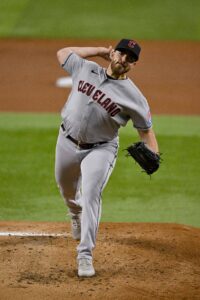
Civale, 28, is in the midst of a fine season and earning just $2.6MM with another two years of club control remaining beyond the 2023 season. The Guardians have been mulling the idea of shopping him, given their need for offense, their rich stockpile of pitching talent, and the general demand for rotation help throughout the league.
The Rays, needing rotation help with Jeffrey Springs and Drew Rasmussen falling to season-ending injuries — Tommy John surgery and flexor surgery, respectively — have been in the market for rotation help throughout the month. They previously had interest in Jordan Montgomery before his trade to the Rangers and in Cubs righty Marcus Stroman before Chicago won eight straight games and went from expected seller to potential buyer.
Civale will fill that need for the Rays, stepping into the rotation alongside Shane McClanahan, Tyler Glasnow, Zach Eflin and Taj Bradley. The Rays have been regularly deploying bullpen games and using openers since Springs and Rasmussen went down, but Civale will give them a conventional — and quite strong — five-man rotation moving forward. He’s sitting on a 2.34 ERA in 77 innings this season, and while the right-hander’s below-average 19% strikeout rate, tiny .242 average on balls in play and huge 82.7% strand rate all make that ERA seem bound for some regression, he’s nonetheless a solid big league starter.
In 433 career innings, Civale touts a 3.77 ERA, 21.1% strikeout rate, 6.1% walk rate and 42.4% ground-ball rate. While he doesn’t throw hard, averaging just 91.8 mph on his heater, Civale has long boasted excellent command, limited hard contact well enough and posted enough swinging-strikes with his versatile repertoire to find plenty of success. He uses a cutter as his primary fastball but also has a traditional four-seamer and a sinker in his quiver.
Civale’s go-to breaking pitch has been a curveball that has graded as an excellent offering throughout his career. Opponents have batted just .182/.215/.299 in the 358 times the right-hander has finished off a plate appearance with that pitch — including a .186/.205/.302 showing in 2023. A hefty 36.3% of those plate appearances have yielded a strikeout. Civale will throw very occasional sliders and changeups as well, but his curve functions as far and away his most frequent offspeed/breaking offering.
Civale is a clear upgrade to the Rays’ staff and could help them through the 2025 season, but he’s not without his own red flags and durability concerns. He’s avoided major injury and hasn’t had any surgeries, but Civale has never topped the 164 2/3 innings he pitched in the minors back in 2017 — his first full season as a professional. Since that time, he’s been on the injured list (minors and majors alike) with a litany of issues, including a lat strain, shoulder tightness, a wrist sprain, a finger sprain, forearm inflammation and an oblique strain (earlier this season).
There’s little doubting that he’s a quality performer when healthy, but Civale has only reached 100 innings in one Major League season and has only twice reached 20 starts. On the other hand, Civale’s frequent trips to the injured list have stunted his earning power in arbitration. He’s earning just $2.6MM this season, and his subsequent pair of arbitration raises will be based off that sum, which should tamp down his earnings a bit further (at least relative to other starters throughout the game).
In exchange for those two and a half seasons of affordable control, the Rays will part with one of the top bats in their system. Manzardo, 23, was Tampa Bay’s second-round pick in 2021 and quickly hit his way onto top-100 prospect rankings throughout the sport. He’s had a rough go in his first run at Triple-A as a 22-year-old, hitting just .238/.342/.442 with 11 homers in 313 plate appearances. Manzardo is walking at a huge 13.4% clip, however, and has a lower-than-average 20.8% strikeout rate despite facing older and more experienced competition. He’s also just one season removed from hitting a combined .327/.426/.617 with nearly as many walks (59) as strikeouts (65) between High-A and Double-A.
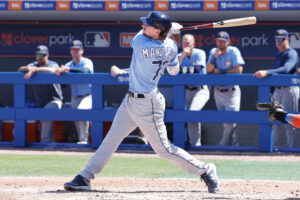
Manzardo entered the season as a consensus top-100 prospect, and even with a lackluster showing in Triple-A so far he’s still quite highly touted. He ranks as the game’s No. 31 prospect at FanGraphs, No. 37 prospect at MLB.com and No. 69 at Baseball America on each publications midseason, post-draft rankings. FanGraphs’ Eric Longenhagen writes in his scouting report that “every aspect” of Manzardo’s profile at the plate is plus, with the exception of his raw power, which is closer to average. He’s lauded for keen strike zone knowledge, consistent hard contact, an all-fields approach, his bat control and a potentially plus-plus hit tool that should allow him to hit for a high average with high-end on-base percentages.
It’s not yet clear when Manzardo will get his first big league opportunity, but it won’t be immediately. He’s been on the minor league injured list since early this month with a shoulder issue, though Cleveland clearly doesn’t believe it to be a major concern. He’ll be a candidate for a call-up late in the season and certainly will have a chance to break the Opening Day roster for the Guardians in 2024.
Since Cleveland isn’t getting an immediate big leaguer in return, there’s little doubting that this move hurts their chances of squeaking out a postseason berth in 2023. The American League Central has been the game’s most feeble division all year, and Cleveland made this trade of one of its best starters despite the fact that Shane Bieber was recently placed on the 60-day injured list and despite the fact that the Guards are only a half-game behind the Twins in the standings. That speaks volumes about how the front office views the club’s chances of faring in a potential postseason series even if they’d managed to overtake a middling and de facto first-place Twins club.
With Civale out of the picture, the Guardians’ rotation will consist of Noah Syndergaard and rookies Tanner Bibee, Gavin Williams and Logan Allen. The latter trio has all found immediate success in the Majors, and each is generally living up to his own top prospect billing. The hope for Cleveland will be that righty Cal Quantrill can return from his current bout of shoulder inflammation sooner than later. Both Bieber and right-hander Triston McKenzie are on the 60-day IL and aren’t expected back anytime soon. Depth options in Triple-A include Cody Morris, Joey Cantillo, Hunter Gaddis and Chris Vallimont — all of whom are on the 40-man roster.
The acquisition of Manzardo also has some implications for breakout Guardians star Josh Naylor, who’s turned in an excellent .308/.347/.504 slash and 15 homers this year. Naylor has spent the bulk of his time at first base, but he could well be pushed to an outfield corner whenever Manzardo is called up for his debut. Manzardo is widely regarded as a first-base-only prospect, whereas Naylor has his share of experience in the outfield. It’s possible the two could eventually split the first base and designated hitter duties, but Cleveland also has veteran Josh Bell currently playing on a two-year deal. Bell can turn down a player option for 2024 and return to free agency this winter, but his underwhelming .233/.319/.385 slash makes that feel rather unlikely.
Positional alignment to the side, the Guardians have clearly been focused on adding a controllable bat to their system for some time now, just as the Rays have been looking for some quality, affordable innings to round out the rotation behind a strong quartet. In that sense, today’s one-for-one swap fills a goal for both parties and allows each to deal from a position of depth in order to satiate that need. The Rays get the more immediate boost to their roster, but the hope among Cleveland brass is surely that Manzardo will be holding down a key spot in the lineup long after Civale would’ve otherwise reached free agency in the 2025-26 offseason.
Rockies Activate Brendan Rodgers From 60-Day IL
The Rockies announced Monday that they’ve reinstated infielder Brendan Rodgers from the 60-day injured list. Rodgers has yet to play in a game this season after suffering a shoulder injury during spring training. Colorado also recalled infielder Coco Montes from Triple-A Albuquerque. That pair of moves will fill the roster spots vacated by last night’s trades of Randal Grichuk and C.J. Cron (both to the Angels in the same deal). Rodgers also fills one of what had been three vacancies on the 40-man roster.
Originally, there was concern that Rodgers’ injury would prove to be season-ending in nature. Ultimately, it’ll still end up costing him about two-thirds of the 2023 campaign, though that’s surely a preferable result for the 26-year-old, as opposed to an entirely lost season. Rodgers has been on a minor league rehab assignment for a couple weeks now and has hit particularly well (7-for-20 with a homer and two doubles) since moving up from Class-A to Triple-A. He appeared in 10 minor league games and tallied 38 plate appearances before being deemed ready to go.
Rodgers, the third overall pick in 2015, has tallied 996 plate appearances from 2021-22 as the Rockies’ primary second baseman, turning in a solid .274/.326/.434 slash with 28 homers, 51 doubles, six triples and strong defense at second base. Defensive Runs Saved credited Rodgers with a whopping +22 mark at the position in 2022, and while metrics like Ultimate Zone Rating (7.9) and Outs Above Average (3) weren’t quite as bullish, he universally graded as an above-average defender and was recognized as such when he captured his first Gold Glove Award last year.
It’s deadline season and the Rockies are sellers, so it’s technically plausible that the Rox could be surprised by an over-the-top offer for Rodgers in the 26 hours between now and tomorrow’s trade deadline, though that seems quite unlikely. Rodgers has another two years of affordable club control remaining beyond the current season, and the Rox surely aren’t keen on trading away such a major piece of their roster when his value is down fresh on the heels of a season-long IL stint. Given the general state of the Rockies, however, Rodgers could emerge as an offseason trade candidate if he performs well in the final two months and sufficiently proves that the shoulder injury is behind him.
Giants Could Deal From Rotation Depth
The Giants have drawn interest in their starting pitchers, and while ace Logan Webb rather clearly figures to be off the table in any discussions, San Francisco has a handful of shorter-term options that could make for more realistic trade possibilities. FanSided’s Robert Murray wrote last week that lefty Alex Wood could be an option to change hands, and Ken Rosenthal and Jayson Stark of The Athletic have now similarly mentioned the possibility of trading Wood or another bulk-innings option as a means of acquiring either middle infield help or prospect depth.
A free agent at season’s end, the 32-year-old Wood has voiced a preference to remain with the Giants (link via Evan Webeck of the San Jose Mercury News). However, he’s also made clear he wants to start games, and San Francisco has frequently used him as a bulk option behind an opener. Four of Wood’s past six appearances have come in relief of an opener. He hasn’t reached six innings in an appearance all season and hasn’t recorded an out in the sixth inning since May 26.
The Giants have been careful about limiting the number of times Wood faces opponents in a game, and with good reason. In 2022, when the lefty was deployed solely as a starter, he held opponents to a .241/.300/.344 batting line on the first trip through the order and a .256/.307/.399 slash the second time around. In the 95 plate appearances where Wood turned a lineup over for the third time, opponents exploded for a .326/.368/.573 batting line. He had similarly problematic splits in 2021, too.
Wood could certainly still be of interest to clubs seeking help at the back of the rotation, although he currently looks like something of a buy-low candidate and might need to be swapped out for an infielder in similar standing with his organization. The veteran southpaw has a pedestrian 4.75 ERA on the season, and his 18.8% strikeout rate, 11.2% walk rate, 43.6% ground-ball rate and 1.19 HR/9 mark have all gone in the wrong direction, relative to his 2021-22 output. Wood is pitching in the second season of a two-year, $25MM deal and will reach free agency again following the season. About $4.167MM of this year’s salary remains to be paid out.
San Francisco has other arms to peddle in similar scenarios. Right-hander Ross Stripling and lefty Sean Manaea are both in the first season of two-year deals that guarantee them the same $25MM promised to Wood. Both, however, can opt out at season’s end. Neither has pitched up to his career standards, but both have been considerably better after a tough start to the year. Since returning from the injured list in late June, Stripling carries a 3.64 ERA and a sensational 22-to-1 K/BB ratio in 29 1/3 innings. Manaea, since a full-time move to multi-inning relief work, has 4.03 ERA with a 29.2% strikeout rate against just a 5.9% walk rate. The recent trends are encouraging, but the Giants might still have a tough time extracting present-day value in a trade — and it’s quite possible one or both will forgo his opt-out opportunity at season’s end. That’ll depend largely on how the final two months play out.
It’s worth noting that since reports about interest in the Giants’ rotation depth first emerged, right-hander Anthony DeSclafani was placed on the injured list. An MRI revealed a Grade 1 flexor strain, and DeSclafani is expected to miss a “few weeks” with the injury, at the very least. That, coupled with his prior struggles leading up to the IL placement (21 runs in his past 23 1/3 innings), figures to all but remove him as a trade candidate.
Zach Eflin Avoids Injured List, Cleared To Start Tuesday
Rays fans were bracing for bad news when righty Zach Eflin exited his most recent start after four innings and went for an MRI on his left knee, but Marc Topkin of the Tampa Bay Times tweets that he’s expected to avoid the injured list entirely. Eflin threw a 25-pitch bullpen session over the weekend and is now slated to start Tuesday against the Yankees. He’s not expected to have any limitations on his workload tomorrow.
It’s a sigh of relief for a Rays club that already lost Jeffrey Springs and Drew Rasmussen for the season. A third major injury would’ve surely accelerated Tampa Bay’s pursuit for rotation help, which has been ongoing, but it seems Eflin has avoided an injury of any real note. The right-hander’s chronic knee issues are well known; he’s spoken openly about them in the past, underwent surgery on both knees in 2016 and had a second surgery on his right knee in 2021.
That history of knee issues didn’t dissuade the Rays from making an aggressive bid to sign Eflin in free agency, ultimately inking him on a three-year, $40MM contract. He’s in the midst of perhaps the finest season of his career, tossing 116 1/3 innings of 3.64 ERA ball with a strong 25.2% strikeout rate, a masterful 3.7% walk rate and a career-high 51.7% ground-ball rate. He’ll remain in the rotation alongside Shane McClanahan, Tyler Glasnow and Taj Bradley.
The Rays were in the market for starting pitching help even before Eflin’s injury scare, and it stands to reason they’ll still be poking around that market, albeit with less urgency than if Eflin had endured a significant injury. Tampa Bay has been connected to the Cardinals’ available starters, and while Jordan Montgomery has since been traded to the Rangers, righty Jack Flaherty remains on the block. They were also tied to Marcus Stroman a few weeks ago, but that was before the Cubs rattled off an eight-game winning streak that thrust them back into the competition in the NL Central. He’s now unlikely to be moved. Lance Lynn, another Rays target, has since been traded to the Dodgers.
Even with those misses, there are still several names available. Michael Lorenzen, Eduardo Rodriguez, Justin Verlander, Jose Quintana, Aaron Civale and old friend Rich Hill are just some of the many pitchers whose names have been bandied about the rumor circuit over the past week or so.
Guardians Have Considered Making Aaron Civale Available
The Guardians’ rotation has been ravaged by injury this season, with right-handers Shane Bieber, Triston McKenzie, Aaron Civale and Cal Quantrill all spending significant time on the injured list. They’ve already added Noah Syndergaard to help patch things over. Civale is healthy and pitching well right now, however, and the Guardians have at least pondered the possibility of selling high on him if it means acquiring a controllable young hitter, reports Zack Meisel of The Athletic. Cleveland has little appetite to trade prospects for a rental acquisition at this point, Meisel further notes.
MLBTR’s Anthony Franco looked at Civale’s trade candidacy two weeks ago, outlining the reasons he’d draw interest (strong results, affordable $2.6MM salary, two-plus seasons of club control remaining) and the reasons the Guardians could be reluctant to move the 28-year-old righty (an otherwise young rotation with workload concerns, injuries to other key starters, a desire to remain competitive in a weak AL Central, and that remaining club control that piques others’ interest). Little has changed in the equation since Anthony wrote that piece, perhaps with the exception of Civale’s ERA, which has continued to drop. Civale has taken the ball four times since that was written, and he’s posted a 1.85 ERA in 24 1/3 frames — dropping his season-long ERA from 2.56 to a stellar 2.34.
There are reasons to be skeptical of Civale’s ability to continue at quite such a strong pace. His career-low 19% strikeout rate is below the league average, and both his .242 average on balls in play and 82.7% strand rate seem bound to regress. He entered the season with respective marks of .281 and 72.3% in those areas. He’s also seen just 5.6% of his fly-balls turn into home runs, which is less than half the 12.5% league average and the 14% mark he carried into the current season.
Even when factoring for some expected regression, however, Civale is still a quality big league pitcher. He’s logged 430 innings in his career and touts a 3.77 ERA. Civale has regularly showed strong command, which has helped him limit hard contact at better-than-average levels. There are durability concerns, as he’s never reached 130 innings in a Major League season and never topped the combined 164 2/3 innings he pitched in the minors back in 2017 — his first full professional season. Civale has been on the minor league and big league injured list with a variety of injuries, including a lat strain, shoulder tightness, a finger sprain, a wrist sprain, forearm inflammation and, most recently, an oblique strain. It’s a lengthy list, but also one that notably does not include any surgeries.
Looking around the league, there’s no shortage of contenders seeking starting pitching — particularly affordable arms with multiple years of club control remaining. Not all of those clubs, however, are in position to deal a big league bat with multiple years of control remaining himself. Two weeks ago, Anthony listed both the D-backs and Orioles as teams brimming with young position players who could make such a swap. Both remain logical fits, as do the Cardinals and the Reds, to name a couple more.
Cleveland has a wealth of pitching talent, with rookies Tanner Bibee, Logan Allen and Gavin Williams currently finding success in the rotation. Bieber, who might’ve been a trade candidate this month were it not for a right elbow injury that sent him to the 60-day IL, is controlled through the 2024 season. He’s due a raise on this year’s $10MM salary, however, and could potentially be moved over the winter. Triston McKenzie (through 2026), Cal Quantrill (through 2025) and Peyton Battenfield (through 2029) all have multiple years of club control remaining beyond the current season. Trades of Civale and/or (in the offseason) Bieber could potentially yield additional pitching talent, and the Guards have numerous other yet-to-debut prospects, including Joey Cantillo, Tanner Burns and the again-injured Daniel Espino.
Orioles, Cardinals Have Discussed Dylan Carlson
The Cardinals’ sell-off is in full swing, with Jordan Montgomery, Jordan Hicks and Chris Stratton already out the door. Prior to trading Montgomery and Stratton to the Rangers, the Cardinals spoke to the Orioles about the left-hander, Derrick Goold of the St. Louis Post-Dispatch reports. He adds that the O’s have also talked to the Cardinals about switch-hitting center fielder Dylan Carlson.
Goold suggests that Carlson hasn’t necessarily been a focal point in talks but rather a value add in addition to the starters they’ve marketed. Even if Carlson were viewed as a standalone target for Baltimore, there’d be some sense to it. The O’s are bursting with young talent, but they’re currently without center fielder Cedric Mullins due to a groin strain. Aaron Hicks, who’s hit well since being released by the Yankees and signing in Baltimore, is also on the injured list at the moment (hamstring strain). The O’s have gotten strong production from corner outfielders Austin Hays and Anthony Santander, but top outfield prospect Colton Cowser has struggled immensely in his first 59 plate appearances since being recalled.
Carlson, unlike the other three players the Cardinals have traded in the past 24 hours, is not a free agent at season’s end. He has three years of club control remaining beyond the current season. A former top prospect himself, the 24-year-old’s standing in St. Louis has seemingly deteriorated as he’s produced at a roughly league-average level since turning in a strong 2021 campaign.
The O’s don’t necessarily need a long-term fix in center field, as Mullins is also under team control for multiple years beyond the current season (through 2025). However, even when Mullins returns, there’d theoretically be room for both him and Carlson in the lineup. Anthony Santander could see more time at designated hitter, perhaps cutting into the playing time of struggling Ryan Mountcastle (though Mountcastle’s offense has ticked up over the past couple weeks). A speculative outfield of Hays, Mullins and Carlson would be defensively superior to the current alignment. Adding Carlson to the mix would also open further avenues for offseason deals. Santander is only controlled through the 2024 season and is due a raise on his $7.4MM salary, for instance.
The Cardinals, notably, are virtually certain to trade 27-year-old right-hander Jack Flaherty before Tuesday’s deadline. If Baltimore’s interest in the Cardinals’ pitchers extended beyond Montgomery, then it stands to reason that a deal surrounding Flaherty and Carlson could still be discussed, though the extent of the Orioles’ potential interest in Flaherty isn’t known. The right-hander is three years younger than his now-former teammate, Montgomery, but is also having a weaker season. Flaherty’s ERA is a full run higher, and he’s sporting inferior strikeout, walk and ground-ball rates.
Reds Place Jonathan India On Injured List
The Reds announced Sunday that they’ve placed second baseman Jonathan India on the 10-day injured list due to plantar fasciitis in his left foot. The move is retroactive to Saturday. Outfielder Stuart Fairchild was recalled from Triple-A Louisville in a corresponding move.
After the move was made, India told Reds beat writers that he’s hopeful of requiring just a minimum stint (link via Charlie Goldsmith of the Cincinnati Enquirer). India acknowledged that he’s been playing through pain for some time but reached a point where it became untenable. “I can’t make this worse,” he said. “If it’s worse, I’m out the whole year.”
In 103 games this season, India is hitting .251/.336/.409 with 14 homers, 20 doubles and a dozen steals. That includes a swoon at the plate over the past couple months. India hit .290/.376/.440 for the season’s first two months, but dating back to Memorial Day weekend he’s limped to a .211/.292/.376 slash.
With India on the shelf, Goldsmith notes that Elly De La Cruz will likely play shortstop regularly, with Matt McLain taking the majority of the reps at second base and Spencer Steer slotting in at third base. That crop of standout young hitters has been the driving factor behind the Reds’ surprising surge into postseason contention in 2023, and the depth they provide gives Cincinnati the ability to withstand a hopefully short-term absence for the 2021 NL Rookie of the Year.
India’s name has surfaced in trade rumors over the past few weeks, with the Reds reportedly willing to consider offers on him as a means of acquiring immediate, controllable rotation help. That’s different, of course, than the Reds actively shopping India — and a deal has never seemed especially likely. Now that he’s on the injured list and dealing with a plantar fasciitis diagnosis, it stands to reason that the already slim chances of a trade involving India have dwindled even further.
Michael Conforto Reaches Vesting Option Threshold, Can Opt Out After 2023 Season
Giants outfielder Michael Conforto reached 350 plate appearances on the season during Sunday’s game, and in doing so vested a provision in his contract that converts the second season of his two-year, $36MM contract into a player option. He’ll now have the right to decline that player option, valued at $18MM, and opt back into free agency this offseason.
Whether Conforto, 30, ultimately opts out of his deal will depend on his final couple months of play. As things stand, he’s had a roughly average season at the plate, batting .241/.331/.401 (102 wRC+) with 13 homers, 10 doubles, four stolen bases, a 10.5% walk rate and a 23.5% strikeout rate. As recently as late May, it looked like the longtime Mets slugger was trending toward an opt-out, but his bat has gone cold as the weather has warmed. Conforto was hitting .250/.347/.464 through his first 196 plate appearances, but he batted just .228/.303/.324 over his next 152 trips to the plate.
Conforto’s season-long numbers are respectable — but they’re also a far cry from the .265/.369/.495 slash he turned in across 1959 plate appearances from 2017-20. The former first-round pick might’ve commanded a nine-figure deal in free agency had he sustained that output for one more season, but Conforto’s production slipped to .232/.344/.384 through 125 games in 2021. He turned down a qualifying offer from the Mets at the end of that season, still hopeful of securing a multi-year deal, but an offseason shoulder injury required surgery that kept Conforto out of action for the entire 2022 season. He didn’t sign with a club until the 2022-23 offseason when he inked his current deal with the Giants.
Though Conforto performed at a star-caliber level during that 2017-20 peak, he’s now turned in tepid .237/.337/.392 slash over his past 827 plate appearances — his 2021 and 2023 campaigns combined. He’s still walking at a strong clip, and his exit velocity and hard-hit rate remain largely unchanged. However, he’s hitting the ball on the ground at the highest rate of his career (46.9%), and this season’s 17% line-drive rate is the lowest of his career. The plus defensive marks he regularly generated early in his career have also deteriorated; he’s sporting negative marks in Defensive Runs Saved (-3) and Outs Above Average (-3) so far in 2023.
The upcoming free agent class skews heavily toward pitchers, with very few impact bats available. A strong finish that looks more like Conforto’s peak years could position him as one of the better bats on the market, joining the likes of Cody Bellinger and Matt Chapman. As far as pure corner outfielders, Conforto would be up against Teoscar Hernandez, Hunter Renfroe, Lourdes Gurriel Jr. and Joc Pederson, among others.
Latest On Justin Verlander
7:36PM: The Braves have also “checked” on Verlander but aren’t currently in talks with the Mets, MLB Network’s Jon Morosi tweets.
5:50PM: Following the Mets’ trade of Max Scherzer to the Rangers led to further increased speculation about a trade of fellow high-priced, multi-time Cy Young winner Justin Verlander. Several teams have been tied to the nine-time All-Star, including the Rangers, Astros and Dodgers. However, Andy Martino of SNY reports that the Mets value Verlander much differently than Scherzer. They’ve placed a higher asking price in terms of prospects and aren’t willing to pay down salary to the same extent they were in order to move Scherzer.
Astros fans may be hoping for a reunion with Verlander, who won his third career Cy Young Award in Houston last season, but it doesn’t appear that’s likely. Astros GM Dana Brown tells Jim Bowden of MLB Network Radio on SiriusXM that his team isn’t in the market for a starting pitcher right now and is instead focused more on the back of the bullpen and a left-handed bat (Twitter link). Per Martino, the Astros indeed checked in on Verlander, but the teams were “nowhere close” to agreeing on his value.
USA Today’s Bob Nightengale hears similarly, writing that while Houston and New York have indeed discussed a Verlander deal, an Astros source tells him they’d likely require the Mets to pay down a “significant” portion of Verlander’s salary this year and next. Verlander’s $35MM vesting option for the 2025 season, which triggers upon reaching 140 innings pitched next year, is another hang-up in a potential deal. All of that complicates a potential Verlander/Astros reunion, which clouds the water on a trade in general. Like Scherzer, Verlander has a full no-trade clause — and Ken Rosenthal of The Athletic writes that the Astros are “perhaps” the team for which he’s most willing to waive that protection.
Broadly speaking, everything will hinge on Verlander’s preferences. Via SNY’s Steve Gelbs (Twitter link, with video), the 40-year-old righty said following Sunday’s game that his openness to a trade “largely depends on how the organization views next year,” adding that he’s “committed to trying to win a championship” in Queens but would be more open to waiving his no-trade protection if Mets decision-makers feel it’s best to take a step back in 2024. The Mets will have plenty of rotation questions with Scherzer now in Arlington and Carlos Carrasco hitting free agency at season’s end. Presently, Verlander, Kodai Senga and Jose Quintana are the only surefire starters signed into 2024. Depth options like David Peterson, Tylor Megill, Joey Lucchesi and Jose Butto all remain on hand as well.
Early indications are that the Mets don’t view this as a large-scale teardown. GM Billy Eppler plainly said after yesterday’s Scherzer trade that he does not view the current step back as a rebuild (link via Anthony DiComo of MLB.com) They’ll have ample financial firepower to pursue new arms to fill out the rotation in the offseason — with a particularly deep crop of free agent starters available. Shohei Ohtani, Julio Urias, Lucas Giolito, Aaron Nola, Blake Snell, Sonny Gray, Marcus Stroman, Jordan Montgomery and NPB ace Yoshinobu Yamamoto are among the names in the upcoming class of free agent arms.
The Mets already have nearly $220MM in guaranteed money on next year’s books, per Roster Resource — a number that includes the $26.833MM they’ll pay Scherzer. (Texas is picking up a reported $16.5MM of next year’s salary.) That’s before factoring in Brooks Raley‘s $6.5MM club option or arbitration raises for a group of ten players, headlined by first baseman Pete Alonso. Owner Steve Cohen trotted out a record payroll of more than $350MM this season, so clearly the capacity for spending is there — it’ll just be a matter of whether the Mets want to spend to that extent again after this year’s efforts fell flat in notable fashion. Trading Verlander would radically lower that 2024 financial outlay, but it’d also only create another hole that the Mets would likely need to fill in the rotation (likely via free agency).
For now, they’ll have about 48 hours to see if anyone’s willing to meet their asking price on Verlander — and then to gauge whether the right-hander is amenable to the deal.