
Dodgers Select Nick Robertson
The Dodgers have selected the contract of right-hander Nick Robertson from Triple-A Oklahoma City and optioned fellow righty Tayler Scott to Triple-A in a corresponding move, per a team announcement. It’ll be the big league debut for Robertson, a 24-year-old bullpen prospect, whenever he first takes the mound. The Dodgers already have an open 40-man spot, so they don’t need an additional move beyond optioning Scott.
Robertson, the Dodgers’ seventh-round pick in the 2019 draft, ranked 46th among Dodger prospects on the list of FanGraphs’ Eric Longenhagen back in January, where he was tabbed as a likely middle reliever despite going unselected in the Rule 5 Draft. He’s had an outstanding start to his season in OKC, pitching 25 1/3 innings with a 2.13 ERA that’s backed by an exceptional 37.4% strikeout rate and strong 7.1% walk rate. Robertson has kept the ball on the ground at a 48.1% clip and found success against both righties and lefties, the latter likely in large part due to heavy usage of an above-average changeup.
While he had a rough go in a couple stints of Double-A ball, Robertson has breezed through Triple-A pitching, both in a small sample of 11 1/3 innings last year and in this season’s 25 1/3 frames. He looks the part of a big league-ready bullpen piece, and the Dodgers will give him that opportunity as they look to stabilize what’s been a top-heavy unit. Dodgers relievers rank 26th in baseball with a 4.64 ERA, and the majority of their success has come from Evan Phillips, Brusdar Graterol and Caleb Ferguson. Robertson will get the chance to help smooth things out, although given the Dodgers’ habitual cycling of arms through the final few spots of their relief corps, it wouldn’t be a surprise to see Robertson optioned a few times even if he performs well.
MLBTR Chat Transcript
Click here to read a transcript of Tuesday’s chat with MLBTR’s Steve Adams.
Nationals Designate Andres Machado For Assignment
June 6: The Nationals have now made these moves official.
June 5, 1:28pm: The Nationals are recalling righty Jordan Weems from Triple-A in a corresponding move to the Machado DFA, per Talk Nats (Twitter link). Weems is already on the 40-man roster, so the Nats’ 40-man will simply drop to a count of 39 players for the time being. It’ll be Weems’ second stint of the season with the Nats. He tossed 2 1/3 scoreless frames earlier in the year and has a 3.75 ERA with a 24.7% strikeout rate and 13.4% walk rate in 24 Triple-A innings.
9:29am: The Nationals designated right-hander Andres Machado for assignment Sunday, reports Jesse Dougherty of the Washington Post, although the team has not yet announced the move or a replacement for Machado in the bullpen.
Machado, 30, was an oft-used member of the Washington bullpen in 2021-22, appearing in 91 games and pitching to a 3.41 ERA in 95 innings. Those solid bottom-line results came despite pedestrian strikeout and walk rates (18.8% and 9.9%, respectively) and came with a well below-average .261 average on balls in play, contributing to some far less favorable grades from fielding independent metrics (4.56 FIP, 4.45 SIERA).
They also likely aided in the Nationals’ successful effort to pass Machado through waivers unclaimed back in January, when he was designated for assignment after the team signed outfielder Corey Dickerson to a one-year contract. Machado remained with the organization and was selected back to the big league roster at the end of April.
It’s been a tough go for the right-hander since his return. Machado has appeared in 14 games and been clobbered for 16 runs on 25 hits and six walks in 17 innings. He’s punched out just 15.4% of his opponents against a 6.4% walk rate, and opposing hitters have already connected for six home runs — more than half the number he allowed (11) in total from 2021-22.
Machado is throwing harder than ever before, averaging 96.8 mph on his fastball this season, but the uptick in velocity hasn’t done him any favors. Machado has seen a slider that ranked as his best pitch in 2021 hit increasingly hard across the past two seasons, which has prompted him to instead favor his changeup as his primary secondary offering. The changeup has been a good pitch for him this year, but his four-seamer, sinker and now-seldom-used slider have all been hit hard.
The Nats will have a week to trade Machado or attempt to pass him through outright waivers. He’s out of minor league options, so any team to acquire him would need to carry him on the big league roster. Because he was also outrighted back in January, Machado would have the right to reject an outright assignment in favor of free agency even if he once again goes unclaimed on waivers.
Reds Promote Elly De La Cruz
The Reds have called up one of the top prospects in baseball, announcing Tuesday that they’ve recalled infielder Elly De La Cruz from Triple-A Louisville. In a corresponding move, third baseman Nick Senzel is headed to the injured list with a right knee issue.
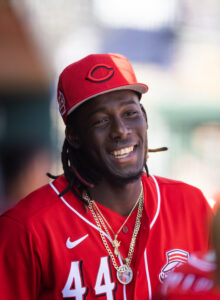
The promotion of the 21-year-old De La Cruz is the latest step in a Cincinnati youth movement that has seen the likes of Hunter Greene, Nick Lodolo, Alexis Diaz, Graham Ashcraft, Matt McLain and Andrew Abbott make their MLB debuts over the past 14 months. De La Cruz has arguably the highest ceiling of the entire group, and his first call to the Major will continue the efforts to usher in a new era of baseball at Great American Ball Park.
Cruz offers one of the most tantalizing blends of power and speed in the sport, evidenced by this year’s 12 home runs and 11 steals in 186 Triple-A plate appearances. He’s batting .297/.398/.633 with a 14% walk rate against a 26.9% strikeout rate in Louisville and has gained increasing notoriety for his Statcast-breaking exit velocities, sprint speed and arm strength at shortstop. Statcast has pegged his sprint speed as high as 31 ft/sec at times (which would rank first in the Majors), and he drew headlines for blistering three balls with exit velocities north of 116 mph in a single game earlier this season.
The 6’5″, 200-pound De La Cruz has been primarily a shortstop in his minor league career, but Cincinnati GM Nick Krall tells Jim Bowden of The Athletic that he’ll likely play both shortstop and third base in the big leagues (Twitter link). Despite his sizable frame, De La Cruz draws strong reviews for his defensive upside at shortstop. Cincinnati currently has McLain thriving at that position, however, so the switch-hitting De La Cruz could see more frequent action at third base, where Baseball America touts him as a potential plus-plus (i.e. 70-grade) defender.
Currently, De La Cruz ranks as the game’s No. 3 prospect at Baseball America, No. 4 at MLB.com and No. 5 at FanGraphs. De La Cruz occupied the top spot on Kiley McDaniel’s midseason update to his top-50 prospects over at ESPN, joining an elite tier of 60-FV prospects alongside the likes of Eury Perez, Marcelo Mayer, Jackson Holliday, Jackson Chourio and James Wood. “De La Cruz has continued to improve his polish at the plate while also continuing to show eye-popping 70- and 80-grade tools all over the field,” McDaniel wrote as part of that ranking.
The predominant concern with the switch-hitting De La Cruz is his penchant for swinging and missing. This year’s 26.9% strikeout rate is actually his lowest full-season mark to date; he’s fanned in over 30% of his plate appearances in each of his stops at Class-A, High-A and Double-A dating back to 2021. R.J. Anderson of CBS Sports points out that De La Cruz’s contact rate against while facing left-handed pitchers this season has been just 58%, underscoring the potential for some struggles in adjusting to big league opponents.
From a service time perspective, De La Cruz is being promoted late enough in the year that he won’t have any chance at organically accruing a full year of Major League service time. That technically puts him on track for free agency following the 2029 season, although for a prospect of this caliber, it’s certainly worth noting that with a top-two finish in National League Rookie of the Year voting, De La Cruz would still be awarded a full year of MLB service time thanks to provisions stipulated in the 2022-26 collective bargaining agreement. Should De La Cruz be in the Majors for good but not accrue that full year based on ROY voting, he’d accumulate 118 days of Major League service time in 2023, placing him on the cusp of Super Two status following the 2025 season.
De La Cruz’s early performance will have particular ramifications for Senzel once he’s deemed eligible to return. While a rough initial showing from De La Cruz could make it a rather straightforward call, in the event that the talented 21-year-old holds his own or seizes a spot in the same manner McLain has, Senzel’s role will become murky. The Reds moved him from center field back to third base this year and have thus far received a .258/.332/.380 batting line in 184 plate appearances. It’s not standout production but is at least solid, particularly with Senzel drawing respectable defensive grades in his return to the hot corner.
Cincinnati could opt to deploy Senzel in super-utility fashion, getting him looks at all three outfield spots in addition to third base, second base and perhaps designated hitter. But if De La Cruz hits the ground running — and arguably, even if he doesn’t — the time to get an extended look at him and McLain on the left side of the infield, opposite second baseman Jonathan India (whom the Reds have no inclination to trade), is nigh. The Reds are hopeful that said trio, along with versatile Spencer Steer and minor league slugger Christian Encarnacion-Strand, can comprise their infield of the future.
That group would leave very little in the way of regular playing time for Senzel, the former No. 2 overall draft pick and top prospect whose career has been repeatedly slowed by injuries. Senzel, who’ll turn 28 later this month, has two years of club control beyond the current season, which (speculatively speaking) could make him an intriguing trade candidate to other teams seeking MLB-ready position players. The Reds’ outfield doesn’t have this same looming influx of young talent, so it’s certainly possible that Senzel could just return to the grass on a full-time basis if De La Cruz earns a long-term look in the infield, but Senzel’s role with the club is murkier now than at any point in his still-young career.
Any such decisions are unlikely to be made in the immediate future, though, and the focus for Reds fans is surely on getting their first look at the ballyhooed De La Cruz. The great hope among a Reds fanbase that has felt jilted in the wake of yet another teardown/rebuild and repeated, poorly received public comments from team CEO Phil Castellini, is that between this wave of young infielders and starting pitchers, a return to relevance in the NL Central could happen by next year at the latest — if not as soon as this summer.
Braves Acquire Ben Heller, Designate Nick Solak
The Braves have acquired right-hander Ben Heller from the Rays in exchange for international bonus pool space and optioned him to Triple-A Gwinnett, per a team announcement. Outfielder Nick Solak was designated for assignment in a corresponding roster move.
Heller, 31, was just designated for assignment by the Rays last week. Signed to a minor league deal in the winter, he had his contract selected in late May but was optioned back to the minors before getting into a game. In 18 games at the Triple-A level for the year, he’s logged 27 1/3 innings with a 3.95 ERA, 26% strikeout rate, 6.1% walk rate and 49.4% ground ball rate.
He has a bit of major league experience, getting into 31 games with the Yankees from 2016 to 2020 with a 2.59 ERA in that time. Unfortunately, he then spent much of 2021 and 2022 injured before landing with the Rays this year. Tampa frequently cycles pitchers on and off their roster throughout the season but it seems that Heller drew enough interest from clubs around the league that Tampa will get a little bit of extra money to spend on international amateurs.
For Atlanta, they’ve dealt with some challenges to their pitching staff, especially with starters Max Fried and Kyle Wright on the injured list and facing significant absences. They also have relievers Dylan Lee and Michael Tonkin on the IL, alongside Tyler Matzek who underwent Tommy John surgery last year. They will add Heller to their Triple-A club and have a bit of extra depth on hand for when they need a fresh arm. Heller is in his final option year and will be out of options next year. He has over three years of service time and will be eligible for arbitration this winter.
In addition to giving up a bit of bonus pool money, the club is also risking losing Solak. The 28-year-old once seemed like a potential building block for the Rangers when he debuted in 2019 and hit .293/.393/.491 in his first 33 games. He had always hit well in the minors and there was little reason to doubt he would continue to do so. Unfortunately, he slashed just .246/.317/.354 from 2020 to 2022. He was also pushed off second base both due to his subpar work there and the club signing Marcus Semien. He’s since spent more time in left field, which put more pressure on his bat to provide value.
In November, the club finally decided to cut bait and flipped Solak to the Reds for cash. He lasted on the Reds’ roster through the winter but was designated for assignment at the end of Spring Training. He then went to the Mariners in another cash deal but got the DFA treatment again just 10 days later. A couple of waiver claims then took him to the White Sox and Braves in the middle of April. Solak hit .272/.364/.444 for a 106 wRC+ in 173 plate appearances for Gwinnett. He struck out in just 15.6% of his plate appearances while walking at a 9.8% rate.
Now Solak has been given the DFA treatment yet again and might soon find himself in a sixth organization in less than a year. Despite the struggles at the major league level, he continues to hit in the minors. He’s in his final option year so some club could put in a claim and stash him in the minors. He’s been limited to left field this year but perhaps some club would give him another chance at the keystone. If he were to clear waivers, he would stick with the Braves since he has less than three years of service time and does not have a previous outright.
Braves Outright Lucas Luetge
10:45am: As expected, Luetge has indeed opted to remain with the Braves and accept his outright assignment, writes Justin Toscano of the Atlanta Journal-Constitution.
9:35am: The Braves announced Tuesday that left-handed reliever Lucas Luetge went unclaimed on outright waivers and has been assigned to Triple-A Gwinnett. Atlanta also announced this morning that right-hander Roddery Munoz will be recalled from Triple-A, setting the stage for the 23-year-old reliever’s big league debut. They had an open 40-man spot after optioning righty Michael Soroka yesterday.
The 36-year-old Luetge, who’d been designated for assignment over the weekend, has the right to reject that assignment in favor of free agency by virtue of both Major League service time (four-plus years) and a prior outright assignment in his career. However, because he doesn’t yet have five years of MLB service, electing free agency would mean forfeiting the remainder of this year’s $1.55MM salary. As such, it seems quite likely he’ll accept and remain in the Braves organization without occupying a spot on the 40-man roster.
Luetge joined the Braves over the winter in a trade that sent minor league infielder Caleb Durbin and minor league reliever Indigo Diaz back to the Yankees. Luetge had been somewhat of a surprise DFA by the Yankees, but the decision to move on from the lefty in exchange for a pair of mid-level minor leaguers — both of whom have played well thus far in 2023 — looks defensible given Luetge’s struggles in 2023.
Thus far, Luetge has appeared in nine games with the Braves but been tagged for 11 runs on 15 hits and six walks through just 9 2/3 frames. After striking out a quarter of his opponents against a 5.8% walk rate in two years with the Yankees, the southpaw has fanned a diminished 22.2% of his opponents and issued walks to 13.3% of them. It’s a small sample, but Luetge has also seen his swinging-strike rate plummet from 12.7% to just 8.1%, while the velocity on his cutter has dipped to a career-low 87.1 mph.
Luetge also spent more than a month on the injured list with inflammation in his left biceps, so it’s possible there’s a physical reason for this year’s struggles. Whatever the root of the issue, he’ll now quite likely look to get back on track with the Braves’ Gwinnett affiliate and earn another look in the big leagues.
As for Munoz, he’s moved to the bullpen in 2023 after spending the majority of his prior professional career as a starter. The Braves signed the 6’2″ righty out of the Dominican Republic back in 2018, and he’s pitched his way into becoming one of the more promising arms in a relatively thin Braves system. Baseball America and MLB.com ranked him 22nd and 21st among Atlanta farmhands, respectively, both touting a potentially plus slider and mid-90s heater. Munoz’s changeup is regarded as a below-average pitch, however, and his command has clear room for refinement.
So far in 2023, Munoz has split the season between Double-A and Triple-A, working to a combined 4.94 ERA in 27 1/3 frames. He’s walked nearly as many of his 126 opponents (20) as he’s struck out (24). He’s avoided home runs and kept the ball on the ground at a strong 46% clip, but it’s been a tough season on the whole. That said, he’s allowed just one run and fanned 14 over his past 11 innings, albeit with seven walks and a pair of hit batters in that time continuing to shine a light on his sub-par command.
Red Sox Designate Raimel Tapia For Assignment
The Red Sox announced Monday that they’ve reinstated infielder Christian Arroyo from the injured list and, in a corresponding move, designated outfielder Raimel Tapia for assignment.
The veteran Tapia, 29, was non-tendered by the Blue Jays last winter and signed a minor league deal with the Red Sox, who selected his contract prior to Opening Day. He’s appeared in 39 games thus far and tallied 97 plate appearances in Boston, batting .264/.333/.368 with a homer, four doubles, a triple and six stolen bases (in seven attempts). He’s drawn nine walks and fanned 19 times along the way, giving him slightly better-than-average rates in both departments.
Tapia has played all three outfield spots in Boston but has primarily been a left fielder in his big league career — most of which has been spent with the Rockies. He’s drawn solid, if unspectacular grades in left field and in center field, though defensive metrics aren’t particularly keen on his right field prowess. He’s been average or a tick worse across the board in the outfield this season per each of Defensive Runs Saved, Ultimate Zone Rating and Outs Above Average.
With some outfield versatility, above-average contact and above-average speed, Tapia has been a solid enough fourth outfielder in Boston, even with a glaring lack of power. That’s generally par for the course for the speedster, who has never topped nine home runs in a big league season and hasn’t been deemed a strong enough defender by any of the Rockies, Jays or Red Sox to run out in center field on a regular or even semi-regular basis.
Tapia can certainly provide value, but as a primarily left-field option without much power and with notable platoon splits (.105/.190/.105 versus lefties in 2023; .275/.305/.361 career), he’s perhaps a bit more limited than one might expect with a cursory glance at his batting line and 89th percentile sprint speed (per Statcast). It’s still at least somewhat surprising to see the Red Sox move on in this fashion, although with an all-left-handed-hitting outfield mix of Masataka Yoshida, Jarren Duran and Alex Verdugo, Tapia’s lefty bat might well have been deemed a suboptimal fit. The right-handed-hitting Rob Refsnyder offers a more natural complement in that regard.
The minor league deal Tapia signed over the winter contained a $2MM base salary, so any team that claims him or acquires him would need to be comfortable picking up the remainder of that prorated bill. Boston could always include some cash to help facilitate a trade, and a trade is surely the team’s preferred option, as Tapia has more than five years of MLB service and can thus reject an outright assignment while retaining the entirety of the salary still owed to him. The Red Sox will have a week to trade Tapia, attempt to pass him through outright waivers, or release him.
Best Deadline Rental Returns In Recent History: Honorable Mentions
The calendar has flipped to June, and more than one-third of the season is in the rearview mirror. While there’s still plenty of time for the standings to change in dramatic fashion — just ask the 2022 Phillies or 2019 Nationals — the “early” portion of the season is a bit behind us. As the weather heats up and playoff pictures begin to take a more definitive shape, the baseball world inherently turns its focus to a few things: the looming All-Star Game, the upcoming amateur draft and, of course, the annual trade deadline.
June trades of note are admittedly rare — particularly over the past ten years or so — but we’re fast approaching the portion of the season where trade needs, potential trade candidates and many other deadline-adjacent minutiae begin to crystallize. It’s common for fans of rebuilding and/or underperforming clubs to begin to wonder just what sort of returns their favorite team might be able to eke out for veteran players with dwindling club control.
Some of the most common questions we’re asked in chats at MLBTR these days center around what a team might be able to get for a certain player — rentals in particular. Names like Lucas Giolito, Cody Bellinger, Jordan Montgomery and Jeimer Candelario were just a few readers asked me about this past week. To be clear, it’s not a given that all or even any of those specific names will change hands in two months’ time (or sooner), but it’s obviously a hot topic that’s on people’s minds.
As such, it only seemed natural to take a look back through recent history and look at some high-profile trades of rental players and see which panned out the best for the team selling off the veteran player in question. Over the next couple weeks, we’ll roll out a look at the ten “best” returns for rental players in recent trade deadline history.
A few caveats of note! At times, it can take three, four, five years or even longer for a team to begin reaping the benefits from such a deal. An immediate return isn’t always apparent, particularly when you’re only selling two months of a player or players. As such, we’re not considering trades completed at last year’s deadline for our top ten, even though they could well prove excellent as soon as 2024 or 2025. It’s simply too soon to evaluate those swaps. Also, these rankings are subjective; they’re not based on a hard-and-fast WAR criteria or anything of the sort. If you think we should’ve ranked No. 7 higher and No. 4 lower, let us know. It’s all part of the fun.
While I said we’re omitting last year’s deadline from our top ten, that doesn’t mean we’ll completely ignore the results of the 2022 deadline. To kick off the series, here’s a quick look at three honorable mentions from 2017-21 as well as a handful of 2022 trades that will be worth keeping an eye on in the years to come. Present-day impact of these 2022 trades has either been minimal or nonexistent, but each brought the “selling” team some nearly MLB-ready help that could be impactful as soon as this season. These honorable mentions and 2022 swaps aren’t ranked — they’re just sorted alphabetically by the last name of the player who was traded.
Let’s begin!
Honorable Mentions
Orioles acquire RHPs Dillon Tate, Cody Carroll and LHP Josh Rogers from the Yankees in exchange for LHP Zack Britton (7/24/18)
Two-thirds of this return for Baltimore wound up making little to no impact, but the acquisition of Tate, a former No. 4 overall draft pick, wound up paying dividends. Though Tate isn’t the rotation piece the Rangers hoped for when drafting him or the Yankees envisioned when acquiring him for Carlos Beltran, he’s emerged as a quality setup man at Camden Yards. The O’s gave Tate just ten starts after the trade before moving him to the bullpen, and while his rookie effort in 2019 left plenty to be desired, he’s since pitched quite well.
Dating back to 2020, Tate has a 3.65 ERA in 158 innings of relief, adding 25 holds and eight saves along the way. Tate’s 19.1% strikeout rate is below-average, but his 6.8% walk rate is better than average and his 57.9% grounder rate is outstanding. In 2022, he pitched to a pristine 3.05 ERA through 73 2/3 frames, tallying five of those saves and 16 of those holds. A forearm strain has kept Tate out of action this year, however.
Tate isn’t peak Britton and likely never will be, but trading two months of an elite reliever and winding up with six years of club control over an above-average reliever isn’t a bad outcome for Baltimore. As for the Yankees, they got the tail end of Britton’s prime. He notched a 2.88 ERA in 25 innings down the stretch and re-signed on a three-year deal with a fourth year option (that had to be exercised after the contract’s second season to prevent a Britton opt-out). Britton posted a sub-2.00 ERA in both 2019 and 2020, but he pitched just 19 innings over his final two years in New York due to injuries.
Rays acquire LHP Jalen Beeks from the Red Sox in exchange for RHP Nathan Eovaldi (7/25/18)
Few could’ve predicted what an impactful trade this would end up being at the time it was made. At the time of the swap, Eovaldi was in his first season back from Tommy John surgery and had pitched 57 innings of 4.26 ERA ball for Tampa Bay. He’d long intrigued teams with his power arsenal but was inconsistent and carried a career ERA that more or less matched that season total.
Eovaldi took off in Boston, however, tossing 54 frames of 3.33 ERA ball as the Sox marched to the postseason, where he cemented his status in Red Sox lore. Eovaldi was a star that October, tossing 22 1/3 innings of 1.61 ERA ball with a 16-to-3 K/BB ratio. Those are impressive numbers on their own, but they only tell part of the tale. Eovaldi won his first two starts of the playoffs before moving to the bullpen and picking up a pair of holds. But it was Game 3 of the World Series, where Eovaldi gutted out six innings of relief in an 18-inning marathon and finished out the game, that many will remember. The Dodgers wound up winning when Eovaldi’s 97th (!) pitch out of the bullpen was deposited in the seats by Max Muncy, but he saved the Boston bullpen with six innings of one-run ball that night. The Sox went on to win the World Series in five games.
As for the Rays, they came away with a lefty who’d come up through Boston’s system as a starter but would be used in a jack-of-all-trades role in St. Petersburg. Beeks has served as a long reliever, a setup man and an opener in parts of five seasons with Tampa Bay, totaling 258 innings of 4.12 ERA ball along the way. He’s been the type of versatile arm whose value can’t be neatly encapsulated in what looks like an otherwise modest WAR total. Beeks has handled just about any role the Rays could ask, and he’s generally been effective in doing so. He’s not a star, but he’s been an important member of their pitching staff for a half decade now and is still under team control through the 2024 season.
Tigers acquire RHP Reese Olson from the Brewers in exchange for LHP Daniel Norris (7/30/21)
The 23-year-old Olson made his big league debut on Friday when he stepped into the Detroit rotation to take the spot of the injured Eduardo Rodriguez. As far as debuts go, it was nearly as good as a young pitcher could ask for. Olson carried a no-hitter into the sixth inning before being tagged for a pair of runs and departing five frames of two-run ball in the books.
Olson isn’t regarded among the sport’s top 100 prospects and isn’t even universally considered to be among the Tigers’ top 10 prospects, but he’s missed bats consistently in the upper minors and is regarded as a potential long-term rotation piece if he can improve upon the command of his fastball. Scouting reports at Baseball America, FanGraphs, The Athletic and MLB.com praise Olson’s secondary pitches, particularly his changeup, which he’s begun using effectively even in right-on-right situations.
Detroit has seen a lot of turnover in the baseball operations department since this trade, but former GM Al Avila, AGM David Chadd and others will be in line for some praise if the Tigers get a viable big leaguer in exchange for two months of the veteran Norris, who was sitting on a 5.38 ERA in 36 2/3 innings at the time of the deal. Norris had been tough on lefties, and the Brewers surely felt they could coax a higher level of performance out of him with some tweaks. That didn’t happen, however, as Norris was rocked for a 6.64 ERA in Milwaukee, walking 15 of the 63 batters he faced (23.8%) and serving up five homers in 20 1/3 frames (2.2 HR/9).
2022 Deadline Swaps to Watch
Pirates acquire RHP Johan Oviedo, INF Malcom Nunez from the Cardinals in exchange for LHP Jose Quintana, RHP Chris Stratton (8/2/22)
Yes, technically this isn’t a pure rental. Stratton had an additional year of club control, and that surely factored into the return. But he was also sitting on a 5.09 ERA at the time of the deal, and this was largely a trade centered around getting Quintana to land some much-needed rotation help in St. Louis.
The Cardinals got just what they wanted out of this deal — and then some. Quintana stepped into the rotation and not only solidified the staff but pitched to a brilliant 2.01 ERA in 62 2/3 frames down the stretch. The lefty was so excellent that St. Louis wound up tabbing him as the Game 1 starter in last year’s National League Division Series. Quintana had signed a one-year, $2MM deal in the offseason and was acquired as a back-end starter but pitched like an ace. The script doesn’t get much better for the acquiring team.
That said, this trade also has the makings of a winner for Pittsburgh. The 25-year-old Oviedo has been inconsistent but shown flashes of brilliance with the Bucs. He’s throwing fewer fastballs and more breaking pitches — particularly more curveballs, which has been an extremely effective offering for him through 11 starts. Oviedo’s 4.50 ERA in 58 innings looks pretty pedestrian, but he’s upped his ground-ball rate and improved his velocity even in a rotation role. He’s allowed one or zero runs in six of his 11 starts this year. The Pirates can control Oviedo for four more years beyond the current season, and if he’s a legitimate starter or even a multi-inning relief piece, that’ll be a fine return for their modest Quintana flier. Nunez, meanwhile, hit .286/.381/.476 in Double-A following the trade and is at .255/.338/.369 in 160 Triple-A plate appearances this year.
Cubs acquire RHP Ben Brown from the Phillies in exchange for RHP David Robertson (8/2/22)
Robertson was one of the most in-demand relievers — or trade candidates in general — at last year’s deadline, and the rebuilding/retooling Cubs needed to get their return right. So far, it looks like they’ve done just that. Brown is out to a sensational start in the upper minors this year, pitching to a combined 2.63 ERA with a 35.5% strikeout rate against a less-appealing 11.7% walk rate. Baseball America ranked him sixth among Cubs prospects heading into the season, and The Athletic’s Keith Law called him a “heck of a get for two months of a 37-year-old reliever.” FanGraphs currently has him ranked 87th on their top-100 prospect list, and MLB.com moved him into its top-100 just this morning.
Despite Brown’s wide-reaching acclaim, the Phillies might not even regret making the swap. Robertson struggled with his command following the trade but still posted 22 1/3 innings of 2.70 ERA ball and saved six games for Philadelphia down the stretch in a tight Wild Card race that saw them edge out the Brewers by exactly one win. The Phillies needed every single victory, and if they’d held onto Brown and targeted a different reliever(s), who knows whether they’d have reached the playoffs? Were it not for Robertson — who pitched 7 2/3 innings of one-run ball in the playoffs — the Phils may never have experienced J.T. Realmuto‘s NLDS inside-the-parker, Rhys Hoskins‘ four-homer NLCS, or Bryce Harper‘s iconic NLCS-clinching bomb.
Angels acquire OFs Mickey Moniak, Jadiel Sanchez from the Phillies in exchange for RHP Noah Syndergaard (8/2/22)
This trade might not have gone as well as the Phillies hoped. Syndergaard was decent down the stretch, pitching to a 4.12 ERA in 10 appearances, nine of them starts. He started just twice in the postseason and made one relief appearance. Syndergaard pitched like a fourth or fifth starter but saw his already diminished velocity and strikeout rate step even further back following the trade. Again, the Phils needed every last win to get to the playoffs, though, so it’s hard to say they’d definitively have done anything different. They won six of Syndergaard’s nine starts and also picked up the victory in the lone game they used him out of the bullpen, when he tossed two scoreless frames.
At least thus far, Angels fans can’t complain about the return. Moniak isn’t going to sustain a .429 batting average on balls in play, but he’s hitting .327/.340/.694 in 50 plate appearances. The BABIP and a 34% strikeout rate scream for regression, but the former 1-1 pick has already hit as many homers through 50 trips to the plate with the Halos (four) as he did in 167 with the Phillies. He’s played good defense, run well and given some hope that he can carve out a role moving forward.
Red Sox acquire INF Enmanuel Valdez, OF Wilyer Abreu from the Astros in exchange for C Christian Vazquez (8/1/22)
Trading Vazquez was part of a disjointed Red Sox trade deadline that saw Boston trade away their longtime catcher and lefty reliever Jake Diekman while also acquiring Eric Hosmer and Tommy Pham. It wasn’t clear that their 2023 roster was improved, and the decision to hold onto other trade targets while adding Pham’s salary left them just over the luxury tax line (thereby reducing their compensation for qualifying offers extended to Xander Bogaerts and Nathan Eovaldi).
Digression aside, the swap might prove beneficial to the Sox in the long run. Valdez has already made his big league debut, and although his bat faded after a hot start, he’s still sporting a passable .244/.292/.422 batting line (91 wRC+) in his first 97 big league plate appearances. He’s picked up four homers, four doubles and three steals (in four tries) while subbing in at second base in the wake of a slew of middle-infield injuries. Valdez posted absolutely massive numbers in 205 Double-A plate appearances last year (.357/.463/.649) before moving up to Triple-A and hitting .265/.327/.488.
Abreu, meanwhile, was added to the 40-man roster over the winter and is hitting .264/.379/.479 in 40 Triple-A games so far. He’s regarded as a potential plus outfield defender, and his success in Triple-A and status on the 40-man roster mean the Red Sox could possibly have two MLB contributors within a year or so of trading Vazquez.
It’s hard to say anything moves the 2022 Astros made “didn’t work out,” as the team won the World Series in the end. But Vazquez took a backseat to Martin Maldonado both in the regular season and the playoffs, hitting just .250/.278/.308 in 108 regular-season plate appearances following the swap (plus .235/.316/.235 in just 19 playoff plate appearances).
Rays Place Brandon Lowe On Injured List
The Rays have placed infielder Brandon Lowe on the 10-day injured list due to inflammation in his lower back, per a team announcement. The move is retroactive to June 4. Infielder/outfielder Vidal Brujan has been recalled from Triple-A Durham to take Lowe’s spot on the roster.
Lowe, 28, sprinted out of the gates with an impressive power display early in the season, slashing .257/.368/.581 with seven homers through his first 87 trips to the plate. His OPS has plummeted by more than 250 points since that time, however, as he’s fallen into a dismal slump. Over his past 114 plate appearances, Lowe is slashing just .157/.237/.255 with a huge 30.7% strikeout rate.
The Rays held Lowe out of yesterday’s lineup with what was initially termed discomfort in his lower leg, but Lowe told reporters not long before the game that he’d also been experiencing discomfort in his back following a recent slide into third base. That issue, it seems, has proved problematic enough that he’ll be shelved for at least the next nine days. The team has not yet provided any sort of timetable for his return to the roster.
Brujan, 25, was long rated as one of the game’s top overall prospects but has yet to find any success in the big leagues. He’s seen time in each of the past three seasons but managed only a .161/.215/.233 output in 209 plate appearances. That includes a .250/.286/.250 slash in 21 trips to the plate this season. He’s been far better in Triple-A, where he sports a .268/.355/.435 batting line, 22 home runs and 79 steals in 198 games (883 plate appearances).
With Lowe sidelined, the ever-versatile Rays will have plenty of options to step into the lineup in his place. Each of Taylor Walls, Isaac Paredes and the newly recalled Brujan is plenty familiar with Lowe’s customary second base. The switch-hitting Walls and the righty-swinging Paredes are both much better against left-handed pitching than against righties. Brujan, also a switch-hitter, has typically been better from the left side of the plate, and that’s especially true in 2023: .286/.380/.484 versus righties, .167/.297/.241 versus lefties. For today, with the Rays taking on Red Sox righty Brayan Bello, it’ll be Brujan drawing the start and batting eighth.
Mets Designate Tomas Nido For Assignment, Activate Omar Narvaez
11:53am: The Mets are hopeful of working out a trade involving Nido before his DFA window expires, tweets Mike Puma of the New York Post. They’ll have five days to do so before Nido must be placed on either outright or release waivers.
11:35am: The Mets have formally announced Nido’s DFA. Narvaez has been reinstated from the injured list in a corresponding move.
11:15am: The Mets are expected to designate catcher Tomas Nido for assignment and move to a catching tandem of young Francisco Alvarez and veteran Omar Narvaez, tweets Andy Martino of SNY. Narvaez, who’s been out since early April due to a calf strain, has played six minor league rehab games and has been trending toward a return to the big league roster.
Nido, 29, inked a two-year deal to buy out his final two arbitration seasons this offseason. That contract guaranteed him a total of $3.7MM. He’s now just 15 days shy of reaching five years of MLB service time, at which point he’d have been able to reject an outright assignment in favor of free agency while still retaining the entirety of that guaranteed salary. However, because he’ll fall shy of five years of service if placed on outright waivers, he’d forfeit the remainder of that salary upon rejecting an assignment to the minors.
The timing of Narvaez’s return likely played a larger role in the decision to DFA Nido, but the fact that the Mets can make this move now and quite likely retain Nido because of that contractual situation was surely a consideration. It’s unlikely that another club would pick up the remainder of this year’s $1.6MM salary and all of next year’s $2.1MM salary when Nido has struggled to a .125/.153/.125 batting line through 61 plate appearances this season.
The Mets would’ve been on the hook for the majority of that money regardless, but if they can’t work out a trade, they’ll now be able to stash Nido in Triple-A as a depth option in hopes that he can get back on track. Given that Narvaez has an opt-out in his two-year contract following the current season, the possibility of retaining Nido at an affordable rate through the 2024 campaign likely holds some additional appeal.
Prior to this season — one in which he was on the injured list due to vision-related issues — Nido has been a solid, albeit glove-first backup option behind the plate in Queens. From 2020-22, the former eighth-round pick tallied an even 500 plate appearances while posting a .236/.275/.338 batting line. That was about 26% worse than the league-average hitter and about 15% worse than the average catcher, by measure of wRC+.
On the other side of the ball, Nido ranked among the game’s best. He piled up a huge 18 Defensive Runs Saved in that stretch despite logging just 1192 innings behind the plate, and he rated among the game’s top backstops in terms of pitch framing as well. After struggling with throwing out runners early in his career, Nido posted a sensational 57% caught-stealing rate in 2021 and sat at 29.8% from 2021-22. He’s just 2-for-13 in 2023 under the new rules and while dealing with his reported vision troubles. Statcast’s new Blocking Runs Above Average metric pegs Nido 22nd in MLB dating back to 2018 despite having far fewer chances than many of the names ahead of him in that cumulative metric. On a per-game basis, he’s tied for 19th in the Majors among qualified catchers (since 2018).
All told, Nido is a light-hitting, quality defensive catcher who’s signed at a generally reasonable rate. Teams tend to bypass taking on even modest sums — particularly multi-year commitments — via waivers, so the likelihood remains that if things get to that point, Nido could stick in the Mets organization. In the days leading up to when he’ll have to be placed on waivers, however, the Mets can discuss trade scenarios and perhaps offer to kick in some cash to sweeten the pot. If he hasn’t been traded within five days, that’ll be a sign that Nido is likely on waivers, the outcome of which would be known within 48 hours of his placement.