
Oscar Mercado Day-To-Day With Sprained Wrist
MARCH 7: Fortunately, it seems Mercado has avoided serious injury. The MRI revealed a “mild sprain,” tweets Zack Meisel of the Athletic. He’s currently day-to-day.
MARCH 6: Indians center fielder Oscar Mercado will undergo an MRI on his left wrist after injuring it while making a diving catch in yesterday’s Cactus League game, the team revealed to reporters (Twitter link via Mandy Bell of MLB.com). Mercado laid out to catch a shallow fly in center field and immediately came up clutching his wrist (video link). He immediately exited the game in obvious pain. The Athletic’s Jason Lloyd tweets that Mercado will be evaluated by hand specialist Dr. Thomas Graham, and an update will likely be provided tomorrow.
Mercado, 25, broke out with a strong rookie campaign in 2019, cementing himself as Cleveland’s center fielder with a .269/.318/.443 batting line, 15 home runs, 25 doubles, three triples and 15 steals. Mercado played a well above-average center field by virtually any available metric (+10 Defensive Runs Saved, +2.8 Ultimate Zone Rating, +5 Outs Above Average). While there’s been plenty of ink dedicated to the uncertainty in the Indians’ corner outfield slots, Mercado’s grip on the center field job has never been in question.
Should the Indians receive bad news, their acquisition of Delino DeShields Jr. in the Corey Kluber trade will give them an experienced center field option to plug in on a short-term basis. DeShields can’t match Mercado’s offensive production — he’s a career .246/.326/.342 hitter (76 wRC+) — but is a similarly well-regarded defender with even more speed to burn. Fellow speedster Greg Allen also has ample experience in center field, too.
Injuries have been an issue for Cleveland early in camp, as Mike Clevinger has undergone knee surgery and Emmanuel Clase (acquired alongside DeShields in the aforementioned Kluber swap) will miss up to 12 weeks after being diagnosed with a strained teres major.
Tyler Beede Diagnosed With Flexor Strain, UCL Sprain
MARCH 7: Beede will visit noted orthopedist Dr. Neal ElAttrache for his previously-anticipated second opinion Monday, per various reporters (including Andrew Baggarly of the Athletic).
MARCH 4: The Giants announced Wednesday that an MRI on right-hander Tyler Beede revealed a flexor strain and a sprain of the ulnar collateral ligament in his right elbow. No immediate treatment plan was provided, as the club will be seeking second opinions for the time being. Beede exited his most recent spring outing due to tightness in his elbow. Beede tells reporters that his UCL is 75 percent intact and that he’s not expecting surgery at this time (Twitter link via Henry Schulman of the San Francisco Chronicle).
Beede, 26, was a leading candidate to break camp in the fifth spot in the Giants’ rotation behind Johnny Cueto, Jeff Samardzija, Kevin Gausman and Drew Smyly. Now, however, his outlook is considerably cloudier, which could open the door for an alternative option to seize that role. Just last week, president of baseball operations Farhan Zaidi listed Beede, Dereck Rodriguez, Andrew Suarez and Logan Webb as potential rotation candidates. The Giants also have veterans Trevor Cahill and Tyson Ross in camp on non-roster invitees.
At the very least, it looks exceedingly likely that Beede will open the season on the injured list. Obviously, though, any UCL injury and/or flexor strain comes with the possibility of a serious operation. Even non-surgical treatments for those types of injuries tend to come with lengthy rehab stints.
It’s a tough blow for Beede, a two-time first-round pick (Blue Jays in 2011, Giants in 2014) who has yet to cement himself as a consistent starter at the big league level. The right-hander started 22 games for the Giants in ’19 and racked up 117 innings, but he also struggled to a 5.08 ERA (5.03 FIP). Despite the Giants’ cavernous home park, the long ball was an issue for Beede (1.7 HR/9). There was perhaps some hope that a correction in the ball’s composition could help Beede. After all, he averaged 94.3 mph on a fastball with above-average spin. Beede’s 8.7 K/9 rate and 11.2 percent swinigng-strike rate both checked in better than that of the league-average starting pitcher as well.
Brewers Extend Christian Yelich
The Brewers have locked up the face of their franchise for the better part of the decade, announcing a nine-year contract with outfielder and 2018 NL MVP Christian Yelich that runs through the 2028 season and includes a mutual option for the 2029 season. Yelich, a client of Paragon Sports International’s Joe Longo, will reportedly be promised seven years and $188.5MM on top of what he was already owed through the 2021 season.
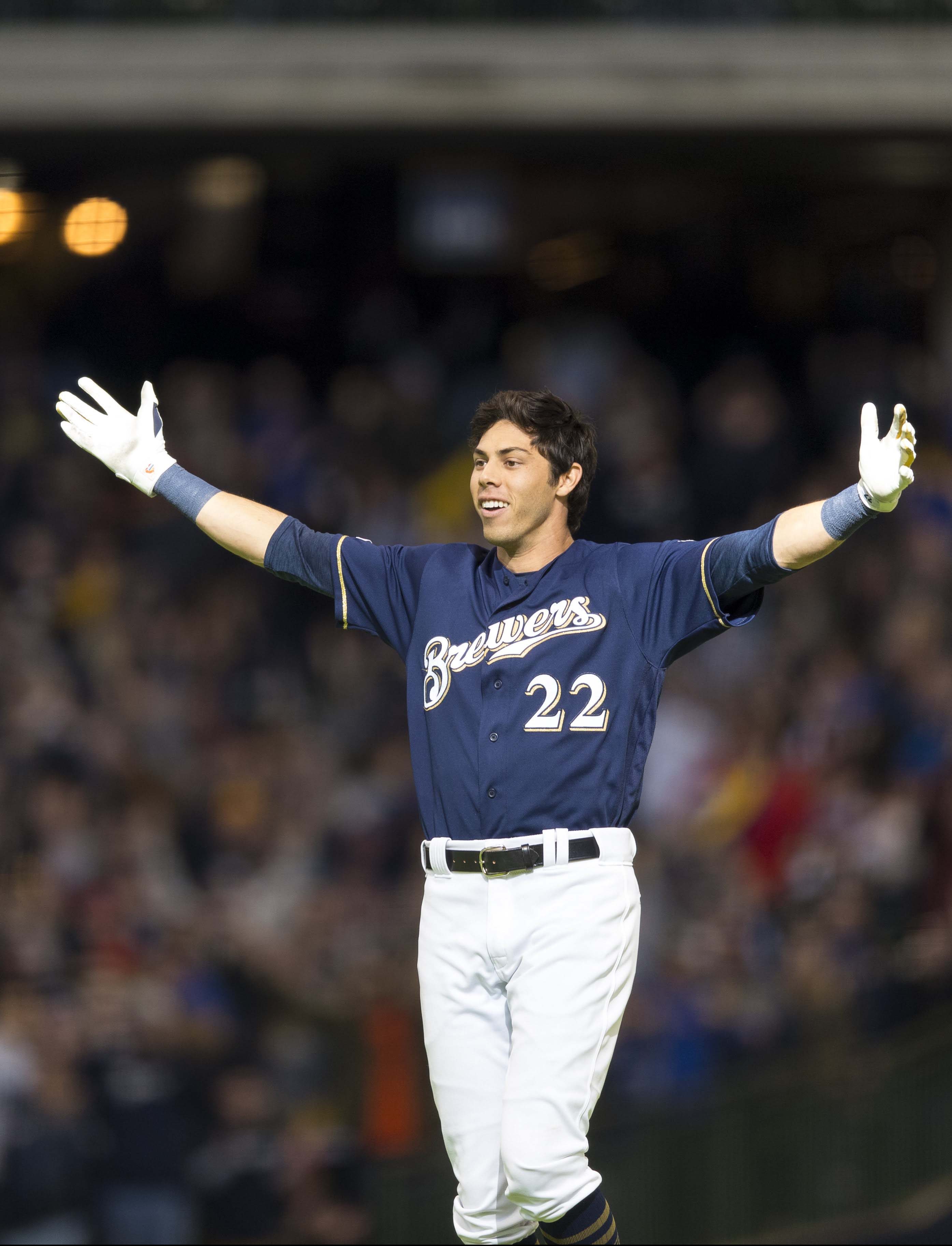
The 28-year-old Yelich was already under club control for $12.5MM in 2020 and $14MM in 2021 — plus a $15MM club option ($1.25MM buyout) for the 2022 season. Those salaries came under the terms of Yelich’s previous seven-year, $49.57MM deal, though; the newly proposed arrangement would obviously catapult him into the game’s elite in terms of annual rate of compensation.
Under the terms of the new contract, those 2020-21 salaries will remain in place, while Yelich will reportedly be guaranteed $26MM annually (with $4MM in deferrals) from 2022-28. The option is said to be valued at $20MM with a $6.5MM buyout. He also receives a full no-trade clause. The contract doesn’t have any opt-outs. In all, he’ll be paid a hefty $215MM over the next nine seasons thanks to today’s extension.
Of course, Yelich has more than proven worthy of that level of investment since being traded over from Miami in a lopsided deal that sent Lewis Brinson, Isan Diaz, Jordan Yamamoto and Monte Harrison to the Marlins. Yelich had cemented himself as a well above-average player in Miami, but the former No. 23 overall pick and top prospect erupted with an MVP season in 2018 and an MVP runner-up in 2019. In two years with the Brewers, Yelich has won a pair of batting titles, posting a combined .327/.415/.631 slash with 80 home runs, 63 doubles, 10 triples and 52 steals (in 58 tries). The 2019 season saw Yelich lead the league not only in batting average but also in on-base percentage and slugging percentage.
That outstanding 2019 campaign ended with an injury — specifically a fractured kneecap suffered when Yelich fouled a pitch into his shin. That might’ve cost him a second consecutive MVP Award — he and eventual winner Cody Bellinger were neck-and-neck at the time of the fracture — but the Brewers clearly don’t have much in the way of concern on potential lingering complications.
In looking for recent comparables, there are some definite parallels with Mike Trout, who also signed what amounts to a career-spanning contract when he was already signed for another two seasons. Yelich’s deal falls well shy of the 10 years and $360MM in new money secured by Trout a year ago, although that’s not really a surprise. Great as Yelich has become, Trout had a superior track record (as he does to everyone else in the game). He was also entering his age-27 season when he put pen to paper, and he didn’t have an option on the contract that his new arrangement was overwriting. Had Yelich played out the remainder of his deal, he’d have needed to wait three years to reach market in advance of his age-31 campaign.
Nolan Arenado, too, bears a quick mention. Like Yelich, he’s an elite talent who inked a mammoth extension in advance of his age-28 campaign, tacking seven years and $234MM onto his previous one-year, $26MM deal. Arenado, however, was only a season away from reaching the open market, so it’s not surprising that his annual value handily tops that of Yelich.
From the Brewers’ vantage point, the Yelich extension should buy some good will with a fan base that grew frustrated by the departures of Yasmani Grandal and Mike Moustakas. Milwaukee spent at a generally conservative rate this winter, eschewing lengthy free-agent deals and high annual salaries alike; the Brewers didn’t give out a free-agent deal longer than Josh Lindblom‘s three-year pact and didn’t promise a larger annual salary than the $10MM rate on Avisail Garcia‘s two-year, $20MM deal.
That aversion to long-term spending surely helped to pave the way for the impending Yelich mega-deal. It’s probably not a coincidence that the Brewers are making a commitment of this magnitude right as the previous franchise-record contract — Ryan Braun‘s $105MM extension — comes off the books. In fact, prior to the Yelich news, the Brewers only had $26.8MM in guarantees on the books in 2022, which will be the first newly guaranteed season on Yelich’s contact. Milwaukee didn’t have a single guaranteed salary on the books for the 2023 season prior to this deal, either. The contract should be manageable in terms of their long-term budget outlook, even if it’s a level of spending which we’ve never seen the Brewers commit to in the past. In that regard, though, it’s clear that the organization views him as a special commodity:
“Christian is everything you could want as the face of a franchise – from his incredible performance on the field, to his leadership as a teammate, to his dedication to the community,” owner Mark Attanasio said in a press release announcing the extension. “This is an exciting day for everyone connected to the organization as we continue our commitment to be a highly competitive franchise and a place that players want to call home.”
The Athletic’s Ken Rosenthal broke the news that the two sides were closing in on a franchise-record deal. ESPN’s Jeff Passan and the New York Post’s Joel Sherman tweeted various aspects of the contract’s structure. MLB Network’s Jon Heyman reported the yearly breakdown. USA Today’s Bob Nightengale reported the no-trade clause and lack of opt-outs. MLB.com’s Adam McCalvy reported on the deferrals in the pact.
Extension Notes: Baez, Minor, Realmuto
Reports back in November indicated that the Cubs had initiated extension talks with star shortstop Javier Baez, but Baez himself said as recently as mid-February that talks on that front have been “up and down.” Asked about the potential of signing a long-term deal in the wake of this week’s seven-year extension for division rival Christian Yelich, Baez told Gordon Wittenmyer of the Chicago Sun-Times that Yelich’s seven-year, $188.5MM extension “doesn’t have anything to do with mine.” Baez acknowledged that he and the Cubs are still “working on” a long-term deal, though there’s no indication that talks have gained significant momentum.
Cubs president of baseball ops Theo Epstein declined to discuss talks with Baez or any other player in detail, merely indicating that the Cubs have tried to sign several players long term. “It’s not worth talking about,” Epstein said of his team’s extension efforts. “If we can get it done, we will. If we can’t, then we’ll move forward. But players don’t have an obligation to sign.” Baez is earning $10MM in 2020 and will be arbitration-eligible one last time next winter before reaching free agency in the 2021-22 offseason.
Some more notes on potential extensions for high-end players…
- Mike Minor has previously made his desire to sign an extension with the Rangers known, but the left-hander told Sam Blum of the Dallas Morning News that “nothing’s happened.” The 32-year-old said he’s not the type to “put a hard deadline kind of thing” on talks before immediately contradicting that statement (to an extent) by adding that he doesn’t want to discuss a new contract during the season. Getting a new deal done before Opening Day would be a “best case” scenario, per Minor, who pitched to a 3.59 ERA with 8.6 K/9, 2.9 BB/9, 1.30 HR/9 and a 40 percent ground-ball rate in a career-high 208 1/3 innings with Texas in 2019. Minor is owed a $9.83MM salary in 2020 — the final season of a three-year, $28MM deal signed with Texas prior to the 2018 campaign. Minor figures to be one of the better arms available on next year’s market and was an honorable mention on the first edition of MLBTR’s 2020-21 Free Agent Power Rankings.
- The Phillies continue to discuss an extension with free-agent-to-be J.T. Realmuto, writes Todd Zolecki of MLB.com. The desire to get a long-term deal worked out isn’t exactly a well-kept secret, as both sides have made their desire to continue the relationship beyond 2020 known. Zolecki reports that talks between the two sides are moving slowly at this point, however. Realmuto for the first time this spring publicly acknowledged that the two sides are indeed talking but wouldn’t specify beyond that, simply stating that there’s “no update” at this time. Realmuto landed second on the first edition of MLBTR’s Free Agent Power Rankings, wherein Tim Dierkes observed that the 29-year-old is one more strong season away from being the first free-agent catcher to ever sign a deal worth more than $100MM.
Murphy, Nola To Split Time Evenly At Catcher For Mariners
While most clubs deploy a clear starter and backup with regard to their catching tandem, the Mariners will have a much more balanced workload behind the plate in 2020, manager Scott Servais told reporters this week (link via Greg Johns of MLB.com). Tom Murphy and Austin Nola will split time in a roughly “55-45” timeshare, per Servais, who acknowledged that Murphy will likely get the nod on Opening Day (and, presumably, receive the slightly larger workload at catcher).
Both Murphy, 28, and Nola, 30, were plucked from relative obscurity by Seattle — the former in a minor trade and the latter on a minor league deal. Both turned in productive efforts in limited time in 2019, as well. Murphy was a clear backup to Omar Narvaez (traded to Milwaukee this winter), catching 67 games while hitting .273/.324/.535 with 18 home runs in 281 plate appearances.
Statcast graded Murphy’s framing efforts nicely behind the plate, and in spite of below-average pop time, Murphy was able to nab 39 percent of the runners who attempted to steal against him. The former top prospect was cut loose by the Rockies organization without ever being afforded an extended look in the Majors, landing with the division-rival Giants on a waiver claim. Four days later, the Giants traded him to Seattle for minor league righty Jesus Ozoria.
As for Nola, the older brother of Phillies righty Aaron Nola, he was simply cut loose by the Marlins organization after making the transition from infielder to catcher while in Triple-A. He functioned more as an infielder with the Mariners in 2019, catching only seven games but appearing in 59 games at first base and another 15 at second base.
However, Nola is focused “strictly” on catching in 2020, per Johns, which is surely due in no small part to the expected emergence of prospect Evan White as the Mariners’ Opening Day first baseman. White signed a six-year contract with three club options before ever appearing in a big league game and is poised to break camp with the club. But even with first base now spoken for, it seems Nola’s strong showing in 2019 will earn him an extended audition elsewhere. Nola ripped through the Pacific Coast League with a .327/.415/.520 slash (134 wRC+) in 55 games last year before being called to the Majors — a promotion to which he responded with a .269/.342/.454 slash (267 plate appearances, 114 wRC+).
Given Nola’s versatility, it’s still possible he’ll see time at other positions, but with Narvaez out of the picture, he’ll have his first extended run as a catcher at the MLB level. Eventually, top catching prospect Cal Raleigh could push his way onto the MLB scene, although at that point, one can imagine Nola as an ideal candidate for the newly created 26th roster spot, given his experience at catcher, first base, second base and third base (as well as a couple of corner-outfield cameos). The 23-year-old Raleigh was Seattle’s third-round pick in 2018 and batted a combined .251/.323/.497 between Class-A Advanced and Double-A last year.
Red Sox Sign Collin McHugh, Designate Hector Velazquez
8:45am: McHugh’s deal comes with $3.625MM available via incentives, tweets Sean McAdam of the Boston Sports Journal. Heyman tweets that those incentives beginning at 30 innings pitched and run up through 115 innings pitched. McHugh’s roster bonuses begin at 15 days on the active roster and range up through 90 days.
8:22am: McHugh’s base salary will be $600K, tweets Alex Speier of the Boston Globe. He’ll be able to boost that sum by unlocking bonuses based on innings pitched and days spent on the active roster.
8:15am: The Red Sox announced Thursday that they’ve signed right-hander Collin McHugh to a one-year, Major League contract. In order to open a spot on the roster for the Moye Sports client, Boston has designated righty Hector Velazquez for assignment.
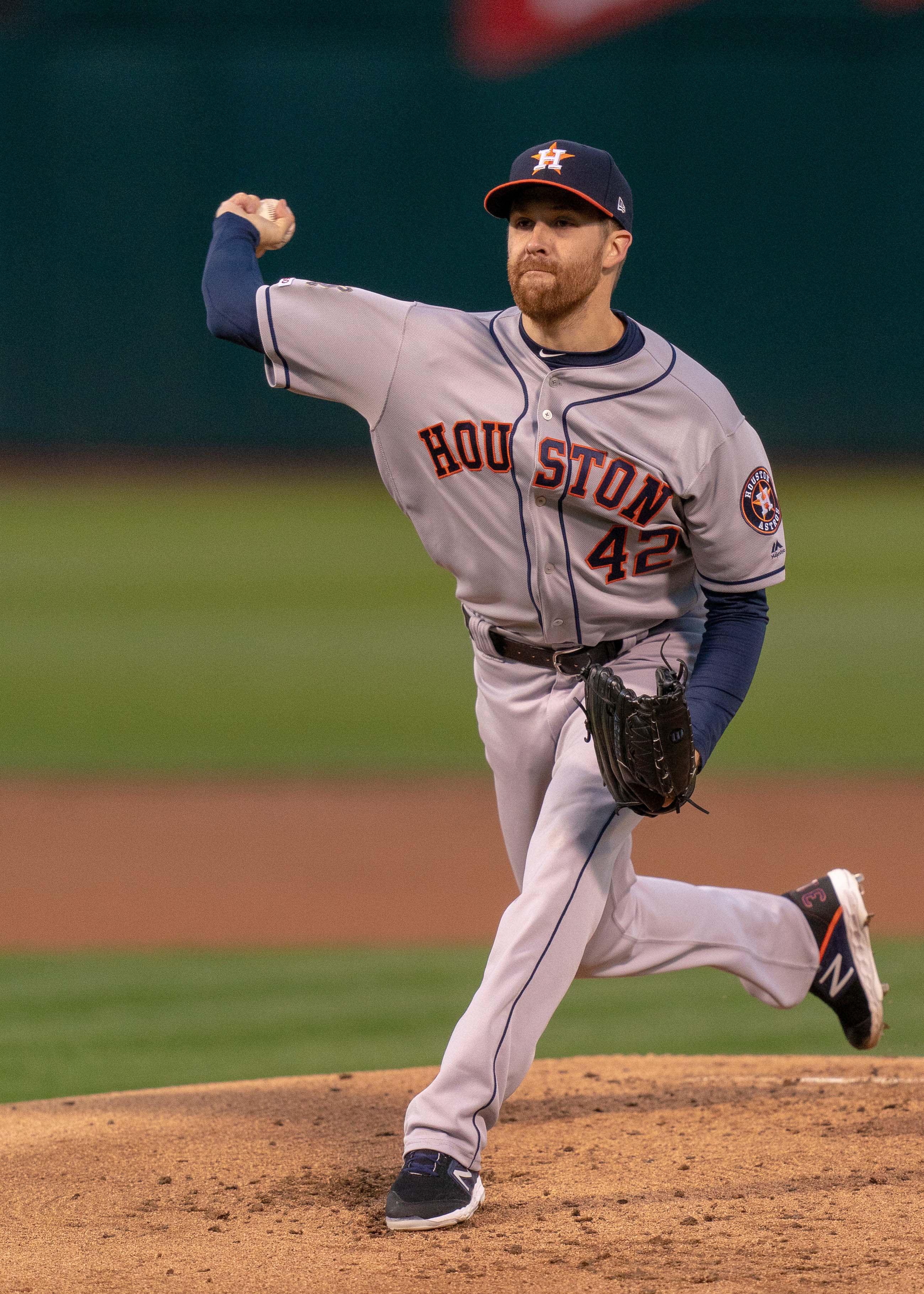
Boston’s announcement on McHugh coalesces with growing uncertainty surrounding the status of ace Chris Sale, who this week underwent an MRI on a problematic right elbow that has since been assessed by some of the industry’s leading surgeons. While Sale is reportedly expected to avoid going under the knife for the time being, he’ll open the year on the injured list and be sidelined for a yet-to-be-determined period of time. Adding some depth in the form of McHugh is certainly a sensible approach and arguably would’ve been necessary even had Sale been healthy.
That said, McHugh himself isn’t a lock to step right into the rotation and contribute as a starter. The 32-year-old missed about a third of the 2019 season due to elbow discomfort and finished out the year on the injured list. MLB Network’s Jon Heyman reported last week that McHugh had been cleared to begin throwing after undergoing a non-surgical “tenex” procedure on his elbow over the winter. His exact timetable to get on a big league mound isn’t yet clear, but he may have to begin the season on the injured list himself if he’s only recently begun throwing.
McHugh made eight starts last year but spent the rest of the 2018-19 seasons in the Astros’ bullpen. His 2019 effort was dragged down by those elbow troubles, which surely contributed to the downward trends in his velocity, swinging-strike rate, opponents’ exit velocity and opponents’ hard-hit rate. McHugh tossed 74 2/3 innings for the ‘Stros last year but turned in a 4.70 ERA that was his highest mark since 2013.
In 2018, though, McHugh was utterly dominant out of the Houston ‘pen. Through 72 1/3 frames, he recorded a stellar 1.99 ERA with averages of 11.7 strikeouts, 2.6 walks and 0.75 home runs per nine innings pitched. And prior to that he was a steady rotation piece, racking up 606 1/3 innings of 3.70 ERA ball (3.60 FIP) with 8.4 K/9 against 2.5 BB/9 from 2014-17.
The manner in which the Red Sox utilize McHugh has not yet come to light, though he could conceivably be deployed in a variety of roles. As noted, he has extensive experience both starting and relieving. With Sale sidelined, the Boston rotation currently has Eduardo Rodriguez, Nathan Eovaldi and Martin Perez locked into starting gigs. Boston has discussed utilizing one or even two openers in the remaining two slots, and manager Ron Roenicke recently revealed that the club will consider stretching left-hander Darwinzon Hernandez out to pitch in lengthier stints. McHugh could function as an opener, a bulk reliever who follows an opener or simply as a conventional starter, depending on the status of his elbow and on how the organization best believes his talents can be maximized.
For now, the Red Sox still appear likely to rely on a hodgepodge of journeymen and fringe prospects to round out their pitching staff, but the ability to eventually insert a health McHugh into the thick of that mix holds clear appeal.
As for Velazquez, he’ll either be traded, run through outright waiver or released within the next seven days. The 31-year-old right-hander was knocked around to the tune of a 5.43 ERA through 56 1/3 innings in 2019. And although he notched a 3.12 ERA with 5.9 K/9, 2.7 BB/9 and a 47 percent grounder rate in 109 2/3 innings from 2017-18, Velazquez’s secondary metrics are less encouraging than that earned run average. His 4.28 FIP was noticeably higher, and he ranked near the bottom of the league in terms of spin rates, hard-hit rates and opponents’ exit velocity. He has a minor league option left and has worked as both a starter and reliever, so it’s possible another club will take him on as a depth piece.
Yoelkis Cespedes To Be Declared Free Agent
Outfield prospect Yoelkis Cespedes, the younger half-brother of Mets slugger Yoenis Cespedes, will be declared a free agent by Major League Baseball on March 18, Jesse Sanchez of MLB.com reports (via Twitter). The 22-year-old left Cuba last June and is planning showcases for MLB clubs in Arizona and in Florida later this month.
Yoelkis has previously played in the Cuban National Series and for Team Cuba in the 2017 World Baseball Classic, but he lacks both the age and the professional experience to be exempt from MLB’s international bonus pools. Players who are younger than 25 and have fewer than six years of professional experience are deemed amateurs under MLB regulations and are thus only allowed to sign minor league deals. Amateurs can still receive signing bonuses, which are deducted from a team’s league-allocated bonus pool, but the most recent iteration of the collective bargaining agreement prevented teams from exceeding their bonus pools under any circumstances.
Because bonus pools are now hard-capped, it’s at least possible that the younger Cespedes will wait until July 2 to sign with a Major League organization. Most clubs have already spent the vast majority (if not the entirety) of their 2019-20 bonus pools, but the 2020-21 signing period will kick off on July 2.
As Sanchez explores in a more extensive pieces on Yoelkis, his top priority is signing with a club that can provide a clear and relatively expedited path to the Major Leagues. MLB.com’s Anthony DiComo, meanwhile, spoke with Yoenis about the difficulty he had in leaving his brother and his family behind when defecting from Cuba back in 2011. The brothers had to go roughly eight years without seeing one another. They were reunited in 2019 when Yoenis was cleared to return to his home country, and the two frequently worked out together in the Bahamas this winter. DiComo adds that Yoenis purchased a house about five miles away from his own Florida home for his younger brother.
Scouting details on Yoelkis are rather sparse. Sanchez notes that he’s listed at 5’9″ and 205 pounds, with some believing him to be a potential five-tool talent. Eric Longenhagen of FanGraphs credited Yoelkis with an 80-grade throwing arm and “loud” tools last summer. Kiley McDaniel called Yoelkis “more of a high six- or low seven-figure [signing bonus] type of talent” back in November. Of course, that’s subjective, and Yoelkis hasn’t been seen by MLB scouts in quite some time. He’ll have the opportunity to showcase himself to all 30 teams in the near future, after which we’ll gain a better understanding of his potential price tag and market. He’ll surely require some time in the minor leagues to refine his skills and get back up to speed after a lengthy absence from game settings, but his age and experience place him in much closer proximity to the big leagues than most international amateurs.
Cubs Targeted Dinelson Lamet, Others In Previous Kris Bryant Talks With Padres
The Cubs and Padres discussed various scenarios involving third baseman Kris Bryant but were (obviously) unable to come to an agreement, Kevin Acee of the San Diego Union Tribune reports. Specifically, the Cubs showed interest in right-hander Dinelson Lamet. Catching prospect Luis Campusano was also a potential target.
It’s hardly a shock to see the pitching-needy Cubs pursuing a controllable big league arm like Lamet. The 27-year-old returned from Tommy John surgery in 2019 and gave the Padres 73 innings (14 starts) of 4.07 ERA ball with a massive 13.0 K/9 against 3.7 BB/9 and 1.48 HR/9. Lamet averaged 96.1 mph on his heater and posted a gaudy 14 percent swinging-strike rate in addition to high-end spin rates on his heater and breaking ball.
Beyond Lamet’s ability to miss bats, he’s controlled for four seasons, which surely holds appeal considering the Cubs could see both Jon Lester and Jose Quintana hit free agency next winter. His fit on the 2020 club would be clear as well; currently, the Cubs’ hope is that Tyler Chatwood can hold down the fifth starter’s role — a task that he hasn’t been up to in either of the first two seasons of his ill-fated three-year, $38MM deal. Installing Lamet as a fifth option behind Lester, Quintana, Yu Darvish and Kyle Hendricks would’ve been considered an upgrade.
Lamet, though, is also viewed as a key part of the Padres’ 2020 plans. He’s expected to hold down a rotation spot alongside Chris Paddack, Garrett Richards, Zach Davies and Joey Lucchesi. The back of the Padres’ rotation will be a bit in flux as their wave of high-end prospects — headlined by MacKenzie Gore and Luis Patino — continue to push toward the big leagues. Lamet, though, has perhaps the highest upside of anyone other than Paddack in that initial quintet.
The 21-year-old Campusano, meanwhile, has significantly elevated his status over the past year. A second-round pick back in 2017, Campusano hit .325/.396/.509 in 487 plate appearances against against much older competition in Class-A Advanced in 2019. He’s now widely considered to be among the game’s 100 best prospects — ranking as high as No. 33 overall in the estimation of ESPN’s Kiley McDaniel.
While Bryant wouldn’t exactly be a clean fit into the Padres’ lineup in terms of position, his bat would represent a major upgrade to a Padres team that collectively batted .238/.308/.410 — good for just an 88 wRC+ that ranked 24th among Major League clubs. But with Manny Machado entrenched at third base and Fernando Tatis Jr. slotted in at shortstop — Machado’s other position — fitting Bryant into the mix would be a bit tougher.
Bryant does have experience in the outfield corners, but the Padres aren’t really short on options there, either (Tommy Pham, Wil Myers, Trent Grisham, Franchy Cordero). Bryant would clearly be the best hitter of the bunch, but San Diego acquired both Pham and Grisham this winter, and Myers’ contract ensures that he’ll be a part of the mix in some capacity. Acee does note that while the Padres were willing to consider moving Tatis to center field in the event of a Francisco Lindor acquisition, that scenario wasn’t a consideration when contemplating a Bryant swap.
At this point, the chances of any deal involving Bryant look to be minimal. The former Rookie of the Year and MVP has already had a sit-down with Cubs president of baseball operations Theo Epstein — a meeting from which he came away with the impression that he’ll be remaining in Chicago. Their asking price could be informative in the event that Bryant once again hits the market, however, and it also speaks to the manner in which the Friars value both Lamet and Campusano.
Twins Notes: Cruz, Gonzalez, Rosario
Nelson Cruz isn’t sure how long he intends to play beyond the upcoming season, but the 39-year-old slugger said earlier today that the 2020 campaign won’t be his last one, tweets MLB Network’s Jon Heyman. That’s not a huge surprise, given that Cruz’s camp has already had some talks with the Twins about extending his contract. Cruz plans to take things “year by year,” but it’s easy to imagine him continuing as long as he produces at such a high level. Cruz, who’ll turn 40 in July, suited up for 120 games and tallied 521 plate appearances with Minnesota last year, hitting at a .311/.392/.639 clip with 41 home runs and 26 doubles. His 163 wRC+ ranked fourth in the Majors among qualified hitters, trailing only Mike Trout, Christian Yelich and Alex Bregman. He’s earning $12MM this season after the Twins picked up a club option on the heels of last year’s excellent output.
Some more notes out of Fort Myers…
- Twins utilityman Marwin Gonzalez underwent a debridement of the patella tendon in his right knee this offseason, he revealed to reporters today (link via La Velle E. Neal III of the Minneapolis Star Tribune). That surgery, which he described as relatively minor, had him behind schedule early in camp. However, Gonzalez made his Grapefruit League debut today and swatted a home run and a double while playing second base in his first outing of the spring. Neal notes that because Gonzalez sometimes still feels a bit of soreness after workouts, he could be held out of the team’s outfield mix early in the season to limit his running.
- Left fielder Eddie Rosario spoke with Do-Hyoung Park of MLB.com about last year’s ankle injury and the manner in which it impacted him in the second half of the season. As Park points out, Statcast points to a notable dip in Rosario’s average sprint speed following his return from the IL, and Rosario himself acknowledged that he couldn’t run at 100 percent and that the ankle sprain “affected everything.” There’s probably no more glaring evidence of Rosario’s limited mobility than his defensive ratings; in 2018, Rosario posted +9 Defensive Runs Saved, a +4.2 Ultimate Zone Rating and -2 Outs Above Average. In 2019, those numbers absolutely plummeted (-6 DRS, -5.7 UZR and an MLB-worst -17 OAA). Twins skipper Rocco Baldelli tells Park that the team is pleased with Rosario’s improved mobility this spring, calling last summer’s injury “fairly significant” and echoing the fact that the 28-year-old never fully recovered from that June 26 ankle sprain.
MLBTR Chat Transcript
Click here to read a transcript of Tuesday’s chat with MLBTR’s Steve Adams.