
Jason Kipnis To Undergo Surgery On Tuesday
Sept. 23: Kipnis will undergo surgery to repair the injury tomorrow, per Paul Hoynes of the Cleveland Plain Dealer.
Sept. 17: An MRI performed on Indians second baseman Jason Kipnis revealed a fracture in the hook of the hamate bone in his right wrist, the team announced Tuesday. The team is currently scheduling a followup appointment for him, but surgery is expected to be required, which would sideline Kipnis for four to six weeks and ostensibly remove any chance of him appearing in a potential postseason series. Cleveland has recalled infielder Andrew Velazquez to add some infield depth in the wake of the injury.
The injury not only brings an end to Kipnis’ 2019 season but could very well bring an end to his career with the only organization he’s ever known. Cleveland’s second-round pick in the 2009 draft, Kipnis was a heralded top prospect who made an immediate impact upon debuting in 2011 and eventually signed a six-year, $52.5MM contract extension covering the 2014-19 seasons. That contract carries a $16.5MM option for the 2020 season, but the Indians are likely to opt instead for a $2.5MM buyout given Kipnis’ recent decline. It’s possible that he could be brought back at a more affordable rate, but both he and the organization will be able to explore alternative options once he reaches free agency.
Kipnis, a two-time AL All-Star, signed the contract early in the 2014 campaign. At the time, he was a 27-year-old coming off a superlative .284/.355/.452 (130 OPS+) showing. He’d swatted 17 home runs, swiped 30 bases and played generally solid defense at second base during his breakout 2013 campaign and looked every bit the part of a potential building block in Cleveland. Injuries, namely an oblique strain, may have hampered Kipnis in 2014, as he floundered through a lackluster season. But he bounced back with a second All-Star nod in 2015 and turned in another strong effort in 2016. Between those two seasons, Kipnis batted a combined .289/.357/.460 with 32 home runs and 27 steals.
Since that time, it’s been a steady downhill trajectory for Kipnis, though. This season’s .245/.304/.410 slash is well below league-average production (84 OPS+), and dating back to 2017 he’s managed only a .236/.305/.403 output. Along the way, he’s been slowed by shoulder, hamstring and calf injuries in addition to his current wrist issue. He’ll quite likely hit the open market on the heels of that unproductive trio of seasons as he heads into his age-33 campaign, making a one-year deal the likeliest outcome for him.
The Indians, meanwhile, will look to a combination of Velazquez, Ryan Flaherty and Mike Freeman to pick up the slack at second base. Velazquez, who has a career .260/.316/.415 batting line in 163 games of Triple-A experience, is in the lineup and getting the nod tonight. He only appeared in a dozen games with Cleveland’s Triple-A affiliate this season, spending the rest of the season in the Rays organization. Velazquez joined the Indians in an early July trade — he was injured at the time, hence the minimal time with Cleveland’s top affiliate — so he’d be postseason-eligible should the Indians secure a Wild Card spot and wish to carry him.
Astros Activate Ryan Pressly
The Astros have one of their best pitchers back from the injured list. Barely four weeks after Ryan Pressly underwent an arthroscopic knee procedure, he’s been reinstated from the IL, the team announced. A four- to six-week timeline was projected at the time of the surgery.
Pressly, 30, returns to the ‘Stros with enough time left on the calendar to get into a few games as a tuneup for the postseason. He’ll rejoin a bullpen that is currently without teammates Brad Peacock and Collin McHugh, each of whom remains on the injured list. McHugh’s throwing program was recently shut down due to renewed elbow discomfort, while Peacock is trying to work back from shoulder trouble that has hindered him throughout the season.
Given those injuries, a healthy Pressly is all the more important. Since being acquired from the Twins at the 2018 trade deadline, he’s morphed from an above-average reliever to a virtual juggernaut, pitching 78 2/3 innings of 1.94 ERA ball with 104 strikeouts against 17 walks between the regular season and last year’s playoff run. Pressly made his first All-Star team in 2019, and he’s currently tied with Sergio Romo for the MLB lead among qualified relievers in terms of opponents’ chase rate (40.9 percent) while sitting 11th in swinging-strike rate (17.3 percent).
Pressly would’ve been a free agent following the 2019 season were it not for the two-year, $17.5MM contract extension he signed prior to Opening Day. The Astros now control him for both the 2020 and 2021 seasons, and his deal also includes a vesting/club option for the 2022 campaign as well.
Blue Jays Claim Breyvic Valera, Designate Ryan Dull
The Blue Jays announced that they’ve claimed infielder Breyvic Valera off waivers from the Yankees and, to create room on the 40-man roster, designated right-hander Ryan Dull for assignment. Toronto claimed Dull himself off waivers from the Yankees just two days ago. He’d yet to pitch in a game for the Jays.
The Yankees claimed Valera, 27, off waivers from the Giants back in May. He appeared in a dozen games for New York and hit .219/.324/.313 in a small sample of 37 plate appearances. The well-traveled Valera has appeared with four different big league teams in the past three seasons, having also spent time with the Orioles, Dodgers and Cardinals in addition to his minor league time with the Giants organization. He was one of the five players the Dodgers sent to Baltimore in last summer’s Manny Machado blockbuster, though it was clear even at the time that Valera wasn’t considered a vital piece for that trade, in which outfield prospect Yusniel Diaz was the headliner.
Dull, 29, has bounced from the A’s, to the Giants, to the Yankees and the Blue Jays via waivers in the past six weeks alone. The righty hasn’t had success in the Majors or in Triple-A this season, but he’s only a few seasons removed from looking like a quality bullpen piece in Oakland. While Dull has been tagged for 17 earned runs through just 11 1/3 innings in the big leagues this year and also has a 5.29 ERA across three Triple-A affiliates, he was one of Oakland’s best relievers back in 2016. That year, he tossed 74 1/3 innings of 2.42 ERA ball with nearly a strikeout per frame and just 1.8 BB/9. He’s since been hampered by shoulder and knee problems, but Dull has some MLB success and a minor league option remaining, so he could still land elsewhere via yet another waiver claim. If not, he’ll be able to elect free agency at season’s end.
Marlins Extend Miguel Rojas
Marlins shortstop Miguel Rojas will be reaching free agency a bit later than initially projected, as the organization formally announced a two-year contract extension for the 30-year-old defensive standout Friday. Rojas, a client of the Beverly Hills Sports Council, will reportedly be guaranteed $10.25MM in total. The contract also comes with a vesting option that’d take the deal north of $15MM, if triggered.
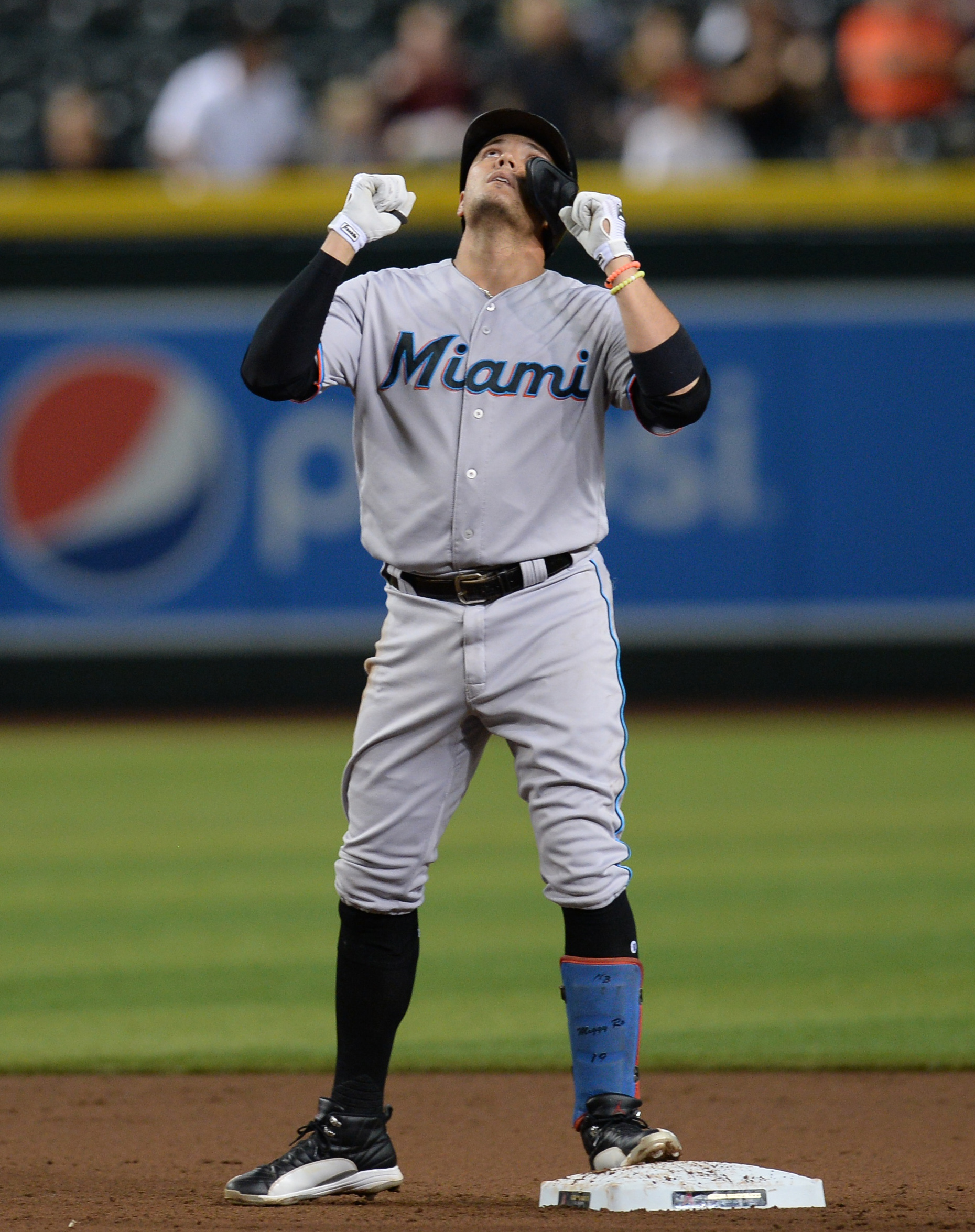
The new contract buys out Rojas’ final season of arbitration, guarantees one free-agent season and gives Miami an option for what would be the second free-agent season for Rojas, who’ll turn 31 in February. Rojas earned a $3.155MM salary in 2019 and would’ve been eligible for arbitration for the final time this winter — although his relatively timid offensive profile would’ve prevented him from cashing in on a substantial raise.
The timing of the contract talks are a bit unusual, but the Miami organization is no stranger to September extensions. The Marlins previously worked out a three-year, $40MM extension for Martin Prado as well as a much smaller one-year extension with Greg Dobbs in the final month of a season (not that either deal panned out particularly well for them). Beyond that, MLB.com’s Joe Frisaro tweeted this week that Rojas has “made it clear” to the Marlins that he wants to stay in Miami. The two sides apparently preferred to skip the potentially contentious arbitration process and proactively work out a multi-year arrangement.
Rojas has quietly become a versatile and fairly valuable player in South Florida, logging time at all four infield positions over the past few seasons while proving to be a difficult strikeout at the plate. He’s currently hitting .288/338/.388 with five homers, 27 doubles, a triple and eight steals in 2019, and he’s put together a serviceable (albeit still below average) .274/.327/.368 slash through 1316 plate appearances dating back to 2017. In that time, he’s punched out in only 12 percent of his plate appearances.
Though he’s spent the bulk of his time at shortstop over the past two seasons, Rojas grades out as an above-average defender all over the diamond. He’s generated elite numbers at the shortstop position, where he’s been credited with +26 Defensive Runs Saved and a +14 Ultimate Zone Rating dating back to 2017, which has helped to offset his lack of power and limited on-base skills.
Looking ahead, Rojas now appears poised to serve as the Marlins’ primary shortstop in both 2020 and 2021 — depending on the timeline of prospect Jazz Chisholm. For now, Rojas will likely be joined on the left side of the diamond by continually improving Brian Anderson, with well-regarded prospect Isan Diaz the favorite at second base. Garrett Cooper will likely round out the 2020 infield, although trades and free-agent acquisitions can certainly impact that composition. Rojas had previously been a somewhat under-the-radar trade asset, but a multi-year deal quite likely takes him off the market — at least in the short term.
MLB Network’s Jon Heyman first reported the deal (Twitter links). Barry Jackson and Jordan McPherson of the Miami Herald added some financial context, and Heyman tweeted final details.
Justin Smoak’s Strange Season
Justin Smoak‘s time with the Blue Jays is all but certain to come to an end when Toronto plays its final game this season. The rebuilding Jays will want to get a look at Rowdy Tellez, who has already begun to cut into Smoak’s playing time, and Smoak is set to become a free agent for the first time in his career.
As far as contract seasons go, Smoak surely can’t be thrilled with his results. He’s hitting .206/.342/.398 with 21 home runs on the year. At a time where seemingly everyone in the league has morphed into a power hitter, Smoak has cleared the fences 17 fewer times than he did in his 38-homer 2017 season. Waning playing time and a brief stint on the injured list have impacted that total, but the overall results aren’t ideal with free agency looming.
Smoak’s season, though, is also among the stranger you’ll come across when sifting through this year’s class of free agents. No one likes a .206 batting average, of course, but there’s also quite a bit to like about Smoak’s 2019 campaign. His 16.1 percent walk rate is the highest of his career by a long shot and is the sixth-highest of any qualified hitter in baseball. Smoak’s strikeout rate (21.1 percent) is down more than five percent from its 2018 level and is the second-best mark of his career. Only eight qualified hitters in baseball — Mike Trout, Alex Bregman, Mookie Betts, Joey Votto, Carlos Santana, Shin-Soo Choo, Tommy Pham and Daniel Vogelbach — have chased fewer pitches outside the strike zone than Smoak and his 22.9 percent clip. He ranks in the top 30 in terms of pitches per plate appearance (4.10). He’s been extremely disciplined at the plate.
A notable portion of Smoak’s struggles could be tied up in the fact that he’s had some poor luck on balls in play (.220). When looking into particularly egregious BABIP erosion, it’s common to see some trends that would portend to fewer balls dropping for hits — an uptick in infield flies, for instance, or for a player with Smoak’s skill set, perhaps a sharp increase in ground-balls. That hasn’t been the case, though. Smoak’s seven percent infield-fly rate is the second-lowest of his career, and his 36.9 percent ground-ball rate is actually down nearly three percent from 2018. His line-drive rate, correspondingly, is up nearly three percent. His fly-ball rate is right in line with his past four seasons.
So perhaps Smoak simply isn’t making good contact anymore? Not the case. Smoak’s overall percentage of balls hit at 95+ mph is down from 41.9 percent last year to 38.9 percent in 2019, but he’s upped his average exit velocity, improved his launch angle and very slightly improved his barrel rate, per Statcast. Smoak’s expected batting average of .242 and his expected slugging percentage of .472 (also via Statcast) dwarf his actual output. Among hitters with at least 100 plate appearances, the -.041 difference between Smoak’s actual wOBA (.325) and his expected wOBA (.366) is the ninth-largest. Put another way: Statcast considers Smoak among baseball’s unluckiest hitters in 2019. Not great timing for a player who’s about to hit free agency.
Of course, a poor season can’t be entirely blamed on rotten luck. Some of the struggles in terms of batting average are tied to aggressive shifting against Smoak — particularly when he hits left-handed (where he’s vastly better than from the right side). Smoak is MLB’s fourth-most shifted player when he bats lefty, and teams are shifting him 12 percent more often than in his monster 2017 season. As such, it’s barely been worth the effort for him to leave the box when he puts the ball on the ground. (I joke for the sake of hyperbole — run out your grounders, kids!)
Smoak is hitting .139 on grounders as a lefty and a ghastly .105 from the right side. Shifts are becoming more aggressive, more universally adopted and more precise; that’s going to hurt your plodding first basemen of the world, and Smoak is no exception. He’s already top-25 among qualified hitters in terms of fly-ball rate, but it’s easy to argue that he should strive to elevate even more. It’s also worth noting that Smoak is hitting .583 on line-drives, which sounds nice but is substantially south of the league average (.686) and his career rate (.711). Shifting likely plays a role there as well — but to a lesser extent. That’s one area where he seems likely to improve moving forward.
Given the leaguewide uptick in shifts over the past few years and Smoak’s decreasing speed, he’s probably never going to hit .270 like he did in 2017 (.270/.355/.529). But Smoak is also still making good contact and is more patient at the plate than he’s ever been before. He’s only been narrowly above replacement level this year by measure of wins above replacement, but there’s good reason to expect his bat to bounce back in 2020. The free-agent market has been particularly harsh for first base/DH types in recent winters, which could lead to someone getting themselves a nice bargain on Smoak.
NL Central Notes: Cardinals, Taillon, Taylor
With Kolten Wong unlikely to play for at least “several days,” the Cardinals will turn to Tommy Edman at second base and return Matt Carpenter to regular duties at third base, per Derrick Goold of the St. Louis Post-Dispatch. Wong is undergoing an MRI to determine the severity of a left hamstring strain he suffered in last night’s game, and his status for the remainder of the Cardinals’ season is up in the air at the moment. The 24-year-old Edman is the latest in a seemingly ceaseless parade of largely unheralded Cardinals prospects to immediately emerge as an impact contributor in St. Louis. A sixth-round pick in 2016, he’s never sniffed a Top 100 ranking, entering the season 12th among Cards prospects at Baseball America and 20th at Fangraphs. But Edman has hit at a .289/.325/.481 clip with 10 homers, 15 doubles, five triples, 13 steals and a 17.9 percent strikeout rate through his first 83 MLB games (302 plate appearances). He’d supplanted the struggling Carpenter as the Cards’ primary third baseman but will now slide over to second base, where he’s logged 857 minor league innings in his pro career.
More from the division…
- Pirates righty Jameson Taillon is taking as optimistic an approach to his second Tommy John surgery as possible, writes Adam Berry of MLB.com. The right-hander feels that he used the downtime from his first surgery in 2014 to improve other areas of his game and believes he can do the same this time around. “I’m seriously confident I’m going to find a way to get better from this one,” said Taillon. “Whether it’s mechanics, how can I take stress off my elbow, how can I get stronger, how can I age better, how can I dive into analytics and video.” Taillon acknowledged that he lost “a lot, a lot, a lot of money” because of the timing of the injury, which came on the heels of his first trip through arbitration and will wipe out his entire second year of arbitration. However, the 27-year-old also said he hopes to pitch for another seven or eight seasons upon returning from surgery and isn’t focusing on the more short-term financial ramifications.
- Brewers outfielder Tyrone Taylor had already gone home for the season and was in the process of applying for an offseason job with FedEx when he got the news that he’d instead be joining the MLB club, Robert Murray of The Athletic writes (subscription required). Taylor’s career has been filled with ups and downs, but after a series of injuries and poor performances, he put himself back on the map with a strong 2018 showing that landed him on Milwaukee’s 40-man roster. He’s been limited to a pinch-hitting role thus far but relishes the opportunity to not only be in the dugout for a playoff race but also to pick the brain of veterans players like Christian Yelich on a daily basis. “You want rookies feeling comfortable and welcome,” Yelich said of his talks with Taylor. “All of that is creating a culture – a winning culture.”
Domingo German Placed On Administrative Leave Under Domestic Violence Policy
1:04pm: The Yankees announced that they’ve selected the contract of right-hander Michael King to fill German’s spot on the 40-man and active rosters. King pitched 46 innings across four minor league levels in 2019 but hasn’t appeared in a game since Sept. 1.
12:43pm: Yankees right-hander Domingo German has been placed on administrative leave under the Joint MLB-MLBPA Domestic Violence Policy, the league announced Thursday. Details surrounding any allegations against German have yet to surface. The Yankees have issued the following statement on the matter:
We fully support all measures being undertaken by the Commissioner’s Office pursuant to the Policy on Domestic Violence. We support this policy which reinforces that domestic violence has no place in our society and cannot be tolerated. We have followed the lead of Major League Baseball and will continue to provide our complete cooperation throughout the investigative process. We reserve any further comment until the investigation reaches its conclusion. All questions pertaining to this matter should be directed to the Office of the Commissioner.
Players placed on administrative leave are paid during their absence unless a suspension is deemed necessary by the Commissioner’s Office, at which point pay issued during said leave is rescinded. The standard period of length for administrative leave is seven days, although the league can continue to extend that period as required by the status of the investigation as it unfolds.
If German is indeed disciplined, any suspension would leave him on the restricted list during the Yankees’ forthcoming postseason run, marking a costly loss for the AL East champions. German, who turned 27 last month, has given the club 143 innings of 4.03 ERA ball while averaging 9.6 strikeouts and 2.5 walks per nine innings pitched.
Further details on the situation will be provided as they emerge.
Edinson Volquez Open-Minded About Returning To Rangers In 2020
As recently as late July, veteran right-hander Edinson Volquez‘s goal was simply to rehabilitate an elbow injury sufficiently enough to return to a big league mound before season’s end. After that, he suggested, retirement was his likeliest path. However, a return to health appears to at least have him reconsidering that trajectory. Volquez tells Evan Grant of the Dallas Morning News that he “might” consider a return, though likely only to the Rangers organization. “If they want me around to help the young guys, that’s a possibility,” said Volquez.
It’s been a pretty smooth return to the mound for Volquez, who has allowed two runs on four hits and three walks with three strikeouts in six innings of relief since returning from the injured list. He’s managed to average a hefty 95.6 mph on his heater in that short-relief role — an increase over the 93-94 mph he averaged while working as a starter with the Pirates, Royals and Marlins from 2014-17. Texas has been judicious in affording Volquez ample rest between relief outings; he’s yet to pitch on consecutive days and hasn’t tossed more than 27 pitches in a single appearance.
Whether the Rangers have interest in Volquez retaining Volquez remains to be seen, though the Texas organization certainly has prioritized instilling some veteran experience in its clubhouse in recent seasons. And the team thought highly enough of Volquez to not only sign him to a two-year minor league contract after his 2017 Tommy John surgery but also select his contract last November to prevent him from being eligible to be selected in the Rule 5 Draft. (Yes, even at 35, he’d have been eligible for a team to take and plug into its pitching staff.)
Any reunion with Volquez would surely be on an affordable deal. He’s pitched just 13 2/3 innings in the Majors since undergoing Tommy John surgery in September 2017 when he was a member of the Marlins’ rotation and turned 36 years old back in July. But there’s enough uncertainty on the Rangers’ pitching staff — both in the rotation and in the bullpen — that Volquez could be a sensible low-cost depth piece.
In the rotation, the Rangers are currently slated to be led by veterans Mike Minor and Lance Lynn. Young lefty Kolby Allard has likely done enough to cement himself as a favorite for one of the three remaining spots, and the Rangers seem likely to pursue some additional veteran upgrades this winter as they look to field an improved team in the first season of a new ballpark. It’s unlikely they’d simply commit a rotation spot to Volquez, but allowing him to battle for the fifth spot in camp with the fallback of a bullpen role could make sense.
Alternatively, the club could just look to try Volquez in a relief role for the whole season. As previously noted, his velocity has improved in that role. It’s also not as if the Rangers’ relief corps is largely solidified. Jose Leclerc and Jesse Chavez are under contract for next season, and the Rangers hold a reasonable $2.5MM option on another veteran righty who has voiced a “Rangers or retire” mentality: Shawn Kelley. Beyond that veteran trio, 24-year-old lefty Brett Martin has thrown rather well, while reclamation project Rafael Montero has posted exceptional K/BB numbers in a smaller sample of work. As with the rotation, the bullpen has a few veteran locks but some room for competition further down the ladder. Texas seems likely to pursue some established offseason upgrades but could at the very least have Volquez compete for a spot in 2020 — particularly with MLB rosters set to expand to 26 players next year.
Orioles Notes: Cobb, Harvey, Castro
The Orioles are hopeful that right-hander Alex Cobb will be ready to go for Spring Training 2020, manager Brandon Hyde tells Roch Kubatko of MASNsports.com. The 31-year-old righty (32 next month) is recovering from surgery to repair a labrum tear in his right hip as well as a separate procedure that repaired a meniscus tear in his knee. “We’ve missed Alex and having a veteran starter like that, there’s a lot of value to that,” Hyde added. There’s little hope of moving Cobb and the $29MM remaining on his deal (which is heavily deferred), though a healthy start to the 2020 season could eventually put him back on the map as a trade candidate. Beyond Dylan Bundy and breakout lefty John Means, the Orioles have virtually no certainty in their rotation, so Cobb should have plenty of opportunity to reestablish himself. The Orioles still seem likely to add some rotation depth in the offseason, although the new-look front office somewhat surprisingly made very few additions in that area last winter when Nate Karns was the team’s lone Major League free-agent signing.
Some more notes out of Baltimore…
- Hyde also informed reporters yesterday that right-hander Hunter Harvey has been shut down for the season (Twitter link via Jon Meoli of the Baltimore Sun). Harvey pitched just 6 1/3 innings at the MLB level (with an 11-to-4 K/BB ratio), but even that brief debut was a significant step forward for the oft-injured former top prospect. Baltimore selected Harvey with the No. 22 pick in the 2013 draft and he quickly came to be ranked among the game’s elite pitching prospects before injuries wiped out several key developmental years. Harvey missed the entire 2015 season and was barely able to compile any innings in 2016 (12 2/3), 2017 (18 2/3) or 2018 (32 1/3). To this point in his career, he’s undergone Tommy John surgery and batted shoulder troubles, making this year’s modest total of 82 innings between Double-A, Triple-A and the big leagues an encouraging sign of progress. That represents Harvey’s largest workload since tossing 87 2/3 frames back in 2014. It might be tempting to try Harvey as a starter again, but he pitched to a 2.81 ERA with a 33-to-7 K/BB ratio in 25 2/3 innings upon moving to the ‘pen in the minors.
- Speaking of intriguing bullpen pieces, while Miguel Castro‘s bottom-line numbers aren’t immediately eye-catching, Joe Trezza of MLB.com observes that there’s some reason for significant optimism when looking at some secondary metrics. Castro has improved his strikeout rate by six percent in 2019 while slightly trimming back his walk rate, and he’s seen a nearly two mile-per-hour increase in his sinker velocity. He’s also made substantial improvements in the quality of the contact he’s allowed, as measured by Statcast. In fact, the gap between Castro’s expected weighted on-base average (xwOBA) in 2018 and his 2019 mark is the second-largest improvement among qualified pitchers, trailing only Lucas Giolito. Castro is still averaging 5.1 walks per nine innings and has been plagued by a well-below-average 68.5 percent strand rate, both of which have contributed heavily to his ugly 4.73 ERA. If he can restore his 2016-17 levels of control (3.6 BB/9) while maintaining some of the gains on his ability to miss bats and limit hard contact, there’s some breakout potential. At the very least, that profile seems intriguing enough to tender Castro a contract in his first offseason of arbitration eligibility — particularly given that his first-year salary will be rather modest.
Blake Treinen Diagnosed With Stress Reaction In His Back
The Athletics are shutting down right-hander Blake Treinen for the remainder of the regular season due to a back issue, manager Bob Melvin announced after today’s game (Twitter links via Susan Slusser of the San Francisco Chronicle). MLB.com’s Martin Gallegos tweets that Treinen has been diagnosed with a stress reaction in his back.
The issue has been bothering Treinen for the past three weeks, it seems, and it’s reached the point where he requires some downtime. It’s worth noting that the team has not yet formally ruled Treinen out for a postseason run, though that’ll surely depend on how his back responds to this shutdown. In his absence, the A’s are moving Chris Bassitt into a long relief/piggyback role, per Slusser, and seemingly going with a rotation consisting of Sean Manaea, Mike Fiers, Tanner Roark, Brett Anderson and Homer Bailey.
It’s been an ugly season for Treinen, who stepped up as one of baseball’s premier relievers almost immediately upon being traded to Oakland at the 2017 deadline. The now-31-year-old posted 38 innings of 2.13 ERA ball with a 42-to-12 K/BB ratio down the stretch for Oakland in ’17 before turning in a ridiculous 0.78 ERA (1.82 FIP) with 11.2 K/9, 2.4 BB/9 and a 51.9 percent ground-ball rate in 80 1/3 innings last year.
Treinen, however, lost his grip on the closer’s role in 2019 and has generally struggled since a late-April meltdown against in Toronto. His regular season will come to a close with a 4.91 ERA (5.14 FIP, 5.02 xFIP), 9.1 K/9, 5.7 BB/9, 1.38 HR/9 and a 42.8 percent grounder rate. Treinen’s average velocity, swinging-strike rate, opponents’ chase rate and opponents’ hard-hit rate have all trended sharply in the wrong direction, leaving the A’s with somewhat of a decision in the offseason; he’s due a raise on this year’s $6.4MM salary in his final offseason of arbitration eligibility. For a team with the type of payroll constraints the Athletics face each year, that could be viewed as a steep price to pay for a rebound candidate.
The Athletics, now 92-61 on the season, have won eight of their past 10 games and now hold a 2.5-game lead on the top Wild Card spot in the American League. There’s still time for the Rays and/or Indians to overtake them, but the A’s are in a fairly commanding spot with regard to the AL Wild Card race at this point. Their schedule the rest of the way features three home games against the Rangers, two on the road against the Angels and four on the road in Seattle.