
Cubs Designate Chris Flexen
The Cubs have designated right-hander Chris Flexen for assignment, according to multiple members of the Cubs beat (including Maddie Lee of the Chicago Sun-Times). Right-hander Gavin Hollowell was called up from Triple-A Iowa in the corresponding move.
Signed to a minor league deal this past winter, Flexen’s contract was selected to Chicago’s roster at the start of May and he immediately reeled off 21 1/3 innings over 12 outings without allowing an earned run. Even through 29 innings and 16 appearances, Flexen’s ERA stood at a minuscule 0.62, making him look like a gem of an under-the-radar signing.
Unfortunately, the magic has worn off, as Flexen has given up 13 ER over his last five outings, translating to a 7.98 ERA over his last 14 2/3 innings of work. The warning signs were apparent before Flexen’s rough July got underway, as he has only a 12.4% strikeout rate over his 43 2/3 total innings, and the right-hander has benefited greatly from a .226 BABIP. Since Flexen’s 3.09 ERA is dwarfed by a 4.94 SIERA, the Cubs have decided to move on from the 31-year-old.
Flexen worked primarily as a multi-inning reliever, and his tenure in Wrigleyville included one four-inning start. He has been a starter for most of his career and tossed 160 innings for the White Sox just in 2024, but his low-strikeout and contact-heavy approach makes him a risk for regular turns in a rotation, as Flexen’s 2021-22 seasons with the Mariners represent his only consistent run of results as a starter at the MLB level. Eating innings in any capacity is a valuable skill, however, so it certainly seems as though another club in need of some bullpen depth might claim Flexen on waivers or work out a low-level trade with the Cubs.
The contract selection locked in a $1.5MM salary for Flexen over the 2025 season. With 91 days of Major League service time logged this season, Flexen now has over five years of career service time, so he can now reject an outright assignment to the minors and elect free agency if he clears waivers.
Ryne Sandberg Passes Away
Hall of Famer Ryne Sandberg has passed away at age 65. The Cubs announced the devastating news on Monday evening. Sandberg had battled metastatic prostate cancer since at least January 2024.
“Ryne Sandberg was a legend of the Chicago Cubs franchise and a beloved figure throughout Major League Baseball. He was a five-tool player who excelled in every facet of the game thanks to his power, speed and work ethic. Ryne earned 10 consecutive All-Star selections, nine straight Gold Gloves, seven Silver Sluggers and 1984 National League MVP honors,” MLB commissioner Rob Manfred said in a statement.
“Ryne remained active in the game he loved as an ambassador for the Cubs, a manager for the Phillies and in the Minor Leagues, and a frequent participant at the Hall of Fame. His many friends across the game were in his corner as he courageously fought cancer in recent years. We will continue to support the important work of Stand Up To Cancer in Ryne’s memory. On behalf of Major League Baseball, I extend my deepest condolences to Ryne’s family, Cubs fans everywhere and his admirers throughout our national pastime.”
Cubs owner Tom Ricketts released his own statement of condolences. “Ryne Sandberg was a hero to a generation of Chicago Cubs fans and will be remembered as one of the all-time greats in nearly 150 years of this historic franchise,” Ricketts said. “His dedication to and respect for the game, along with his unrelenting integrity, grit, hustle, and competitive fire were hallmarks of his career. He was immensely proud of his teammates and his role as a global ambassador of the game of baseball, but most of all, he was proud of Margaret, his children and his role as husband, father and grandfather.”
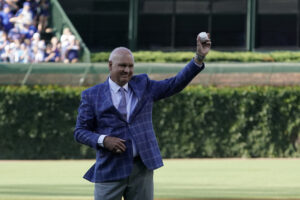
While Sandberg would become an iconic figure in Cubs history, he began his career in Philadelphia. The Phillies signed the Spokane native away from a commitment to Washington State after drafting him in the 20th round in 1978. Sandberg debuted with the Phils as a September call-up in 1981, going 1-6 while appearing in 13 games. His first hit, a single off Mike Krukow as a visitor at Wrigley Field, would be the only one of his major league career that did not come in a Cubs uniform.
During the 1981-82 offseason, the Phillies traded a 22-year-old Sandberg alongside veteran shortstop Larry Bowa to the Cubs for outfielder Iván de Jesús. It was one of the best moves in Chicago’s franchise history. Sandberg opened the season as their starting third baseman. He earned a sixth-place finish in NL Rookie of the Year balloting after hitting .271 with 33 doubles and seven home runs. The Cubs acquired six-time All-Star third baseman Ron Cey from the Dodgers the following offseason. Sandberg moved permanently to second base by 1983.
He’d go on to become one of the greatest ever at the position. Sandberg won a Gold Glove in his first full season at the keystone. While he was mostly a light-hitting defensive stalwart in ’83, Sandberg truly broke out offensively in his third year in the big leagues. He batted .314/.367/.520 while leading the National League in runs scored and topping MLB with 19 triples. He hit a matching 19 home runs, two of which were game-tying shots off future Hall of Famer Bruce Sutter in the so-called “Sandberg Game” against the Cardinals in June. He reached 200 hits for the only time in his career.
Sandberg won his second straight Gold Glove and led the Cubs to a 96-win season and an NL East title — the franchise’s first playoff berth in 39 years. Sandberg was resoundingly voted the Senior Circuit’s most valuable player. He hit .368 in what was then a best of five NL Championship Series, but the Cubs dropped three straight after taking a 2-0 series lead and fell a game shy of a World Series berth.
That was the first of 10 consecutive All-Star seasons for Sandberg. He won the Gold Glove nine straight times between 1983-91 while claiming the Silver Slugger in all but two years from 1984-92. He hit .306 with 26 longballs and a career-high 54 stolen bases as a follow-up to his MVP season.
After a trio of relatively average seasons with the bat in the mid-1980s, he had a four-year resurgence as one of the best hitters in MLB. Sandberg finished fourth in MVP balloting in both 1989 and ’90. He led the Cubs back to the playoffs in ’89, where he hit .400 in a losing effort against the Giants in the NLCS. The 1990 campaign was arguably the best of Sandberg’s career. He led National Leaguers with a career-high 40 home runs and paced the NL with 116 runs scored. He drove in 100 runs in consecutive seasons in 1990-91.
The Cubs signed Sandberg to a four-year, $28.4MM extension going into the ’92 season. That made him MLB’s highest-paid player at the time, and he responded with a monster .304/.371/.510 showing with 26 homers and 87 RBI. He hit .309 in 1993 but was off to a very slow start to the ’94 season. Sandberg shockingly announced his retirement that June, later explaining that he’d lost the drive to play every day and felt he’d be doing a disservice to the organization, fans and himself by playing at less than 100%. He sat out the ’95 season before making a comeback, finishing his playing career with two more seasons in Wrigleyville.
Sandberg retired for good after the 1997 campaign. He finished his illustrious career with a .285/.344/.452 batting line. Sandberg tallied 2386 hits, drilled 282 home runs, and drove in more than 1000 runs. He topped 400 doubles, hit 76 triples, and stole 344 bases. He ranks fourth in Cubs history in hits, fifth in homers, and seventh in runs batted in. According to Baseball Reference, only Cap Anson and Ron Santo had more Wins Above Replacement in a Cubs uniform among position players.
That kind of production from a middle infielder is almost unheard of — much less from as sure-handed an infielder as Sandberg was. Among second basemen, only Roberto Alomar topped Sandberg’s nine Gold Gloves. He still ranks fifth all time at the position in career home runs, surpassed only by Jeff Kent, Robinson Canó, Rogers Hornsby and Craig Biggio. Sandberg is 11th among second basemen in bWAR and by Jay Jaffe’s JAWS score, which measures a player’s career value and peak seasons as a proxy for his Hall of Fame candidacy.
Sandberg’s numbers compared favorably to other Hall of Famers at the position. It took three years on the ballot, but he was deservedly voted into Cooperstown in 2005. The Cubs retired his #23 not long after his Hall of Fame induction. Sandberg took a managerial position in their farm system a year later, hoping to eventually work his way up to manage the franchise with which he’d starred.
While that never came to pass, Sandberg did get an opportunity to manage his former team in Philadelphia. The Phillies hired him on an interim basis after firing Charlie Manuel midway through the 2013 season. Sandberg signed a three-year contract to take the position permanently the following offseason. He resigned during the 2015 campaign when the rebuilding club had a 26-48 record, finishing with a 119-159 record overall. He returned to the Cubs in a part-time instructional role and worked with the team as recently as this past Spring Training.
On top of his laundry list of on-field accomplishments, Sandberg was held in high esteem by teammates, fans and colleagues for his work ethic and humility. The Cubs will wear a jersey patch honoring him for the remainder of the season. His legacy will live on far beyond this year in the memories of generations of fans within and outside Chicago. MLBTR joins others throughout the game in sending condolences to Sandberg’s family, loved ones, friends and the countless people whose lives he impacted.
Image courtesy of David Banks, Imagn Images.
Cubs, Jed Hoyer Agree To Multi-Year Extension
The Cubs have agreed to a multi-year contract extension with president of baseball operations Jed Hoyer. The team announced the move this afternoon. Cubs executive chairman Tom Ricketts praised his POBO in a press release: “Jed and his baseball operations staff have built a healthy player development organization and put an exciting, playoff-contending team on the field. We are looking forward to the rest of the season and to working with Jed for years to come.”
Hoyer’s previous contract, which he signed when he took over from Theo Epstein as Chicago’s chief baseball decision maker after the 2020 season, would have expired at the end of the 2025 campaign. The Cubs underperformed in each of Hoyer’s first four seasons at the helm, failing to make the playoffs from 2021-24. Another disappointing season this year and he very well could have been out of a job. Yet, many of his offseason moves have worked wonders, with additions such as Kyle Tucker, Matthew Boyd, Carson Kelly, Caleb Thielbar, and Ryan Pressly complementing a strong core that Hoyer put together over the past handful of years.

So, the Cubs enter play on Monday tied with the Brewers for the best record in the National League (62-43). Their +116 run differential is the best in baseball, and FanGraphs puts their odds of making the playoffs at 96.6%. It’s not hard to understand why the Cubs waited to extend Hoyer until it was clear he had built a strong contender, but neither is it hard to understand why they didn’t want to wait any longer to get a deal done. This team is primed to be a major buyer this week, and evidently, they didn’t want to go into such a pivotal trade deadline season with a lame duck executive in the driver’s seat. As ESPN’s Jesse Rogers put it, the Cubs came into the season “looking for a reason” to retain Hoyer. The team’s strong performance over the first four months proved to be that reason.
Hoyer began his front office career with the Red Sox in 2002. He served as an assistant general manager under Epstein from 2005-09 and briefly served as a co-GM when Epstein stepped away during the 2005-06 offseason. Following the 2009 season, Hoyer left Boston to become the Padres’ GM, a role he held for two years before he left to take the GM job in Chicago, where he reunited with Epstein. From 2012-20, Epstein ran the Cubs front office with Hoyer as his second-in-command. Together, they helped the Cubs win a World Series championship in 2016, the club’s first since 1908. When Epstein resigned after the 2020 campaign, Hoyer took his place as president of baseball operations. Since then, he has acquired players like Pete Crow-Armstrong, Michael Busch, Dansby Swanson, Shota Imanaga, Seiya Suzuki, and Daniel Palencia, as well as Tucker, Boyd, Kelly, Thielbar, and Pressly, all of whom have been instrumental to the team’s success this season.
While it’s unclear how long Hoyer’s new extension will keep him in Chicago, he now has at least a couple more years to continue to build upon the core he’s assembled. With the trade deadline fast approaching on Thursday, it’s safe to expect him to start right away.
Sahadev Sharma of The Athletic was the first to report that Hoyer had signed a multi-year extension with the Cubs. Image in article courtesy of Kamil Krzaczynski of Imagn Images.
Cubs Interested In Raisel Iglesias, MacKenzie Gore
The Cubs are known to be looking far and wide for pitching upgrades at the deadline, with both long-term and short-term arms on the team’s radar. Two more names can be added to Chicago’s pitching search, as The Athletic’s Patrick Mooney writes that Braves closer Raisel Iglesias “is one of several options under consideration” for bullpen help, and the Cubs are also “very interested in” the possibility of trading for Nationals southpaw MacKenzie Gore.
Iglesias is the much more clear-cut trade candidate of the two, as Iglesias is a free agent at season’s end and the struggling Braves are nowhere near the playoff race. While Iglesias has a 5.09 ERA over 40 2/3 innings, his 3.00 SIERA is over two runs lower, and his strikeout/walk/hard-hit ball rates range from strongly above-average to elite. The veteran righty’s ERA reflects Iglesias’ tendency to get hit particularly hard when he does get hit, as 10 of his 23 earned runs allowed this season were contained within just three outings (April 21 against the Giants, June 5 against the Diamondbacks, and July 19 against the Yankees).
It is clear that Iglesias still has plenty left in the tank at age 35, and could be a big help to a team in need of high-leverage relievers. The bullpen isn’t quite as glaring a need as it seemed for the Cubs earlier in the season, yet the relief corps has been shaky over the last month, and adding Iglesias to the mix is an obvious improvement. Daniel Palencia has been a revelation as the Cubs’ closer, but given his lack of a proven track record, Chicago could prefer to have an established closer like Iglesias on hand.
Gore seems like a much more speculative pitcher on the wishlist. Nationals interim GM Mike DeBartolo recently said that his team was planning to retain its young core at the deadline, and made of point of including Gore in that cornerstone group, saying it is “not a focus of mine to move him.” There is seemingly no rush for DeBartolo or the organization to consider trading a pitcher who is arbitration-controlled through the 2027 season, and Mooney notes that an interim general manager like DeBartolo might not get the green light from ownership to pull the trigger on “a monumental decision” like moving a pitcher who has emerged as the ace of Washington’s rotation.
Even if the door may not be completely closed on the possibility of Gore being traded, the Nats’ asking price is unsurprisingly “viewed as sky-high,” Mooney writes. For two-plus years of a frontline starter, it is easy to picture Washington demanding multiple high-level prospects and at least one young player who is close to MLB-ready. As hefty as this ask might be, the Cubs are perhaps one of the few teams that has enough blue-chip minor league depth to make the Nationals at least consider dealing the 26-year-old All-Star.
Owen Caissie, for instance, is the type of elite prospect that would surely be a priority for the Nats in any Gore trade package. The outfielder is crushing Triple-A pitching for the second consecutive season and seems to have little left to prove in the minors, except Chicago’s outfield (and overall lineup) is deep enough that there’s no current place for Caissie to break into the Show. That could change quickly if Kyle Tucker departs in free agency this winter, higlighting Caissie’s importance as a long-term asset in Wrigleyville.
Mooney writes that the Cubs are very likely not going to offer Caissie in a trade for a rental player, and would only be inspired to move him at all if a controllable talent (like Gore) is on the table. In a particularly interesting detail, Mooney reports that Caissie would have been part of a proposed trade between the Cubs and Marlins for Jesus Luzardo this past offseason that was eventually scuttled when Chicago had concerns over Luzardo’s medicals. This provides some context for what it would take for the Cubs to move Caissie, yet his big Triple-A numbers in 2025 have probably made the team even more loath to part with the outfielder.
Cubs Interested In Adrian Houser
Just 11 months after being released by the Cubs, Adrian Houser may be a candidate to return to Wrigleyville. The Athletic’s Patrick Mooney writes that Houser is one of many pitchers the Cubs “are considering” as deadline upgrades.
The Cubs got a first-hand look at Houser just last night, as he tossed 6 2/3 innings while allowing three earned runs on five hits and three walks in a 12-5 White Sox win over the crosstown rivals. It was Houser’s ninth quality start in 11 outings this season, resulting in a sterling 2.10 ERA for the veteran right-hander over 68 2/3 innings. Houser’s 4.51 SIERA is much less flattering, as he has achieved his success despite a middling walk rate and a 17.1% strikeout rate that ranks only in the 15th percentile of all pitchers.
Houser has also allowed a lot of hard contact, but he has done a good job of avoiding the most damaging types of contact, as his 4.9% barrel rate is one of the league’s best. The righty has also limited fly balls altogether, with a very solid 47.3% grounder rate. His signature sinker continues to be a very effective pitcher, and while Houser’s 95.1mph fastball is only slightly above league average velo-wise, it represents the highest velocity of Houser’s nine MLB seasons.
Even if some regression is inevitable, Houser has at least bounced back nicely from a rough 2024 season. He posted a 5.84 ERA over 69 1/3 innings with the Mets before being designated for assignment and then released in late July. The Cubs and Orioles each signed Houser to minor league deals over the remainder of the 2024 season but he didn’t receive any big league playing time with either club. Another minors deal with the Rangers in the offseason also didn’t go anywhere and he was released by Texas in mid-May, but soon landed with the White Sox on a guaranteed one-year deal worth a prorated $1.35MM salary.
That contract has ended up being a tremendous bargain for the Sox, who now look to further benefit by flipping Houser before the July 31 trade deadline. The return will be pretty limited for a rental pitcher with Houser’s spotty Statcast metrics and career history, but the 32-year-old has certainly performed well enough to get onto the radar of the many contenders that in search of rotation help.
The Cubs have one of baseball’s best lineups, so improving the rotation and bullpen has been the team’s chief goal as the deadline approaches. Houser has worked as a swingman and long reliever in the past, so he could help Chicago in both regards depending on how the Cubs might choose to deploy him, or depending on what other arms could be joining Houser either as deadline adds or as internal returns. As Mooney notes, Jameson Taillon and Javier Assad are on track to return from the injured list in August, but that won’t be until well after the deadline, and the Cubs need pitching help now in their battle with the Brewers for the NL Central lead.
Dylan Cease and Mitch Keller are among the starters who have been linked to the Cubs on the rumor mill. Chicago is also heavily involved in the bullpen market and is reportedly looking for third base help, so president of baseball operations Jed Hoyer has plenty of plates in the air this close to July 31. If the Cubs invest more of their trade capital in landing a third baseman or a blue chip reliever, Houser represents more of a less expensive backup plan for the rotation in terms of both salary owed and trade cost.
Seranthony Dominguez, Pete Fairbanks Among Cubs’ Bullpen Targets
The Cubs are eyeing upgrades for the back end of the bullpen and have looked into Orioles setup man Seranthony Dominguez and Rays closer Pete Fairbanks, reports Bruce Levine of 670 The Score. Levine notes that the Rays have been showing reluctance to part with Fairbanks, which lines up with recent reporting from Will Sammon, Katie Woo and Patrick Mooney of The Athletic, wherein they indicate that Tampa Bay “strongly prefers” to hang onto Fairbanks (but are still hearing out interested teams who inquire).
Both Dominguez and Fairbanks are sensible targets for a Cubs bullpen in need of help. Dominguez is being paid $8MM in his final year of club control. He’s a pure free agent at season’s end. The 30-year-old righty is in his first full season with the O’s after having been acquired from the Phillies at last year’s deadline. He’s pitched 40 2/3 innings this season and worked to a sharp 3.32 ERA with a hefty 31% strikeout rate. Dominguez has been one of the primary setup options for closer Félix Bautista, tallying 13 holds and two saves of his own on the season. He’s averaged a sizzling 97.7 mph on his four-seamer and 97.9 mph on his sinker.
Command troubles have plagued Dominguez at times in his career, however, and that’s never been truer than in 2025. This year’s 14% walk rate is far and away the worst of his career, and he’s also tossed nine wild pitches. That’s clearly far from ideal, but Chicago’s combined 20.1% strikeout rate from their relievers is fourth-lowest in MLB, so adding some swing-and-miss is an understandable focus — particularly given how important that ability tends to be in the postseason.
Fairbanks is earning a bit more than $3.8MM this season and has a club option for the 2026 campaign. That option comes with a $7MM base value, but Fairbanks has already boosted that to to $8MM as he begins reaching escalator milestones. So long as he remains healthy, he’ll likely increase that option value considerably more.
The 31-year-old Fairbanks has already finished 29 games and boost next year’s option value by $500K for each of 30, 35 and 40 games finished in 2025. The option also climbs by $1MM apiece when Fairbanks reaches 135, 150 and 165 total appearances from 2023-25 combined. He’s currently at 134 games total between those three seasons. There’s a strong chance that option winds up valued at $11.5MM.
In the past, Fairbanks has missed bats at comparable levels to Dominguez, but his 20.3% strikeout rate in 2025 is a career-low. He’s dealt with shoulder, lat, forearm and hip injuries over the past five seasons, and a four-seamer that once averaged a blistering 99 mph has accordingly dropped off, sitting at 97.3 mph in each of the past two seasons.
Fairbanks’ swinging-strike rate has unsurprisingly dropped as he’s lost some zip on that heater, though his velocity is still well above average and he’s continued to remain effective. In 38 innings this season, he’s sporting a 2.84 earned run average and has gone 17-for-20 in save opportunities. With the exception of 21-inning rookie debut, Fairbanks has never posted an ERA north of 3.59 in a season. This year’s 2.84 ERA is almost a dead match for the 2.88 mark he’s compiled dating back to the 2020 season.
Dominguez and Fairbanks are surely just two of many targets the Cubs are eyeing as they look to bolster a relief corps that ranks 10th in the majors with a collective 3.78 ERA but 27th in strikeout rate, 15th in FIP (4.05) and 24th in SIERA (3.98). Emerging closer Daniel Palencia and resurgent veteran Brad Keller are both showing plus velocity, with the former sitting at a whopping 99.5 mph with his fastball and Keller sitting 97.1 mph. The rest of Chicago’s bullpen — aside from the currently injured Porter Hodge — has average to below-average velocity (and, in many cases, sub-par strikeout rates to match).
Latest On Eugenio Suárez’s Market
The D-backs have officially chosen a lane and are heading down a seller’s trajectory. First baseman Josh Naylor is already on his way to the Mariners for a pair of pitching prospects, but it’s third baseman Eugenio Suárez and his thunderous power output that have captivated fans of contenders for much of deadline season. The 33-year-old, earning $15MM in the final year of his contract, is hitting .252/.325/.593 with 36 home runs on the season — including 21 round-trippers dating back to June 1 (a span of 179 plate appearances.
Even after the Mariners landed Naylor, they remain in the mix for Suárez, per multiple reports from the Seattle beat (link via Shannon Drayer of Seattle Sports 770 AM). Naylor cost the Mariners two well-regarded pitching prospects — lefty Brandyn Garcia and righty Ashton Izzi — but left the upper tiers of a Seattle farm system that’s arguably the best in baseball untouched. Earlier in the week, Suárez was reported to be the Mariners’ top deadline target. Adding Naylor, it seems, will not put an end to that existing pursuit.
They’ll face steep competition, however, It’s known that in addition to the Mariners, each of the Reds, Cubs and Yankees have some level of interest in the Arizona third baseman. That’s just the tip of the iceberg, as John Gambadoro of Arizona Sports 98.7 FM reported earlier today that as many as a dozen teams have at least looked into the possibility of adding Suárez to their lineup.
That includes at least one division rival. Francys Romero of BeisbolFR.com reports that in the wake of a serious injury to Isaac Paredes, the Astros have joined the bidding for Suárez. Houston has some hurdles in their path to landing the coveted D-backs slugger, however. Owner Jim Crane has been loath to cross the luxury tax threshold for what would be a second straight season. Adding Suárez would put them into tax territory unless the ‘Stros shed payroll elsewhere or convince the Snakes to pay down his salary. Houston also does not have as strong a farm system as many of the teams against which they’d be bidding.
Whether it’s Suárez or another bat, the Astros’ priorities seem to have shifted. General manager Dana Brown suggested earlier in the summer that pitching would be his primary focus. Now, with Paredes shelved indefinitely and Yordan Alvarez‘s recovery from a hand fracture dragging out, Brown tells Chandler Rome of The Athletic that his primary focus is on adding to its lineup. The Astros have several starters on the mend, including Cristian Javier, Luis Garcia, Spencer Arrighetti, J.P. France and Lance McCullers Jr. It seems they’ll hope for some internal reinforcements to support co-aces Hunter Brown and Framber Valdez and instead aim to use their limited financial and prospect resources to augment the offense.
With that number of teams at least on the periphery of the market, it can be presumed that most contenders have at least put out some feelers. One team that notably is not in the running, per the New York Post’s Jon Heyman, is the Mets — at least for the moment. Despite a rotating cast of characters on the infield this year — Brett Baty, Mark Vientos, Ronny Mauricio and Luisangel Acuña have all seen time around the infield but struggled to varying extents — the Mets’ main focus has been and remains upgrading the bullpen.
That said, SNY’s Andy Martino suggests that if the Mets use that infield depth to add to the bullpen or rotation (which they’re reportedly willing to do), they could at least consider the idea of pursuing Suárez to take over at the hot corner. The Mets haven’t been keen on parting with top prospects for rental players, but the D-backs have been scouting their Double-A club, in particular, with an eye toward potential Suárez packages, per Martino.
There’s no immediate indication that a Suárez trade will come together quickly on the heels of the Naylor swap, but the very fact that Naylor is on his way out the door serves as a clear indicator that any combination of Suárez, Zac Gallen and Merrill Kelly — at the very least — could be on the move in the next week. The D-backs also have rental relievers Jalen Beeks and Shelby Miller as trade candidates (Miller is on the injured list but has resumed throwing), and outfielder Randal Grichuk has a mutual option that won’t be exercised by both parties.
Jesse Chavez Announces Retirement
Right-hander Jesse Chavez announced his retirement on Foul Territory today. He was on the Braves’ roster until recently but was designated for assignment a week ago when that club acquired Dane Dunning. Chavez elected free agency after clearing waivers and has apparently decided to hang up his spikes in recent days.
“I don’t think we’re gonna keep going,” Chavez said. “I think this is it, time to turn the page, focus on the next chapter in life and go help all the young kids, all the stuff that I did so they don’t have to take two steps backwards and take those three steps forward.”
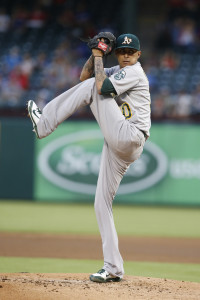
Chavez wraps up his career just shy of his 42nd birthday, which is less than a month away. He had an incredibly unique career in terms of the miles he traveled and jerseys he wore over the years. As detailed by Matt Monagan of MLB.com in 2022, Chavez is the most traded player in history, having been flipped ten times.
He was initially drafted by the Cubs in the 39th round of the 2001 draft but decided to go to college. Then the Rangers took him in the 42nd round the year after and got him to sign. The draft is now only 20 rounds in length but was obviously longer back then.
Prior to making it to the majors, he was traded for the first time, getting sent to the Pirates for Kip Wells in 2006. He made his major league debut with that club in 2008, tossing 15 innings with a 6.60 earned run average. He stuck with the Bucs through 2009 but then before the 2010 season was flipped to the Rays for Akinori Iwamura and then to the Braves for Rafael Soriano. His first stint with Atlanta lasted just a few months, as he was traded to the Royals at the deadline alongside Gregor Blanco and Tim Collins for Rick Ankiel and Kyle Farnsworth.
He stuck with the Royals through the 2011 season before being put on waivers, when the Blue Jays claimed him. In August of 2012, he was traded to the Athletics in exchange for cash considerations.
At the end of the 2012 season, Chavez still hadn’t had a lot of major league success. He had a 5.99 ERA in 177 1/3 innings. The move to Oakland seemed to work out well for him. In 2013, he tossed 57 1/3 relief innings with a 3.92 ERA. He got stretched out for a rotation role and performed well. He logged 303 innings over the 2014 and 2015 seasons with a 3.83 ERA.
Going into 2016, he was traded back to the Blue Jays, with Liam Hendriks sent the other way. That second stint with the Jays lasted just a few months, as he was flipped to the Dodgers for Mike Bolsinger ahead of the 2016 deadline. Both of those clubs kept in him relief and he had a 4.43 ERA that year.
He reached free agency for the first time ahead of the 2017 season and signed a one-year, $5.8MM deal with the Angels. The Halos stretched him back out but the results weren’t great, with a 5.43 ERA through July. He was moved back to the bullpen and had a slightly better 4.94 ERA the rest of the way.
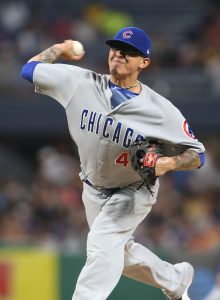 Going into 2018, he signed a one-year, $1MM deal to return to the Rangers, the first organization he signed with. That turned out to be one of his best seasons. He was traded the Cubs for Tyler Thomas at the deadline and finished that year with a 2.55 ERA. He got to make his first postseason appearance with the Cubs, tossing a scoreless inning in the Wild Card game against the Rockies, but the Cubs ultimately lost in 13 innings.
He returned to free agency and signed with the Rangers yet again, this time on a two-year deal worth $8MM. That deal didn’t work out quite as well, as he posted a 5.21 ERA over those two seasons.
He had to settle for a minor league deal with Atlanta going into 2021, but he showed he still had something left in the tank. He was able to to throw 33 2/3 innings in the majors that year with a 2.14 ERA. He cracked the postseason roster and tossed 6 1/3 scoreless innings as Atlanta won it all, getting Chavez a World Series ring.
He signed a minor league deal with the Cubs going into 2022 and got a brief stint on their roster before getting flipped back to Atlanta for Sean Newcomb. A few months later, he and Tucker Davidson were flipped to the Angels for Raisel Iglesias.
In the latter years of his career, he always seemed to wind up back in Atlanta. Even after being traded away in August of 2022, he was back in Atlanta via waivers a few weeks later. Via further minor league deals, he ended up tossing 34 2/3 innings in 2023 with a 1.56 ERA and then 63 1/3 innings last year with a 3.13 ERA. This year, his time on the roster has been more limited, with eight innings and eight earned runs allowed.
In the end, Chavez played in 18 seasons for nine different teams, getting traded ten times. He got into 657 games and tossed 1,142 innings with a 4.27 ERA. He had a 51-66 win-loss record, nine saves and 76 holds. Baseball Reference lists his career earnings above $25MM. We at MLB Trade Rumors salute him on his incredibly long and winding career and wish him the best with the next phase of his life. Based on his comments above, it sounds like maybe he’ll turn up in a coaching role in the future.
Photos courtesy of Kelley L Cox, Tim Heitman and Charles LeClaire, Imagn Images
Cubs Interested In Emmanuel Clase
The Cubs are one of the clubs “most actively monitoring” Guardians closer Emmanuel Clase, reports Francys Romero of BeisbolFR.com. Clase has been recently connected to clubs such as the Dodgers and Phillies in recent weeks. The Cubs were also connected to Clase ahead of the 2024 season.
It’s not a surprise that the Cubs or any other club would be interested in Clase, who has been one of the best closers in the sport for a few years now. From 2021 to the present, he has 180 saves for Cleveland, the most of anyone in the majors for that span. He has a 1.77 earned run average in that time. His 24.9% strikeout rate is only a bit above average, unusual for a closer. However, his 4.7% walk rate and 58.4% ground ball rate are both strong figures.
In addition to the results, his contract is very favorable. He has a $4.5MM salary this year and will make $6MM next year. He then has a pair of $13MM options with $2MM buyouts. In free agency, top closers like Edwin Díaz and Josh Hader have been able to secure average annual values around $20MM. Clase’s deal therefore has heaps of surplus value.
However, that also makes him very valuable to a low-payroll club like the Guardians. They are reportedly willing to listen to offers but that doesn’t mean they’re pushing him out the door. A recent four-game winning streak has pulled them to 51-50 and just 2.5 games back of a playoff spot. Their pre-deadline schedule is on the softer side. They’re playing the Orioles today, followed three games in Kansas City and three games in Cleveland against the Rockies.
Perhaps the Guardians can pull themselves out of seller position and into buyer mode, which may or may not impact Clase’s availability. It’s possible to imagine them doing some selling but holding Clase or trading him while still hoping to compete. The Guardians are often willing to walk a buy/sell tightrope, balancing their current and future needs. The decision is presumably dependent on what kinds of offers they receive. They have other strong relievers, including Cade Smith, so it’s possible they view a Clase trade as something that could upgrade another part of the roster without significantly hurting the bullpen. Then again, there is no rush to flip him if they’re not bowled over by an offer.
For the Cubs, it’s easy to see the appeal. They are one of the best teams in baseball and clearly in buyer mode this year. Elite relievers take on outsized importance in the playoffs, where off-days make it possible for them to impact almost every game.
The club’s relief corps has a collective 3.78 ERA, which puts them 10th in the majors. Daniel Palencia is doing a good job as the closer but adding Clase and moving everyone else down a peg on the depth chart would make the whole group stronger.
Pulling off a trade of Clase would require the club to part with some notable pieces to make it worth Cleveland’s while, though perhaps the Cubs are willing to do so. They already showed an all-in mentality in the Kyle Tucker trade this offseason and could perhaps keep the foot on the gas pedal. The Cubs have some notable outfield prospects, including Owen Caissie and Kevin Alcántara, which is an area of ongoing concern in Cleveland. It’s unclear if the Cubs would be willing to include any players like that for a bullpen upgrade. They have long-term outfield questions of their own, as Tucker is an impending free agent while Ian Happ and Seiya Suzuki are slated for free agency after 2026.
Photo courtesy of Ken Blaze, Imagn Images
Cubs, Zach Pop Agree To Minor League Deal
The Cubs reached agreement with reliever Zach Pop on a minor league contract, according to Tommy Birch of The Des Moines Register. The right-hander was assigned to Triple-A Iowa.
Pop is on his fourth organization of the season. He has bounced between the Blue Jays, Mariners and Mets. Pop was on the injured list with Toronto and combined for five outings between Seattle and New York. He was tagged for 12 runs (11 earned) including four homers in 6 2/3 innings. Pop is out of minor league options, so teams couldn’t afford to give him much rope when he was struggling to that extent.
The 28-year-old has pitched in parts of five MLB seasons. He threw 48 1/3 frames for the Jays last year, working to a 5.59 ERA with a well below-average 15.8% strikeout percentage. Pop doesn’t have huge swing-and-miss stuff, but he sits around 96 MPH with his sinker and has posted a 55% ground-ball rate in his MLB career. He carries a 3.71 ERA in 80 career Triple-A innings.