
Reds Acquire Curt Casali
4:34pm: Casali has not been placed on the MLB roster to this point, per C. Trent Rosecrans of The Athletic (via Twitter). Presumably, though, the team will select Casali’s contract or otherwise bring another catcher up before its next game, which is tomorrow evening.
4:20pm: The Reds have acquired catcher Curt Casali from the Rays, per a club announcement. Cash considerations are heading to Tampa Bay in return.
Casali, 29, has seen action in four MLB campaigns. He’s a .199/.285/.385 hitter with 19 home runs in 466 career plate appearances. This season, Casali is off to a solid start to the year at Triple-A, where he’s slashing .283/.330/.467 in one hundred trips to the plate. He has also typically graded as a solid performer at framing pitches, blocking balls in the dirt, and handling the running game.
It seems that the Reds will be adding Casali to the MLB roster, as the club announced that fellow backstop Tony Cruz has been optioned down to Triple-A. The 31-year-old Cruz has struggled in limited action this year at the MLB level, with 11 strikeouts in his 26 plate appearances.
Reds Move Homer Bailey To Bullpen
TODAY: Bailey will indeed move into the relief unit, MLB.com’s Mark Sheldon tweets.
YESTERDAY: The Reds have had discussions with right-hander Homer Bailey about a potential shift from the rotation to the bullpen, per John Fay of the Cincinnati Enquirer (Twitter links). While nothing has been finalized, Fay characterizes the move as a fairly likely one. Righty Luis Castillo would be able to make a start on regular rest in Bailey’s place this Sunday thanks to an upcoming off-day on Thursday.
Bailey’s six-year, $105MM contract extension with the Reds has proven to be a regrettable misstep for the organization, as the righty underwent Tommy John surgery in 2015 and a second elbow surgery to remove bone spurs in 2017. In all, he’s been limited to just 187 1/3 innings dating back to the 2015 season. In that time, he’s averaged fewer than five innings per start while recording a 6.59 ERA and allowing a .310/.384/.511 batting line to opposing hitters. The 2018 campaign has arguably been his worst, as he currently leads the Majors in allowing hits, home runs and earned runs.
While it seems fair to question just how much of a leash Bailey has left with regard to hanging onto his roster spot, the fact that the team is exploring a move to a relief role suggests that he won’t be cut loose just yet. Bailey is still owed a whopping $14MM of this season’s $21MM salary, plus a $23MM salary in 2019 and a $5MM buyout on an option for the 2020 campaign. Given that hefty $42MM sum, it’s hardly a surprise that the Reds would exhaust their options in terms of salvaging some kind of value from the ill-fated deal.
In the meantime, a move of Bailey to the bullpen would create an opening in the rotation behind Castillo, Matt Harvey, Tyler Mahle and Sal Romano. That spot could be earmarked for right-hander Anthony DeSclafani, who is on a minor league rehab assignment at the moment and is nearing a return to the Majors for the first time since 2016. A sprained ulnar collateral ligament in his right arm prevented DeSclafani from taking the hill last season, and he’s yet to pitch in the bigs this year thanks to an oblique strain.
[Related: Cincinnati Reds depth chart]
Of course, the rest of the Reds’ rotation isn’t exactly stable in its own right. Castillo has shown signs of rebounding after a rough start, but Harvey is still a ways from cementing himself as a viable big league rotation option just yet. Mahle and Romano have each had their own struggles as well, particularly the latter of the two. Certainly, further juggling of the rotation down the stretch is a possibility, as the Reds have several alternatives in the minors — many of whom are already on the 40-man roster.
Robert Stephenson, Cody Reed, Brandon Finnegan, Jose Lopez and Keury Mella are the top names in that group, though only Mella has posted particularly strong numbers, and he’s registered those while pitching in Double-A. (The others have all been in Triple-A.) Stephenson has the best surface-level numbers of the Triple-A arms, with a 3.59 ERA in 47 2/3 innings, but while he’s averaged an impressive 10.6 K/9 this year, he’s also averaging more than five walks per nine innings pitched. Lefty Justin Nicolino is also on hand as a veteran option in Louisville, though he’s not on the 40-man roster at present.
Scooter Gennett Discusses His Future In Cincinnati
Reds second baseman Scooter Gennett discussed his future with the ballclub after last night’s game, as MLB.com’s Mark Sheldon reports. While a mid-season trade seems possible, Gennett says he’d “like nothing more than to play [in Cincinnati] long-term.”
Gennett’s comments are most notable, perhaps, for his discussion of one potential alternative to a trade scenario. The veteran infielder says that his agent made an offseason attempt at starting extension talks with the organization. That effort fizzled, however, when the team “shot it down.”
A native of the area and childhood Reds fan, Gennett seemingly suggests he’d still be amenable to discussing a new deal. “The ball’s in their court,” he tells Sheldon. “I think it’s really up to Mr. Castellini [owner Bob Castellini] and the front office about where we go from here. I love the team and I’d love to be here.”
It seems there isn’t any lingering negativity following the unsuccessful offseason contract negotiation efforts. Apart from the differing viewpoints on a long-term deal, the sides failed to settle on an arbitration number. Gennett ultimately prevailed in a hearing, taking down a $5.7MM salary rather than the $5.1MM that the team defended.
Gennett is eligible for arbitration one final time after the present campaign. It’s certainly possible the Reds could decide to keep him and simply tender him a contract for 2019, though it’s still hard to see the organization as a likely contender next year. Holding Gennett without extending him would mean giving up a chance at achieving future value through a trade or a new contract. It’s not a straightforward decision, particularly with Eugenio Suarez locked in at third and top prospect Nick Senzel at or near MLB readiness and in need of a position.
It seems at least plausible to think, then, that Gennett will be shopped at the deadline if the club does not view him as a long-term piece that they can extend at an appealing price tag. With a strong offensive track record dating back to the start of the 2017 season, Gennett has certainly earned consideration as a trade target for contending teams. Indeed, we fully examined his potential trade candidacy just yesterday, noting the excellent output at the plate along with some lingering concerns as to its sustainability.
Trade Candidate: Scooter Gennett
The Reds don’t have much going on at the MLB level this year. Their 19-36 record is a bit disappointing, perhaps, but largely aligns with expectations after a winter that mostly involved acquiring some affordable pitching depth to supplement a returning roster filled with question marks.
There have been some recent front-office wins, though. Offseason additions David Hernandez and Jared Hughes have been nice bullpen buys to this point; both could end up as deadline assets or useful pieces for the 2019 season. The extensions of Tucker Barnhart and Eugenio Suarez have worked out nicely so far. Reclaiming Matt Harvey seems to be a worthwhile, albeit still-uncertain venture.
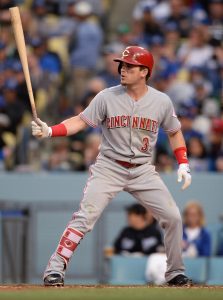
Perhaps the biggest score of late, though — setting aside the landing of Luis Castillo, at least — has come via the waiver claim of Scooter Gennett from the division-rival Brewers late in Spring Training last year. Gennett was very productive in 2017, but has now elevated his output yet further in the new season. With the picture of the 2018 trade deadline beginning to take shape, he’s a potential source of trade value for the Reds and an interesting player to examine.
Avid readers of MLBTR may recall that, at times in the past, I have shed some doubt on Gennett’s merits as a trade candidate. His effort last year was not accompanied by any improvements to his plate discipline, he carried a somewhat elevated .339 batting average on balls in play with less-than-promising Statcast data (.367 wOBA vs. .322 xwOBA), and he continued to struggle against same-handed pitching (.248/.287/.404 vs. lefties).
Entering the current season, then, my own expectations were not terribly lofty for the 28-year-old, who is playing on a reasonable, but not exactly cut-rate $5.7MM salary. That non-bargain pay grade also weighs down the value of controlling Gennett’s 2019 season via arbitration. It wasn’t all that surprising that he remained with the Reds when the season began, particularly given the relative dearth of demand at second base, a position that he has never fielded with particular excellence.
Rumors of regression have to this point been greatly exaggerated, though, as Gennett is off to a fabulous start in the new year. Through 212 plate appearances this year, he’s slashing a healthy .340/.376/.558 with ten home runs. That’s good for a 156 wRC+. Despite typically middling defensive grades at second base, Gennett has already contributed 2.2 rWAR / 1.9 fWAR on the year.
Basically, Gennett is performing right now like a post-breakout Daniel Murphy. The added benefit here, of course, is that he’s younger and cheaper. Gennett is even torching lefties thus far, with a .364/.375/.545 slash that quiets one of the most obvious critiques of his abilities at the plate.
Impressive as Gennett has been, though, some concerns continue to nag. Surely, he won’t be able to sustain a .405 batting average on balls in play. Statcast numbers again indicate that he has been somewhat fortunate, grading him at a .349 xwOBA that substantially lags his actual .397 wOBA. Gennett certainly has not shown any leaps in the plate-discipline department, as he has an unremarkable combination of a 20.7% strikeout and 5.1% walk rate to begin the 2018 season. And these signals are all the more evident in his 57 plate appearances against southpaws (.514 BABIP, 18:1 K/BB).
It still seems, then, that some regression is in store. But Gennett has shown signs of real change, too. He has quietly converted groundballs to line drives of late. In 2016, he put the ball on the ground 44.7% of the time and hit liners on 20.8% of his batted balls. Thus far in 2018, he’s at 37.3% and 26.6%, respectively. Though he’s not a particularly dramatic participant in the Launch Angle Revolution, Gennett has steadily elevated over time, moving from an average of 10.5 degrees (2015) to 11.7 degrees (2016) to 12.8 degrees (2017). This year, so far, he sits at 14.4 degrees on average. Of late, Gennett has maintained a lofty homer-per-fly rate (20.8% last year, 17.5% this).
An optimist might argue that this interesting blend of data points suggests that Gennett has honed in on being the best version of himself. He’s hitting the ball sharply on a line while generating well-struck high flies when that’s what’s available. That it has come through steady development rather than an obvious change in approach should not necessarily represent a red flag. Pessimists, on the other hand, will cite many of the above figures in support of the proposition that Gennett’s skills simply don’t support this kind of output. By that view, while he’s going well over an extended stretch, Gennett still hasn’t provided good reason to believe it’s sustainable. Projection systems, for instance, generally anticipate that he’ll settle into producing in range of the league-average rate.
We still have about two months of action left before the trade deadline, so the evidence is still being gathered. At some point, though, contending teams with a need at second base will need to decide whether it’s worth trying to pry Gennett loose from the Reds. Just how willing the Cincinnati organization is to deal, meanwhile, could depend in part upon whether and when top prospect Nick Senzel forces a promotion. But the biggest driver will likely be the quality of the offers.
There are a few other second basemen that will surely be weighed as deadline targets — MLBTR’s Steve Adams recently listed a few — but Gennett is the one presently pacing all MLB second baggers in offensive output. It’s hardly certain that there’ll be broad demand at the position. That may not be entirely necessary if Gennett truly stands out, but that’s just where the core question lies. Clearly, he has proven since joining the Reds that he’s a quality MLB player who can help a contender. But unless one or more teams come to believe he’s truly an everyday, high-level type of performer, it’s fair to wonder whether an offer will come in that’s strong enough to pique the Reds’ interest.
Photo courtesy of USA Today Sports Images
Central Notes: Meadows, Reds, Cards, Miggy
When the Pirates promoted outfield prospect Austin Meadows on May 18, the plan was for him to quickly return to the minors, manager Clint Hurdle told Elizabeth Bloom of the Pittsburgh Post-Gazette and other reporters Saturday. However, Meadows’ “performance was eye-catching,” according to Hurdle, which convinced the team to keep him around when it activated fellow outfielder Starling Marte from the disabled list Saturday. With Marte, Gregory Polanco and Corey Dickerson, the Pirates now have their starting outfield intact again, but Hurdle still sees enough opportunities for the 23-year-old Meadows to justify keeping him in the majors. “We need to continue to monitor [Corey] Dickerson’s on-field innings,” Hurdle said. “Marte’s bouncing back, we’re going to be smart with, and Polanco. So I think between the four of them, and a true fourth outfielder, we’ll be able to have the opportunity to get everybody playing time.” Meadows was out of the lineup for the Bucs’ game on Saturday, but he did collect a pinch-hit appearance. He didn’t reach base in that at-bat, dropping his line to a still-stellar .433/.433/.867 over his first 29 major league trips to the plate.
More from the majors’ Central divisions…
- Reds left-hander Brandon Finnegan tells Bobby Nightengale of the Cincinnati Enquirer that he’s displeased the team demoted him to Triple-A on May 10 to make room for Matt Harvey‘s acquisition. Finnegan noted that he’s fine either starting or relieving in the majors, saying “whatever helps the team out is what I want to do,” but he believes he made a case earlier this season to continue in the Reds’ rotation. “I felt like I had two pretty good starts up in Cincinnati,” Finnegan said. “You can’t do anything about getting taken out of the game after 70 pitches. (Reds interim manager Jim) Riggleman loves using the bullpen; that’s his thing. That part was out of my hands. Besides that, two of my five starts I had, I thought were pretty good. I was attacking guys.” Notably, Finnegan added that he has no hard feelings toward Riggleman, per Nightengale. Regardless, Finnegan didn’t exactly make a case to stay in the Reds’ rotation during his five pre-demotion starts – he logged a 7.40 ERA with 15 walks and 14 strikeouts in 20 2/3 innings – though he still expected more leeway after missing most of last season with shoulder issues. The Reds, for their part, haven’t given up on Finnegan serving as a starter in the majors, and they sent him down so he’d work out of their their Triple-A rotation rather than the big league bullpen, Nightengale writes. Finnegan, meanwhile, is using his stint in the minors as motivation and “hoping to get back” to the Reds sooner than later.
- Cardinals righty Alex Reyes will make his much-anticipated 2018 debut on May 30 in a start against the Brewers, Joe Trezza of MLB.com tweets. It’ll be the prized 23-year-old’s first MLB outing since he underwent Tommy John surgery prior to the 2017 season. Reyes tore through multiple minor league levels during his rehab stint this year, racking up 44 strikeouts against seven walks in 23 scoreless frames, and looks unlikely to work under an innings limit upon his return to the majors.
- Tigers first baseman Miguel Cabrera is making progress as he works back from a hamstring strain, as Evan Woodbery of MLive.com details, but a return date for the future Hall of Famer is still unclear. Cabrera hasn’t played since May 3, before which he seemed to be in the midst of a bounce-back campaign. After posting an uncharacteristically pedestrian 2017, Cabrera opened this year – his age 35-season – with a .323/.407/.516 line in 108 PAs. Fortunately for Detroit, first base fill-ins John Hicks and Niko Goodrum have fared respectably in Cabrera’s stead.
Reds Place Raisel Iglesias On Disabled List
The Reds announced this afternoon that they’ve placed closer Raisel Iglesias on the 10-day disabled list due to soreness in his left (non-throwing) biceps. Fellow righty Austin Brice is also headed to the DL thanks to an upper back injury. In their place, the Reds activated righties Michael Lorenzen and Tanner Rainey from the disabled list. The announcement didn’t include any expected timeline for either player’s absence.
Iglesias, 28, struggled with his control early in the season but has corrected that issue lately and looked to be in excellent form since late April. He did issue a pair of runs and suffer his second blown save in his most recent appearance, but he’s gone 10 outings without issuing a walk and pitched to a 1.74 ERA with 12 strikeouts in that time. Overall in 21 2/3 innings this season, he’s notched a 2.08 ERA with 11.2 K/9, 3.3 BB/9, 1.25 HR/9 and a 36.2 percent ground-ball rate.
Brice, meanwhile, has been scored upon in four of his past past five appearances, causing his ERA to balloon up to 4.67 despite largely promising K/BB and ground-ball tendencies. In 25 innings of relief this season, he’s averaged 9.4 K/9 against 2.5 BB/9 with a 50.7 percent ground-ball rate. He’s been too prone to the long ball, though, already serving up four homers on the season. That’s been an ongoing trend for Brice in the big leagues, as he’s yielded a dozen big flies in just 71 2/3 frames at the game’s top level.
[Related: Cincinnati Reds depth chart | MLB closer depth chart at Roster Resource]
It’s not yet clear who’ll step into the ninth inning for the Reds with Iglesias out of action. For all of the Reds’ flaws, they actually have several high-quality options in the ‘pen, where Amir Garrett, Jared Hughes and Dylan Floro have all worked to a sub-2.00 ERA in 2018. Garrett has very arguably been the team’s most dominant relief arm, averaging better than 10 strikeouts per nine innings and notching a 1.67 ERA in his 27 frames this far. The veteran Hughes has shown the best control of the bunch and comes with the most late-inning experience in the big leagues, having spent several seasons as a setup man for the division-rival Pirates. Lorenzen, meanwhile, was the top setup man to Iglesias last season but has yet to pitch in the Majors this season due to a shoulder strain that caused him to open the season on the disabled list.
Minor MLB Transactions: 5/22/18
Here are the day’s minor moves…
Latest Transactions
- The Nationals signed outfielder Jaff Decker to a minors contract, the Washington Post’s Chelsea Janes reports (via Twitter). The 30-year-old has appeared in each of the last five MLB seasons, posting a .510 OPS over 191 career plate appearances with the Padres, Pirates, Rays, and A’s. Decker signed a minor league deal with Atlanta over the winter but was released earlier this month.
- The Mets signed veteran lefty Aaron Laffey to a minor league deal, purchasing his contract from the independent Atlantic League. The Somerset Patriots, Laffey’s Atlantic League team, reported the news on Twitter. The 33-year-old worked as both a starter and reliever for six teams (including a brief stint with the Mets in 2013) over parts of eight MLB seasons, though Laffey has only 7 1/3 innings in the Show since the end of the 2013 season and none since 2015. He has bounced around the minors, including a previous stint with Somerset last season that ended when he signed a minors deal with the D’Backs.
Earlier Today
- The Reds selected the contract of infielder/outfielder Brandon Dixon from Triple-A, optioning Rosell Herrera to Triple-A in a corresponding move. Dixon, a third-round pick for the Dodgers in the 2013 draft, was one of the three youngsters (along with Jose Peraza and Scott Schebler) dealt to Cincinnati as part of the three-team trade that sent Todd Frazier to the White Sox. Neither Baseball America or MLB.com ranked Dixon among the Reds’ top 30 prospects, though he put himself on the map this season thanks to an impressive .326/.371/.527 slash line over 140 PA at Triple-A Louisville. While he has spent much of his pro career as a second and third baseman, Dixon has made multiple starts as a first baseman and corner outfielder this season, giving him added versatility on the Reds’ roster.
- The Tigers announced the purchase of left-hander Kevin Chapman‘s contract from the independent Atlantic League’s New Britain Bees. Chapman has been assigned to Triple-A. The southpaw posted a 4.09 ERA over 55 relief innings for the Astros in 2013-16, and spent last season in the Braves’ and Twins’ farm systems. The Tigers are short on left-handed relievers both in the majors and upper minors, so there seems to be an opportunity for Chapman to earn a spot back to the big leagues.
- The Nationals announced that outfielder Moises Sierra has cleared waivers and been optioned back to Triple-A. Sierra was designated for assignment earlier this week to clear roster space for the promotion of top prospect Juan Soto. Appearing in his first MLB action since 2014, Sierra hit .167/.217/.404 over 60 PA for Washington this season.
- Southpaw Jairo Labourt has been released by the Tigers, as Evan Woodberry of MLive.com covers on Twitter. Despite being a popular waiver wire target over the offseason, the 24-year-old lefty has not been in good enough form even to join an affiliate to this point. The Tigers originally acquired him in the 2015 David Price swap.
- The Pirates have released right-hander Tyler Jones, according to John Dreker of PiratesProspects.com. Jones, 28, has had some promising seasons in the upper minors, but hasn’t shown as well in the last two campaigns. Homers have been an issue for Jones thus far, as he has been tagged for a 5.40 ERA with 9.2 K/9 and 3.8 BB/9 over 16 2/3 innings with the Bucs’ top affiliate.
- Rangers righty David Ledbetter has decided to retire, according to MLB.com’s T.R. Sullivan (via Twitter). Per the report, the 26-year-old decided to hang things up as a “family decision.” A third-round pick in 2013, Ledbetter has never quite found his form in the minors. In 115 1/3 Triple-A innings, he owns a 4.99 ERA with 6.0 K/9 and 4.0 BB/9.
NL Central Notes: Krall, Vazquez, Anderson/Peralta, Hicks, Darvish
On his latest podcast, MLB.com’s Mark Feinsand chats with just-minted Reds GM Nick Krall, who took a grinder’s approach to getting into the game. The back story is an interesting listen and also provides some insight into Krall’s background with the Moneyball-era A’s. Of what he learned from Billy Beane, Krall says he was impressed by Beane’s scope of knowledge of players from outside the Oakland organization along with his certitude as to “what he wanted on his team.” From former Reds GM Walt Jocketty, Krall says he learned to exercise greater patience. (Krall describes himself as “a very impatient person” by nature.) It’s a worthwhile listen for fans who want to learn more about the most recent person to be named a major-league general manager.
Here’s more from the NL Central:
- Elizabeth Bloom of the Pittsburgh Post-Gazette looks at a few interesting subjects involving the Pirates. In particular, she dives into the question of fastball velocity in regard to closer Felipe Vazquez, whose slight loss of speed does not seem to represent much cause for concern — particularly since he has actually increased the spin rate on the offering. Though Vazquez only carries a 3.86 ERA on the year, it’s worth noting too that he has been hurt by a 58.3% strand rate. That said, while Vazquez is still getting loads of swinging strikes, his walk rate has gone backwards and he isn’t getting as many grounders as he has in years past. At this point, he hasn’t shown quite the level of dominance he did in 2017, but there’s not yet any reason to believe he won’t be a quality late-inning arm for the foreseeable future.
- The Brewers activated righty Chase Anderson from the DL to take the ball yesterday, optioning Freddy Peralta to open a roster spot. It’s certainly good news for Milwaukee that Anderson was able to bounce back quickly from illness; now, the 30-year-old will look go get back on track after a messy start to the year. He has managed a 3.86 ERA in 51 1/3 frames, but has showing worrying trends in his peripherals that have fielding-independent pitching metrics raising red flags (6.02 FIP; 5.36 xFIP; 5.16 SIERA). The brief respite for Anderson may not have been the worst thing for all involved. In addition to giving him a chance to get sorted, the team surely now feels like it has a better sense of Peralta’s potential to help at the MLB level in the near term. His second outing wasn’t quite as stirring as his first, to be sure, but Peralta impressed overall by allowing just four earned runs on four hits while recording 18 strikeouts against eight walks in 9 2/3 innings.
- Over at Fangraphs, there are a couple pieces well worth a read for fans of the division. Jeff Sullivan examines the curious case of Cardinals reliever Jordan Hicks, the flamethrowing reliever who has thus far registered very few strikeouts. It’s a well-balanced take on the youngster, who certainly has exhibited a fascinating skill but still will need to make improvements to become a dominant MLB reliever. Speaking of fastballs, Jay Jaffe looks at the arsenal of Cubs starter Yu Darvish and his reasonably promising return from the DL. It’s a complicated picture, but well worth a look for anyone looking to gauge where things are headed for the high-priced hurler.
Heyman’s Latest: Arrieta, Cain, Davis, Rays, Reds, Morales
Some items from around baseball in the latest notes collection from FanRag Sports’ Jon Heyman…
- The Nationals were linked to Jake Arrieta during the offseason, and Heyman reports that the team was interested in signing the righty to a contract similar to the three-year, $75MM deal Arrieta eventually got from the Phillies. No offer was officially made, however, while GM Mike Rizzo had interest in adding Arrieta, ownership declined to make another big investment in a starting pitcher. With Arrieta pitching well and the Phillies ahead of the Nats in the NL East standings, this non-signing could be an interesting what-if scenario for the future, though Washington’s rotation is already one of the best in baseball.
- Speaking of winter what-ifs, Heyman adds the Mariners, Braves, and Dodgers to the list of teams that had interest in signing Lorenzo Cain before the center fielder inked a deal with the Brewers. Seattle had a clear need for center field help prior to the Dee Gordon trade, though the other two wouldn’t seem to be obvious fits on paper for Cain’s services. The Braves already have Ender Inciarte in center, plus they needed to trade Matt Kemp to make room for Ronald Acuna‘s eventual promotion; potentially, Cain could’ve been a fit if Atlanta had managed to trade Nick Markakis (and then convince Cain to shift to right field). For the Dodgers, signing Cain would have run counter to their plan of getting under the luxury tax threshold, plus L.A. would’ve had to give up two draft picks and $1MM in international bonus pool funds as compensation for signing Cain. It’s also possible, of course, that both the Braves and Dodgers merely had a due diligence-type of interest in Cain given that his free agent stint stretched into late January.
- Khris Davis and the Athletics were in talks about a one-year extension to cover Davis’ final season of arbitration eligibility, though Heyman reports that Davis declined an offer from the team. It isn’t known whether negotiations are ongoing or if the two sides will table the issue. Davis has a .235/.307/.497 slash line and 13 homers through his first 205 PA, so he is on pace to earn another big raise from his current $10.5MM salary in his last arb year.
- The Mets aren’t for sale, though “folks around the league believe” that Rays owner and New York native Stuart Sternberg would try to buy the the Mets if they were available. Needless to say, the Mets would be a highly sought-after property if the Wilpon family did decide to sell — one would imagine the sale price of a team in the gigantic NYC media market would easily surpass the $2 billion mark. Heyman writes that there is even some speculation Sternberg would try to move the Rays to New York or Montreal if the league allowed it, though obviously the Mets and Yankees would have something to say about the former option in terms of territorial-rights issues. Sternberg’s relative lack of ties to his own team’s area (“he isn’t often in Tampa“) could also be an obstacle in the Rays’ longstanding desire for a new stadium.
- The Reds have been playing better under Jim Riggleman, but if the team does still want to make a long-term change in the dugout, Heyman hears that the team isn’t going to be spending big on a managerial salary. A new skipper will almost certainly make less than Dusty Baker’s $3.5MM annual salary when he was running the team. This could rule out a star hire like Joe Girardi, who impressed Reds ownership when he interviewed for the job prior to Baker’s hiring. Interestingly, Heyman believes that Girardi — an Illinois native — could be a candidate if the White Sox decided to make a managerial change, though there isn’t any indication that the Sox are considering moving on from Rick Renteria. That scenario would have a strong echo of Renteria’s last managerial job, when he stewarded the Cubs through some rebuilding years before being replaced by another star manager in Joe Maddon.
- The Royals had some interest “awhile back” in a reunion with Blue Jays DH Kendrys Morales, though that trade possibility has evaporated since both the Royals and Morales are badly struggling. K.C. is looking like a deadline seller, while Morales is hitting so poorly (.163/.248/.279 through 117 PA) that the Jays may have to release him or eat all of the approximately $19.76MM left on his contract through the 2019 campaign.
NL Notes: Russell, Kershaw, Reds, Mets
There has been speculation about the Cubs pursuing Orioles shortstop Manny Machado in a deal that could cost the North Siders their current shortstop, Addison Russell. But Russell told Patrick Mooney of The Athletic (subscription required) and other reporters Saturday that he’s not sweating those rumors. “As far as the trade rumors, if it happens, it happens. But I really don’t pay them any attention,” he said. “The only time I really even hear about them is the media bringing it up to me.” Unsurprisingly, the 24-year-old Russell also made clear that he’d like to remain with the Cubs, who originally acquired him from the Athletics in a 2014 blockbuster with the Athletics. Russell has since emerged as a solid starter, not a superstar like Machado, but trading him to acquire the latter would mean surrendering his three-plus years of control for a few months of control over Machado. Of course, it would also boost the Cubs’ World Series chances for this season, thus creating a conundrum for Chicago’s brass if it actually does discuss a Machado-Russell trade with Baltimore.
In other NL news…
- The Dodgers’ rotation took another hit Sunday when left-hander Rich Hill landed on the disabled list, but ace Clayton Kershaw seems to be nearing a return. Kershaw, on the DL since May 6 with a biceps injury, threw a bullpen session Sunday and could be one away from going on a rehab assignment, Pedro Moura of The Athletic was among those to report. Kershaw may even be able to rejoin the Dodgers as early as next weekend, manager Dave Roberts suggested to Bill Plunkett of the Orange County Register.
- Like Kershaw, Reds righty Anthony DeSclafani is making progress as he works back from his own injury – a left oblique strain. DeSclafani, who previously missed all of last season with a sprained UCL, made a successful start at Double-A on Saturday and could be just two more rehab starts from returning to the majors, Brian Scott Rippee of MLB.com writes. Before injuries derailed his career, DeSclafani was an effective starter in Cincinnati, where he combined for 308 innings of 3.74 ERA/3.79 FIP ball from 2015-16. If the 28-year-old’s anywhere near that good upon returning, it would be a boon for a rebuilding Cincy club that has struggled to find quality starters. The Reds’ DeSclafani-less rotation has posted a horrendous 5.66 ERA dating back to last season.
- In the wake of outfielder Juan Lagares‘ season-ending injury, the Mets are experimenting with young first baseman Dominic Smith in the grass, Anthony DiComo of MLB.com tweets. Smith, 22, lined up in right field at the Triple-A level on Saturday and could emerge as an option there for the Mets, who – thanks to injuries to Lagares and Yoenis Cespedes – “don’t have many outfielders,” manager Mickey Callaway noted. “When Lagares got hurt, we had to start thinking outside the box.”