
Dodgers Option Hyeseong Kim
The Dodgers optioned infielder Hyeseong Kim and right-hander Bobby Miller this evening. They also reassigned non-roster invitees Giovanny Gallegos, Eddie Rosario, David Bote, Michael Chavis and top prospect Dalton Rushing to minor league camp.
Additionally, Bob Nightengale of USA Today reports that Dustin May will open the season as the fifth starter as Tony Gonsolin is ticketed for an injured list stint. Manager Dave Roberts told Dodgers Territory yesterday that was likely to be the case, as Gonsolin recently tweaked his back while lifting weights.
Kim entered camp as the favorite for the second base job. The Dodgers signed the lefty-hitting infielder to a three-year deal that guaranteed $12.5MM. While that’s a relatively modest investment, L.A. traded Gavin Lux to Cincinnati a few days later. That seemingly opened the path for Kim to step in at the keystone, but the Dodgers evidently have some concerns about how his bat will translate to open the season.
Offensive impact has been the question dating back to Kim’s time in Korea. Evaluators credit him as a good baserunner and plus defender. He hit .304 over eight KBO seasons but was never much of a power threat. Last season’s 11 home runs represented a career high. The 26-year-old infielder struck out 10 times in 31 plate appearances during his first MLB camp. He hit .222 with one homer in 14 spring games.
Starting Kim in the minors provides Roberts some flexibility at second base. The Dodgers could turn to any of Miguel Rojas, Enrique Hernández or Chris Taylor — all of whom would otherwise play utility roles. Alternatively, they could bring Tommy Edman back in from center field to play second. That’d open center field for Andy Pages or James Outman, but neither of them have had especially impressive Spring Trainings.
The Gonsolin injury resolves L.A.’s biggest camp battle: the fifth starter competition between him and May. Both pitchers missed all of last season rehabbing surgeries. Gonsolin underwent a 2023 Tommy John procedure. May required a flexor repair in ’23 and needed to undergo emergency esophageal surgery last summer after suffering a life-threatening throat tear while eating. His season debut will be his first major league appearance in nearly two years.
May rounds out what will be a five-man rotation for the time being. Tyler Glasnow, Yoshinobu Yamamoto, Roki Sasaki and Blake Snell will hold the top four rotation spots. Yamamoto and Sasaki are respectively tabbed for Games 1 and 2 during next week’s Tokyo Series matchup against the Cubs.
Dodgers Sign Dave Roberts To Four-Year Extension
The Dodgers announced the signing of manager Dave Roberts to a four-year extension that covers the 2026-29 seasons. The team did not confirm salary figures, but Roberts will reportedly be paid $32.4MM — an average annual value of $8.1MM. That surpasses the $8MM AAV on Craig Counsell’s five-year, $40MM deal with the Cubs.
The news doesn’t come as a shock. Clubs generally don’t like to have skippers in “lame duck” position, that is, managing on a deal that is about to expire. Reporting throughout the winter has suggested the Dodgers and Roberts were likely to work out a new deal prior to the start of the 2025 season. It was reported on Thursday that the two sides were making progress on a deal that would see Roberts surpass Counsell’s AAV. On Friday, Roberts referred to the talks as being on “the one-yard line”, per Fabian Ardaya of The Athletic.
Roberts has been at the helm for the Dodgers since November of 2015. The club was already in good overall position at that time, having just won three straight division titles under manager Don Mattingly, but with three straight deflating postseason losses. They lost the NLCS to the Cardinals in 2013 and then suffered quick NLDS defeats in the next two seasons.
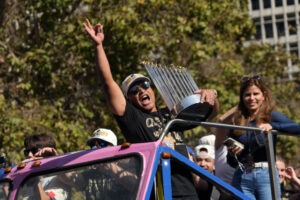
Under Roberts, the regular season success has continued and the postseason record improved. They made it to the NLCS in the first season and the World Series in his second and third campaigns. The club lost the 2017 World Series to the Astros and the 2018 series to the Red Sox, both asterisk-marked campaigns for those winning clubs. The Dodgers suffered a quick NLDS exit in 2019 but hoisted the trophy in the shortened 2020 season. The next three seasons saw the club eliminated before the World Series, but they won it all again in 2024, getting Roberts his second ring in five years.
Roberts currently sports a managerial record of 851-506 in the regular season and 56-44 in the postseason, with the Dodgers getting to the playoffs in each season with him at the helm. Roberts has had some loaded rosters to work with but appears to be well-liked by players and other Dodger personnel.
Counsell left the Brewers after the 2023 season with the reported goal of improving the earning power of managers. Joe Torre had been able to secure an $8MM salary in his days with the Yankees but skipper salaries had seemingly stalled. Reportedly, Terry Francona was the highest-paid manager in 2023 with a $4.5MM salary. Counsell managed to get a five-year, $40MM deal from the Cubs, an AAV of $8MM. That seemingly set a baseline foundation, with Roberts able to negotiate his way just over that line. Earlier in the winter, Roberts said he was hopeful of getting a new deal done but wanted “to feel (his) value.”
Jon Heyman of The New York Post first reported that Roberts and the Dodgers had agreed to a new four-year deal worth slightly more than $8MM annually. Bob Nightengale of USA Today first reported that the deal would start in 2026. Joel Sherman of The New York Post reported the $32.4MM total.
Dodgers’ Michael Grove Undergoes Season-Ending Shoulder Surgery
6:20pm: Per Ardaya, Grove underwent surgery to repair his right labrum. Roberts added that Grove attempted to pitch through the issue dating back to last season, but the club opted for surgery after the issue did not respond well to an offseason of rest.
12:58pm: Michael Grove‘s season has already come to an end, as the Dodgers right-hander underwent surgery on his throwing shoulder and will now miss the entire 2025 campaign, The Athletic’s Fabian Ardaya reports. Grove’s last 2024 appearance came in Game 2 of the NLDS, and he was removed from the Dodgers’ playoff roster after that game with the first occurrence of this shoulder issue.
Manager Dave Roberts stated two weeks ago that Grove was expected to start the season on the injured list, as recovering from that postseason shoulder problem had cost the righty about a month of his normal winter ramp-up work. It isn’t yet known if Grove was trying to pitch through more discomfort or if a new issue was discovered after testing, but regardless, the 28-year-old will now unfortunately be sidelined until 2026.
This marks the second major surgery of Grove’s baseball career, as he had a Tommy John procedure in 2017 when he was still playing college ball at West Virginia. The Dodgers were still intrigued enough by his potential to make Grove a second-round pick in the 2018 draft, though between his injury rehab, the canceled 2020 minor league season, and simply some struggles in his first taste of pro ball, Grove didn’t really start delivering good numbers until 2022.
That same year saw him make his big league debut in the form of 29 1/3 innings of 4.60 ERA work, as Grove started six of his seven games. The right-hander started 12 of 18 MLB appearances in 2023, with Los Angeles cycling Grove up and down from Triple-A multiple times whenever they needed a fresh arm in the rotation or bullpen. Grove was also shuttled back and forth several times last season, though he worked primarily as a reliever and posted a 5.12 ERA over 51 innings.
Grove’s 5.48 ERA over 149 1/3 career Major League innings isn’t very impressive, yet his SIERA is a far more palatable 3.85. With decent strikeout (23.2%) and walk (6.9%) rates, plus several other solid peripherals, Grove’s under-the-hood numbers paint a far better picture of his ability, though he has a penchant for allowing home runs at inopportune times. Injuries also hampered Grove over the last two seasons, as he missed significant chunks of time with groin and lat-related issues, beyond the shoulder injury that took him off the Dodgers’ postseason roster.
Los Angeles overcame an absurd number of pitching injuries to capture last season’s World Series, and it already looks like the Dodgers’ staff will be facing more health issues in 2025. As per RosterResource‘s projections, ten pitchers are set to begin the season on the injured list, with issues ranging from relatively minor injuries to season-ending problems (i.e. Grove’s surgery, or River Ryan and Kyle Hurt probably missing 2025 after undergoing Tommy John surgeries last year). This is on top of the several pitchers with checkered injury histories who are expected to be part of the Opening Day roster, such as Tony Gonsolin, Dustin May, Blake Snell, Tyler Glasnow, and two-way superstar Shohei Ohtani.
The Dodgers are so deep in pitching that the team is hoping the sheer volume of available arms can help cover for any more injuries that might arise during the season, and this is also why L.A. was so aggressive in adding Snell, Roki Sasaki, Tanner Scott, Kirby Yates, and others to their depth chart. While Grove isn’t exactly a household name amidst all of the Dodgers’ superstars, losing another innings-eating reliever removes another layer of security from the Dodgers’ plans.
Dodgers To “Slow-Play” Shohei Ohtani’s Pitching Rehab
Since his debut in 2018, Shohei Ohtani has gone 38-19 with a 3.01 ERA and 608 strikeouts. In that time, only five starters (min. 400 IP) have a lower ERA, and only six have a higher strikeout rate. There is no denying that Ohtani has been a terrific pitcher when he has been healthy enough to take the mound. Alas, injuries have limited the two-way superstar to just 86 starts in seven MLB seasons. He has not pitched in a big league game since August 2023. Of course, that hasn’t stopped him from being one of the best players in the world – he won his third MVP in 2024 without pitching a single inning – but it would be an understatement to say that fans are excited to see him back on the mound in 2025.
Unfortunately, the wait might be longer than initially expected. Not only is Ohtani working his way back from UCL surgery in September 2023, but he is also recovering from surgery on his non-throwing shoulder this past November. In February, Dodgers manager Dave Roberts suggested Ohtani could start facing live batters ahead of the Tokyo Series and return to the team’s rotation at some point in May – perhaps even earlier. As recently as two weeks ago, that still seemed to be the case. This past Thursday, however, the skipper was singing a slightly different tune.
Ohtani has not thrown off of a mound since a bullpen session on February 25. Roberts told reporters (including Jack Harris of the Los Angeles Times) that the team is being extra cautious with the two-way player as he gets back into games as DH. His last bullpen session came three days before his first Cactus League appearance as a hitter. “We just felt that to intensify the bullpens, alongside of the intensity of the games, wasn’t smart,” Roberts explained. “So we just wanted to kind of slow-play it.”
Asked if Ohtani could still return to the rotation in May, Roberts was noncommittal: “We just don’t know.”
Pitching coach Mark Prior said the Dodgers are “trying to control overall workload management” for Ohtani’s left shoulder. He told Bill Plunkett of the Orange County Register, “There’s a little bit of a shift towards making sure he’s dialed in, ready to go, from a DH standpoint.” Thankfully, Prior does not believe Ohtani’s new timeline is any cause for concern. This isn’t a sign of a major setback; the Dodgers simply seem to be exercising the utmost caution with their most important player. Still, it’s worth noting that Ohtani’s timeline to return looks longer than it did a few weeks ago. As Sonja Chen of MLB.com points out, Ohtani is now unlikely to face live opponents until the team gets back from Tokyo.
As thrilling as it will be to finally see Ohtani back on a big league mound, one absolutely cannot fault the Dodgers for playing things safe. With Blake Snell, Tyler Glasnow, Yoshinobu Yamamoto, Roki Sasaki, Tony Gonsolin, and Dustin May in the fold, L.A. isn’t exactly short on rotation depth to begin the season. Moreover, the worst-case scenario is that Ohtani suffers an injury that prevents him from pitching or hitting for any period of time. Needless to say, the Dodgers understand that better than anyone, and they’re taking precautions to avoid such a disaster.
Offseason In Review: Los Angeles Dodgers
The Dodgers followed up their World Series win with another aggressive offseason, making many headline-grabbing additions as well as some less splashy moves. Despite years of playoff disappointments, they now go into 2025 viewed as a juggernaut that is despised by all other fan bases around the league.
Major League Signings
- LHP Blake Snell: Five years, $182MM (includes conditional club option, $52MM signing bonus and $65MM in deferrals)
- LHP Tanner Scott: Four years, $72MM (includes conditional 2029 club option, $20MM signing bonus and $21MM in deferrals)
- OF Teoscar Hernandez: Three years, $66MM (includes 2028 club option, $23MM signing bonus and $23.5MM in deferrals)
- RHP Blake Treinen: Two years, $22MM (includes $5MM signing bonus)
- OF Michael Conforto: One year, $17MM (includes $8.5MM signing bonus)
- RHP Kirby Yates: One year, $13MM
- IF Hyeseong Kim: Three years, $12.5MM (includes 2028-29 club option)
- LHP Clayton Kershaw: One year, $7.5MM
- IF/OF Enrique Hernández: One year, $6.5MM
2025 spending: $185.5MM
Total spending: $398.5MM
Option Decisions
- LHP Clayton Kershaw declined $10MM player option (though re-signed on aforementioned $7.5MM deal with incentives)
- Team exercised $5MM club option on IF Miguel Rojas
- Team exercised $3.5MM club option on C Austin Barnes
Trades and Claims
- Traded IF Gavin Lux to Reds for OF Mike Sirota and Competitive Balance Round A draft pick
- Traded C Diego Cartaya to Twins for RHP Jose Vasquez
- Traded OF Dylan Campbell to Phillies for international bonus pool space
- Traded OF Arnaldo Lantigua to Reds for international bonus pool space
- Traded RHP Ryan Brasier and cash to Cubs for PTBNL or cash
Notable Minor League Signings
- Roki Sasaki, Eddie Rosario, David Bote, Michael Chavis, Luis García, Giovanny Gallegos, Chris Okey, Joe Jacques
Extensions
- IF/OF Tommy Edman: Four years, $64.5MM (includes 2030 club option, $17MM signing bonus and $25MM of deferrals)
Notable Losses
- Jack Flaherty, Walker Buehler, Joe Kelly (still unsigned), Kevin Kiermaier (retired), Daniel Hudson (retired), Ryan Brasier, Gavin Lux, Diego Cartaya, Connor Brogdon (outrighted), Brent Honeywell Jr. (non-tendered), Zach Logue (non-tendered)
Things change fast in baseball. The Dodgers finished 2023 on a down note, having been swept out of the NLDS by the Diamondbacks. Though that was their 11th consecutive postseason appearance, many of them had ended in heartbreaking fashion. Fans of the club were in MLBTR's mentions, calling for manager Dave Roberts and president of baseball operations Andrew Friedman to be fired. Fans of other clubs were taunting them for their failed attempts to "buy" a World Series. But they then signed Shohei Ohtani to a heavily-deferred deal, as well as grabbing Yoshinobu Yamamoto and many others, eventually winning it all in 2024.
The club therefore went into the 2024-25 offseason with the wind in their sails and they didn't slow down. Within a few months of their parade, they had signed one of the top free agent starters, a few of the top relievers, some solid outfielders and the most notable international amateur since Ohtani.

Unlock Subscriber-Exclusive Articles Like This One With a Trade Rumors Front Office Subscription
- Access weekly subscriber-only articles by Tim Dierkes, Steve Adams, and Anthony Franco.
- Join exclusive weekly live chats with Anthony.
- Remove ads and support our writers.
- Access GM-caliber tools like our MLB Contract Tracker
Soto: Mets Didn’t Offer The Most Money
The Juan Soto free agency was one of the most anticipated in baseball history. It was expected to deliver historic results and did just that. He signed a massive 15-year, $765MM deal with the Mets. That’s the longest contract ever and the largest guarantee. The $51MM average annual value is also a record if one considers the deferrals in Shohei Ohtani‘s deal with the Dodgers. Ohtani technically got $700MM over ten years for a $70MM AAV but the heavy deferrals bring the net present value down to the $45MM range annually.
Despite all those records, Soto claims he could have got more. Abriendo Sports released a teaser for a Spanish-language interview they did with Soto. The full conversation won’t be released until Sunday but reporter Mike Rodriguez provided an English translation of the teaser. Soto says that the field was narrowed to the Mets, Yankees, Dodgers, Blue Jays and Red Sox and that the Mets didn’t offer the most money, with multiple teams offering more.
No other details were provided but it’s potentially an interesting bit of information. The five finalists are not surprising, as they were the clubs most often connected to Soto throughout the winter and towards the end of his free agency. Soto’s claim that the offer from the Mets wasn’t actually the highest doesn’t align with previous reporting. At the time of the agreement with the Mets, it was reported by Jon Heyman of The New York Post that the Yankees topped out at $760MM over 16 years. Sean McAdam of MassLive reported that the Red Sox maxxed out at $700MM over 15. Shi Davidi and Ben Nicholson-Smith of Sportsnet reported that the Blue Jays stopped short of $700MM. Patrick Mooney, Will Sammon, Brendan Kuty and Ken Rosenthal of The Athletic reported the Dodgers stopped at $600MM.
All those numbers are under what Soto got from the Mets, so it’s tough to figure which teams could have had a larger offer than $765MM. Andy Martino of SNY reports today that Boston was one of multiple clubs willing to go higher than the top offer if they thought Soto would accept, but he went to the Mets because of the “family-friendly vibe” established by Alex Cohen, wife of Mets owner Steve Cohen. Perhaps the Red Sox had topped out at $700MM in terms of an official offer but had made some sort of verbal indication to Soto and agent Scott Boras that they were willing to keep pushing.
Speculatively speaking, it’s also possible that there was some creative accounting going on. The Dodgers are famous/infamous for their heavy use of deferred money in the contracts they sign with players. Ohtani’s contract is the most extreme example. As mentioned, it came with an advertised sticker price of $700MM but actually had a net present value that the league calculated at just over $460MM while the MLBPA calculated it around $438MM. While the Dodgers reportedly stopped their offer at $600MM, perhaps that was a post-deferral number, while the offer might have had a shinier pre-deferral number.
Or perhaps there was some mystery team willing to throw out wild numbers that Soto never took especially seriously. 11 clubs reportedly reached out to him at the start of free agency. Soto was connected to clubs like the Giants, Phillies, Rays, Royals and even his original Nationals club at various points through the offseason. None of them seemed to get especially close. The Rays reportedly offered Soto some kind of high-AAV deal on a short-term, so it’s also possible that’s what Soto is referring to. Maybe the Rays offered a higher AAV than the Mets but with far fewer years.
Ultimately, it’s all a moot point. Soto has signed with the Mets and that can’t be changed now. Still, it does make for fun hypothetical speculation. Teams generally went nuts for Soto because of his incredible track record at such a young age. Many top prospects don’t debut until their mid-20s but Soto already had 936 big league games under his belt by the end of his age-25 season. And he had hit .285/.421/.532 for a 158 wRC+ in those. To get that player with so many prime years remaining was a very rare alignment that led to an unprecedented bidding war and perhaps we don’t know how high it actually could have gone.
Dodgers, Dave Roberts Making Progress In Extension Talks
The Dodgers and longtime manager Dave Roberts are making progress on a new contract, reports Joel Sherman of The New York Post. Sherman writes that a deal is expected to be finalized before the team heads to Tokyo next week in preparation for their opening series against the Cubs.
According to Sherman, Roberts is likely to establish a new record for average annual value. That indicates he’ll beat the $8MM salary which Craig Counsell received on his five-year deal with the Cubs last winter. It’s unclear how long Roberts’ next deal will be. He’s currently slated to enter the final season of the three-year extension he signed in March 2022.
A deal has seemed to be a formality for months. The front office has unsurprisingly expressed interest in continuity on the heels of their second World Series within the last five years. Roberts said in early February that negotiations had just gotten underway. He indicated he was hopeful of getting a deal done but added that he wanted “to feel (his) value” on the contract terms. A record-setting deal should do just that.
Roberts has been at the helm in Los Angeles since November 2015. He’s the National League’s longest-tenured active manager. Kevin Cash, who is entering his 11th season in Tampa Bay, narrowly tops him in that regard overall. The Dodgers have made the playoffs in each of Roberts’ nine seasons. Only a 107-win season by the 2021 Giants kept L.A. from winning the NL West every year. Los Angeles had also won the NL West under Don Mattingly in each of the three years preceding Roberts’ hiring.
The 52-year-old Roberts has been fortunate to work with incredible rosters. Still, talent alone doesn’t guarantee success. No other team has made the playoffs in each of the last nine years. Dodger brass was comfortable enough with Roberts’ leadership skills to stick by him despite some criticism about his in-game tactics in the postseason early in his tenure. The veteran skipper adroitly handled a rotation that had been decimated by injury during last year’s World Series run.
Roberts has led the Dodgers to an 851-507 record in the regular season. No other skipper who has managed as many games has bested that 62.7% win percentage. Roberts has helmed the Dodgers to four pennants and a pair of championships. He won the NL Manager of the Year award in 2016.
MLBTR Podcast: Jose Quintana, Luis Gil’s Injury, The Nats’ TV Situation, Salary Floor Talk, And More!
The latest episode of the MLB Trade Rumors Podcast is now live on Spotify, Apple Podcasts, and wherever you get your podcasts! Make sure you subscribe as well! You can also use the player at this link to listen, if you don’t use Spotify or Apple for podcasts.
This week, host Darragh McDonald is joined by Anthony Franco of MLB Trade Rumors to discuss…
- The Brewers having an agreement with Jose Quintana (1:20)
- Luis Gil of the Yankees to be shut down for at least six weeks (5:15)
Plus, we answer your questions, including…
- With MASN now solved and stadium naming rights and jersey patches on the way do you see the Nationals making the leap into big spenders sooner than later? (12:30)
- Do you see the MLBPA pushing for a salary floor? (22:05)
- Will the White Sox trade Luis Robert Jr. before the start of the regular season? (25:20)
- While neither is particularly likely, is it more probable that the Pirates extend Paul Skenes or the Reds extend Elly De La Cruz? (27:40)
- What is your opinion of the White Sox upper management and will they lose 100 games this year? (30:45)
- The Mets are loaded with infield prospects. Do they trade Jeff McNeil to make room? (37:30)
- With the Tigers’ outfield injuries, do they go get a right-handed bat? And who is available? (42:00)
- With the Mariners bringing back most of their position players, what are the chances they get better production from them in 2025? (44:30)
- Does David Bote have a legitimate shot to make the Dodgers’ roster? (50:35)
- Why doesn’t MLB expand to 36 teams instead of just 32? (51:35)
Check out our past episodes!
- Atlanta’s Pitching Depth, Iglesias, Jobe, Castillo, And More! – listen here
- Alex Bregman, The Padres Add Players, And No Extension For Vlad Jr. – listen here
- Pete Alonso’s Deal, And Potential Landing Spots For Bregman and Arenado – listen here
The podcast intro and outro song “So Long” is provided courtesy of the band Showoff. Check out their Facebook page here!
Dodgers Notes: Phillips, Kopech, Henriquez
The Dodger bullpen was so crowded that Ryan Brasier was designated for assignment and flipped to the Cubs a little over a month ago, despite posting a solid 3.54 earned run average last year. Since camp has opened, a few injuries have created a bit of breathing room, with Evan Phillips and Michael Kopech a bit behind the rest of the group.
It was reported about three weeks ago that both pitchers were delayed as camp opened. Phillips was diagnosed with a small tear of a tendon in his rotator cuff during last year’s playoffs. Surgery was not recommended and a cortisone injection had led to some healing, but the damage lingered into at least December and slowed his offseason throwing progression. It was reported a little over a week ago that the righty would not be ready by Opening Day.
Manager Dave Roberts provided Fabian Ardaya of The Athletic with a positive update. Roberts relayed that he watched Phillips throw a bullpen session today and came away impressed. He added that Phillips will stay in Arizona to continue getting work in while most of the Dodgers head to Japan for the Tokyo Series. Phillips will miss those Tokyo games and the start of the domestic regular season but Roberts says he should be back with the club in the first half of April. That’s good news as Phillips posted a 2.21 earned run average with the Dodgers over the past three seasons, striking out 29.6% of opponents while only giving out walks at a 6.5% clip.
As for Kopech, his track record as a reliever is far shorter but he still projects to be a key part of the bullpen. A starter for most of his career, he moved to relief work last year and had a 3.46 ERA between the White Sox and Dodgers. His 12.2% walk rate for the year was high but he punched out 31.5% of batters faced.
But he has been battling some forearm inflammation in recent months, putting his status for the start of 2025 in question. Yesterday, Ardaya relayed that Kopech was throwing a bullpen session. Kopech’s status is still up in the air but it does at least seem as though some progress is being made.
With some extra bullpen opportunities opening up, it could have been a chance for someone like Edgardo Henriquez to earn a job, but that won’t happen now. The young righty was spotted in a walking boot in the clubhouse yesterday. Roberts told Ardaya that the righty had a “mishap” away from the field and will be out of action for about four to six weeks. While the nature of the injury is mysterious, the point is that Henriquez won’t be able to step up and force his way into the bullpen while Phillips and Kopech are delayed.
Henriquez, 23 in June, was called up by the Dodgers late in September of last year. He tossed 3 1/3 innings but impressed the club enough to make the playoff roster, tossing another five innings in the postseason.
It’s hard to read much into that small sample of work but he averaged 98.7 miles per hour on his heater and 89.4 mph with his cutter. Prior to his call-up, he logged 53 minor league innings last year with a 2.72 ERA and 38.9% strikeout rate. The 12.8% walk rate is on the high side but the punchouts are huge and he is still young. He should factor into the Dodger bullpen mix down the line but will have to stay on ice for now.
NL Injury Notes: Smith, Gomber, Minter
Will Smith has been dealing with a bone bruise in his left ankle for almost nine months, as the Dodgers catcher revealed to The Athletic’s Fabian Ardaya and other reporters this weekend. Smith hurt his ankle while sliding into second base to try and break up a double play in the Dodgers’ 11-3 win over the Yankees on June 8, and he has been dealing with some level of discomfort ever since, though Smith didn’t go on the injured list or even miss really any time in the aftermath of the injury. The issue has persisted even after an offseason of rest, resulting in Smith being held out of Spring Training games until last Friday.
Smith said his ankle is only sore when he runs, and he is otherwise able to catch and hit normally. As Ardaya notes, Smith’s post-injury numbers imply otherwise — Smith hit .292/.361/.498 in 238 plate appearances though June 8, and then only .213/.301/.382 in 306 PA afterwards, plus a .568 OPS over 65 more trips to the plate during the playoffs. Los Angeles GM Brandon Gomes implied that the team might be more open to giving Smith extra off-days to keep him healthy and more well-rested in general for what the Dodgers hope is another deep postseason run.
This might not be the most prominent Will Smith-related news item to ever arise on an Oscar night, but let’s move onto some other notes from around the National League…
- Austin Gomber was scratched from a scheduled start today due to some soreness in his throwing shoulder, MLB.com’s Thomas Harding writes. Testing revealed no structural damage, though Rockies manager Bud Black wasn’t sure when Gomber might be back on the mound. While Gomber isn’t a high-velocity pitcher, his fastball was also down a tick during his first Spring Training start last week, so the matter didn’t solely arise today. Gomber viewed the situation as “a reset” rather than anything too serious, saying “maybe I would have tried to push it a little bit more if we were in a different spot on the calendar. But it being so early in the year, I just felt like I wanted to take a few days to try to get a touch better and not have something that’s like nagging throughout the year.” The veteran southpaw has been part of Colorado’s rotation for the last four seasons, and he posted a 4.75 ERA in 165 innings in 2024.
- A.J. Minter underwent season-ending hip surgery last August, and he hit a big checkpoint in his rehab process by throwing 20-25 pitches during a live batting practice session. Minter told MLB.com’s Anthony DiComo and other reporters that he “felt good” in the aftermath, and figures he’ll have at least one more live BP session before taking part in a proper Spring Training game setting. Despite Minter’s injury, his track record as a reliable bullpen arm led to plenty of interest on the free agent market, and he joined the Mets on a two-year, $22MM deal (with an opt-out after the first year). His progress hints that he might be able to be part of New York’s roster on Opening Day, but “we’re going to be smart about this. If I have to miss a few days or a couple weeks, my goal is to help this team at the end of the season.”