
The Marlins Should Make A Change Behind The Plate
Agustín Ramírez was the worst defensive catcher in the majors last year. The Marlins haven’t yet given up on him but perhaps they should. They have one of the top catching prospects knocking on the door and there’s an open path for them to surge into contention this year.
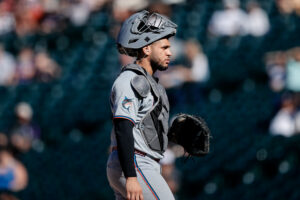
31 different catchers caught at least 600 innings in 2025. J.T. Realmuto led the way with 1151 1/3, almost double the 605 2/3 caught by Ramírez. Despite catching notably fewer innings than most of the catchers in this sample, Ramírez led the pack with ten errors. He allowed 19 passed balls, which was more than twice as much as the next person on that list, as no one else allowed more than nine. He was also behind the plate for 36 wild pitches, which are technically the fault of pitchers, but a good catcher can occasionally save his teammates from those. Four of those 31 catchers allowed a few more wild pitches but all in larger sample sizes. In short, if Ramírez was catching, the ball was at the backstop a lot.
Those traditional stats aligned with more advanced ones. Ramírez was credited with minus-14 Defensive Runs Saved. Only Salvador Perez, at minus-15, was worse than him in that column. The Fielding Run Value stat at FanGraphs had him last at minus-12. Statcast credited him with minus-13 catching runs, ahead of only Edgar Quero. Baseball Prospectus was less down on him overall, having him merely as one of the 13 worst catchers, but they were the one outlet that didn’t like his framing work.
Presumably, the Marlins have been willing to tolerate this in the hopes that there’s a path to improvement. Ramírez has been a very strong hitter in the minors and could be an asset if his defense got to more passable levels. He put up a combined line of .268/.357/.473 at various rungs of the minors from 2023 to 2025, leading to a 128 wRC+. His 11.5% walk rate and 18.4% strikeout rate were both strong figures and he hit 46 home runs in 1,120 plate appearances.
But his bat hasn’t quite clicked in the majors yet, perhaps due to him focusing so much on trying to improve his defense. Ramírez did hit 21 home runs last year but with a low batting average and poor walk rate, leading to a lopsided line of .231/.287/.413. That resulted in a 91 wRC+, indicating he was nine percent below league average. That’s not bad for a catcher since backstops tend to be about ten points below par, but it’s not great when considering his glovework.
Going into 2026, there was an argument for moving Ramírez to a role as a first baseman and designated hitter. Moving to first would require some work but Ramírez did play the position some in the minors. Though Ron Washington will tell you moving to first is not easy, catching is considered the most rigorous position on the field and playing anywhere else would afford Ramírez more ability to focus on his hitting.
All of that is especially true when considering the presence of Joe Mack, who is one of the top catching prospects in the league. He is considered to be a very strong defender behind the plate. He reached the Triple-A level in 2025, getting into 99 games. His offense is considered more questionable than his defense but he slashed .250/.320/.459 for a 107 wRC+ with the Jumbo Shrimp last year. He was added to the 40-man roster in November to keep him out of the Rule 5 draft.
The Fish could have gone with Mack and bumped Ramírez to first base, a position that was fairly open. They didn’t go that way. They have continued to stick with Liam Hicks and Ramírez as their catching duo, splitting the time almost equally. Ramírez has been behind the plate for 122 innings, compared to 123 for Hicks. Hicks is doing fine, pairing adequate defense with a .314/.354/.523 line in the early going this year, though he’s not great with the running game.
Ramírez, on the other hand, hasn’t shown many signs of improvement. His 122 innings caught this year are about a fifth of last year’s 605 2/3. He already has four errors, almost half the ten he had last year. That’s tied with Quero for the league lead. He has allowed three passed balls, a better pace than last year but not by much. Francisco Alvarez is the only guy with more, at four. Ramírez has been behind the plate for nine wild pitches already, a worse pace than last year. Only Logan O’Hoppe and Drew Millas have allowed more. FanGraphs and Statcast have soured on his framing a bit, though in a very small sample.
The Ramírez/Hicks pairing impacts their pitchers in other ways as well, as neither is great as controlling the running game. The Fish allowed 191 stolen bases last year, easily the most in the majors. The Astros were a distant second on that list with 157. Miami only caught 24 attempted steals on the year. Technically, that was higher than the 23 that the Royals nabbed, but that was because K.C.’s catchers were run on far less, only allowing 47 steals. So far in 2026, the Marlins have allowed 37 steals, again the most in the majors. They’ve only caught three.
Catchers can sometimes provide value in other ways which are difficult to measure, such as working with a pitching staff. Even there, it’s hard to give the Ramírez and Hicks much credit. Starting last year, the Marlins began calling pitches from the dugout. Ramírez and Hicks might still be doing something in terms of communication and providing confidence but it’s fair to say they’re impacting intangibles less than catchers on other teams.
The offense from Ramírez also continues to lag, as he is currently sporting a .235/.303/.367 line and 84 wRC+ this year. It’s a small sample but he’s now up to 694 career plate appearances with a .231/.290/.406 line and 90 wRC+.
Mack, meanwhile, continues to do well in Jacksonville. In his first 83 plate appearances for the Jumbo Shrimp this year, he has three home runs and a huge 19.3% walk rate. Even with a subpar .267 batting average on balls in play, he has a .224/.373/.388 line and 115 wRC+ this year.
Perhaps there are service time considerations at play. Mack is a consensus top 100 prospect in the league. The Fish could have put him on the Opening Day roster and made him eligible to earn the club a bonus draft pick as part of the prospect promotion incentive. They opted not to do that. At this point, they probably are thinking about the flip side of the PPI. Eligible players who are not promoted in the first few weeks of the season can be awarded a full year of service retroactively if they finish in the top two of rookie of the year voting.
If that were to happen, it would be the worst of both worlds for the Marlins, in a sense. They would not get a bonus pick and their window of club control over Mack would be a standard six, as opposed to being juiced to six-plus. From the team’s perspective, you’d ideally not be in that middle spot.
But the downside of keeping Mack down is that the major league club is likely worse off. With prospects, there are no guarantees of immediate success, so it can’t just be assumed that Mack will boost the big league squad. But since a big part of his appeal is his defense, he should be a lock to at least be an upgrade over Ramírez in that regard. On offense, perhaps he would struggle with the promotion, but it’s not as though Ramírez is crushing the ball so far this year.
The Marlins have received a combined .192/.248/.279 line from the DH spot this year, resulting in a 47 wRC+ which places them ahead of just the Pirates and Rockies. Putting Ramírez in there, and having him focus less on catching, could theoretically be good for the lineup.
And turning back to the PPI situation, there’s also some space opening up. Sal Stewart has nine home runs, a .291/.385/.602 line and 1.2 wins above replacement, in the eyes of FanGraphs. JJ Wetherholt is at 1.1 fWAR and Moises Ballesteros at 0.9. On the pitching side, Nolan McLean is at 1.3 fWAR and Rhett Lowder 1.0. It’s theoretically possible for Mack to come up and have a monster finish while some of those other guys struggle, but getting into the top two of voting is going to be tough when those guys already have a decent head-start.
On top of all that, there’s a window for the Marlins to have a special season. On paper, they came into the year as the fourth-best team in the division, in the eyes of most evaluators. But the Phillies and Mets are both out to awful starts. It’s still early, and the Marlins are only four games clear of those two clubs. But since the Mets and Phillies are 9-19 right now, there’s a real chance they can’t climb back into contention and end up selling at the deadline. In that situation, the Marlins would still have to battle the other N.L. clubs for a wild card spot, since it feels like Atlanta will run away with the division, but Miami’s chances feel a bit better than a few weeks ago even if they’re only 13-15.
Even putting aside the early-season standings, which could change in a hurry, this feels like a move the Marlins should make. All signs point to Mack being the long-term answer behind the plate. Ramírez, meanwhile, would seemingly be better served as a bat-first player. Perhaps the Marlins are hoping that another club will take a chance on Ramírez as a catching project, which would allow them to use him in a deadline deal, but it’s hard to envision that when progress isn’t really being made.
Photo courtesy of Mady Mertens, Isaiah J. Downing, Jim Rassol, Imagn Images
Austin Slater Clears Waivers, Elects Free Agency
April 26: Slater has cleared waivers and elected free agency, per Mish.
April 23rd: The Marlins made the Slater and Ruiz moves official today.
April 22nd: The Marlins are designating veteran outfielder Austin Slater for assignment, reports Craig Mish of SportsGrid. Esteury Ruiz has played four Triple-A games on a minor league rehab stint and will be activated for Friday’s series opener in San Francisco. Miami’s 40-man roster count will drop to 39.
Slater signed a $1MM free agent contract at the end of Spring Training. He had been in camp on a minor league deal with Detroit but didn’t crack their roster. The Fish wanted a righty-hitting platoon outfielder with Ruiz shelved by an oblique strain and starting left fielder Kyle Stowers down with a hamstring strain. Stowers returned over the weekend, and Ruiz’s forthcoming return pushes Slater off the roster.
It wasn’t a great showing for the 33-year-old Slater. He played in 12 games and collected just four hits, all of them singles. He took four walks but struck out nine times in 28 plate appearances. Slater has pinch hit a few times but hasn’t been in Clayton McCullough’s starting lineup since April 12. Heriberto Hernández gets some work as a righty-hitting left fielder. Utilityman Javier Sanoja can also play out there.
Ruiz, an offseason trade pickup from the Dodgers, adds a speed element off the bench. He hasn’t hit much in the big leagues but raked in Triple-A last year. Ruiz stole 67 bases for the A’s back in 2023, his only full season at the MLB level.
Miami has five days to trade Slater or place him on waivers. He has sufficient service time to decline an outright assignment and seems likely to be released.
Max Meyer’s Approach Is Working
Marlins right-hander Max Meyer held the Cardinals to two earned runs across 5 1/3 innings on Monday. One of those tallies came around on a Calvin Faucher wild pitch, tying the game and ruining Meyer’s chance at a win, but it was another solid outing for the young starter. Meyer has allowed three earned runs or fewer in all five appearances. He’s flashed the best swing-and-miss stuff of his career.
The 27-year-old Meyer has been a slider-first pitcher as a big leaguer. It remains his most-used pitch in 2026, but he’s also ramped up his sweeper usage. Meyer is relying on his breaking balls more than half the time (52.3%). The arsenal tweak has led to throwing his four-seamer at a career-low 19.8% rate. It’s a worthwhile adjustment given the pitch’s performance. Meyer’s heater had a -7 Run Value in 2024, back when he was throwing it nearly as often as his slider. He cut the usage to 22.2% last season, but it still posted a -6 Run Value.
The strikeouts finally came against St. Louis. Meyer punched out eight Cardinals, with the sweeper doing most of the damage (five Ks). He came into the outing with an excellent 13.3% swinging-strike rate, but a middling 22.7% strikeout rate. Considering his most-used pitch has a whiff rate above 50%, a better-than-league-average strikeout rate should be expected. Meyer now ranks ninth among qualified starters with a 14.4% swinging-strike rate. Only two pitchers were above 15% in 2025 (Tarik Skubal, Dylan Cease).
The increased reliance on his breaking balls has pushed Meyer’s strikeout rate to a career-best 25.2%. He has a sub-4.00 ERA supported by a 3.77 xFIP and a 3.78 SIERA. Walks have been the main drawback. Meyer has issued free passes at a 9.9% clip, more than 2% above his career mark heading into the season. He walked two Cardinals on Monday, giving him multiple BBs in all but one outing. He also hit two Cardinals and uncorked a wild pitch.
Meyer hasn’t just made gains in the strikeout department. He’s also taken a step forward in terms of contact quality. The righty has a career-low 38.6% hard-hit rate. That number has never been below 44% in any of his three previous big-league seasons. Meyer has permitted an 8.6% barrel rate, which is still above league average but represents a major improvement on his 11.2% career mark.
Miami selected Meyer with the third overall pick in the 2020 draft. He was among the organization’s top prospects as recently as 2024. Injuries have kept him from consistently contributing with the big-league club. Meyer suffered an elbow sprain just two starts into his MLB tenure in 2022. He underwent Tommy John surgery and missed all of 2023. Meyer returned to the big leagues for 11 starts in 2024. A shoulder injury ended his season prematurely in September. Meyer broke camp with the team last season, but a hip injury cost him the final three months of the campaign.
A healthy and effective Meyer would be a big boost to a Marlins rotation that has more young firepower on the way. Top prospect Thomas White has a silly 45.0% strikeout rate through three Triple-A starts. Robby Snelling has been just as good, with a sub-2.00 ERA and 31 strikeouts over 19 innings at Jacksonville. It’s easy to forget Eury Perez is still only 23 years old. Miami has the makings of an imposing rotation, regardless of whether they trade ace Sandy Alcantara.
Photo courtesy of Jim Rassol, Imagn Images
Marlins To Activate Kyle Stowers On Sunday
7:00 pm: The club will option infielder Deyvison De Los Santos to Triple-A as the corresponding move for Stowers, according to Daniel Álvarez-Montes of El Extrabase.
2:43 pm: The Marlins are about to get an All-Star back in their lineup, as manager Clayton McCullough told reporters (including Kevin Barral of Fish On First) that Kyle Stowers will be activated from the 10-day injured list before Sunday’s game with the Brewers. MLB.com’s Christina De Nicola wrote earlier today that Stowers is already at loanDepot Park but would probably get one final day of rest and examination before making his 2026 debut tomorrow.
Right hamstring tightness bothered Stowers for most of Spring Training, and he left one of the Marlins’ final Grapefruit League games with a Grade 1 hamstring strain that required a season-opening IL stint. The recovery period was initially estimated at 3-4 weeks, so Stowers will indeed make it back on the higher end of that projected timeline.
Stowers’ rehab assignment at Triple-A Jacksonville lasted five games, with three played in his usual left field position, one game at DH, and one game at first base. This marked Stowers’ pro debut as a first baseman, though he spent a bit of time at the position in college and in summer ball action (the West Coast League and Cape Cod League). McCullough recently indicated that Stowers might get some prep work at first base just in case the Marlins decide to incorporate him into the first base mix at the MLB level, both to help Miami out at a trouble position and to give Stowers some time at a lower-intensity position.
Stowers is the most high-profile of the five position players on Miami’s injured list, though Christopher Morel‘s absence due to an oblique strain has been the major cause of the team’s revolving door at first base. While the Marlins’ roster has been a little short-handed, the team’s offense hasn’t much suffered, as Xavier Edwards, Otto Lopez, Liam Hicks, and Connor Norby are all off to hot starts.
Needless to say, getting Stowers back will be a huge boost. Sunday will mark Stowers’ first MLB game since August 15, as his breakout 2025 campaign was cut short by an oblique strain. Stowers’ first full season in Miami saw him hit .288/.368/.544 with 25 home runs over 457 plate appearances, and he generated 4.0 fWAR over only 117 games.
The corresponding move for Stowers remains to be seen. Graham Pauley left yesterday’s game due to oblique discomfort and isn’t in today’s starting lineup, but McCullough told Barral and company that Pauley is expected “to be available today for whatever is needed.”
NL East Notes: Strider, Moore, Cannarella
Spencer Strider threw a live batting practice session yesterday at Truist Park, and the Braves right-hander is now set to begin a minor league rehab assignment. Manager Walt Weiss indicated to reporters (including MLB.com’s Mark Bowman) that Strider will throw 40-45 pitches in a minor league game on Thursday, with likely two more rehab outings after that. “He’s on the right path but with starters, it takes time,” Weiss said. “We’ve got to build him back up now, so that’s probably going to take the rest of the month.”
An oblique strain sent Strider to the 15-day IL just prior to Opening Day. If Strider is able to return by the first week of May, missing “only” five weeks isn’t a bad outcome considering the unpredictable nature of oblique injuries. It also helps that the Braves have thus far impressively managed their lack of rotation depth, as Martin Perez and Bryce Elder have each been terrific in filling for Strider and Atlanta’s other injured starters.
More items from the NL East…
- Back in March, Dylan Moore utilized the opt-out clause in his minor league contract with the Phillies, and the team quickly signed him to a guaranteed contract to finalize Moore’s spot on the Opening Day roster. The Athletic’s Matt Gelb has some details on Moore’s deal, as the utilityman will earn $1.45MM in guaranteed money, with a $100K bonus unlocked for every 100 plate appearances (up to 400 PA). As per the terms of Moore’s original minors deal, Gelb writes that Moore was set to earn $1.85M if he’d made Philadelphia’s active roster. It seemed like the new agreement was made so the Phillies could save a bit of money while still retaining Moore, and the veteran may have been willing to forego some of his guarantee in order to ensure he broke camp. Moore hasn’t seen much action yet, with only seven PA over five games.
- Marlins prospect Cam Cannarella will miss roughly the next 6-8 weeks after suffering a broken wrist from a collision in the outfield, according to Fish On First’s X feed devoted to Miami’s farm system. The 43rd overall pick of the 2025 draft had an impressive 1.019 OPS over his first 25 PA for A-level Beloit this season, but Cannarella’s second pro season will now be put on hold. Baseball America and MLB Pipeline each rate Cannarella as the eighth-best prospect in the Marlins’ system, praising his excellent center field glovework and solid contact hitting.
Griffin Conine To Miss 6-8 Weeks After Hamstring Surgery
TODAY: Conine will undergo surgery next week and is expected to be sidelined for 6-to-8 weeks, MLB.com’s Christina De Nicola writes.
APRIL 10: Marlins outfielder Griffin Conine has a torn left hamstring and will likely require surgery, reports Barry Jackson of The Miami Herald. The Marlins haven’t yet provided any specific estimates for his recovery but it seems fair to assume Conine will miss significant time. He has been placed on the 10-day injured list with infielder Deyvison De Los Santos recalled in a corresponding move. It was reported yesterday that De Los Santos would likely be replacing Conine on the roster.
It’s brutal news for Conine, as he was looking to get back on track after an injury-marred 2025 season. He dislocated his shoulder on April 19th last year and ultimately required surgery. That was expected to be a season-ending procedure but he managed to get back to the big league club in late September, getting into four games before the season was done. Now, almost exactly one year after his previous injury, he is once again facing surgery and a significant absence.
In the short term, the Marlins will have to work around a few notable absences in their outfield. Kyle Stowers and Esteury Ruiz were both on the injured list and now they have three outfielders on the shelf, four if you count Christopher Morel. Stowers is starting a rehab assignment tonight, so he could be back in the mix soon, though he missed a lot of spring training and may need a few weeks to get back into game shape. The others are progressing and might not be too far behind Stowers.
For the time being, the Marlins are left with one fewer outfielder. They have been platooning Owen Caissie and Austin Slater in right with Jakob Marsee in center, along with a platoon of Conine and Heriberto Hernández in left. De Los Santos doesn’t have any outfield experience and is a righty bat, so he won’t be able to take up Conine’s role. The Marlins may have to opt for either Hernández or Slater to start against some righties, at least until Stowers gets back. Javier Sanoja is another right-handed option for some left field time.
For Conine, he’ll be focused on his recovery for the time being. If he does require surgery, or even if he doesn’t, he may be a candidate for the 60-day injured list when the Marlins need a 40-man spot.
Photo courtesy of Sam Navarro, Imagn Images
Poll: Is Sandy Alcantara Back?
2025 was a season to forget for Marlins righty Sandy Alcantara. The 2022 NL Cy Young award winner looked to be establishing himself as one of the top pitchers in the entire sport just a few years ago, but that reputation has slipped the past few years due to injuries and ineffectiveness. Tommy John surgery Alcantara underwent in late 2023 wiped out his 2024 season. While he returned in time for the start of 2025, he wasn’t an effective starter for most of the year. Overall, he entered 2026 with a 4.73 ERA (95 ERA+) and 4.15 FIP in 59 starts since receiving his aforementioned Cy Young. Those numbers are closer to a fifth starter than an ace and questions over what the righty could really offer a team at this point helped keep him in Miami through last year’s trade deadline and this past winter.
Three starts into his 2026 campaign, Alcantara already seems to be changing the narrative. The righty has posted a sterling 0.74 ERA in 24 1/3 innings of work across his trio of outings this season. Those results are obviously excellent, but Alcantara’s trademark ability to pitch deep into games has been on full display as well; he’s averaged more than eight innings per start so far this year. Neither the sub-1.00 ERA nor his 240-inning pace will continue all year, of course, but what can fans expect from the righty this year?
There are some signals that Alcantara’s hot start to the year might be a mirage. The right-hander has limited his opponents to a .159 BABIP that will be impossible to maintain and sits more than a hundred points below his career norm. He’s also enjoyed a very easy schedule for the start of the season, facing off against bottom-feeders like the Rockies and White Sox while catching the Reds at a time where most of their lineup is scuffling badly. Given that level of competition, it would be understandable to exercise caution regarding the righty until he proves effective against some more challenging offenses.
That’s not to say there isn’t reason for optimism, however. The most obvious one is that Alcantara is now a full year removed from his Tommy John rehab, and his last season where he didn’t deal with elbow troubles or the aftermath of that surgery was his Cy Young 2022 campaign. That’s further supported by the fact that Alcantara improved drastically over the course of the 2025 season. After carrying a ghastly 7.22 ERA into last year’s All-Star break, he posted a 3.33 ERA with a 3.89 FIP the rest of the way, including a 2.62 ERA and 24.9% strikeout rate in the final six weeks of the regular season. When looking at the second half of 2025 in conjunction with the start of the 2026 season, Alcantara looks a whole lot like the ace he once was with a 2.75 ERA, 3.53 FIP, 48.6% ground ball rate, and a 15.5 K-BB% in 108 innings of work across 16 starts.
Zooming back in on his performance so far in 2026, Alcantara’s strikeout and walk rates are better than they’ve been since his Cy Young season and his ground ball rate is trending back up after dropping to just 46.5% last year. The most encouraging sign so far is the complete lack of hard contact Alcantara has allowed. That was the righty’s biggest issue in 2023 and ’25, and while those numbers will take some time to stabilize, things look very encouraging so far in 2026. He’s allowed just one barrel so far this year and his 28.6% hard-hit rate is exceptional thus far. It would be a shock to see those rates stay that low all year, but if he can post a barrel rate in the five to six percent range and a hard-hit rate under 40%, that would leave his profile looking a lot more like it did at his peak than in the years surrounding his surgery, when he combined for a 7.8% barrel rate and a 42.6% hard-hit rate.
How do MLBTR readers think Alcantara’s 2026 season will shake out this year? Will he re-establish himself as one of the league’s top pitchers? If not, will he at least return to being a clearly above-average starter in terms of run prevention for the first time since 2022, or is this hot start merely a flash in the pan? Have your say in the poll below:
What will Sandy Alcantara's 2026 season look like?
Marlins Notes: Stowers, Conine, De Los Santos
Marlins’ outfielder Kyle Stowers is nearing a return, according to MLB.com’s Christina De Nicola. Stowers will begin a rehab assignment with Triple-A Jacksonville Jumbo Shrimp this Friday. The 28-year-old enjoyed a breakout 2025 after cracking 25 homers, and his 149 wRC+ (a ballpark-adjusted measure of total offensive production that indicates he was 49% better than a league-average hitter) ranked 8th among all batters with a minimum of 450 PAs.
Stowers, who primarily split time between the corner outfield spots last year, has begun taking first base drills in addition to his usual outfield work. While manager Clayton McCullough didn’t commit to using Stowers there, he called it “a possibility” that the Fish could occasionally get him first base work in games. Coming off a Grade-1 hamstring injury, the Marlins will be keen to protect their star hitter’s health and address the void at 1B in the wake of Christopher Morel’s oblique injury.
In Morel’s absence, the Marlins have Frankensteined a first baseman, primarily out of Connor Norby and contributions from Liam Hicks, Graham Pauley, and prospect Deyvison De Los Santos. Although the early returns have been positive, there are some roster advantages to having Stowers at first. While Stowers has not donned a first base mitt professionally at any level, the Marlins have a glut of outfield options with Jakob Marsee, Owen Caissie, Heriberto Hernandez, Griffin Conine, and Austin Slater on the active roster. Playing Stowers at first base also gives them the option to insert an extra left-hander into the lineup alongside Griffin, Marsee, and Caissie, and despite being a finalist for the 2025 left field Gold Glove, advanced defensive metrics like DRS (1) and FRV (0) value Stowers’ contributions as neutral/average (in Stowers’ defense, none of the other Marlins’ outfielders are pushing him out of left with their defensive production to this point).
However, not all the health news coming out of Miami is positive: Conine exited Thursday’s game against the Reds with left hamstring discomfort, McCullough told reporters (including Kevin Barral of Fish on First). Conine has been hot in the early going with a .300/.390/.650 triple-slash with a pair of homers and steals, good for a 188 wRC+ (88% better offensive production than league average), but he may have an IL trip ahead of him. Barral also notes that De Los Santos was pulled from the Jacksonville lineup mid-game as a possible precursor to a corresponding move (should Conine’s injury warrant an IL trip). De Los Santos, who profiles as an aggressive, power-over-hit batter, should be in the mix for first base starts alongside fellow righty hitter Connor Norby while the Marlins continue to weigh their options at first and in the outfield.
Marlins Release Daniel Johnson
The Marlins released outfielder Daniel Johnson, according to the MLB.com transaction log. He’d been at Triple-A Jacksonville on a minor league deal.
Johnson had only appeared in five minor league games. He started very slowly, striking out seven times with one hit through his first 16 trips to the plate. The lefty hitter had taken 23 plate appearances during big league Spring Training. He batted .222 with one home run.
The 30-year-old Johnson has played parts of four big league seasons. He got into a career-high 31 games last year, dividing that time between the Giants and Orioles. The New Mexico State product is a .196/.243/.322 hitter across 152 MLB plate appearances. Johnson owns a .255/.321/.448 line over parts of seven seasons at the Triple-A level, including this year’s brief look.
What’s Next For Sandy Alcantara?
For the past few years, the Marlins have been shopping pitching almost constantly, even guys with multiple years of club control. Despite persistent rumors, Sandy Alcantara has usually been off the table, for different reasons at different times. As time goes on and we move closer to the end of his contract, the Marlins will have to make a decision, with still several ways for the situation to play out.
The Marlins and Alcantara agreed to an extension in November of 2021, a five-year deal covering the 2022 through 2026 seasons. It guaranteed him $56MM and also came with a $21MM club option for 2027, with a $2MM buyout.
That deal was well-timed from the team perspective, as Alcantara went on to have the best season of his career in 2022. He logged 228 2/3 innings, allowing 2.28 earned runs per nine. He wasn't the most dominant pitcher in terms of strikeouts, but thanks to his strong ground ball rate, no one was more likely to just carve through a lineup for an entire contest. He tossed six complete games that year. From 2018 to the present, no other pitcher has tossed more than three complete games in a season. Alcantara was given the National League Cy Young award for that dominant campaign.
Despite Alcantara's efforts, the Fish were still rebuilding, as they went 69-93 that year. Going into 2023, they were willing to listen to trade offers regarding their pitchers, but Alcantara was reportedly not available. That made plenty of sense at the time. Though the club wasn't in great shape, Alcantara was still under club control for five more seasons and was just coming off that dominant showing.

Unlock Subscriber-Exclusive Articles Like This One With a Trade Rumors Front Office Subscription
- Access weekly subscriber-only articles by Tim Dierkes, Steve Adams, and Anthony Franco.
- Join exclusive weekly live chats with Anthony.
- Remove ads and support our writers.
- Access GM-caliber tools like our MLB Contract Tracker