
Mariners Acquire Yimi Garcia
Less than 24 hours after beefing up their lineup with the acquisition of Randy Arozarena, the Mariners have bolstered their bullpen by acquiring right-hander Yimi Garcia from the Blue Jays. Outfielder Jonatan Clase and minor league catcher Jacob Sharp are going from Seattle to Toronto in return.
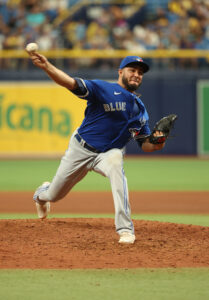
Garcia, 34 next month, is in his third season with the Jays. He originally signed a two-year, $11MM contract with Toronto, but he’s beefed up that contract through his performance. Garcia pitched enough games to vest a $6MM option for the current season and also picked up an additional $1MM of incentives in years one and two of the contract, ultimately turning it into a three-year, $18MM pact. He’s a rental for the Jays who’ll be owed $2.1MM from now until season’s end. Garcia is a free agent thereafter.
Regarded as one of the better relief arms on this year’s market, Garcia will bolster a bullpen that looked like one of the strongest in the game heading into the season but has been hit with some notable injuries. Star setup man Matt Brash required Tommy John surgery that knocked him out for the season, while offseason trade acquisition Gregory Santos only recently made his team debut after suffering a significant lat strain in spring training. The right-hander was removed from his most recent appearance with a knee issue. Perhaps that pushed the Mariners to make this move, but Santos has not yet been placed on the injured list, nor has the team announced a substantial injury for the right-hander.
Seattle has spent much of the season patching things together on the bridge to manager Scott Servais’ excellent closer, Andres Munoz. Now, if Santos’ knee injury proves minor they could go from a piecemeal approach to a pair of high-octane setup men in a matter of weeks.
Garcia has been a force this year, sporting a career-high 96.7 mph average fastball en route to a mammoth 36.5% strikeout rate that tops his prior career-high by nearly five percentage points. He’s coupled that with a strong 7% walk rate.
Over the past two seasons, Garcia has notably cut back on the usage of that fastball and significantly upped his curveball usage, helping to contribute to the rise in punchouts. He’s sitting on an excellent 2.70 ERA that metrics like FIP (2.64) and SIERA (2.30) suggest could undersell his performance to date. Garcia has gone 5-for-6 in save opportunities (bringing his career total to 26) and picked up 10 holds this year as well. He only just returned from a monthlong stay on the injured list due to a bout of elbow neuritis (nerve inflammation), but Garcia has tossed two innings, faced eight batters and punched out five of them while averaging 96.6 mph on his fastball; the elbow doesn’t seem to be bothering him.
In return for Garcia, the Jays will add a big league-ready outfielder with a full six seasons of club control: Clase. The 22-year-old speedster made his big league debut with the M’s earlier this season and .195/.233/.220 slash in a tiny sample of 44 plate appearances. That’s a small enough number of plate appearances at a young enough age that it’s not worth reading into; Clase has had a nice season in Triple-A Tacoma this year, slashing .274/.373/.483 with 10 homers, 11 doubles, four triples and 26 steals in 35 attempts. His 25.7% strikeout rate there is higher than one would prefer for a player who’s considered to have below-average power, but Clase has also walked in nearly 15% of his plate appearances.
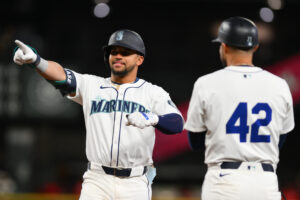
This year’s 26 steals are a nice mark but they don’t tell the full tale of Clase’s speed. Baseball America pegs him as a 70-grade runner (on the 20-80 scale), while FanGraphs lists him as a true 80-grade burner. His 29.6 ft/sec average sprint speed this season (as measured by Statcast) ranks in the 97th percentile of MLB players. Clase swiped a whopping 79 bases (94 attempts) in just 129 games between High-A and Double-A last year — all while hitting .242/.353/.449.
For a Jays club that’ll see Kevin Kiermaier retire at season’s end, he stands as a potential everyday player as soon as 2025 … if he can make enough quality contact to keep himself in the lineup. The Blue Jays have one of the game’s best outfield defenders in Daulton Varsho, who could slide to center in place of Kiermaier next year, but Clase will have a chance to win an everyday role regardless of whether it’s in left or center. Despite all his speed, Clase isn’t regarded as the same level of defender as Varsho, though he’s young enough that he could of course improve his reads, jumps and routes in the years ahead.
Sharp, 22, was Seattle’s 17th-round pick just last summer. The former UNLV backstop is a right-handed hitter who’s spent the season thus far in Class-A, hitting .255/.339/.435 (105 wRC+). He’s a bit old for that level, but it’s still hard to overlook his eye-catching bat-to-ball skills. Sharp has struck out in only 9.9% of his plate appearances — a mark that’s barely higher than his 9.4% walk rate. He’s thrown out 21% of runners who’ve attempted to steal against him since being drafted. He’s a longer-term play than Clase, but a catcher with that type of feel for contact makes for an interesting add to the lower levels of the farm.
ESPN’s Jeff Passan first reported that the Mariners were acquiring Garcia and sending Clase to Toronto. Sportsnet’s Ben Nicholson-Smith first reported Sharp’s inclusion in the trade.
Dodgers Trade James Paxton To Red Sox
The Red Sox have added some depth to their rotation, acquiring lefty James Paxton from the Dodgers in exchange for minor league infielder Moises Bolivar, the teams announced Friday. Boston transferred right-hander Bryan Mata to the 60-day injured list to open a spot on the 40-man roster. WEEI’s Rob Bradford reported yesterday that the Red Sox, who need some rotation stability and who employed Paxton from 2022-23, were expected to pursue him.
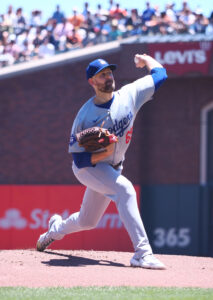
Paxton was something of a surprise DFA by the Dodgers. He’s made all 18 starts asked of him this season and posted a respectable, if unspectacular 4.43 earned run average. Those numbers closely mirror the 4.50 ERA he logged in a similar sample of 96 frames with Boston last season, but the rest of the 35-year-old’s profile doesn’t look nearly as strong.
After averaging 95.2 mph on his fastball with the Sox last season, Paxton is down to 93.2 mph in 2024. He’s seen his strikeout rate plummet from 24.6% to 16.4%, while his walk rate has soared from 8% to 12.3%. Paxton’s average exit velocity has also jumped by a mile and a half per hour, from 89.3 mph with the Sox to 90.8 mph with Los Angeles. His overall hard-hit rate has climbed in similar fashion, from 39.6% to 43.3%. He’s gotten by with a career-low .267 average on balls in play and homer-to-flyball rate that’s also notably lower than his career marks.
Whether Paxton can sustain his passable results with that lackluster array of under-the-hood numbers is far from clear, but the Sox also don’t necessarily need him to perform like an front-of-the-rotation arm. Boston’s depth behind Tanner Houck, Kutter Crawford, Nick Pivetta, Brayan Bello and Cooper Criswell is thin, and several of those arms (Houck, Crawford, Criswell) are either approaching or have already established new career-high workloads. Adding a stable back-end arm surely holds plenty of appeal for a team in that situation — particularly given Paxton’s affordable contract.
Paxton inked a one-year deal with $7MM guaranteed and another $6MM in attainable bonuses. However, $3MM of that guarantee came in the form of an up-front signing bonus that’s already been paid out. He’s also already unlocked all $6MM of incentives ($2MM for making the Opening Day roster and another $4MM based on his number of games started). As such, the Red Sox will only owe him the prorated portion of that $4MM base between now and season’s end (approximately $1.42MM).
That modest sum bumps Boston’s payroll to an approximate $180MM. Their luxury-tax ledger is a good bit higher, checking in at an estimated $218.1MM prior to this swap (via RosterResource). Paxton will push the Sox just shy of $220MM, leaving chief baseball officer Craig Breslow and his staff about $17MM of breathing room between their current number and the first luxury tax threshold. Breslow & Co. should have ample room to make further additions, even if ownership is reluctant to cross that first tax threshold. Boston, in addition to seeking rotation depth, has been in the market for bullpen upgrades and a right-handed bat.
For the Dodgers, the trade of Paxton, who ranks third on their team in innings pitched, clearly isn’t a sign of selling. Los Angeles is in first place in the NL West and stands as a veritable lock to make the postseason. But the Dodgers also welcomed Tyler Glasnow and Clayton Kershaw back from the injured list this week.
That pair of high-quality veterans joins a youthful trio of Gavin Stone, Justin Wrobleski and River Ryan in the rotation at the moment, but the Dodgers are also expecting Yoshinobu Yamamoto to return in August and Walker Buehler to return sometime before season’s end. Between that depth and their outspoken pursuit of an “impact” starting pitcher on the trade market (in the words of general manager Brandon Gomes), Paxton was pushed out of the mix.
In exchange for the final two-plus months of Paxton’s services, the Dodgers will receive the 17-year-old Bolivar. He signed with the Red Sox as an amateur free agent out of Venezuela just this past January, receiving a bonus of $25K. He’s not considered a high-end prospect in Boston’s system, but that sort of lottery-ticket return is to be expected for a veteran pitcher who was designated for assignment.
Bolivar, already six feet tall and listed at 175 pounds, has gotten out to a strong start in his professional debut. He’s appeared in 31 games with the Red Sox’ Rookie-level Dominican Summer League affiliate and slashed .270/.364/.423 with three homers and nearly as many walks (17) as strikeouts (21). He’s a right-handed hitter who’s played primarily third base but has also logged 26 innings across the diamond at first base.
FanSided’s Robert Murray first reported that the two sides were engaged in trade talks. ESPN’s Jeff Passan reported a deal had been finalized. Fabian Ardaya of The Athletic and Alex Speier of the Boston Globe added details on the Dodgers’ return.
Blake Snell Among Giants Drawing Trade Interest
8:46pm: Jon Heyman of the New York Post tweets that five teams have shown some amount of interest in Snell.
10:22 am: The Giants have hovered around the National League Wild Card race for most of the year but slipped back recently, which could lead to them deciding to sell prior to Tuesday’s trade deadline. Andrew Baggarly of The Athletic took a look at some possible trade candidates, reporting that left-hander Blake Snell is drawing significant trade interest. Earlier this week, Ken Rosenthal of The Athletic listed Michael Conforto, Mike Yastrzemski and Wilmer Flores as bats that are available around the league. Baggarly also mentions right-hander Alex Cobb and lefty Taylor Rogers as candidates to be moved in the coming days.
San Francisco is currently 49-55, which only puts them 5.5 games back of the nearest playoff spot, but they would have to pull away from the Cubs and then pass the Reds, Pirates, Diamondbacks, Cardinals and Padres in order to get into postseason position. They’re not totally buried but the Playoff Odds at FanGraphs give them just an 11.5% shot of getting in while the PECOTA Standings at Baseball Prospectus are even less optimistic at 5.6%. With that kind of Hail Mary window, it’s logical that the Giants would look into shifting their priorities to optimizing next year’s team, which would mean making some players available now.
It’s unsurprising that Snell would draw significant trade interest, though his trade candidacy would have complications. He’s one of the top pitchers in baseball when at his best, which is why he has two Cy Young awards on his mantel. That includes getting last year’s National League trophy when he posted a 2.25 earned run average over 32 starts with the Padres.
But 2024 has been far less smooth. Despite his excellent 2023 campaign, he lingered in free agency for a long time and didn’t sign with the Giants until the middle of March. After a quick ramp-up, he made three rough starts before landing on the injured list with a left adductor strain. He returned from the IL and had three more bad outings before returning to the IL in early June with a left groin strain. At that time, he had an ERA of 9.51 in those six starts.
He has since returned and been in much better form. He shut out the Blue Jays and then the Twins before allowing two earned runs against the Dodgers. Those three better starts have reduced his ERA to 5.83 for the year.
Despite the inconsistent results this year, some clubs would surely be willing to bank on his track record and recent return to form. However, his contract adds another layer of complication. He signed a two-year, $62MM deal with the Giants that allows him to opt-out at season’s end.
Trading players with such provisions is usually a tricky proposition, something that MLBTR’s Anthony Franco recently explored in a piece for Front Office subscribers and it’s a situation that Giant fans are likely familiar with from the Carlos Rodón saga from a few years ago. Despite having a dominant season for a middling Giants club, Rodón wasn’t moved at the deadline as he had an upcoming opt-out that seemed to ward off potential buyers.
Players in such situations are mostly downside for the acquiring club. If the player performs well, they will leave, making them a rental in a best-case scenario. If they perform poorly or get hurt, they will stick around and keep their notable salary on the books. Surrendering notable prospects for such an arrangement is often an unattractive proposition and the selling club might not want to give up a star player for an uninspiring return.
Snell’s contract consists of a $15MM salary this year and a $17MM signing bonus that Baggarly notes is not transferable to a trade partner. There’s a $30MM player option for 2025 that Snell could trigger if he finishes the season poorly or is injured, but he could also opt-out if he finishes strong. Those complications might soften the offers but demand for pitching is expected to outstrip supply, especially in terms of front-of-the-rotation type arms, so perhaps the Giants will get some intriguing calls.
It makes sense that the Giants would listen to offers to see if they could get that contract off their books while also recouping some younger talent. Even without Snell, next year’s rotation could consist of Logan Webb, Kyle Harrison, Robbie Ray and Jordan Hicks, with Tristan Beck and Keaton Winn perhaps back in the mix if their health allows. Prospect Carson Whisenhunt has reached Triple-A while the club also has Mason Black, Hayden Birdsong, Landen Roupp and Kai-Wei Teng on the 40-man roster.
Sticking with the rotation, Cobb is a more straightforward trade candidate in the sense that he’s an impending free agent. Even though he underwent hip surgery in October, the Giants picked up his $10MM option for this year in the hopes that he wouldn’t miss that much time. Unfortunately, his return has been slowed by some elbow and shoulder issues and still hasn’t pitched in the majors this season.
He has been rehabbing of late and tossed five shutout innings at the Triple-A level on Saturday. Baggarly notes that he could be reinstated and pitch for the Giants on Sunday, which would essentially be a pre-deadline showcase for interested clubs. The injury issues from this year will likely give clubs some hesitation but Cobb is an established veteran with a 3.85 ERA over 230 career starts. As recently as last year, he was able to toss 151 1/3 innings with a 3.87 ERA.
As for the bats, Rosenthal mentioned Flores as a trade candidate on Wednesday but the Giants put him on the IL the next day due to right knee tendonitis. Players on the IL can still be traded but he is also having a down season, hitting .206/.277/.318 for a wRC+ of 71. He’s making $6.5MM this year and then has a dual player/team option for 2025. He first has to decide on a $3.5MM player option and then, if he declines, the team would have an $8.5MM option available. Given his down season, he might be inclined to pick up his end of the deal rather than going to free agency.
Conforto is a straightforward trade candidate since he’s an impending free agent. He signed a two-year, $36MM deal going into 2023 and then declined to opt out after hitting a league-average .239/.334/.384 last year. He started out well this year but has tapered off. He was hitting .280/.331/.490 when he landed on the IL on May 12 due to a right hamstring strain. Since coming off the IL in early June, he’s hitting .165/.262/.331.
Yastrzemski can be retained via arbitration through next year, but there’s logic in considering trades now. He’ll turn 34 next month and is making $7.9MM, meaning he could be looking for an eight-figure salary in arbitration next year. He’s been a consistently solid player during his career on both sides of the ball. He has hit .241/.326/.458 for a wRC+ of 114 while racking up 35 Defensive Runs Saved and seven Outs Above Average. Per FanGraphs, he’s been worth at least 1.6 wins above replacement in every previous season of his career and is currently at 1.3 fWAR this year.
Even without Conforto and Yastrzemski, the Giants could go into next year with an outfield mix consisting of Jung Hoo Lee, Heliot Ramos and Luis Matos with guys like Derek Hill, Tyler Fitzgerald and Wade Meckler also in the mix.
As for Rogers, he’s in the second season of a three-year, $33MM deal he signed with the Giants. He has continued to pitch well and the Giants could keep him for next year, but moving now might also make sense. He has a 2.27 ERA this year but that’s largely propped up by an unsustainable 84.1% strand rate. His 25.6% strikeout rate is his worst since 2017 and he’ll be turning 34 this winter.
Teams generally sign free agents looking for most production in the beginning of the deal, with the later years a pill they swallow as the price of doing business. If there’s a way for them to wriggle out of the last season of the Rogers pact, they might consider taking it. Such a move could potentially free up some cash, bring back some young talent or both. It would create a hole in next year’s bullpen but relievers are often viewed as volatile and fairly replaceable.
All together, the Giants make for an interesting late entry into a market that has been perceived to have a lack of sellers. As laid out by Baggarly, the club could try to duck under the competitive balance tax in the days to come but it would be difficult to do. RosterResource estimates they are currently just above $253MM, more than $16MM above the $237MM base threshold. They would effectively have to find takers for all the money owed to Snell, Rogers, Conforto, Yastrzemski and Cobb to dip under and therefore might be focused on prospect capital between now and the July 30 deadline.
Mets Acquire Ryne Stanek
The Mariners announced they’ve traded reliever Ryne Stanek to the Mets for minor league outfielder Rhylan Thomas. New York has yet to announce the move and will need to clear a spot on the 40-man roster.
Stanek, who turns 33 today, has worked in generally high-leverage spots. His performance has been uneven. Stanek owns a 4.38 ERA across 39 innings spanning 46 appearances. He has fanned an above-average 25.9% of opponents while walking nearly 10% of batters faced. It’s a reasonable enough strikeout and walk profile, but Stanek has fallen on hard times of late. He has allowed five runs over 5 2/3 frames this month, giving up a pair of homers and issuing six walks in the process.
Over parts of eight MLB seasons, Stanek owns a 3.54 earned run average. He throws very hard, averaging north of 98 MPH on his fastball. Stanek misses bats but has fringy command and occasionally struggles with home runs. He’s a potential setup option who could fit more cleanly in the middle innings.
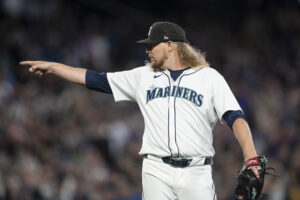
The Mariners upgraded their setup core this afternoon, bringing in Yimi García from the Blue Jays. That evidently made Stanek expendable. New York takes a low-cost flier to add a power arm to their bullpen. The Mets brought in Phil Maton — coincidentally, a teammate of Stanek’s for the past few seasons with the Astros — in a trade with the Rays earlier this month. While Stanek and Maton are different types of pitchers, this is a similar kind of move. The Mets take on a few million dollars to add to their bullpen without expending much prospect capital.
Stanek is playing this season on a $4MM base salary. He’s on a one-year deal and will return to free agency at the end of the year. He’s due around $1.4MM in salary through season’s end. His deal contains up to $2MM in performance bonuses. Stanek would lock in $250K for reaching 50, 60 and 70 appearances. He should at least hit the first two of those markers. He’d earn $250K for reaching 20 games finished, with another $250K available for every five games finished up to 40. He’s at 12 so far and will probably work in middle relief for the Mets, so he could fall short of even the lowest of those thresholds. Any incentives he unlocks will be paid proportionally between the two teams. He also picks up a $250K assignment bonus because of the trade.
The Mets are paying a 110% tax on any money they take on. They’re absorbing around $1.54MM in taxes and would be taxed at the same rate for whatever incentives Stanek earns. The overall cost will probably check in around $4MM by season’s end.
New York also relinquishes their 11th-round pick from two seasons ago. A USC product, Thomas is a left-handed hitting outfielder. He has split his time between the top two minor league levels this year, hitting .265/.318/.387 over 305 plate appearances. Thomas hasn’t hit for power or drawn many walks, but he’s striking out at only a 12.1% clip. The 24-year-old can play anywhere in the outfield and likely projects as a fifth outfielder. Baseball America does not rank him among New York’s top 30 prospects.
Andy Martino of SNY first reported the Mets were acquiring Stanek for Thomas.
Image courtesy of USA Today Sports.
Rangers Among Clubs With Interest In Yandy Díaz
Rays infielder Yandy Díaz has been on the restricted list for almost a week while attending to an undisclosed personal matter, but the Rays announced that they reinstated him today. They already had three vacancies on their 40-man roster, so this move brings their count to 38. Marc Topkin of the Tampa Bay Times relayed on X earlier that the club was hopeful of Díaz returning tonight. Ken Rosenthal of The Athletic reported last night that the Rangers are interested in adding him to their lineup. Mark Feinsand of MLB.com says on X that the Astros, Mariners and Pirates are possible suitors, though it’s unclear if any of those clubs have engaged with the Rays.
Díaz, now 32, has been a fixture of the Rays for many years. He came to Tampa from Cleveland heading into 2019 as part of the three-team trade and quickly worked his way into being a regular for the Rays. From the start of 2019 to the present, he has drawn walks in 11.6% of his plate appearances while only striking out 14.5% of the time. His .288/.375/.439 batting line translates to a 133 wRC+, indicating he’s been 33% better than league average overall.
That offense is his best attribute. He’s not a burner on the basepaths and his third base defense was poorly regarded, though he’s been closer to average at first base and has been more or less permanently moved to that side of the diamond. But the 133 wRC+ that Díaz has put up from 2019 to the present is one of the top 15 marks in baseball among qualified hitters, highlighting that such consistently above-average production is hard to find.
Here in 2024, his season-long stats look mildly disappointing, a .273/.329/.396 line and 111 wRC+, but that’s mostly due to a brutal start that he has put behind him. He hit .211/.279/.276 through May 1 but his line of .302/.354/.453 since that time leads to a 134 wRC+, right in line with his overall track record.
The Rays don’t strictly have to move him but their behavior suggests he’s available. Going into 2023, he and the Rays signed an extension that runs through 2025 with a club option for 2026. He’ll make $10MM next year with the option valued at $12MM.
Tampa could certainly keep him but they have shown, both recently and in the past, that they are generally unafraid to move players nearing free agency. Although they are 52-51 this year and just four games out of a playoff spot, they have already traded Aaron Civale, Phil Maton and Randy Arozarena in recent weeks.
Some recent reporting suggested the Rays were more likely to trade arbitrations players than those signed to long-term deals, but that contradicts their past behavior. Players like Evan Longoria, Blake Snell, Tyler Glasnow and Manuel Margot have all signed extensions and then been traded before those contracts ended, so there’s no real reason to believe the Rays won’t be open to trade offers on Díaz.
Doing so wouldn’t even be a signal that the club is giving up on 2024, as players like Isaac Paredes and Curtis Mead could fill in at first base. Jonathan Aranda is currently hurt but could be in the mix later. Infielders like Junior Caminero, Austin Shenton and Osleivis Basabe could be called up to fill in elsewhere around the infield. In the long term, Xavier Isaac is a first baseman and considered one of the top 50 prospects in the league, though he’s yet to reach Double-A.
For the Rangers, Rosenthal relays that they are looking for “either a left-handed hitting outfielder/DH or a platoon-neutral right-handed hitter.” Díaz is better against lefties but isn’t a liability without the platoon advantage. He has a 148 wRC+ against southpaws in his career and a 121 wRC+ against righties. It’s a far wider split of 151 and 99 this year, though in a much smaller sample size.
Texas hitters have a collective line of .237/.309/.378 against right-handed pitching, with that line leading to a 93 wRC+, putting them ahead of just seven clubs in that split. They have Nathaniel Lowe at first base but don’t really have a regular designated hitter and should be able to fit both him and Díaz into the same lineup.
The Rays and Mariners already lined up on one deal, sending the aforementioned Arozarena to Seattle as the M’s look for more offense. Díaz could further augment their lineup, especially with the struggling Ty France have been recently designated for assignment and leaving an opening at first base. They have plugged Tyler Locklear into that spot but he has only 40 major league plate appearances thus far.
The Astros also cut ties with a struggling first baseman, releasing José Abreu earlier this year. They have mostly used Jon Singleton to fill that hole but he’s hitting just .231/.319/.343 this year for a 93 wRC+.
The Pirates have a bit less of a dire need as they held onto their struggling first baseman and were rewarded with a bounceback. Rowdy Tellez was hitting .177/.239/.223 through the end of May but has a line of .328/.364/.588 since the calendar flipped to June. His season-long line is still subpar thanks to that early slump but the Pirates probably feel less inclined to replaced Tellez on the heels of his hot streak this summer. They have Andrew McCutchen in the designated hitter spot most days, which makes the lineup fit a bit less clean unless they plan on moving on from Tellez, who is a free agent at season’s end.
Both the Astros and Rangers are set to pay the competitive balance tax at season’s end, so they may have to consider the taxes involved in taking on the Díaz contract. The Astros are set to be a first-time payor and have a base rate of 20% but RosterResource has their CBT number at $256MM. Crossing over the $257MM second tier would increase their tax rate to 32% for spending beyond that line. Recent reporting suggested they are trying to move Rafael Montero‘s contract to lessen their tax burden but doing so will be difficult given his poor results of late. RosterResource has the Rangers at $249MM but they are set to be a second-time payor and have a base tax rate of 30%.
Orioles, Phillies Swap Austin Hays For Seranthony Dominguez
The Orioles announced Friday that they’ve traded outfielder Austin Hays to the Phillies in exchange for right-hander Seranthony Dominguez and outfielder Cristian Pache. Baltimore is designating righty Levi Stoudt for assignment to open a 40-man roster spot, the team announced. The Phillies filled their open roster spot by reinstating right-hander Michael Rucker from the 60-day injured list.

It’s a rare swap of major leaguers between a pair of World Series hopefuls. Hays will give the Phillies a more impactful right-handed bat in their outfield mix than they had in the glove-first Pache. Hays isn’t having his best season but was a 2023 All-Star and has pounded left-handed pitching both in 2024 and throughout his career. Dominguez, similarly, is having a down season but sports a much better track record. He’s still a hard-throwing reliever with high-leverage experience and has at times operated as the Phillies’ closer.
Hays, 29, is hitting .255/.316/.395 this season in 175 plate appearances. He missed nearly a month with a calf strain earlier this season, and it’s certainly possible that injury impacted his production; Hays hit just .111/.200/.111 in 50 trips to the plate prior to that IL stint but has returned with an excellent .313/.363/.509 slash in 125 subsequent plate appearances.
That slash is perhaps partially attributable to the fact that Hays has been platooned more than in seasons past, thanks to the emergence of lefty-hitting outfielders Colton Cowser and Heston Kjerstad in Baltimore. Between that pair, center fielder Cedric Mullins, right fielder Anthony Santander and first basemen/designated hitters Ryan O’Hearn and Ryan Mountcastle, the O’s are dealing from a wealth of corner depth in this swap. Hays has been exclusively a corner outfielder this year and hasn’t played center field with any regularity since 2020.
Prior to this season’s rough start (and the emergence of those young top prospects), Hays has been a fixture in the Baltimore outfield. The former third-round pick was a top-100 prospect himself and from 2019-23 tallied 1886 plate appearances with a strong .264/.317/.441 batting line (109 wRC+). Hays doesn’t walk much (career 5.9%) but strikes out at a 21.5% clip that’s slightly below league-average. He’s typically posted average or better grades in left field, though his marks this season are down across the board. Again, however, that’s not necessarily a surprise for an outfielder who’s battled a lower-leg injury that impacted his speed and mobility.
Hays will give the Phillies a productive platoon partner to pair with lefty-swinging Brandon Marsh in left field. Both Marsh and Hays (in a pinch) can handle center field as well, though it’s likely that defensive standout Johan Rojas will continue to patrol that position regularly — barring an additional outfield acquisition from president of baseball operations Dave Dombrowski. Hays has bludgeoned lefties at a .328/.394/.500 clip in 72 plate appearances this year and touts a lifetime .272/.328/.463 output against southpaws.
The Phillies will be able to control Hays through the 2025 season if they choose, though he’d be an expensive part-time player if they plan to platoon him all season in 2025. He’s earning $6.3MM this year in his second arbitration season and will be due one final raise this winter — likely to a number north of $8MM — before qualifying as a free agent in the 2025-26 offseason.
Turning to the Orioles’ end of the deal, they’ll first and foremost add an experienced reliever in the form of the 29-year-old Dominguez. He’s been tagged for a 4.75 ERA this year in 36 innings but entered the 2024 campaign with a career 3.31 earned run average, 27 saves and 52 holds. Dominguez has been uncharacteristically homer-prone this year and thus struggled to strand runners, but his velocity (97.5 mph average fastball), strikeout rate (25.5%) and walk rate (7.6%) all remain strong. This year’s walk rate is actually a career-low, and Dominguez’s 25.5% strikeout rate isn’t terribly far off the 27.5% mark he carried into the season.

As is often the case with relievers, Dominguez’s pedestrian earned run average is skewed by a small number of meltdowns. He’s been tagged for four earned runs on two separate occasions this season, accounting for 42% of his earned runs in those two trips to the mound (just 5.2% of his total appearances).
That clearly doesn’t make the bottom-line results any more palatable, but it’s preferable to have a reliever who’s had a handful of awful outings as opposed to one who’s prone to giving up a run or two every other time out. With Craig Kimbrel currently in a rough patch and Danny Coulombe on the 60-day injured list, Dominguez could find himself in some leverage situations.
Like Hays, Dominguez can be controlled through the 2025 season — but the choice is at the team’s discretion. He’s playing out the second season of a two-year, $7.25MM contract that covered his final two arbitration seasons and includes a club option for what would’ve been his first free-agent year. The O’s will hold an $8MM club option over Dominguez that comes with a $500K buyout — effectively rendering it a net $7.5MM decision. If he can rebound to his prior form following the swap, that could prove to be a palatable price point even for what’s typically been a frugal Orioles club (albeit under their now-former ownership).
Baltimore will also add Pache to its bench mix. It’s an offensive downgrade, as the 25-year-old is hitting only .202/.288/.269 in 118 plate appearances and carries a .179/.243/.272 slash in parts of five MLB seasons. That said, Pache is a lights-out defender who’s been credited with a dozen Defensive Runs Saved and 16 Outs Above Average in just 1334 career innings in the outfield. He’s a plus-plus defender in center field, offering the O’s a more true fourth outfielder than Hays did, but he can certainly play strong corner defense as well.

Pache is out of minor league options, so he can’t be sent to the minors without first being designated for assignment and exposed to waivers. As such, he’ll need to stick on Baltimore’s roster. For a team that’s a near-lock to make the postseason, this type of outfielder — light hitting, plus defense, good speed — is a particularly useful asset.
Pache is earning just north of the league minimum this season. Dominguez is being paid $4.25MM and has the $500K buyout on his option. The swap is close to cash-neutral, but the Phillies will be taking on about $297K in additional payroll. When factoring in their luxury tax status, the trade will cost them about $481K overall.
As a result of this swap, the 26-year-old Stoudt will be designated for assignment for the third time this season. He’s bounced from the Reds, to the Mariners (his original organization), to the Orioles via a series of waiver claims. Stoudt allowed 11 runs in 10 1/3 innings during last year’s MLB debut with Cincinnati. He was one of four players the Mariners sent to the Reds in the Luis Castillo blockbuster two seasons ago.
A former third-round pick, Stoudt ranked among the top 20 prospects in both the Mariners’ and Reds’ systems from 2021-23. He’s worked primarily as a starter in the minors, but the O’s put him in their Double-A bullpen after claiming him. He’s posted a 4.26 ERA in 12 2/3 innings in that role but also walked 12.1% of his opponents, continuing some longstanding command issues. The Orioles can trade Stoudt until Tuesday’s deadline. Failing that, he’ll likely be placed on outright waivers.
Mariners Acquire Randy Arozarena
The Mariners landed a much-needed lineup upgrade on Thursday night. Seattle announced the acquisition of Randy Arozarena from the Rays in exchange for two prospects — outfielder Aidan Smith and right-hander Brody Hopkins — as well as a player to be named later. Seattle had an opening on their 40-man roster after designating Ty France for assignment earlier this week, so no additional move was necessary.
Arozarena had an excellent four-plus year run in Tampa Bay. The Rays acquired him from the Cardinals over the 2019-20 offseason in a deal sending top pitching prospect Matthew Liberatore to St. Louis. Arozarena had made a brief MLB debut the prior season, but the 2020 postseason represented his true emergence as a star. He mashed 10 home runs in 20 games, snagging ALCS MVP honors and helping the Rays reach the World Series.
Despite that breakout playoff performance, Arozarena retained rookie eligibility into 2021. He cruised to Rookie of the Year honors behind a .274/.356/.459 slash with 20 homers and stolen bases apiece. That was the first of three straight 20-20 campaigns for the Cuban outfielder. He swiped a career-high 32 bases in ’22 and reached 23 longballs in his first All-Star season last year.
Arozarena appeared in 445 games between 2021-23. He hit .264/.349/.443 with 63 homers in a little more than 1900 plate appearances. That production was 26 percentage points above league average, as measured by wRC+, putting him among the best left fielders in the game. Arozarena’s accolades and consistency led to quickly escalating arbitration salaries. That fueled chatter that the low-payroll Rays could deal him last offseason.
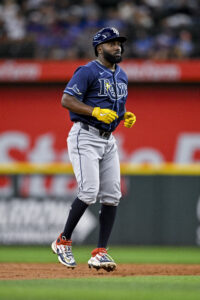
Tampa Bay obviously rebuffed whatever trade offers they received over the winter. They certainly hoped Arozarena would anchor their lineup and help them to a sixth straight playoff berth. He and the team got off to a cold start, however, putting them in a hole from which they’ve never really recovered.
Arozarena hit .158/.257/.312 through the end of May. Some of that was the result of an unsustainably poor .186 average on balls in play, but his strikeout rate spiked to a near-29% rate. Arozarena has turned things around following that disastrous stretch. He’s raking at a .290/.402/.517 clip over the past two months. He has dramatically cut back on the swing-and-miss (down to 19.5%) and slightly increased his walk percentage. The results have been far more in line with his career track record.
In aggregate, Arozarena’s season numbers are pedestrian. He’s hitting .211/.318/.394 with 15 homers through 409 plate appearances. That’s only marginally better than average and would be the worst numbers of his career. Given his overall track record and recent form, it seems fair to view his early-season struggles as more of an anomaly than a worrying trend. Getting anything close to the 29-year-old’s career production would be a major boost for a Seattle lineup that has hit .216/.298/.362 on the year. Only the White Sox have scored fewer runs this month, the biggest reason the M’s have watched their 10-game cushion in the AL West evaporate.
The Mariners are only a half-game ahead of the Rays in the American League standings. It’s rare to see a team trade an impact player to another club that close to them in the playoff picture. Seattle is in better shape than Tampa Bay with regards to snagging a playoff berth, though. The Rays need to jump three teams and erase a four-game deficit in the Wild Card mix. Seattle has a much more realistic path to a division title, as they’re only one game behind the Astros and hold a 1.5 game edge on the third-place Rangers.
While Tampa Bay isn’t going to completely tear things down, they could dangle a number of veteran players in the next few days. The Rays had already moved Aaron Civale and Phil Maton. Dealing Arozarena seems to increase the likelihood of them moving the likes of Brandon Lowe, Yandy Díaz, Zach Eflin and Zack Littell. The Rays could also try to acquire upper minors or MLB-ready talent to aid a long shot playoff push this season and help them for a return to contention next year.
Seattle is in much more traditional buyer mode. Their offense was reeling even before losing Julio Rodríguez and J.P. Crawford to injury this week. Arozarena is one of what is likely to be multiple upgrades to their lineup as they try to capitalize on arguably MLB’s best starting rotation. The M’s have relied on another former Ray, Luke Raley, as their primary left fielder. Raley has been an average hitter on the season overall, but he has fanned 22 times with a .119/.224/.254 slash in 67 plate appearances this month.
Arozarena is playing this season on an $8.1MM salary. The M’s take on around $2.83MM for the stretch run, which will push their estimated player payroll to around $143MM (as calculated by RosterResource). Managing partner John Sherman said last month that the front office had the spending capacity to add players at the deadline. They’ve put that into practice here and could do so again before Tuesday. Seattle controls Arozarena through arbitration for two more seasons. He’ll likely earn a boost into the $12-14MM range next year and could approach a $20MM salary for the ’26 campaign.
The Rays, a team that entered the season with a player payroll below $100MM, probably weren’t eager to commit to those 2025-26 salaries. A trade by next offseason always seemed likely. They’re sufficiently intrigued by the prospect package to make the move a few months early, even if it deals a hit to their already slim playoff chances.
Smith and Hopkins each ranked in the middle tiers of a Seattle farm system that is arguably the best in the league. They respectively checked in 14th and 15th on Baseball America’s most recent organizational list. Smith, 20, was a fourth-round pick out of a Texas high school last summer. He signed for an overslot $1.2MM bonus.
The righty-hitting outfielder has posted huge numbers for Low-A Modesto. Smith is hitting .284/.402/.470 with 26 doubles, a triple and nine homers across 358 plate appearances. He’s drawing walks at a massive 14.5% clip against a slightly elevated 24.3% strikeout rate. BA praises Smith’s athleticism and defensive instincts in center field. He has significant power potential in a 6’3″ frame, though there are still questions about his pure hitting ability.
Hopkins was a sixth-round draftee out of Winthrop last year. The 6’4″ righty has been one of the big risers in the system this year. He owns a 2.90 ERA over 83 2/3 innings with Modesto. Hopkins has fanned 26.5% of batters faced while issuing walks at an 11.1% clip. He has hard a tough time throwing strikes dating back to his time in college, but Baseball America credits him with a plus fastball/slider combination from a lower arm angle that’s especially tough for same-handed hitters. He could project to a bullpen future but should continue to start for the time being.
Neither Smith nor Hopkins are close to the majors or to Rule 5 eligibility. Pending the revelation of the PTBNL (who cannot be on Seattle’s 40-man roster or one of this year’s draftees), it’s a future-oriented package for Tampa Bay. The next few days should reveal whether the Rays are focusing their deadline hauls on lower minors prospects or simply liked Smith and Hopkins enough to overlook their distance from the big leagues.
Francys Romero first reported the Rays were trading Arozarena to Seattle. Mark Feinsand of MLB.com reported the Rays were acquiring two prospects and a player to be named later. Marc Topkin of the Tampa Bay Times was first to report that Smith and Hopkins were the prospects.
Image courtesy of USA Today Sports.
Diamondbacks Acquire A.J. Puk
The Diamondbacks are making a big move on the relief market. Arizona announced the acquisition of A.J. Puk from the Marlins for two prospects: corner infielder Deyvison De Los Santos and center fielder Andrew Pintar. The D-Backs designated lefty reliever Joe Jacques for assignment to create a 40-man roster spot.
It’s the second consecutive season in which Arizona makes a major addition to the late innings. The Snakes brought in Paul Sewald to lock down the ninth a year ago. Sewald is still holding down the closer role despite a rough stretch this month. Puk adds a high-octane southpaw to the setup group.
A former sixth overall pick by the Athletics, Puk broke through as a high-leverage reliever in 2022. Oakland dealt him to Miami for outfielder JJ Bleday in a swap of former top draft picks the following offseason. Puk fired 56 2/3 frames of 3.97 ERA ball with excellent strikeout and walk numbers during his first season in South Florida. He held the closer role for a stretch, picking up 15 saves and finishing 31 games altogether.
Miami could have been content to leave Puk in a late-innings role. First-year president of baseball operations Peter Bendix and his front office were curious about the possibility of stretching Puk back into the rotation role he’d occupied in college and during the early part of his minor league career. While the Spring Training results were promising, the starting pitching experiment proved a short-lived blunder.
The 29-year-old opened the season in Miami’s rotation. He took the ball four times and didn’t once make it through the fifth inning. Opponents teed off for 17 runs in Puk’s 13 2/3 innings as a starter. He walked 17 and hit a batter while recording just 12 strikeouts. The Marlins placed him on the injured on April 20, citing shoulder fatigue.
When they reinstated him a few weeks later, Miami abandoned the rotation maneuver and kicked Puk back into his customary short relief role. The results since then have been exceptional. The University of Florida product has turned in a 2.08 ERA over 30 1/3 innings out of the ‘pen. He has punched out 33 of 114 batters faced while walking only six. Opponents are hitting .159/.204/.252 in that time. Puk has held seven leads in front of All-Star closer Tanner Scott (who is basically a lock to move before next Tuesday’s deadline himself).
Puk’s season stats are still weighed down by his disastrous few weeks in the rotation. Excluding his starting work paints the picture of an impact reliever. Over his season and a half in Miami, Puk carried a 3.31 ERA through 86 appearances when working out of the bullpen. He punched out 31.2% of batters faced compared to a tidy 5.3% walk rate. Puk has been particularly lethal to left-handed batters. Southpaws have hit .174/.215/.287 with 45 strikeouts and four walks over 123 plate appearances when Puk has pitched in relief. Righties have had a bit more success, particularly from a power perspective, but they’ve hit .236 with a modest .283 on-base percentage.
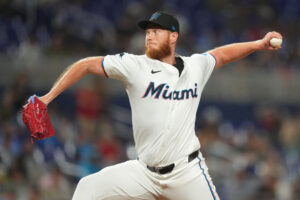
The D-Backs had been light on left-handed relief depth. Joe Mantiply was the only southpaw in Torey Lovullo’s bullpen. He has a 3.99 ERA behind a solid 48.2% ground-ball rate, but he doesn’t throw hard or record many strikeouts. Puk averages north of 95 MPH with his fastball and has a swing-and-miss slider that more comfortably plays in the late innings. Mantiply can serve as the second lefty in the hierarchy, while Brandon Hughes is on optional assignment to Triple-A.
Puk is playing on a $1.8MM salary in his first season of arbitration. The Diamondbacks are taking on a bit less than $700K for the stretch run. He’ll go through the arbitration process twice more before hitting free agency during the 2026-27 offseason. Puk doesn’t have the gaudy save totals that arbitrators tend to value from relievers, so he should be a generally affordable bullpen piece for the next couple years.
Miami brings back a pair of mid-tier prospects in their first of what should be a handful of deadline deals. De Los Santos is the more highly-regarded of the duo. He’s a right-handed hitting infielder who has elevated his stock with a monster season in the upper minors. Baseball America’s JJ Cooper tweets that De Los Santos would have ranked eighth on the outlet’s forthcoming update of Arizona’s top 30 prospects. Pintar would’ve landed 21st on that list.
The D-Backs signed De Los Santos out of the Dominican Republic five years ago. He immediately intrigued evaluators with his power upside but struggled to make contact in the low minors. He played his way to Double-A by age 20 and connected on 20 homers there last season. Yet he also struck out at a 26% clip and only managed a .297 on-base percentage. The Diamondbacks left him unprotected for the Rule 5 draft and briefly watched him depart the organization. The Guardians snagged De Los Santos in the Rule 5 and carried him on their 40-man roster during Spring Training.
Cleveland decided at the end of camp that they couldn’t devote a bench spot to a development project. The Guards returned De Los Santos to Arizona after he cleared waivers. The Snakes sent him back to Double-A Amarillo for a second straight year. De Los Santos obliterated the level, hitting .372/.426/.696 with 14 homers in 38 games. He hasn’t tailed off much since being promoted to Triple-A Reno. De Los Santos has 14 more homers over 49 Triple-A contests, and he’s running a .289/.338/.588 slash.
There’s still a fair bit of risk with De Los Santos’ profile. Scouts have never loved his defense at third base. Arizona has used him mostly at first base this season, suggesting that’s where he projects as a big leaguer. He remains an aggressive hitter who isn’t taking many walks. That’s a difficult profile to pull off, but De Los Santos clearly has impact power that could fit in the middle of a lineup if he hits his ceiling. Miami will need to put him on their 40-man roster at the start of the offseason to keep him out of the upcoming Rule 5 draft. There’s a good chance they call him up at some point after the deadline, particularly if they manage to find a taker for Josh Bell in the coming days.
Pintar, 23, was a fifth-round pick out of BYU back in 2022. A righty-swinging center fielder, he has spent the bulk of the season in High-A. Pintar hit .304/.403/.516 with nine homers and nearly as many walks as strikeouts over 57 games. Arizona had promoted him to Double-A a couple weeks ago. Pintar has above-average speed and has improved his offensive profile with his strong showing through the season’s first few months.
As for Jacques, he’ll likely land on waivers in the next few days. Arizona claimed him off waivers from the Red Sox in April. He only pitched once for them at the MLB level. The 29-year-old southpaw has a 5.60 ERA over 27 1/3 innings in the minors this season. He made his MLB debut with Boston last season and worked to a 5.06 ERA across 26 2/3 frames.
The D-Backs could look into adding a starting pitcher and/or an offensive upgrade before Tuesday, though a high-leverage reliever has seemed their priority for weeks. Miami will certainly remain active on the trade market. Beyond Scott, they’re likely to move Jazz Chisholm Jr. and try to offload some of Bell’s contract. They could field offers on others relievers like Andrew Nardi and Calvin Faucher, starter Trevor Rogers, and outfielders Jesús Sánchez and Bryan De La Cruz. The Fish are in full rebuild mode and don’t have many players who’ll be categorically off the table.
Ken Rosenthal of the Athletic first reported the Diamondbacks were acquiring Puk. Craig Mish of SportsGrid reported the Marlins were acquiring De Los Santos as one of two prospects. USA Today’s Bob Nightengale identified the second prospect as a position player, while Ari Alexander of KPRC-2 was first to report it would be Pintar. Alexander reported the Jacques DFA.
Image courtesy of USA Today Sports.
Astros Interested In Erick Fedde, Jameson Taillon
The Astros are prioritizing starting pitching before Tuesday’s deadline. They seem to be casting a wide net in their pursuit of at least a mid-rotation arm. This morning, Marc Topkin of the Tampa Bay Times listed the Astros among the teams in on Rays right-hander Zach Eflin. Eflin is one of many arms on their radar.
Russell Dorsey of Yahoo! Sports reports that the Astros and Cardinals are among 10 teams in contact with the White Sox about Erick Fedde. USA Today’s Bob Nightengale first reported the Cards’ interest in Fedde over the weekend. Chandler Rome, Ken Rosenthal and Patrick Mooney of the Athletic report that the Astros are also among the teams in the mix for Cubs starter Jameson Taillon, a Houston-area native.
Both pitchers have performed like #3 caliber starters this season. Fedde would command the more significant prospect package because of his affordability. A former first-round pick of the Nationals, Fedde never emerged as more than a back-end arm in Washington. He tweaked his pitch mix after signing with the KBO’s NC Dinos last season. After dominating en route to the KBO MVP award, he returned stateside on a two-year, $15MM free agent deal with the White Sox.
It’s the most successful move of Chris Getz’s general manager tenure to date. Fedde’s stuff has played in this look against big league hitters. He carries a 2.98 earned run average across 20 starts. Fedde is averaging nearly six innings per appearance and hasn’t had any difficulty turning a lineup over three times. His 21.6% strikeout rate is right around league average, while his 6.6% walk percentage is strong. Fedde doesn’t have the swing-and-miss stuff of teammate Garrett Crochet, but he has been a very productive source of above-average innings.
As something of a buy-low signing, Fedde is plenty affordable. He’s playing this season on a $7.5MM salary and will make a matching amount in 2025. Jon Heyman of the New York Post writes that the Sox are telling interested teams they’re willing to hang onto Fedde into next season if clubs don’t overwhelm them with a trade package. It’d nevertheless be a huge surprise if the 31-year-old is still in a White Sox uniform by Wednesday. There’s no realistic path for the Sox back to contention by next season and little chance that Fedde’s trade value will be higher than it is now — when he’s pitching at a career-best level and comes with a year and a half of cheap control.
Taillon’s production has been very similar. The 32-year-old righty has a 2.96 ERA over 100 1/3 frames. He’s striking out 19.1% of batters faced against a minuscule 5.1% walk rate. It’s a nice rebound after a home run spike led Taillon to allow nearly five earned runs per nine during his first season in Chicago. Taillon’s average fastball speed has dropped a tick to a career-low 92.5 MPH. That’s somewhat alarming but hasn’t prevented him from performing well this year.
Fedde is the more appealing trade chip based largely on the differences in their contracts. Taillon signed with the Cubs on a four-year, $68MM deal over the 2022-23 offseason. He’s playing on an $18MM salary and due a matching annual sum from 2025-26. While Fedde’s contract is well below what he’d get on the open market, Taillon’s is closer to neutral. If the Cubs were primarily concerned about offloading the latter half of that deal, they wouldn’t get a huge prospect return.
Houston has stormed back to overtake a reeling Mariners team atop the American League West. They’ve put themselves in position to buy — validating a front office that consistently maintained they’d do so — and now need to fortify the rotation. Houston is giving starts to rookies Spencer Arrighetti and Jake Bloss without much success.
They’re looking to move to a six-man rotation to lighten the stress on the rookies behind Framber Valdez, Hunter Brown and Ronel Blanco. Houston is hopeful of getting Justin Verlander and Luis Garcia back from injury after the deadline, but neither has had a linear recovery process. Cristian Javier and José Urquidy are down for the season, while Lance McCullers Jr. has hit repeated snags as he rehabs a flexor injury. If everyone’s healthy, acquiring another starter could push one or both of Arrighetti and Bloss out of the rotation.
The Astros don’t have a ton of assets to leverage in trade. Aggressive trades, picking at the back of the draft, and the fallout from the sign-stealing punishment have thinned the farm system. Outfielder Jacob Melton is the only Houston player on Baseball America’s most recent Top 100 prospect list, and the organizational depth is also lacking.
That’s not to say they can’t add rotation help. Hypothetically, Melton would be a compelling headliner in a Fedde package. Young big leaguers like Bloss, Arrighetti or outfielder Joey Loperfido are interesting potential secondary pieces. Houston isn’t working with the same prospect stockpile as are a lot of other teams in the market for rotation help, though.
One way to compensate for the mediocre farm system would be to take on salary. That’s particularly true with a player like Taillon. Yet Houston is already at an organizational high in terms of player spending. They’re going to pay the luxury tax for the first time in franchise history.
RosterResource calculates their CBT number around $256MM. Any noteworthy deadline pickup is going to push them past the $257MM mark for the second tier of penalization. That’s not much of an impediment on its own, but it involves a 32% tax on further spending. Houston is already paying a 20% fee on their first $20MM above the $237MM base threshold. It’s not clear how much further owner Jim Crane is content to stretch.
To that end, The Athletic writes that the Astros are trying to offload Rafael Montero in trade packages. Houston re-signed Montero to a three-year, $34.5MM deal early in the 2022-23 offseason. (That came while Crane was playing an outsized role in baseball operations between the firing of previous GM James Click and before Houston tabbed Dana Brown as general manager.) It has proven a very poor decision.
Montero was tagged for a 5.08 ERA across 67 1/3 innings a year ago. While this season’s 4.58 mark is a bit more respectable, Montero’s strikeout rate has plummeted to 14.6%. Montero has given up 12 runs over 13 2/3 innings since the start of June. He has walked nine batters and surrendered four home runs with only eight strikeouts in that time. Manager Joe Espada has had little choice but to relegate the veteran reliever to low-leverage work.
Clearly, Montero’s contract is well underwater. He’s playing on $11.5MM salaries this year and next. Other teams aren’t going to have any interest in taking any portion of that unless the Astros take back an undesirable deal or add to the prospect capital they’re putting in the offer.
Garrett Crochet Hoping To Stay In Rotation, Desires Extension Before Pitching In October
Garrett Crochet of the White Sox has had a very unusual trajectory which makes him one of the more unique trade candidates. Per reports from Jon Heyman of the New York Post as well as Patrick Mooney, Ken Rosenthal and Will Sammon of The Athletic, Crochet would prefer to stay in a starting role through the end of the year but clubs have concerns about how he will hold up down the stretch. As he pushes his workload into uncharted personal territory, he reportedly desires a contract extension before pitching in October.
This is a situation that has been a long time coming, given the strange combination of Crochet’s elite 2024 campaign and lack of previous track record. Back in 2018, he tossed 63 2/3 innings of college ball in Tennessee, then added another 65 innings the year after. In 2020, he missed some time due to shoulder soreness and then tossed just 3 1/3 innings before the pandemic shutdown.
The Sox then selected him 11th overall in that summer’s draft. There were no minor league games that year due to the pandemic, but they called him up the majors and he pitched six innings down the stretch. With his limited workload, they kept him in a relief role in 2021 and he tossed 54 1/3 innings that year. Then Tommy John surgery wiped out his 2022 season and limited him to just 25 innings in 2023: 12 2/3 in the majors plus 12 1/3 minor league frames from his rehab assignment.
That left Crochet coming into 2024 with 217 1/3 innings of official game action on his arm over the six-year period from 2018 to 2023. The 65 innings from his second college season were his personal high for one year and his biggest workload as a professional was the 54 1/3 relief innings from 2021. Ignoring the college years altogether and he only had 85 1/3 innings as a professional, majors and minors combined, coming into this year. He only logged 25 totals innings over the past two years.
Despite all of that, the Sox stretched him out as a starter this year and the results have been better than anyone could have reasonably hoped. Through 21 starts, he has logged 111 1/3 innings, a higher tally than his entire professional workload coming into the season. He has allowed 3.07 earned runs per nine innings with a 35.4% strikeout rate, 5.6% walk rate and 46.1% ground ball rate.
Despite the fairly limited number of innings, Crochet has actually been nudging towards free agency due to all that time spent on the injured list. He crossed three years of service last year and qualified for arbitration. But due to all the missed time, he only got his salary bumped to $800K, just barely over this year’s $740K league minimum. He’ll be able to raise his salary via two more arbitration passes before he’s slated for the open market after the 2026 season.
Normally, a 25-year-old having a breakout as a bonafide ace wouldn’t be available on the trade market, but the circumstances of the Sox might allow it to happen. They are awful this year, with a record of 27-77, easily the worst in baseball this season and in the running for one of the worst ever. It will take a lot of work to get them back to contention and it may not happen within their window of control over Crochet.
Signing him to an extension would be a possibility but his quick call-up means that he’s on track to hit free agency after his age-27 season. That puts him on a path for a massive free agent payday if he stays healthy for the next few years, so he may not want to give that up easily.
All of these factors have made Crochet seemingly available and in plenty of trade rumors. He has already been connected to the Padres and Dodgers with plenty of other clubs presumably interested as well given his performance, affordability and availability.
But hanging over all of this has been the question of what an acquiring team could expect from Crochet down the stretch. Given that he’s ventured so far beyond his previous workloads, would he be able to continue starting for the rest of the year? Would he need to be moved to a relief role or shut down completely? The two extra years of cheap control are obviously still appealing but teams would naturally have questions about what remains in 2024.
From Crochet’s perspective, it’s understandable that he may want the security of having an extension in place before the postseason arrives. Any club acquiring him would be hoping for him to be playing a key role through a World Series run, either as a starter or a reliever. Since he’s already missed significant time due to Tommy John surgery and is currently pushing his arm to places it’s never been before, it’s fair that he’s thinking about a safety net. Crochet reportedly wants to keep starting, believing that to be the best option for his long-term health. If any club wants to shift him to a relief or hybrid role, he would want to be given an extension first.
He wouldn’t really have the ability to simply decide to shut himself down, but at the same time, a theoretical club acquiring him would have some overlapping interest with Crochet. Trading for Crochet is already a long-term proposition with his two extra years of control, so any club acquiring him would naturally want to keep him happy and healthy for at least that amount of time. Given his obvious talents, keeping him around for longer via an extension would have appeal as well.
But negotiating contract extensions can be tricky business and accomplishing something like that in short order during an ongoing pennant race would be a challenge. That might be especially true in Crochet’s case, as all the unique circumstances of his career might make it difficult to align on value.
Perhaps all of these complications reduce the chances of a trade coming together in the next few days. The White Sox don’t necessarily need to trade him now, given the extra two years of club control. An offseason trade could perhaps even lead to a larger market of suitors, as the Sox wouldn’t be limited only to those currently contending. Waiting until the offseason would come with some risk of Crochet getting hurt between now and then and they would also be marketing two postseason runs instead of three, but the workload/extension concerns might be a thing of the past if he can finish the season healthy.
Taken all together, there are plenty of moving parts here and it should lead to White Sox general manager Chris Getz spending plenty of time on the phone in the next few days. The circumstances around Crochet are fairly unprecedented, meaning there’s no real blueprint for what’s to come.