
A’s Place Mason Miller On Injured List With Broken Left Hand
3:10pm: Gallegos now tweets that Miller “did not pound the table out of frustration” but rather “put his hand down awkwardly” while getting ready to do an exercise.
3:02pm: The A’s indeed announced that Miller has been placed on the 15-day IL due to a fractured left hand. He’s the corresponding move to activate right-hander Ross Stripling from the 15-day IL.
2:47pm: The Athletics are placing star closer Mason Miller on the 15-day injured list due to a fractured pinkie finger in his left (non-throwing) hand, reports Martin Gallegos of MLB.com. Miller suffered the injury when he pounded a padded table in the Athletics’ training room out of frustration earlier this week, per Gallegos.
Miller has been one of the most oft-speculated names on the trade market throughout the season. The A’s were considered long shots to trade the right-hander anyhow, given that they control him for five additional seasons. ESPN’s Buster Olney reported earlier this week that Miller was “out of play” on the trade market. Whether that was due to this injury — Olney’s report came yesterday, while Miller’s injury occurred Monday, per Gallegos — or whether the A’s had simply decided the offers weren’t going to be sufficient isn’t clear.
Regardless, it now seems quite likely that Miller will remain with the A’s through the deadline. A trade is still technically possible, but it was already going to be difficult to line up on valuing five years of control over perhaps MLB’s most dominant reliever. Throwing an injury into the mix only further complicates the scenario and makes it more difficult for the A’s to extract max value.
The 6’5″ Miller is a flamethrowing powerhouse who’s averaged 100.9 mph on his heater this season, per Statcast, and fanned a comical 45.8% of his opponents. This year’s 9.2% walk rate is a step forward from last year’s 11.5% mark. Opponents rarely make contact against Miller in the first place, and when they do, it’s typically feeble in nature. He’s yielded just an 86.6 mph average exit velocity and a putrid 29% hard-hit rate on the season. Only four of the batted balls against Miller have been “barreled” as measured by Statcast. Miller’s gargantuan 20.3% swinging-strike rate leads all pitchers in MLB (min. 10 innings pitched). He’s sitting on a 2.21 ERA with even better marks from metrics like FIP (1.68) and SIERA (1.62).
Miller entered the season with under one year of major league service time. He’s under club control for another five seasons beyond the current campaign, though he’ll finish the 2025 season with 2.166 years of service time, making him a surefire Super Two player. That’ll let him go through the arbitration process four times rather than the standard three. Either way, he can’t become a free agent until the 2029-30 offseason.
Miller’s utter dominance and that mountain of club control made him one of the most coveted players on the trade market, although it bears repeating that a deal was in no way a strong likelihood. Assuming he does indeed make it through the season on Oakland’s roster, it’s likely that trade chatter surrounding the power-armed 25-year-old will rekindle this offseason.
Dodgers, Yankees Interested In Rich Hill
44-year-old left-hander Rich Hill appears to be sticking to his plan for a midseason signing. Per Pete Abraham of the Boston Globe on X, the free agent is on the mound and has interest from the Yankees and Dodgers.
Through a plan of his own devising, Hill has set himself up to be a unique entry into the market. Way back in August of 2022, he told Rob Bradford of WEEI that he was considering only playing in the second half of the 2023 season. The idea would have both off-field and on-field implications, as Hill could spend more time with his family and then theoretically have more impact for a club by preparing his body for a three-month sprint as opposed to a six- or seven-month grind. He would also have the freedom to target a contending club and increase his chances of playing for a World Series ring.
Hill didn’t follow through on his plan last year, as he agreed to an $8MM deal with the Pirates at the end of December. He spent the first few months of the season in Pittsburgh and then was flipped to San Diego at the deadline, though the Padres fell out of contention down the stretch and ultimately missed the playoffs.
The idea of a midseason signing was clearly still on his mind, however, as he mentioned the idea again in October to Kevin Acee of the San Diego Union-Tribune. Back in May, he told Ian Browne of MLB.com that he was still committed to the plan, saying that he turned down some offseason offers but was keeping himself ready to be signed when he decided it was time.
With the trade deadline now less than a week away, Hill is an intriguing wild card in the market. If any team is frustrated by the lack of sellers or simply put off by the asking prices for starting pitching, they could perhaps reach out to Hill. Or if Hill remains unsigned after the deadline, he could market himself to whichever clubs came up short in pursuing rotation upgrades via trade. Though he appears to be doing prep work on his own, he will presumably need some kind of ramp-up period even after signing.
Assuming he gets back on a major league mound for someone, he will be looking to continue what has already been a unique career. He struggled badly in 2009 and then hardly pitched in the majors at all from 2010 to 2014. Then he came roaring back with four excellent starts for the Red Sox in 2015 and amazingly had the best run of his career in his late 30s. From 2016 to 2020, his age-36 to age-40 seasons, he had a 3.01 earned run average in 476 innings. He paired a 28.3% strikeout rate with an 8.2% walk rate.
He’s naturally slipped a bit as he has pushed into his 40s, an age when most pitchers aren’t even still in the league, but the results have still been passable. He had a 4.04 ERA in 283 innings over 2021 and 2022, but then his ERA jumped to 5.41 last year.
If Hill can get any kind of a boost from his unusual trajectory this year, he could be a key pickup for the stretch run. For the Dodgers, they have had plenty of issues in their rotation this year. Both Emmet Sheehan and Dustin May are out for the year after undergoing season-ending surgeries. Yoshinobu Yamamoto is on the 60-day injured list due to a rotator cuff strain and can’t return until mid-August at the earliest. Bobby Miller is in the minors after posting an 8.07 ERA earlier this year. Walker Buehler also struggled before landing on the IL with a hip injury.
The club reinstated Tyler Glasnow from his own IL stint yesterday and will do the same with Clayton Kershaw today, but the rotation behind those two consists of rookies Gavin Stone, River Ryan and Justin Wrobleski. They could get Yamamoto, Buehler and/or Miller back later in the year but adding Hill would be sensible. The Dodgers are apparently more focused on an “impact” addition at the deadline as opposed to marginal upgrades, but adding Hill could be done in conjunction with their pursuits of guys like Garrett Crochet of the White Sox.
As for the Yankees, their rotation looks good on paper but has been struggling lately. Despite having Gerrit Cole, Nestor Cortes, Carlos Rodón, Marcus Stroman and Luis Gil, their rotation has a collective ERA of 5.11 since the start of June, which is better than just the Marlins and the Rockies in that time. Gil hardly pitched in the past two years due to Tommy John surgery but is already up to 107 1/3 innings here in 2024, so adding another starter and bumping him to a relief role or the minors would make sense. Clarke Schmidt is on the IL and could return to that mix later but has yet to begin a rehab assignment.
Both clubs are set to be third-time payors of the competitive balance tax and each is slated to finish 2024 above the fourth and final CBT tier in 2024. That means they would each be looking at a 110% tax rate for any money they give to Hill or anyone else at this point.
Astros, Braves, Cardinals Reportedly Interested In Zach Eflin
The Rays have been open to trading from their rotation this year and could do so again, with right-hander Zach Eflin one of the possible candidates. Marc Topkin of the Tampa Bay Times reports that the Astros, Braves and Cardinals are “among the teams expected to have strong interest” in the righty.
The Rays aren’t fully in the seller camp as they are currently 51-51 and just 4.5 games back of a playoff spot. However, their rotation health has improved as the season has gone along and given them a relative surplus. That has allowed them to explore deals that either address another area of the roster, bolster the prospect depth, save some money or some combination of those goals.
Each of Shane Baz, Jeffrey Springs and Drew Rasmussen began the season recovering from past arm surgeries. The Rays had a rotation of Eflin, Taj Bradley, Ryan Pepiot, Zack Littell and Aaron Civale for most of this year. Once they were ready to put Baz back into the rotation, they flipped Civale to the Brewers for a prospect and called up Baz.
A similar trade could make sense in the coming days. Pepiot is currently on the injured list with a knee infection but isn’t expected to be out for too long, while the Rays have Springs and Rasmussen both currently on rehab assignments. It’s therefore possible that they could trade a pitcher or two and still go through the stretch run with a healthy rotation. They have Tyler Alexander and Jacob Lopez around as depth and then Shane McClanahan should be back in the mix next year, after he recovers from his own elbow surgery.
Most of the pitchers in Tampa’s rotation mix are controllable for many years but Eflin and Littell are each slated for free agency after 2025. Eflin is a particularly sensible candidate for the budget-conscious club due to his contract. He signed a three-year, $40MM deal with Tampa going into 2023, with that deal being backloaded. He made $11MM last year and has that salary again here in 2024, with a jump to $18MM next year.
That is vaguely reminiscent of the extension that the Rays signed with Tyler Glasnow. While he was recovering from Tommy John surgery, Glasnow signed a two-year extension with the Rays which was also heavily backloaded. He was paid $5.35MM in 2023, his final arbitration season and a year in which he was expected to return from the surgery. The Rays also gained an extra year of control over him by giving him a $25MM salary for 2024.
He ended up returning in 2023 as expected, tossing 120 innings with a 3.53 earned run average. But before the big salary jump kicked in, he was traded to the Dodgers in a four-player deal that brought back Pepiot.
With Eflin set for a big raise next year and the Rays having plenty of other rotation options, he could be on the move shortly and should have plenty of suitors. He’s been a solid rotation stalwart for several years now, first with the Phillies and then with the Rays since signing his aforementioned deal. Dating back to the start of 2018, he has a 4.01 ERA in over 800 innings. His 22.2% strikeout rate in that time is close to par but he’s limited walks to a tiny rate of 4.9%.
Health has been an issue for Eflin, largely due to knee problems. He was limited to just 181 1/3 innings over 2021 and 2022, his final two years in Philadelphia, but has managed to stay on the mound more in Tampa. He logged 177 2/3 innings over 31 starts last year with a 3.50 ERA. This year, he’s already up to 19 starts and 110 innings with a 4.09 ERA. He had brief stints on the IL both years due to lower back issues but otherwise kept the train on the tracks.
That type of solid performance would have plenty of appeal and the listed teams each make sense as a landing spot. Atlanta lost Spencer Strider to UCL surgery and also saw Max Fried head to the injured list recently, along with depth options like Huascar Ynoa and Hurston Waldrep.
Currently, their rotation consists of Chris Sale, Reynaldo López, Charlie Morton and Spencer Schwellenbach, with various guys rotating through the back end. Bolstering that group with an external addition or two is plenty logical. Fried could perhaps be back but there’s risk in the current composition. Sale has a lengthy injury history and the club might want to hedge against him getting hurt again, even though he’s stayed healthy this year. López was just returned to a starting role after working as a reliever for a few years and could perhaps run out of gas later in the year. Morton’s gas tank might also be a factor just because he’s now 40 years old. Schwellenbach has been performing well but has just nine career starts in the majors.
The fact that Eflin is under contract for next year is likely appealing to Atlanta as well. Fried and Morton are both impending free agents, with the latter a possibility to consider retiring at season’s end. Strider will still be out of action by the start of 2025 so the on-paper rotation for next year will be Sale, López and a few question marks. Schwellenbach and some of the other young guys could step up and fill that in, but it’s no guarantee, so adding Eflin into the group would make sense.
The competitive balance tax may be a concern, as Atlanta is currently at $273MM, per the calculations of RosterResource. If they cross the third threshold of $277MM, they would not only incur a higher tax rate but their top pick in next year’s draft would also be moved back ten spots. Given where they are, they probably prefer to stay south of that line.
Eflin’s CBT hit is currently $13.33MM, based on the average annual value of his three-year, $40MM deal. However, a player’s CBT hit is recalculated when he is traded. If a deal comes together in the next few days, he would have about a third of this year’s $11MM salary remaining, in the ballpark of $3.67MM. Combined with his $18MM salary next year, that’s $21.67MM over a season and a third, making for a CBT hit of $16.3MM. If Atlanta acquires him for the final two months of the season, they would put a third of that figure on their CBT calculation for this year, or $5.43MM.
Assuming the RR calculations are close to correct, taking on Eflin’s entire contract might be problematic for Atlanta, so they might try to get creative and have Tampa eat a portion of the deal. Next year’s CBT hit is far lower, currently at $185MM, but they will undoubtedly add to that with some offseason moves.
The Astros have also had their share of rotation challenges this year, with Cristian Javier and José Urquidy both requiring Tommy John surgery. Luis Garcia has yet to return from his own TJS operation from last year while Lance McCullers Jr. is still trying to get back from his own elbow procedure. Justin Verlander is also on the shelf with a neck injury.
Their current rotation consists of Framber Valdez, Hunter Brown, Ronel Blanco, Spencer Arrighetti and Jake Bloss. Brown has recovered from an awful start to the season but each of Blanco, Arrighetti and Bloss is lacking in experience. Blanco only recently moved to the rotation after years of bullpen work while Arrighetti and Bloss are rookies who both have ERAs north of 5.60 so far this year.
Like Atlanta, Houston is set to pay the CBT this year but they have far more wiggle room. Houston’s CBT number is currently at $256MM, per RR. That’s just shy of the $257MM second line but crossing that only comes with a slight bump in tax rate and no draft pick penalties.
The Cardinals have a solid rotation front four consisting of Sonny Gray, Lance Lynn, Kyle Gibson and Miles Mikolas. With Steven Matz injured, they have had Andre Pallante holding down the fifth spot lately. Pallante has a decent 3.42 ERA in his nine starts but he has a subpar strikeout rate of 19.8% and a limited track record overall.
Adding Eflin could bolster that group for this year and 2025 as well. Both Gibson and Lynn are on one-year deals and could be free agents this winter. They both have club options on their deals but it’s not a guarantee that the Cardinals would pick either of those up. Unlike Atlanta and Houston, the CBT is not a huge concern in St. Louis. RR currently has the Cards at $215MM, which is $22MM south of the $237MM base threshold.
Breslow: Red Sox Looking To Add Pitching, Right-Handed Bat
The Red Sox are six games out in the AL East and sit just one game back of the final Wild Card spot in the American League. They’ve been linked to a number of trade targets over the past week — James Paxton, Jameson Taillon and Luis Rengifo among them. That should be indicative of the team’s deadline approach, but chief baseball officer Craig Breslow removed any doubt and publicly stated that he’s “looking for ways to improve the club” in the final days before next Tuesday’s trade deadline (link via Alex Speier of the Boston Globe).
Specifically, Breslow cited a desire to add to an injury-depleted pitching staff and to find a right-handed bat to complement a lineup that leans left-handed. Asked about the possibility of both moving some current contributors who are free agents at season’s end (e.g. Tyler O’Neill, Kenley Jansen) and also looking to add elsewhere on the roster, Breslow said it’d be “irresponsible” if he didn’t at least listen to what teams had to offer, but he also heavily downplayed the possibility of trading a current contributor: “It’s hard to think about how moving those guys would make us better,” said Breslow.
Boston’s rotation was dealt a significant blow before the season even began, when offseason signee Lucas Giolito suffered a UCL tear during spring training and underwent an internal brace procedure that’ll keep him out of action until 2025. Righty Garrett Whitlock underwent the same procedure just two months later. Depth starter Chris Murphy had Tommy John surgery in April.
At the moment, the Sox are going with a rotation of Tanner Houck, Kutter Crawford, Nick Pivetta, Brayan Bello and Cooper Criswell. Houck has already set a new career-high in innings pitched with more than two months of the season to play out. Crawford is 10 innings shy of last year’s 129 1/3 frames. Criswell has been a nice under-the-radar find for the Sox, pitching to a 4.02 ERA in 65 innings. However, he’s cooled after a hot start. Even with the seven scoreless frames he tossed in his most recent start, Criswell has a 5.26 earned run average dating back to mid-May. Like Houck and Crawford, he’d sail past his career-high innings count if he remained in the rotation for the rest of the season.
Boston’s depth beyond that quintet isn’t great. Righty Josh Winckowski has pitched well in five starts, but he’s been valuable as a long reliever as well (highlighted by an excellent six-inning relief appearance in which he held the Jays to two runs and saved the rest of the ‘pen on a day when Bello was knocked out in the third inning). Veteran Chase Anderson is another long option in the bullpen but has a rough track record in recent seasons. He’s pitched to a 4.59 ERA in 2024 but has generally worked in low-leverage and mop-up situations. Veteran Brad Keller is on the 40-man roster in Triple-A, but the Sox used him in relief earlier this season and he was hit hard both in Boston and with the ChiSox. Non-40-man options include Naoyuki Uwasawa, prospect Richard Fitts and journeyman Jason Alexander.
Suffice it to say, the Sox could use both some bulk innings and some more depth. Breslow indicated that “in a perfect world,” he’d be able to acquire someone controlled/signed beyond the current season, though such options aren’t exactly plentiful. Boston’s reported interest in Paxton signals that they’re at least open to a short-term rental, while their talks with the Cubs about Taillon demonstrate a willingness to take on some salary of note. Taillon is signed through 2026 and earning $18MM per season along the way.
With regard to a right-handed bat, the need is arguably less acute but notable nonetheless. Red Sox hitters have posted a league-average .249/.325/.403 slash against left-handed pitching this season. That’s hardly a glaring flaw, but there’s room for improvement. That’s especially true when it comes to their contact abilities against lefties — or rather, their lack thereof. Sox hitters have fanned at an MLB-worst 28.8% clip against lefties, and no other team is particularly close. The Mariners have the second-worst mark at 26.2%, and the Rockies (25.2%) are the only other team north of 25%.
Between Rafael Devers, Jarren Duran and Wilyer Abreu, the Sox have a handful of key left-handed bats in the lineup. Devers and Duran have been fixtures regardless of opponent. Abreu is typically complemented by righty-swinging veteran Rob Refsnyder. Right-handed regulars in the lineup include catcher Connor Wong (who’s in the midst of a breakout year at the plate), versatile Ceddanne Rafaela and the aforementioned O’Neill.
Speculatively speaking, first or second base would be a sensible area to target a right-handed bat. Dominic Smith has held his own with a .232/.326/.371 slash in the absence of slugger Triston Casas (another lefty), but Casas isn’t especially close to returning. Boston’s Chris Sale-for-Vaughn Grissom swap has been disastrous thus far, with Sale returning to form in Atlanta while Grissom has hit .148/.207/.160 in 87 plate appearances during an injury-ruined first year in Boston. Sox second basemen have batted an MLB-worst .197/.253/.299 on the season.
Mark Canha, Gio Urshela, Amed Rosario and old friend Justin Turner are among the rental options who could help in one of those roles. More controllable names include Brent Rooker, Isaac Paredes and the aforementioned Rengifo (a switch-hitter).
The Red Sox drew plenty of criticism for a relatively quiet offseason that followed chairman Tom Werner’s regrettable “full throttle” comments earlier in the winter, but one notable result of that is a luxury-tax ledger that’s not all that close to the threshold. RosterResource projects about $218MM worth of luxury obligations for the Sox, meaning they’re a hefty $19MM shy of the first tier of luxury penalization. The Sox reset their tax bracket when they dipped under the threshold in 2023, but even if ownership is reluctant to exceed it again, their current number should allow Breslow and his staff flexibility when exploring trades in the next few days.
Phillies Showing Interest In Lane Thomas, Kyle Finnegan
The Phillies are about as well-positioned as any team with the deadline approaching. While Philadelphia has tailed off lately and is playing at a .500 pace this month, they’re nine games clear of the Braves in the NL East. They hold a three-game edge on the Dodgers for the top record in the National League and have arguably the most well-rounded roster in MLB.
They’re obviously positioned as buyers and should at least make some additions around the margins. They’ve been seeking a right-handed hitting outfielder for the last couple weeks. The bullpen has fallen on hard times this month, making that another obvious area for potential upgrade.
One of Philadelphia’s division rivals would make for a natural trade partner. Matt Gelb of the Athletic reports that the Phils have expressed interest in Nationals’ outfielder Lane Thomas and closer Kyle Finnegan. Washington could market both players, each of whom is under arbitration control for one more season. The Nats are considering offers on players they control for this season and next. They already dealt one such player, setup man Hunter Harvey, to the Royals in one of the more impactful moves in what has been a slow-moving deadline season.
Thomas is a right-handed hitter who does the vast majority of his damage in favorable platoon situations. He is destroying lefties at a .329/.414/.518 clip over 99 plate appearances this season. While a half-season platoon split is an extremely small sample, Thomas has been a lefty masher throughout his career. He’s a .307/.369/.520 hitter against southpaws. Thomas has produced below-average numbers versus righties. That has again been the case this year, as he’s hitting .211/.269/.347 without the platoon advantage.
The Nats have maintained they view Thomas as more than a short-side platoon bat. He has been in the starting lineup for 73 of the team’s 102 games. That includes a couple starts in center field, but Thomas is best served in a corner. He’s a middling defender even in right field.
Thomas isn’t the answer if the Phils are looking to upgrade over Johan Rojas in center field. Philadelphia would like a lefty-hitting complement for Brandon Marsh in left. Marsh has been an above-average bat (.274/.350/.448) against righties over his career. He hasn’t done anything against left-handers, striking out more than 40% of the time en route to a .211/.268/.289 slash.
Gelb writes that the Phillies aren’t exclusively looking at right-handed hitters in their outfield search. They could upgrade on either Rojas or Nick Castellanos in right if they landed an everyday player. A Thomas-Marsh platoon in left would yield excellent results, although it remains to be seen if the Phils are willing to meet Washington’s asking price to immediately curtail Thomas’ playing time. The 28-year-old outfielder is playing on a $5.45MM salary.
Finnegan is a more valuable trade asset. He was a first-time All-Star this summer after a few seasons of quietly strong work at the back of the Washington ‘pen. Finnegan has worked as their closer for most of the past four years. After three straight seasons allowing between three and four earned runs per nine, he carries a 2.32 mark over 42 2/3 frames. Finnegan is 28 of 32 in save chances and has solid peripherals.
The righty has fanned 26% of batters faced against an 8.3% walk percentage. He’s sitting north of 97 MPH with his fastball and is getting swinging strikes at a decent 11.8% clip. Finnegan’s stuff is probably a tick below that of the top handful of relievers in the game, but he’s a consistently effective presence with ample ninth inning experience.
Philadelphia’s closing situation has been in flux with José Alvarado scuffling lately. Gregory Soto took the ninth in a tied game today against Minnesota. He hit a batter and allowed a walk-off single after a sacrifice bunt. Soto has been prone to bouts of wildness throughout his career, making him an imperfect fit for the ninth. Finnegan, who is making $5.1MM, has been a much more consistent strike-thrower.
Thomas and Finnegan may be obvious fits for the Phillies’ needs, but they’re surely two of many players the front office is considering. Acquiring either player (or both, in a package deal) could be complicated by the difficulty of trading within the division. Detroit’s Mark Canha, Oakland’s Brent Rooker and the Angels’ Kevin Pillar are among other righty-hitting outfielders who’d make sense as speculative targets. (USA Today’s Bob Nightengale tied the Phils to Rooker earlier this month.) There are no shortage of relievers who’ll move in the next few days, with Miami’s Tanner Scott and the Halos’ Carlos Estévez clear candidates as rental closers on bad teams.
One area which is evidently not a priority: the rotation. Gelb writes that the Phils are not emphasizing the starting staff and remain reluctant to part with their top prospects. Jon Morosi of MLB.com tweeted yesterday that the Phils were discussing Garrett Crochet and Jack Flaherty. Philadelphia already has a strong starting five, so it’d be very surprising to see them beat offers by other teams that much more desperately need rotation help for those top-of-the-market starters.
Giants Reinstate Robbie Ray, Option Luis Matos
Robbie Ray is officially back from the injured list. San Francisco reinstated the southpaw from the 60-day IL to take the ball tonight against the Dodgers. The Giants also added recent waiver claim Derek Hill to their active roster. San Francisco optioned Luis Matos and Randy Rodriguez to Triple-A Sacramento in corresponding moves. To open a spot on the 40-man roster for Ray, the Giants moved Keaton Winn to the 60-day IL.
Ray makes his team debut after being acquired from the Mariners over the winter. Seattle and San Francisco lined up on an out of nowhere swap of veterans on big contracts. The Giants shipped Anthony DeSclafani and Mitch Haniger to Seattle to take a flier on Ray, who was about halfway through his rehab from last May’s Tommy John procedure. The M’s flipped DeSclafani to the Twins, with whom he suffered a Spring Training injury and underwent season-ending surgery. Haniger has underperformed for a second straight year.
The Giants hope their end of the deal yields better results. Ray is more than 14 months removed from his most recent MLB pitch. He’s one of the higher-upside pitchers in baseball when healthy. He won the American League Cy Young award when he turned in a 2.84 ERA with an MLB-best 248 strikeouts for the Blue Jays in 2021. That led the Mariners to sign him to a five-year free agent pact. Ray posted good but not elite numbers in year one, working to a 3.71 earned run average through 189 innings. He made all of one start last season before suffering the injury that sent him under the knife.
If the Giants get even the ’22 version of Ray, that’d be a major boost to their rotation. He joins last year’s Cy Young winner Blake Snell as high-risk, high-reward lefties. Logan Webb is one of the game’s best starters, while Kyle Harrison and Jordan Hicks round out the group. Harrison has a 3.86 ERA over 17 starts in his first full MLB season. Hicks started the season very well but has seemingly shown signs of fatigue lately in his first extended look out of the rotation.
Winn was also part of the rotation early in the season. The ground-ball specialist took the ball 12 times but struggled to a 7.16 ERA across 55 1/3 frames. He has been out for about a month with elbow inflammation. Alex Pavlovic of NBC Sports Bay Area reported earlier this week that Winn is still feeling soreness and has been shut down from throwing (X link). He’s eligible to return at the end of August, but it now seems in doubt if he’ll make it back this season.
On the position player side, Hill steps into the outfield at Matos’ expense. They’re each righty hitters with the ability to play all three positions. Matos has struggled to a .217/.238/.333 slash over 40 games. He’s also had some defensive lapses that’ll lead the Giants to send him back to Triple-A. Matos is only 22 and rates as one of the better prospects in the system. He owns a .295/.358/.536 slash over 76 career Triple-A games.
Dodgers, Nick Ahmed Agree To Major League Deal
The Dodgers are signing shortstop Nick Ahmed to a big league deal and placing Miguel Rojas on the injured list, tweets Fabian Ardaya of the Athletic. David Vassegh of 570 Sports first noted (on X) that Ahmed was with the team. The veteran infielder is an Excel Sports Management client.
Ahmed continues his tour of the National League West. The longtime Diamondback signed a minor league deal with the Giants over the winter. He made the Opening Day roster and appeared in 52 games with San Francisco. Ahmed struggled to a .232/.278/.303 batting line over 172 trips to the plate and was released two weeks ago. He lingered on the open market before landing an immediate big league opportunity because of the Dodgers’ injury situation in the middle infield. Ahmed will only make the prorated portion of the MLB minimum salary for whatever time he spends on the L.A. roster. The Giants are still on the hook for the rest of his salary.
Los Angeles has been without Mookie Betts for more than five weeks. Betts was amidst another MVP-caliber season in his first year as an everyday shortstop before he broke his hand on a hit-by-pitch. That pushed Rojas from a glove-first utility role back into regular work at shortstop. He hasn’t provided much offensively, hitting .241/.282/.329 across 86 trips to the plate since the Betts injury. The Dodgers were mostly hoping he’d keep things afloat on defense, and Rojas has indeed posted above-average marks with the glove.
The Dodgers will rely on Ahmed to play a similar role. Rojas went down over the weekend with forearm tightness and hasn’t played since Sunday. Los Angeles was using Enrique Hernández as their fill-in shortstop, but he’s better suited for work at second or third base and around the outfield. While the Dodgers won’t expect much at the plate from Ahmed, he’s a two-time Gold Glove winner who remains a solid or better defensive shortstop.
Ahmed figures to play everyday until Rojas or Betts comes back. He starts tonight against his old Giants teammates and will take on Robbie Ray in the lefty’s season debut, tweets Juan Toribio of MLB.com. The Dodgers could theoretically look for middle infield help before next Tuesday’s deadline, although that hasn’t seemed to be a priority thus far. Betts is expected back sometime next month and should take shortstop back over headed into the postseason. The Dodgers seem more concerned with landing impact talent who could aid them in October rather than expending prospect capital for lower-ceiling players to bridge the gap in the regular season.
The Dodgers have a full 40-man roster, but they’re reportedly going to designate right-hander Ricky Vanasco for assignment. That was expected to be the corresponding move for Clayton Kershaw returning from the 60-day injured list tomorrow. The Dodgers could DFA Vanasco today and clear space for Kershaw tomorrow. Righty Kyle Hurt is undergoing Tommy John surgery and could be transferred to the 60-day injured list if the Dodgers don’t want to expose anyone to waivers.
Kevin Kiermaier To Retire After 2024
Outfielder Kevin Kiermaier is planning to retire after the current season, he tells Marc Topkin of the Tampa Bay Times. “This is it, 2024 is it for me,” Kiermaier said today. “This next week will be very interesting (in terms of a potential trade). But this will be my last year playing. I’m going to give it my all the rest of the year regardless of what situation I’m in. But my body is talking to me now more than ever.”
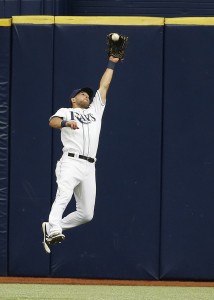 Kiermaier, now 34, began his career in fairly humble fashion. The Rays selected him in the 31st round in 2010, a portion of the draft that no longer exists, and gave him a $75K signing bonus. He was up in the majors by 2013 and quickly drew attention with his hard-nosed style of play, running the bases aggressively while also crashing his body into walls and the ground in order to make highlight reel catches.
The reckless abandon that he had for his own health was simultaneously his greatest asset and also the thing that most frequently held him back. He has been known as one of the best defenders of the most recent era of baseball while also often missing time due to injuries.
By the end of the 2016 season, he had appeared in 365 games for the Rays. He hit 32 home runs in that time and slashed .258/.313/.425 for a wRC+ of 105. He also stole 44 bases in that stretch and received some of the strongest defensive grades in the league.
Having established himself as a solid piece of the Rays’ roster, the two sides agreed to an extension going into 2017. Kiermaier had qualified for arbitration as a Super Two player and still had four years of club control remaining at that time. The deal was a six-year pact with a $53.5MM guarantee and a $13MM club option for 2023 that included a $2.5MM buyout.
Over the life of that deal, Kiermaier continued contributing in roughly the same way that he had before. He was solid though not elite at the plate while stealing bases and providing superlative defense, though the injury concerns would mount over time. From 2017 to 2022, the six guaranteed years of his extension with the Rays, he never once reached 130 games played in a season and he only hit the 100-game mark twice. One of those years was the shortened 2020 campaign but Kiermaier spent time on the injured list due to a right hip fracture, a torn ligament in right thumb, a left thumb sprain and a left wrist sprain.
In 2022, he dealt with a torn labrum in his left hip that ultimately required season-ending surgery in July. That led the Rays to go for the $2.5MM buyout instead of picking up his $13MM club option, sending him to free agency for the first time in his career.
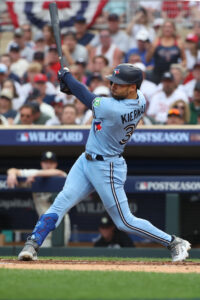
He was able to land a one-year, $9MM deal with the Blue Jays and then engineered a solid bounceback campaign. He slashed .265/.322/.419 for a wRC+ of 104, stole 14 bases and continued to provide his customary excellent glovework. He did go on the injured list once, suffering a right elbow laceration crashing into the outfield wall attempting to make a catch, but got into 129 games for the Jays.
He re-signed with the Jays on another one-year deal, this time securing a $10.5MM guarantee, but his results have fallen off significantly here in 2024. He did go on the IL once due to left hip flexor inflammation, returning after a minimum stay. In his 77 games for the Jays this year, he’s hit just .195/.239/.314 for a wRC+ of 55.
“The way I reflect on it, the product I put on the field now still can be good, but the effort it takes to get it to what I’ve been used to all those years, with my speed and defense and arm and everything, it’s tough,” he said to Topkin today. “I knew this year was going to be tough just with how I felt last year, and I know as the years go by it’s going to get tougher and tougher. I have my third kid coming in December, and it’s time for me to be a dad and let my body recover.” He continued: “I’m very proud and very happy,” Kiermaier said, “and it’s just been the best journey I could ever ask for. … It’s been incredible.”
Though retirement is just over the horizon, Kiermaier still has the 2024 season to get through and it remains to be seen where he will finish his career. The Jays are 45-55 at the moment and ten games back of a playoff spot, making them clear sellers prior to the July 30 trade deadline. Even before announcing his upcoming retirement, Kiermaier was a logical trade candidate as an impending free agent.
However, his value is at a low ebb, given his salary and struggles at the plate this year. A couple of weeks ago, the Jays placed him on waivers in the hopes that some other club would take the contract off their hands but they all passed. Despite clearing waivers, Kiermaier wasn’t removed from Toronto’s roster and could still be traded in the next week, though the Jays would have to eat some of his remaining salary to facilitate a deal. Despite the tepid offense this year, Kiermaier’s defensive grades are still strong and the Reds are one club that reportedly has some interest in him.
He will have a few more months to add to his career totals but has thus far played in 1,120 major league games with 890 hits. That includes 94 home runs, 59 triples and 167 doubles. He has scored 491 runs, driven in 370 and stolen 131 bases.
But he will of course be most remembered for that superb defense. From 2014 to the present, he has accrued 159 Defensive Runs Saved as a center fielder so far. That’s the most of any player in baseball at any position and doesn’t even include the 13 DRS he had in right field prior to establishing himself as Tampa’s regular in center. His 88 Outs Above Average in center that time frame are tops among outfielders and behind only infielders Francisco Lindor, Nick Ahmed and Nolan Arenado. (His time as a right fielder predated the invention of Outs Above Average.)
We at MLBTR salute Kiermaier on a fine career and wish him luck in the remainder of his playing career as well as his post-playing days.
Red Sox, Alex Cora Sign Three-Year Extension
5:25pm: Cora confirmed the news after today’s game, per Bob Nightengale of USA Today on X. The deal is now official, per Julian McWilliams of the Boston Globe on X.
2:25pm: Per Jon Heyman of The New York Post on X, Cora and the Sox have agreed to a three-year deal of more than $7MM annually, which aligns with the figure from Olney. Heyman says the deal is being finalized now.
1:50pm: The Red Sox and manager Alex Cora have recently engaged in talks about a contract extension, per Jeff Passan and Buster Olney of ESPN, as relayed by Passan on X. Passan says there is momentum towards a deal with a multi-year deal possible. In a subsequent tweet, he adds that the sides have talked about a three-year pact. Olney tweets that the discussed deals would pay Cora in the range of $21.75MM over those three years.

Cora, 48, has been the subject of speculation for a while since he is in the final year of his current contract. The club finished last in the American League East in both 2022 and 2023, which led the franchise to fire chief baseball officer Chaim Bloom. Cora stayed on with Craig Breslow replacing Bloom, but it wasn’t clear if Cora would stay beyond the current season.
Some had speculated that Cora might look to pivot to a front office role, something he has openly expressed an interest in. Others wondered if he might follow the path of Craig Counsell, who surprised many by becoming a free agent and signing with the Cubs for $40MM over five years, changing the landscape of salary expectations for high-profile managers.
After those aforementioned last-place finishes, the Sox went on to have a fairly modest offseason. Their most notable deal in the winter was signing Lucas Giolito to a two-year deal, but they also traded away Chris Sale and then Giolito required season-ending surgery, seemingly leaving the club worse than where they were before.
Expectations were therefore fairly low but the Sox have easily surpassed them. Thanks largely to breakouts from incumbent players like Tanner Houck, Jarren Duran, Wilyer Abreu, Kutter Crawford and others, the Sox are 54-46, putting them just one game back of a playoff spot.
As recently as last month, Cora told reporters that he and the club had no plans to discuss a midseason extension, but it appears that has now changed. Perhaps that’s due to the club performing better than expected or simply because Cora and Breslow have now had a few months to work together and become comfortable with one another.
The franchise has shown loyalty to Cora before. He managed the club in 2018 and 2019, winning the World Series in the first of those years, but he missed the 2020 season after being suspended by Major League Baseball. Cora was the bench coach for the Astros in 2017 and received that punishment for his role in their infamous sign-stealing operation. Ron Roenicke served as the bench boss in Boston that year but Cora was re-hired after his suspension was served, a two-year deal with club options for 2023 and 2024.
The Sox then went on a surprise playoff run 2021, despite finishing in last in the East the year prior. On the heels of that strong season, the Sox preemptively exercised both of their club options, keeping Cora in the dugout through 2024. That contract is now nearing its completion but it sounds as though there’s a good chance of a new deal getting done to keep him in Boston.
MLB, MLBPA Agree To Redirect CBT Money To Teams Losing TV Revenue
MLB and the Players Association have agreed to a change to the collective bargaining agreement that’ll help teams whose television rights situations are uncertain. Evan Drellich of The Athletic reports that the league is now permitted to redirect its portion of competitive balance tax money to clubs that have lost TV revenue. Those teams can receive a maximum of $15MM or the necessary amount to compensate for their revenue drop.
Teams that exceed the competitive balance tax threshold are required to pay fees at the end of each season. The league and union split the money. The MLBPA’s portion funds its retirement accounts. That is unaffected by today’s agreement. The league now has the discretion to allocate some of its half of the money to clubs that have seen their TV revenues drop in either of the last two seasons. According to Drellich, the MLBPA projects the league’s half of the CBT payments to total around $150MM this year. Today’s agreement permits the commissioner’s office to distribute half that money to the teams affected by TV problems.
It’s a sensible arrangement for both parties. MLB gets more flexibility to support organizations that have lost some or all of a key revenue source in recent seasons. The union expects that’ll lead to a trickle-down benefit on player salaries. Last offseason, roughly a third of teams pointed to concerns about the long-term viability of their TV contracts as justification for limiting payroll raises or outright payroll cuts. Most of those organizations had contracts with Diamond Sports Group, which is trying to survive as it concludes a lengthy bankruptcy proceeding.
Diamond dropped its contracts with the Padres and Diamondbacks midway through last season. This spring, it renegotiated its deals with the Guardians, Twins and Rangers at lesser fees after threatening to abandon those contracts. Texas had a quieter offseason than expected for a defending World Series champion. Minnesota sliced payroll over the winter and its ownership is reportedly still reluctant to take on money via deadline deals. AT&T Sports dropped its local TV deals with the Rockies, Pirates, Mariners and Astros last offseason. Pittsburgh, Seattle and Houston found alternate broadcasting arrangements (likely with reduced revenues), while MLB stepped in to handle Rockies broadcasts within market.
A good number of teams remain skeptical about the long-term future of their regional sports networks. Diamond is carrying 12 teams on its networks at least through the end of this season. MLB has made no secret of its wariness about the broadcaster’s viability for ’25 and beyond.
Diamond’s ongoing conflict with Xfinity hasn’t done it any favors in that regard. A contract dispute between the broadcaster and the carrier has kept Xfinity customers from watching any games on Diamond networks since May. Blackout restrictions prevent MLB from stepping in to handle in-market broadcasts, leaving a subset of fans without the ability to watch their teams for a couple months.
There was a positive development on that front this morning. An attorney for Diamond said at today’s bankruptcy hearing that DSG and Xfinity had made progress in negotiations and expected to finalize a new contract “in the very near term” (link via Alden González of ESPN).