
Marcus Stroman Opts Out Of Deal With Cubs
Marcus Stroman has enacted the opt-out clause in his contract and will now become a free agent, the New York Post’s Jon Heyman reports (X link). Stroman’s three-year, $71MM deal with the Cubs from the 2021-22 offseason allowed Stroman to opt out of the final year of that contract, and the right-hander will be leaving $21MM on the table in search of a larger and more lucrative deal this winter.
Stroman faced one of the more interesting option decisions of any player on the market, as his 2023 campaign was a tale of two seasons. In the first half, Stroman had a 2.96 ERA over 112 2/3 innings and received an All-Star nod for his efforts. In the second half, Stroman had an 8.63 ERA over only 24 innings, as he missed about six weeks on the injured list. Initially sidelined with hip inflammation, Stroman was revealed to have a right rib cartilage fracture, which delayed his IL stint beyond what seemed like a fairly minimal 15-day absence. While the righty was able to make it back for the Cubs’ late-season playoff push, Stroman was limited to bullpen duty and shortened starts, as Chicago ended up missing the postseason.
Altogether, Stroman delivered a 3.95 ERA over 136 2/3 innings, with his usual outstanding (57.1%) grounder rate and a below-average (20.7%) strikeout rate. Good control has also been part of Stroman’s repertoire, but his 9% walk rate in 2023 was both the highest of his career and only in the 40th percentile of all pitchers. It is fair to say that Stroman’s injuries contributed to his struggles over the season’s last three months, though it also marks his second straight year with a notable injury absence. Between shoulder inflammation and a brief stint on the COVID-related IL, Stroman threw only 138 2/3 innings in 2022, barely above his 2023 total.
While not the ideal platform into free agency for a pitcher entering his age-33, Stroman and his reps at Roc Nation Sports should certainly be able to find a multi-year pact on the open market, worth well above the $21MM Stroman would’ve received from the Cubs. Stroman’s groundball-heavy approach may not quite fit the preferred mold for some front offices, yet it’s hard to argue with results, as Stroman has posted generally good results over his nine MLB seasons. At his best, Stroman has looked like a front-of-the-rotation star, with two All-Star nods on his resume and a seventh-place finish in AL Cy Young Award voting when he was a member of the Blue Jays in 2017.
Stroman will head into free agency without having to worry about a qualifying offer, as Stroman previously received (and accepted) a QO from the Mets following the 2020 season. The lack of draft compensation attached to his services could give Stroman a leg up on other starters on the market, and it also means that the Cubs won’t receive anything in return should Stroman sign with another team.
The Cubs reportedly had some degree of extension talks with Stroman this past spring, through the right-hander’s comments in June indicated that those negotiations were minimal at best. “Up until now, there’s been nothing from their side. No offers, no talks, really, at all,” Stroman said. Though Stroman made it clear that he wanted to stay in Chicago, the lack of contract discussions apparently lasted through the summer, as it seemed for much of the season that the Cubs were leaning towards trading Stroman at the deadline. However, Stroman’s second-half struggles and the Cubs’ own improvement and surge into the playoff race changed those plans, even if the irony was that Stroman wasn’t able to contribute much to the pennant race.
As recently as two weeks ago, The Athletic’s Patrick Mooney wrote that Stroman and Kyle Hendricks were “expected” to return to Wrigleyville in 2024, with Stroman passing on his opt-out and the Cubs exercising Hendricks’ $16MM club option. There hasn’t yet been word on Hendricks’ option, though the two sides are reportedly discussing a contract extension that might overwrite the option entirely. Speculatively, this situation might’ve impacted Stroman’s choice, as if he felt the Cubs were prioritizing Hendricks in their long-term plans, Stroman might’ve decided to seek out a longer-term deal with another team now, rather than spend one final year in Chicago. Stroman might’ve faced more trade buzz if the Cubs weren’t in contention, or another injury-marred season might’ve more fully hampered his free agent case in the 2024-25 offseason.
A reunion between Stroman and the Cubs probably shouldn’t be entirely ruled out, though Chicago has other pitching options. Assuming Hendricks stays in some capacity, the rotation lines up as Justin Steele, Hendricks, Jameson Taillon as the top three starters, and Javier Assad, Hayden Wesneski, and Jordan Wicks competing for the last two spots. Drew Smyly could also be involved if he doesn’t opt out of the final year (and $11MM) of his contract. It stands to reason that the Cubs will look to augment this group with at least one veteran arm, whether Stroman or another free agent or trade chip.
Clayton Kershaw Undergoes Shoulder Surgery; Hoping For Summer Return
Left-hander Clayton Kershaw announced on Instagram that he underwent a surgical procedure this morning to repair the gleno-humeral ligaments and capsule of his left shoulder. He says that he is “hopeful to return to play at some point next summer.”
Kershaw, 35, had a strange campaign in 2023. He had made 16 starts through the end of June with typically strong results, holding an ERA of 2.55 at that time. He was placed on the injured list in early July due to some shoulder soreness. It didn’t seem especially concerning at that time, with the hope seeming to be that the All-Star break would allow him to miss just one or two turns through the rotation.
However, a couple of weeks later, there seemed to be some confusion around the issue. He underwent an MRI in the middle of July and wasn’t activated from the IL, although he wasn’t in any pain. “I feel completely fine. The shoulder feels good,” Kershaw said at the time. “I’ve just been told it has to rest. It’s a weird deal. I’ve never had anything like it, to the point where, like I’m gonna go play catch today and throw it as hard as I can, and they say it needs to rest. It’s just weird, honestly. I don’t know what to make of it. But I’m just gonna have to listen to [doctors].”
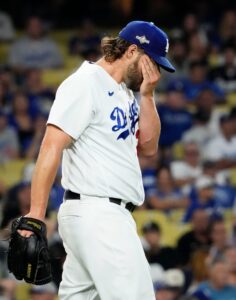
He was eventually activated in early August, with more confusion to come. His results continued to be strong, as he posted an ERA of 2.23 in his final eight starts of the year. But he was clearly working with diminished stuff. While he averaged above 91 MPH on his fastball prior to that IL stint, it was down to 90.2 MPH in August and 88.6 MPH in September. His slider also lost a few ticks as the season wore on. Although he was able to continue pitching well in the regular season, the wheels finally came off in the playoffs. Kershaw was lit up in Game 1 of the NLDS against the Diamondbacks, allowing six earned runs while only recording one out.
It seems Kershaw finally got some answers from the medical community and went under the knife today. While solving the mystery around his ailment provides some clarity, it seems there’s plenty of uncertainty ahead. This appears to be the first time the phrase “gleno-humeral” has appeared on the pages of MLBTR, suggesting this isn’t a particularly common procedure to be working back from. Kershaw has also had plenty of other ailments in the recent parts of his career. His 131 2/3 innings pitched in 2023 were the most he’s logged since 2019, spending time on the IL in recent years due to back stiffness, left elbow inflammation, left forearm discomfort, right SI joint inflammation, low back pain and the recent shoulder soreness.
Even without the health issues, Kershaw has gone into the past two offseasons with an uncertain path forward. It was seen by many that he was deciding between returning to the Dodgers, joining his hometown Rangers or retiring. In both cases, he returned to the Dodgers on a one-year deal, with a $17MM salary in 2022 and $20MM this past year. Last month, he again expressed uncertainty about his future going into free agency once more.
The Dodgers opted against issuing Kershaw a qualifying offer in those two years, though he would have deserved one based on his performance. As a sign of respect to the long-tenured player, they afforded him the freedom to take his time making a decision, whereas issuing a QO would have required Kershaw accept or decline within a few days of receiving it. They were presumably planning the same course of action this winter but this surgery would seemingly take the QO off the table even if they were considering it.
More information will likely trickle out over the winter, but the fact that Kershaw is “hopeful” of returning to play in the summer suggests that it’s not a guarantee. Perhaps he will spend some time rehabbing and trying to get healthy before signing a new contract, though that’s entirely speculative.
For the Dodgers, they likely have to proceed under the assumption that they can’t count on Kershaw, though president of baseball operations Andrew Friedman previously stated they would welcome him back. Beyond the fact that he’s not officially on the team anymore, it’s not certain he will be able to rejoin them even if he were willing to do so. In addition to Kershaw, Julio Urías and Lance Lynn are now free agents, with the club declining an option on the latter today. Tony Gonsolin could miss all of 2024 due to Tommy John surgery, while Dustin May‘s flexor tendon surgery should keep him out for at least the first half of 2024.
That leaves the Dodgers’ on-paper rotation with Walker Buehler, who missed all of 2023 recovering from his own TJS, in the top spot. He is followed by guys with very limited experience, such as Bobby Miller, Ryan Pepiot, Michael Grove, Emmet Sheehan and Gavin Stone. There’s also Ryan Yarbrough, though he might wind up non-tendered, the same way the Rays cut him loose a year ago.
Though the Kershaw news may complicate things, the Dodgers do have plenty of money to work with and figure to be active in all levels of free agency. The top of the market features names like Yoshinobu Yamamoto, Blake Snell, Aaron Nola and Jordan Montgomery, though there are plenty of other intriguing names from Sonny Gray to Lucas Giolito and Jack Flaherty and many more.
Image courtesy of USA Today Sports.
Cody Bellinger Declines Mutual Option With Cubs
Cody Bellinger has declined his end of a mutual option with the Cubs, the team informed reporters (including Meghan Montemurro of the Chicago Tribune). He receives a $5MM buyout and officially becomes a free agent. Chicago also announced they’ve declined their end of a $5MM mutual option on reliever Brad Boxberger. He collects an $800K buyout.
Both moves were straightforward. Bellinger signed a one-year guarantee last offseason after being non-tendered by the Dodgers. His goal was to turn in a rebound campaign that allowed him to get back to the open market this winter. Bellinger followed through with a resurgent year, blasting 26 homers with a .307/.356/.525 showing. Aside from a month-long absence due to a left knee contusion, it would’ve been hard to draw up a much better season.
That makes taking the option buyout a formality. Bellinger is the clear #2 position player on the free agent market. Going into his age-28 campaign, he could find a deal approaching or exceeding a decade in length. The Cubs will make him a $20.325MM qualifying offer before Monday’s deadline. Bellinger will decline, thereby entitling Chicago to draft compensation if he signs with another team.
The Cubs have top prospect Pete Crow-Armstrong as a potential successor in center field. They nevertheless figure to make an effort at retaining the 2019 NL MVP, although teams like the Giants, Yankees and Mariners could join them in the bidding.
Chicago signed Boxberger to a $2.8MM free agent deal last offseason. The veteran righty was limited to 22 contests by a pair of injuries, including a forearm strain that ended his season in September. Over 20 innings, he pitched to a 4.95 ERA with a modest 20.2% strikeout rate and an elevated 13.1% walk percentage. The 35-year-old might be limited to minor league offers this winter.
Justin Turner Declines Player Option
The Red Sox announced a pair of option decisions Friday evening. Infielder Justin Turner has declined his $13.4MM player option in favor of a $6.7MM buyout. Meanwhile, the team declined its $11MM provision on right-hander Corey Kluber.
Turner signed with Boston last offseason. He inked a two-year, $21.7MM guarantee that always looked likely to send him back to the market after one season. Turner locked in an $8.3MM base salary, an extra $1MM in incentives, and the hefty buyout — which only required he’d top $6.7MM on his next contract to come out on top.
There’s no doubt he’ll beat that number after another strong season. The right-handed hitter posted a .276/.345/.455 line while connecting on 23 home runs over 626 plate appearances. The presence of Rafael Devers and Triston Casas at the infield corners consigned Turner primarily to designated hitter work. It raises questions about whether he could be an everyday third base option for another team as he enters his age-39 season.
Despite his age, there’s little doubt that Turner still projects as one of the better hitters in the class. He has topped 20 homers in two of the past three seasons, running a .277/.352/.455 slash since the start of 2021. Turner still has plus contact skills and good plate discipline.
The Kluber signing worked out a lot less favorably. Boston inked the two-time Cy Young winner to a $10MM guarantee. Kluber had turned in 164 innings with a 4.34 ERA for the Rays a season ago. His stint in Boston didn’t go well, as he was tagged for a 7.04 ERA through 55 frames. The right-hander struggled both during an early-season stint from the rotation and following a bullpen transfer in May.
Making matters worse, Kluber landed on the injured list on June 21 with inflammation in his throwing shoulder. He suffered a setback a month later and never returned to the big league club, although he did pitch twice for Triple-A Worcester in September. There was never any chance the Sox were going to retain him for $11MM. Assuming he wants to continue playing, the 38-year-old could conduct some offseason showcases in hopes of finding a major league contract elsewhere.
Dodgers Decline Option On Lance Lynn
The Dodgers have declined their club option on right-hander Lance Lynn, per Fabian Ardaya of The Athletic. They will pay him a $1MM buyout and send him to free agency instead of retaining him with an $18MM salary for 2024.
The move doesn’t come as a surprise, as Lynn just wrapped up the worst season of his career. He made 32 starts in 2023 between the White Sox and the Dodgers, switching teams in a trade prior to the deadline. His 23.6% strikeout rate and 8.3% walk rate were both around league average, but he was victimized by the long ball. He allowed an incredible 44 fly balls to go over the fence this past season, the most of any pitcher in the league and easily the highest tally of his career. Despite those struggles, the Dodgers’ rotation had been decimated by injuries and they sent Lynn to the mound in the playoffs. He started Game 3 of the NLDS against the Diamondbacks with two scoreless innings but allowed four home runs in the third, getting pulled before finishing that inning.
The Dodgers need starting pitching next year but it’s understandable they didn’t want to commit $17MM to Lynn just as the offseason is kicking off. After his poor results this year, he will likely have to settle for a lower salary than that. He may be able to top that number in total guarantee if he can find a multi-year deal, as even back-end veteran types can often get to eight figures on an annual basis.
Though the 2023 season was obviously rough and he turns 37 in May, Lynn will still have appeal as a bounceback candidate. He has a career ERA of 3.74 in a career that dates back to 2011. In each of the four seasons prior to 2023, he kept his ERA under 4.00. In that 2019 to 2022 stretch, he made 95 starts with a 3.42 ERA, 26.8% strikeout rate and 6.2% walk rate.
Veteran starters can often find decent contracts for themselves, even when the expectations of their production have waned. Zack Greinke got $13MM from the Royals going into 2022 and another $8.5MM going into 2023, his age-38 and age-39 seasons. Corey Kluber got $10MM from the Red Sox prior to 2023, even with questions around his health and effectiveness. 43-year-old Rich Hill got $8MM from the Pirates for 2023. Perhaps some club thinks they can get Lynn back on track or merely have him serve as an innings-eater, but he should be able to find a decent contract regardless.
As for the Dodgers, they go into the winter with plenty of question marks in their rotation. Lynn is now heading into free agency, joining Julio Urías and Clayton Kershaw. The latter has re-signed with the Dodgers many times but is slated for an uncertain road back from shoulder surgery. That leaves Walker Buehler, who missed all of 2023 recovering from Tommy John surgery, as well as a batch of guys with limited experience like Bobby Miller, Emmet Sheehan, Ryan Pepiot, Gavin Stone and Michael Grove. There’s also Ryan Yarbrough in the mix but he’s a non-tender candidate.
The club has plenty of payroll space to work with and will likely be very active in free agency. They are expected to pursue two-way superstar Shohei Ohtani, though he won’t be pitching in 2024. The other top names on the pitching market will be Yoshinobu Yamamoto, Blake Snell, Aaron Nola and Jordan Montgomery, with many others also available.
Dodgers Sign Max Muncy To Two-Year Extension
The Dodgers announced they’ve signed infielder Max Muncy to a two-year, $24MM extension. The deal also includes a $10MM club option for 2026. The contract overwrites a $14MM option that L.A. had on Muncy’s services for next season.
A client of Hub Sports Management, Muncy will reportedly receive a $5MM signing bonus. He’ll make a $7MM salary next season and $12MM in 2025, while the deal includes additional bonuses based on his plate appearance totals. The contract has a $12MM average annual value.
Muncy, 33, has spent the past six seasons in Los Angeles. Originally an unceremonious addition via minor league contract, he quickly developed into one of the Dodgers’ most important hitters. The lefty-swinging infielder has reached the 35-homer mark in four of the five full schedules. He popped 36 longballs this past season, tying with Jorge Soler for 12th in the majors in that regard.
That power production comes with one of the sport’s more extreme offensive approaches. Muncy is a prototypical three true outcomes hitter. He pairs the home runs with an extremely patient plate approach. The deep counts translate to plenty of walks, as he has drawn a free pass in 15% of his career plate appearances. Yet he’s also prone to strikeouts and runs very low averages on balls in play thanks to a fly-ball heavy swing.
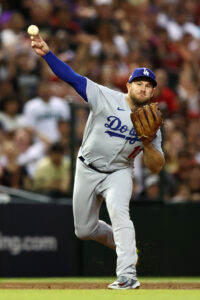
As a result, Muncy has one of the lower batting averages among everyday players. He hit .212/.333/.475 through 579 trips to the plate this past season. That’s on the heels of a .196/.329/.384 showing. Over the last two years, the two-time All-Star sports a .204/.331/.430 line in a little more than 1100 trips to the plate.
That isn’t quite as impressive as Muncy’s production over his first few seasons in Southern California. The overall offensive production is still clearly above-average, however. Muncy’s 118 wRC+ this year indicates he was 18 percentage points better than an average batter. The front office clearly values his contributions, as they’ve now signed him to three separate extensions.
Muncy has a decent amount of experience at first and second base. He spent the entire ’23 campaign at third base, logging a personal-high 1052 innings there. Metrics like Defensive Runs Saved and Outs Above Average estimated he was between three and five runs below par at the hot corner. That’s hardly disastrous but aligns with his reputation as a bat-first player.
As he gets into his mid-30s, that profile seems likely to skew increasingly towards offense. Whether Muncy sees another 120+ starts at third base may well be determined by the Dodgers’ subsequent offseason moves. Freddie Freeman is locked in at first base. The club should welcome Gavin Lux back from the ACL tear that cost him all of 2023, likely securing second base. Miguel Vargas, Michael Busch and Chris Taylor are among the possibilities for third base reps, although Muncy is clearly above that group on the depth chart.
The designated hitter role will be one of the stories of the offseason. L.A. will see J.D. Martinez hit free agency in the coming days, although they could make him a qualifying offer. They’re sure to make a run at Shohei Ohtani, a potential addition that would push Muncy back to third base.
Even with this deal in place, the Dodgers have plenty of breathing room financially. Roster Resource projected the 2024 payroll around $127MM before this extension. That’ll sit a little under $140MM now, well below this year’s $223MM Opening Day estimate. The $12MM AAV pushes their luxury tax projection to roughly $155MM. That’s more than $80MM south of next year’s $237MM base threshold.
Robert Murray of FanSided first reported the Dodgers and Muncy were seriously discussing a two-year extension. Jon Heyman of the New York Post first suggested the deal was agreed upon. Murray had the specific salary breakdown.
Image courtesy of USA Today Sports.
Jorge Soler Opts Out Of Deal With Marlins
Jorge Soler has informed the Marlins he is declining his $13MM player option for next season, reports Craig Mish of SportsGrid (Twitter link). He is a free agent and will be able to begin negotiating with other teams on Monday.
It’s an entirely unsurprising decision. Soler, 32 in February, is coming off his best season in a few years. He connected on 36 home runs with a .250/.341/.512 batting line. The right-handed hitter walked at a strong 11.4% clip while cutting his strikeout rate to a manageable 24.3%.
That marked a strong rebound showing after a tough first year in South Florida. Originally signed to a three-year, $36MM guarantee during the 2021-22 offseason, Soler slumped to a .207/.295/.400 slash over 72 games a season ago. He had an opt-out possibility last winter but understandably forewent a trip to the open market. With a much better platform performance, he’ll get to the market this time around.
While Soler’s opt-out call was made without much suspense, it puts the onus on Miami to answer a more interesting question. The Fish have until Monday to determine whether to tender a $20.325MM qualifying offer. If they do, Soler would have just over a week to gauge the market before deciding if he wants to accept.
In the event Miami opts against the QO or Soler declines one, he’ll be one of the top offensive players in a rough free agent class. Soler doesn’t offer much defensive value. He’s a well below-average corner outfielder who spent the majority of his time at designated hitter this past season. Miami plugged him into right field for just 241 2/3 innings. Few impending free agents can match his power upside, although Soler’s pre-2023 production has been inconsistent.
Miami’s QO decision is clouded by an uncertain front office picture. General manager Kim Ng recently departed the organization and the club has yet to name her replacement. Brian Chattin is leading the front office on an interim basis. Miami also awaits an opt-out decision from first baseman Josh Bell, while they’re sure to decline team provisions on Johnny Cueto and Matt Barnes.
Twins To Exercise Options On Max Kepler, Jorge Polanco
The Twins are exercising their club options on outfielder Max Kepler and infielder Jorge Polanco, reports Dan Hayes of the Athletic (X link). Kepler will make $10MM, while Polanco is set for a $10.5MM salary.
Both moves were expected. Kepler started slowly but found his form in the second half. He finished the season with a .260/.332/.484 line with 24 home runs across 491 plate appearances. That’s well above-average offense, his best season since a 36-homer showing in 2019. He’s also a strong defender in right field, making the $10MM price point a bargain. He’ll be a free agent for the first time in his career next offseason.
Polanco was limited to 80 games by injury but turned in a characteristically solid season. The switch-hitting infielder ran a .255/.335/.454 line through 343 trips to the plate. Primarily a second baseman, Polanco moved to third base later in the year in deference to hot-hitting rookie Edouard Julien. The Twins have Royce Lewis at the hot corner, leaving Polanco in a multi-positional role.
Despite the infield depth, there was never much question about Minnesota exercising the option. A $10.5MM salary is strong value for a player who would have been this year’s top free agent middle infielder had the Twins cut him loose. His contract also contains a $12.5MM team option for 2025. That comes with a $750K buyout that is now guaranteed.
The moves add an expected $20.5MM to Minnesota’s player payroll, which now sits around $88MM. That’s well below this year’s Opening Day estimate of approximately $154MM. The Twins have a fair bit of spending room and could certainly find trade interest in Kepler and/or Polanco if they were to entertain dealing from their position player depth.
Nelson Cruz To Retire
Nelson Cruz revealed on the Adam Jones Podcast that he is planning to retire from playing after an upcoming stint in the Dominican Winter League.
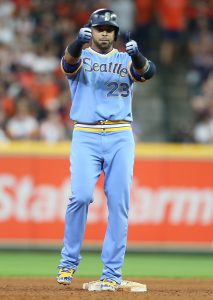 Cruz, now 43, was something of a late bloomer but still went on to have an incredibly long and productive career in the big leagues. He didn’t fully establish himself as an everyday big league player until 2009. That was technically his “age-28 season”, but he turned 29 on July 1, just after the standard June 30 cutoff for such distinctions. He had some limited looks in the big leagues with the Brewers and Rangers from 2005 to 2008 but that 2009 season saw him bust out with 33 home runs and 20 stolen bases for Texas.
He would follow that with 22 and 29 home runs in the next two years, helping the Rangers reach the World Series in each campaign, though they ultimate lost on both occasions. He continued serving as a potent slugger for a time but that was put on pause when he was connected to the Biogenesis performance-enhancing drugs scandal, receiving a 50-game suspension in August of 2013.
He reached free agency after that campaign and the Rangers gave him a qualifying offer of over $14MM, which he turned down. The draft pick forfeiture tied to that QO and his PED situation led to him lingering on the open market until late February, eventually signing with the Orioles for one year and $8MM, well below the QO he turned down.
He had a monster year for the O’s in 2014, launching 40 home runs and helping that club reach the American League Championship Series. The O’s then gave him a $15.3MM qualifying offer, as players were still allowed to receive multiple QOs at that time. The limit of one per career did not come into place until the 2017-2021 Collective Bargaining Agreement. Cruz turned the QO down again but fared far better in this trip to free agency, landing a four-year, $57MM deal with the Mariners.
Though he had been an outfielder earlier in his career, he slid more into a full-time designated hitter role over the course of that deal with Seattle. The club likely didn’t mind as he continued mashing, with 163 home runs in that four-year span. He then continued to produce in a similar fashion after joining the Twins, launching 41 more homers in 2019 then 16 in the shortened 2020 season.
He was still crushing baseballs through the first half of 2021, but his production slid after a midseason trade from the Twins to the Rays. He signed one-year deals with the Nationals and Padres for the past two seasons but his offensive production slid to below par. Since he was into his 40s and limited to DH duties only, it became tougher to roster him and the Padres released him in July.
Cruz retires having played in 2,055 regular season games, hitting 464 home runs in that time. His finishes with a batting line of .274/.343/.513, which translates into a wRC+ of 128, indicating he was 28% better than the league average hitter. He made seven All-Star teams, won four Silver Sluggers, a Roberto Clemente Award and various other honors. He represented the Dominican Republic in the World Baseball Classic on four separate occasions, winning the 2013 tournament. His Baseball Reference page indicates he earned over $140MM in his career. We at MLB Trade Rumors salute Cruz for his many accomplishments and wish him the best of luck for whatever awaits him in his post-playing days.
Image courtesy of USA Today Sports.
Qualifying Offer To Be $20.325MM For 2023-24 Offseason
The qualifying offer value is going to be $20.325MM for this offseason, reports Jon Heyman of The New York Post. It had been previously reported that it would land “around” $20.5MM but it seems the final number will be a smidge lower.
The value of the QO is calculated by averaging the salaries of the 125 highest-paid players in the league each year. As the season ends, a player reaching for free agency is eligible for a qualifying offer if they spent the entire season with just one team and have never received a QO before. If the player declines and signs elsewhere, the signing club is subject to draft pick forfeiture as well as a possible reduction of their international bonus pool. The player’s previous club receives draft pick compensation.
The value of the QO generally goes up as salaries rise. Here are the values of the past dozen QOs:
- 2012-13: $13.3MM
- 2013-14: $14.4MM
- 2014-15: $15.3MM
- 2015-16: $15.8MM
- 2016-17: $17.2MM
- 2017-18: $17.4MM
- 2018-19: $17.9MM
- 2019-20: $17.8MM
- 2020-21: $18.9MM
- 2021-22: $18.4MM
- 2022-23: $19.65MM
- 2023-24: $20.325MM
14 players received qualifying offers last offseason. Joc Pederson and Martín Pérez accepted. The other 12 players declined, though Aaron Judge, Anthony Rizzo and Brandon Nimmo subsequently ended up re-signing with their previous team.
MLBTR recently took a look at the pitchers and position players that could potentially receive QOs this year, though it has since been reported that Lourdes Gurriel Jr. is not eligible to receive one. Clubs have until 4:00 pm Central on November 6 to decide whether or not to extend the QO to eligible players. Players who receive the QO will have until 3:00 pm Central on November 14 to decide whether or not to accept.