
Seidler Family Exploring Potential Sale Of Padres
The Padres announced Thursday that the Seidler family, which has owned the majority stake in the franchise since 2012, will explore “strategic options” for the team, including a potential sale of the franchise. Kevin Acee of the San Diego Union-Tribune reported the potential sale just minutes before the team’s formal press release.
“The family has decided to begin a process of evaluating our future with the Padres, including a potential sale of the franchise,” chairman John Seidler said within this morning’s announcement. “We will undertake this process with integrity and professionalism in a way that honors [late chairman Peter Seidler’s] legacy and love for the Padres and lays the foundation for the franchise’s long-term success. During the process and as we prepare for the 2026 season, the Padres will continue to focus on its players, employees, fans, and community while putting every resource into winning a World Series championship. We remain fully committed to this team, its fans, and the San Diego community.”
It’s been nearly two years to the day since the untimely passing of late Padres chairman Peter Seidler, who passed away at just 63 years of age. His brother, John, was approved as the team’s control person earlier this year.
That appointment came after a monthslong legal battle wherein Peter’s widow, Sheel Seidler, filed suit against brothers-in-law Matt and Bob Seidler, alleging that they had breached fiduciary duty and committed fraud as successors of their late brother’s trust. Sheel Seidler accused Matt and Bob of selling assets to themselves at “far” below-market prices as they attempted to consolidate control of the franchise. Matt vehemently denied the allegations in a formal statement of his own, wherein he accused Sheel of “manufacturing claims” against other trustees in an effort to secure control of the franchise herself.
To this point, Sheel’s lawsuit has yet to be litigated in full. If it reached that point, it’d presumably be a yearslong process. There’s no indication that the parties have settled the suit outside of court, either.
At this juncture, it’s not yet known whether the Seidler family will sell the majority stake or seek new minority investors. Acee reports that one minority owner, who owns a roughly 10% stake in the team, is in the process of selling his stake in the club. Whether there will be larger portions available remains to be seen and is surely in part dependent on interest. Acee’s report also indicates that the preliminary $1.8 billion valuation of the franchise includes around $300MM in debt and “more than $150 million in paybacks to owners for two cash infusions made in recent years.”
As we recently saw with the Twins, who had a reported $425MM in debt while they attempted to sell the franchise for around $1.7 billion, that level of debt can prove a major obstacle in finding a buyer. The Pohlad family ultimately opted not to sell the Twins franchise, instead bringing in two new minority stakeholders whose investments in the club (coupled with an aggressive deadline fire sale) helped to clear that debt.
While the current ownership landscape is rather tumultuous, the Padres should still be in a position to command considerable interest. Both Forbes and CNBC have reported the team to be profitable. They’ve set franchise attendance records in three straight seasons and ranked second in the National League in terms of attendance this season — thanks in part to a lack of competition in terms of major sports teams in the market — but still enjoy the benefit of receiving revenue-sharing funds due to the size of their market. In that sense, even with that notable debt and some infighting among the current owners, the Padres have many points working in their favor if the Seidler family does choose to pursue a sale of the majority stake.
Acee further reports that even as the team explores a potential sale, one source described the team’s baseball operations as “business as usual,” adding that payroll will be in the same general range as in 2025. The Padres opened the 2025 season with a payroll of nearly $210MM and tacked on a few million more over the course of the season. RosterResource currently projects a $201MM payroll, though that’s before any potential non-tenders or trades from the big league roster.
The Padres were far more free-spending under Peter Seidler’s watch than they have been since his passing. “Business as usual,” in that sense (coupled with a repeat of the 2025 payroll), seems to suggest that San Diego will need to explore creative deals to address various holes on the roster. The Padres have utilized complex contract structures (e.g. Nick Pivetta‘s backloaded, opt-out-laden four-year contract) to keep payroll in what current ownership deems an acceptable range. They’ve also worked aggressively on the trade market to find low-cost options at areas of need (e.g. catcher Freddy Fermin, closer Mason Miller) — but in the process have further depleted an already thin farm system. They’ll now look to fill multiple rotation holes and perhaps add a bat without much in the way of financial flexibility.
Further cementing the notion that the status quo will be maintained, at least from a baseball operations standpoint, Acee writes that John Seidler and president A.J. Preller have been discussing a contract extension which could be finalized in the near future. Preller is entering the final season of his most recent contract extension. He’s been running baseball operations in San Diego since 2014. Readers are highly encouraged to read Acee’s piece in full, as it contains more granular details about the current financial structure of the ownership group and quotes from various anonymous sources on the possibility of a sale and the long-term outlook of the club.
Astros GM: “No Interest” In Trading Isaac Paredes
The Astros appear to have something of a corner infield logjam. They acquired Carlos Correa at the deadline, and Jeremy Peña’s presence meant Correa needed to move to third base. That made sense while Isaac Paredes was injured but is a tougher fit if everyone is healthy. The Astros have Christian Walker signed for two more seasons at first base. Yordan Alvarez remains the primary designated hitter, and the Astros would probably welcome the opportunity to get Jose Altuve more DH at-bats if they could find them.
Based on that glut of corner bats, there’s been speculation about the Astros trading an infielder this offseason. Most of that has revolved around Paredes or Walker, but general manager Dana Brown downplayed the idea that the Astros were looking to move either player. That’s particularly true of Paredes, who turned in a .254/.352/.458 line with 20 homers in 102 games during his first season in Houston.
“He was one of the best guys at seeing pitches and working counts and it’s one of the reasons why we went out and traded for him,” Brown told reporters at the GM Meetings on Wednesday (link via Matt Kawahara of The Houston Chronicle). “We need that value in our lineup. It’s the exact direction we’re trying to take it. We feel like if we trade him it would be weakening our lineup. So right now, we have no interest in trading him.”
Paredes was the centerpiece of the Kyle Tucker return from the Cubs. He ranked fifth on the team in on-base percentage and tied for third in homers despite missing most of the second half with a significant strain of his right hamstring. Paredes returned late in the season but was limited to DH work. Brown said he’s currently at roughly 65% health and will “potentially” be available for Opening Day (via Brian McTaggart of MLB.com).
The 26-year-old’s swing is geared for pull-side pop that makes him an ideal fit in Houston’s Daikin Park, where the Crawford Boxes leave a short porch in left field. The two-time All-Star was an accomplished hitter with the Rays, so it’s not as if he’s only a product of the park, but he’s perfectly tailored even for a lineup that skews very heavily to the right side.
MLBTR contributor Matt Swartz projects Paredes for a $9.3MM arbitration salary. He’ll go through that process once more before hitting free agency during the 2027-28 offseason. There’d be significant interest if the Astros did decide to shop him, likely for starting pitching, but they’re clearly proceeding as if he’ll be in their lineup. Brown said the Astros are not considering him for a regular role at second base, so he’ll be back mostly in the corners.
While that’d seemingly point in the direction of a Walker trade, the GM indicated that’s not currently under consideration either. “We haven’t talked about Walker in a trade. Walker’s our everyday first baseman,” Brown said. He’s in a much different spot from Paredes. He’s signed for $20MM annually for his age 35-36 seasons. Walker had a team-leading 27 homers this year, but he hit .238 with a career-worst .297 on-base percentage. The three-time Gold Glove winner also posted uncharacteristically middling defensive grades. Baseball Reference felt he was right around replacement level overall, while FanGraphs had him at one WAR.
That’s not the kind of season that would net Walker $20MM per season on a multi-year deal if he were a free agent. The Astros might need to eat around half the money just to move him for a middling return. That would open first base for Paredes and reallocate a bit of payroll room for rotation adds, yet it’d leave them with more dead money on a first baseman right as the José Abreu contract finally comes off the books. The Astros could value Walker’s power and defensive reputation enough to hold him in hope that he rebuilds some value.
Trading Correa or Peña seems even more far-fetched. “We’re not really trying to pull from the infield in the trade market, simply because we feel like all those guys are going to be part of the top of our lineup,” Brown said generally. “I think they’re all going to hit somewhere between 1 and 6. So I wouldn’t try to make any moves from the infield standpoint.” That blanket statement probably doesn’t apply to utility players Ramón Urías or Mauricio Dubón, who are respectively projected for $4.4MM and $5.8MM in their final seasons of arbitration. The Astros could trade or non-tender either or both.
Brown spoke generally about the Astros bouncing players around the diamond to maximize rest opportunities for their veteran hitters. Correa has never played second base, though he’d presumably be capable of doing so. One speculative option would be to get Correa semi-regular second base work on days when Paredes is at the hot corner. They’ll have Altuve continue bouncing between second base, left field and DH with Alvarez splitting time between DH and left.
That carries into an outfield that should feature a couple changes. Houston traded for Jesús Sánchez to add a left-handed bat who could play right field down the stretch. Sánchez played terribly, batting .199/.269/.349 with multiple defensive lapses. He’s projected at a $6.5MM arbitration salary and under club control for two seasons. Chandler Rome of The Athletic writes that the Astros are open to trade inquiries on Sánchez, though it seems more likely they won’t find interest and will simply non-tender him at next Friday’s deadline.
That’ll likely leave the Astros in search of another left-handed hitting outfielder. Rookies Zach Cole and Jacob Melton could factor in but have limited track records. Taylor Trammell is probably on the roster bubble. Moving on from Sánchez and adding someone like Max Kepler, Cedric Mullins or Mike Yastrzemski in free agency would make sense.
Notably, Brown would not commit to second-year outfielder Cam Smith breaking camp in 2026. The former first-rounder, acquired alongside Paredes in the Tucker deal, hit .236/.312/.358 across 493 plate appearances as a rookie. It was hardly a disastrous showing for a player with such limited professional experience, and Smith played an excellent right field despite being drafted as a third baseman. Yet he struggled significantly in the second half (.154/.247/.242) and could be due for a look against Triple-A pitching.
“We saw glimpses of it last year, but we’re going to need him to be more consistent,” Brown said (via Rome). “I would think he comes back and tries to play with more consistency and makes the necessary adjustments, but we have to be open to sending him back to Triple-A if he hasn’t turned the corner. … There’s a lot to be said for guys that work hard in the offseason and then make the necessary adjustments. We’re hoping that Cam does that. If he does that, we’ll be excited.”
Optioning Smith would give the Astros the flexibility to pursue an everyday right fielder. Jake Meyers should be back as the primary center fielder, though Rome reports that Houston has received a fair bit of trade interest in the 29-year-old. That’s to be expected, as Meyers is a plus defender who is coming off a career year at the plate. He hit .292/.354/.373 over 381 plate appearances with dramatically improved strike zone discipline. He’s controllable for another two seasons and projected at a bargain $3.5MM rate. It’s difficult to envision a Houston team already looking for outfielders trading Meyers, but it’s possible another club tries to force their hand by putting a controllable starting pitcher on the table.
Paul Skenes Wins NL Cy Young Award
Paul Skenes has won his first career Cy Young award. The Pirates righty is named the National League’s best pitcher one year after winning Rookie of the Year and finishing third in Cy Young balloting. He beat out Cristopher Sánchez and Yoshinobu Yamamoto for the honors. The vote was unanimous, as he received all 30 first-place votes. Sánchez was second on every ballot, so it wasn’t until third that voters began to diverge.
Skenes is the third pitcher in franchise history to win the Cy Young, joining Vernon Law (1960) and Doug Drabek (1990). He turned in an MLB-best 1.97 earned run average over his first full season in the big leagues. He’d posted a 1.96 mark across 23 starts as a rookie. He’s the only starting pitcher in the majors with a sub-2.00 ERA over the past two seasons. Skenes ranked fourth in the NL with 187 2/3 innings pitched and tied Jesús Luzardo for second with 216 strikeouts.
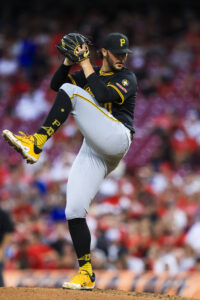
Only Logan Webb recorded more strikeouts. Skenes ranked fifth in strikeout rate (minimum 100 innings) and third behind Webb and Sánchez with 20 quality starts. He led the Senior Circuit with a 2.36 FIP and placed fifth with a 3.10 SIERA. FanGraphs and Baseball Reference each had him in essentially a dead heat with Sánchez for the Wins Above Replacement lead.
The 2023 first overall pick is widely considered one of the two best pitchers in the sport. There’s a fair debate between him and two-time AL Cy Young winner Tarik Skubal, but they’re almost certainly 1-2 in some order. Fans of other teams may dream about prying Skenes out of Pittsburgh, but that’s not happening anytime soon. General manager Ben Cherington stated in no uncertain terms yesterday that their ace would remain a Pirate in 2026. He’s under club control for another four seasons, and while a trade may be in the cards down the line, the immediate focus for player and team is getting the Bucs to the postseason. Skenes is the most important player on a team trying to break a decade-long playoff drought.
Sánchez had a breakout season to establish himself as a true ace for the Phillies. He fired 202 innings of 2.50 ERA ball across 32 starts. He finished fourth in the NL with 212 strikeouts. Sánchez had been a borderline top-of-the-rotation starter between 2023-24, earning a top 10 Cy Young finish in the second of those seasons. This was his first time posting a sub-3.00 ERA or topping 200 innings and strikeouts, so he certainly leveled up in his age-28 season. He’s signed through 2028 and under control through ’30 via a pair of club options on one of the most team-friendly contracts in the game.
Yamamoto’s World Series heroics weren’t a factor in the voting, which takes place at the end of the regular season. He earned his first All-Star nod and first Cy Young votes by turning in a 2.49 ERA across 30 starts. Yamamoto managed 201 strikeouts across 173 2/3 innings while leading the NL with fewer than six hits allowed per nine innings. Yamamoto had flashed ace potential in his first MLB season, but he was limited to 18 starts by a rotator cuff strain in 2024. He showed what he’s capable of in a full season in year two, and the Dodgers have won consecutive World Series in the first two seasons of his record-setting $325MM free agent contract.
Just over half of voters placed Yamamoto third. Webb received 10 third-place votes and finished fourth overall. Freddy Peralta picked up the four remaining third-place nods and landed in fifth place. Skenes and Sánchez were the only pitchers who appeared on every ballot. Nick Pivetta, Jesús Luzardo, Andrew Abbott and Zack Wheeler also received votes.
Image courtesy of Katie Stratman, Imagn Images. Full vote tally available courtesy of BBWAA.
Tarik Skubal Wins AL Cy Young Award
For a second straight season, Tarik Skubal is the American League Cy Young award winner. He beat out Garrett Crochet and Hunter Brown, the other two finalists. Skubal received 26 of 30 first-place votes. The other four voters had him second behind Crochet, and those pitchers were 1-2 in some order on every ballot.
Skubal is the first pitcher to win back-to-back Cy Youngs since Jacob deGrom took the NL honors in 2018 and ’19. He’s the 23rd pitcher in MLB history to win the award twice. Skubal cemented himself as one of the two best pitchers on the planet by turning in a 2.21 earned run average across 31 starts. He recorded 241 strikeouts, 13 more than he did during last year’s award-winning season, and won a second straight ERA title.

The Tigers’ star southpaw was fourth in the AL in innings, second in strikeouts behind Crochet, and trailed only Logan Gilbert with a 32.2% strikeout rate (minimum 100 innings). Both FanGraphs and Baseball Reference credited him the most Wins Above Replacement of any AL pitcher. He also had the lowest FIP (2.45) and SIERA (2.71). He tied Brown and Bryan Woo for second in the league with 21 quality starts, one behind Crochet.
Skubal is headed into his final season of arbitration control. With no progress on a long-term extension, there’ll surely be teams trying to pry him out of Detroit. It’s very difficult to imagine the Tigers trading their ace on the heels of two consecutive playoff appearances, though. He’ll likely be back as A.J. Hinch’s Opening Day starter and go for a third consecutive AL Cy Young while trying to get Detroit back to October.
It’s the first top three finish for both Crochet and Brown. The Red Sox could not have asked for more out of Crochet in his first season in Boston. He led the AL in strikeouts and innings pitched (205 1/3) while pitching to a 2.59 ERA over 32 starts. This was only Crochet’s second season as a starting pitcher and his first logging a full starter’s workload. The White Sox had eased him back in the second half of the ’24 campaign to not put too much stress on his arm after years working in relief. He demonstrated he’s capable of maintaining his stuff and ace level over a full season with the Red Sox, who signed him through the 2031 season in April.
Brown’s top three placement earned the Astros an extra pick after the first round of the 2026 draft under the Prospect Promotion Incentive. Houston’s ace turned in a 2.43 ERA across 31 starts. He struck out a career-high 206 batters over 185 1/3 innings. This was Brown’s first time receiving any Cy Young votes. He’s entering arbitration and is under club control for another three seasons.
Voters unanimously had Skubal and Crochet as the AL’s best pitchers in some order. Brown was the consensus choice for third, receiving 24 of 30 third-place votes. The other six third-place nods went to Max Fried. Brown and Fried appeared on all but one ballot apiece. Woo finished comfortably in fifth. Carlos Rodón, Aroldis Chapman, Jacob deGrom, Trevor Rogers and Drew Rasmussen were the other pitchers to receive at least one vote.
Image courtesy of Stephen Brashear, Imagn Images. Full vote tally available via BBWAA.
Reds’ Krall Further Downplays Chances Of Hunter Greene Trade
Reds president of baseball operations Nick Krall has already downplayed the idea of trading from his rotation this winter, but the fact that he didn’t expressly state he will not trade ace Hunter Greene led to some fan bases, and surely some rival teams, clinging to the faint hope that Cincinnati’s top starter might be available. At this week’s GM Meetings, Krall again downplayed the idea of trading a starting pitcher and was a bit more forceful with regard to Greene in particular (link via Gordon Wittenmyer of the Cincinnati Enquirer). Krall still declined to speak in absolutes but came close when speaking about the possibility of trading Greene, specifically:
“…[T]hat’s a hard one to actually say, ‘Hey, we’re going to trade the guy that has a chance to be the ace of your staff and top-of-the-rotation guy going into the postseason.’ We’re looking to figure out how to get better, but right now that’s not on the table.”
Greene, 26, is signed for another three seasons and owed a guaranteed $41MM in that time. His contract contains a club option that, if exercised, would bring his four-year earnings total to $60MM. He could slightly boost his 2028-29 salaries via All-Star nominations and Cy Young voting.
Cy Young consideration is hardly far-fetched for Greene. Early in the 2025 season, he looked squarely in the National League mix. A pair of groin strains wound up limiting him to 19 starts and dashing those hopes, but when he was healthy Greene turned in a 2.76 ERA with a 31.4% strikeout rate and 6.2% walk rate in 107 2/3 innings. A year prior, he gave the Reds 150 1/3 frames of 2.75 ERA ball.
Greene, the No. 2 overall pick in the 2017 draft, is one of baseball’s hardest throwers and clearly one of the most talented overall pitchers in the NL — if not in all of MLB. Among the 78 pitchers who have tossed at least 250 innings since 2024, his 2.76 ERA ranks sixth, trailing only Paul Skenes, Tarik Skubal, Chris Sale, Zack Wheeler and Yoshinobu Yamamoto. His 29.2% strikeout rate ranks eighth among that same set of pitchers, and the 21.1-point differential between his strikeout and walk percentages sits 11th in the sport.
The Reds could extract a king’s ransom for Greene, but it’s never seemed likely that they’d pull the trigger on moving a potential four years of control over a Cy Young-caliber arm who only just turned 26 — particularly coming off a late run to the postseason. The Reds need to add multiple bats to their lineup, and the front office isn’t expecting much of a payroll bump, but teams generally balk at trading this much affordable control over a player this talented.
The safe bet will be to expect Greene to again head up one of the game’s best rotations. He’ll be joined by Andrew Abbott, Nick Lodolo and Brady Singer, with top prospect Chase Burns (another former No. 2 overall pick) the early favorite for the final spot. Top prospects Chase Petty and Rhett Lowder, both former first-rounders themselves, loom in the upper minors. Lefty Brandon Williamson and righty Julian Aguiar are on the mend from 2024 Tommy John surgery and should be options in 2026.
Given that wealth of pitching, other clubs will surely try to pry some arms loose. Singer has just one year of relatively pricey club control remaining (projected $11.9MM salary), making him the most prototypical trade candidate of the bunch. Lodolo has two years of arbitration control. Abbott has three. The potential return the Reds could extract from another club would improve with every additional year of control they’re willing to surrender, but as Krall has said in the past, dealing from the established group might simply necessitate signing a veteran to backfill those lost innings.
If the Reds are indeed loath to part with pitching talent, they could look into trading a controllable young position player for a more established hitter that’s closer to free agency. Shortstop Elly De La Cruz isn’t going anywhere, and the Reds only just traded for third baseman Ke’Bryan Hayes at the deadline. But the Reds also have Matt McLain, Sal Stewart, Christian Encarnacion-Strand and Spencer Steer on the roster and won’t find regular at-bats for the whole bunch. (Encarnacion-Strand’s stock is in the tank after two injury-marred, unproductive seasons.) Prospects Cam Collier and Edwin Arroyo aren’t too far from MLB readiness themselves.
There are ways to go about trading for an offensive upgrade without sacrificing much or any of the current rotation depth, and while the payroll isn’t set for a big increase, there’s still room to splash around some cash on the open market, too. The Reds currently have a payroll projection of about $97.5MM, per RosterResource. That’s before factoring in potential trades or non-tenders of arbitration-eligible names like Gavin Lux (projected $5MM salary), Will Benson ($1.7MM projection) and Sam Moll ($1.2MM projection). Cincinnati opened the 2025 season with a roughly $112MM payroll and finished close to $120MM. They could use a bullpen arm or two as well, but there should be space to sign at least one prominent bat in free agency.
Kodai Senga Garnering Trade Interest
Mets right-hander Kodai Senga has already garnered trade interest from multiple clubs, Will Sammon of The Athletic reports. The Mets aren’t known to be outright shopping the 2023 Rookie of the Year runner-up, but they’ve at least held discussions as they’ve been approached by interested teams.
Those who don’t follow the Mets closely might raise an eyebrow at the idea of a win-now club like the Mets trading a pitcher who carries a flat 3.00 ERA in 285 innings across 52 MLB starts. That includes a tidy 3.02 ERA in 113 1/3 innings this past season. However, Senga’s standing in the organization fell in the second half of the 2025 campaign. After a shoulder injury limited him to just one start in 2024, Senga returned on a hot streak, posting a 1.74 ERA in his first 13 trips to the mound.
That superlative production never appeared fully sustainable. Senga’s 23.9% strikeout rate was good but not great, and his 10.6% walk rate was nearly two percentage points higher than average. His .251 average on balls in play and 88% strand rate both seemed ripe for regression. Still, metrics like FIP (3.24) and SIERA (4.28) felt he was still a quality or at least serviceable arm even if his ERA was bound to take some steps back.
Senga sustained a calf strain in mid-June that sent him to the injured list for nearly one month. It’s a fairly innocuous-sounding injury, but whether he rushed back too soon or simply developed some bad mechanical habits while compensating for the resulting discomfort, the rest of Senga’s season was a nightmare. From July 11 through Aug. 31, he took the ball nine times and turned in a 5.90 ERA with a diminished 20.6% strikeout rate and an even more problematic 12.7% walk rate. And after allowing just 0.59 homers per nine innings in his first 13 starts, Senga’s HR/9 mark more than tripled during that miserable nine-start stretch (1.82).
The Mets optioned Senga to Triple-A — a move to which the right-hander had to consent — in hopes of getting him back on track. Senga, however, didn’t return to the majors in the season’s final month. The Mets rode a contingent of rookies down the stretch, leaning heavily on Nolan McLean, Jonah Tong and Brandon Sproat in the rotation as they eventually narrowly missed a return to postseason play.
The fact that Senga didn’t return to the majors leaves him as something of a question mark. He made two starts in Triple-A following his demotion: one very good (six innings, one run, eight strikeouts, no walks) and another very poor (3 2/3 innings, four runs, two walks, one hit batter, four strikeouts). It’s difficult to glean exactly which version of Senga will show up. Outstanding as he was during his rookie season, injuries and this year’s second-half struggles have limited him to a total of 146 innings (majors and minors combined) across the past two seasons.
If the Mets had four healthy, mostly established other options in the rotation, it’d be easier to simply hope for a Senga rebound. They lack that stability, however. New York’s rotation will surely include McLean, who dazzled as a rookie. Veteran David Peterson finished with a respectable 4.22 ERA but faceplanted down the stretch, pitching to an 8.42 ERA over his final nine starts. Reliever-turned-starter Clay Holmes had a successful move to the rotation but only pitched beyond five innings four times in his final 18 appearances and posted ugly strikeout and walk rates in that time (15.8 K%, 10.6 BB%). Sean Manaea posted a 5.64 ERA in just 60 2/3 frames thanks to injuries. Frankie Montas and Tylor Megill both had UCL surgery. Tong and Sproat have sizable upside but remain unproven.
Given all that tumult in the starting staff, rotation help is a natural priority for the Mets this winter. That only makes uncertainty surrounding Senga all the more confounding. On the one hand, selling low on a pitcher who has often looked like a top-of-the-rotation arm and is at least ostensibly healthy seems like a risk the team can ill afford to take. On the other hand, Senga’s uneven 2025 season is a driving factor behind the Mets’ current rotation instability. If they’re not confident he can get back on track, moving him now would be prudent. It’d only become more difficult to deal Senga if he suffers an early injury or pitches poorly despite a clean bill of health.
The Mets owe Senga $14MM in both 2026 and 2027. If he suffers a major elbow injury that requires surgery, a conditional $15MM club option would be tacked onto the deal. A total guarantee of two years and $28MM is eminently affordable, although the Mets are effectively paying double that amount since they’re being hit with a 110% tax on all dollars spent over the top tier of the luxury tax threshold.
Senga’s contract included a full no-trade clause covering the first three seasons of the five-year pact. That’s now shrunk to a limited 10-team no-trade list for the final two years of the deal. The list of teams to which he can block a move isn’t clear at present, but the Mets have more latitude to trade him than in the past.
New York certainly isn’t going to just dump the remainder of Senga’s contract for no return. There’s far too much upside, particularly relative to his modest salary. Any team looking to pry Senga loose will have to offer up some actual talent, though clearly not as much as Senga would command were he coming off a healthy, successful season. Then again, if Senga were coming off that type of season, the very idea of trading him would be a nonstarter for the Mets. Questions about his health, mechanics and results have at least nudged Senga onto the periphery of the trade market, but those same factors also make him an incredibly tricky asset on which to find common ground with another club.
Emmanuel Clase, Luis Ortiz Indicted On Gambling Charges
November 11: Ken Rosenthal and Zack Meisel of The Athletic report that MLB is hopeful of imposing discipline by the beginning of Spring Training. The pitchers remain on paid administrative leave, though obviously they’re not collecting salary during the offseason. If there’s no change to their status by the time games resume, the Guardians would need to continue paying them until discipline is formally imposed.
That doesn’t matter much for the Guardians with Ortiz, who had yet to reach arbitration. Clase had been slated to earn $6MM next year, though, and the Guardians would prefer not to pay that if the pitcher is unavailable. A suspension would get them off the hook for that money. Players found to have bet on games in which their team has been involved are given a lifetime ban. Attorneys for Clase and Ortiz released statements denying their involvement in the wake of the criminal charges.
November 9: Guardians pitchers Emmanuel Clase and Luis Ortiz have been indicted by prosecutors in Brooklyn on charges involving sports betting, reports Jeff Passan of ESPN, among others. Ortiz was arrested earlier today. Clase is not currently in custody.
Clase and Ortiz are charged with “wire fraud conspiracy, honest services wire fraud conspiracy, conspiracy to influence sporting contests by bribery, and money laundering conspiracy, for their alleged roles in a scheme to rig bets on pitches thrown” according to the Department of Justice, relayed by Zack Meisel of The Athletic. The indictment details an alleged scheme that involves the pitchers purposely throwing balls so gamblers could bet on pitches being balls or strikes.
The allegations from prosecutors in the indictment include a specific incident on June 15, when Ortiz was paid $5K for throwing an intentional ball, and Clase received $5K for facilitating it. Co-conspirators won at least $400K on fraudulent wagers relating to Clase and at least $60K on fraudulent wagers relating to Ortiz, prosecutors allege in the indictment. (Meisel explored some of the incidents detailed in the indictment in a longer piece for The Athletic.) Clase and Ortiz face up to 65 years in prison if convicted on all charges.
“MLB contacted federal law enforcement at the outset of its investigation and has fully cooperated throughout the process. We are aware of the indictment and today’s arrest, and our investigation is ongoing,” the league said in a statement to ESPN.
Cherington: Paul Skenes “Is Going To Be A Pirate In 2026”
Every offseason there are at least a handful of high-profile players other clubs and their fans dream upon as the trade market begins to ramp up. Pirates ace and likely NL Cy Young Award winner Paul Skenes may be coveted by every other team and fan base in the league, but general manager Ben Cherington was quick to stomp out any trade chatter before it even picked up. Speaking with FanSided’s Robert Murray, Cherington plainly stated that he will not trade his ace this offseason. Skenes “is going to be a Pirate in 2026,” Cherington said.
There’s little reason to think the Pirates would move Skenes at this juncture anyhow, save for owner Bob Nutting’s typically frugal habits. Skenes, the No. 1 overall pick from the 2023 draft, burst onto the scene early in the 2024 season, started the All-Star Game just a couple months later, won ’24 NL Rookie of the Year honors and is now poised to win the first of what could very well be multiple Cy Young Awards in his career.
Since taking a major league mound for the first time, Skenes has started 55 games and posted a comical 1.96 earned run average (1.96 ERA in 2024, 1.97 in 2025). He’s punched out 31% of his opponents against just a 5.9% walk rate and has only allowed 21 home runs in 320 2/3 innings (0.59 HR/9). Forty-seven percent of his batted balls have been grounders, and opponents have averaged a paltry 87.7 mph off the bat against him. He’s already staked a defensible claim to being the best pitcher in the National League, and were it not for the fact that Tigers ace Tarik Skubal is poised to win his second straight Cy Young Award in the AL, Skenes might well be the consensus top pitcher in the sport.
Trading Skenes somewhere down the road feels almost inevitable. If he continues this trajectory, he’ll have the opportunity to shatter contract precedents for starting pitchers. He already has two full years of big league service and won’t turn 24 until next May. He’ll reach free agency heading into his age-28 season. The thrifty Pirates almost certainly aren’t going to put forth a record-breaking extension offer, which is presumably already what it’d take to extend Skenes.
That said, Skenes is still under club control for four more seasons, and he won’t even reach arbitration until after the 2026 season. At least the first of his arb years will be affordable even by Pirates standards, and for a pitcher of this caliber it wouldn’t be surprising to see them hold Skenes later than some of the prior pitchers they’ve traded away with two years of club control remaining (e.g. Gerrit Cole, Joe Musgrove).
There was never really any expectation that Skenes would be traded this offseason — we didn’t include him on our list of the offseason’s top 40 trade candidates — but it’s nevertheless notable to hear the team’s baseball operations leader so definitively say a trade won’t happen. Most front office leaders tend to avoid speaking in absolutes of this nature, after all.
Beyond that, Cherington’s comment comes at a time when the Pirates are widely expected to make a bit more of a push for a return to contention. The 2026 season will be year six of Cherington’s GM tenure, and the team hasn’t topped 76 wins during his time running the club. Pittsburgh already dismissed manager Derek Shelton back in May — he’s since been hired as the Twins’ new skipper — and the baseball ops leader tends to be next on the chopping block after a manager is shown the door.
The Athletic’s Ken Rosenthal said earlier today in an appearance on Fair Territory that agents he’s spoken to have already received signals from the Pirates that they’re planning to be more active on the open market this winter (video link). That doesn’t mean the Bucs are going to play at the top of the market, of course, but the 2025-26 offseason could see them step out of the bottom tiers of free agency where they tend to reside. Cherington himself told Murray that he has “more flexibility than we’ve had in [any] other offseasons I’ve been in Pittsburgh.”
As MLBTR’s Contract Tracker shows, it’s been nearly a decade since the Pirates have signed a free agent to a multi-year contract. That’s not an indication that they haven’t made any multi-year offers, but the Pirates certainly haven’t been aggressive during Nutting’s ownership, whether under Cherington or predecessor Neal Huntington.
In an appearance on the MLB Trade Rumors podcast late in the season, Cherington acknowledged that he’s made multi-year offers to free agents — specifically free agent position players. Obviously, those offers have been rebuffed. Still, the sixth-year Pittsburgh GM made clear that he plans to continue those efforts, and there are now multiple indicators that he might have the financial latitude to be a bit more aggressive as he looks to line up on such a deal to add some offense to the lineup.
The Bucs could still trade some pitching to add a big league bat(s), but veteran Mitch Keller or 26-year-old Mike Burrows seem like more plausible candidates than Skenes, Bubba Chandler, Braxton Ashcraft or Jared Jones (on whom they’d be selling low as he finishes off his rehab from UCL surgery).
Pat Murphy, Stephen Vogt Win Manager Of The Year
For the second consecutive season, Pat Murphy and Stephen Vogt have been named the Managers of the Year. Murphy received 27 of 30 first-place votes in the National League. The American League tally was closer, but Vogt picked up 17 first-place nods to keep his title.
Both skippers have won the award in their first two seasons on the job. They’ve each led a small-market franchise to a Central division title in consecutive seasons. Milwaukee won 97 games and played .500 or better ball in every month after starting the season 0-4 in the final few days of March. The Brewers coasted to another division title and held off the Phillies for the top seed in the Senior Circuit.
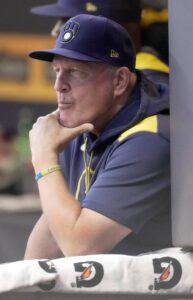
The Brewers seamlessly integrated a few quality rookies along the way. Caleb Durbin, Isaac Collins, Chad Patrick and Jacob Misiorowski all made strong contributions in their debut campaigns. Milwaukee also weathered a series of early-season rotation injuries behind Freddy Peralta. A mid-April trade for Quinn Priester paid massive dividends. The offense, meanwhile, trailed only the Yankees and Dodgers in scoring despite the free agent departure of Willy Adames.
Milwaukee knocked off the Cubs in a five-game Division Series. They were swept by the Dodgers in the NLCS and are still searching for their first trip to the Fall Classic since 1982. Awards voting takes place at the end of the regular season, so the postseason performance is irrelevant.
While the Brewers were well positioned to make the playoffs by the end of June, the Guardians got in via a late-season run that surely surprised even the Cleveland front office. The Guards were deadline sellers and seemed more or less finished once Emmanuel Clase was placed on administrative leave. A ten-game losing streak dropped them as low as eight games under .500 shortly before the All-Star Break, and they trailed Detroit by as much as 15.5 games in the division.
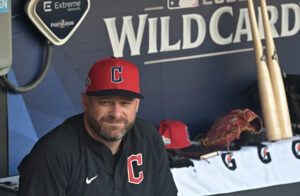
The Guards went 14-13 in August before reeling off a 20-7 record in September to steal a division title. They never led the AL Central by more than one game but had the edge when it mattered, finishing the season at 88-74. That included a 5-1 showing against the Tigers in the final two weeks of the regular season. Detroit wound up getting the last laugh in October, though, going into Cleveland and bouncing the Guards in the Wild Card Series.
Murphy appeared first or second on all but one ballot in the NL. Cincinnati’s Terry Francona and Philadelphia’s Rob Thomson also received at least one-first place vote. They finished second and third, respectively. Craig Counsell, Clayton McCullough, Torey Lovullo and Mike Shildt all received votes. Toronto’s John Schneider was a close-runner up in the Junior Circuit. He received 10 first-place votes. Seattle’s Dan Wilson (the other finalist) and Boston’s Alex Cora also had at least one first-place nod. A.J. Hinch and Joe Espada received votes.
Full vote tallies courtesy of the BBWAA. Images via Imagn Images.
Nick Kurtz Wins American League Rookie Of The Year, Earns Full Year Of Service Time
Athletics first baseman Nick Kurtz has been named the 2025 American League Rookie of the Year, the Baseball Writers Association of America announced. His teammate Jacob Wilson finished second and Roman Anthony of the Red Sox finished third in the voting. Kurtz, who was the unanimous choice for the award, will be retroactively awarded a full year of service time by finishing in the top two of the voting. The full voting results can be found here.
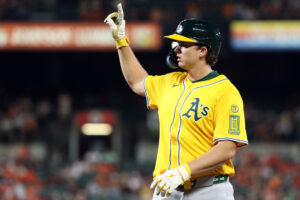
Kurtz was the fourth overall pick of the 2024 draft and came into 2025 as one of the top prospects in the league. He didn’t break camp with the club but was called up on April 23rd. Almost immediately, he started showing his talent for crushing the ball. Due to his late call-up and a brief injured list stint for a strained left hip flexor, he only got into 117 games, but that was still enough time for him to put the ball over the fence 36 times.
It wasn’t a perfect season, as Kurtz struck out at a high 30.9% rate. However, his 12.9% walk rate was quite strong. When combined with his aforementioned power, it was a very productive season. His .290/.383/.619 slash line translated to a wRC+ of 170. Among hitters with at least 20 plate appearances this year, only Aaron Judge and Shohei Ohtani topped that wRC+ number.
It’s impressive that Kurtz did so much despite not even playing a full season. His late call-up also has notable implications for him and the club. The most recent collective bargaining agreement included measures to discourage service time manipulation. If a team promotes a top prospect early enough in a season for him to earn a full service year, the team can earn an extra draft pick if the player meets certain awards voting criteria, via the Prospect Promotion Incentive. On the flip side, if a player is not promoted early enough for a full service year and then goes on to finish in the top two of Rookie of the Year voting in his league, then he is retroactively credited with a full service year.
Kurtz came into the year as a consensus top 100 prospect in baseball, meaning he would have been PPI-eligible this year if the A’s had called him up earlier. He only got 159 days of service, 13 shy of the 172 needed for a full season. If he were PPI-eligible, this award win would have netted them an extra draft pick in 2026. Since they did not call him up early enough and Kurtz finished in the top two of the voting, he will get a full year of service anyway. That reduces the club’s window of control over Kurtz from six years to five, meaning he’s now on pace to reach free agency after 2030 instead of 2031.
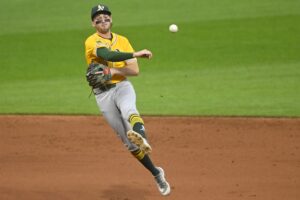
Wilson is Kurtz’s teammate but the two are polar opposites when it comes to their offensive profiles. While Kurtz strikes out a lot but also draws walks and has huge power, Wilson has modest power and rarely walks but almost never strikes out. His 7.5% strikeout rate this year was the second-lowest among qualified hitters, trailing only Luis Arráez. Wilson only hit 13 home runs and drew a walk in just 5.2% of his plate appearances, but he still managed to hit .311/.355/.444 for a 121 wRC+ while playing the premium position of shortstop, even if his defense wasn’t highly rated.
The shortstop actually got promoted in July of 2024 but he landed on the injured list and missed enough time to still have rookie status coming into 2025. Despite having rookie status, he would not have earned the A’s a PPI pick even if he had finished first in the voting. Players are ineligible for the PPI bonus if they have at least 60 days of service time. Wilson earned 73 days of service in 2024, much of it on the injured list, meaning he was in a weird twilight zone of being rookie eligible but not PPI eligible.
Anthony came into the year not only as a top 100 prospect but most rankings had him first or second in the league. However, the Red Sox had a crowded outfield mix that was difficult for him to break into. Eventually, injuries opened a path and he finally got the call in June. By August, he had impressed the Sox enough that they signed him to an eight-year, $130MM extension.
Though he only got into 71 games, Anthony slashed .292/.396/.463 for a 140 wRC+ and stole four bases. He was credited with seven Defensive Runs Saved and six Outs Above Average. FanGraphs credited him with 2.7 wins above replacement in less than half a season. He would have pushed those numbers even further if not for an oblique injury sending him to the IL in early September.
Anthony only got 112 service days this year. He would have earned a full year if he had cracked second place in the voting, though that is largely a moot point with his extension. However, the result does impact him financially when looking at the details of his pact. The deal contains a number of escalators which Anthony can unlock via awards voting. Some extra money could have been tacked on with a top two finish but this third-place finish isn’t enough for him to add anything to the $130MM total. He can still push that up in the future by getting MVP votes.
Several other players received some recognition from the voters. Noah Cameron of the Royals finished fourth in the voting, followed by Colson Montgomery of the White Sox, Carlos Narváez of the Red Sox, Jack Leiter of the Rangers, Will Warren of the Yankees, Luke Keaschall of the Twins, Braydon Fisher of the Blue Jays, Shane Smith of the White Sox, Cam Smith of the Astros, Chandler Simpson of the Rays, Luis Morales of the A’s and Jasson Domínguez of the Yankees.
Photos courtesy of Charles LeClaire, Daniel Kucin Jr., David Richard, Imagn Images