
Blue Jays To Sign Yusei Kikuchi
The Blue Jays are signing left-handed pitcher Yusei Kikuchi, per Jon Heyman of MLB Network. It’s a three-year, $36MM contract. (Twitter links) The deal is frontloaded, per Bob Nightengale of USA Today, with Kikuchi earning a salary of $16MM in 2022, followed by $10MM in each of 2023 and 2024.
Starting pitching has been a hot commodity this offseason, with most of the top names signing before the lockout. Now that the transactions freeze has thawed, the market has picked up right where it left off. The top two free agent hurlers that lingered on the market through the lockout, Clayton Kershaw and Carlos Rodon, signed on the first full day after the lockout ended. That left Kikuchi and Zack Greinke as the only healthy starters remaining from MLBTR’s list of Top 50 Free Agents. With the Jays scooping up Kikuchi, that leaves Greinke as the last man standing.
Kikuchi has been one of the more difficult pitchers to evaluate since coming over from Japan prior to the 2019 season. In his first MLB season, he made 32 starts for the Mariners, throwing 161 2/3 innings with an ERA of 5.46 and a strikeout rate of just 16.1%. In the shortened 2020 campaign, he made nine starts and still had a high ERA of 5.11, but made huge strides in the strikeout department, bumping his rate up to 24.2%.
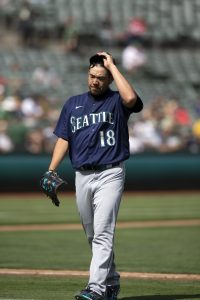
2021 was a tale of two seasons for Kikuchi, as the first half his campaign was excellent. At the start of July, MLBTR’s Steve Adams wrote about Kikuchi’s season around the midway point, when Kikuchi had made 15 starts and was sitting on an ERA of 3.18, strikeout rate of 25.4%, walk rate of 8.5% and ground-ball rate of 53.8%. But things went completely in the opposite direction in the second half of the season, as Kikuchi threw 63 2/3 innings from that point on, with a 6.22 ERA, 23.3% strikeout rate, 10.3% walk rate and 41.7% ground-ball rate.
As part of the unusual structure of Kikuchi’s contract, at the end of the season, the Mariners then had to decide whether or not to execute a series of four one-year options valued at $16.5MM each, effectively a four-year, $66MM extension that would cover the 2022-25 seasons. After they declined, then Kikuchi could have selected a one-year, $13MM player option for the 2022. Though it seemed there was a chance he would accept that deal after his poor performance down the stretch, he ultimately declined and tested the free agent market. That has now proven to be a wise decision on his part, as he has earned himself a new contract at that exact rate but three times as long.
The Blue Jays were evidently encouraged enough by Kikuchi’s strengths to overlook his weaknesses, much like they were with Robbie Ray and Steven Matz. Although those two pitchers had serious flaws on their respective resumes, they both went on to have excellent campaigns with the Jays in 2021, with Ray earning the American League Cy Young award. Although Ray and Matz will both be wearing new uniforms this year, Kikuchi is still going to be joining a strong rotation. The club also added Kevin Gausman prior to the lockout, joining Jose Berrios, Hyun Jin Ryu and Alek Manoah. That is likely to be the club’s front five, but they also have Ross Stripling on hand, who could function either as a starter or long-man out of the bullpen. Nate Pearson could potentially join the rotation at some point, though he has durability concerns after throwing just 18 innings in 2020 and just 45 2/3 in 2021.
After the lockout, the 2022 season is going to feature a condensed Spring Training and a regular season with added double-headers to make up for the delayed start to the campaign. Those factors, combined with the dwindling options in the free agent market, led the Jays to take a risk by bolstering their depth with a pitcher who has had flashes of excellence but also definite concerns.
As for the structure of the deal, it’s worth pointing out that the Blue Jays also front-loaded their contract with George Springer. This seems to be a way of taking advantage of the fact that most of the club’s core players are still working their way through arbitration and will only get increasingly expensive in the coming years. Vladimir Guerrero Jr. is arbitration eligible for the first time this year as a Super Two player. Teoscar Hernandez will be playing his second of three arbitration seasons in 2022. Bo Bichette and Jordan Romano won’t be arbitration eligible until next year. By paying Springer and Kikuchi more now, the club will have a little bit extra wiggle room to weather the increasing salaries of those players in the coming seasons.
Image courtesy of USA Today Sports.
Twins Acquire Isiah Kiner-Falefa For Mitch Garver
The Twins and Rangers are in agreement on a deal that will send infielder Isiah Kiner-Falefa to Minnesota, reports Jeff Passan of ESPN. Kiner-Falefa and a prospect will head to Minnesota in exchange for catcher Mitch Garver, per Jon Heyman of MLB Network. Pitcher Ronny Henriquez is the prospect heading to Minnesota in the deal, per Betsy Helfand of the St. Paul Pioneer-Press.
For the Rangers, this is yet another headline-grabbing move in what has been a very busy offseason for the club. Prior to the lockout, they threw around big money to add various players, with the two biggest names being shortstop Corey Seager and second baseman Marcus Semien. The addition of those two infielders, along with the impending arrival of prospect Josh Jung, led to immediate speculation that Kiner-Falefa could be a trade candidate. But when Jung underwent shoulder surgery last month, that seemed to swing the pendulum towards Texas keeping Kiner-Falefa as their everyday third baseman. However, that has now proven not to be the case, as he is headed for Minnesota.
The Twins had Andrelton Simmons as their primary shortstop last year. Despite showing the defensive skills he has long been known for, Simmons had a dismal year at the plate, hitting .223/.283/.274, wRC+ of 56. Yesterday, he signed with the Cubs for a modest $4MM salary, showing that the Twins weren’t terribly motivated to bring him back into the fold. With Kiner-Falefa, they’ve brought in a player with a similar profile to Simmons, but more reasons to be optimistic about his future performance. Like Simmons, Kiner-Falefa is a glove-first player, winning a Gold Glove in 2020 and finishing third among MLB shortstops in the Fielding Bible’s voting this past season. His bat has been below average thus far in his career, having never put up a wRC+ higher than 94. However, he’s still relatively young, turning 27 later this month, compared to the 32-year-old Simmons. He also hit .271/.312/.357 last year for a wRC+ of 85, not great numbers but certainly better than what Simmons provided. He’s also projected for an arbitration salary of $4.9MM, per MLBTR contributor Matt Swartz, and comes with an extra year of control beyond that.
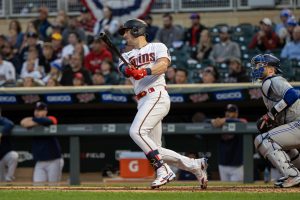
But in order to make that solid addition to their infield, the Twins have had to send a valuable player the other way. Garver had a tremendous breakout season in 2019, hitting .273/.365/.630, wRC+ of 155. That would be exceptional production for any player but was especially impressive for a catcher. Injuries limited him to just 23 games of anemic production in the shortened 2020 season, but he bounced back well last year. Despite still dealing with injuries and only playing 68 games, his 2021 line was .256/.358/.517, wRC+ of 137. Last year, the Rangers split the catching duties almost evenly between Jose Trevino and Jonah Heim, who put up wRC+ tallies of 60 and 64, respectively. Garver is capable of producing at a much higher rate, but comes with concerns given the injuries of the past few years, making him a high-risk, high-reward option for Texas. He won’t be a huge risk from a financial standpoint, however, as he’s projected for an arbitration salary of $3.1MM this year, with another year of control remaining after that.
The reason the Twins could afford to part with such a talented catcher as Garver was the emergence of Ryan Jeffers. Making his MLB debut in 2020, he played 26 games and hit .273/.355/.436, wRC+ of 120. In 2021, he got off to a rough start, hitting .147/.216/.176 before getting demoted at the end of April. After showing signs of improvement in Triple-A, he was recalled in June and hit .206/.277/.433 the rest of the way, good enough for a wRC+ of 92. Although that’s clearly a drop-off from Garver’s numbers, Jeffers is turning 25 years old in June and comes with five remaining years of control. The Twins clearly felt that it was worth taking the chance on the younger player as their regular catcher in order to upgrade their infield.
Of course, that’s not all the Twins added, as they also brought Ronny Henriquez over in the deal. The 21-year-old right-hander split last season between High-A and Double-A, making 16 starts in 21 total games. In 93 2/3 innings, his 4.71 ERA wasn’t especially impressive, but the Twins were surely intrigued by his 27.1% strikeout rate and 6.5% walk rate, both of those being better than average. The club certainly needs arms after losing Jose Berrios to trade, Kenta Maeda to injury and Michael Pineda to free agency. Henriquez likely won’t provide immediate help in that regard, given that he’s never pitched above Double-A, but he could potentially be a factor later in the season.
Circling back to the Rangers, with Kiner-Falefa out of the picture and Jung on the shelf for around six months, they will have to decide what do about third base for this season. In-house options include Andy Ibanez, Nick Solak, Yonny Hernandez and Sherten Apostel. They could also turn their attention towards outside addition, although a tweet from Jeff Wilson casts doubt about a pursuit of Kris Bryant.
Image courtesy of USA Today Sports.
Nationals To Sign Steve Cishek
The Nationals have agreed to a one-year contract with Steve Cishek, reports Ken Rosenthal of The Athletic. The contract comes with a $1.75MM guarantee, along with $500K in performance bonuses, per Mark Feinsand of MLB.com.
Signing a veteran like Cishek, who will turn 36 in June, is a fairly logical move for a club that underwent a massive fire sale at last year’s deadline. While the headliners of that selloff were Max Scherzer and Trea Turner, the bullpen also took a hit with the deals of Daniel Hudson and Brad Hand. That left the club with a reliever corps that largely consisted of unproven players with limited big league experience, with the exception of Will Harris. However, Harris turns 38 in August and only threw six innings last year before surgery for thoracic outlet syndrome ended his season, making him a question mark in his own right.
In contrast to that lack of reliability, Cishek has been remarkably consistent in his career. In each season since 2011, he has thrown at least 44 innings, with the exception of the shortened 2020 season, where he still logged 20 frames. Since his debut in 2010, he’s appeared in a total of 668 games, notching 644 1/3 innings with an ERA of 2.85, strikeout rate of 24.7%, walk rate of 9.6% and groundball rate of 49%. With the exception of 2020, he’s never had an ERA higher than 3.58 in a season.
Last year, Cishek signed a one-year deal with the Angels late in March for a salary of $1MM. He ended up making 74 appearances for the Halos, logging 68 1/3 innings with an ERA of 3.42, strikeout rate of 20.8% and walk rate of 13.3%. That walk rate was the worst of his career, and the strikeout rate just a hair above his previous career lows. That could perhaps be cause for some concern, but the Nationals still game him a modest raise on last year’s salary.
For a team that wiped millions from its books at the trade deadline last year, it’s still an incredible modest sum with little downside. If Cishek has yet another season like he’s had for the majority of his career, he could act as a stabilizing force on a pitching staff with high variance and perhaps be dealt to a contender at the deadline, as the team looks to bolster its farm and reload for their next competitive window.
Dodgers Reportedly “Making Strong Push” For Freddie Freeman
8:08pm: Jon Heyman of the MLB Network tweets that the Dodgers and Braves are Freeman’s most likely landing spots. He hears that Atlanta’s offers have been in the five-year, $140MM range.
7:32pm: Morosi adds that Freeman is expected to make his decision within the next 24 hours and could do so as soon as this evening.
7:04pm: The Dodgers are “making a strong push” for star first baseman Freddie Freeman, reports Jon Morosi of MLB.com (Twitter link). Los Angeles has put a formal offer on the table, Morosi adds.
Freeman is among the top free agents on the market, and it’s generally been expected he’d sign quickly in the wake of the end of the lockout. The Dodgers are among the teams who have been linked to the 2020 NL MVP, as are the incumbent Braves, Yankees, Blue Jays and — most surprisingly — Rays.
Many have long expected that Freeman, a career-long Brave, will re-sign with Atlanta on a long-term deal. Calls for the Braves to keep him around particularly mounted after the club wrapped up a World Series title in November. Freeman, of course, played no small part in Atlanta’s first championship in 26 years; after hitting .300/.393/.503 during the regular season, he posted an OPS above .990 in all three playoff rounds.
However, the Braves have reportedly been unwilling to offer a sixth guaranteed year to the 32-year-old first baseman. Freeman didn’t agree to terms with anyone before the lockout, and rumors swirled throughout the work stoppage that he and the club may go in different directions. There’s been no shortage of interest in Freeman’s services, and the Braves have at least looked into the possibility of trading for A’s star Matt Olson or signing Anthony Rizzo as contingency plans.
Of course, it’s far from a lock that Freeman will wind up departing. That the Dodgers are making a serious run at the five-time All-Star is no surprise. Atlanta could yet look to make another push themselves, and there’s no indication an agreement between Freeman and Los Angeles is imminent.
The first base market figures to see quite a bit of action in the coming days and weeks. Freeman and Rizzo have yet to sign. It’s widely believed the A’s will move Olson before the start of the season as they reportedly embark on a payroll-cutting effort. The Yankees have been tied to first base upgrades this offseason, which might make 2020 home run champ Luke Voit a realistic trade candidate as well.
Cubs To Sign Andrelton Simmons
The Cubs and shortstop Andrelton Simmons have agreed to a one-year contract that will pay Simmons $4MM plus incentives, according to MLB Network’s Jon Heyman (via Twitter). The Athletic’s Ken Rosenthal (Twitter link) was the first to report that the two sides were closing in on a deal. Simmons is represented by ISE Baseball.
One of the best defensive players of all time, ankle injuries led to an uncharacteristically mediocre season of glovework for Simmons in 2020, but he looked much more like his old self this past season with the Twins. Simmons posted a +16 Outs Above Average and +15 Defensive Runs Saved over 1091 2/3 innings at shortstop last year, though the UZR/150 metric (-1.1) took a dimmer view of his performance.
While Simmons’ age (32) and recent history of ankle problems are undoubtedly a concern, it would certainly seem like he should still be a defensive plus in the middle of the Cubs infield. Such quality defense will be particularly important since it has been three years since Simmons has been even a league-average hitter, with only a .250/.302/.323 slash line to show for his last 1002 plate appearances since the start of the 2019 season.
Glovework has always been Simmons’ calling card, yet in the few seasons (2017 and 2018) where he has provided both a solid bat along with his excellent defense, Simmons looked like one of the game’s most valuable players. It remains to be seen if he can get back to that all-around form, yet the Cubs would be satisfied if he can merely provide his usual stellar work at shortstop.
Simmons will be filling the defensive void left behind by another Gold Glove-winning shortstop in Javier Baez, who was dealt to the Mets last summer as part of the Cubs’ trade deadline fire sale. As much as the Cubs tore things down pre-deadline, however, the team has been looking to build things back up to make at least some attempt at contending in 2022, adding Marcus Stroman, Wade Miley, and Yan Gomes prior to the lockout.
Of course, Chicago had been linked to another prominent shortstop in Carlos Correa, with the logic being that the Cubs could now afford Correa’s big asking price after clearing so much future salary off the books. The Simmons deal could quite possibly indicate that the Cubs have opted out of the Correa sweepstakes, and yet as journalist Sung Min Kim speculates, Simmons’ $4MM salary “is not necessarily starter money.” Theoretically, the Cubs could still sign Correa and then use the two players in a timeshare at shortstop, with the other perhaps moving to second base or third base.
This would allow the Cubs to juggle Nick Madrigal or Patrick Wisdom (the other incumbent infield starters) in and out of the lineup as the situation warrants, and the DH spot is also now available for Chicago to work with in 2022 and beyond. Madrigal’s health is also a bit of a question mark, as he underwent season-ending hamstring surgery last summer, though reports from January indicated that the young infielder was making good progress in his recovery. Nico Hoerner had been penciled into the starting shortstop job, but with Simmons now in the fold, the Cubs can continue experimenting with Hoerner as a multi-position player.
Rangers To Sign Martin Perez
The Rangers have agreed to terms on a contract with free-agent lefty Martin Perez, reports FanSided’s Robert Murray (via Twitter). It’s a one-year, $4MM contract for Perez, MLB Network’s Jon Heyman adds. Perez, a client of Octagon, will return to the organization that originally signed and developed him. He made his big league debut with Texas in 2012 and spent the next seven seasons with the Rangers.
Perez, 31 next month, spent the 2019 season with the Twins and was with the Red Sox in 2020-21 before returning to Texas. In his three years away from his original club, the southpaw turned in 341 1/3 innings of 4.88 ERA ball with rather pedestrian strikeout (18.4%), walk (8.7%) and ground-ball (44.9%) rates. Boston declined a $6MM club option in favor of a $500K buyout on Perez after the 2021 season.
Once lauded as one of the sport’s premier pitching prospects, Perez has instead settled in as a back-of-the-rotation starter. Those 2019-21 rates represented a slight uptick over his career strikeout rate and a slight downgrade over his career ground-ball rate, but generally speaking, Perez’s output in three years away from Texas was roughly in line with his lifetime numbers at the big league level. He doesn’t necessarily work deep into starts, but Perez has avoided the injured list for the past three seasons, with the exception of a brief absence this past summer following a positive Covid-19 test. He’ll give the Rangers some needed stability at the back of a starting staff that was — and still is — in need of multiple arms.
Perez will join fellow offseason signee Jon Gray and right-hander Dane Dunning as one of the only three locks in the Texas rotation. Lefty Taylor Hearn could get another look, depending on other moves that are made, but he was hit hard in limited work out of the rotation while thriving in the bullpen this past season. Right-hander A.J. Alexy had a big year in the upper minors but a tepid 4.70 ERA in 23 big league frames. Prospects Spencer Howard and Glenn Otto, acquired at the trade deadline, both were hit hard in their brief MLB looks. Right-hander Yerry Rodriguez and southpaw Brock Burke are both on the 40-man roster but were both ineffective in Triple-A this past season.
Put another way, Perez figures to be one of multiple arms acquired by the Rangers, whether via free agency or trade. Texas has been strongly linked to hometown star Clayton Kershaw, and the general belief is that Kershaw will either return to the Dodgers this winter or sign with the Rangers to be close to his family. The Rangers are also known to be keenly interested in A’s first baseman Matt Olson, and Oakland has several arms who could be on the trade block alongside their All-Star first baseman (Sean Manaea, Chris Bassitt, Frankie Montas).
The Rangers’ hope is surely that 2021 No. 2 overall pick Jack Leiter and 2019 first-rounder Cole Winn — two of the sport’s most promising arms — will be able to factor into the big league rotation sooner than later. That may not be the case until 2023, however, so the veteran Perez will give them a bridge to those younger arms. His $4MM salary is a mere footnote in what’s been a massive offseason of spending for president of baseball operations Jon Daniels and general manager Chris Young. Texas has also signed Corey Seager (10 years, $325MM), Marcus Semien (seven years, $175MM), Gray (four years, $56MM) and Kole Calhoun (one year, $6.2MM), bumping their projected payroll to just under $134MM. That’s a notable increase from the past couple seasons but still a good bit shy of 2017’2 franchise-record $165MM payroll.
Cubs Extend Manager David Ross
The Cubs announced Friday that they’ve signed manager David Ross to a contract extension that runs through the 2024 season and contains a club option for the 2025 campaign. Ross had been set to enter the final guaranteed season of his previous contract (although the team did hold a 2023 club option over him).
The team could have and quite likely did discuss the possibility of a new contract throughout the lockout. Ross told reporters back in October that he and president of baseball operations Jed Hoyer had begun some “preliminary” discussions on a new contract. The general expectation throughout the offseason was that a Ross extension was little more than a formality. The organization has been quite happy with Ross’ leadership, even after a losing 2021 season. The Cubs went 71-91 last year, although the July dismantling of the team’s longstanding core played an obvious role in that poor record.
Ross, 45 next week, is entering his third season as the Cubs’ manager. He was plenty familiar with the organization and the front office before ever taking on the role, having spent the final two seasons of his playing career (2015-16) as the Cubs’ backup catcher. Ross garnered the nickname “grandpa” as the team’s elder statesman during those final seasons and earned the respect of many of the players he eventually wound up managing years later.
After last summer’s fire sale, it’s easy to forget that the Cubs not only made the expanded postseason field in 2020 but did so by winning the National League Central with a 34-26 showing. That proved to be another postseason exit for a club that never really developed into the dynasty many expected on the heels of the organization’s 2016 World Series title. Former president of baseball ops Theo Epstein stepped down after the season, giving way to longtime GM Hoyer as the Cubs embark in something of a transitional period.
The current retooling hasn’t resembled the complete teardown the Cubs went through a decade ago. Chicago kicked off its offseason by claiming veteran starter Wade Miley off waivers, and the Cubs have since further fortified their rotation by adding Marcus Stroman on a three-year contract. It’ll still quite likely be a team populated by young and/or inexperienced players, as the team looks toward establishing the nucleus of another perennial contender. Whether that includes another free-agent splash or simply allowing unproven but controllable players the chance to cement their place on the roster (e.g. Nico Hoerner, Frank Schwindel, Adbert Alzolay, etc.), it seems the front office and ownership are in agreement that Ross’ voice is the steadying presence they’d like to shepherd the group as the roster turns over from the Kris Bryant/Javier Baez/Anthony Rizzo era.
Bryan Reynolds Turned Down Extension Prior To 2021 Season
Pirates outfielder Bryan Reynolds turned down multiple extension offers prior to the 2021 season, reports Craig Mish of SportsGrid and the Miami Herald (Twitter links). News of rebuffed extension efforts will only serve to further trade speculation surrounding Reynolds, though the Bucs surely have a sky-high asking price, as he’s emerged as their best player and can be controlled via arbitration for another four years.
Reynolds recently told the Pittsburgh Post-Gazette that he didn’t talk about a long-term deal between the end of the 2021 season and MLB’s implementation of the lockout that froze transactions for 99 days, although that shouldn’t be taken as an indication that the Pirates have given up hope of signing him, even in light of today’s report from Mish. Extension talks are often reserved for Spring Training, with teams preferring to spend the bulk of the offseason exploring free agent and trade possibilities. The Pirates explored a possible extension with Reynolds prior to the 2020 season as well, though those talks obviously proved unfruitful as well.
Mish adds, as he’s previously reported in the past, that the Marlins still hold keen interest in prying Reynolds from Pittsburgh, and longtime Marlins beat writer Joe Frisaro tweets the same — that Reynolds remains a target for GM Kim Ng and her staff now that the lockout has lifted. They won’t be the only team with interest, of course, as there are several other teams in the hunt for outfield upgrades. The Yankees, Astros, Angels, Braves, Brewers and Mariners have all unsuccessfully tried to trade for Reynolds over the past year alone, and there are undoubtedly other clubs who’ve done so more quietly. The Phillies, Guardians and White Sox are all expected to pursue outfield help in this second wave of offseason activity.
[Related: Post-Lockout Impact Trade Candidates]
Realistically, the list of teams without any interest in trading for Reynolds is likely shorter than the list of teams who’d like to add him to their outfield mix. The switch-hitting 27-year-old finished fourth in NL Rookie of the Year voting in 2019 after posting a huge .314/.377/.503 batting line with 16 home runs, 37 doubles and four triples. He followed that with the quintessential “sophomore slump” in 2020’s shortened season (.189/.275/.357), but that came in a small-ish sample of just 208 plate appearances. Reynolds not only rebounded in 2021 but turned in his best year yet, batting .302/.390/.522 with 24 homers, 35 doubles and a league-leading eight triples. That 2020 flop looks like an aberration at this point, and Reynolds’ overall line .290/.368/.490 in 1400 big league plate appearances is immensely tantalizing for any club seeking outfield upgrades.
Of course, it’s also tantalizing for the Buccos to keep Reynolds and hope to build around him moving forward. Teams will undoubtedly try to persuade the Pirates to part ways with their newest star, but the Pirates’ rebuild is well underway and Reynolds will still be in his prime as prized prospects like Oneil Cruz, Henry Davis, Liover Peguero, Nick Gonzales and others percolate up to the Majors. The Pittsburgh farm is already ranked third in the game by the team at Baseball America, third by ESPN’s Kiley McDaniel and sixth by Keith Law of The Athletic. That system will be further bolstered when Pittsburgh picks fourth overall in this summer’s draft. Eventually, the Pirates will need to shift their focus to wins at the big league level, and Reynolds could be a huge part of that — or perhaps the final player moved on the path to building up MLB’s best overall farm system.
MLB, MLBPA Reach New Collective Bargaining Agreement
After 99 days, the MLB lockout is finally drawing to a close. The Major League Baseball Players Association has voted to approve the most recent counterproposal from ownership, setting the stage for a new collective bargaining agreement to be ratified, as first reported by Daniel Alvarez-Montes of El Extra Base. The new CBA covers the 2022-26 seasons, and the transaction freeze associated with the lockout has been lifted. The Score’s Travis Sawchik tweets that the proposal passed by a vote of 26 to 12 among the MLBPA’s 30 team union reps and eight executive subcommittee members.
Increasing pay for younger players, advancing the competitive balance (luxury) tax thresholds in a meaningful way, implementing anti-tanking measures and eliminating draft-pick compensation took center stage among the players’ must-have goals. MLB, meanwhile, sought to further expand revenues by widening the postseason field and adding advertising patches to player uniforms. The league also pushed for, and was ultimately granted, the creation of a fourth tier of luxury-tax penalization. Additionally, ownership saw to it that a handful of grievances filed by the MLBPA over the past several years would be dropped.
Among the more notable gains for the players, they’ll now see the luxury-tax threshold jump from this past season’s $210MM up to $230MM in 2022. It will rise to $244MM over the life of the agreement. Given the manner in which the competitive balance tax has begun to function as a soft salary cap among the sport’s top-spending teams, notable advancement was vital. The 9.5% jump in the first year of the new CBA marked a notable gain for the players’ side, even if it fell shy of their initial ask.
Other notable gains for the union include a newly created league-funded pool that will provide pre-arbitration players with bonuses based on performance. After much back-and-forth, the two parties settled on a sum of $50MM (just under $2MM per team) that can be divided among the sport’s top pre-arbitration stars. The exact parameters of how that will be doled out remain unclear, but it’s a notable uptick in the earning power of the game’s young stars.
Pre-arbitration players will also see a sizable increase in their base levels of pay, as the minimum salary will jump from $570,500 to $700,000. That number will grow by a measure of $80K over the agreement’s five years, pushing the league-minimum salary to $780K by the time the 2026 season rolls around.
The players also sought to clamp down on the issue of service time manipulation, and an agreement is believed to be in place that would award a full year of service to players who finish well in end-of-season Awards voting. As with the pool, the finer details have not yet come to light. On the flip side of that equation, teams now also stand to be awarded draft picks if young players on their Opening Day roster finish well in Rookie of the Year voting.
The hope among players is that such measures will bring star players up sooner, as the issue of service manipulation was seen both as a means of tamping down players’ earning potential and also a data point in a long string of anti-competitive behaviors by clubs. Essentially, teams argued that the best players in an organization should be on its Major League roster. Along those same lines, the union pushed for a draft lottery as a means of curbing the increasingly popular multi-year rebuilds that see a team effectively tank for premier draft position. While the lottery that was eventually implemented wasn’t quite as robust as the MLBPA originally proposed, it’s expected that the first six selections of the draft will now be determined in lottery fashion.
Perhaps the key victory for the league was the expansion to a 12-team playoff field — which will reportedly secure them an additional $85MM in annual television revenue from ESPN alone. The additional profits associated with any live game (gate, parking, concessions, etc.) will only add to that total. The league also succeeded in its desire to add advertising patches to player uniforms, which will generate tens of millions in revenue itself. Rates will presumably only increase during the spotlight of the postseason, making the extra games added via the expanded field all the more lucrative.
Major League Baseball secured a provisional agreement to discuss the implementation of an international draft, setting a July 25 deadline for the two parties to come to terms on a format that would go into effect in 2024. If an agreement is reached, the qualifying offer system pertaining to free agency will be eliminated. Absent an agreement on the international draft, the two sides agreed that both the qualifying offer system and the current international free-agent system will remain in place.
It seems we could soon have some rule changes on the horizon, as the league sought the implementation of several measures it believes will improve in-game action and pace of play. While the specifics and timing remain to be seen, the stage is set for measures such as a pitch clock, the banning of aggressive defensive shifts and larger bases — if not in 2022 than in 2023. The universal designated hitter, as has long been expected, will formally go into effect under this new CBA.
MLB also pushed for revenue-sharing grievances against the A’s, Pirates, Rays and Marlins to be dropped and succeeded in having Oakland reinstated as a revenue-sharing recipient. The A’s had previously been ousted from that designation in the prior CBA. A late revelation regarding their proposal was the push for the MLBPA to drop its $500MM grievance that claimed the league did not act in good faith during return-to-play negotiations in the Covid-shortened 2020 season.
Over the days and weeks to come, we’ll break out some of the finer details of the collective bargaining agreement and drill deep into the specifics of every new wrinkle. For the time being, however, the focus shifts immediately to one of player movement and the long-awaited return of the lifeblood of MLBTR: transactions! Owners are reportedly expected to ratify the new agreement on a 6pm ET call, and free-agent and trade activity can begin immediately once that occurs.
Prior to a lockout they all saw coming, teams scrambled to scoop up the offseason’s top free agents before the previous CBA expired. Thirty of MLB’s top 50 free agents were signed in an unprecedented November spending spree, with nine-figure pacts going to Corey Seager, Marcus Semien, Javier Baez, Max Scherzer, Robbie Ray, and Kevin Gausman. Now, three months’ worth of remaining offseason signing and trading is expected to take place in roughly a four-week period, creating a frenzy the likes of which we’ve never seen. The salary arbitration process will likely bleed into the regular season. You can review the best remaining free agents here, and our series of posts on the trade market here.
The bottom line in all of this: baseball is back, and it will be back in a big way. Spring Training games will commence late next week, and April 7 is now the target for Opening Day. Carlos Correa, Freddie Freeman, Trevor Story, Clayton Kershaw, Nick Castellanos, Kyle Schwarber and dozens of other free agents remain unsigned, while the A’s and Reds are among the teams expected to be active in trading veteran players coming out of the lockout. Stars like Matt Olson and Luis Castillo are among the most notable names expected to be on the market, and activity is expected to be nothing shy of frenetic.
As is the case with every trade deadline and Winter Meetings bonanza, we’re prepared to cover the deluge of Hot Stove activity to the fullest here at MLB Trade Rumors. After nearly 100 days with only minor league free agency, labor quarrels and countless “what if” scenarios dreaming of idyllic post-lockout days, we’re just as excited as the rest of our readers to have actual baseball transactions and actual baseball games now on the horizon. Thanks for sticking with us through it all, and let the chaos begin!
Opening Day Set For April 7
6:35pm: Tim Healey of Newsday reports (Twitter link) that the league and union also agreed to a series of games or tours in various destinations outside the United States and Canada. During the next CBA, they’ll stage events in Mexico, Asia, Puerto Rico, London, the Dominican Republic and Paris.
5:25pm: Jared Diamond of the Wall Street Journal reports (on Twitter) that beginning in 2023, the schedule will be adjusted such that every team plays all 29 opponents in each season. The exact format is to be determined, but those games will come attached to a decrease in the number of intra-divisional games teams will play. Previously, teams played 19 games per season against all four of their divisional opponents.
2:34pm: With the new collective bargaining agreement in place, Opening Day will be set for April 7, as first reported by Bob Nightengale of USA Today (Twitter links). It’ll be a 162-game season with full player pay, with the end of the season pushed back three days and doubleheaders in place to compensate for the one-week delayed start. Spring Training games will begin around March 18.
Players will be able to report to Spring Training tomorrow, tweets Jeff Passan of ESPN. The mandatory spring report date is Sunday, March 13, according to Chelsea Janes of the Washington Post.
MLB had announced yesterday it was canceling games through April 13. However, today’s progress in negotiations led the league to backtrack on that stance. Nothing has been made official on the league’s end — presumably, that’s pending this evening’s ownership ratification, which is expected to be a formality. At that point, the league figures to make a formal announcement on the schedule. Presumably, it’d reinstate the originally scheduled games it nominally wiped out yesterday, but there’s been no word on that yet.