
Astros Fire Jeff Luhnow, A.J. Hinch
In the wake of severe MLB discipline arising out of the Astros sign-stealing scandal, team owner Jim Crane announced that he has fired both GM Jeff Luhnow and manager A.J. Hinch. It’s a stunning end to a notable tenure in Houston for both men.
The Astros organization has been a lightning rod ever since Luhnow took over in December of 2011. But the swings in fortunes have reached dizzying levels in recent months. The club bungled a self-created controversy even as it prepared for the World Series, then lost consecutive home games in spectacular fashion, thus failing to win a second title in a three-year span.
It turned out that was only the beginning. It started out as a normal-enough offseason — some change was afoot with top starter Gerrit Cole reaching free agency and Crane suggesting the team might tighten up payroll. But things took a calamitous turn when allegations emerged in mid-November that the Houston organization had improperly utilized technology to ascertain opposing teams’ signs and then convey them in real-time to Astros hitters during the 2017 and 2018 seasons.
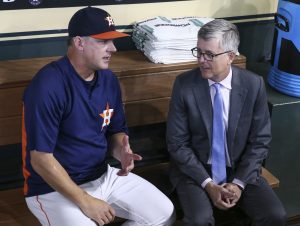
The resulting league investigation unfolded even as public evidence emerged to fully confirm the claims. It became undeniably clear that the Astros had acted in a manner that fell well outside the traditional sign-stealing culture of the game and clearly broke the rules. Commissioner Rob Manfred had made clear previously that he’d come down hard on any teams that misused technology.
While a big punishment had been anticipated, this nevertheless rates as a momentous decision for the organization as well as for the game generally. The fallout will be immense and can’t be fully known at the moment.
From the Astros’ perspective, the firing unquestionably taints the team’s successes in recent years — even if Crane declined to acknowledge that fact in his press conference. And it raises huge questions about the future. It takes out the club’s baseball architect in Luhnow, even as his top understudies have already departed the organization. (Brandon Taubman was fired. Previously, David Stearns and Mike Elias left for GM jobs elsewhere.) There had already been some degree of uncertainty regarding the team’s precise direction this offseason and beyond. Now, the club’s top leaders are gone and more could still follow. Crane said he was still assessing the culpability of other personnel and deciding how to fill the void for the departing leaders. He’ll personally oversee baseball ops for the time being. Whether there’ll be an impact to the roster isn’t yet known.
Across the league, there’ll surely be a strong desire to avoid a similar fate. Available information and scrutiny — both publicly and within the game — are obviously reaching new heights. Manfred’s statement made clear that, despite the lack of a smoking gun linking Luhnow to the cheating effort, he and Hinch were being punished for overseeing a baseball operations department and uniformed staff that pursued it. As Crane told reporters today, it was obvious that both men were aware of and did not intervene to stop the sign-stealing. The onus will now be on other top organizational leaders to halt any untoward behavior, at risk of severe consequences.
Beyond that, any changes to the course of the Houston organization will obviously impact the broader player market and their competitors in the American League West. The organization’s philosophical approach and its near-term decisionmaking could well undergo change.
Baseball has long grappled with the cutthroat approach to roster building that Luhnow brought to the Astros. As an analytically focused executive who launched a full-blown tear-down/rebuild, that was somewhat inevitable. But the organization went to extremes to build what has been characterized as “an unprecedented player-development machine” — albeit one that also created “human costs.” The win-at-all-costs vibes left many feeling uneasy well before news emerged of actual rules violations.
Luhnow insists that he did not direct any cheating and wasn’t even aware it was occurring, as Jared Diamond of the Wall Street Journal reports (Twitter link). But the league investigation did find that Luhnow failed to take adequate action to ensure compliance with league rules — and that he had at least some amount of knowledge regarding the sign-stealing operation. Despite disavowing any intent to break the rules, Luhnow did state that he accepts responsibility for what went on during his stewardship of the organization’s baseball operations.
Luhnow’s baseball operations department carried an image akin to the unfeeling Soviet boxing-industrial complex portrayed in the Rocky series. But Hinch was no Ivan Drago. He and some of the team’s biggest stars put a much more personable face on the organization. He was by all appearances not only a high-quality skipper and tactician, but also a genuinely thoughtful and caring figure.
But that reputation, even if largely accurate, did not absolve Hinch of responsibility. Manfred’s report on the investigation’s findings makes clear that the manager knew what was going on. He’s said to have had some misgivings about the actions but obviously failed to act firmly to halt the operation, either by issuing clear orders to those theoretically under his command or by raising the matter to higher authorities. Hinch acknowledged as much in his own statement on the matter (via Chandler Rome of the Houston Chronicle, on Twitter). Though he says he did not “endorse or participate in the sign stealing practices,” he acknowledges that he “failed to stop them.”
It’s a major shift for a Houston organization that had seemingly arrived at a winning formula. With Luhnow masterminding the talent flow and Hinch maximizing the pieces made available to him, the organization built a powerhouse that won the 2017 World Series, came up just shy in another, and reeled off three-straight 100-win regular seasons. Much was achieved and it seemed likely there was more success yet to come. Quite a lot of creative thinking and hard work went into the undertaking. But the wins will be remembered with an asterisk — in collective memory, if not in the actual record books — and the Astros will now embark upon a new era under new leadership.
Photo courtesy of USA Today Sports Images.
MLB To Suspend Jeff Luhnow, A.J. Hinch For One Year; Astros Stripped Of Draft Picks
Major League Baseball commissioner Rob Manfred announced an unprecedented level of discipline against the Astros organization Monday in the wake of the sign-stealing scandal that many feel has called into question the legitimacy of their 2017 World Series victory. President of baseball operations/general manager Jeff Luhnow and manager A.J. Hinch will both be suspended, without pay, for one year — beginning today and running through Jan. 13, 2021.
[RELATED: Astros Fire Jeff Luhnow, A.J. Hinch]
The Astros will also lose their first- and second-round picks in each of the next two seasons and be fined the maximum $5MM that is allowable under the league’s constitution. If the team does not have a first- or second-round selection in either draft — due to draft forfeitures for signing a free agent, for instance — they’ll lose that pick in the subsequent year’s draft. Per Manfred’s report on the investigation, the Astros “will forfeit two regular first round selections and two regular second round selections in total,” whether they come in 2020-21 or in later seasons.
Punishment stemming from the 2017 sign-stealing scandal won’t stop with the Astros organization, either. ESPN’s Jeff Passan reports that “harsh” punishment will be levied against Red Sox manager Alex Cora as well for the role he played in the now-infamous “trash can” setup. Cora was the Astros’ bench coach at the time but was hired by the Red Sox in the 2017-18 offseason, and Manfred’s report leaves little doubt that he’ll be sanctioned heavily.
Manfred’s report outlines the role that Luhnow, Hinch, Cora and the Astros’ players had not only in the trash-can scheme but also in improperly utilizing the reply review room to decode opponents’ signs. Manfred’s report also explains the rationale for the punishment (or, in Cora’s case, the surely forthcoming punishment).
Beginning with Luhnow, Manfred details that the president/GM was “adamant” in denying knowledge of the ongoing sign-stealing scheme. However, the report cites “both documentary and testimonial evidence” which indicates that Luhnow had “some” knowledge of the operation but “did not give it much attention.” Manfred makes clear that he holds Luhnow accountable for the action of all employees, both in the front office and in the dugout, and he goes out of his way to explain that Luhnow largely neglected the memo sent out by the Commissioner’s Office regarding further disciplinary measures for improper use of technology:
Luhnow did not forward the memoranda and did not confirm that the players and field staff were in compliance with MLB rules and the memoranda. Had Luhnow taken those steps in September 2017, it is clear to me that the Astros would have ceased both sign-stealing schemes at that time.
Manfred’s report goes on to suggest that under Luhnow, the Astros’ baseball operations department has developed a “problematic” and “insular” culture that has lacked “sufficient oversight” — all of which is reflected in Luhnow’s punishment:
[W]hile no one can dispute that Luhnow’s baseball operations department is an industry leader in its analytics, it is very clear to me that the culture of the baseball operations department, manifesting itself in the way its employees are treated, its relations with other Clubs, and its relations with the media and external stakeholders, has been very problematic. At least in my view, the baseball operations department’s insular culture – one that valued and rewarded results over other considerations, combined with a staff of individuals who often lacked direction or sufficient oversight, led, at least in part,to the Brandon Taubman incident, the Club’s admittedly inappropriate and inaccurate response to that incident, and finally, to an environment that allowed the conduct described in this report to have occurred.
As far as Hinch is concerned, Manfred indicates in his report that the manager was aware but not supportive of the trash-can system. That system, it seems, was largely put into place by Cora and newly hired Mets skipper Carlos Beltran. Hinch, according to the league’s investigation, actually expressed frustration with the operation and damaged the hallway monitor to the point of needing replacement on two occasions, but he also never brought the issue to the attention of Luhnow or anyone in the Commissioner’s Office. “As the person with responsibility for managing his players and coaches, there simply is no justification for Hinch’s failure to act,” the report reads.
Furthermore, the report leaves little doubt that harsh punishment indeed is nigh for Cora. Manfred indicates that it was Cora who “arranged for a video room technician to install a monitor displaying the center field camera feed immediately outside of the Astros’ dugout.” Says Manfred of the impending discipline for Cora:
Cora was involved in developing both the banging scheme and utilizing the replay review room to decode and transmit signs. Cora participated in both schemes, and through his active participation, implicitly condoned the players’conduct. I will withhold determining the appropriate level of discipline for Cora until after the DOI completes its investigation of the allegations that the Red Sox engaged in impermissible electronic sign stealing in 2018 while Cora was the manager.
As for the players themselves, the Commissioner’s Office will not be seeking out punishment against them. That seemingly includes Beltran, who is being treated as a player (as he was in ’17) rather than his newfound role as a Major League manager. Manfred explains that in 2017, he made the decision that he “would hold a Club’s General Manager and Field Manager accountable for misconduct of this kind” and has no plans to deviate from that line of thinking. He’s also clear to note that multiple players acknowledged they were keenly aware that they were crossing a line and would have stopped had Hinch or another authority figure cracked down on the behavior — a reality that surely factored into the decision to suspend Hinch.
As for owner Jim Crane, the report indicates that he was “unaware” of any wrongdoing and will not face punishment outside of the reported $5MM fine and loss of two years’ worth of first- and second-round draft selections.
Ken Rosenthal and Evan Drellich of The Athletic first reported the news.
Dodgers Sign Alex Wood
The Dodgers have agreed to a deal with free agent left-hander Alex Wood, reports Ken Rosenthal of the Athletic (via Twitter). The deal will guarantee the ACES client $4MM on a one-year term, with incentives that can push the total to $10MM, Rosenthal adds (via Twitter). Wood has already passed his physical, Rosenthal further reports. Wood himself has confirmed the agreement on Twitter.
The reunion marks a nice birthday present for Wood, who turned 29 today. The lefty has done his best work in Dodger Blue, combining for a 3.46 ERA and 3.50 FIP over 434.2 innings in three-plus seasons in Los Angeles. Over that time, Wood only managed an average strikeout rate (22.3%), but he proved stingy with walks (6.7%) and induced ground balls on over half the balls in play against him. That mid-rotation output prompted the Reds to acquire him (alongisde Yasiel Puig and Kyle Farmer) last offseason for a pair of well-regarded prospects.
Unfortunately, a back injury limited Wood to seven ineffective starts in Cincinnati. He didn’t make his season debut until July 28, and only once did he exceed six innings in a start. Never an extremely hard thrower, Wood’s 89.98 MPH average sinker velocity last season, per Brooks Baseball, was down over two MPH from his career-best 2017 effort.
2019 struggles notwithstanding, it’s not hard to see the upside for both parties. Wood was an above-average starter as recently as 2018. He has four career seasons in which he was worth at least two wins above replacement, per Fangraphs, and as noted, he remains quite young for a free agent. Injuries have hampered Wood in recent seasons, to be sure, as he’s been on the injured list each of the past four years. There’s little long-term risk here for the team, though, and their $4MM investment is minuscule for a franchise which ended the 2019 season with an estimated $210MM payroll, per Roster Resource.
Wood, meanwhile, gets an opportunity to reestablish his health. Should he reclaim his prior form, he’d likely earn some or all of the available incentives. More importantly, he can reenter the open market at a still-young 30 next offseason in search of the multiyear deal for which he seemed ticketed before his 2019 tribulations.
Wood joins a crowded Dodgers’ rotation mix behind Clayton Kershaw and Walker Buehler. LA hasn’t been shy about moving pitchers in and out of the rotation under manager Dave Roberts. Wood figures to compete with Kenta Maeda, Julio Urías, Tony Gonsolin, Dustin May, and the newly-signed Jimmy Nelson for rotation innings. Surely, some or all of those pitchers will log some time out of the Dodgers’ oft-maligned bullpen as well.
So continues an offseason trend for the NL West favorites. Nelson, Wood, and reliever Blake Treinen have all been brought in on one-year deals this offseason. All three have shown high ceilings in the past, but struggled through injuries or ineffectiveness (or both) in 2019. They may not be the stars Dodger fans have been coveting, although each brings quite a bit of upside. None, it should be noted, would preclude the Andrew Friedman-led front office from striking on a bigger name if the opportunity were to present itself.
Rangers To Sign Todd Frazier
The Rangers have reached an agreement with free-agent third baseman Todd Frazier, according to Evan Grant of the Dallas Morning News. The Athletic’s Ken Rosenthal reports that it’s a one-year, $5MM guarantee that includes a club option for a second year. Frazier will collect a $3.5MM salary in 2020 with a $5.75MM option for 2021 that comes with a $1.5MM buyout, per Mark Feinsand of MLB.com. The deal is pending a physical.
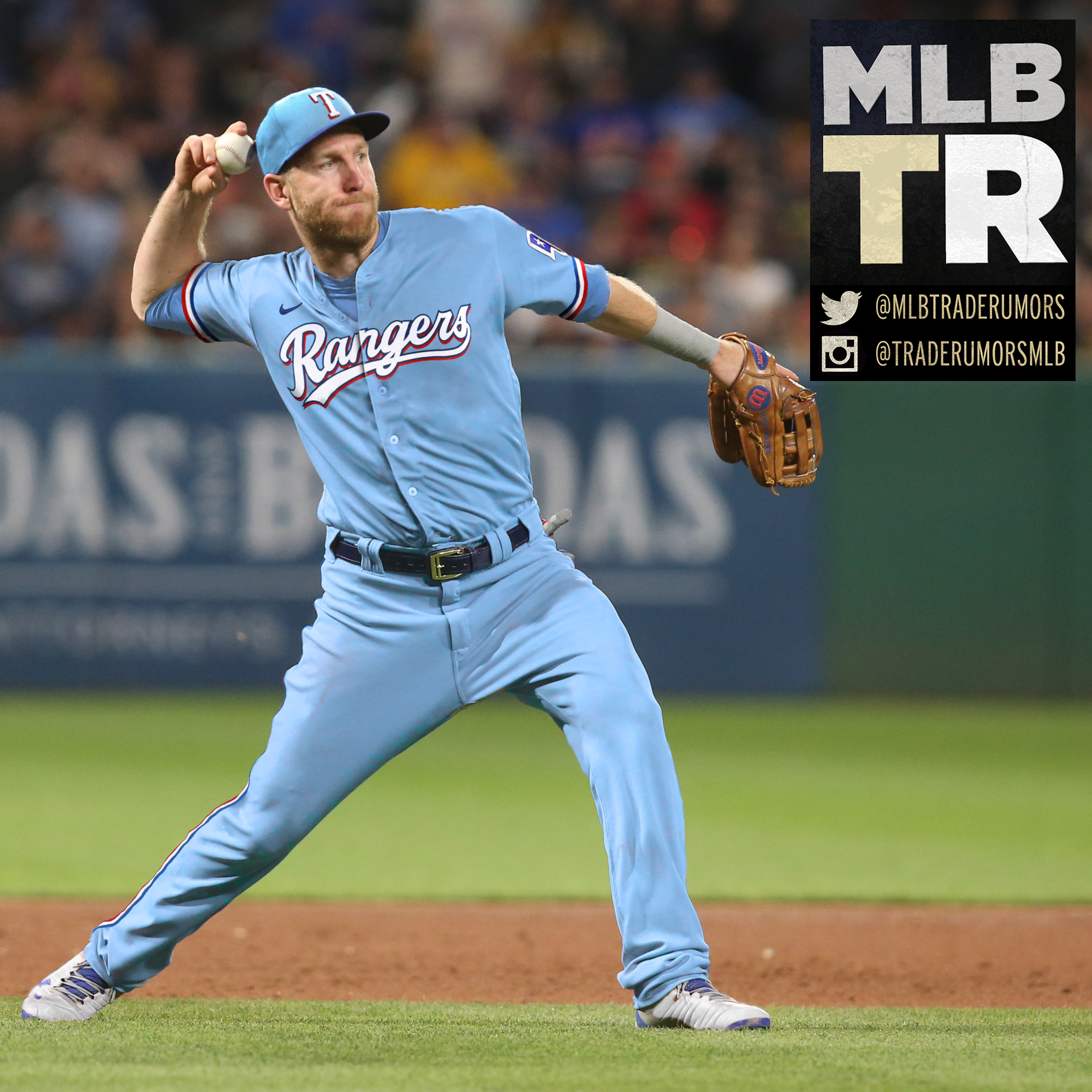
Frazier, who will turn 34 in February, just wrapped up his second season with the Mets, authoring a nice bounce-back after a rough 2018. He posted a .251/.329/.443 slash line with 21 homers in 499 plate appearances. He’s been sapped of some of the power that made him a fan favorite in Cincinnati, but he has remained a roughly league-average hitter that also provides passable defense at third base. That’s enough to make him attractive to a Texas team that didn’t get great production from the position last year.
The numbers Frazier posted last year were in line with his career marks, making his dismal 2018 season look more like an outlier. If that’s true, and the Rangers get a version of Frazier that performs closer to his 2019 levels, it will be hard for Texas to be upset with such a low-cost signing that fills a clear need. Nick Solak looked to be the best in-house candidate to claim the position, though the Rangers may prefer to deploy him in a utility infield role.
Texas has been variously connected to all of the offseason’s big names at third base, including top free agents Anthony Rendon, now with the division rival Angels, and Josh Donaldson. The latter has yet to sign, but the Rangers are said to have backed off in their pursuit as he eyes a four-year deal. Most recently, they’ve been connected to Rockies star Nolan Arenado, though there’s skepticism that a deal will get completed. To be sure, Frazier doesn’t offer the same star power as the aforementioned trio, but he represents an adequate stopgap and insurance should they go 0-for-3 in their pursuit of the big fish.
Moreover, the addition of Frazier, who can also play first base, presumably doesn’t necessarily preclude the Rangers from continuing their pursuit of a top-flight option at the hot corner. Indeed, MLB Network’s Jon Morosi reports that Texas will not cease in attempting to acquire Arenado even after signing Frazier. Should their play for Arenado come to fruition, Frazier would likely slide into a timeshare with Ronald Guzman at first base. And should the Rangers miss out on Arenado and Donaldson, then Frazier is penciled in as a short-term solution, with top prospect Josh Jung waiting on the horizon.
To this point, the Rangers have allocated most of their offseason resources to upgrades on the pitching side, adding Corey Kluber, Kyle Gibson, and Jordan Lyles to the projected starting rotation. That has left some work to be done on the position player side of things, with third base getting the most buzz. But the Rangers have some interest in free-agent slugger Nicholas Castellanos, though interestingly they like Castellanos only as a potential first base upgrade—not as an outfielder. On the other hand, Marcell Ozuna might still be in play for the outfield, which currently features Joey Gallo, Danny Santana, and Willie Calhoun.
Dodgers Avoid Arbitration With Cody Bellinger, Corey Seager, Enrique Hernandez
The Dodgers have struck a record-breaking arbitration deal with outfielder/first baseman Cody Bellinger, per Mike DiGiovanna of the Los Angeles Times (via Twitter). Bellinger is said to have a $11.5MM pact, topping the prior record (Kris Bryant, $10.85MM) for a first-time arb-eligible player.
Other top performers have also reached deals. Corey Seager will play at a $7.6MM salary. And utilityman Enrique Hernandez will earn $5.9MM, per Bill Plunkett of the Orange County Register (Twitter link).
Bellinger lands right at the projection of MLBTR contributor Matt Swartz. As Matt explained in a closer look, though, there was an argument for the reigning NL MVP to earn even more. He’ll still end up setting a new high-water mark for arbitration rookies by a fairly healthy margin.
Entering 2019, Bellinger had already established himself as a high-quality hitter and versatile defender. But he took things to a whole new level in his age-23 season, slashing a hefty .305/.406/.629 and launching 47 home runs while delivering big value on the bases and with the glove.
The projections were also close for Seager ($7.1MM) and Hernandez ($5.5MM). Both players were at less than top form in 2019 but remain key contributors — at least, unless they end up being shuffled out of the deck with a spring trade.
Indians Avoid Arbitration With Francisco Lindor, Mike Clevinger
4:23pm: Mike Clevinger also has a deal with the Cleveland org, per Zack Meisel of The Athletic (via Twitter). It’s a $4.1MM deal, per Ryan Lewis of the Akron Beacon Journal (Twitter link).
Clevinger had projected for $400K more than the settlement point. As MLBTR’s Matt Swartz explained, there was a good argument for him to reach his $4.5MM projection. But the Indians were able to hold Clevinger to just under the amount secured by Kyle Hendricks in 2018.
1:48pm: The Indians have avoided arbitration with shortstop Francisco Lindor, per Jon Heyman of MLB Network (via Twitter). He’ll reportedly earn $17.5MM in a deal that also includes some award incentives.
The arbitration model of MLBTR and Matt Swartz projected a $16.7MM salary for the still-youthful star. But it was an especially difficult number to gauge, as Matt explained in his recent look at Lindor’s arb case.
Interestingly, Matt had anticipated that his projection was a bit high. It turned out to be low. As he noted in that post, the difficulty was in sorting out how to handle the positional adjustment for Lindor. While recent raises for lumbering sluggers might have operated as caps for Lindor’s earnings, he obviously could and would have argued that his defensive proficiency should be weighed on the scale. The team obviously agreed — or, at least, felt there was a legitimate chance that an arbitrator would be swayed by such evidence.
This now makes for an important market marker to bear in mind in the future. Of course, it’s likelier to act as a ceiling unless a truly exceptional player comes along. Lindor, who just turned 26, swatted 32 home runs and slashed .284/.335/.518 in 654 plate appearances in 2019.
Red Sox Avoid Arbitration With Mookie Betts, Jackie Bradley Jr.
The Red Sox have avoided arbitration with outfielders Mookie Betts and Jackie Bradley Jr. Betts, according to ESPN’s Jeff Passan, will receive a record-setting $27MM for his final season of club control. Julian McWilliams of the Boston Globe, meanwhile, tweets that Bradley will earn $11MM. Betts’ record payout comes in $700K shy of his $27.7MM projection from MLBTR contributor Matt Swartz, while Bradley’s $11MM salary is an exact match with his projection. The Boston organization also locked up righty Brandon Workman to a $3.5MM deal, per MLB.com’s Mark Feinsand (via Twitter).
Betts’ contract sets a record for an arbitration salary, topping previous record holder Nolan Arenado’s old mark by a full million dollars. He’ll head into his final season of club control as one of the more fascinating storylines in baseball; Red Sox ownership reportedly is intent on dipping south of the luxury tax, and while there’s been no indication that the team is definitively planning to move Betts this winter — much the opposite, as of late, in fact — they could find themselves in a trickier situation as the trade deadline approaches.
Boston could yet take another run at extending Betts, but the former AL MVP has been vocal and candid about his desire to test the open market once he accrues six years of Major League service. As such, the team’s previous efforts to hammer out a long-term deal have fallen flat.
It’s another case altogether with Bradley, who is also entering his final year of club control but is a much more plausible trade candidate. Moving him wouldn’t dip the Red Sox below the luxury line in one fell swoop, as moving Betts effectively would, but as the season draws nearer it’d be a surprise if Bradley’s name weren’t bandied about the rumor circuit to an extent. While his overall season numbers in 2019 weren’t particularly eye-catching, Bradley hit .252/.342/.504 over his final 422 plate appearances and has long been considered a standout defender. Given the lack of center field options available in free agency, he could yet hold appeal to a club looking for a short-term boost in center.
Diamondbacks To Extend David Peralta
The Diamondbacks and outfielder David Peralta are in agreement on a three-year extension that’ll guarantee the ACES client a total of $22MM, reports USA Today’s Bob Nightengale (Twitter links). He can earn another $1.25MM annually via incentives. The contract will pay Peralta $7MM in 2020 and $7.5MM in each of the two subsequent seasons, tweets Nick Piecoro of the Arizona Republic.
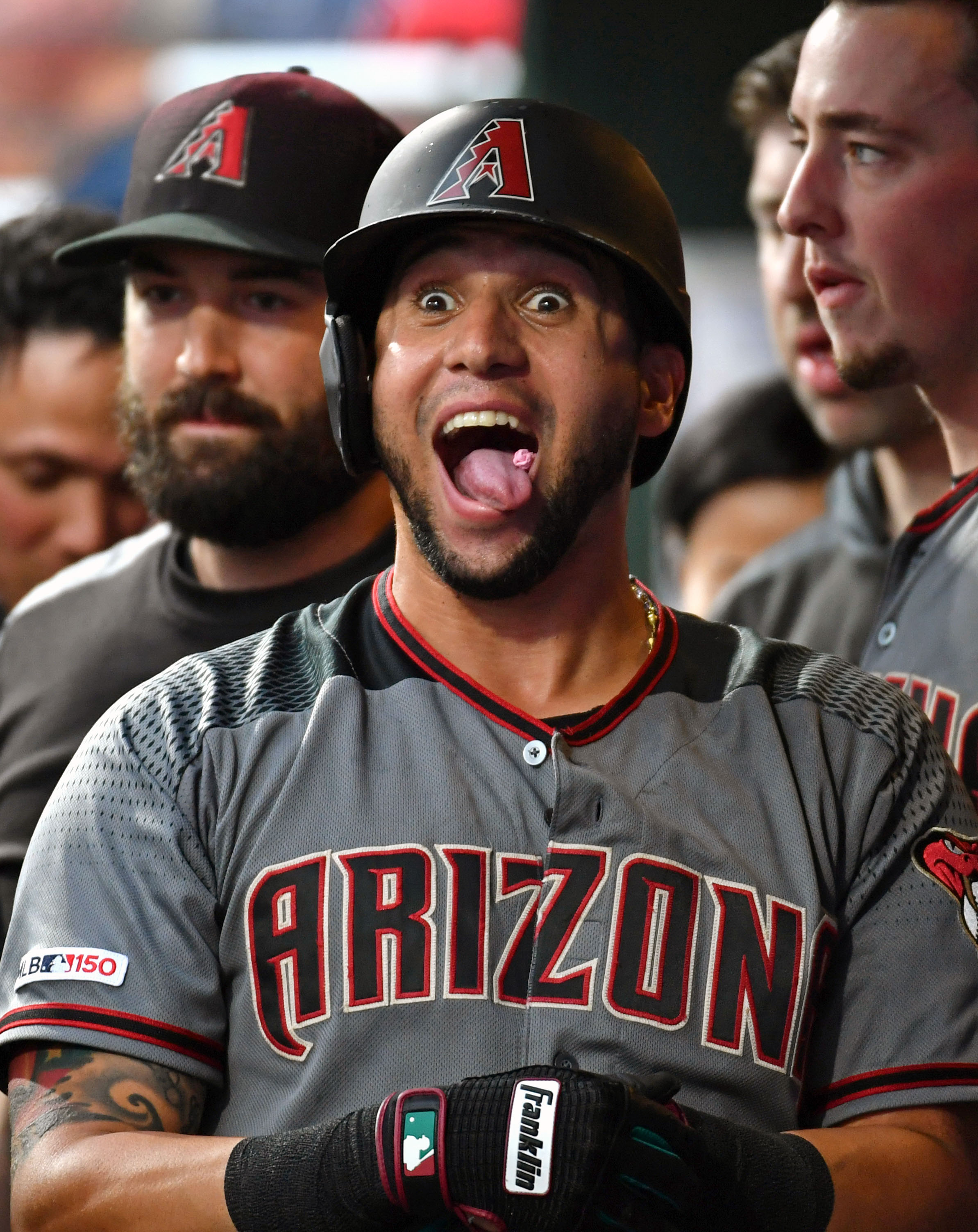
Peralta was arbitration-eligible for the final time and was projected by MLBTR contributor Matt Swartz to earn $8.8MM. Instead, he’ll sign away a pair of free-agent years on a contract that spans his age-32 through age-34 seasons.
The deal looks to be a sound one for the D-backs, who owed Peralta a raise on last season’s $7MM salary. While the exact number he’d have secured can’t be known, even if he’d fallen shy of his $8.8MM projection, it still looks as though Peralta is signing away two free-agent years at a total of no more than $14MM. That falls a bit shy of what Corey Dickerson just received from the Marlins ($17.5MM), though it’s worth noting that Peralta is a bit older. All the same, Arizona looks to have carved out a nice value with the move.
Peralta, 32, hit .275/.343/.461 (107 wRC+) with a dozen homers, 29 doubles and three triples in 99 games/423 plate appearances with the Snakes in 2019. He endured three separate stints on the injured list due to an issue with the AC joint in his right shoulder, which limited his time on the field and likely helped to sap his production. A year prior, in 2018, Peralta put together then finest season of his career when he slashed .293/.352/.516 with 30 long balls.
Both Baseball-Reference (8.4) and FanGraphs (7.7) agree that Peralta has been worth in the vicinity of eight wins above replacement over the past three years. He’s consistently been an above-average bat and at least an average defender in the outfield corners, and his 2019 season rated particularly well according to most defensive metrics, as he took home a Gold Glove Award. While there’s always some risk of decline as he enters his mid-30s — particularly coming off a shoulder issue — it’s easy to see why the Diamondbacks preferred to keep him in the fold beyond his preexisting level of club control.
From a payroll standpoint, the deal actually helps to lower Arizona’s bottom line in 2020. Peralta’s salary for the coming season is the same as his 2019 salary and $1.8MM shy of where he’d been projected in arbitration, leaving the club with a roughly $114MM payroll (per Roster Resource’s Jason Martinez). The D-backs had less than $60MM on the books in 2021 and less than $40MM in 2022 prior to brokering this multi-year arrangement, so fitting him onto the ledger for an additional two seasons was rather easy.
Seeking MLB Arbitration Expert For Paid Project
As you may know, MLBTR has been publishing salary projections for arbitration eligible players for nine years, using an algorithm developed and maintained by economist Matt Swartz.
The traditional method of projecting the proper salary for arbitration eligible players does not involve an algorithm, instead focusing on comparable players. As we’re always seeking to improve our own knowledge and projections, I hope to be trained on this traditional method. I’m seeking a person with relevant experience at the MLB Labor Relations Department, MLB Players Association, teams, agencies, or third party consulting firms who is willing to teach me traditional arbitration projecting as a paid project. We would collect the statistics needed and work through relevant examples. Please note that I am not interested in learning how to argue cases at hearings, but rather in projecting the correct salary or salary range for any individual player. If you’re interested in this paid project, please contact me at mlbarbitration@gmail.com and outline your relevant experience.
Rays Acquire Jose Martinez, Randy Arozarena From Cardinals
The Rays have acquired first baseman/outfielder Jose Martinez, outfielder Randy Arozarena, and the Cardinals’ Competitive Balance Round A draft pick in exchange for left-handed pitching prospect Matthew Liberatore, the Rays’ pick in Competitive Balance Round B, and a catching prospect from the lower levels of the minors, ESPN.com’s Jeff Passan reports (Twitter link). Edgardo Rodriguez is the catcher going to the Cardinals, The Athletic’s Ken Rosenthal tweets. Passan reported earlier today that Liberatore was headed to St. Louis, with Rosenthal adding that the trade involved six assets and at least two draft picks.
Tampa Bay was known to be looking outfield depth beyond its starting trio of Austin Meadows, Kevin Kiermaier, and Hunter Renfroe, especially after the club non-tendered Guillermo Heredia, its primary fourth outfielder from 2019. Heredia’s role will be filled by Arozarena, who also brings added potential and some strong hitting numbers in his native Cuba, in the minor leagues, and even in his brief 23-plate appearance cameo with the Cardinals last season.
An international signing in the summer of 2016, Arozarena has a .292/.377/.477 slash line and 38 homers over 1302 minor league PA. MLB Pipeline ranked him as the tenth-best prospect in the St. Louis farm system, with a scouting report that expressed some concerns about Arozarena’s aggressiveness at the plate and on the bases, as well as his ability at “making swift adjustments at the plate.” Nonetheless, Arozarena’s hitting approach has only delivered good results thus far, and his speed makes him a solid center field option at least in the near future, if he might be better suited for the corners down the road.
 Martinez is also technically a depth option for the Rays in the corner outfield, but given Martinez’s longstanding defensive issues, he has long been tabbed as an ideal candidate to play for an American League team with DH at-bats on offer. The right-handed hitting Martinez will now join three left-handed hitters (Nate Lowe, Ji-Man Choi, and the newly-signed Yoshitomo Tsutsugo) in the first base/DH mix, though Tampa expects Tsutsugo to see some action at third base.
While it remains to be seen how the Rays will fully shuffle and adjust their lineups, Martinez’s primary role seems pretty simple — he’ll be called upon to mash southpaws. The 31-year-old late bloomer has hit .331/.405/.570 with 15 homers over 298 career PA against left-handed pitching, and also solid career numbers against righties, though Martinez’s same-sided productivity declined last season. With fielding no longer a concern, however, the Rays (who have been linked to Martinez on the rumor mill for well over a year) are hoping that Martinez can concentrate fully on being a force at the plate.
The Cardinals entered the offseason with a clear goal of reducing their surplus in the outfield, and between today’s trade and dealing Adolis Garcia to the Rangers last month, St. Louis has achieved that goal without making any significant impact on its 2020 roster. Perhaps most importantly, the Cards were able to move their excess parts while picking up one of baseball’s more promising pitching prospects in Liberatore, whose credentials we detailed earlier today.
Dexter Fowler, Harrison Bader, Lane Thomas, Tyler O’Neill, and utilityman Tommy Edman all figure to play notable roles in the Cardinals’ outfield next season, with top prospect Dylan Carlson on the cusp of his MLB debut and utilitymen Rangel Ravelo and Yairo Munoz also capable of playing on the grass in a pinch. It’s still possible St. Louis could further trade from this collection….or, perhaps, add to it. The Cards have been linked to free agent outfielder Marcell Ozuna all winter long, and re-signing Ozuna would allow the club to put a proven everyday performer in the midst of an outfield group that, besides Fowler, is young and pretty inexperienced at the big league level.
The draft pick swap is also a major component of this deal, as Tampa Bay will now have the 38th overall selection in the 2020 draft and St. Louis moves to 66th overall. (Here is the current draft order, as well as the outline of the Competitive Balance Round selection process.) The Competitive Balance Round picks are the only types of draft selections that can be traded, and the Rays have now boosted their standing next June by almost a full round’s worth of picks. The Cards may see their 28-slot drop as the cost of acquiring a major prospect like Liberatore, who likely wasn’t available for only Martinez and Arozarena.
The 19-year-old Rodriguez has hit .338/.389/.495 with six home runs over his first 244 PA as a professional, two seasons with the Rays’ teams in the Dominican Summer League and rookie-ball Gulf Coast League (though he missed over six weeks this season due to injury). Signed out of Venezuela during the 2017-18 international signing period, Rodriguez was ranked prior to the 2019 season as the 53rd-best prospect in Tampa Bay’s system, as per Fangraphs’ Kiley McDaniel and Eric Longenhagen. It remains to be seen if Rodriguez can remain as a catcher, though Longenhagen/McDaniels were impressed by his hitting ability.
Photo courtesy of USA Today Sports Images