
Brewers Acquire Alex Claudio
The Brewers have officially struck a deal with the Rangers to acquire lefty Alex Claudio, according to Ken Rosenthal of The Athletic (Twitter links). Texas will receive Milwaukee’s competitive balance pick in the deal, which will deliver the club a draft choice in the range of the 40th overall selection (with the final order yet to be fixed).

Claudio, 26, has made the most of his arsenal with impeccable command and an uncanny ability to generate groundballs and limit dingers. Over his five seasons of MLB action, the southpaw has averaged 6.2 K/9 against just 1.9 BB/9 with a hefty 62.5% groundball rate.
While he never seemed likely to hang onto the closer’s role he briefly occupied in 2017, Claudio has mostly been an effective relief arm. His lifetime 3.20 ERA, though, reflects a string of productive seasons that was followed by a 4.48 mark in 2018.
The Brewers will hope that most recent set of results was unduly influenced by a .366 batting average on balls in play. Claudio did allow more hard contact than usual (36.0%), but Statcast also felt he was unfortunate to carry a .352 wOBA, with the system crediting him with a .315 xwOBA. Though he doesn’t get many strikeouts, Claudio managed an 11.4% swinging-strike rate in 2018.
Though the Milwaukee relief corps already features one of the game’s most exciting lefties in Josh Hader, he’s utilized as a high-leverage asset. Claudio will presumably serve in more of a specialist role. He has held opposing lefties to a .191/.220/.278 slash over his career.
The Brewers will take over Claudio’s anticipated arbitration salary, which MLBTR and contributor Matt Swartz project at an affordable $1.3MM. He’ll remain controllable for two more campaigns in the future as well.
Photo courtesy of USA Today Sports Images.
Phillies Sign Andrew McCutchen
THURSDAY: McCutchen will earn $10MM in 2019, $17MM in 2020, and $20MM in 2021, per Ken Rosenthal of The Athletic (via Twitter). The Phillies, then, were obviously willing to tie up more of their future payroll space on this signing, though it’s hard to gauge just what that portends for the remainder of their offseason.
WEDNESDAY: The Phillies have announced the agreement.
TUESDAY, 6:20pm: McCutchen’s option for 2022 is worth $15MM and comes with a $3MM buyout, Heyman tweets.
1:46pm: The Phillies have a deal in place with free agent outfielder Andrew McCutchen, according to Matt Gelb of The Athletic (Twitter link). The agreement is still pending a physical.
McCutchen will reportedly receive a three-year, $50MM contract that includes an option for a fourth season. Jim Salisbury of NBC Sports Philly (via Twitter), who first broke the news that the sides were in serious talks, reported the years, with Jon Heyman of Fancred reporting the guarantee and option year (Twitter links).
This contract lands above MLBTR’s predicted value for McCutchen, but falls right in line with our expectations of a three-year, $45MM pact. We had ranked Cutch just behind fellow open-market vets A.J. Pollock and Michael Brantley, each of whom remains unsigned at this stage.
For the Phillies, this is a stage-setting move that fills one need and creates quite a few new opportunities. The organization previously dealt for Jean Segura, meaning GM Matt Klentak has now slotted in new corner outfield and shortstop pieces — without moving on top free agents Bryce Harper and Manny Machado. That’s not to say that pursuit of one of those players is out of the question at this point, but the Phils are certainly also now positioned to look elsewhere if they so desire. Certainly, there’s also an argument to be made that these splashes only make it more reasonable for the club to go big on another free agent.
There are innumerable possibilities, still, for the Phils. The team could conceivably deal just about any of its preexisting outfielders. Odubel Herrera, Nick Williams, Aaron Altherr, Dylan Cozens, and Roman Quinn would all hold some degree of appeal elsewhere. Surely some of those players will remain, but the Philadelphia organization will likely seek to rearrange some other pieces to make further moves possible. In addition to several still-youthful position players, top pitching prospect Sixto Sanchez has evidently been talked about in trade chatter, per Ken Rosenthal of The Athletic (Twitter link).
What’s clear, though, is that McCutchen will step into the Philadelphia lineup on most days in 2019. He certainly represents a quality addition, even if he’s no longer the superstar that he was when he was playing with the cross-state Pirates.
Since wrapping up a forgettable 2016 campaign, McCutchen has turned in consecutive solid seasons with the bat. In 1,332 plate appearances over the past two season, he’s slashing a combined .267/.366/.455 with 48 long balls. McCutchen did lag in the power department in 2018, with a year-over-year isolated slugging drop from .207 to .169, but made up for it with a 13.9% walk rate that’s just shy of his career peak.
McCutchen won’t be an option in center for the Phils, though his long experience there could come in handy at times. After a solid debut season in right field last year, he’ll be an upgrade defensively for a club that received atrocious glovework in the outfield last year from Rhys Hoskins, who is moving back to first base. If there’s one area that McCutchen slid most notably, though, it was in the baserunning department. Once a standout, he graded at a putrid -5.0 BsR in 2018. Of course, he also still swiped 14 bags, so perhaps that broader performance is more a blip than an indicator of a significant loss of athleticism.
Photo courtesy of USA Today Sports Images.
Reds Acquire Tanner Roark
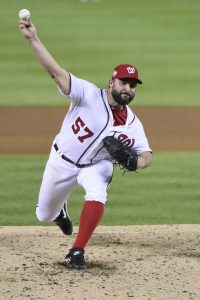
The Reds have announced the acquisition of veteran righty Tanner Roark from the Nationals. Reliever Tanner Rainey goes to Washington in the swap.
There have been indications over recent months that the Nats were inclined to move on from Roark, who projects to earn $9.8MM in his final trip through arbitration. It seems reasonable to anticipate that the D.C. organization has its eyes on another upgrade to its staff, with an obvious need for one or two additional rotation pieces.
Meanwhile, Roark will help to shore up a Cincinnati starting unit that the club has long targeted for improvement. The 32-year-old has thrown at least 180 frames in each of the past three seasons, even if the results haven’t always been there. Adding him to the staff likely won’t take the Reds out of the market for starters, though the club surely values the lack of a long-term commitment given the price for open-market pitching we’re seeing so far this winter.
Roark has, to be sure, turned in some eye-popping earned run averages over full seasons, but it’s tough to see him as much of an upside play. He has only once topped a ten percent swinging-strike rate, during his otherwise poor 2017 season, and has consistently graded out as a low-4 ERA type hurler in the eyes of ERA estimators.
That’s not to say that there isn’t value in Roark’s profile — there is. But it seems likelier that the Reds should anticipate a quality, durable rotation piece than the front-line starter Roark produced like in the 2014 and 2016 seasons, in which he spun 2.85 and 2.83 ERAs, respectively, in ~200-frame samples. The varying highs and lows over the years have seemingly correlated more with variations in opponents’ batting averages on balls in play than with significant differences in the underlying quality of Roark’s work on the mound.
If there’s an area of concern, it could be in the cozy confines of Great American Ball Park. Roark has never had particularly pressing issues with the long ball, but he has coughed up quite a few more in his lesser seasons (2015, 2017, 2018) than in his good ones. And after turning in approximately 48% groundball rates over the prior three years, Roark dropped to 40.7% in 2018 even as his flyball rate rose to 37.6% after sitting at or below 32% in that same three-year span.
As for the other Tanner R. in this swap, the 25-year-old Rainey is perhaps a more intriguing asset than his forgettable MLB debut effort would suggest. He scuffled badly in an eight-appearance showing last year, but did show a blazing fastball that touched 100 and averaged out at a healthy 98.3 mph.
Promising, Rainey also produced 52 innings of 2.60 ERA ball at the Triple-A level in 2018. Of course, that comes with a massive caveat: he also surrendered more than six free passes per nine innings, continuing his longstanding control difficulties. The Nats have taken some other notable risks on high-octane, command-challenged hurlers this winter. It seems likely that Rainey will open his time with the organization at Triple-A, unless he shows a major spark or a clear need arises during camp.
Photo courtesy of USA Today Sports Images.
Dodgers “Actively” Attempting To Trade Yasiel Puig, Matt Kemp
TODAY: Aside from Puig, the Dodgers and Reds have also discussed Alex Wood in trade talks, MLB.com’s Mark Feinsand tweets, though Feinsand’s source says “nothing serious at this point” has developed.
TUESDAY, 10:53pm: The Mets aren’t in on Puig, Andy Martino of SNY tweets.
10:27pm: The Dodgers are “actively” attempting to trade either or both of Yasiel Puig and Matt Kemp, according to Mark Feinsand of MLB.com. Los Angeles would presumably have a much easier time moving the mercurial Puig, who’s the younger, less expensive and better of the two outfielders.
The 28-year-old Puig is projected to make an affordable $11.3MM in 2019, his last season of team control, and is reportedly “open” to playing for another club after developing a distrust of Dodgers management in 2018. The right-handed Puig has fallen flat against left-handed pitchers in back-to-back years, but nevertheless, he didn’t like that the Dodgers limited his playing time versus southpaws in 2018. Despite that, Puig still turned in another quality offensive season, hitting .267/.327/.494 (123 wRC+) with 23 home runs and 15 stolen bases in 444 plate appearances. Since then, the Indians, Mets and Reds have been connected to Puig.
Kemp, 34, was similarly effective at the plate in 2018, as he bounced back from a rough 2017 in Atlanta to bat .290/.338/.481 (122 wRC+) with 21 long balls in 506 PAs. However, Kemp tailed off in the second half of the season, continued to struggle in the outfield and is due an unreasonable $21.5MM next year. The Dodgers figure to have trouble dealing Kemp, then, unless they eat a large portion of his salary or swap him for another team’s undesirable contract.
Jettisoning one or both of the Puig-Kemp duo would still leave the Dodgers with other outfield-capable players in Joc Pederson, Cody Bellinger, Chris Taylor, Enrique Hernandez, Andrew Toles and high-end prospect Alex Verdugo. Plus, given the Dodgers’ ability to spend, they may add to the group by signing Bryce Harper, the best, most expensive outfielder available in free agency. Incidentally, the Dodgers reportedly offered Puig to the Nationals for Harper at last summer’s trade deadline.
Nationals Sign Patrick Corbin
Dec. 11: Corbin’s deal includes a $2.5MM signing bonus, per Heyman, and the following yearly salaries: $12.5MM in 2019, $19MM in 2020, $24MM in 2021, $23MM in 2022, $24MM in 2023 and $35MM in 2024.
Dec. 7: The Nationals have formally announced the signing of Corbin to a six-year contract.
“As the top free agent pitcher on the market this offseason, we targeted Patrick from the onset,” said general manager Mike Rizzo in a statement within the press release. “He was one of the top pitchers in the National League in 2018 and at 29 years old, we believe the best is yet to come. We are thrilled to bring him into our organization.”
Dec. 6: Just $10MM of salary is deferred, per Jayson Stark of The Athletic (via Twitter). It’ll be due in a period from November of 2024 through January of 2026, so ultimately it’s only a small portion of the contract that won’t be kicked very far down the road.
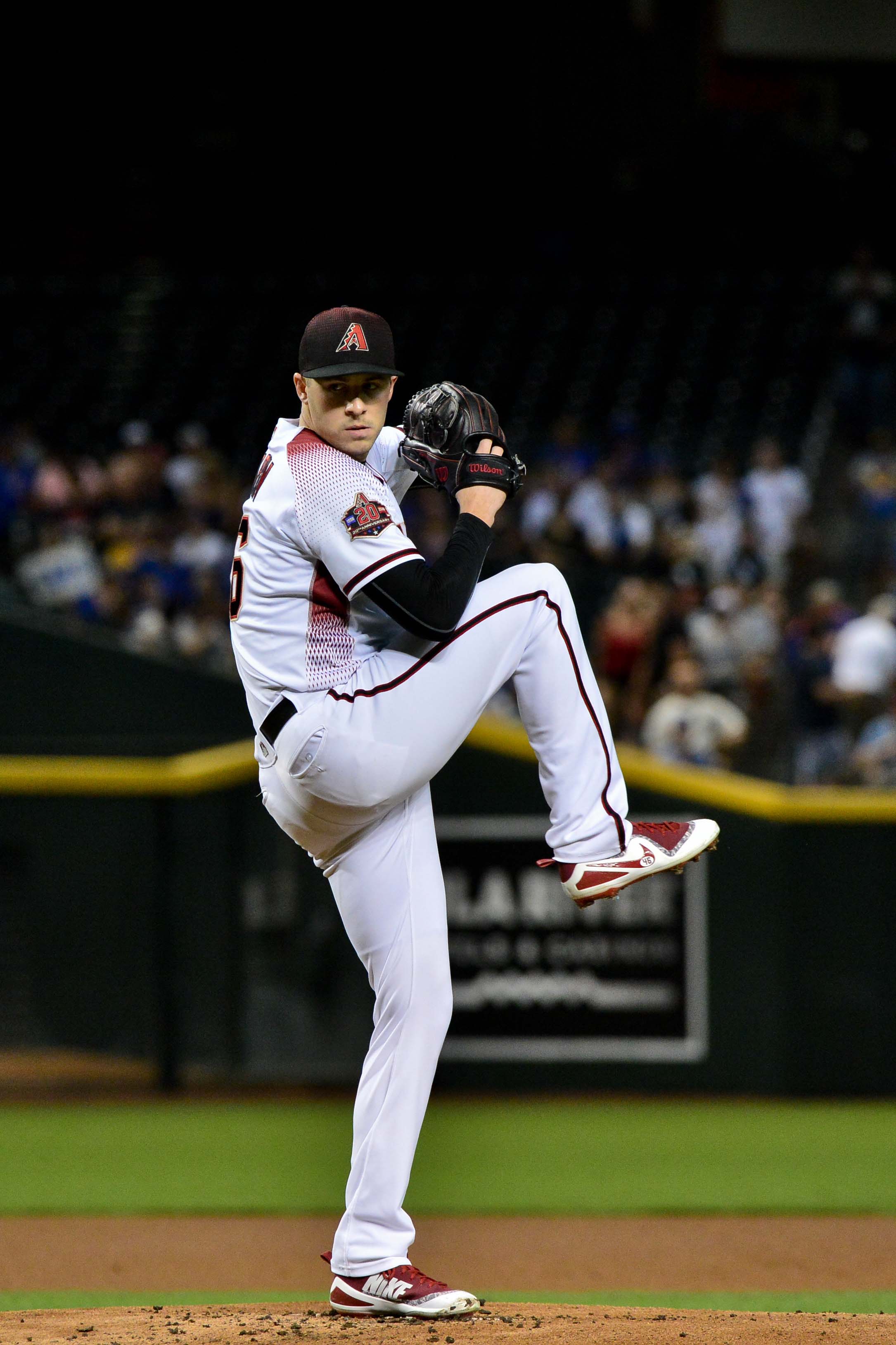
Dec. 4: The Nationals have agreed to a deal with veteran lefty Patrick Corbin, according to Chelsea Janes of the Washington Post (via Twitter). Corbin, a client of ISE Baseball, has landed a $140MM guarantee over a six-year term, Jon Heyman of Fancred tweets.
 Deferrals will reduce the true, present-day value of the deal, but it’s still a huge sum. Joel Sherman of the New York Post tweets that the deferrals will be relatively minor, though details aren’t yet known. There will not be an opt-out opportunity in the deal, Bruce Levine of 670thescore.com tweets. That’s one area in which the Nats will avoid giving further value. (As MLBTR contributor Matt Swartz has explained, those increasingly common clauses convey sometimes-significant value to players.) There’s no word yet as to whether Corbin will obtain any no-trade protection.
It turns out that Corbin will not only top the $126MM guarantee achieved last winter by Yu Darvish,but will do so handily. Entering the winter, MLBTR predicted that Corbin would beat Darvish slightly, grading him as the top arm on the market. That seemed an aggressive prediction at the time, with many other outlets suggesting Corbin would earn less, but his market took off from the outset with several large-market clubs driving the bidding.
The Nats ultimately topped the Yankees (who entered as the perceived favorite) and division-rival Phillies to get a deal done. It long seemed a match with the New York club made the most sense, due not only to need and spending power but also to Corbin’s well-known roots in New York. It turns out the Yanks were unwilling to move past a $100MM offer on a five-year term, per Billy Witz of the New York Times (via Twitter). The Phillies also were stuck on five years, per Heyman (Twitter link).
Corbin’s decision to head to D.C. represents the first major move of this winter’s free agent market. He’ll join Max Scherzer and Stephen Strasburg to make up an imposing trio atop the Nats’ rotation — a unit that still could be supplemented with another addition. All three will be playing on nine-figure deals, representing a remarkable overall commitment to maintaining a top-level pitching staff.
This is the most significant acquisition yet for the Nats, but hardly the first. Previously, the Nationals lined up a new catching duo (Yan Gomes and Kurt Suzuki) and added a pair of relievers (Trevor Rosenthal and Kyle Barraclough). Clearly, the organization is fully committed to a run at a return to glory in 2019 and beyond. The same can be said of much of the rest of the division, setting the stage for a fascinating remaining winter of dealmaking (to say nothing of the season to come).
Because he declined a qualifying offer from the Diamondbacks, Corbin’s signing will trigger some draft pick implications. The Nats will cough up a second-round pick and a fifth-rounder as well, as they were one of two teams that paid the competitive balance tax in 2018. The D-Backs will add a sandwich round pick (after the conclusion of the first round).
It’s a big price for the Nats to pay, but they obviously felt it was worth it to add a 29-year-old pitcher who took major new strides in 2018. Corbin threw exactly 200 frames for the Snakes, working to a 3.15 ERA and — more importantly — looking every bit an ace in doing so. He ended the season with 11.1 K/9, 2.2 BB/9, and a 48.5% ground-ball rate, leaving ERA estimators gawking (2.47 FIP, 2.61 xFIP, 2.91 SIERA). Notably, Corbin’s eye-popping 15.6% swinging-strike rate was orders of magnitude superior to his prior personal-best (11.0% in the season prior) and ranked as the second-highest of any qualified starting pitcher in the Majors. That occurred even as his average fastball dipped below 92 mph for the first time since he established himself as a full-time MLB starter.
Beyond questions of the sustainability of Corbin’s performance, many will wonder whether this contract brings too much health risk. The southpaw missed all of the 2014 campaign after undergoing Tommy John surgery, after all. Of course, the Nats have not shied away from TJ patients in the past, and Corbin has otherwise mostly been a rather durable hurler by today’s standards. He topped two hundred frames in 2013 and slung 189 2/3 in the 2017 campaign. Plus, the still-youthful hurler has a deeper potential advantage for longevity: he did not push his arm on the youth baseball circuit and did not even join the baseball team in high school until he was a junior.
The addition of Corbin at such a lofty rate will leave many to wonder whether the Nationals have moved on from Bryce Harper. The addition of Corbin’s $23.33MM annual salary will bring the Nationals’ luxury tax ledger to a bit more than $188MM for the 2019 season — about $17.9MM south of the luxury tax line. Obviously, adding Harper to the fold would tax the Nationals well north of the $206MM luxury line, but the Nationals demonstrated last year that they were comfortable crossing that threshold.
Beyond that, Nationals general manager Mike Rizzo has suggested that the Nats payroll could support both an extension for Anthony Rendon and a new contract for Harper. While it’s possible that the addition of Corbin could make it difficult to ultimately sign both Rendon and Harper long-term, Rizzo’s prior comments at the very least lend credence to the notion that both Corbin and Harper could coexist on an increasingly large payroll. Furthermore, as Janes tweets, the Nats’ front office knows that in order to retain Harper, ownership will need to make an “unprecedented commitment” and looks to be building up the roster while leaving a decision on Harper in the hands of the Lerner family.
Now that the dust has cleared, Corbin has ended up topping some notable recent price points. In addition to beating the Darvish deal, he’ll receive more total money than Johnny Cueto ($130MM), though that contract included an early opt-out chance, as well as Jordan Zimmermann ($110MM). The contract will still fall comfortably shy of Jon Lester‘s somewhat front-loaded, $155MM pact with the Cubs in December of 2014.
Photo courtesy of USA Today Spots Images.
Royals Sign Billy Hamilton
TODAY: The deal is official. Hamilton will receive a $4.25MM salary in 2019, with a $1MM buyout on a $7.5MM mutual option, per MLB.com’s Jeffrey Flanagan (via Twitter). Hamilton’s incentives package is based upon plate appearances, beginning with his 325th and maxing out at 550.
YESTERDAY, 7:58pm: Hamilton and the Royals have agreed to the deal, Fancred’s Jon Heyman reports (via Twitter).
11:02am: Saying that Hamilton’s defensive abilities make for a good fit at spacious Kauffman Stadium, Royals GM Dayton Moore confirmed that the club is down the line in talks with the free agent in an interview with MLB Network Radio on Sirius XM (Twitter link).
It’s a $5.25MM deal that includes up to $1MM in available incentives, per Buster Olney of ESPN.com (via Twitter).
9:57am: The Royals are “close” to striking a deal with free agent outfielder Billy Hamilton, according to Jim Bowden of The Athletic (via Twitter). Terms of the prospective agreement are not yet known.
This potential match was reported recently and seems to have continued to progress over recent days. Hamilton, 28, was recently non-tendered by the Reds. He had projected to take home a $5.9MM salary in arbitration, a price tag deemed too steep by his longtime organization.
For the Royals, Hamilton would become the second player added under similar circumstances. The organization just nabbed infielder/outfielder Chris Owings after he was cut loose by the Diamondbacks. It seems the Kansas City club is willing to place some low-priced value bets on younger players whose time ran out with other teams.
Hamilton, certainly, is an interesting asset for any organization. Though the switch-hitter has never done much with the bat, especially against left-handed pitching, he’s an elite defender and baserunner. His skillset could benefit the Royals’ uncertain pitching staff while potentially leaving the team with a marketable mid-season trade piece.
It stands to reason that adding Hamilton would push out one of the Royals’ existing left-handed-hitting outfielders. Unless there’s a taker for the remainder of Alex Gordon‘s contract, or the K.C. club does not wish to extend the audition of Brett Phillips, it could be that Brian Goodwin will ultimately be nudged out of the roster picture. The right-handed-hitting Jorge Soler is also a factor in the mix, though he could see time in the DH slot as well.
Report: Red Sox Taking Offers On Rick Porcello, Others
The defending World Series champion Red Sox are at least opening the door to some surprising sell-side moves, according to Bob Nightengale of USA Today (Twitter links). Though the club is obviously not going to divert from its attempt to repeat, it seems there’s a movement afoot to pare back some existing payroll.
The true end goal here isn’t clear. Boston already splurged to re-sign Nathan Eovaldi, giving him a four-year deal at a $17MM rate of pay, and it doesn’t seem as if the club is interested in doing anything that would substantially harm its competitive position. The division, after all, promises to be quite competitive — to say nothing of the top-heavy American League.
Still, the Sox are said to be “openly listening” to offers for veteran right-hander Rick Porcello, who’ll earn $21MM this year before reaching free agency. Yet more surprisingly, the club is said to be “willing to talk about” star shortstop Xander Bogaerts (projected $11.9MM arbitration salary in final season of eligibility) and quality center fielder Jackie Bradley Jr. ($7.9MM, second-to-last season of eligibility).
Parting with any of these players would clearly harm the team’s 2019 roster — unless, that is, there was a plan in place to add a different piece to fill the opening. Ken Rosenthal of The Athletic tweets that the idea would indeed be to repurpose any payroll savings, perhaps opening the door to some bullpen reinforcements.
While that’s sensible from one perspective, it still feels like an incomplete picture. After all, it’s not as if the Boston organization has high-quality fill-in pieces knocking down the door. In Porcello’s case, at least, there’s an argument that the Red Sox have sufficient depth after bringing back Eovaldi, but it obviously wouldn’t be as good as the sturdy 29-year-old. Bogaerts is not remotely replaceable from within; presumably, the club would go onto the market for a different option at short. As for Bradley, it’s easy to imagine Andrew Benintendi taking over in center, but that’d still leave an outfield opening that would need to be addressed in some regard (perhaps in part through reliance upon Steve Pearce and other existing reserves).
It’s fair to wonder just what the Sox could anticipate recouping in hypothetical trades. Porcello’s hefty salary limits his appeal, making him more of a candidate to be dealt for another spendy veteran or perhaps a limited prospect return. Bogaerts has plenty of rental value, though the Red Sox would be dealing with fellow contenders to find a fit and there’s limited demand at the shortstop position. Bradley is controllable fr two years and could fit in plenty of places, though his offensive numbers have been down and he’s not the type of piece that most teams would go wild to acquire — particularly with some similar players potentially also available via trade.
Generally speaking, boosting the farm would certainly be of interest, but it’d be quite tricky to do that and save money without significantly damaging the team’s immediate competitiveness. Sussing out how this potential strategy could make sense in the aggregate is frankly difficult to do without contemplating multiple successive transactions. It’s certainly a fascinating development for the Red Sox and the broader market, but it is tough to guess at this point how it might all play out.
Blue Jays Release Troy Tulowitzki
The Blue Jays announced today that they have released veteran shortstop Troy Tulowitzki. The Toronto organization will remain obligated to pay him the remaining $38MM in guaranteed money on his contract (including a buyout of a 2021 option).
Tulowitzki, 34, missed all of the 2018 season due to bone spurs in both heels. He had been sidelined for a long stretch of 2017 as well, all while enduring an offensive decline, making for quite an uncertain future for the former superstar.
Still, it’s surprising that the Jays ended up moving on in this fashion. With two more guaranteed seasons on his contract, Tulowitzki could have been given a shot to work back to health and perhaps build up some trade value. Evidently that was not seen as a workable solution by the organization, which is transitioning to what it hopes will be a new core.
Teams that wish to take a shot on a rebound can now employ Tulowitzki for the league minimum salary for the next two campaigns, with the Jays footing the remainder of the bill. He’ll surely be guided by the chance at playing time, among other considerations, though even with that appealing contract situation it remains to be seen whether any MLB clubs will consider Tulo a reasonable candidate for semi-regular time (and, if so, whether he’ll still be seen as a shortstop).
White Sox Acquire Ivan Nova
12:58am: Young hurler Yordi Rosario and $500K in international spending capacity are going to the Bucs, Heyman tweets. The deal has now been announced.
12:10pm: The Pirates will receive a “young pitcher” and an unstated amount of international bonus pool availability, per Jon Heyman of Fanced (via Twitter).
10:55am: The White Sox have struck a deal with the Pirates to acquire righty Ivan Nova, according to Ken Rosenthal and Robert Murray of The Athletic (via Twitter). The return is not yet known; the deal will not be finalized until the teams have completed a review of medicals.
At first glance, this is quite an interesting swap owing to its potential downstream ramifications. Moving Nova will clear $8.5MM of payroll for the Bucs, who could put those funds to use in pursuing other players. The White Sox, meanwhile, have continued to make good on their stated intention to bolster their MLB roster in the near term.
Nova, who’ll turn 32 early next year, has been a sturdy rotation piece since landing in Pittsburgh at the 2016 trade deadline. He re-signed with the club in the ensuing winter on a three-year deal that expires at the end of the 2019 campaign.
Over the past two campaigns, Nova carries a 4.16 ERA with 6.3 K/9 and 1.8 BB/9 over 348 frames. He’s not generating as many grounders as he once did, but still has drawn worm burners on over 45% of the balls put in play against him. Meanwhile, Nova has been hurt by the long ball, allowing more than 1.4 per nine since the start of 2017.
It’s not a terribly exciting profile, but it’s one with value. Nova is still working in the 93 to 94 mph range with his pair of fastballs, while his swinging-strike rate has sat above eight percent — right in line with his career average. There’s good reason to anticipate that he’ll mostly be the same pitcher in 2019.
For the Chicago organization, adding Nova will help bolster a staff that has bid adieu to veteran James Shields. The club could certainly stand to add more arms, though it’ll also continue to decade at least two or three spots to its preexisting rotation options. Previously, the South Siders added veteran reliever Alex Colome to anchor the bullpen.
Interesting as it will be to see what else the White Sox do the rest of the way, the Pirates are now a potentially intriguing wild card on the market. Having dealt for Chris Archer and Keone Kela over the summer, the Bucs certainly seem positioned to add more pieces. After today’s trade, they’ll have more free payroll space to work with than they did at the outset of the offseason, even after having already signed Jung Ho Kang and Lonnie Chisenhall. Of course, moving Nova also leaves the Pittsburgh rotation with one less reliable arm. The organization could fill the opening from within (with Nick Kingham and eventually top prospect Mitch Keller) and/or pursue cheaper depth pieces via free agency.
Photo courtesy of USA Today Sports Images.
Cashman On Harper, Machado, Gregorius, Kikuchi, Corbin
Yankees GM Brian Cashman met with media today in Las Vegas and provided updates on several potential targets (and non-targets) on the team’s radar this winter. The highlights….
- Cashman gave his firmest answer yet about the Yankees’ apparent lack of interest in Bryce Harper, telling reporters (including Newsday’s David Lennon and the New York Post’s Joel Sherman) “I’m surprised you’re still asking” about the free agent outfielder. Cashman reiterated that the Yankees don’t have room for Harper, as the club already has six outfielders and Harper isn’t viewed as a first base option, and the general manager would prefer to spend on more pressing areas of need on the roster. While this could be some gamesmanship on Cashman’s part, he isn’t saying anything that isn’t true, as making a $400MM splurge on Harper wouldn’t seem to be the best use of the team’s resources.
- Manny Machado, however, still seems to be a target. Cashman said he’d had “several conversations” with Dan Lozano, Machado’s agent (via Sherman and MLB.com’s Mark Feinsand on Twitter), though the two sides had yet to meet at the Winter Meetings. Reports yesterday from Fancred Sports’ Jon Heyman indicated that the Yankees had interest in Machado but weren’t willing to spend more than $300MM to sign him, which could be a roadblock to an eventual signing. Unlike with Harper, the Yankees have a clearer positional need for Machado, given that Miguel Andujar‘s mediocre glovework may require him to move away from third base, and shortstop Didi Gregorius will miss at least part of 2019 recovering from Tommy John surgery. Speaking of Gregorius, Cashman again noted (via Sherman) that he would like to retain the shortstop on a long-term deal.
- Cashman has also spoken to agent Scott Boras about one of his more notable free agent clients, Japanese southpaw Yusei Kikuchi (via Feinsand). The GM first mentioned his team’s interest in Kikuchi a few weeks ago, and the Yankees have a long history of landing top talents out of Japan.
- The Yankees considered Patrick Corbin to be the best free agent pitcher available, though Cashman said the team wasn’t comfortable about giving the left-hander a six-year contract (as per The Athletic’s Lindsey Adler and WFAN’s Sweeny Murti). Since Corbin was firm in looking for that sixth year, New York never made him a formal contract offer. Corbin did land that six-year deal, and $140MM in salary, from the Nationals last week.