
Rays Nearing Deal With Asdrubal Cabrera
The Rays are nearing a deal with Asdrubal Cabrera, CBS Sports’ Jon Heyman tweets.
Padres, Josh Johnson Still Working Toward Deal
DEC. 29: The Padres are preparing to announce their deal with Johnson and could do so as soon as today, Passan tweets.
DEC. 22, 2:22pm: Sosnick tells ESPN’s Jerry Crasnick that an agreement isn’t in place, and Johnson has not taken a physical (Twitter links). If and when a contract gets done, Sosnick tells Crasnick, it will take a few more days.
1:54pm: The Padres and right-hander Josh Johnson are now in agreement on a one-year deal worth a guaranteed $1MM that can reach $7.25MM total via incentives, reports Jeff Passan of Yahoo Sports. Johnson, a client of Sosnick/Cobbe Sports, was said to be on the verge of an agreement late last week.
Johnson will receive $500K for making his fifth start, $1MM for his 10th start, $500K for his 15th start and $1MM for his 20th. He will then earn $250K per start for starts 21-33, according to Passan.
The 30-year-old Johnson (31 next month) signed a one-year, $8MM deal with the Padres last offseason coming off a down season with Toronto. However, Johnson underwent Tommy John surgery in April and never made a start wearing a Padres uniform. His contract contained a conditional $4MM club option that triggered in the event he made fewer than seven starts, but the Friars declined that option and chose to re-sign him to an even lower guarantee. Though Johnson had the ability to test the open market, it was widely expected that he’d return to San Diego, as agent Matt Sosnick said more than once that Johnson felt he has “unfinished business” in San Diego.
It’s been two full years since Johnson was fully healthy, but there’s little denying what an impactful arm he can be when healthy. Johnson led the National League with a 2.30 ERA/2.41 FIP over the course of 183 2/3 innings with the Marlins in 2010 and has a career 3.40 ERA in 998 innings at the Major League level. Staying healthy has never come easy to Johnson, however, who has topped 180 innings just three times since debuting in 2005.
Johnson is the second injury-prone, high-upside arm that the Padres have added this offseason. GM A.J. Preller also inked Brandon Morrow to a one-year, $2.5MM contract that is heavily incentive-laden as well. Those two will give the Padres some rotation depth beyond a front trio of Andrew Cashner, Tyson Ross and Ian Kennedy. Right-hander Jesse Hahn, who pitched well out of the Friars’ rotation in 2014, was dealt to the A’s in the Derek Norris trade, and fellow righty Joe Wieland went to Los Angeles in the Matt Kemp deal. Johnson and Morrow will compete with Robbie Erlin and Cory Luebke (who is recovering from his second Tommy John operation) for spots in manager Bud Black’s rotation. Johnson, however isn’t likely to be ready to pitch on Opening Day, as his operation came on April 24 last season.
Cliff Pennington, Diamondbacks Avoid Arbitration
The Diamondbacks have avoided arbitration with infielder Cliff Pennington by signing him to a one-year deal, SB Nation’s Chris Cotillo tweets. ESPN’s Jerry Crasnick tweets that Pennington will receive $3.275MM in his last year before free agency eligibility, almost identical to MLBTR’s projection of $3.3MM. Pennington is a client of Sosnick Cobbe.
Pennington, 30, just completed a two-year, $5MM deal that bought out his first two years of arbitration eligibility. He hit .254/.340/.350 in 201 plate appearances in 2014 and played good defense at second base, third base and shortstop, moving around the diamond while Aaron Hill, Martin Prado, Didi Gregorius and Chris Owings did most of the starting. Pennington missed most of June and all of July with a thumb injury.
You can keep track of all arbitration eligible players in MLBTR’s tracker.
Top Ten Remaining Free Agents
As we finish the year, here are the top 10 remaining free agents (per the rankings of MLBTR’s Tim Dierkes). MLBTR’s Charlie Wilmoth provided an update two weeks ago, but six players already signed or will play in Japan. New notes have emerged on most of the others. Last-minute shoppers still have a choice of a couple top pitchers and a variety of veterans.
1. Max Scherzer — The 30-year-old has yet to see his market pick up, but that’s par for the course with Scott Boras. Scherzer is said to be seeking over $200MM. During the last couple weeks, we learned three teams are distancing themselves from Scherzer – the Yankees, Cardinals, and Giants. Of course, such statements could be posturing, especially when large sums of money are involved. MLBTR readers predict a return to Detroit, with the Yankees a close second.
3. James Shields — The Giants are said to be deciding between spending on Shields or a left fielder. All indications point to San Francisco as the top candidate to land the righty, who turns 33 today. The Red Sox, who have also been tied to Shields, could be out, based on GM Ben Cherington’s comments.
20. Colby Rasmus — Rasmus’ market may be heating up as the free agent outfielder cupboard grows bare. The Twins aren’t in on Rasmus, but the Orioles are one possibility. The Cubs also showed interest earlier last week. Teams may have difficulty gauging Rasmus’ value. Early in his career, he had a falling-out with the Cardinals, and last season the Blue Jays demoted him to a reserve role.
22. Asdrubal Cabrera — With the dearth of free agent middle infielders, Cabrera should remain popular until he signs. After trading Jimmy Rollins, the Phillies may be one of the only teams looking at him as a shortstop. Meanwhile, the Giants are probably out, given the acquisition of Casey McGehee. The Twins, A’s, and Mets are also saying they’re uninterested.
36. Francisco Rodriguez – The rumors thus far for the Boras client can be best described as “crickets.” The White Sox were tied to him shortly before they signed David Robertson. MLBTR’s Jeff Todd wrote a free agent profile on Rodriguez, ultimately concluding that a two-year, $14MM deal was a good estimate. Few teams need closers, and Rodriguez is probably best suited to a pitchers park. He’s been homer-prone since joining the Brewers in 2012. MLBTR readers selected Rodriguez as the most desirable reliever of the remaining closers.
37. Rafael Soriano – Like Rodriguez, Soriano has yet to be tied to any teams. Jeff profiled Soriano and concluded that a two-year, $12MM deal could be within reach. However, his late-season collapse for the Nationals probably complicates his market. With the deep supply of excellent relievers, the demand for proven, mid-market closers may be down.
38. Ryan Vogelsong –Teams are quickly scooping up mid-priced pitching. However, steady, low-ceiling veterans like Vogelsong have yet to draw much public interest. The last week saw a bevy of injury-prone, higher-upside pitchers like Brett Anderson, Kris Medlen, and Gavin Floyd sign substantive contracts. As teams look to shore up the backs of their rotations, Vogelsong should draw more rumors. The Giants are out, and the Twins showed interest prior to signing Ervin Santana.
39. Aaron Harang – After a nice rebound season that included a 3.57 ERA over 204 1/3 innings, Harang, 37 next season, has drawn mild interest from the Rockies. The slightly fly ball prone righty is seemingly a poor fit for Colorado’s high-octane park. The Braves are keeping tabs on his market, and they remain open to re-signing him. MLBTR’s Zach Links predicted a two-year, $14MM payday.
40. Nori Aoki – The leadoff hitter consistently posts a solid average and on base percentage, but he swatted just one home run for the Royals last season. Aoki, 33 in January, was an option to re-sign in Kansas City before they inked Alex Rios. The Orioles reportedly have “lukewarm” interest in Aoki, while the Reds have also been tied to the left-handed outfielder. Charlie predicted a two-year, $16MM contract for Aoki.
42. Stephen Drew – Earlier this month, we learned Drew is drawing broad interest despite a painful 2014 campaign. Drew, 32 next season, hit just .162/.237/.299 in 300 plate appearances after signing mid-season. With shortstop so thin league-wide, some team will take a chance on him recapturing his .256/.322/.425 career numbers. The Mets are the most closely tied to Drew, although plenty of teams could use a low-risk middle infielder. Charlie pegged him for a one-year, $7MM deal to rebuild value.
Cafardo On Drew, Swisher, Longoria, Gomes
In today’s column, Nick Cafardo of the Boston Globe writes that the Orioles are still the team to beat in the AL East, a largely stagnant offseason which included losing two top players. The Orioles are, in part, banking on Chris Davis having a bounce back season in his walk year and they believe healthy seasons out of Manny Machado and Matt Wieters will elevate them. More from Cafardo..
- Agent Scott Boras thinks the market for Stephen Drew will heat up in January after teams have exhausted trade possibilities for a middle infielder. Boras hinted to Cafardo that a personal issue may have contributed to his offensive decline last season, though he declined to elaborate.
- The Indians would like to trade Nick Swisher after acquiring Brandon Moss from Oakland and the Rays, Blue Jays, Orioles, Padres, Brewers, and Cubs could all be possible trade partners. Swisher is owed about $30MM on his deal, however, so Cleveland might have to foot some of the bill.
- One National League GM told Cafardo that he inquired about Rays third baseman Evan Longoria and was rebuffed. The Rays have Longoria under contract at $11MM this year and $11.5MM next year before his extension kicks in in 2017, running through 2023.
- Cafardo writes that Jonny Gomes could wind up with former Red Sox Jon Lester and David Ross on the Cubs to add some veteran presence to a young outfield. “He’s still an effective player. He works for a team that’s on the verge and on a team like the Cubs or Astros who need a veteran presence,” said one National League GM.
- At some point, the Phillies might have to release Ryan Howard and eat more than $60MM in salary. Still, it’s not surprising to hear that a GM told Cafardo that an American League team would scoop him up as a DH if he is free.
Phillies Sign Wandy Rodriguez To Minor League Deal
The Phillies have signed left-handed pitcher Wandy Rodriguez to a minor league deal, reports CSNPhilly.com. Dominican sport commentator Santana Martinez was the first to report the signing (via Twitter). The move is pending a physical. CBS Sports’ Jon Heyman confirms (Twitter link) that the deal is not yet finalized. Presumably, Rodriguez will be invited to spring training to compete for a rotation spot, although that detail is not specifically mentioned in the report.
Rodriguez, 36 in January, has struggled with injuries in recent seasons. He lost much of 2013 to a forearm strain. The Pirates designated him for assignment last May after he was sidelined with knee inflammation. Over the past two seasons, he managed just 18 starts including 6.75 ERA over six starts in 2014.
His career numbers are substantially better. In 1,471 career innings, the southpaw has a 4.06 ERA, 7.40 K/9, and 3.05 BB/9. He’s also re-established his health while pitching in the Dominican Winter League. His best seasons came with the Astros, although his injury shortened 2013 campaign included a 3.59 ERA in 12 starts.
Once the signing is finalized, Rodriguez will likely compete for one of three open rotation jobs with the Phillies. Presently, Cliff Lee and Cole Hamels front the rotation, although Lee is recovering from an elbow injury and Hamels is frequently linked to trade rumors. After the top duo, Jerome Williams, David Buchanan, Kevin Slowey, Miguel Alfredo Gonzalez, Sean O’Sullivan, and Jonathan Pettibone are part of a wide open field for the remaining jobs. Presumably, Williams and Buchanan are penciled in to the third and fourth spots.
Nationals, Heath Bell Agree To Minor League Deal
SATURDAY: Assuming he makes the team, Bell will receive a $1M base salary with a possible $1M in incentives, Jon Heyman of CBS Sports tweets.
MONDAY: The Nationals have reached a minor league contract with right-hander Heath Bell, the pitcher himself wrote in an exclusive guest column for The Players’ Tribune. The contract includes an invitation to big league Spring Training. Bell is a client of the Ballengee Group.
Bell, 37, was an All-Star closer with the Padres from 2009-11, pitching to a combined 2.36 ERA with 9.6 K/9, 3.2 BB/9 and 132 saves in 202 1/3 innings of work. That excellent performance netted him a three-year, $27MM contract with the Marlins in their offseason spending spree prior to the opening of the new Marlins Park, but that deal proved to be an ill-fated move. Bell struggled to a 4.91 ERA over the past three seasons with three different teams — Miami, Arizona and Tampa Bay — changing hands often in salary dump trades.
Though Bell has struggled tremendously over the past three years, he does come with some upside and carries minimal risk on a minor league pact. The Nationals already possess a pair of strong closing options in Drew Storen and Tyler Clippard. Presumably, Bell will battle to make the club and serve in a setup capacity to Storen.
Arbitration Breakdown: Lance Lynn, Chris Tillman, Alex Cobb
Over the next few weeks, I will be discussing some of the higher profile upcoming arbitration cases. I will rely partly on my arbitration model developed exclusively for MLB Trade Rumors, but will also break out some interesting comparables and determine where the model might be wrong.
Way back in 2006, Dontrelle Willis set a record for first-time eligible starting pitchers by earning a $4.35MM salary. Arbitration records rarely last eight years, but Willis’ record has. This year, however, three pitchers emerged as possible contenders to top this record. There have been a number of pitchers who looked destined to break this record before. Notably, Tim Lincecum and Clayton Kershaw had cases that were far stronger than Willis. But each signed a multi-year deal, which does not count towards arbitration records. As a result, there have been a number of pitchers who have crept closely up to Willis’ record but failed to top it. Had Lincecum or Kershaw signed a one-year deal to avoid arbitration, it is likely that other pitchers would have ended up earning more than the $4.35MM that Willis earned in 2006.
This type of situation is one that can break a model of arbitration salaries. My model sees Lance Lynn earning $5.5MM, Chris Tillman earning $5.4MM, and Alex Cobb earning $4.5MM. Of course, “The Kimbrel Rule” would cap Lynn and Tillman at $5.35MM, letting them only eclipse the previous record by $1MM. But these are all sort of path-dependent. Only Lynn looks likely to break the arbitration record on his own, but if he does that it is likely to affect what Tillman and Cobb earn. The effect that records have for a given service class and role can make the model look bad in that respect. There have been nine different pitchers in the last five years who have gotten within $50K of Willis’ record, but in each case something led the players to earn just less than him.
The lower run-scoring environment in the league in recent years has certainly helped Lynn, Tillman, and Cobb put together better cases than some of the other nine guys. Last year, Lynn had a 2.74 ERA while Cobb allowed 2.87 earned per nine. The only two starting pitchers in recent years to reach their first year of arbitration eligibility with ERAs under 3.00 have actually been Lincecum and Kershaw. Stephen Strasburg had an ERA of 3.00 exactly and earned $3.97MM last year, but he struggled with run support and only had an 8-9 record. Travis Wood and Mike Minor earned $3.90MM and $3.85MM last year with low ERAs of 3.11 and 3.21, but their records were 9-12 and 13-9. Lance Lynn had a 15-10 record, which should help him put together a better case than any of them. Cobb only mustered a 10-9 record despite his 2.87 ERA. Tillman went 13-6 with a 3.34 ERA, so his ERA is more in line with these other pitchers, but he had a better record than many of them. Tillman also has a lot of innings under his belt for a first-time eligible pitcher. He not only threw 207.1 innings in 2014, but logged 473 innings in his pre-platform years, which is basically as many as any of the nine pitchers who earned within that $3.85-4.35MM range that I mentioned earlier.
David Price actually matched Willis’ record with a 12-13 record in 2011 and a 3.49 ERA in 224.1 innings, so he might be that person that would be considered if any of these pitchers try to set a new high mark. Lance Lynn seems the most likely to do so, and his case actually compares pretty favorably to Price’s. Lynn had a better record and ERA (15-10, 2.74) than Price (12-13, 3.49) in his platform year. Although Price threw 224.1 innings, Lynn did throw 203.2. Lynn also had a 34-18 record with a 3.82 ERA in 412.1 innings in his pre-platform seasons, while Price had a 29-13 record with a 3.31 ERA in 351 innings. Lynn’s case also is pretty good compared to the next highest case in recent years. In 2010, Jered Weaver went 16-8 with a 3.75 ERA in 211 innings, after having a 35-19 record with a 3.71 ERA in 460.2 innings in his pre-platform years. Lynn’s pre-platform numbers are very similar to Weaver’s but his platform year ERA is a run better. Putting Lynn’s case up against Price and Weaver makes it look likely that he could set the record.
That being said, I doubt that Lynn will crush the record and end up with the $5.5MM the model projects without applying the Kimbrel Rule, or even the $5.35MM that he would earn once the Kimbrel Rule was applied. But it does seem likely that he will find himself earning north of $4.35MM.
If Lynn established the record, then he may be used as a comparable for Tillman and/or Cobb. But I suspect that they will still not be able to top $4.35MM despite what the model says. Cobb’s 10-9 record will hurt him, although his 2.87 ERA is obviously outstanding. Price’s numbers look better when you consider the fact that he threw 58 more innings than Cobb in his platform year and won two more games. He also had 80 more pre-platform innings and four more pre-platform wins with a similar pre-platform ERA. I suspect Price will be seen as a ceiling for Cobb unless his ERA matters more than I suspect. I could see Doug Fister’s 2013 case, which earned him $4.00MM, serving as a floor for Cobb though. Fister also struggled with run support and only went 10-10, so he had the same number of wins as Cobb. Fister only had 161.2 innings, too, which is almost equal to Cobb’s 161.1. But Fister had a 3.45 ERA, which is more than half a run higher than Cobb. Fister also had only a 20-31 record pre-platform with a 3.49 ERA in 448.1 innings, while Cobb had a 25-14 record and a 3.39 ERA in 332.1 pre-platform innings. Obviously Fister has the edge in pre-platform innings, but I suspect the superior ERA will make Cobb’s case look better. I think somewhere between $4-4.35MM is likely for Cobb, falling somewhat short of his $4.5MM projection but still in the same ballpark.
Chris Tillman’s projection looks less likely to be close. Tillman went 13-6 with a 3.34 ERA in 207.1 innings last year and 32-25 with a 4.28 ERA in 473 pre-platform innings. His case actually looks a lot like Price—he has one more win with an ERA 0.15 lower in his platform season, but with 17 fewer innings. He also won 29 games pre-platform, shy of Price’s 32, but had a 4.28 ERA. Price’s ERA was nearly a run better at 3.31. At the same time, Tillman had 473 pre-platform innings to Price’s 351. So depending on whether pre-platform ERA or pre-platform innings are more important, Tillman could beat Price or fall short of him. Mike Minor from last year might serve as a solid comparable for Tillman too. He won 13 games like Tillman did, with a 3.21 ERA and 204.2 innings. However, he had only 19 pre-platform wins in 302.2 pre-platform innings and an ERA even higher than Tillman at 4.37. So Minor would actually be more of a floor at $3.85MM. I suspect Tillman will probably match Price, but if not I doubt that he will fall below Minor’s numbers.
Overall, I think the model is going to be high on all three of these pitchers. They will probably move together, so if one of them ends up hitting the model, then the others are more likely to do so as well, but if they fall short, they will probably do so together. I think that Tillman and Cobb are probably not going to top the $4.35MM record, although I suspect Lynn will. If any of them do—and without signing multi-year deals—then they may make it easier for future starters to do so as well.
Hiroki Kuroda Signs With Hiroshima Carp
Veteran righty Hiroki Kuroda is returning to the place where he made his name: the Hiroshima Toyo Carp of Japan’s Nippon Professional Baseball league.
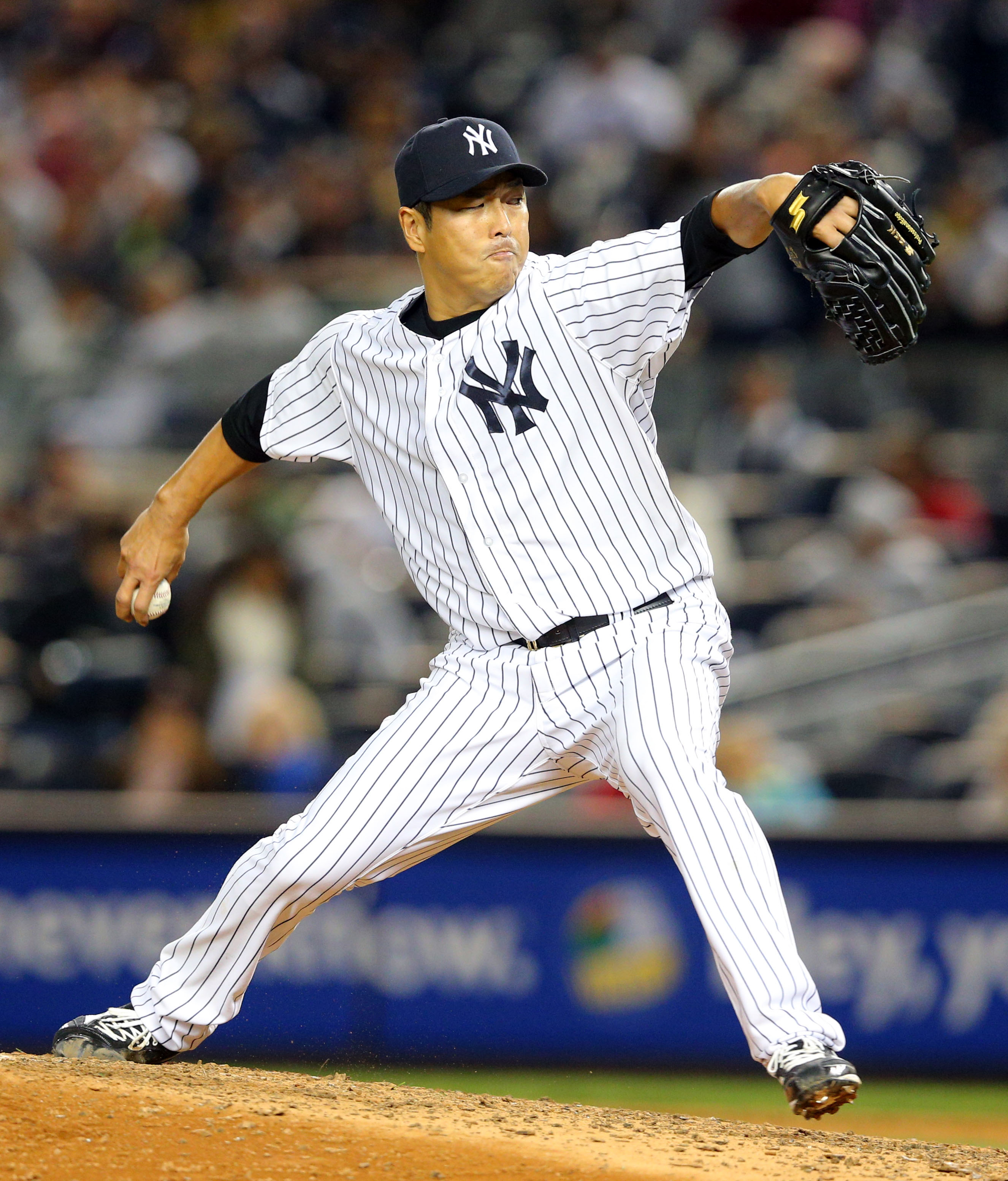
Soon to turn 40 years of age, Kuroda remains every bit as sturdy and effective as ever. Since coming to the big leagues from NPB back in 2008 — his age-33 season — Kuroda has never ended a season with an ERA over 3.76. In seven MLB campaigns, he owns a 3.45 ERA with 6.7 K/9 and 2.0 BB/9.
Of course, Kuroda had entire separate career in Japan before he came stateside. He broke in at age 22 and threw 11 seasons, all with Hiroshima. His numbers there looked quite similar to his big league marks: 3.69 ERA with 6.7 K/9 against 2.4 BB/9.
Kuroda will no doubt take a significant pay cut to return to the Carp, but he has the luxury to choose his destination at this point in his career. He ultimately earned a total of $88.3MM over his time in the big leagues, mostly through short-term deals as he continually chose to keep his options open rather than committing to a lengthy pact.
Though Kuroda was of course free to sign with any team, it had long been thought that he would be choosing between the Yankees, NPB, and retirement. In that respect, today’s move resonates most in New York, as the Yanks are left with a rotation full of durability questions.
For the rest of the starting pitching market, the news should have relatively little effect. Most of the quality mid-level starters have already found new homes, and Kuroda likely had a narrow range of suitors.
Jim Allen of Kyodo News tweeted that the Carp had announced the signing; Japanese media outlets Nippon and Chugoku Shimbun first reported that Kuroda was set to return to NPB.
Free Agent Faceoff: K-Rod vs. Soriano vs. Janssen
Among the remaining free agents on the open market, only three held down a ninth-inning job for a significant portion of the season: Francisco Rodriguez, Rafael Soriano and Casey Janssen. The trio is similar in that each has a history of pitching in the ninth inning, each is in his mid-30s and each succeeds despite lacking an overpowering heater. Let’s take a bit of a closer look at each.
Rodriguez’s relative youth may surprise some; he’ll turn 33 in January. It may feel like he should be in his upper 30s, but that comes with the territory when you cut your teeth as a 20-year-old in the midst of a World Series run. K-Rod’s ERA has been 3.04 or lower in four of the past five seasons (a 4.38 in 2012 being the lone exception), and it has, in fact, been 3.04 or better in all but two of his 13 big league seasons. fWAR was down on K-Rod quite a bit this season, as his FIP of 4.50 was rather pedestrian. However, that number doesn’t account for his eye-popping 23.3 percent homer-to-flyball ratio. Rodriguez’s career mark in that field is 9.9 percent, and even if he’s more homer-prone now (and the past three seasons suggest he might be), it can be reasonably expected for his HR/FB to drop by as much as 10 percentage points. xFIP normalizes HR/FB when projecting a 2.91 ERA for Rodriguez, and even if the true talent level is something a bit higher, Rodriguez would have value. He’s the youngest of the three relievers in question and also had the best ground-ball rate (43.9 percent) in 2014.
Soriano is the elder statesman of this group at the age of 35. He, too, has just one ERA blemish under his belt over the past five seasons — a 4.12 mark in an injury-shortened season with the 2011 Yankees. Over the past three seasons he has a 2.84 ERA with 8.2 K/9 and 2.8 BB/9. Soriano throws the hardest of this bunch (91.5 mph average fastball in 2014) and was having far and away the best season of the group as of mid-August. Soriano’s ERA was under 2.00 entering play on Aug. 15, but he limped to the finish line, allowing 12 runs in 14 2/3 innings over his final 16 games. While that offers cause for concern, some clubs may just write it off as poor luck (he did have a .367 BABIP in that stretch).
Janssen, who turned 33 in September, was in the midst of a characteristically strong season when he caught a violent case of food poisoning. He reportedly lost eight pounds within a day’s time and was never fully recovered, which was a contributing factor to his 6.46 second-half ERA. Even when Janssen was healthy, his K/9 rate was down this season, however, and he does throw the slowest of this trio. However, Janssen has also shown the best command of this group in recent seasons, and he’s missed plenty of bats in previous years. Plus, his recent trials have come in the AL East, whereas Soriano and Rodriguez have both worked in the National League in recent years.
All three of these relievers could help a bullpen, but it doesn’t seem that all three will end up with a closer’s job. Clearly, this post is just a mere glimpse into each reliever’s profile, so feel free to do a bit more of your own research before answering…
Which reliever would you rather sign?
-
Francisco Rodriguez 39% (5,943)
-
Rafael Soriano 34% (5,110)
-
Casey Janssen 27% (4,159)
Total votes: 15,212