
Sandro Fabian Reportedly Agrees To Three-Year Deal With NPB’s Hiroshima Toyo Carp
Outfielder Sandro Fabian has reportedly agreed to join the Hiroshima Toyo Carp of Japan’s Nippon Professional Baseball, per details from Francys Romero and Mike Rodriguez (X links). It’s a three-year pact worth $5.8MM, plus $600K of incentives. Fabian was on the 40-man roster of the Texas Rangers, who have apparently received some release fee from the Carp to let Fabian go, though the exact value of that hasn’t been reported. Once this all becomes official, the Rangers’ 40-man roster count will drop from 39 to 38.
Fabian, 27 in March, was an international signing of the Giants out of the Dominican Republic back in 2014. Baseball America considered him one of the top prospects in that system from 2017 to 2020 as he performed well in the lower levels of the minors, but he struggled more as he climbed the ladder. His prospect stock dimmed and he reached minor league free agency after 2021, having not climbed higher than Double-A.
In each of the past three offseasons, he has signed a minor league deal with the Rangers. He did finally get to make his major league debut late in 2024, getting selected to the roster in the first week of September. He went hitless in five plate appearances over three games.
For the most part, Fabian has been upper level depth for the Rangers. He has taken 1,093 plate appearances in 265 games at the Triple-A level, keeping his strikeout rate down to 15.3% but only walking at a 6.9% clip. In the hitter-friendly environment of the Pacific Coast League, his .272/.332/.482 batting line over that time translates to a wRC+ of 95.
His grip on his roster spot was likely tenuous and he was probably looking at more time in a minor league depth role if he had stayed in North America. Even if he earned himself a regular big league job, it would have taken him three years to get enough service time to qualify for arbitration. By heading to Japan, he is leaving affiliated ball but jumping to a higher level of earning power far more quickly.
Perhaps that will lead to another MLB opportunity down the road. After three years with the Carp, Fabian will be heading into his age-30 season. If he flourishes overseas, he can look for a new deal that would allow him to return to North American ball.
MLBTR Podcast: Roki Sasaki, Cole’s Non-Opt-Out, And Cardinals Rumors
The latest episode of the MLB Trade Rumors Podcast is now live on Spotify, Apple Podcasts, and wherever you get your podcasts! Make sure you subscribe as well! You can also use the player at this link to listen, if you don’t use Spotify or Apple for podcasts.
This week, host Darragh McDonald is joined by Anthony Franco of MLB Trade Rumors to discuss…
- Roki Sasaki to be posted for MLB clubs (1:45)
- Gerrit Cole‘s weird non-opt-out situation with the Yankees (17:50)
- The Cardinals might trade Nolan Arenado but might keep Willson Contreras and Sonny Gray (24:20)
- The Braves and Angels swap Jorge Soler and Griffin Canning (33:05)
- The Dodgers are moving Mookie Betts back to the infield (41:50)
Check out our past episodes!
- Breaking Down The Top 50 Free Agents List – listen here
- The Mets’ Spending Power, Juan Soto Suitors, And The Rangers’ Payroll Limits – listen here
- The World Series, The White Sox Reportedly For Sale, And Tropicana Field – listen here
The podcast intro and outro song “So Long” is provided courtesy of the band Showoff. Check out their Facebook page here!
NPB’s Chiba Lotte Marines To Post Roki Sasaki For MLB Clubs
November 10: The previously unspecified arm injury that caused Sasaki to miss time in 2024 was reportedly “a bout with shoulder fatigue,” according to The Athletic’s Will Sammon. The young right-hander’s recent injury history is just about the only thing that could give potential suitors pause this offseason, but such a relatively minor ailment is unlikely to do much damage to his market.
November 9: Roki Sasaki is coming to MLB next season. His NPB team, the Chiba Lotte Marines, announced overnight (on X) that they intend to make their ace available via the posting system. They did not reveal a specific date when they’ll open the posting window. Sasaki will be represented by Wasserman, tweets Francys Romero.
The announcement opens one of the top storylines of the offseason. Sasaki, who turned 23 last week, is the best pitcher in Japan. He’s one of the most talented pitchers on the planet. It’s the second consecutive offseason in which MLB teams will compete for arguably NPB’s best pitcher. Unlike the Yoshinobu Yamamoto bidding, Sasaki’s earning power is capped at a few million dollars.
MLB classifies players who sign out of a foreign league before they turn 25 as amateurs. Those players can only sign a minor league contract and are subject to a hard-capped bonus limit. Whichever team signs Sasaki is allowed to add him to the MLB roster by Opening Day — he isn’t going to start the season in Triple-A even though his first contract will be a minor league deal — but he won’t be able to sign for huge money.
After he signs, Sasaki will be subject to the same six-year control window that applies to any player called up from the farm system. He’ll play the next three seasons on roughly league minimum salaries before going through arbitration three times. Sasaki would not return to the open market until the 2030-31 offseason. He would be eligible to sign an extension during his team control window, but MLB has the ability to block a contract that it deems a circumvention of the bonus pool limits. There’s no set criteria for what might cause MLB to intervene, but it’s safe to say that Sasaki won’t be signing a massive extension within a few weeks of agreeing to a modest signing bonus.
Yamamoto waited until his 25th birthday to avoid the bonus limit. That freed him to sign with the Dodgers for $325MM, the largest guarantee for a pitcher in history. Sasaki didn’t want to follow that path. He instead prioritized making the move to MLB as quickly as possible, though that required the cooperation of the Marines.
NPB players are not eligible for international free agency until they’ve accrued nine years of service time. Sasaki has pitched at Japan’s highest level for four years. He unsuccessfully pushed for the Marines to post him for MLB teams last offseason. He gets his wish this time around. There’s been speculation that Sasaki’s contract might’ve contained some kind of clause to force the team’s hand.
Whether out of contractual obligation or simply to honor the player’s wishes, the Marines will lose their ace for essentially nothing. The posting agreement between MLB and Nippon Professional Baseball ties the NPB team’s compensation to the value of the free agent contract. An MLB team signing a posted player pays a fee to the Japanese team on top of what goes to the player. The fee is a fixed amount calculated as 20% of a deal’s first $25MM, 17.5% of the next $25MM, and 15% of further spending.
Yamamoto’s deal came with a windfall for his former team, the Orix Buffaloes. The Dodgers paid the Buffaloes $50.625MM to release him from his contract. The Marines will get a fraction of that. If Sasaki signs for $10MM — and there’s a decent chance his bonus will land below that — the team would receive a $2MM posting fee.
The Marines’ loss will be an MLB team’s gain. Evaluators project Sasaki as a top-of-the-rotation starter. He can push into the triple digits with his fastball and has a potentially lethal splitter. His fastball lost a bit of life this past season, though the pitch still sits in the upper 90s. Marquee’s Lance Brozdowski reports (YouTube link) that Sasaki averaged 97.1 MPH this year after sitting at 99 MPH in ’23. That’s well above average for an MLB starter despite trending in the wrong direction.
While the fastball velocity is eye-catching, evaluators suggest his low-90s splitter is his best pitch. He deploys a slider as his top breaking ball, and while that’s not as well regarded as the fastball-splitter combination, it’s a potential above-average offering. The Athletic’s Eno Sarris broke down Sasaki’s pitch mix in greater detail this week.
Writing for Baseball America in 2023, Kyle Glaser projected Sasaki as an ace who’d warrant the first overall pick if he were in the domestic amateur draft. Glaser ranked Sasaki as the most talented non-MLB player in the ’23 World Baseball Classic, one spot ahead of Yamamoto. Sasaki struck out 11 hitters over 7 2/3 innings of four-run ball for Japan’s championship team.
The 6’2″ hurler has posted dominant numbers on a rate basis in NPB. He has a career 2.10 earned run average in nearly 400 innings. This year’s 2.35 ERA was the highest of any of his four seasons. In a relative down year, Sasaki punched out nearly 29% of batters faced against a manageable 7.1% walk percentage.
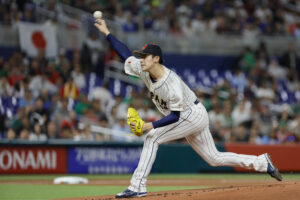
To the extent there’s a knock against Sasaki, it’s his workload. He has yet to reach 130 innings in any season. He was limited to 111 frames this year and missed time midseason due to an unspecified injury in his throwing arm. ESPN’s Jeff Passan reports that he also suffered a torn oblique. The injury history is a concern when paired with his slight velocity dip, but it’s unlikely to dissuade teams from an all-out recruitment. The upside of getting a potential top-of-the-rotation arm far outweighs the minimal cost.
Passan writes that the Marines have not settled on a date when they’ll open the posting window. Whenever they officially post him, Sasaki has 45 days to decide where to sign. It’s possible that’ll carry well into the 2025 calendar. Major League Baseball’s signing periods for international amateurs run between January 15 and December 15 every year. Teams commit the vast majority of that money on 1/15, finalizing contracts that have been verbally agreed upon well in advance.
Sasaki may prefer to wait until the opening of next year’s signing window. Teams already have verbal agreements with amateur players — most of whom are signing out of Latin America at age 16 — for their 2025 bonus window. Clubs could renege on some of those unofficial agreements to reallocate money for Sasaki. Teams are also allowed to trade for international signing bonus space up to a point. A team can acquire up to 75% of its initial bonus pool allotment. A club that knows it won’t have a chance to land Sasaki may be willing to trade most of its bonus space to a team in pursuit of the Japanese star in exchange for other prospects or MLB help.
In April, Baseball America’s Ben Badler published a list of teams’ bonus allotments for the ’25 signing period. The Reds, Tigers, Marlins, Brewers, Twins, A’s, Mariners and Rays have the largest pools at $7.5555MM each. If one of those teams acquired another 75% via trade and devoted the entire allotment to Sasaki, his maximum signing bonus would be around $13.22MM.
He’ll almost certainly sign for far less. If Sasaki were prioritizing money, he’d have waited until he turned 25 and sought a deal that rivaled or beat Yamamoto’s. As was the case with Shohei Ohtani in 2017, Sasaki is leaving hundreds of millions of dollars on the table in the short term to get to MLB right away. All 30 teams will be on more or less even footing financially. His free agency will be about teams’ competitive outlooks, pitching development plans and geographic preferences.
There’s already ample speculation about the Dodgers as a landing spot. They’re certainly well positioned from a competitive and geographic perspective. Financial might isn’t a direct consideration for this free agent, though, and any team could fit Sasaki into the budget if he were genuinely open to all offers.
Image courtesy of USA Today Sports.
NPB’s Hiroshima Carp Sign Elehuris Montero, Re-Sign Taylor Hearn
The Hiroshima Carp of Japan’s Nippon Professional Baseball announced this week that they’ve signed infielder Elehuris Montero and re-signed lefty Taylor Hearn, who excelled for the Carp in a relief role in 2024 (Japanese-language links via Yahoo Japan). Both players are CAA clients, and both are receiving one-year deals for the 2025 campaign.
Montero, 26, was once a highly touted corner infield prospect in the Cardinals system. He landed with the Rockies alongside Austin Gomber, Mateo Gil, Tony Locey and Jake Sommers in the trade sending Nolan Arenado to St. Louis. Colorado outrighted him off the 40-man roster this past July, and he became a minor league free agent at season’s end.
The Rox gave Montero his big league debut in 2022, but while he’s shown power at times throughout parts of three MLB seasons, he’s never been able to put the ball in play or reach base with any real consistency. The righty-swinging slugger is a career .228/.277/.387 hitter in 739 plate appearances. He’s been far better in Triple-A, mashing at a .314/.392/.589 pace in 877 trips to the plate. That’s the type of production the Carp surely are hoping to acquire.
The 30-year-old Hearn was a fifth-round pick by the Nats back in 2015 and has pitched in parts of five MLB seasons — primarily with the Rangers. He worked as both a starter and reliever during his time in Texas, enjoying far more success in the bullpen (4.48 ERA, 24.6 K%, 11 BB%) than in the rotation (6.36 ERA, 18.3 K%, 9.5 BB%).
It was in the bullpen that Hearn starred for the Carp upon signing with them last December. He missed some time in ’24 but was excellent when on the mound, pitching 35 innings with a pristine 1.29 ERA. Hearn was one of the primary setup men for the Carp, though he picked up a pair of saves as well. In his 35 frames, he fanned 20.2% of his opponents against a terrific 5.4% walk rate.
Anderson Espinoza Re-Signs With NPB’s Orix Buffaloes
Right-hander Anderson Espinoza has re-signed with the Orix Buffaloes of Japan’s Nippon Professional Baseball on a two-year deal worth roughly $6MM, according to a report from Swing Completo’s Victor Briceno (h/t to Yakyu Cosmopolitan). 2025 will be Espinoza’s second year with the Buffaloes in NPB.
Espinoza, 26, made his pro debut with the Red Sox back in 2015 after signing as an international free agent out of Venezuela. He quickly emerged as one of the league’s top up-and-coming pitching talents as he was consistently rated as a top-20 prospect in the sport, and was traded from Boston to San Diego in the Drew Pomeranz trade back in 2016. Unfortunately, Espinoza promptly fell victim to the injury bug and did not throw another pitch in the minor leagues for four years due to multiple Tommy John surgeries and the cancelled 2020 minor league season.
In 2021, Espinoza finally made his way back to the minor league mound and was traded to the Cubs in a deal that sent Jake Marisnick to the Padres. Espinoza struggled badly at the minor league level during his time in the Cubs organization, posting ERAs north of 5.00 at every stop on his journey, but that didn’t stop the rebuilding club from giving Espinoza his first look in the big leagues during the 2022 season, seven years after he first threw a professional pitch. That cup of coffee saw him pitch to a 5.40 ERA in 18 1/3 multi-inning relief appearances, though he was eventually cut from the club’s roster and headed to minor league free agency the following offseason.
2023 saw Espinoza return to the Padres organization on a minor league deal, and he moved back into the rotation after his stint in the bullpen with Chicago. Espinoza’s results at Triple-A El Paso were ugly, as he struggled to a 6.15 ERA in 131 2/3 innings of work that was well below average even for the inflated offensive environment found in the Pacific Coast League. He struck out just 19.3% of opponents while walking 12%, and he once again headed into free agency last winter with his future uncertain.
That led Espinoza to take a deal with the Buffaloes back in January, and his move overseas could hardly have gone better. In 22 Pacific League starts for the club this year, Espinoza was utterly dominant with a 2.63 ERA in 133 2/3 innings of work. The right-hander’s 20.5% strikeout rate wasn’t especially extraordinary, but he managed to cut his walk rate to a much more manageable just 8.7% while averaging just over six innings per start during his time in NPB this year.
That’s likely a strong enough performance that Espinoza, who is still just 26 years old, could have received some level of interest in stateside ball this winter. Rather than pursue a minor league deal in MLB, however, the right-hander instead took the Buffaloes up on their offer to return on a deal that not only provides him multi-year security for the first time in his career but also figures to pay him more handsomely than any offers on this side of the pond would have. With that being said, if Espinoza can continue to put up strong numbers in Japan over the next two years it’s not hard to imagine him then considering a move back to MLB as a number of pitchers who went overseas such as Miles Mikolas and Erick Fedde have done in the past.
Franmil Reyes Re-Signs With NPB’s Hokkaido Nippon-Ham Fighters
After a strong first season in Nippon Professional Baseball, Franmil Reyes is planning an encore, as the Hokkaido Nippon-Ham Fighters announced that the slugger has signed a new contract with the team for the 2025 season. Japanese media reports from last weekend suggested that Reyes was likely to stay with the Fighters and the club was prepared to offer him a multi-year contract, but he’ll instead return on a one-year deal.
In taking the one-year contract, Reyes might well be keeping his options open about a possible return to the majors next winter, as another big season in NPB would help his case for a guaranteed contract with a North American team. Reyes hit .290/.348/.564 with 25 homers over 368 plate appearances this season, mostly as a designated hitter and with a handful of appearances at first base. This production helped the Fighers to a second-place finish in the Pacific League and then a victory over the Chiba Lotte Marines in the first postseason round, though a sweep at the hands of the Fukuoka SoftBank Hawks denied the Fighters a spot in the Japan Series.
It was a needed bounce-back season for Reyes after his MLB career seemed to stall out after a pair of very rough seasons. Reyes hit only .217/.268/.356 with 16 home runs over 538 PA with the Guardians, Cubs, and Royals in 2022-23, plus a stint in the Nationals’ farm system came and went without a big league call-up.
Reyes hit a much more impressive .260/.325/.503 with 92 homers in 1540 PA over his first four seasons in the majors, slugging 92 homers for San Diego and Cleveland. Though strikeouts were always a big part of his game and his shaky defense indicated a DH-only future, Reyes still seemed to be on track to be a three-true-outcomes type of force before his sudden decline. While Reyes was still making a lot of hard contact in 2022, his walk rate dropped off sharply and his strikeout rate continued to rise.
Reyes is still only 29 years old, with his 30th birthday coming up in July. He could well pursue a third act to his career back in the big leagues in the wake of what seems to be a successful second act in Japan, or perhaps likes it enough in NPB to eventually pursue a multi-year deal with the Fighters if he keeps hitting.
NPB’s Chunichi Dragons To Post Shinnosuke Ogasawara
The Chunichi Dragons of Japan’s Nippon Professional Baseball have granted left-hander Shinnosuke Ogasawara‘s request to be posted for MLB teams, per a report from Yahoo Japan. He’ll be available to big league clubs in free agency this winter and is being represented by WME. A formal date for his posting has not yet been determined, but he’ll have 45 days to negotiate with MLB clubs once posted. If no deal is reached, Ogasawara will return to the Dragons for the 2025 season.
Ogasawara just turned 27 years old earlier this month. He’s already a veteran of parts of nine NPB seasons, having made his Central League debut as an 18-year-old back in 2016. Listed at 5’11” and 183 pounds, he’s of slighter frame than the typical big league starter but has started at least 23 games and topped 140 innings in each of the past four seasons. That includes a career-high 160 2/3 innings with the Dragons in 2023.
This past season, Ogasawara tossed 144 1/3 innings and notched a solid 3.12 ERA with an outstanding 3.7% walk rate — the best mark of his career. Unfortunately, that pinpoint command came with a career-worst 13.6% strikeout rate that will limit Ogasawara’s appeal. To his credit, Ogasawara has missed far more bats in the past, punching out 24% of opponents as recently as 2022 and fanning 20.1% of opponents in 2023. In both instances, he had higher but nevertheless strong walk rates (6.7% and 6.1%, respectively).
Video of Ogasawara reveals a pitcher who sits in the 91-93 mph range with his four-seamer, complementing the pitch with a low-80s changeup and a slow knuckle curve that sits in the low 70s. Neither Ogasawara’s frame nor velocity stand out, but both are relatively comparable to those of 5’10”, 175-pound Cubs lefty Shota Imanaga. Ogasawara’s camp may try to make that comparison, but Imanaga consistently posted lower earned run averages and far superior strikeout rates in NPB (29.5% in his final season with the BayStars). That said, Ogasawara is three years younger than Imanaga was at the time of posting. A multi-year deal seems plausible, though likely not at the same levels as Imanaga’s $53MM guarantee (which can grow to $79MM based on club/player options).
For those in need of a reminder or an introduction to the NPB/MLB posting system, NPB clubs are allowed to “post” players for MLB teams to bid on prior to those players reaching free agency for the first time (nine years of service, under NPB rules). Any major league team can negotiate with the player and his representatives to negotiate a contract for any amount — provided the player is at least 25 years old and has at least six seasons of professional experience. (Players under 25 and/or with fewer than six years of experience are deemed “amateurs” by MLB and restricted to minor league deals and hard-capped signing bonuses.)
The posting window lasts 45 days but can reach a conclusion earlier, depending on when the player in question strikes a deal to his liking. In addition to paying the player the agreed-upon guarantees in the contract, the MLB team will also be on the hook for a release fee to the player’s former team. That fee is equal to 20% of the contract’s first $25MM, 17.5% of the next $25MM and 15% of any dollars thereafter. Contractual factors like club options, incentives based on innings/plate appearances, awards bonuses, etc. are all subject to being included in the release fee as well, once those earnings are unlocked.
Shinnosuke Ogasawara To Request Posting For MLB Teams
Left-hander Shinnosuke Ogasawara is looking to move to the majors, and as per a report from Yahoo Sports Japan (Japanese language link), he’ll ask the Chunichi Dragons to make him available to MLB teams via the posting system this offseason. The Yakyu Cosmopolitan also reported earlier this year that Ogasawara was aiming to pitch for a big league team in 2025, and MLB Network’s Jon Morosi reported (via X) back in April that Major League scouts were watching Ogasawara pitch in Japan.
The southpaw celebrates his 27th birthday on Tuesday, and he has appeared with the Dragons in each of the last nine Nippon Professional Baseball seasons. However, since he is short of nine full years of NPB service time, Ogasawara will need to be posted in order to make the move to North American baseball.
To recap the posting system, any team that signs Ogasawara will have to pay a separate posting fee to the Dragons that is contingent on the size of the contract — the 20% of the contract’s first $25MM, plus 17.5% of the next $25MM and 15% of any dollars thereafter. If Ogasawara is posted, Major League teams will have 45 days to reach an agreement with the left-hander. If no deal is reached within that window of time, Ogasawara will return to the Dragons for the 2025 NPB season.
Ogasawara has a 3.66 ERA over 1095 career innings for the Dragons, and he has tossed at least 141 1/3 innings in each of the last four seasons. In 2024, he had a 2.99 ERA in 141 1/3 frames, with a very impressive 3.42% walk rate but also only a 13.87% strikeout rate. While Ogasawara’s control has only been getting better during his NPB career, he has never been a big strikeout pitcher, and this season’s low rate of missed bats will certainly stand out as a potential red flag to big league evaluators.
It remains to be seen how highly Ogasawara will be judged by MLB teams, though he’ll be one of the youngest rotation candidates available in this year’s free agent market. With scouts already keeping an eye on his work for the Dragons, Ogasawara figures to draw some attention should the Dragons decide to post him.
Tomoyuki Sugano Expected To Sign With MLB Team This Offseason
Longtime Nippon Professional Baseball star Tomoyuki Sugano is planning to sign with an MLB team this offseason, according to ESPN’s Jeff Passan. After 12 years in NPB, Sugano more than meets the requirements (nine years of NPB service) to qualify for international free agency, so he will not be subject to the rules of the posting system.
Sugano, soon to be 35, is an eight-time NPB All-Star, two-time Central League MVP, and two-time winner of the Eiji Sawamura Award, given out annually to the best starting pitcher in NPB. After collecting his second MVP trophy in 2020, he was posted for MLB clubs and drew interest from several teams, including the Giants, Mets, Red Sox, Padres, Blue Jays, and Rangers. However, he did not sign before the deadline, choosing instead to re-up with the Yomiuri Giants on a four-year, $40MM deal. His contract gave him the option to opt out after every season to pursue international opportunities, and following the first year of the deal, he he had enough NPB service time that he would not have been restricted by the posting system. Nevertheless, he decided to stay with the Giants throughout the length of the contract.
One reason Sugano may have decided not to pursue international free agency after the 2021, ’22, or ’23 seasons was his declining performance. He was outstanding in 2020, pitching to a 1.97 ERA with a 24.6% strikeout rate over 137.1 innings. However, he had ERAs of 3.19, 3.12, and 3.36 the following three years. His strikeout rates slowly declined, while his home run rates shot up. Moreover, injuries limited him to just 77.2 IP in 2023. His performance from 2021-23 wasn’t poor by any means, but it’s understandable why he chose not to sacrifice his guaranteed salary.
The 2024 season marked a return to dominance for the Sugano. Over 156.2 IP, he went 15-3 with a 1.67 ERA. His 18.3% strikeout rate was lower than it was at his peak – he struck out 24.2% of batters from 2016-20 – but he is finding success in new ways as an older pitcher. His 2.6% walk rate in 2024 was a career-best. His 6.94 strikeout-to-walk ratio was his best since 2016. In addition, he gave up only six home runs to the 608 batters he faced, 0.99% home run rate. That’s the lowest home run rate of his career, and significantly lower than his 2.91% home run rate from 2021-23. As a cherry on top, Sugano also threw three complete games this past season. He hadn’t thrown a single complete game since 2021.
Now that the four-year contract he signed during the 2020-21 offseason is up, Sugano has little reason not to give an MLB career another try. According to reporter Francys Romero, the veteran has hired VC Sports Group to represent him in free agency. The starting pitching market will feature plenty of big names this offseason, including Corbin Burnes, Yusei Kikuchi, Max Fried, Jack Flaherty, and likely Blake Snell, who has a player option for 2025. Considering his age, Sugano won’t be looking for a long-term contract, so he could represent an interesting alternative for a team that wants to add a potential top-flight starting pitcher on a shorter deal.
Marwin González Retires
Former big league player Marwin González announced he is retiring, through a press release from the Orix Buffaloes of Nippon Professional Baseball, the club he’s played with for the past two years. Yahoo Japan had reported on his retirement plans prior to the official announcement.
“After two amazing years in Japan, it’s time for me to say goodbye,” González says in his statement. “I’m incredibly grateful to my teammates, coaches, and fans for welcoming me with open arms. Despite the language barrier, we formed a bond with ease, making every moment on the field special. Playing here has been a life-changing experience, especially getting to share it with my family. Japan will always hold a special place in our hearts. I’m filled with gratitude for the opportunity, the memories, and the friendships made along the way. Thank you for welcoming me into your world and for the endless support. You have all my respect. Arigatou gozaimasu.”
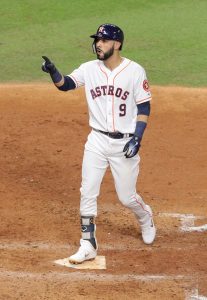 González, now 35, got his professional start when the Cubs signed him as an international amateur out of Venezuela and he made his minor league debut in 2006. In the 2011 Rule 5 draft, the Astros had the first pick since they were rebuilding at that time and lost 106 games that year. They used that first pick to take Rhiner Cruz from the Mets but also apparently had their eye on González. With the 23rd pick of the draft, the Red Sox took González and promptly flipped him to the Astros for Marco Duarte.
The second of those pickups ended up being far more impactful for the franchise, as Cruz tossed just 76 1/3 innings for the Astros, posting a 5.31 earned run average over the 2012 and 2013 campaigns before going into journeyman mode for the rest of his career.
González would eventually become a solid multi-positional piece for the Astros, though not right away. In 441 plate appearances over 2012 and 2013, he hit just .227/.266/.323. That production translated to a 59 wRC+, indicating he was 41% below league average. The Astros didn’t seem to mind much as they were still quite bad at that time, losing 107 and 111 games in those two seasons respectively. González was at least able to provide them defensively versatility, spending time at second base, third base and shortstop.
He was able to break out in 2014, hitting .277/.327/.400 for a wRC+ of 110. He also added first base and outfield to his defensive repertoire that year. He would continue to produce in roughly similar fashion in following seasons as the Astros emerged from their rebuild and became the perennial powerhouse that they still are today.
From 2014 to 2018, González got into 643 games for the Astros and stepped to the plate 2,265 times. He slashed .271/.328/.438 in that time for a 111 wRC+ while bouncing all around the diamond, playing everywhere except the battery.
He also got into 30 postseason games in that time, including 18 as part of the 2017 club’s World Series run, though that title is now mired in controversy with the revelation of Houston’s cheating scandal. Data from the scandal points to González as one of the biggest users of the trashcan-banging scheme. His 144 wRC+ and 4.4 wins above replacement from FanGraphs that year are both easily the bests of his career, as he otherwise never topped 111 wRC+ or 1.8 fWAR. Though he later apologized for the team’s actions, the first position player on the club to do so.
He reached free agency after 2018 and signed a two-year, $21MM deal with the Twins going into 2019. His bat dipped a bit in his first year in Minnesota, at least relative to the league. His .264/.322/.414 batting line was fairly similar to his previous five years, but 2019 was the “juiced ball” season with huge offensive numbers around the league, so González’s production led to a 94 wRC+. It fell more significantly in the shortened 2020 campaign, with González slashing .211/.286/.320.
Going into 2021, the Red Sox gave him a $3MM deal, hoping that his most recent performance was just a small sample blip in the odd circumstances of the pandemic. Unfortunately, that bet didn’t pan out, as González hit .202/.281/.285 before being released in August. He then returned to the Astros but hit just .176/.222/.441 in 14 games for them down the stretch. He signed a minor league deal with the Yankees going into 2022 and got into 86 games for that club, but hit .185/.255/.321 in those.
After three consecutive rough seasons in the majors, he headed overseas. He signed with the Buffaloes going into 2023 on a deal that paid him $1.5MM. He hit .217/.266/.385 in 84 games for that club last year. He returned for 2024 but dealt with injuries and only got into 23 games, per Yakyu Cosmopolitan on X.
González will primarily be remembered for that strong run with the Astros, which will provide fond memories to some fans while others will dismiss his accomplishments due to his involvement in the electronic sign-stealing scheme.
Regardless of how one feels about that, the record books have him with 3,882 plate appearances in 1,139 major league games. He collected 888 hits, including 183 doubles and 107 home runs. He scored 420 runs and drove in 415. He slashed .252/.310/.399 for a wRC+ of 94. FanGraphs considered him to have been worth 10.9 wins above replacement while Baseball Reference credits him with 14.3 WAR. B-Ref lists his major league earnings at just over $37MM, with González likely getting that up to around $40MM with the money he made in Japan. MLBTR salutes him on his unique career and wishes him the best in whatever comes next.