
Athletics To Trade Jorge Mateo To Padres
In the first trade since MLB’s transaction freeze has lifted, the Padres are set to acquire infield prospect Jorge Mateo from the A’s, Jeff Passan and Kiley McDaniel of ESPN report (Twitter link). Oakland will receive a player to be named later in return. San Diego has announced the trade.
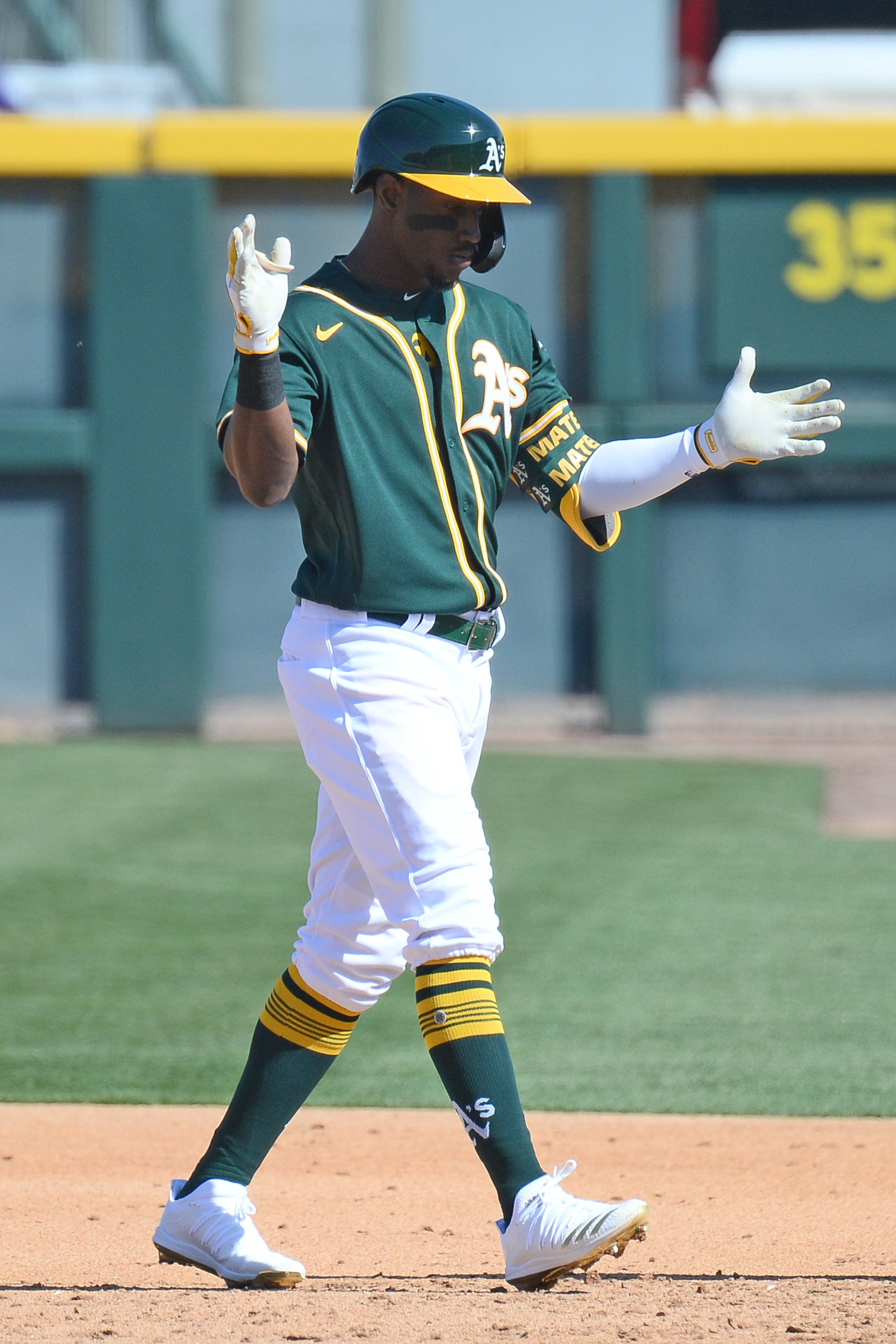
Long regarded as one of baseball’s more promising prospects due in no small part to his 80-grade speed, Mateo has yet to debut in the Majors. The 25-year-old was a central piece in the trade that sent right-hander Sonny Gray from Oakland to New York, but he hasn’t been afforded a chance in the Majors with either the Yankees or the A’s. He has, however, been on the 40-man roster of both clubs long enough to have exhausted all of his minor league options. In other words, he’ll have to make the Padres’ Opening Day roster or else be designated for assignment.
Mateo was one of several players in the mix for playing time at second base in Oakland, vying with Franklin Barreto, Tony Kemp and Rule 5 pick Vimael Machin for that role. Now in San Diego, he’ll once again be looking up at Jurickson Profar — a former ballyhooed prospect himself — and hoping to find his way into the mix for at-bats. Mateo does have a bit of center field experience as well, having logged 247 innings there back in 2017.
It’s easy to see why Mateo was so well-regarded back in 2015-16. He split the 2015 campaign between Class-A and Class-A Advanced at just 20 years of age and slashed a combined .278/.345/.392. He only homered twice, but Mateo added 23 doubles, 11 triples and an unheard-of-in-today’s-game 82 stolen bases in just 117 games. His stock dipped a bit with a mediocre showing in 2016, but 2017 saw Mateo bounce back with a .267/.322/.459 slash and 52 steals. A shortstop with that type of output piqued the Athletics’ interest, and the A’s sent Gray to the Bronx in exchange for Mateo, Dustin Fowler and James Kaprielian in a trade that now hasn’t really panned out for anyone involved.
Mateo’s numbers cratered in 2018, and while last year’s .289/.330/.504 slash in Triple-A were a nice rebound, the bounceback effort wasn’t quite as strong as it’d appear on the surface. That slash line translated to just a 96 wRC+ in the supercharged offensive environment in the Triple-A Pacific Coast League (where Mateo’s home park in Las Vegas is particularly hitter-friendly).
Athletics Sign Tyler Soderstrom
The Athletics have announced a deal with top pick Tyler Soderstrom. It includes a $3.3MM signing bonus, Jim Callis of MLB.com reports (via Twitter). The San Francisco Chronicle’s Susan Slusser reported yesterday that Soderstrom would sign today and is expected to be added to Oakland’s 60-player pool.
Also going under contract was fifth rounder Stevie Emanuels. The University of Washington righty receives a $400K bonus. With his signing, the A’s have completed all of their draft business.
Soderstrom, a high school catcher out of California, received a bonus that weighed in about $646K north of his slot value at No. 26. Emanuels also went over-slot, with both players getting an extra payout from the cash the Athletics saved in signing second-rounder Jeff Criswell and third-rounder Michael Guldberg to below-slot deals.
The A’s obviously had their eyes on Soderstrom entering the draft. All major draft pundits rated him among the 25 best players available. ESPN.com’s Kiley McDaniel was particularly bullish, grading the youngster as the tenth-best player available due to his promise as a hitter.
While it’s awfully tempting to imagine Soderstrom as a bat-first catcher, there’s concern with his ability to develop defensively while also maximizing his offensive potential. It remains to be seen what course the A’s will take, but most scouts seemingly believe Soderstrom is athletic enough — and sufficiently talented with the bat — to man other areas of the diamond (third base or the corner outfield, most likely).
Athletics Announce Initial 60-Man Player Pool
Today marks the deadline for teams to submit to Major League Baseball their initial spring training player pools, which can comprise up to 60 players. Players are not eligible to participate in either a spring training or regular season game until they are included in the pool. Teams are free to change the makeup of the pools as they see fit. However, players removed from a team’s 60-man (for reasons unrelated to injury, suspension, etc.) must be exposed to other organizations via trade or waivers.
Not all players within a team’s pool are ticketed for MLB playing time, of course. Most teams will include well-regarded but still far-off prospects as a means of getting them training reps with no intention of running them onto a major league diamond this season. A comprehensive review of 2020’s unique set of rules can be found here.
The Athletics’ initial player pool consists of the following players, per various reporters (including Martín Gallegos of MLB.com).
Right-handed pitchers
- Chris Bassitt
- Tyler Baum
- Paul Blackburn
- Parker Dunshee
- Mike Fiers
- Daniel Gossett
- Liam Hendriks
- Grant Holmes
- Brian Howard
- Daulton Jefferies
- James Kaprielian
- Frankie Montas
- Yusmeiro Petit
- Jaime Schultz
- Burch Smith
- Joakim Soria
- Lou Trivino
- Jordan Weems
- J.B. Wendelken
Left-handed pitchers
Catchers
Infielders
- Nick Allen
- Franklin Barreto
- Matt Chapman
- Logan Davidson
- Ryan Goins
- Tony Kemp
- Vimael Machin
- Jorge Mateo
- Sheldon Neuse
- Matt Olson
- Nate Orf
- Chad Pinder
- Marcus Semien
Outfielders
Quick Hits: Schedule, Twins, A’s, Minor League Pay
The Nationals and Yankees are tentatively scheduled to play on July 23, according to Joel Sherman and Andrew Marchand of the New York Post, which would make for a big Max Scherzer vs. Gerrit Cole pitching matchup to highlight Opening Day. It might still be at least a week or two before the 2020 schedule is officially finalized, however, as the league is still considering a number of factors, chief among them coronavirus outbreaks around the United States. “Better, the league believes, to take its time, see how the [COVID-19] testing of personnel goes this week and the preferences expressed in feedback from clubs,” Sherman and Marchand write. “So the current schedule can change drastically and, if it does, the union will have to provide its blessing again.”
More from around baseball…
- Tomorrow is the deadline for teams to submit their initial 60-man player pool, and details are already beginning to emerge about which players may or may not be included. The Twins‘ taxi squad will include top prospects Royce Lewis, Alex Kirilloff, and Brent Rooker, SKOR North’s Darren Wolfson tweets. Caleb Thielbar, who rejoined Minnesota on a minors contract last winter, is also expected to be on taxi squad duty.
- The Athletics will initially split their player pool into two groups, Susan Slusser of the San Francisco Chronicle reports, with much of the big league roster training in Oakland and the taxi squad potentially training in nearby Stockton — the home of the Athletics’ Class-A affiliate — if a deal can be finalized with Stockton city officials. Offseason minor league signings Ryan Goins, Carlos Perez, Jordan Weems, and Lucas Luetge will all be in Oakland, while taxi squad players include such notable prospects as Tyler Soderstrom, Daulton Jefferies, Nick Allen, Dustin Fowler and (as per MLB.com’s Jesse Sanchez) Robert Puason.
- Slusser also provides updates on some Athletics players who were battling injuries during the spring but are now on track to be ready for Opening Day. A.J. Puk “has been throwing bullpen sessions for months” following a shoulder strain in the spring, and looks to be ready to begin the season in Oakland’s rotation. Right-hander Daniel Mengden is also ready to be part of the pitching mix after recovering from arthroscopic elbow surgery in February. After being sidelined with an intercostal strain during Spring Training, Stephen Piscotty said he is now “100 percent with no limitations.”
- The Rays and Rangers are the latest teams to commit to paying their minor leaguers through the end of July, as respectively reported by Marc Topkin of the Tampa Bay Times and Jeff Wilson of the Fort Worth Star-Telegram. Minor leaguers in each organization will continue to receive their $400 weekly stipends for at least another month.
West Health Notes: A’s, D-backs, Mariners, Giants, Rangers
Players who are at high risk of contracting the coronavirus have the right to opt out of participating this season, but they’d still receive full pay and service time. Athletics reliever Jake Diekman, who has ulcerative colitis and who had his colon removed in 2017, is one of those players. Diekman, however, informed Susan Slusser of the San Francisco Chronicle that he has no interest in opting out of the campaign – at least, not yet. “I’ve never thought once about opting out,” said the southpaw, though he added: “Say two or three guys on the team get it, we’ve all been around each other. I don’t know if I’d opt out in the middle of the season, but it definitely worries you.” Slusser also spoke with A’s utility player Chad Pinder, whose wife is expecting a baby in September, about the season. Pinder said, in part: “We have to do it right — or it just might not work. But there is a risk to this.”
- An unnamed player on the Diamondbacks tested positive for the coronavirus in Arizona within the last month, general manager Mike Hazen said Wednesday (via Bob Nightengale of USA Today). That player was not using their facility, though, Hazen added. It’s unclear how his recovery has gone.
- The Mariners have “had a few players test positive” for the virus, general manager Jerry Dipoto said Wednesday (via Ryan Divish of the Seattle Times). Fortunately, Dipoto went on to reveal that “they’re asymptomatic, and they feel great.”
- More on the Mariners, who are uncertain whether outfielder Mitch Haniger will be ready for the resumption of spring training, according to GM Jerry Dipoto (via Divish). The past year has been an injury-filled nightmare for Haniger, who only played in 63 games in 2019 and then underwent two offseason surgeries – one a core procedure, the other a dissectomy. In better news for the Mariners, reliever Austin Adams – who underwent surgery on a torn ACL last fall – is set for camp. The 29-year-old Adams may have broken out for the Mariners last season with 32 innings of 3.94 ERA ball and a whopping 14.91 K/9.
- Giants corner infielder Pablo Sandoval and lefties Tony Watson and Tyler Anderson will all be good to go for camp’s return, Henry Schulman of the San Francisco Chronicle tweets (1, 2). Catcher Aramis Garcia could be ready to come back in mid- to late August, meanwhile, and reliever Reyes Moronta may be set by then or in September. Sandoval had Tommy John surgery on his right elbow last September; Watson dealt with shoulder issues before spring training shut down; Anderson underwent a procedure on his left knee last summer; Garcia’s still recovering from February hip surgery; and Moronta’s on the mend from the right shoulder surgery he had in September.
- Rangers left-hander Joely Rodriguez is back to throwing after suffering a lat strain in April, but he won’t be ready for the start of the season, Evan Grant of the Dallas Morning News reports. Rodriguez should return at some point during the campaign, though. Texas lured Rodriguez back to the majors on a a two-year, $5.5MM contract in free agency after the former Phillie thrived in Japan from 2018-19.
Athletics Announce Three Draft Signings
The Athletics announced that they have inked three drafted players. Second rounder Jeff Criswell, third rounder Michael Guldberg, and fourth rounder Dane Acker are all now under contract.
With these additions, the A’s have two remaining unsigned players. First rounder Tyler Soderstrom and fifth rounder Stevie Emanuels have yet to put pen to paper.
Criswell landed a $1MM bonus, Susan Slusser of the San Francisco Chronicle reports on Twitter. That leaves over $200K for the club to put to use on other signings. Acker landed right at the slot value of $447,400, per MLB.com’s Jim Callis (via Twitter). It’s not clear yet what Guldberg will take home.
Both Criswell (Michigan) and Acker (Oklahoma) are right-handed collegiate hurlers. Baseball America rated the former 53rd among draft-eligible players, citing his sturdy mid-nineties heater and suitably robust frame. The latter doesn’t possess loud tools, but is considered a well-rounded hurler who could perhaps end up in the back of a rotation one day.
As for Guldberg, he was an on-base machine at Georgia Tech, posting a silly .465 OBP over 393 career plate appearances. Unfortunately, his hit tool isn’t accompanied by power and scouts aren’t convinced he’ll remain a center fielder over the long haul.
A’s To Begin Negotiations To Fully Purchase Oakland Coliseum Site
In the latest wrinkle in the Athletics’ quest to build a new ballpark, Oakland’s City Council decided in a “nearly unanimous” vote Thursday to start negotiations about selling the city’s half of the Oakland-Alameda County Coliseum site to the team, Phil Matier of the San Francisco Chronicle reports.
The A’s already own the other half of the site, having completed the purchase with Alameda County over the winter. The city of Oakland is looking for a similar version of that sale, which would see the A’s pay the city $85MM over an unspecified time frame. Those funds would greatly help a city that, like virtually everywhere else in the world, suddenly faces major financial issues in the wake of the COVID-19 pandemic.
“After the coronavirus shutdown, we are looking at a very,very serious budget deficit, and they are saying it could cost us $6MM just to maintain the site,” city councilman Noel Gallo said prior to the closed session of council. “We don’t have that kind of money. This way we can get some badly needed help.”
The deal is based around the A’s ultimately staying in Oakland, and assuming that the Coliseum site deal goes through as planned, the club would now have multiple options towards that end. The Athletics’ first choice is still to build a new ballpark at the Howard Terminal site in downtown Oakland, and should that ballpark be completed, the A’s would then look to develop the Coliseum site themselves. As per Sports Illustrated’s John Hickey, the 155-acre property that currently houses both the Coliseum and the Oakland Arena (the former home of the Golden State Warriors) would become “a shopping, cultural and residential area…The Coliseum itself would be razed, although the baseball diamond would become a large park.”
The other possibility is that the site could be used as a backup plan for a new A’s ballpark. The Athletics would continue to play in the Coliseum until a new stadium was built in what is currently the site’s north parking area. As Hickey notes, however, that the pandemic could make this scenario more realistic if the A’s aren’t able to borrow the funding necessary to convert the Howard Terminal area.
Earlier this month, A’s president Dave Kaval said Howard Terminal was still the team’s priority, though “we’re just focused on taking it quarter by quarter and seeing how much progress we can make.” While some obstacles remain in the way of the Howard Terminal project getting a full green light, that endeavor looked to tentatively be on track, with the Athletics originally hoping for an opening by the 2023 season prior to the coronavirus shutdown.
This is purely my speculation, but if financing becomes enough of an issue, the Athletics could theoretically look to sell the 155 acres to another developer in order to generate the money necessary to finalize the Howard Terminal concept. Such a next step would add another major layer of complication to what has already been a drawn-out process, of course, and obviously the A’s would prefer both their new ballpark and the Coliseum residential area as dual revenue-generators.
It’s fair to say that some fans could be a little perturbed to hear about another potential multi-million-dollar development deal during a time when so many teams are claiming economic strife. The A’s have long been one of baseball’s lower-spending teams, and their cost-cutting measures have often drawn criticism — even just recently, owner John Fisher had to admit fault and reverse the team’s initial plan to eliminate the $400 weekly stipend given to Athletics minor leaguers. A’s ownership has insisted for years that a new ballpark is necessary for the team to remain in Oakland, and if nothing else, today’s news should deepen the ties between the club and the city.
The Longest Flirtation In Baseball
For those who love the will-they-won’t-they back-and-forth of a classic rom-com, Major League Baseball has a story for you. The Chicago White Sox and lefty hurler Gio Gonzalez are drawn to each other. There’s no denying the connection. They’re the Ross and Rachel of the MLB (or Jim and Pam, or whatever reference is relevant these days). Though they’ve never stayed together long, these would-be soulmates are on the verge of finally making it work. Should baseball return in 2020, their long-standing flirtation should finally consummate with Gonzalez in black-and-white, taking the hill in front of the Southside faithful.
Gonzalez, 34, has long been a productive pitcher in the bigs, but he hasn’t gotten the respect he deserves of late. Though Gonzalez is aging, he certainly pitched well enough to prove himself a viable rotation candidate. And yet, following the 2018 season, Gonzalez languished on the free-agent market. He eventually accepted a minor league deal with the Yankees, but he never made an appearance for their big-league team. He found his way back to Milwaukee where he went 3-2 with a 3.50 ERA/4.04 FIP across 87 1/3 innings (17 starts). Again, solid numbers for Gonzalez, but again there wasn’t much buzz around him as he returned to free agency.
Fear not, for an old friend came to the rescue. The White Sox signed Gonzalez to a $5MM guarantee just before Christmas with plans of slotting him into the rotation. The White Sox are a team on the rise with a young rotation in need of guaranteed, quality innings. Lucas Giolito and Dallas Keuchel are set to front the rotation with less proven assets like Reynaldo Lopez and Dylan Cease likely to follow. Gonzalez should help the young arms take their time and weather the storm, should there be one.
Regardless of fit, we know the White Sox like Gonzalez. This was, after all, the third time they’d acquired him. The White Sox first drafted Gonzalez 38th overall in the 2004 June Draft. But he didn’t last long in their system, as the Sox traded Gonzalez to the Phillies after the 2005 season (with Aaron Rowand and Daniel Haigwood) for Jim Thome.
Just a year later, Gonzalez found himself headed back to Chicago. The White Sox and Phillies connected on a new deal wherein the Phils acquired Freddy Garcia for Gonzalez and Gavin Floyd. Garcia made just 11 starts for the Phillies before leaving as a free agent after 2007. Floyd found his sea legs in Chicago after struggling to make good on his top draft pick status in Philly. He ended up playing seven seasons with the White Sox, going 63-65 with a 4.22 ERA/4.20 FIP in that time, settling in as a decent rotation piece.
Gonzalez’s second stint with the White Sox lasted barely longer than the first. He did, however, begin to flourish. Upon his return, Gonzalez quickly became a top arm in their system, topping out of as their number one ranked prospect by Baseball America in 2008 (#26 overall in the majors).
Still, they traded him – again – this time to the Oakland Athletics (along with Fautino De Los Santos and Ryan Sweeney) in exchange for Nick Swisher. Swisher was a personality match with the White Sox, a spiritual successor to Rowand and other hard-nosed dirt dogs to play on the grass in Chicago – but he only lasted one season (.219/.332/.410 with 24 home runs).
Gonzalez became the gem of that deal for Oakland, making his debut in 2008 as a 22-year-old. It took Gonzalez a couple seasons to find his footing, but by the end of 2011, Gonzalez was an established pro. He put together back-to-back 200-inning seasons for the A’s, amassing 8.3 rWAR/6.5 fWAR across 2010 and 2011 before Oakland shipped him to Washington.
At this point, Gonzalez was entering his age-26 season with some runway to finally settle in after being traded four times already. Gonzalez became a rotation stalwart for the Nationals from 2012 to 2018, a two-time All-Star, and a 124-game winner.
His best season was his first in Washington. The 26-year-old Gonzalez led the league in wins going 21-8 with a 2.89 ERA/2.82 FIP across 199 1/3 innings. As the Nats’ nominal ace, Gonzalez led them to their first-ever postseason appearance. Of course, this was the season the Nationals famously withheld Stephen Strasburg from the playoffs to ensure his long-term health. An undercurrent of that story, however, was Gonzalez, whose dominance that year made such a bold move possible. Gio started games one and five of the NLDS, pitching well but lasting just five innings in both outings – a common thread for Gonzalez. The Nats went 1-1 in those games but ultimately lost the series to the Cardinals.
Gonzalez never put up another season quite like his 2012, but he nonetheless gave the Nats solid work for 6+ seasons. Regardless, there wasn’t a ton of interest when the Nats shopped him during the 2018 season. Gonzalez was eventually traded to the Brewers, for whom he pitched well in five late-season starts. He even got a pair of postseason starts, though he went just two innings in the first outing and left due to injury one inning into his second.
Eight seasons after arriving in Washington and 16 years after Chicago selected him in the first round, Gonzalez may finally have the opportunity to pitch for the White Sox. Of course, a lot stands in the way of Gonzalez making his debut in Chicago, but that’s nothing new. Now in his third stint in the organization, the White Sox hope Gonzalez will help lead this young team.
Of course, if they don’t make the leap many expect, Chicago could embark on one last selloff of veterans before making a run at contention again in 2021. If that happens, Gonzalez could find his name in the trade papers once again. But for now, as before, Gio Gonzalez is a member of the Chicago White Sox.
Athletics, First-Rounder Tyler Soderstrom Will Reportedly Reach Agreement
JUNE 12: Expectations are that Soderstrom will sign for approximately $3.3MM, Jon Heyman of MLB Network tweets. That would indeed check in well above slot, as Glaser reported.
JUNE 10, 10:54pm: There’s no deal yet, according to Soderstrom. However, the A’s are optimistic he will sign, per Slusser.
9:38pm: The Athletics have already reached an agreement with first-round pick Tyler Soderstrom, Kyle Glaser of Baseball America reports. Details aren’t known yet, but it’s worth “considerably above slot,” according to Glaser. Soderstrom’s pick, No. 26, comes with a slot value of $2,653,400. Oakland entered the draft with an overall pool of $5,241,500.
Soderstrom’s a local product out of Turlock High School in California, and he’s also the son of 1993 Giants first-rounder Steve Soderstrom, a former pitcher who had a cup of coffee with San Francisco in 1996. Tyler Soderstrom had been in line to play at UCLA before the draft, but he’ll instead continue his development as part of one of the state’s major league teams.
Oakland’s clearly bullish on the younger Soderstrom, as its scout for Northern California, Kevin Mello, told Susan Slusser of the San Francisco Chronicle: “He’s the best amateur bat I’ve seen in my 15-year career. He’s got a chance to be very, very good. He’s a really special player.”
Mello’s also of the belief that Soderstrom will stick behind the plate, though that may not be a given. MLB.com, which ranks Soderstrom as the 19th-best player in this year’s class, notes that he’s “raw in terms of blocking and game management.” But Soderstrom’s a good athlete who can play third base and the outfield, so those factors and his considerable offensive upside suggest he may be able to carve out a successful MLB career even if he doesn’t last as a catcher.
Athletics Have Ample Future Payroll Flexibility
2020 salary terms still need to be hammered out. But what about what’s owed to players beyond that point? The near-term economic picture remains questionable at best. That’ll make teams all the more cautious with guaranteed future salaries.
Every organization has some amount of future cash committed to players, all of it done before the coronavirus pandemic swept the globe. There are several different ways to look at salaries; for instance, for purposes of calculating the luxury tax, the average annual value is the touchstone, with up-front bonuses spread over the life of the deal. For this exercise, we’ll focus on actual cash outlays that still have yet to be paid.
We’ll run through every team, with a big assist from the Cot’s Baseball Contracts database. Next up is the Athletics:
*Includes buyouts of club options over Stephen Piscotty and Jake Diekman
(click to expand/view detail list)
