
Quick Hits: Harris, Nationals, A’s Ballpark, Cardinals
Nationals assistant general manager and VP of player personnel Doug Harris is back home and recovering after a recurrence of leukemia, the Washington Post’s Barry Svrluga writes. This is the fourth separate time Harris has fought the disease, with this latest incident resulting in a blood transplant, further rounds of chemotherapy and radiation treatments, and a 26-day stint in hospital. This all came as the coronavirus pandemic wreaked havoc on the medical system and put patients like Harris at an even more elevated risk. “It was the lowest point in my life, without a doubt,” Harris said, as he had to endure this battle while his family was prohibited from visiting due to COVID-19 restrictions. “I’m a very faithful person, but it’s tough to understand,” Harris said. “And there’s people out there far worse off than me. I never lose sight of that. But, my goodness, four times? Come on, man. It tests your mettle.”
Thankfully, the transplant was a success (all three of Harris’ daughters volunteered blood, with doctors opting for the donation from his middle daughter Sydney) and Harris is now resting at home. While his daily activities are understandably limited, Harris has been able to join other Nationals staffers in conference calls about how to approach and prepare for a potential 2020 season. “This has been part of my life. I’m proud of what I’ve been able to overcome,” Harris said. “And there’s a great story that is not finished yet. Not even close.” We at MLBTR are all looking forward to the next chapters of Harris’ story, and we join the rest of the baseball world in wishing him the best in his recovery.
More items….
- Athletics president Dave Kaval provided the latest on the team’s efforts towards a new Oakland ballpark, telling Susan Slusser of the San Francisco Chronicle that the A’s are still “moving forward with” the plan at the Howard Terminal site. “Right now, we’re just focused on taking it quarter by quarter and seeing how much progress we can make. We are not at the top of the list [for the city of Oakland] because there are more pressing issues, and we want to be respectful of that as we garner the necessary approvals to move forward,” Kaval said. It isn’t yet known if the pandemic could result in the project being pushed back from the original target date of the 2023 season, as “the timing of those things aren’t known right now because everything is still in flux,” Kaval said.
- As for the Athletics’ current ballpark, Kaval told Slusser that the team is in discussions with local officials about how to safely open and operate the Oakland Coliseum under advanced health guidelines. The A’s already submitted a 67-page document outlining what health and safety procedures will be in place, and approval from Alameda County could come as early as Monday. When or if this approval is granted, A’s players will be able to begin workouts at the ballpark.
- The Cardinals have five selections within the first 93 picks of Wednesday’s amateur draft, and seven picks overall during the five-round event. As Derrick Goold of the St. Louis Post-Dispatch describes the situation, “it’s a cluster of picks that allows for some gamesmanship. The Cardinals could use it as a reason to shuffle around bonus money and reach for a pick, to gamble on signability — or play it safe, target predictable picks, and try to get sure things from an unsure draft.” Whether the club pursues any sort of overarching strategy at all might not be realistic, as assistant GM Randy Flores notes that “in reality, each pick is made in the context of that moment.” The shortened nature of the draft will also be a big factor in the team’s decision-making, as Goold points out that the Cardinals have traditionally been very successful at finding future gems later in the draft. On the current St. Louis roster alone, Matt Carpenter (13th round, 2009) and Tommy Edman (sixth round, 2016) were two homegrown products drafted after the fifth round.
Each AL Team’s Top Recent Draft Class
With the MLB draft scheduled for next week, let’s take a look at each American League team’s most successful draft class in recent memory. Using Baseball Reference’s draft tracker, we can sum the combined career bWAR of each player selected by each team in a given year. It’s a simple shorthand, not a perfect measure, but it’ll give some insight into which teams have really hit in certain years.
First, a quick note on the methodology. For simplicity, we’re limiting this search to the 2006-2015 classes. A player’s value is only included if he signed with the club, although he needn’t have actually played for his drafting team in the majors. (So, the 2008 Yankees don’t get credit for drafting but failing to sign Gerrit Cole, while the 2007 Red Sox do get credit for drafting and signing Anthony Rizzo, even though he was traded before ever playing an MLB game for Boston). Of course, a player drafted in 2006 has had more time to rack up value than one drafted in 2015, so we’ll note in each team’s capsule if a more recent class is on the verge of taking over from an older class. On to the results…
- Angels: 2009 (109.3 bWAR) – Go figure. Picking one of the greatest players of all time is a heck of a way to kick off a draft class. But this 2009 class wasn’t just about Mike Trout, even if he’s accounted for about two-thirds of its cumulative value. That year, the Angels also selected Patrick Corbin, Randal Grichuk, Garrett Richards and Tyler Skaggs. Former MLBTR contributor Chuck Wassterstrom took a behind-the-scenes look at this class a few years ago.
- Astros: 2009 (53.2 bWAR) – Not a single one of the Astros’ top five rounders in 2009 reached the majors. The late rounds, though, were a smashing success with J.D. Martinez (20th), Dallas Keuchel (7th) and Kiké Hernández (6th) accounting for the class’ value. Of course, Martinez did his damage elsewhere after the Astros released him.
- A’s: 2012 (37.7 bWAR) – The A’s 2012 class produced seven big leaguers, most notably Matt Olson. He leads a group that also included Addison Russell and Max Muncy, who have played most or all of their MLB careers elsewhere.
- Blue Jays: 2009 (39.2 bWAR) – They won’t get credit for selecting James Paxton in supplemental round one here, but Yan Gomes was a nice find in the tenth round, though he would play only briefly in Toronto before being dealt to Cleveland. Outside of Gomes, the Blue Jays found a few nice role players, including Jake Marisnick, Aaron Loup, Ryan Goins, and others.
- Indians: 2011 (38.7 bWAR) – Selecting Francisco Lindor eighth overall in 2011 was a key to Cleveland’s 2016 AL pennant. So too was then-closer Cody Allen, whom they grabbed in the 23rd round. With Lindor mid-prime, the class’ value should just continue to grow.
- Mariners: 2006 (40.2 bWAR) – Doug Fister and Chris Tillman went on to become mid-rotation starters for a time (Fister arguably even a bit more than that), albeit with other clubs. Fifth overall pick Brandon Morrow disappointed as a starter but had a late-career renaissance as a quality reliever before various injuries derailed him.
- Orioles: 2007 (43.2 bWAR) – Although only four players from this class would wind up making the Majors, the combination of Jake Arrieta and Matt Wieters makes the 2007 draft a pretty solid one for the O’s. While Wieters, the fifth overall pick, maybe didn’t turn out to be the franchise cornerstone he was hailed to be, he has nonetheless had a nice career. Arrieta had a slow start in Baltimore, but would of course earn a Cy Young with the Cubs. It’s worth noting that this spot will be taken by the 2010 class before too long, almost entirely on the back of Manny Machado.
- Rangers: 2008 (33.3 bWAR) – Despite garnering only a 25th-round selection, Tanner Roark has turned out to be the most productive player in this class. First-round choice Justin Smoak deserves a mention too, though his career didn’t really take off until he’d been traded out of Texas. The 2011 class, headed by Kyle Hendricks, is not far behind and could claim this title in the near future.
- Rays: 2006 (81.5 bWAR) – Franchise legend Evan Longoria does a lot of the heavy lifting for this class, having amassed 56 total WAR by age 34. Even so, there are some other quality players here: Desmond Jennings and Alex Cobb are the other notables, with Jennings carving out a solid MLB career as a tenth-round pick.
- Red Sox: 2011 (70.2 bWAR) – This is far and away the best Sox draft class in recent memory, and it shouldn’t surprise anyone. Mookie Betts, one of the finest players in baseball, established himself as Boston’s franchise player after he was selected in the fifth round. Even outside of Betts, this class yielded a few key members of the Red Sox 2018 World Series team, with Jackie Bradley Jr. and relief ace Matt Barnes also coming out of that draft.
- Royals: 2007 (47.1 bWAR) – Speaking of drafting World Series contributors, the Royals in 2007 added both Mike Moustakas and Greg Holland, both of whom turned out to be central in the Royals’ playoff runs in 2014 and 2015. And that’s before mentioning third-rounder Danny Duffy, who’s still with Kansas City and inked a nice extension prior to 2017.
- Tigers: 2007 (20.6 bWAR) – With just 20.6 WAR, the Tigers’ best draft in recent memory doesn’t compare favorably to the rest of the AL, and that partly illuminates the franchise’s current standing in baseball. The notable player from the 2007 class is Rick Porcello, who had some nice years to begin his career with the Tigers and would later win a Cy Young. Maybe they get bonus points for discovering high-schooler D.J. LeMahieu, who wouldn’t sign with the team, in round 41?
- Twins: 2009 (32.4 bWAR) – Between Kyle Gibson and Brian Dozier, the Twins drafted a pair of staples on the Minnesota teams of the mid-2010s. But with both playing elsewhere now, keep an eye on the 2012 draft class, which features a trio of young centerpieces for a new era of Twins baseball: Byron Buxton, Jose Berrios, and Taylor Rogers are up-and-comers who could rack up a lot of value as they enter their primes.
- White Sox: 2010 (55.3 bWAR) – Chris Sale carries the 2010 class for the South Siders, by far the best draftee in an otherwise mediocre string of years for Chicago. That said, 2010 yielded a couple of other role players for the White Sox, with Addison Reed, Jake Petricka, and Tyler Saladino all making nice MLB contributions.
- Yankees: 2006 (69.4 bWAR) – Whereas many teams’ success in a given year is determined by one standout player, the Yankees’ installment on this list displays a surprising breadth of quality players, without a single superstar. Evidently, the 2006 Yankees cornered the market on MLB relievers: Ian Kennedy, David Robertson, Dellin Betances, Mark Melancon, and Joba Chamberlain are the five most productive players from the Bombers’ draft that year (granted, Kennedy didn’t transition to the bullpen until last year).
Athletics To Pay Minor Leaguers
The Athletics decided last week that they wouldn’t pay their minor league players their $400 weekly stipend as of June 1. Oakland was the only club to make that choice, and it naturally didn’t go over well. Now, in the wake of the vast criticism they’ve received, the A’s are doing a 180. Owner John Fisher told Susan Slusser of the San Francisco Chronicle on Friday that not only will the A’s pay their minor leaguers for the first week of June, but they’ll continue to receive weekly pay through the end of the scheduled minor league season.
“I’ve listened to our fans and others, and there is no question that this is the right thing to do,” Fisher said to Slusser. “We clearly got this decision wrong. These players represent our future and we will immediately begin paying our minor-league players. I take responsibility and I’m making it right.”
Additionally, while many major league teams have been releasing droves of minor leaguers, Fisher informed Slusser that the A’s have not discussed doing so. The club will also set up an emergency assistance fund for the employees it has furloughed, Slusser reports. The A’s recently furloughed more than half of their employees through the end of October, but Fisher credited those individuals for their loyalty and added, “It felt like the right thing to do was to set up a fund to support them.”
Quick Hits: A’s, Phillies, Yankees, Mets
Checking in on a few MLB teams…
- Athletics owner John J. Fisher made the widely panned decision last week to stop paying minor leaguers at the end of May. Industry sources told Susan Slusser of the San Francisco Chronicle they’re of the belief that “the front office was tremendously disappointed” in A’s ownership’s call. It’s a choice that Slusser notes could have a negative effect on the A’s after next week’s five-round draft, as various minor leaguers and agents told Slusser the A’s would not be their No. 1 choice. However, as Slusser writes, Oakland still has a chance to land talent if it’s willing to pay enough, and if it presents the best opportunity to the player.
- With no season underway yet, the Phillies are in cost-cutting mode. Owner John Middleton told full-time employees in an email Monday that the team’s projecting losses of “substantially more than $100 million” in 2020, Scott Lauber of the Philadelphia Inquirer reports. As a result, anyone in the team’s business department who’s on a $90K salary or above must take a pay cut. The Phillies will continue to provide health insurance, pension and 401(k) benefits to their full-time staff. However, because there may not be fans in the stands this year, the team’s facing “an enormous financial challenge” according to Middleton, who wrote that “approximately 40% of our total annual revenue is generated by attendance — tickets, food and merchandise concessions, parking and sponsorships.” Of course, the lack of fans is one of the reasons the owners have pushed for a far smaller schedule this year. They and the players have not been on the same wavelength in negotiations, though.
- Teams are expected to have a few extra rosters if there is a season in 2020. Between that and likely a lack of a minor league campaign, Kristie Ackert of the New York Daily News has been profiling Yankees pitching prospects who could get to the majors sooner than expected this year. Right-handers Deivi Garcia (link) and Clarke Schmidt (link) are among them. Garcia (No. 3) ranks a bit below Schmidt (No. 2) on Baseball America’s list of Yankees farmhands, and the scouts Ackert spoke with are optimistic they’ll turn into capable major league contributors.
- The Mets have reopened their spring training complex in Port St. Lucie, Fla., to players for the first time since late March, Anthony DiComo of MLB.com writes. Four to six players, including catcher Wilson Ramos, have resumed training at the facility. It’s an encouraging sign that they’re getting back to work, though DiComo points out that the players must follow “MLB, CDC, and local and state safety protocols.”
Latest News, Notes On Minor League Pay
The manner in which teams are — or, in some cases, aren’t — continuing to pay their minor league players has drawn increased attention as the end of the month draws near. Major League teams agreed back in March to pay minor league players $400 per week through the end of May, but most minor league players now face ongoing financial uncertainty. The Dodgers have already committed to continue that $400 weekly stipend through the end of June, but veteran left-hander David Price is stepping up to add a helping hand, pledging $1,000 to each non-40-man Dodgers minor leaguer, according to a report from Francys Romero (Twitter link). That includes more than 220 minor leaguers, per MassLive.com’s Chris Cotillo. It’s a similar gesture to the one Shin-Shoo Choo made with the Rangers back in April.
Of course, the very fact that veterans such as Choo and Price even feel it necessary to step up to help out minor leaguers speaks to the manner in which minor league players are under-compensated. While some clubs — the Marlins and Padres — are reportedly set to pay out that $400 weekly stipend through the end of the minor league season, the Athletics are cutting off the stipend at month’s end. Others have extended the stipend through June but have not committed further.
Here’s how a few other clubs are handling the matter…
- The Mets, Rays, Brewers, Cardinals, Giants and Indians are all extending the $400 weekly stipend through the month of June, per reports from MLB Network’s Jon Heyman (tweet), the Tampa Bay Times’ Marc Topkin, the Milwaukee Journal-Sentinel’s Todd Rosiak (tweet), the St. Louis Post-Dispatch’s Derrick Goold, Alex Pavlovic of NBC Sports Bay Area (tweet) and Kyle Glaser of Baseball America (tweet). “This money right now, especially for guys who aren’t as well off, this is a huge deal,” Rays minor league catcher Chris Betts tells Topkin. “…I’m beyond excited about it, and I’m honestly just more stoked and proud that the organization I play for took this route more than anything.”
- The Athletics have, unsurprisingly, drawn a wide array of harsh criticism for their wide-ranging furlough and the full cutoff of minor league payment, Susan Slusser of the San Francisco Chronicle writes. Slusser notes that owner John Fisher repeatedly used the word “family” in his letter to fans explaining the cutbacks, but many impacted by the cuts don’t feel the effects of that word. “It’s very hard to preach family and then not act like it when times are difficult,” Class-A pitcher Aiden McIntyre tells Slusser. Triple-A outfielder Jason Krizan added: “…[I]t hurts to see the Marlins continue to pay their players when they made the least in baseball last year,” though he noted he’d rather remain an Athletic and receive benefits than otherwise. Other players, past and present, voiced similar criticisms to Slusser, as did a big league agent and an executive with another club. Sports Illustrated’s Stephanie Apstein writes that termination of the stipend saves the Athletics an approximate $1.3MM.
Latest On Furloughs, Pay Cuts Among MLB Clubs
6:09pm: The Rangers have committed to $400 a week for their minor leaguers through at least June, Levi Weaver of The Athletic was among those to report. The same goes for the Braves, per David O’Brien of The Athletic, as well as the Diamondbacks, Nick Piecoro of the Arizona Republic adds.
12:59pm: The Padres will also pay their minor leaguers the $400 weekly stipend through the end of August, Dennis Lin of The Athletic tweets.
12:34pm: Most of MLB’s 30 organizations agreed a ways back to pay their employees through the end of May. There were instances of lengthier commitments, but May 31 was broadly used as an initial endpoint, at which time fiscal matters would be reassessed. Minor league players have been receiving $400 weekly stipends during this time, but that arrangement is also only promised through the end of May. As you’d expect, clubs have begun to inform employees (both on the business and baseball operations side) and minor leaguers of their next steps. And, as you’d expect, in some instances it’s not pretty.
Yesterday was a particularly dark day in the Athletics organization, as ESPN’s Jeff Passan reports that the team informed minor league players they will no longer be paid their stipend as of June 1. Robert Murray of The Score shares the email that was sent to Oakland minor leaguers — one which was signed by GM David Forst rather than managing partner John J. Fisher. (Forst, of course, is being asked to play the messenger in this instance and is not the one making the decisions.)
Minor league players are generally undercompensated as a whole, and the $400 weekly stipend they’ve received over the past two months will now seemingly go down as the only baseball-related compensation they’ll receive in the calendar year. Their contracts, which are in a state of suspension but not terminated, bar them from “perform[ing] services for any other Club” and also render them ineligible for unemployment benefits, per The Athletic’s Emily Waldon (Twitter link).
As for the operations side of the equation, Athletics front office personnel will be either furloughed or see their pay reduced effective June 1 and running through the end of October, The Athletic’s Alex Coffey reports (Twitter thread). She adds that the maximum cut is 33 percent, and those determinations are based on seniority. Scouts aren’t considered front-office personnel, but they’ll be hit hard as well; USA Today’s Bob Nightengale tweets that A’s amateur and pro scouts alike will be furloughed from June 16 through Oct. 31. Fisher did write a letter to the club’s fanbase confirming the dramatic cuts (Twitter link via the San Francisco Chronicle’s Susan Slusser), emphasizing the pain that went into the decisions and his “deep commitment to the long-term future of the A’s.”
Those cutbacks are similar to the substantial cuts the Angels put in place earlier this month, but other L.A. club isn’t taking such rash measures. The Dodgers have informed all employees earning more than $75K that they’ll be subject to pay reductions beginning June 1, Ramona Shelburne of ESPN (Twitter thread). The extent of the reductions is dependent on overall salary — larger salaries get larger percentage cuts — and will be capped at 35 percent for the most part, although that they could be greater for the team’s very top executives. Those measures are being taken in an effort to avoid the type of large-scale furloughs being put in place in Oakland and Anaheim.
Across the country, the Nationals have implemented a series of partial furloughs both in baseball ops and business ops, Jesse Dougherty of the Washington Post reports (Twitter thread). The Nats are still covering full benefits and haven’t made any layoffs, but they’re implementing a sequence of 10 to 30 percent reductions in pay and total hours. The Brewers, meanwhile aren’t making any baseball ops furloughs but are furloughing some business operation employees, Todd Rosiak of the Milwaukee Journal-Sentinel tweets.
It’s not yet clear how every organization plans to handle the minor league pay dilemma, but Baseball America’s Kyle Glaser has heard from at least three clubs that plan to continue varying levels of compensation. The Phillies will keep paying their minor leaguers through at least June, but likely at less than the current $400 stipend. The White Sox are paying $400 per week through the end of June, and the Marlins have committed to paying their minor leaguers the full $400 per week through August — the would-be conclusion of the 2020 minor league season. The Marlins already informed players earlier this month that about 40 percent of the baseball ops department will be furloughed on June 1.
Daniel Mengden “About 95 Percent” After February Elbow Surgery
Athletics righty Daniel Mengden underwent an arthroscopic procedure on his elbow back in February, but the right-hander told Brodie Brazil of NBC Sports Bay Area over the weekend that he’s now at “about 95 percent” in his recovery process.
Notably, Mengden also revealed to Brazil that he had two other procedures over the offseason — both to address an undiagnosed intestinal issue that had plagued him late in the 2019 season. He’d dropped 25 pounds at one point and reported to camp a bit below his typical weight, not having quite built back up. It seems now that despite the trio of surgeries, he should be ready to go. The 27-year-old has been throwing all of his pitches in bullpen sessions.
With a shortened ramp-up to the season and expanded rosters, a stockpile of quality pitching depth will be paramount for any contending club. A healthy Mengden should prove important for the A’s in that regard. While he wasn’t expected to crack the rotation barring injuries elsewhere — Sean Manaea, Mike Fiers, Frankie Montas, Jesus Luzardo, A.J. Puk and Chris Bassitt are all ahead on the depth chart — Mengden has functioned primarily as a starter in the big leagues. He’ll make a nice multi-inning piece for the A’s and could potentially make some spot starts, depending on what scheduling tactics the league utilizes to shoehorn as many games as possible into a narrowed schedule.
Mengden certainly isn’t a household name, but he’s quietly been a solid member of the Oakland staff in recent years. Dating back to 2017, the mustachioed right-hander has racked up 218 1/3 innings of 4.08 ERA ball with 5.9 K/9, 2.6 BB/9, 1.28 HR/9 and a 38.8 percent ground-ball rate. In a way, he’s the type of player who can find a silver lining amid the prolonged stoppage of play. In addition to the added recovery time, Mengden likely now has roster certainty that wasn’t present when players reported to camp. He’s out of minor league options, so under normal circumstances, he’d have had to win a spot in an already-deep Athletics bullpen or else be exposed to waivers.
10-Year-Old A’s Trade Paying Dividends
If you followed Major League Baseball for most of the this century, you probably remember David DeJesus. The now-retired outfielder posted a solid career as part of a few different teams from 2003-15, during which he amassed 25.5 fWAR. DeJesus spent one of his seasons in Oakland, and though he didn’t have a banner year then, the franchise is still benefiting from his acquisition – one that could pay dividends for at least a few more years.
Back in November 2010, DeJesus was coming off one of the most productive seasons of his career. Although he only played in 91 games that year with the Royals, DeJesus batted .318/.384/.443 (127 wRC+) with 2.5 fWAR. However, after spending the first eight seasons of his career in Kansas City, the non-contenders traded him and his $6MM salary to Oakland for pitchers Vin Mazzaro and Justin Marks. The Royals received little to no value from either of those players, though. Mazzaro threw 72 1/3 innings of 6.72 ERA ball in their uniform, and the Royals dealt him to the Pirates after that. Marks tossed just two frames in KC (both in 2014) and was out of the organization after that.
Oakland made out far better, though it took some time for that to become the case. Both the team and DeJesus underwhelmed in 2011, in which the A’s went 74-88 and DeJesus saw his line plummet to .240/.323/.376 (96 wRC+) with 1.7 fWAR over 506 trips to the plate. DeJesus became a free agent after that, and the A’s let him leave for the Cubs on a two-year, $10MM contract (fun fact: He was president of baseball operations Theo Epstein’s first free-agent signing in Chicago). So the trade was close to a wash for the A’s, right? Not quite.
As MLBTR’s Tim Dierkes wrote when DeJesus joined the Cubs, “DeJesus was offered arbitration by the A’s last week, so they’ll receive a supplemental draft pick in 2012 for their loss.”
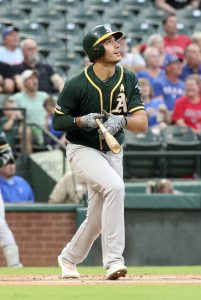
This is where it gets good for the Athletics. With selection No. 47, the one the club received for DeJesus, it chose a Georgia-born high school first baseman named Matt Olson.
“The A’s see Olson as a future middle-of-the-order hitter,” Baseball America wrote at the time. And though Olson was long a well-regarded part of the A’s system, he was never a premium prospect across the league. Now, though, he’s one of the most valuable players on the A’s and among the most well-rounded first basemen in the sport.
After a run as a productive minor leaguer, Olson made it to Oakland in 2016, though he struggled over a mere 26 plate appearances. The next season, however, Olson turned into a monster at the MLB level. The lefty swinger racked up 216 PA and slashed .259/.352/.651 (164 wRC+) with 24 home runs. To this point, that has been Olson’s lone elite showing as a hitter, but that’s not to say he hasn’t been easily above average since then. Dating back to 2018, Olson has slashed .256/.342/.495 (126 wRC+) with 65 homers over 1,207 PA. Those numbers, not to mention his all-world defense, helped him post 7.3 fWAR during the previous two seasons.
Among all major leaguers dating back to 2018, Olson ranks seventh in Ultimate Zone Rating (18.1) and eighth in Defensive Runs Saved (31). One of the few better defenders than Olson has been teammate and third baseman Matt Chapman. He and Olson comprise one of the premier corner infield tandems in the game, and they’ve done it at affordable prices for low-budget Oakland. That’s going to start changing soon – b0th players will enter arbitration for the first of three potential trips next winter. Whether the A’s will be able to keep either around beyond their arb years remains to be seen, but there’s no denying they’ve already gotten excellent value from the two. In Olson’s case, it all began with a trade that didn’t bring potentially strong returns in the beginning.
Photo courtesy of USA Today Sports Images.
Which 15 Players Should The Athletics Protect In An Expansion Draft?
In a few weeks, we’ll be running a two-team mock expansion draft here at MLBTR. Currently, we’re creating 15-player protected lists for each of the existing 30 teams. You can catch up on the rules for player eligibility here.
So far, we’ve done the Angels, Astros, Twins, Royals, Tigers, Indians, White Sox, Rays, Yankees, Red Sox, Blue Jays, and Orioles. The Athletics are next.
First, we’ll remove free agents Marcus Semien, Joakim Soria, Yusmeiro Petit, Khris Davis, Mike Fiers, Liam Hendriks, T.J. McFarland, and Robbie Grossman from consideration.
Then, we’ll lock down this group of nine players:
Matt Chapman
Matt Olson
Frankie Montas
Ramon Laureano
Mark Canha
Sean Manaea
Sean Murphy
Jesus Luzardo
A.J. Puk
That leaves six spots for these 17 players:
Austin Allen
Luis Barrera
Franklin Barreto
Chris Bassitt
Paul Blackburn
Skye Bolt
Seth Brown
Jake Diekman
Daniel Gossett
Tony Kemp
Daniel Mengden
Sheldon Neuse
Chad Pinder
Stephen Piscotty
Burch Smith
Lou Trivino
J.B. Wendelken
With that, we turn it over to the MLBTR readership! In the poll below (direct link here), select exactly six players you think the Athletics should protect in our upcoming mock expansion draft. Click here to view the results.
Oakland’s Meager Return For A Superstar
One of the highest-profile trades of the previous decade saw the Athletics send third baseman Josh Donaldson to the Blue Jays for a four-player package consisting of infielders Brett Lawrie and Franklin Barreto, right-hander Kendall Graveman and lefty Sean Nolin in November 2014. The return at the time seemed underwhelming for an Oakland team that was then coming off its third consecutive playoff berth. Donaldson was highly instrumental in the team’s success in two of those last three seasons – he combined for 13.0 fWAR from 2013-14 – and he wasn’t due to reach free agency until after 2017. Even a low-budget club like the A’s should have been able to keep Donaldson in the fold for at least a little while longer, but they decided against it, to their detriment.
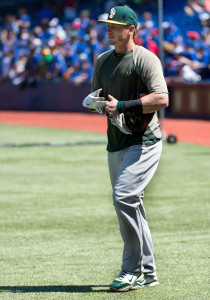
Donaldson, whom many now know as the “Bringer of Rain,” saw his star continue to rise in Toronto. He played for the Jays from 2015-18, during which he slashed .281/.383/.548 (150 wRC+) with 118 home runs and 22.2 fWAR. There were few better major leaguers during that stretch than Donaldson, who took home the AL MVP in 2015 – the first of two straight seasons in which Toronto went to the ALCS. Meanwhile, the A’s won fewer than 70 games in those two years and endured another sub-.500 campaign in 2017 before finally returning to relevance the next season. Oakland has since found its answer at third in the great Matt Chapman.
Despite Chapman’s emergence, has the Donaldson trade been worth it from the A’s standpoint? It doesn’t look like it.
The players Oakland got for Donaldson have combined for 3.8 fWAR in their uniform. Lawrie, once a seemingly can’t-miss prospect, spent one underwhelming season as an Athletic before they traded him to the White Sox in December 2015. Barreto was also considered a superb prospect in his younger days, but the now-24-year-old has done nothing in the majors so far. Graveman was useful with the A’s from 2015-18, during which he turned in 441 1/3 innings of 4.38 ERA ball, but was never more than a back-end starter with the team. He’s now a member of the division-rival Mariners. And Nolin, who only pitched for Oakland during a 2015 season in which he registered a 5.29 ERA over 29 innings, is now with the Seibu Lions of Nippon Professional Baseball.
As of now, it seems fair to call the Donaldson return an enormous disappointment for the Billy Beane-led A’s, who typically know what they’re doing. If there’s one potential silver lining, though, it’s J.B. Wendelken. The righty reliever joined the A’s in a trade with the White Sox for Lawrie in December 2015, and has since turned into a solid reliever. Going back to 2018, Wendelken has logged a 2.55 ERA/3.01 FIP with 8.76 K/9 and 2.55 BB/9 in 49 1/3 innings. Among 523 pitchers whom hitters amassed at least 100 plate appearances against last year, he ranked sixth in expected weighted on-base average (.234), placing him a couple points behind the excellent Josh Hader.
Wendelken hasn’t racked up a large amount of major league experience yet, but if the A’s are going to get anything from deciding to deal Donaldson, he may be their best hope. For the most part, barring a eureka moment for Barreto, the return that Oakland originally received is a lost cause. Donaldson’s still humming along, though. He was good enough as a Blue Jay and then an Indian for the Braves to sign him to a $23MM guarantee going into 2019, and he was so effective in Atlanta last season that Minnesota gave him a four-year, $92MM guarantee over the winter.
Photo courtesy of USA Today Sports Images.