
Giants Notes: Bart, Winn, Eldridge
The Giants are nearing a decision point with catcher Joey Bart, who is now out of options and seems unlikely to crack the club’s Opening Day roster. Patrick Bailey is set to be the primary backstop after a strong season last year and the club signed Tom Murphy in the offseason to back him up. They also have Blake Sabol on the 40-man and can now option him to the minors. He was a Rule 5 pick last year and had to stay up due to the restrictions of that status, but they have now fully secured his rights and can send him down to act as a depth piece.
A spring injury could always clear a path for Bart but he otherwise seems poised to be squeezed off the roster in the next month or so. It’s something that Bart is aware of and he spoke to Susan Slusser of the San Francisco Chronicle about it. “I try not to look out too far ahead,” Bart said. “I can only control what I can control, otherwise you can go off too many places mentally and that wouldn’t put me in the position to be my best. I’m just going to get after it and have fun and have a good spring.”
The second overall pick in the 2018 draft, Bart has hit just .219/.288/.335 in his first 503 major league plate appearances, striking out in 35.4% of them. His work at Triple-A hasn’t been outstanding either, having slashed .274/.357/.434 at that level over the past three years. That line looks decent at first glance but it all came in the hitter-friendly Pacific Coast League, where it actually comes in below average, 97 wRC+. His 28.3% strikeout rate at that level is also on the high side.
Slusser notes that Bart showed up to camp this year in excellent condition, with caveats that “best shape of his life” narratives are common at this part of the calendar. Whether any other clubs buy into his altered physique or not, he could garner interest in spite of his uninspiring results thus far. He was still considered a top 100 prospect in the league as recently as two years ago and catching tends to always be in demand. Slusser speaks to an unnamed scout and executive who each suggest there would be interest from other clubs.
Last month, MLBTR’s Anthony Franco took a look at some clubs who could make sense as a landing spot, listing the Brewers, Diamondbacks, Marlins, Pirates and Rays. Milwaukee has since agreed to terms with Gary Sánchez while Pittsburgh added Yasmani Grandal, but the other three remain plausible fits. Bart’s recent struggles will likely lead to a modest return but the Giants have a few weeks to try to line something up.
Turning to the rotation, Slusser also relays that Keaton Winn is dealing with some elbow soreness. MRIs didn’t reveal any structural damage but manager Bob Melvin says they are “trying to formulate some opinions on where we go.”
Winn also dealt with some elbow soreness last spring and missed about a month of the summer, going on the injured list in the minors while on optional assignment. The fact that no structural damage can be found is perhaps a good sign, but any little issue with a starting pitcher figures to be magnified given the general flimsiness of the club’s starting rotation.
Both Alex Cobb and Robbie Ray are set to start the season on the injured list, rehabbing from hip surgery and elbow surgery, respectively. That leaves the club with a rotation headlined by Logan Webb but little certainty beyond that. Jordan Hicks will be attempting to transition from the bullpen to the rotation, a role in which he has yet to prove himself. Youngsters like Winn, Kyle Harrison and Tristan Beck are the likeliest to fill out the rotation but none of that group has even a year of big league experience.
If Winn’s elbow issue requires him to miss any time, that could force the Giants to turn to depth pieces, with Slusser highlighting non-roster invitees Spencer Howard and Daulton Jefferies as a couple of possibilities. The former has a career ERA of 7.20 while the latter has hardly pitched recently due to thoracic outlet surgery in June 2022 and then Tommy John surgery in September of that same year. If the Giants decide to bolster their rotation mix with an external addition, the free agent market still features Blake Snell, Jordan Montgomery, Michael Lorenzen and others.
Turning to the long-term picture, Slusser also notes that prospect Bryce Eldridge will just be a first baseman for now. He was drafted last year, 16th overall, as a two-way player but it seems he’ll be putting pitching aside for the time being. “We haven’t ruled anything out there, but this year the focus is first base,” general manager Pete Putila says. “We’re super excited about the bat and we want him to get as many plate appearances as possible.”
After the draft last summer, Eldridge got into 16 Complex League games and 15 Single-A games. He hit .294/.400/.505 in 130 plate appearances but didn’t pitch. Prospect evaluators are generally more keen on his abilities as a hitter and it seems the Giants are as well. Listed at 6’7″ and 223 pounds, he played right field last year but will now be moving to first, which is where some evaluators expect him to wind up in the future.
Pohlad: Twins “Not In The Market” For Top Remaining Free Agents
As the baseball world collectively wonders where top-tier free agents like Cody Bellinger, Blake Snell, Jordan Montgomery and Matt Chapman will sign, it seems scarcely a day goes by without at least one team effectively proclaiming itself to be out of that market. The Rangers, Blue Jays, Angels, Giants, Nationals and Mariners have all seen a top baseball ops executive or ownership representative cast doubt on their ability and/or willingness to make further free agent additions of note. Add the Twins to that growing list, as owner Joe Pohlad said in an appearance with WCCO radio’s Jason DeRusha today that his club isn’t likely to make a significant late splash like they did when signing Carlos Correa a couple offseasons ago (audio link).
“…We’re not going to go out and spend $30MM on a player right now,” Pohlad plainly stated without mentioning any of Bellinger, Snell, Montgomery or Chapman by name. “The players that are out there right now that probably a bunch of fans are talking about, we are not in the market for those players.”
Minnesota never looked like a good fit for either of the position players — particularly Chapman — but the Twins are known to be looking for rotation help after seeing Sonny Gray, Kenta Maeda and Tyler Mahle depart as free agents. A late deal with Snell or Montgomery would’ve registered as something of a surprise, given the organization’s candid acknowledgment of plans to reduce payroll amid television uncertainty this winter, but their late entry into the Correa market a couple winters ago might’ve left some to wonder whether a similar approach could be in the offing here. Joel Sherman of the New York Post wrote just yesterday that he “would not discount the Twins as a wild card” for the remaining starters, but Pohlad’s comments today strongly suggest otherwise.
The Twins said early this winter that payroll would likely take a step back, and at the time, Dan Hayes of The Athletic reported a rough target of $125-140MM. Minnesota currently sits just south of that number, at a projected $123.5MM per Roster Resource. It should be noted that Pohlad did not rule out any subsequent additions at all — rather just a big play at the top end of the market.
“…There are definitely other players that can have a positive impact on our team that [president of baseball operations Derek Falvey], I’m sure, is looking at,” Pohlad added.
The Twins, for instance, have reportedly expressed interest in unsigned players like Michael Lorenzen, Adam Duvall and Michael A. Taylor. Signing one or even two of those names would cost considerably less than a run at Montgomery or Snell. They also watched old friend Jake Odorizzi‘s recent workout for teams. Falvey and his staff have also never been ones to shy away from trades late in the offseason. Deals to acquire Pablo Lopez (Jan. 23) and Odorizzi (Feb. 17) were both completed well after the New Year in their respective offseasons. The acquisition of Chris Paddack and Emilio Pagan came on the eve of Opening Day in 2022. It remains possible that some pitching or right-handed-hitting outfield help could be acquired via that market.
Generally speaking, it’s been a quiet offseason for the Twins. They shipped stalwart infielder Jorge Polanco to the Mariners late last month in a deal netting right-handers Justin Topa and Anthony DeSclafani and prospects Gabriel Gonzalez and Darren Bowen. Minnesota netted about $6.5MM in that deal as well and reinvested that money in free agent deals to sign Carlos Santana and Jay Jackson. More recently, they flipped utilityman Nick Gordon to the Marlins for lefty reliever Steven Okert.
Red Sox, Brayan Bello Discussing Extension
The Red Sox and right-hander Brayan Bello are actively engaged in contract discussions, Bello himself tells Chris Cotillo of MassLive.com. While the 24-year-old righty didn’t put a specific timetable on when an agreement might come together, he suggested it’s possible that a deal could come together this spring.
Bello has long been viewed as a potential core piece for the Sox. Prior to making his big league debut in 2022, he was widely regarded as one of the Sox’ five to ten best prospects. He’d posted strong numbers in the upper minors and drawn praise from scouts for both a plus changeup and potentially plus heater, leading to projections as a future mid-rotation arm if all went according to plan.
Through the first season-plus of his career, Bello has pitched 214 1/3 innings of 4.37 ERA ball. His 20% strikeout rate is below the league average, but his 7.7% walk rate is better than average and his 56.1% ground-ball rate is among the best in the game for starting pitchers. That grounder rate and his command have led fielding-independent metrics to be a bit more bullish on the righty than his earned run average (4.11 FIP, 4.14 SIERA).
Bello’s four-seamer and more heavily used sinker have both been hit hard by MLB opponents, but that highly touted changeup has indeed stood out as a clear plus pitch for him; opponents have batted just .186 and slugged only .256 off the pitch in his career thus far. That’s been his only pitch with consistently strong results to date, but Bello sits 95.2 mph on his sinker and 95.7 mph on his four-seamer, so the velocity is certainly there for him to find success with his primary offerings. His 11% swinging-strike rate and 32.1% opponents’ chase rate are both right in line with the league-average marks, so there’s room for his strikeout rate to creep up a bit even in the absence of significant gains with his fastballs.
To this point in his career, Bello has amassed 1.082 years of major league service time. That puts him on track to be eligible for arbitration in the 2025-26 offseason and keeps him under Red Sox control through at least the 2028 season. Contract extensions for starting pitchers in this service bracket have been surprisingly rare in recent years, as shown in MLBTR’s Contract Tracker. For a whole decade, Madison Bumgarner‘s five-year, $35MM extension with the Giants back in April of 2012 stood as the record for this service class.
Braves righty Spencer Strider utterly shattered that precedent when he put pen to paper on a six-year, $75MM extension after just having surpassed one year of service (1.003). That extension came on the heels of an overpowering rookie season in which Strider finished second (to his own teammate, Michael Harris II) in National League Rookie of the Year voting. He’d logged 131 2/3 innings with a 2.67 ERA while fanning a borderline comical 38.3% of his opponents.
Bello’s performance to date doesn’t measure up to that dominance from Strider, and he’d likely fall well shy of that highwater mark on an extension of his own. Cincinnati right-hander Hunter Greene‘s even more recent six-year, $53MM extension could be viewed as a more salient comp for Bello’s camp, though it’s not perfectly analogous in its own right. Greene’s rookie showing in 2022 featured 125 2/3 innings of 4.44 ERA ball, and when he signed his contract in April of 2023, he carried a career 4.42 ERA in 148 2/3 frames. His path to those results was quite different — overpowering triple-digit fastball, plus strikeout rate, average command and a pronounced fly-ball profile — but they roughly align with Bello’s run-prevention numbers. Greene, however, is generally regarded as having a higher ceiling.
Both Strider and Greene signed six-year deals with a club option for a seventh season. A six-year deal would carry Bello through the 2029 season, and a seventh-year club option would give the Sox control over Bello’s 2030 campaign. If the two sides were to deviate from that structure, age could be a factor; Greene’s deal began in his age-23 campaign and Strider’s in his age-24 season. The 2024 campaign will be Bello’s age-25 season. A six-year deal and club option would keep him under club control through his age-31 year and position him to become a free agent entering his age-32 season.
If Bello wants a faster path to free agency (e.g. five years and an option), that’d be understandable but would also surely mean taking a guarantee shy of Greene’s $53MM. Even on a six-year deal, he’d likely fall a bit shy of that mark. When comparing him to Greene, it also bears mentioning that Greene had a larger safety net as a former No. 2 overall pick who’d received a $7.25MM bonus in the draft. Bello signed as a teenager out of the Dominican Republic for a $28K bonus and doesn’t have that type of financial security already established.
Whatever shape talks take, the mere fact that Boston is actively engaged in contract talks with a core young player represents a change of pace. The team waited until Rafael Devers was a year from free agency before shelling out a massive 10-year, $313.5MM extension (on top of his existing $17.5MM salary for his final arb year). Extensions for Xander Bogaerts (six years, $120MM) and Chris Sale (five years, $145MM) both similarly came when they were established stars with more than five years of MLB service. Again looking to our Contract Tracker, the only other pre-arb extension the Sox have given out in the past decade was Garrett Whitlock‘s four-year, $18.75MM deal. Prior to that, you’d have to go way back to Clay Buchholz in 2011 to find an extension for a player who’d yet to reach arbitration.
Red Sox CEO Sam Kennedy spoke earlier in camp about a need to begin exploring this type of contract earlier in his players’ careers (link via MassLive’s Sean McAdam). “Starting earlier, is probably a lesson,” Kennedy said just a few days ago. “We’ve not had a ton of success in extending our own guys. We have in the past and it’s been a great recipe for success. But I think starting those conversations earlier is a great idea.”
The Opener: Woodruff, Ryu, Rays, Full-Squad Workouts
With Spring Training workouts in full swing, here are three things to keep an eye on around baseball today:
1. Awaiting financial details for Brandon Woodruff, Hyun Jin Ryu
A couple of veteran starters reportedly agreed to new deals this past week, but the financial details of both contracts have yet to be revealed. News of Brandon Woodruff returning to the Brewers broke on Monday morning, but currently, all we know is that his new pact is a two-year deal. Hyun Jin Ryu is also returning to a former team, the Hanwha Tigers of the KBO. While the complete details of his contract have not been revealed either, Jeeho Yoo of Yonhap News reports that the Eagles are likely to announce the deal on Thursday. Taking into account the time difference, Ryu’s deal could be announced at some point this evening; 6:00 pm CT will be 9:00 am in South Korea.
2. Are the Rays planning to trade an infielder?
The Rays agreed to terms on a one-year, $1.5MM contract with infielder Amed Rosario on Tuesday. While $1.5MM might be a drop in the bucket for some teams, it’s hard to imagine the Rays would sign Rosario to such a deal if they weren’t planning to give him regular playing time. Yet, with Brandon Lowe entrenched at second base and José Caballero the presumptive starter at shortstop, Rosario is likely to fill a utility role off the bench. That would leave infielders Junior Caminero and Osleivis Basabe without a clear path to playing time. A top prospect like Caminero can force his way onto the roster with a strong performance in the minor leagues, but it is less clear how Basabe fits into the Rays’ plans for 2024. Moreover, with veteran infielder Yu Chang in the organization on a minor league deal and Taylor Walls set to return from hip surgery sooner rather than later, this team has no shortage of depth. One has to wonder if the Rays are planning to make a trade from their surplus of infielders.
3. Full-squad workouts have begun, but teams are far from complete
As of Tuesday, all 30 clubs have now held their first full-squad workouts. That means Spring Training is officially underway, with games set to begin later this week. The Dodgers and Padres will kick things off in the Cactus League on Thursday afternoon, with Grapefruit League play set to begin a couple of days later. However, despite what the moniker “full-squad workout” might imply, several clubs are far from finished improving their rosters. With 10 of MLBTR’s Top 50 Free Agents still unsigned, including Cody Bellinger, Blake Snell, Jordan Montgomery, Matt Chapman, and J.D. Martinez, plenty of teams could be significantly better by Opening Day than they appear right now. The free agent market has been slow as of late, but as Spring Training continues, more pieces will inevitably fall into place.
Rays Sign Amed Rosario To One-Year Deal
The Rays added to their infield on Tuesday afternoon, signing Amed Rosario to a one-year contract. The Octagon client is reportedly guaranteed $1.5MM and can unlock an additional $500K in incentives. Tampa Bay placed Drew Rasmussen, who is recovering from flexor surgery, on the 60-day injured list in a corresponding move.
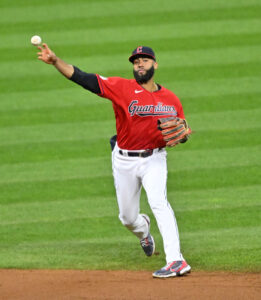
Rosario, 28, has been an everyday big league shortstop for many years but is coming off a challenging season. He started the year with the Guardians but was hitting just .265/.306/.369 when the deadline was approaching, with that production translating to a wRC+ of 87. His shortstop defense had always been questionable but it became downright problematic in 2023. He was tagged with grades of -16 Defensive Runs Saved and -15 Outs Above Average with Cleveland.
The Guards flipped him to the Dodgers for Noah Syndergaard, and Rosario’s new club moved him to the other side of the bag most of the time. He seemed to take well to the position switch, at least in a small sample of 190 innings, producing 3 DRS and OAA at an even zero. His bat was roughly the same, as he hit .256/.301/.408 as a Dodger for a wRC+ of 93.
He was a notably better in the two prior seasons. He hit 11 home runs in both 2021 and 2022, a modest number but much better than the six he hit in 2023. He slashed .282/.316/.406 in those two years with Cleveland for a 103 wRC+, not walking much but also avoiding strikeouts, 4.5% walk rate and 18.4% strikeout rate.
Defensively, he had a positive grade from DRS in 2022 but has otherwise always been subpar. OAA has had him in negative territory in each full season of his career. He probably won’t be an everyday option for the Rays at shortstop but he might see some occasional time there.
The Rays love flexibility and have a big hole at shortstop thanks to the absence of Wander Franco, who has an uncertain future as he’s under investigation for having a relationship with an underage girl. In addition to that, Taylor Walls is recovering from hip surgery and will miss at least part of the season. President of baseball operations Erik Neander recently suggested that José Caballero could be the starter to begin the year.
The club also has prospect Junior Caminero, who is generally considered one of the top 10 prospects in the sport and has already made his major league debut. But his bat is considered superior to his defense and some evaluators expect him to wind up at third base rather than short. Osleivis Basabe is in the mix but he didn’t hit much in his first taste of the majors or Triple-A. They added Yu Chang on a minor league deal earlier today to provide some non-roster depth.
Caballero, acquired from the Mariners in the Luke Raley deal, has just 280 MLB plate appearances and slashed just .221/.343/.320 in those. He has some speed, having swiped 26 bags in 29 tries last year, and the defense seems to be good, 4 DRS and 2 OAA thus far. But overall, the Rays don’t have a ton of solid answers for their shortstop position and Rosario could perhaps factor in there.
But if his days at that position are no more, there are still ways for him to be useful for the Rays. The right-handed hitter has wide platoon splits in his career, having hit .298/.339/.467 against lefties for a 121 wRC+ but just .262/.296/.374 the rest of the time for a wRC+ of 84.
The Rays have a left-handed hitting second baseman in Brandon Lowe and he also fares better with the platoon advantage. He’s hit .220/.284/.437 against southpaws, 99 wRC+, but produced a huge line of .253/.349/.499 and 135 wRC+ against righties. He’s also had notable injury setbacks in his career, with 2021 being his only season in the big leagues where he played in more than 109 games. A platoon of Lowe and Rosario at the keystone could perhaps be best for both players.
Players like Josh Lowe and Jonathan Aranda are also lefties with notable issues when southpaws are on the mound. That could perhaps lead to Rosario getting some time as the designated hitter or even taking a corner outfield role on occasion. He has just 171 1/3 innings of outfield experience at the big league level but the Rays could perhaps try to rotate him through if they think it will help their versatility.
Despite his rough season and generally poor defensive track record, Rosario still generated plenty of interest this winter. The free agent market for middle infielders was on the weak side but plenty of teams were in need of help there. The Angels, Marlins, Red Sox and Blue Jays were connected to him at various points in the offseason. The Jays pivoted to Justin Turner and Isiah Kiner-Falefa as their infield additions while the Red Sox filled their second base position by trading for Vaughn Grissom. The Marlins are still looking to upgrade at shortstop but reportedly have made an offer to Tim Anderson. The Angels are known to have interest in bringing back Gio Urshela as a multi-positional infield upgrade.
Jeff Passan of ESPN first reported the Rays and Rosario had agreed to a one-year, $1.5MM contract. Marc Topkin of the Tampa Bay Times reported the $500K in incentives.
Latest On MLB’s Expansion Timeline
With the A’s and Rays nearing resolution on their long-running stadium disputes, expansion could become a more pressing topic for MLB in the second half of the 2020s. Rob Manfred said earlier this month he hoped to have the next couple major league cities agreed upon by the end of his tenure as commissioner. Manfred plans to retire at the conclusion of his term in January 2029.
ESPN’s Jeff Passan writes that while there are no current expansion plans in place, many high-ranking team and league officials consider it inevitable the league will move to 32 franchises. Passan suggests that’s unlikely to occur before the early portion of the 2030s, a timeline that generally aligns with Manfred’s goal of getting the ball rolling before leaving office in five years. There are clear logistical issues — expansion fees, stadium construction, etc. — that’d need to be sorted out between narrowing the field of cities and putting two more MLB teams on the field.
While the league could get a jump on that process, expansion isn’t yet a priority. The A’s are still figuring out where they’ll play between 2025-27. Manfred said this month that MLB also needed to “get our footing on local media a little bit better” before making significant changes. That’s a reference to the uncertain broadcasting revenues facing a number of teams as cord-cutting has threatened the viability of many regional sports networks.
There will also be another round of collective bargaining negotiations before the expansion process kicks into gear. We’re two-fifths of the way through the current CBA, which expires in December 2026. The last round of collective bargaining resulted in a 99-day lockout over the offseason, the first official MLB work stoppage since the strike in 1994-95. Labor issues also delayed the return to play during the COVID-19 pandemic in 2020. It’s possible the next round of CBA negotiations could be similarly contentious.
Once expansion does become a more immediate concern, various cities could make a push for teams. Passan reports that early planning is to choose one team each from the East and West. According to Passan, Nashville and Salt Lake City have emerged as preliminary frontrunners.
Music City Baseball was established in 2019 with the goal of bringing a franchise to Nashville. Don Mattingly, Tony La Russa, Bruce Bochy, Dave Stewart and Dave Dombrowski are among a host of high-profile people who have been associated with the project.
Salt Lake City’s push didn’t begin in earnest until last April. Big League Utah, a group led by former Utah Jazz owner Gail Miller, began the process of seeking an expansion franchise. SLC is one of three cities — joining Oakland and Sacramento — that is in contention to host the A’s before their planned Vegas stadium opening in 2028. Landing the A’s on a temporary basis would presumably boost their chances of securing a franchise of their own in the future.
Of course, plenty can change in the intervening few seasons. Nothing is anywhere near set in stone. The process hasn’t yet begun, but it could come into focus within the next couple years. MLB has been at 30 teams since adding the Diamondbacks and Devil Rays in 1998, the longest static period since the league first expanded from 16 to 18 teams in 1961. Passan’s column is worth a full read, as he lists a few other cities that have been floated as possibilities and covers a number of challenges that groups could face as they try to secure a new franchise.
Hollander: Mariners Additions Likely To Be “More On The Margins”
Mariners general manager Justin Hollander met with reporters this afternoon to discuss the possibility of some late-offseason acquisitions. While Hollander — who is second in the Seattle front office hierarchy behind baseball operations president Jerry Dipoto — left the door ajar for anything, he indicated the likelier course of action was to supplement towards the back of the roster.
“You never know. I think this group of players that we have — our 40-man roster as is — we may add on the margins. We may add in a more significant way, but I would expect it’s probably more on the margins than a real significant way based on where we’re at,” Hollander said (link via Daniel Kramer of MLB.com).
The comments come a couple days after Ryan Divish of the Seattle Times reported that the M’s have had internal discussions about Matt Chapman, one of the top four unsigned free agents. Hollander didn’t comment on Chapman — the CBA limits what team personnel are allowed to say regarding specific players — but Kramer writes that the M’s conversations about the third baseman occurred earlier in the month.
There was never any indication that Seattle is deeply involved in Chapman’s market. Kramer reports that the M’s interest has been contingent on the four-time Gold Glover lowering his asking price significantly. According to Kramer, a nine-figure deal for Chapman would be a “non-starter” for Seattle. The MLB.com report indicates the Mariners would be amenable to a shorter-term/incentive-laden contract, although that unsurprisingly hasn’t been of interest to Chapman’s camp at the Boras Corporation.
Third base looks like a relative weak point for Seattle. The Mariners dealt Eugenio Suárez to the Diamondbacks at the beginning of the offseason. They brought in Luis Urías in a small trade with the Red Sox and indirectly addressed the hot corner with last month’s Jorge Polanco deal. Installing Polanco at second base pushes lefty-hitting Josh Rojas over to third, likely in a platoon with the right-handed Urías.
Urías enters camp at a little less than full strength. The Mariners reveled today that he is battling some soreness in his throwing shoulder coming out of winter ball (via Divish). It’s not a serious issue but will keep him from throwing across the diamond in infield drills early in Spring Training.
Hollander downplayed any concern about the third base platoon. Asked if the M’s felt they’re vulnerable at the position, he replied: “I don’t really feel that way, no. … We feel really good about what the combination of Josh and Luis can do for us this year.”
That’s the expected tone for a GM to strike publicly. That said, Chapman is the only unsigned third baseman who’d be a clear upgrade on the Rojas/Urías pairing. If Seattle is simply keeping tabs on his market in case the opportunity presents itself to jump in at a lower price, they’re presumably otherwise content with their in-house options.
Seattle has also been loosely tied to the top two remaining free agents, Blake Snell and Cody Bellinger. The link to Snell has primarily been about geography rather than team need. The defending NL Cy Young winner is a Seattle native and there has been some speculation he could prefer to stay on the West Coast after three seasons in San Diego.
Despite that chatter, Kramer writes that the Mariners haven’t shown much interest in Snell at any point during the winter. The M’s traded rehabbing starter Robbie Ray and depth arm Marco Gonzales but have held onto their top five starters: George Kirby, Luis Castillo, Logan Gilbert, Bryce Miller and Bryan Woo. Former top 10 pick Emerson Hancock remains on hand as a high-upside depth piece.
Bellinger was arguably a better roster fit, but Kramer reports that Seattle hasn’t considered the former MVP in either of the past two offseasons. The M’s reacquired Mitch Haniger and brought in Luke Raley from Tampa Bay as part of a reshaped corner outfield. Seattle shipped out one-time top prospect Jarred Kelenic, leaving Haniger and Raley as the presumptive starters alongside Julio Rodríguez on the outfield grass.
Seattle has generally preferred the trade route over free agency under Dipoto, particularly with regards to position players. This offseason’s two-year, $24MM deal for Mitch Garver was the first multi-year free agent contract for a hitter that Seattle has given out in Dipoto’s tenure. Roster Resource projects the organization’s 2024 player spending in the $135MM range. That’s a middle-of-the-pack figure that’s right in line with last year’s approximate $137MM Opening Day sum.
White Sox’ Edgar Navarro To Undergo Tommy John Surgery
White Sox reliever Edgar Navarro is slated to undergo Tommy John surgery in early March, the team announced to reporters Tuesday evening (X link via Scott Merkin of MLB.com). He’ll miss the 2024 season as a result and could be sidelined early in 2025 as well.
Navarro, 26, made his big league debut with the ChiSox in 2023, pitching 8 2/3 innings out of manager Pedro Grifol’s bullpen. He was tagged for seven runs on 11 hits and a pair of walks with nine punchouts in that brief cup of coffee, with the bulk of the damage coming in one nightmare outing that saw him yield five runs in a lone inning of work. Chicago outrighted him off the 40-man roster in December to clear a roster spot for free-agent signee Erick Fedde. Injured players can’t be placed on outright waivers, so the fact that Navarro was outrighted a couple months back suggests this is a new injury that occurred in the offseason.
In the upper minors, Navarro has enjoyed better run prevention but still displayed shaky strikeout and walk tendencies. He notched a combined 3.59 ERA between Double-A and Triple-A in 2023 but did so while fanning just 19% of his opponents against a 16.1% walk rate. Navarro kept the ball on a huge 59.8% clip in the minors and at a 53.8% clip in the big leagues, leaning hard on a sinker that averaged 93.6 mph. That’s an encouraging trait, but he’ll need to drastically improve his K-BB profile if he’s to find sustained success at the game’s top level. The injury in question will prevent his ability to refine that K-BB profile for at least the next year.
Navarro has never been considered among the White Sox’ top prospects, due in no small part to his poor command. He’s shown the ability to miss bats at times and has consistently piled up grounders at borderline elite levels, but the 6’1″ righty has also walked 12.8% of his opponents across all professional levels and plunked a whopping 44 batters in 273 professional innings. In all, he’s allowed 16.2% of his opponents to reach base without even putting a ball in play.
Dominic Fletcher Has “Leg Up” On White Sox’s Right Field Job
While most of the White Sox’s offseason has focused on players they could trade away, they acquired outfielder Dominic Fletcher from the D-Backs a few weeks ago. Chicago sent pitching prospect Cristian Mena to Arizona to take a look at Fletcher, so it’s no surprise he goes into camp with a good chance at securing a starting job.
General manager Chris Getz told reporters this evening that Fletcher has the “leg up” in the right field competition (via Vinnie Duber of CHGO Sports). If Fletcher secures the spot in camp, it’d be his first Opening Day job. The Arkansas product made his MLB debut at the end of last April.
Arizona didn’t give Fletcher much of a look in the majors. He appeared in 28 games and turned in a solid .301/.350/.441 showing through his first 102 plate appearances. Fletcher spent the bulk of the year at Triple-A Reno. He hit .291/.399/.500 with 10 homers in 334 trips to the plate. Fletcher kept his strikeouts to a modest 18.6% rate and walked at a strong 12.6% clip.
The 26-year-old has posted above-average offensive production throughout his professional career. He owns a .295/.366/.474 line in parts of four minor league seasons. That has generally come in hitter-friendly settings against younger competition, though, which is part of the reason that many prospect evaluators suggest he’s better suited as a complementary outfield piece than a regular. There are still questions about his pitch selection and raw power upside. Baseball America slotted him as the #20 prospect in the Chicago system after the trade.
Nevertheless, the White Sox are in position to give Fletcher an opportunity to try to outperform those projections. They had the worst right field grouping in MLB a season ago. Chicago received a .219/.271/.344 batting line with below-average defense from the position. Oscar Colás was a reasonably well-regarded prospect but posted a miserable .216/.257/.314 slash through his first 75 MLB games. Gavin Sheets‘ .203/.267/.331 mark wasn’t much better. Colás and Sheets each have at least one minor league option remaining, so the Sox could send either player back to Triple-A Charlotte without putting them on waivers.
Aside from Fletcher, Chicago hasn’t done a whole lot to bolster the short-term outfield mix. They acquired Zach DeLoach from the Mariners as part of the Gregory Santos return. He’s on the 40-man roster but has yet to make his MLB debut. DeLoach had a .286/.387/.481 showing in Triple-A a year ago. He connected on 23 homers but also struck out at an alarming 27.8% rate. Kevin Pillar, Rafael Ortega and Brett Phillips are all in camp as non-roster invitees. Pillar, as a right-handed hitter, could have the best path of that trio to an MLB job. Each of Fletcher, DeLoach, Colás and Sheets hit from the left side.
The other two outfield spots at Guaranteed Rate Field are locked in. Luis Robert Jr. is a franchise cornerstone in center field. Left fielder Andrew Benintendi had a rough first season in Chicago but will get a chance at a rebound in year two of a franchise-record $75MM free agent deal.
Yankees Notes: Judge, Holmes
Yankees outfielder Aaron Judge had a challenging season in 2023, suffering a torn toe ligament when he collided with the outfield wall at Dodger Stadium. Back in December, general manager Brian Cashman described it as “a resolved issue” but Judge spoke on it today and didn’t frame it with the same sort of finality. He said it will likely require “constant maintenance” for the rest of his career, per Gary Phillips of the New York Daily News.
Judge still said that he’s feeling good, so it doesn’t appear there’s real cause for concern in the immediate future. Nonetheless, it’s something that could be worth watching going forward. Judge is turning 32 years old in April and it slated to become an everyday center fielder this year, with Juan Soto and Alex Verdugo in the corners. Judge may get the occasional day as the designated hitter, with Trent Grisham taking over in center, but it still figures to be a notable jump in terms of work.
In 2022, Judge got into 78 games as a center fielder and logged 632 2/3 innings at the position, with both of those currently standing as his career highs. Assuming he avoids the injured list this year, he should easily blow past both figures. His career marks have been passable at the position, especially considering his minimal experience there, with three Outs Above Average, -1 Defensive Runs Saved and a grade of -0.4 from Ultimate Zone Rating.
Maintaining those average-ish marks over a larger sample of playing time will something of a challenge. He’ll also be doing so while trying to work against the natural aging curve that generally comes for players as they push towards their mid-30s and trying to keep the toe thing at bay. It’s a lot of minor things but they could perhaps add up over time, with Judge having eight years left on his contract. Last season’s results were nothing to worry about, however. After coming off the IL in late July, Judge hit .245/.408/.557 over the remainder of the season for a wRC+ of 164.
Elsewhere in Yankee news, right-hander Clay Holmes tells Joel Sherman of The New York Post that the club has not yet approached him about an extension. Holmes, 31 next month, is slated to become a free agent at the end of this year.
Over the past two years, Holmes has established himself as the club’s primary closer, racking up 44 saves over those two campaigns. He’s thrown 126 2/3 innings in that time, allowing 2.70 earned runs per nine. He has struck out 26.1% of batters faced and given out walks at an 8.2% clip while, most impressively, keeping 70.6% of balls in play on the ground. That’s the best grounder rate in the majors among pitchers with at least 120 innings pitched over the last two years.
Keeping that kind of production around beyond the upcoming season is surely appealing, especially for a Yankee club that is known to favor ground ball specialists. But since he’s so close to the open market, the Yanks would likely have to pay something close to free agent prices in order to get him to sign.
Perhaps the club feels they can find the next Holmes another way. As Sherman points out, Holmes didn’t have a huge track record at the time the Yankees acquired him. He had a 5.57 career ERA when the Yanks sent Hoy Park and Diego Castillo to the Pirates to get Holmes, before turning him into a lockdown closer.
But as Sherman also points out, the bullpen is on the cusp of major turnover. Each of Holmes, Jonathan Loáisiga, Tommy Kahnle and Caleb Ferguson are impending free agents. Those four are arguably the club’s top high-leverage guys, leaving a lot of uncertainty going into 2025 and beyond. Bullpens can be fungible and it’s entirely possible the picture is drastically changed by next winter, but there’s a decent chance the Yanks will need to go get someone in free agency.
The club’s payroll will likely be a topic of conversation next winter, as they will likely find themselves paying the competitive balance tax yet again. Roster Resource calculates next year’s CBT number as $190MM, even before factoring in arbitration raises for players like Grisham, Nestor Cortes or Jose Trevino. There’s also Anthony Rizzo‘s $17MM club option to consider, with a $6MM buyout making it a net $11MM decision.
Next year’s base threshold will be $241MM while the Yanks will be looking to replace impending free agents like Soto and Verdugo in their outfield mix. Perhaps they would prefer to keep their powder dry for those pursuits instead of spending on their bullpen ahead of time.