
Legends Memorabilia – Mike Trout Signing OPEN! (Sponsored)

This holiday season, Legends Memorabilia Collection (LMC) offers a gift lineup for the ultimate sports fan. From MLB autographs from Hall of Famers and All-Stars to iconic NFL and college football memorabilia from the biggest names in the game, this curated guide spotlights top items perfect for the holiday gift-giving season!
Right now, there is a special opportunity for MLB Trade Rumors readers. Using the discount code “TR10”, receive 10% off any purchase.
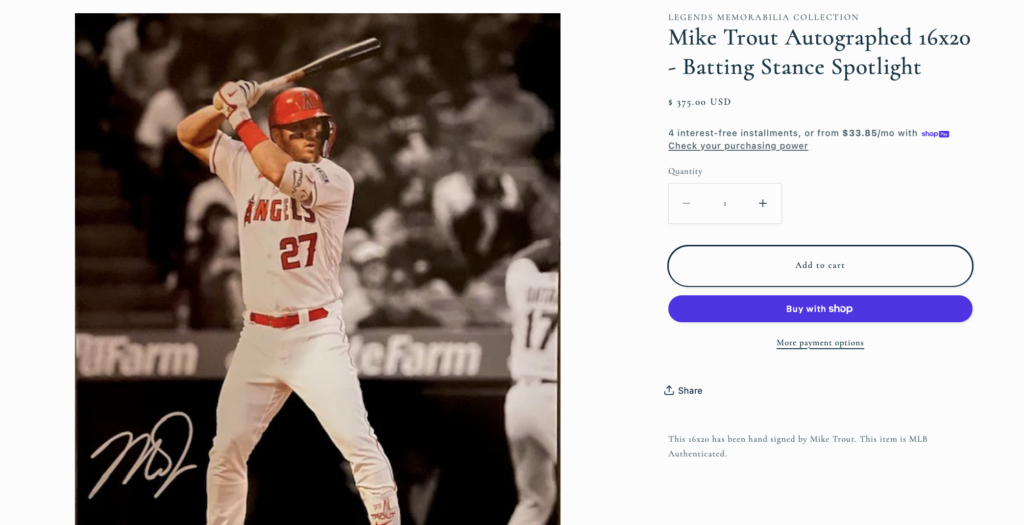
Now through December 1st, fans can send in items to be signed by Mike Trout.
How it works:
Go to ShopLegends.com and locate the Mike Trout signing page.
There will be several options for allowable products to send-in that include:
- Send-in baseball
- Sent in flat item (up to 16×20 in size)
- Trading card
- Equipment (jersey/bat/helmet, etc).
- Game used item
- Original artwork
- Team signed item
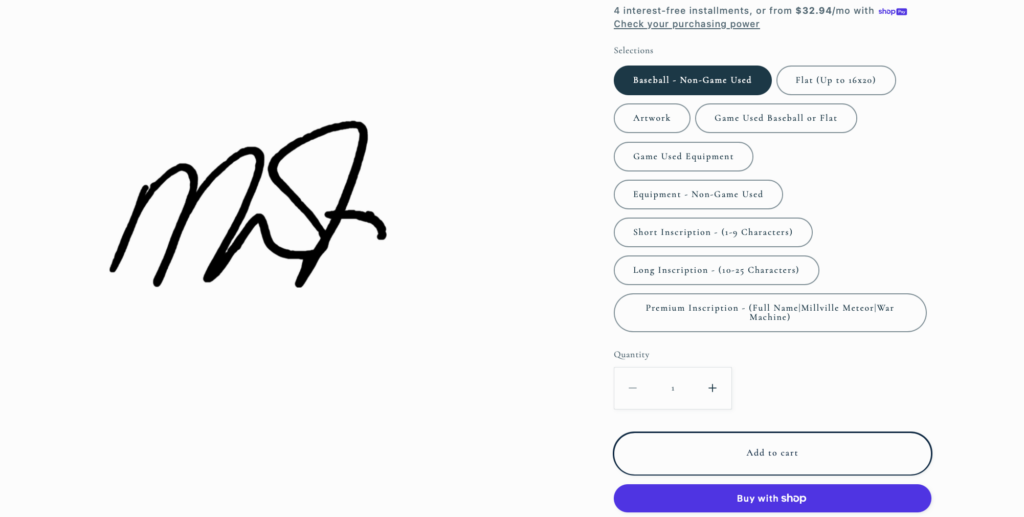
Simply pick what you’ll be sending, add to cart, and pay – don’t forget to use “TR10” as a code!
After, send-in your item to the address on the website:
Legends Memorabilia Collection
ATTN: Send Ins (CUSTOMER NAME – ATHLETE NAME)
7100 Broadway, Building 6H
Denver, CO 80221
If the signing option isn’t the best fit – don’t worry! There are tons of other products available, that include other signatures from Roki Sasaki, World Series MVP Yoshinobu Yamamoto, Derek Jeter, & more.
Plus, plenty of Mike Trout memorabilia available on the site too if you can’t wait for send-in items!
About Legends Memorabilia:
At Legends Memorabilia Collection, their mission is to honor the legacy of the game by preserving and showcasing iconic sports memorabilia—while giving back to the legends who made it all possible. They are committed to putting money back into the pockets of the players, ensuring they share in the value of the memories they helped create. By connecting fans with authentic, player-backed collectibles, they celebrate the past, empower the present, and invest in the future of sports history.
All items come with MLB Authentication. They are one of two companies that have access to MLB authentication, so everything is authentic from the signings.
Visit ShopLegends.com often or subscribe to their email list this offseason to stay up to date on all happenings, like their Mike Trout signing that ends on December 1st. Get your send-ins done now before the Holidays!
This is a sponsored post from Legends Memorabilia.
Rangers Trade Marcus Semien To Mets For Brandon Nimmo
Nov. 24: The two teams have formally announced the swap.
Nov. 23: In an intriguing one-for-one swap of prominent veterans, the Mets and Rangers have agreed to a trade that will send second baseman Marcus Semien to Queens in exchange for outfielder Brandon Nimmo. New York is also sending $5MM to help Texas offset some of the difference between the two players’ remaining salaries.
Reports emerged earlier this week that the Mets were open to moving Nimmo, though as of Thursday, trade talks reportedly hadn’t developed to the point that the Mets had approached Nimmo about waiving his contract’s no-trade clause. Mike Puma of the New York Post wrote today that the team raised the subject of the Texas trade with Nimmo on Friday. After a day’s consideration and a chat with Rangers ace (and his former Mets teammate) Jacob deGrom, Nimmo agreed to approve the deal.
Given the trade buzz this week, it isn’t entirely shocking to see the veteran outfielder’s time in New York come to an end. That said, a straight-up swap for Semien is eye-opening, given how Semien is coming off a dismal year at the plate and comes with a significant future price tag in his own right.
Semien has $72MM and three seasons remaining on the seven-year, $175MM free agent deal he signed with Texas during the 2021-22 offseason. Nimmo is owed $101.25MM through the 2030 season, as he has completed three years of the eight-year, $162MM free agent he signed to remain with the Mets in December 2022. Since luxury tax figures are re-calculated to account for just remaining money owed in the wake of trades, Semien’s tax number is $24MM, and Nimmo has a $19.25MM figure (when factoring in the $5MM Texas is getting from New York).
 The Mets are therefore taking on a slightly bigger tax hit while reducing the amount of overall dollars owed, while the Rangers are reducing their tax number but adding more overall money to their books. That adds an interesting wrinkle for a Texas club that was expected to reduce payroll this winter, though it is worth noting that the Rangers cleared a good chunk of money off the books (a projected $21.1MM) on Friday with four non-tenders.
While the financial elements can’t be overlooked, the trade is also something of an old-school, need-for-need “baseball deal” that allows both the Mets and Rangers to address needs. Beginning with Texas, the team was prioritizing a different offensive approach based around contact hitting and getting on base.
Nimmo’s strikeout rates have been overall middling throughout his career, though his chase and whiff rates have been consistently above average. His walk rates had also been strong before suddenly dropping to 7.7% in 2025, in a career-low for the outfielder over a full season. Still, Nimmo hit .262/.324/.436 with 25 homers over 652 plate appearances, translating to a 114 wRC+ over 652 plate appearances as New York’s everyday left fielder. Public defensive metrics have also looked a lot more fondly on Nimmo’s glovework since he moved to left field from center field.
Since Adolis Garcia has now been non-tendered, Nimmo can slide into the left field position in Arlington, with Evan Carter or (probably more likely) Wyatt Langford moving into Garcia’s old spot in right field. Second base is now opened up for Josh Smith or Ezequiel Duran in the short term, and top prospect Sebastian Walcott could also potentially find a home at the keystone depending on how long Corey Seager remains at shortstop. The Rangers could also now explore the market for trade or free agent options at second base, with Semien no longer in the picture.
Selected 13th overall by the Mets in the 2011 draft, Nimmo has spent his entire career with the Amazins, becoming a fan favorite due to his consistent offense. Injuries were a major hindrance for Nimmo earlier in his career and he is entering his age-32 season, but he has played in at least 151 games in each of his last four seasons.
In short, it seems like the Rangers feel more comfortable about paying Nimmo a bit of extra money over a longer term than they were paying Semien over his age 35-37 seasons. A picture of durability throughout his career, Semien suffered a rare serious injury in 2025, as he was limited to 127 games by a Lisfranc sprain and a small fracture in his left foot. Beyond just the health issue, Texas was perhaps more concerned about Semien’s dropoff at the plate over the last three seasons.
 2023 was Semien’s last year as a premium hitter, as he hit .276/.348/.478 with 29 homers over 753 PA for the Rangers’ World Series team. Semien delivered a 128 wRC+ that year, and his key role in Texas’ first championship will forever make him a beloved figure in Arlington. After that dream season, however, Semien dropped to a 101 wRC+ in 2024, and then a subpar 89 wRC+ in 2025. A .251 BABIP over the last two seasons is a partial explanation, yet the bigger culprit is a sizeable decline in power.
A change of scenery could perhaps get Semien’s bat going, even if Citi Field is known as a pitcher-friendly ballpark. Semien does bring a right-handed hitting element to a Mets lineup that leaned left, and has now subtracted an everyday lefty swinger in Nimmo. Beyond just Semien’s offense and his reputation as a clubhouse leader, he remains an outstanding defensive second baseman who just won his second career Gold Glove.
Mets president of baseball operations David Stearns stated that run prevention was a chief area of improvement for his team, so installing Semien at second base is a big defensive upgrade. Removing a solid defender like Nimmo from left field is a hit unto itself, yet Jeff McNeil could make up some of the difference since left field now looks to be McNeil’s primary position with Semien locked into second base. McNeil could also get part-time work in center field, or it is possible he might also end up on another roster, as rival teams have been discussing McNeil in trade talks.
It is a little surprising to see New York make such a prominent move to address second base, given how first and third base were the far more unsettled infield positions heading into the winter. Pete Alonso‘s free agency leaves first base open, and Brett Baty now looks to be staying at third base with Semien on board. Top prospect Jett Williams is expected to make his MLB debut in 2026, and the outfield could now be Williams’ future position since Semien and Francisco Lindor have accounted for the middle infield. Semien’s addition also brings fresh questions about how the Mets will incorporate Mark Vientos, Luisangel Acuna, and Ronny Mauricio into the infield mix, or if any of these players (or Baty) could now be trade chips.
Nimmo’s departure also means that the Mets could make a larger move to address their outfield. The club was already expected to be looking for center field help, and Juan Soto could possibly be shifted over to left field if the Mets wanted to acquire a new right fielder. This will probably spark some inevitable Kyle Tucker speculation, but Cody Bellinger is already known to be a player on the Amazins’ radar.
ESPN’s Jeff Passan was the first to report that the two teams were in the final stages of a deal involving Semien and Nimmo, and the New York Post’s Jon Heyman had the additional detail about the $5MM heading to Arlington. The Athletic’s Will Sammon reported that Nimmo has agreed to waive his no-trade clause.
Inset pictures courtesy of Jerome Miron (Semien) and Vincent Carchicetta (Nimmo) — Imagn Images
Most Popular Choices From MLBTR’s Free Agent Prediction Contest
Entries for MLB Trade Rumors’ annual Free Agent Prediction Contest closed on November 13, with 4,604 different readers submitting their choice of landing spot for each of the offseason’s top 50 free agents. This year, we’re going to provide another fun resource for reference purposes — which teams were the most popular choices for each of the 50 players.
As you might expect, the bigger-spending teams got a lot of attention, though 21 of the 30 teams were the top choice for at least one free agent. (The Rockies, Cardinals, Pirates, Nationals, Astros, White Sox, Guardians, Royals, and Twins were the only teams not listed as a top choice.) Of the six players who have already signed, the plurality or majority of contestants correctly identified that Josh Naylor, Raisel Iglesias, and the qualifying offer-accepting quartet of Brandon Woodruff, Trent Grisham, Shota Imanaga, and Gleyber Torres would remain with their 2025 teams.
The most popular choice of all 50 players was Bo Bichette returning to the Blue Jays, with 81.5% of contestants predicting a reunion. This narrowly edged out Kyle Schwarber (79.9%) and J.T. Realmuto (76.1%) re-signing with Philadelphia, as readers are confident that the Phillies will retain those two veteran bats, but there is far less of a consensus about the chances of Ranger Suarez (13.2%) returning to Philly. Eight percent of readers predict Ryan Helsley to the Marlins, which represented the lowest top choice of any player in the top 50.
- Kyle Tucker: Dodgers (39.9%), Yankees (17.8%)
- Bo Bichette: Blue Jays (81.5%)
- Dylan Cease: Red Sox (20.9%), Cubs (17%), Mets (13.9%)
- Munetaka Murakami: Mets (20.3%), Mariners (17.4%), Dodgers (16.7%)
- Alex Bregman: Red Sox (37.3%), Tigers (30.3%)
- Framber Valdez: Giants (18.7%), Mets (14.2%), Orioles (10.2%), Cubs (9.8%)
- Tatsuya Imai: Dodgers (20.2%), Mets (13.7%), Giants (12.7%), Cubs (12.6%)
- Cody Bellinger: Yankees (61.2%)
- Kyle Schwarber: Phillies (79.9%)
- Ranger Suarez: Blue Jays (13.2%), Cubs (12.7%), Phillies (12.3%)
- Pete Alonso: Mets (35.8%), Red Sox (29.6%)
- Josh Naylor: Mariners (72.6%)
- Edwin Diaz: Mets (38.1%), Dodgers (23.2%), Yankees (10.2%)
- Michael King: Orioles (14.5%), Padres (12.3%), Yankees (11.8%)
- Zac Gallen: Diamondbacks (26.3%), Giants (10.4%), Angels (8.1%)
- Devin Williams: Dodgers (23.3%), Mets (9%)
- Brandon Woodruff: Brewers (30.3%), Mets (18.4%)
- Trent Grisham: Yankees (25.9%), Angels (13.2%)
- Kazuma Okamoto: Dodgers (11.6%), Padres (10.9%), Mariners (10%), Angels (9.9%),
- Eugenio Suarez: Mariners (18.7%), Reds (17.5%)
- Robert Suarez: Dodgers (15.7%), Mets (13.7%), Blue Jays (7%)
- Shota Imanaga: Cubs (22.1%), Angels (11.6%)
- Jorge Polanco: Mariners (37.7%), Royals (7.8%)
- Chris Bassitt: Blue Jays (30.8%), Braves (15.7%)
- Merrill Kelly: Diamondbacks (38.5%), Rangers (7.3%)
- Brad Keller: Cubs (15.6%), Braves (12.2%), Yankees (11.6%)
- Lucas Giolito: Red Sox (21.1%), Orioles (9.6%)
- Ha-Seong Kim: Braves (45.4%)
- J.T. Realmuto: Phillies (76.1%)
- Ryan O’Hearn: Marlins (18%), Padres (8.4%)
- Harrison Bader: Phillies (15.6%), Royals (11.9%), Guardians (8.8%)
- Raisel Iglesias: Braves (24.3%)
- Nick Martinez: Reds (9.6%), Padres (8.7%)
- Luis Arraez: Rangers (12.2%), Padres (9.1%), Angels (7.4%)
- Zack Littell: Angels (12.9%)
- Ryan Helsley: Marlins (8%)
- Gleyber Torres: Tigers (59.4%)
- Justin Verlander: Tigers (29.1%), Astros (18.2%), Giants (18.2%)
- Cody Ponce: Brewers (11%), Cardinals (10.1%)
- Kyle Finnegan: Tigers (28.1%)
- Luke Weaver: Yankees (17.4%), Cubs (9%)
- Tyler Rogers: Mets (16.1%), Orioles (13.2%), Giants (13.1%)
- Seranthony Dominguez: Blue Jays (25%)
- Pete Fairbanks: Dodgers (12.9%), Cubs (9.3%)
- Gregory Soto: Blue Jays (14.3%)
- Emilio Pagan: Reds (28.8%)
- Tyler Mahle: Athletics (8.9%), Rangers (8.5%)
- Max Scherzer: Blue Jays (33.2%), Giants (14.4%), Tigers (11.9%)
- Victor Caratini: Rays (22.3%), Astros (11.9%)
- Willi Castro: Padres (10.6%)
The Opener: Mets, Rangers, Maton
Here are three things we’ll be keeping an eye on around the baseball world as we head into the week:
1. What’s next for the Rangers?
A surprising swap of big names on large contracts happened yesterday, as the Rangers sent second baseman Marcus Semien to the Mets in exchange for Brandon Nimmo. From the Rangers’ perspective, the deal allows them to re-imagine their lineup and replace non-tendered corner outfielder Adolis Garcia while still staying in line with their goals to cut payroll this year. While Nimmo is on the books for five years as opposed to Semien’s three, he’ll actually cost about $4.75MM less per year for luxury tax purposes after factoring in the cash New York sent alongside Texas’ new left fielder. With a luxury tax payroll that RosterResource now projects to land around just $191MM and Josh Smith free to take over at second base, the Rangers come out of this trade with the flexibility to perhaps even make another addition to the lineup or sign some bullpen help while still cutting payroll substantially from last year. It’s unclear what exact level ownership is comfortable spending to this year.
2. Mets’ infield logjam grows bigger:
The Semien-Nimmo trade is a bit more complicated from the Mets’ end. With Nimmo headed to the Rangers, the Mets now have Juan Soto as their only locked in regular in the outfield for the 2026 season. By contrast, they’re flush with infield options after adding Semien to a group that already included Brett Baty, Mark Vientos, Luisangel Acuna, and Ronny Mauricio. Semien and Francisco Lindor figure to handle regular reps up the middle, which would leave just two spots on the infield for those four youngsters. A Pete Alonso reunion would further cut into those opportunities. Also displaced by the deal is Jeff McNeil, who could move into the outfield if necessary but was already the subject of trade rumors even before this deal.
The Mets could move any of those infielders as they look for help in the rotation or bullpen. It’s also worth noting that one of the game’s perennial top spenders now has a corner outfield vacancy and less money on the long-term books when the market’s top free agent is corner outfielder Kyle Tucker.
3. Maton signing not yet official:
The Cubs agreed to terms with right-hander Phil Maton on a two-year deal Friday night, though that signing has not yet been finalized. Maton’s deal is pending a physical, and financial specifics are not yet known. The Cubs have been reluctant to commit to relievers on multi-year deals in recent years, making the signing all the more notable. Chicago’s last multi-year free agent signing for a relief arm was the Craig Kimbrel contract all the way back in June of 2019. (They did make a strong offer to Tanner Scott last winter, though.) Is this a change in philosophy or merely a one-off? The Cubs have plenty of space on the 40-man roster, so a corresponding move will not be necessary when the Maton deal becomes official.
NPB’s Chiba Lotte Marines Sign Sam Long
The Chiba Lotte Marines of Nippon Professional Baseball announced that left-hander Sam Long has been signed to a contract for the 2026 season. Long heads to Japan after five MLB seasons, and after posting a 5.36 ERA over 40 1/3 relief innings for the Royals in 2025.
Long’s top big league campaign was in 2024, when he had a career-best 3.16 ERA and 25% strikeout rate over 42 2/3 innings out of the K.C. bullpen. Generally a low-strikeout pitcher with pretty ordinary walk rates, Long’s results have tended to ebb and flow along with his batted-ball luck, and he has a 4.65 ERA to show for his 211 career innings in the majors with the Giants, Athletics, and Royals.
Injuries could partially explains his underwhelming results this year, as Long missed over two months of action due to elbow inflammation. He started to find his form closer to the end of the season, but it wasn’t enough to stop the Royals from outrighting him off their 40-man roster in November, and Long then elected minor league free agency.
The 30-year-old almost surely would’ve had to settle for a minor league contract this winter if he’d stuck to courting MLB teams, so the move to Japan will earn Long some extra money on a guaranteed deal. He’ll now look for a fresh start to his career and a role with a Marines team that has made the playoffs four times in the last six years, thought they have been unable to advance to the Japan Series.
Mets Interested In Robert Suarez
While the Mets remain engaged with Edwin Diaz about a new contract, the club is keeping its bases covered by also checking in with other major free agent closers. Reports from earlier this week cited the Mets as one of the many teams involved in Devin Williams‘ market, and The Athletic’s Will Sammon reports that New York has been in touch “multiple times recently” with the reps for both Williams and Robert Suarez.
This makes the Mets the first club publicly linked to Suarez this winter, though it is probably safe to assume that most or all of the clubs in on Williams are similarly exploring Suarez’s asking price. MLB Trade Rumors ranked Williams 16th on our list of the offseason’s top 50 free agents and projected him for a four-year, $68MM contract, while Suarez ranked 21st and got a three-year, $48MM projection. (Diaz was the top closer in our list, ranked 13th with a projection of four years and $82MM.)
Diaz and Williams are both entering their age-32 seasons, whereas Suarez is turning 35 in March. The age gap will alone put some limitations on Suarez’s market, even if teams should still be open to giving him a high average annual salary within a shorter-term contract. Raisel Iglesias (who turns 36 in January) took a one-year, $16MM deal to return to the Braves, though Iglesias’ fairly quick departure from the market could indicate that he simply preferred to return to Atlanta over more fully waiting around to see if he could land at least one more guaranteed year.
Indeed, Suarez’s age might even be something of a selling point in regards to how teams are approaching the bullpen market. Diaz is reportedly looking for a contract akin to his previous five-year, $102MM deal with New York, and while the Amazins have interest in bringing Diaz back, Sammon writes that the team would prefer a shorter-term pact. If Suarez’s age might naturally leave him looking at something like a three-year contract as a ceiling, that might work out just fine for the Mets or other teams who are wary about lengthy commitments to relief pitchers.
Suarez felt comfortable enough about his chances in free agency that he chose to opt out of the final two years (and $16MM) on his contract with the Padres. There’s certainly no indication that Suarez is slowing down, either in the figurative or literal sense. Suarez’s 98.6mph fastball is still among the highest velocities in the game, and he posted a 2.97 ERA, 27.9% strikeout rate, and a 5.9% walk rate over 69 2/3 innings in 2025. Over his two seasons as San Diego’s closer, Suarez has closed out 76 of 87 chances and twice been named to the NL All-Star team. He has also carried his strong performance into October, with a 2.45 ERA over 14 2/3 career postseason innings.
MLBTR Chat Transcript
Mark P
- How kind of the Mets and Rangers to make that trade before the Weekend Chat started! Let’s see if we can fit this chat in between any more breaking news items tonight…
‘Ners
- Who is the mariners starting 3rd baseman this season, not named Williamson or Suarez?
Mark P
- Colt Emerson
Guest
- Will the Cardinals target anything specific (i.e. young, controllable pitching over hitting) in the Donovan return? Seems like they have a large list of suitors for him, so they should be able to target what they want.
Mark P
- Probably pitching, but you’re right in that the Cardinals will be getting plenty of good offers. If the best offer of the bunch involves a controllable young bat, the Cards will be open to it
Mr Met
- What is happening? What is the logic behind the trade for both teams?
Guest
- Thoughts on the Mets and Rangers trade?
Mark P
- It’s a fascinating trade for both sides. I think both teams made the trade for the same reason — they think the player they’re giving up is a lesser long-term investment than the player they’re getting. Given Semien’s declining numbers, Texas might think he’ll never get back to his old self at the plate. The Mets might have soured on the idea of paying Nimmo for five more years, and Semien represents a shorter-term commitment.
Marlins Fan
- I know the Marlins will be in the market for late inning arms but why not convert Max Mayer to possibly close games out
Mark P
- It’s probably a little early to convert Meyer to relief pitching just yet, despite his injury issues
Guest
- Do you think the Astros trade Christian Walker at all?
Mark P
- Probably unlikely, given that Walker is owed $40MM and is coming off a very shaky season. But then again, I wouldn’t have thought Semien would’ve been dealt in the wake of his unspectacular year, yet here we are
Braves Re-Sign Joel Payamps
The Braves announced that they have signed right-hander Joel Payamps to a one-year, $2.25MM deal. Payamps is represented by agents Larry Reynolds and Rosie Lopez-Herrera.
After Payamps was designated for assignment by the Brewers in September, Atlanta stepped in to claim the righty on waivers, and Payamps logged two appearances and 2 2/3 innings with his new team before season’s end. The Braves then outrighted Payamps off their 40-man roster and (since he has been previously outrighted in his career) he elected free agency rather than accept the assignment.
The move was essentially an early non-tender on the Braves’ part, as Payamps was projected to earn $3.4MM in his second trip through the arbitration process. This new contract brings Payamps back into the fold on a lower price tag, and a number that the Braves were surely more comfortable paying in the wake of a disappointing 2025 season for the veteran reliever.
Payamps posted okay but unremarkable numbers over his first four big league seasons before taking things up a notch as a member of Milwaukee’s bullpen in 2023-24. The reliever posted a 2.78 ERA, 26.1% strikeout rate, and 6.7% walk rate over 129 2/3 innings, emerging as a trusted setup man in front of closer Devin Williams.
In 2025, however, Payamps’ effectiveness suddenly went south, with a 6.84 ERA, 20.5 K%, and a 7.7 BB% over 26 1/3 combined innings with the Brewers and Braves. While his 4.16 SIERA was nothing special, it at least reflected some of the misfortune (such as a .346 BABIP and a 60.4% strand rate) that went into Payamps’ performance.
The Braves are investing $2.25MM in the idea that Payamps can regain his old form with a change of scenery. Payamps is out of minor league options and thus can’t be sent to Triple-A without first being designated for assignment, though his guaranteed contract provides leverage for the team. Because Payamps has less than five full years of MLB service time, he would have to forfeit any remaining guaranteed salary if he refused another outright assignment in favor of free agency. The added salary might also act as a bit of a deterrent for other teams who might otherwise be interested in claiming Payamps off waivers following a DFA.
Payamps was one of several arb-eligible players (along with the likes of Alek Manoah, Vidal Brujan, and Jake Fraley) picked up later in the season by the Braves, as the club was basically getting an early start on its offseason by auditioning some intriguing depth candidates. Manoah was non-tendered and Fraley was waived, but Brujan agreed to an arbitration-avoiding contract and now Payamps is back in the mix.
If the 2023-24 version of Payamps resurfaces, Atlanta has added a solid bullpen arm at a budget price. The Braves also re-signed Raisel Iglesias to return as closer, and more relief additions seem likely given the continued uncertainty over Joe Jimenez‘s health status. It is possible Iglesias could be the priciest of the Braves’ bullpen adds, as the team might prefer to save its larger dollars for the other needs and aim for less-expensive hidden gems on the relief front.
Angels Notes: Ward, Rodriguez, Bellinger
The Angels’ trade of outfielder Taylor Ward for right-hander Grayson Rodriguez stands as one of the most notable and most surprising deals of the young offseason. The swap caught Ward himself off guard, as he told Sam Blum of The Athletic, but the outfielder expressed gratitude to the Halos and had nothing but good things to say about his experience with the organization. Ward is a free agent after the season, and he noted to Blum that he’d be open to re-signing in Anaheim if the team shows interest next winter — though obviously a lot can happen between now and then. Said Ward:
“I had a wonderful time being in Anaheim, playing in Anaheim, getting to know the guys and getting to play next to Hall of Fame players too. I’m just very thankful for that time period, and it’s something I’ll cherish for the rest of my life.”
General manager Perry Minasian said after the trade that he couldn’t pass up the opportunity to add four years of a viable rotation arm in exchange for one year of Ward, even if there’s severe injury risk with Rodriguez, who hasn’t pitched since July 2024. Via Jeff Fletcher of the Orange County Register, Minasian called Rodriguez “a gamble worth taking” and noted that when healthy, the former first-round pick and top prospect “can beat anybody on any given night.”
For the 2026 season, Rodriguez will surely be on some form of innings limit. Between that and the general uncertainty behind Yusei Kikuchi and Jose Soriano in the rotation, the Angels remain in the market for further starting pitching upgrades. They’re also known to be on the hunt for help at third base and in center field. Whatever additions are (or aren’t) made in the outfield will impact any chances of the return referenced by Ward. Jorge Soler is a free agent next offseason. Jo Adell is under club control through 2027.
The free agent market is thin on center fielders, but Jon Heyman of the New York Post reports that the Angels have at least checked in on the top name available: Cody Bellinger. Given the Halos’ need in center, it’s only natural that they’d perform some due diligence. (It’d almost be more noteworthy to hear that they weren’t planning to at least gauge the price on Bellinger.) Heyman notes that a match between the two parties is viewed as a long shot, which shouldn’t come as a great surprise. Bellinger figures to finally command a nine-figure deal in free agency, likely for five or even six years.
While the Angels have the payroll capacity to make that type of addition — Mike Trout is the only player guaranteed anything beyond the 2027 season — it’s an open question as to whether Bellinger can truly be considered an everyday center fielder anymore. He hasn’t played the position on a full-time basis since 2022 and logged only 306 innings there with the Yankees in 2025.
Bellinger’s sprint speed hasn’t really dipped since that time, but Bellinger still has drawn negative grades from Defensive Runs Saved (-4) and Statcast (-1 OAA) in just over 700 innings of center field work across the past two seasons. He’d certainly be better there than Adell was when forced into the position in ’25 (-13 DRS, -8 OAA), but Bellinger will draw significant interest from contenders who are a cleaner fit — the Yankees certainly among them. After playing on teams with clear postseason aspirations throughout his entire career, he may also be skeptical of joining an Angels club that’s a long shot to contend.
Photo courtesy of Jayne Kamin-Oncea, Imagn Images
Five Non-Tendered Hitters To Keep An Eye On This Winter
Every year, MLB’s non-tender deadline sees clubs allow some of their players who remain under team control to test the open market early, whether it be due to an increasing price tag in arbitration or a need for additional space on the club’s 40-man roster. Previous seasons have seen a number of high-profile players wind up non-tendered, with Kyle Schwarber, Cody Bellinger, and Brandon Woodruff all having been non-tendered at one point or another in their careers only to this year appear on MLBTR’s Top 50 Free Agents list.
While players of that caliber who reach free agency by way of a non-tender are extremely rare, plenty of others find themselves cut loose early by their clubs only to make an impact elsewhere down the line. That could be as a regular in the lineup or rotation or simply as a solid contributor off the bench or out of the bullpen. Let’s take a look at five hitters who hit free agency following last week’s non-tender deadline and could be worth keeping an eye on throughout the coming offseason. Players are listed in alphabetical order, with their age for the 2026 season in parentheses.
JJ Bleday (28)
Bleday has quite the pedigree behind him, as he was drafted fourth overall by the Marlins back in 2019. A consensus top-50 prospect in the game prior to his MLB debut in 2022, Bleday struggled for the Marlins and A’s across his first two seasons in the majors before enjoying what looked to be a breakout 2024 campaign. That year, he slashed .243/.327/.437 (120 wRC+), cut his strikeout rate to just 19.5% while maintaining a solid 10.4% walk rate, and showed enough pop in his bat to hit 20 homers and a whopping 43 doubles. He was a below average but not disastrous defender in center field, and that in combination with his strong offensive production allowed him to put together a 3.2 fWAR season.
Unfortunately, Bleday’s star fell back to Earth this year with a tough season where his strikeout rate ticked back up to 26.5% while his power dissipated, leaving him with a .212/.294/.404 slash line and a wRC+ of just 90. Things got bleak enough that the A’s actually optioned Bleday to the minors multiple times this season. Perhaps a change of scenery can help Bleday recapture the form he flashed in 2024, and it’s not hard to imagine an outfield-needy team like the Royals or Guardians scooping him up. One sign of optimism regarding Bleday is his performance over the season’s final two months, as he slashed .252/.306/.495 (115 wRC+) with six homers and seven doubles in 111 plate appearances after being recalled to the majors on August 2nd.
Nathaniel Lowe (30)
By far the most established hitter on this list, Lowe has a Gold Glove, a Silver Slugger award, and a World Series ring on his mantle for his work with the Rangers from 2021-24. Over that four-year stretch, he slashed a strong .274/.359/.432 with 78 home runs and a 124 wRC+. That’s the performance of a quality regular and left him good for around three WAR per season at first base. Lowe was shipped from Texas to D.C. last offseason, however, and his time with the Nationals left much to be desired.
He hit just .216/.292/.373 across 119 games before he was cut loose from the organization, and while his time with the Red Sox saw him rebound to a .280/.370/.420 slash line closer to what he’s posted in the past, that 34-game stint in Boston only brought his season-long wRC+ back up to 91. While Lowe is hardly likely to get the sort of attention pieces like Pete Alonso or even Luis Arraez will garner this winter, he’d still be an upgrade to a club in need of help at first base like the Padres, Diamondbacks, or Twins.
Christopher Morel (27)
The youngest player on this list by more than a year, Morel arguably has the highest upside of any player on this list but significant flaws that could hold him back from getting a starting job somewhere. The youngster’s big league career started with a bang in 2022, and over his first two seasons with the Cubs Morel slashed .241/.311/.471 with 42 homers in 220 games and a wRC+ of 115. While he struck out at a massive 31.6% clip and was a below-average fielder everywhere he played on the diamond, his impressive power and ability to take walks were enough to make him a well above average hitter.
The past two years have been brutal for the slugger, however, as his production has largely dissipated. Morel’s first half with the Cubs in 2024 was unusual, as his numbers dipped (91 wRC+) despite most of his peripherals trending in the right direction, including a strikeout rate that dropped to 24.5% while his walk rate climbed to 11.1% with 18 home runs. While the usual above-average production wasn’t quite there, the Rays were interested enough to make him a centerpiece of the return for Isaac Paredes at the trade deadline. Unfortunately, Morel’s production completely collapsed during his time with the Rays as he hit just .208/.277/.355 (79 wRC+) in 495 plate appearances over the past two years. While it wouldn’t be a surprise to see a team try to unlock the upside Morel flashed with the Cubs early in his career given his youth and three years of remaining team control, his lack of defensive ability could make him a tough fit for many teams.
Mike Tauchman (35)
Tauchman is the oldest player on the list, and returns after also being listed in last year’s edition of this post. Non-tendered by the Cubs last winter, Tauchman stayed in Chicago by way of a deal with the White Sox and generally made good on his contract with the South Siders, hitting .263/.356/.400 (115 wRC+) across 385 plate appearances. Tauchman may not still be the capable center field defender he was earlier in his career, but teams would be hard pressed to find a player who can more reliably provide on-base ability.
That’s especially true at his expected price tag, which could draw in suitors with tight budgets this winter. Among the 229 players to record at least 1000 plate appearances since the start of the 2023 season, Tauchman’s .359 OBP ranks 21st, sandwiched between Rafael Devers and Kyle Schwarber. His production naturally falls well short of those star players thanks to a lack of power, as he’s not hit even ten homers in a season since 2019. Even so, he’d be a valuable addition to a team like the Royals, Astros, or Rays in either a bench or platoon role.
Ramon Urias (32)
Urias stands out among this group as being the most valuable defender of the bunch. Bleday and Tauchman are both restricted to the outfield and profile poorly in center, while Lowe is a first base-only defender. Morel has experience at valuable positions like center field and third base, but has graded out terribly at them by defensive metrics and profiles best as a DH. Urias, by contrast, is a Gold Glove winner at third base who has substantial experience at both second base and shortstop as well. His +5 Outs Above Average around the infield this year ranked in the 88th percentile among all fielders.
Typically, Urias pairs that strong glove with a decent bat that makes him a solid second-division regular or high-quality part-time player. In parts of six seasons in the majors, Urias is a career .257/.321/.403 (104 wRC+) hitter who had consistently been at or above league average until this season. This year, however, Urias hit just .241/.292/.384 (87 wRC+). That performance is in part dragged down by a rough stint in Houston after being dealt to the Astros at the trade deadline, but even his mark with Baltimore was below league-average. Questionable as Urias’s numbers were this year, his overall track record and ability to provide solid infield defense should make him an attractive addition for a team, particularly given a thin infield market with few everyday options. The Yankees, Brewers, Mariners, and Tigers are among the many teams Urias could make at least some sense for.