
Astros Acquire Bligh Madris
The Astros have acquired first baseman/outfielder Bligh Madris in a trade with the Tigers, per announcements from both clubs. The Tigers, who recently designated Madris for assignment, will receive cash considerations in exchange. Houston’s 40-man roster in now at 39.
Madris, 27 in February, was selected by the Pirates in the ninth round of the 2017 draft. He worked his way up the minor league ladder with a solid eye at the plate, not providing much power but generally posting healthy walk rates without striking out too much. In 2021, he got his first taste of Triple-A, walking in 10.4 percent of his trips to the plate while going down on strikes in just 18.2 percent of them.
In 2022, he continued that good work in the minors and was selected to Pittsburgh’s roster in July. He got into 39 big league games but hit just .177/.244/.265 in that sample. He was designated for assignment in September, getting claimed by the Rays, though the latter club kept him in the minors to finish the year. They then sent him back into DFA limbo in September, with the Tigers putting in a claim, though they then gave him his third DFA of the year in December.
Though Madris didn’t show much in the majors this year, he did well in 81 Triple-A games between the Pirates’ and the Rays’ systems. He posted a 9.9 percent walk rate against a 22.2 percent strikeout rate, leading to a combined batting line of .297/.366/.510 and a wRC+ of 130.
For the Astros, they had a couple of open roster spots and have decided to use one of them to grab Madris.He has limited experience at first base and in center field but has primarily been a corner outfielder. The Astros should have Kyle Tucker in one corner while Yordan Alvarez and Michael Brantley will likely be sharing another corner and the designated hitter slot. Alvarez dealt with some nagging injuries in 2022 while Brantley underwent season-ending shoulder surgery in August. Madris still has a couple of option years remaining and can give the club an extra layer of cover for an injury but could also be sent to the minors if he’s not needed in the big leagues.
Orioles Acquire Ryan O’Hearn From Royals
The Orioles have acquired first baseman/outfielder Ryan O’Hearn from the Royals in exchange for cash considerations, per announcements from both clubs. O’Hearn had recently been designated for assignment by the Royals. In order to open up a spot on the 40-man roster, the O’s designated right-hander Chris Vallimont for assignment.
O’Hearn, 29, will join a new organization for the first time in his career, as he was drafted by the Royals in 2014 and has been with them until today. He made his way to the majors by 2018 and had a tremendous debut in that season. He was selected to the club’s roster at the end of July and got into 44 games over the latter months of that campaign. He hit 12 home runs in that brief spell and produced a batting line of .262/.353/.597, with his 153 wRC+ indicating he was 53 percent better than league average in that time.
However, the subsequent four seasons have increasingly made that look like a mirage. From the beginning of 2019 to the present, O’Hearn has hit 26 home runs in 298 games and slashed .211/.282/.351, producing a wRC+ of just 68. That production was 32 percent below the league average hitter in that time but was especially disappointing given his defensive limitations. O’Hearn is primarily a first baseman who has occasionally seen time in the outfield corners. Since those positions come with higher expectations for offensive production, a tepid showing like O’Hearn’s was increasingly untenable.
The Royals had already tendered O’Hearn a contract for 2023, avoiding arbitration by agreeing to a $1.4MM salary for 2023. However, once they made their signing of Jordan Lyles official, they designated O’Hearn for assignment and have now sent him to Baltimore. For the O’s, they’ve been busy trying to add left-handed first baseman and/or corner outfielders for most of the offseason. They’ve signed Nomar Mazara and Franchy Cordero to minor league deals and also claimed Lewin Díaz off waivers, though they later designated Díaz for assignment and traded him to the Braves. A similar situation played out with Jake Cave, who was claimed off waivers from the Twins but then lost to the Phillies on a subsequent waiver claim.
The O’s are set to have right-hander Ryan Mountcastle as their primary first baseman in 2023 but they seem to be hoping to find a left-handed option to give manager Brandon Hyde some options in setting his lineups. O’Hearn certainly has noticeable splits in his career, as he’s hit just just .169/.244/.257 against lefties. He’s been much better the rest of the time, with a .228/.302/.414 line, though that’s still below average with his wRC+ coming in at 90 against righties. Regardless, the O’s will take a shot on him and see if they can get O’Hearn to take a step forward. He has one option year remaining and could therefore be sent to the minors for a time for some extra at-bats down there. FanGraphs calculates his service time at 4.002 right now, meaning he can be retained for 2024 via arbitration, though a significant stint in the minors would prevent him from reaching the five-year service mark this year and give the club an extra year of control beyond that.
As for Vallimont, 26 in March, he has yet to make his major league debut. Drafted by the Marlins, he was traded to the Twins in 2019 and got added to Minnesota’s roster in November of 2021 to protect against selection in the Rule 5 draft. He had just finished a season in which he posted a 6.03 ERA over 21 starts in Double-A, but with a huge 31.1 percent strikeout rate. He also walked 14.6 percent of the batters he faced, but the Twins were intrigued enough to give him a roster spot.
In 2022, he returned to Double-A and posted a huge 9.95 ERA over his first seven appearances and was designated for assignment in May. The O’s grabbed him off waivers sent him to their own Double-A affiliate and saw him turn things around for a time. He registered an ERA of 0.69 over three starts and got sent up to Triple-A. However, the new level proved a challenge for him, as he ran up a 5.38 ERA the rest of the way. The O’s will now have a week to trade him or pass him through waivers. Vallimont still has a couple of option years and could interest teams that are looking for some pitching depth.
Nationals To Sign Dominic Smith To One-Year Deal
The Nationals and first baseman/outfielder Dominic Smith are in agreement on a one-year deal, pending a physical. He will make a $2MM salary with a further $2MM available in performance bonuses. Smith is a client of Roc Nation Sports.
Smith, 28 in June, is a former first round pick, having been selected by the Mets 11th overall in 2013. He went on to earn high praise from prospect evaluators, with Baseball America ranking him one of the top 100 prospects in the game in 2014, 2016 and 2017. He struggled in his first tastes of the majors in 2017 and 2018 but seemed to finally click in 2019. He hit 11 home runs in 89 games and produced a batting line of .282/.355/.525. That production was 34 percent better than league average, as evidenced by his 134 wRC+.
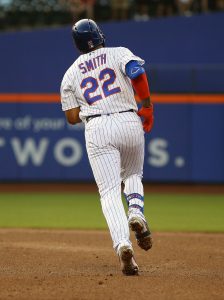 The problem was that 2019 was also the rookie breakout of Pete Alonso, who launched 53 home runs and cemented himself as the first baseman in Queens. That forced Smith to move off first and spend more time in left field, where he’s been ranked as a poor defender. He continued hitting in the shortened 2020 season though, launching 10 home runs in just 50 games and finishing with a line of .316/.377/.616, wRC+ of 166.
The past couple of campaigns have been a struggle, as he played through a partially torn labrum in 2021 and saw his batting line fall to .244/.304/.363 and a wRC+ of 86. In 2022, he struggled at the start of the season while battling J.D. Davis for playing time and was optioned to Triple-A for a time. He finished the year with a batting line of .194/.276/.384 in the majors for a 67 wRC+, but a .284/.367/.472 in the minors for a 122 wRC+.
Smith still could have been retained via arbitration for another couple of seasons, with MLBTR contributor Matt Swartz projecting him for an arbitration salary of $4MM in 2023. Instead, the Mets decided it was time to move on and non-tendered him. Smith will now join the Nats at a slightly lower guarantee but still could get to that $4MM figure via the incentives. If he has a successful campaign, the Nats can retain him for 2024 via arbitration, or use the extra year as a selling point in shopping Smith at the deadline.
Perhaps more importantly, Smith has a chance to get a regular job as a first baseman for the first time in years, with Bob Nightengale of USA Today reporting that’s where Smith will be playing. The rebuilding Nationals had Josh Bell at first for 2021 and the first half of 2022, but he went to the Padres in the Juan Soto trade and is now a free agent. The Nats got Luke Voit back in that deal but non-tendered him at season’s end. After Bell’s departure, 30-year-old rookie Joey Meneses got an extended look and mashed 13 home runs in 56 games. He will likely get plenty more at-bats in 2023 but he can also play the outfield corners, or he and Smith could share first base and the designated hitter slot. Jeimer Candelario could be in the mix as well, though he and Carter Kieboom will be jockeying for the third base job.
Since being non-tendered by the Mets, Smith has also garnered interest from the Rays, Royals, Cubs and Padres. If those clubs are still looking to bolster their first base depth charts in the coming weeks, some of the remaining free agents include Voit, Trey Mancini, Eric Hosmer and Brandon Belt.
Bob Nightengale of USA Today first reported that the two sides were in agreement on a one-year deal. Robert Murray of FanSided first reported the financial breakdown.
Image courtesy of USA Today Sports.
MLBTR Chat Transcript
Click here to read a transcript of today’s chat with MLBTR’s Steve Adams.
The A’s Could Make A Left-Handed Power Bat Available In Trade
The A’s are firmly amidst a rebuild. They stripped the roster almost to its studs over the 2021-22 offseason, dismantling what had been a borderline playoff team to cut spending. Matt Chapman, Matt Olson, Sean Manaea and Chris Bassitt all departed last winter; Frankie Montas followed at the deadline, and Sean Murphy was the last big piece to move a few weeks ago.
With all their star players out the door, Oakland has mostly completed its sell-off. They’re now integrating a number of younger, pre-arbitration players onto a roster that again figures to be one of the worst in the American League in 2023. The A’s are looking a few years down the road, and it stands to reason they’d therefore be open to moving virtually any player on the roster with an established major league track record.
Ramón Laureano may be their highest-upside trade candidate, but he’s coming off a rough season that’s a year removed from a performance-enhancing drug suspension. It’s probably best to let him try to rebuild his stock with an eye towards a deadline deal. There’s another outfielder whom general manager David Forst could consider more of a sell-high possibility: Seth Brown.
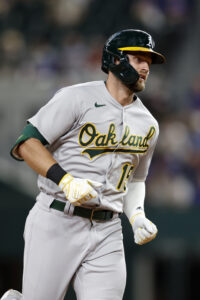
A former 19th-round pick, Brown was never regarded as an especially notable prospect. He didn’t reach the majors until after his 27th birthday late in the 2019 season. Brown barely played at the MLB level his first couple years, not topping 26 MLB games in a season until 2021. He picked up 307 plate appearances that year, connecting on 20 home runs but only reaching base at a .274 clip.
Last season, the Lewis-Clark State College product got his first real run as an everyday player. He suited up 150 times and tallied 555 trips to the plate. Brown hit .230/.305/.444 with 25 homers. His on-base percentage, while a bit below the .312 league mark, wasn’t at the untenable clip of the previous season. He cut his strikeout rate from 29% to a more manageable 26.3% while boosting his walk percentage to a solid 9.2% clip. Brown still doesn’t have a great plate discipline profile, but those numbers are sufficient for a player with his power. His slugging mark was nearly .050 points above the league average despite playing half his games at Oakland’s spacious ballpark.
Virtually all of those gains came as part of a torrid second half. Brown carried a .216/.269/.396 line into the All-Star Break. After the Midsummer Classic, he posted a .249/.348/.507 showing over 250 plate appearances. He more than doubled his walk rate from 6.2% to 12.8% and collected 15 longballs in the second half. He finished tied for 11th in the majors in homers after the Break, while his 147 wRC+ during that time (indicating overall offensive production 47 percentage points above the league average) checked in 27th among those with at least 150 plate appearances.
As with any relatively small-sample performance of that nature, it’s probably fair to assume Brown won’t maintain that pace. He doesn’t need to be a top 30 hitter in the league to be valuable, though, and it’s clear he has legitimate power upside. He’s now picked up 45 homers in a bit less than 900 plate appearances over the past two seasons. In both years, he’s put up a hard contact rate north of 40% — around five points higher than the league mark.
Even with some likely regression from his late-season tear, Brown at least profiles as a quality power bat for the strong side of a platoon. For his career, the left-handed hitter owns a .239/.309/.482 line against right-handed pitching. He’s managed only a .172/.230/.297 mark against southpaws and would probably be shielded from looks against tough lefty arms if he were to land with a contender.
A decent runner, Brown also stole 11 bases in 13 attempts last season. The A’s even gave him some late-season work in center field, though he struggled significantly there. Public metrics suggest he’s a more viable defender in the corner outfield and at first base. The bat will have to carry the profile, but Brown has enough athleticism he could factor in at a few of the lower-value positions on the defensive spectrum.
There haven’t been any indications Brown’s name has come up in trade talks between Oakland and other clubs thus far. Unlike most of the players the A’s have shipped off in recent seasons, they have no payroll motivation to deal Brown. He’ll play this season for little more than the league minimum salary and is eligible for arbitration three more times after that. Trading him wouldn’t be about saving money but the opportunity to potentially recoup a mid-level prospect or two for a player whose trade value may be at its peak. While he’s controllable for the foreseeable future, Brown is already 30 and presumably not seen as a core long-term organizational piece for a rebuilding club.
A productive lefty platoon bat to rotate through the corner outfield and first base should have more appeal to an immediate contender, particularly since Brown’s affordability means he’d fit on the books anywhere. Teams like the Rays, Yankees, Rangers, Braves, Brewers and Dodgers all have some amount of uncertainty at either first base or in the outfield. Tampa Bay and New York stand out as particularly strong speculative fits considering their lineups tend to skew right-handed. Brown wouldn’t be a franchise-altering addition, but he should be of interest to a number of teams as they build out their roster depth with free agency mostly finished.
Image courtesy of USA Today Sports.
Yankees Appoint Brian Sabean Executive Advisor To Brian Cashman
The Yankees announced today that Brian Sabean has been appointed executive advisor to senior vice president and general manager Brian Cashman.
This is a homecoming for Sabean, as he began his career in Major League Baseball with the Yankees. He was hired as a scout back in 1985, later earning other titles such as director of scouting and vice president of player development/scouting. He was with the organization as they drafted and signed the young players that would later form the core of the club that won four championships from 1996 to 2000. In relaying today’s news, Joel Sherman of The New York Post recalls a statement Cashman made about the teams of the ’90s. “The underrated heroes of the dynasty are Bill Livesey and Brian Sabean,” Cashman said.
However, Sabean was no longer with the Yankees when those trophies were lifted. He joined the Giants in 1993 as assistant to the general manager and vice president of scouting/player personnel. He would later be promoted to general manager in 1996. The Giants finished 68-94 in that year but went on to post winning records in each season from 1997 to 2004. They dipped below .500 for a few years but later returned to success in a big way, winning the World Series in 2010, 2012 and 2014.
After that third title, Sabean was given the new title of executive vice president of baseball operations and seemed to move away from the day-to-day business of running the club. Bobby Evans took over as the general manager and stayed in that role through the 2018 season. At that point, he was reassigned and Farhan Zaidi was hired as president of baseball operations. As those transitions were taking place, Sabean seemed to have moved into an advisory/scouting role.
The Giants released a statement about Sabean’s hiring to reporters, with Alex Pavlovic of NBC Sports Bay Area among those to relay it on Twitter. “The San Francisco Giants would like to extend its deepest gratitude to Brian Sabean for his enormous contributions to our organization and wish him the best of luck in his new position with the New York Yankees.” The statement goes on to list the club’s aforementioned accomplishments during his tenure, before finishing thusly: “We truly believe he’s a Hall of Fame worthy executive in every sense of the word and wish him, his wife Amanda, and his entire family nothing but the best in the future. He will always be a Forever Giant.”
In the past few years, he has been connected to front office jobs with the Marlins and Mets that didn’t come to fruition, but he will now return to where his career began and rejoin the Yankees.
Red Sox, Rafael Devers Avoid Arbitration
12:30pm: The Red Sox formally announced that Devers has signed a one-year deal for the 2023 season.
11:37am: The Red Sox have agreed to a one-year, $17.5MM contract with third baseman Rafael Devers, reports ESPN’s Jeff Passan (via Twitter). That’ll avoid an arbitration hearing for Devers’ final season of eligibility but does not extend the team’s control over the All-Star slugger. He’ll be a free agent next offseason. Devers had been projected by MLBTR contributor Matt Swartz to earn $16.9MM this coming season but will top that mark by $600K. Devers is a client of Rep 1 Baseball.
Devers, 26, has cemented himself as one of the American League’s top hitters over the past several years, hitting at a combined .292/.352/.532 clip with 108 plate appearances in 2228 homers dating back to 2019. Along the way, he’s been named to a pair of All-Star teams and won a Silver Slugger Award.
A long-term extension with Devers has been a priority for Boston’s front office for some time, but a sizable gap between the two parties has remained — and that was before Devers watched several mid-20s free agents ink contracts of 11 or more years in length this offseason. One would imagine that the revitalized trend of contracts reaching or even exceeding ten years in length has only further prompted Devers to ponder what he might be able to earn in an open-market setting.
That said, there’s still ample time for the Red Sox to close the gap in negotiations. The fact that the two parties were able to amicably agree on a one-year compromise without needing to resort to a more contentious arbitration hearing bodes well for the status of talks, to an extent. It also frees the two parties to focus negotiations solely on Devers’ would-be free agent seasons.
Long-term deals of that nature are often left to be discussed in Spring Training, but given Devers’ importance to the Red Sox and the dwindling clock, it’s certainly behoove the front office to take every moment available in order to try to work something out. Boston ostensibly waited until last spring to discuss a long-term pact with Xander Bogaerts but only made an unrealistic one-year extension offer. They broadcast confidence in their ability to ultimately retain Bogaerts up until the final day that he agreed to terms with the Padres on an 11-year, $280MM contract. Certainly, one would imagine Sox brass hopes to avoid a similar sequence with Devers, who’s four years younger than Bogaerts and thus would be positioned all the more favorably in free agency.
However extension talks play out, there’s benefit to the Red Sox in securing this cost certainty on Devers sooner than later. With Devers’ salary locked in, the Sox are now projected for an Opening Day payroll just shy of $187MM, per Roster Resource. Their projected $212.6MM luxury-tax ledger sits more than $20MM shy of the $233MM first tier of penalization. Boston quite arguably still has needs behind the plate, in the rotation and on the bench, and knowing the exact price point on Devers helps chief baseball officer Chaim Bloom and his staff gain a better picture of just how many resources are available before any concerns pertaining to the luxury tax — if they exist at all — need to be considered. Boston would be a second-time luxury offender upon exceeding the tax threshold in 2023.
Tigers, Andrew Knapp Agree To Minor League Deal
The Tigers are in agreement on a minor league contract with Andrew Knapp, as first reported by Complete Baseball News. Evan Petzold of the Detroit Free Press further reports that Knapp’s minor league deal contains an invite to Major League Spring Training. Knapp is repped by Apex Baseball.
The 2022 season was a rough one for Knapp, who posted just a .128/.239/.154 batting line while splitting time between the Pirates, Mariners and Giants. That came in a tiny sample of just 46 plate appearances, however, and his combined .245/.313/.486 output in 230 Triple-A plate appearances between the Mariners and Giants was far better. Current Tigers president of baseball operations Scott Harris was still with the Giants as their general manager when Knapp signed a minor league deal with San Francisco last July.
Knapp, a former second-round pick (Phillies, 2013), has racked up more than five years of big league service while spending parts of six seasons in the Majors. He’s a career .209/.310/.313 hitter in the big leagues and a .257/.328/.415 hitter in parts of four Triple-A seasons. Knapp has struggled with a 19% caught-stealing rate and sub-par framing metrics in the Majors, but he’s nabbed 31% of those who’ve attempted to steal against him in the minors — including a strong 8-for-18 showing (44%) in Triple-A Sacramento in 2022.
The Tigers currently have Eric Haase and Jake Rogers as their primary catching options, though Haase has struggled defensively himself and Rogers missed the 2022 season due to Tommy John surgery. Detroit also picked up Mario Feliciano off waivers from the Brewers last month and is still hopeful that 2020 second-round pick Dillon Dingler can force his way into the picture eventually. Dingler hit .238/.333/.419 (107 wRC+) in a pitcher-friendly Double-A setting in 2022.
Brewers, Alex Claudio Agree To Minor League Deal
The Brewers have agreed to a minor league contract with left-handed reliever Alex Claudio, tweets Todd Rosiak of the Milwaukee Journal-Sentinel. The MDR Sports Management client will be invited to Major League Spring Training.
It’s a reunion between the Brewers and Claudio, who spent the 2019-20 seasons pitching out of manager Craig Counsell’s bullpen. The now-30-year-old southpaw (31 later this month) pitched to a 4.11 ERA with a 17% strikeout rate, 8.6% walk rate and 54.9% ground-ball rate in 81 innings during that time but stumbled to a 5.51 ERA in 32 2/3 frames with the Angels in 2021. Claudio spent the 2022 season with the Mets, tossing 3 1/3 shutout innings at the MLB level but otherwise pitching the remainder of the season in Triple-A Syracuse. The veteran lefty was effective in that hitter-friendly setting, logging a 3.91 ERA in 48 1/3 innings.
Overall, Claudio has spent parts of nine seasons in the big leagues and tallied more than six years of MLB service time. He sports a lifetime 3.60 ERA in 347 2/3 innings, and while his 17% strikeout rate is well south of the league average, his 6.5% walk rate and, in particular, his 59.8% ground-ball rate are both demonstrably better than that of the average MLB hurler.
The three-batter minimum has hurt pitchers of Claudio’s ilk, as he carries pronounced platoon splits that make him an unpalatable option against right-handed opponents. Lefties have flailed away at just a .210/.255/.335 pace against Claudio over the years, but right-handed opponents have tattooed him to the tune of a .302/.357/.440 batting line.
As things stand, Hoby Milner is the only left-handed bullpen option on the Brewers’ 40-man roster — assuming prospect Ethan Small continues to work as a starting pitcher in the upper minors. Eric Lauer and Aaron Ashby, the only other two lefties on the roster, are both ticketed for rotation work next year. As such, it wouldn’t be a surprise to see the Brewers bring in some more veterans in this mold on non-roster deals between now and Spring Training. It’s also possible that Milwaukee could make a late play to add a more established southpaw to pair with Milner. Andrew Chafin, Matt Moore, Zack Britton and Brad Hand all remain unsigned in free agency, and the trade market of course presents further options.
Twins Have Shown Interest In Michael Wacha
The Twins have shown interest in free-agent righty Michael Wacha, per Dan Hayes and Aaron Gleeman of The Athletic. There’s no indication talks between the two parties have been particularly serious to this point, but Wacha would give Minnesota a veteran arm to help stabilize the back of the rotation if a deal eventually came together.
Wacha, 31, posted a sharp 3.32 ERA in 127 1/3 innings with the Red Sox in 2022, though he did so with a sub-par 20.2% strikeout rate and a 93.2 mph average fastball that tied his previous career-low. Wacha’s 6.0% walk rate was excellent, but he also rather clearly benefited both from some good fortune on balls in play (.260 BABIP) and a career-high 80.3% strand rate that topped his 72.9% career mark by more than seven percentage points. Fielding-independent metrics generally felt Wacha was solid but not to the extent that his baseline ERA might indicate (4.14 FIP, 4.07 SIERA).
That was Wacha’s first productive season since the 2018 campaign, however. The 2012 first-round pick was a steady contributor with the Cardinals, when healthy, from 2013-18 (741 innings, 3.77 ERA, 3.68 FIP, 4.07 SIERA). However, from 2019-21, Wacha was rocked for a 5.11 ERA in 285 1/3 innings, settling for a series of one-year contracts in free agency while dealing with previously unseen levels of susceptibility to home runs; Wacha averaged a whopping 1.83 home runs per nine innings pitched in that three-year span after previously surrendering just 0.86 long balls per nine frames from 2013-18.
The fit with the Twins is at least a bit muddled, if only due to the number of comparable options Minnesota has in its rotation already. The Twins’ starting staff currently projects to include Sonny Gray, Joe Ryan, Tyler Mahle, Kenta Maeda and Bailey Ober, with depth options including prospects such as Louie Varland, Josh Winder, Simeon Woods Richardson and Matt Canterino (among others).
That said, each of Gray, Mahle, Maeda and Ober dealt with injury issues in 2022. Gray had multiple IL stints due to hamstring strains. Mahle twice landed on the injured list due to shoulder troubles. Ober, meanwhile, was out roughly half the season due to a groin strain. And Maeda, of course, didn’t pitch in 2022 as he recovered from 2021 Tommy John surgery. Given that protracted layoff and a complete lack of innings in ’22, Maeda figures to have his workload monitored in 2023.
Adding Wacha to the fold would provide some injury insurance, though Wacha himself comes with a lengthy injury history. He’s been on the injured list four times due to shoulder injuries in his decade-long MLB career, including an absence spanning more than a month just this past season. He’s also been sent to the injured list by oblique and intercostal strains, patellar tendinitis in his left knee and a hamstring strain. Most of the injuries were overcome in relatively short order, but a 2019 oblique strain and a stress reaction in his shoulder back in 2014 did result in stints on the 60-day IL.
A signing of Wacha or any other veteran starter would give the Twins another capable arm to help piece together the starting staff, but it could also further embolden the front office to pursue upgrades on the trade market. Much of Minnesota’s offseason hinged on its efforts to re-sign Carlos Correa, and while that ship perhaps hasn’t technically sailed just yet — Correa and the Mets have yet to announce a deal while working through concerns on the infielder’s physical — it’s decidedly unlikely he’ll return. In the meantime, the majority of the game’s top free agents signed elsewhere, leaving few alternatives for the Twins to pursue now that they’ve missed out on their top target.
The Twins have signed catcher Christian Vazquez and outfielder Joey Gallo, so they haven’t been completely dormant to this point in the winter. Still, there’s a need for further upgrades at various spots on the roster. Just as signing Gallo seemed to further create the possibility of a trading one of the organization’s many left-handed-hitting outfielders, an addition in the rotation could lead to the possibility of a trade involving some of that pitching depth.
As far as payroll is concerned, the Twins can afford virtually any free agent or trade target they like at this point. Byron Buxton, Gray, Gallo, Vazquez, Max Kepler, Jorge Polanco and Maeda are guaranteed a combined $67.625MM in 2023, and the Minnesota’s projected arbitration salaries add up to just under $32MM. Suffice it to say, the Twins aren’t particularly close to the more than $140MM they spent on 2022 payroll.
It’s been a generally quiet offseason with regard to Wacha, as the Orioles have been the only other publicly linked team to the veteran righty. However, he’s one of the few remaining free-agent starters who’s coming off a solid season, joining Johnny Cueto, Zack Greinke and Zach Davies in that regard. At this point, Wacha is arguably the top free-agent starter remaining based on his combination of age and track record, so it’s easy to envision his market picking up some steam in the weeks ahead.