
Aaron Altherr Eyeing MLB Comeback Following Productive KBO Stint
Former Phillies, Mets and Giants outfielder Aaron Altherr, who has spent the past two seasons playing in the Korea Baseball Organization, is now a free agent and is eyeing a potential MLB comeback after a strong run overseas, MLBTR has learned. A jump to Japan’s NPB is also a possibility.
Set to turn 31 in January, Altherr spent the 2020-21 seasons with the NC Dinos as their primary center fielder, helping the club to a Korean Series championship and posting consecutive 30-homer/20-steal seasons. In a combined 1,111 plate appearances, Altherr slashed .275/.356/.528 (130 wRC+) with 63 home runs, 39 doubles, nine triples and 42 steals (in 48 attempts). Strikeouts have been an issue (27.4%), though he’s also drawn a respectable number of free passes (9.3% overall, including 10.1% in 2021).
A ninth-round pick by the Phillies back in 2009, Altherr briefly reached the big leagues in 2014, got his first extended look a year later in 2015, and at that point seemed like a potential long-term answer in the outfield. He posted a .241/.338/.489 batting line through 161 plate appearances as a rookie (124 wRC+), squarely putting himself into the team’s outfield mix. However, 2016 was largely a lost season. Altherr had wrist surgery that April, and while he made it back to the field late in the summer, his .202/.304/.293 slash showed that he clearly wasn’t at full strength.
In 2017, Altherr bounced back with a .272/.340/.516 batting line through what’s still a career-high (in MLB) 412 plate appearances. He swatted 19 home runs for the Phils that season while seeing time at all three outfield spots.
With the Phillies’ Carlos Santana signing pushing Rhys Hoskins into left field in 2018 and Odubel Herrera then entrenched in center field, Altherr found himself jostling with Nick Williams (who’d had a solid 2017 season himself) for playing time in right field. Altherr started the season in a slump and never really recovered, batting just .181/.295/.333 in 285 plate appearances.
Philadelphia’s subsequent signings of Andrew McCutchen and Bryce Harper completely eroded the path to playing time for Altherr in 2019. He was designated for assignment in early May, bouncing quickly from the Phillies, to the Giants (who gave him one plate appearance), to the Mets via waivers. Altherr struggled in 35 plate appearances with the Mets before being outrighted to Triple-A Syracuse, where he hit well but spent a notable chunk of time on the injured list.
The prospect of a guaranteed seven-figure salary lured Altherr to the Dinos, and he’s taken home more than $2.3MM during his time in South Korea. He’ll likely have interest from the Dinos and other KBO clubs in free agency, but opportunities in Japan and certainly back in the Majors could be more lucrative.
Overall, Altherr has a .219/.308/.402 batting line in 1,156 Major League plate appearances, but his .275/.356/.528 slash in the KBO at least offers the promise that he could do more with a larger opportunity than he received during his stop-and-start Phillies tenure. We’ve seen a handful of former big league bats make successful returns after starring in South Korea, including Eric Thames and Darin Ruf.
Altherr is two years younger than Ruf was at the time of his return, and given that he’s a viable center field option in an offseason where there are few available options at the position (particularly now that Starling Marte has signed), Altherr could be viewed as an interesting roll of the dice for a team seeking relatively affordable outfield help. The looming lockout surely complicates matters — teams in Japan and South Korea likely don’t care to wait on free-agent decisions while MLB is under a transaction freeze — but Altherr ought to at least have a few days to gauge interest before that wrench is thrown into the market.
Rangers Sign Marcus Semien
The Rangers made the first major strike of the offseason shortstop market, agreeing with Marcus Semien on a seven-year, $175MM contract. According to The Athletic’s Levi Weaver, Semien will earn $25MM in 2022, $26MM in each of the 2023-27 seasons, and then $20MM in 2028. Semien is represented by the Boras Corporation.
“Marcus’ reputation around the game is impeccable. He’s a leader in every clubhouse he steps into, respected for the way he goes about his work and how he treats others,” Rangers President of Baseball Operations Jon Daniels said in a press release officially announcing the signing. “There are few players in the game who garner the level of respect that he does from teammates and opponents alike. We’re thrilled to add a player of his caliber to the organization.”
There were indications that Semien was one of the free agents looking to get his next contract finalized prior to the expiration of the Collective Bargaining Agreement on December 1, as a lockout and transactions freeze are widely expected to follow. The Rangers were also known to be one of the more aggressive teams of the offseason, with money to spent and a direct interest in the shortstop market.
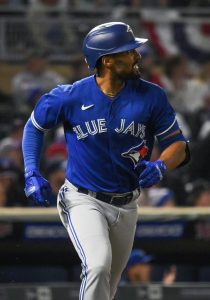 With these factors in mind, a deal between the two sides doesn’t necessarily count as a surprise, but the sheer size of the contract is a little eye-opening. MLBTR projected Semien for six years and $138MM, as though Semien is already 31 years old, he has been a very durable player throughout his career and isn’t necessarily as much of a decline risk as other players his age. Needless to say, the Rangers agreed, giving Semien the biggest contract of any free agent to date this winter. With Semien now locking in $175MM, the asking price will probably only go up for Carlos Correa (age 27), Corey Seager (28 in April), Trevor Story (who just turned 29) and Javier Baez (who turns 29 on December 1).
It also isn’t out of the question that one of these other shortstops might still end up joining forces with Semien in the Texas infield, as ESPN’s Jeff Passan reporting that Story is still under consideration. Theoretically, a scenario exists where Story signs to play shortstop, while Semien moves to second base, as he did last year with the Blue Jays alongside shortstop Bo Bichette.
If another shortstop isn’t added, Semien might conceivably still remain at second base, since Rangers incumbent Isiah Kiner-Falefa is a fine defensive shortstop in his own right. Kiner-Falefa would likely be a defensive standout anywhere he plays around the infield, however, so Texas could opt to put IKF at second or third base, and install Semien back in his former shortstop position.
The seven-year contract represents quite a turn of events for Semien, who struggled through the first six weeks of the shortened 2020 season, thus limiting his value heading into free agency last winter. Semien opted to sign a one-year deal with the Jays in order to re-establish his market, and the result was a third-place finish in AL MVP voting. Semien hit .265/.334/.538 with 45 homers during his spectacular year, appearing in all 162 games and leading the league with 724 plate appearances. In addition to Silver Slugger honors, Semien also won a Gold Glove in his first year as a second baseman since 2014.
The Rangers were very familiar with Semien from his days with the Athletics, and the infielder now returns to the AL West as the veteran face of a new era of Texas baseball. After five straight losing seasons, both president of baseball operations Jon Daniels and GM Chris Young indicated that the club was willing to spend some serious money to return to contention. The Rangers have so little on the books in future salary commitments that multiple signings seemed likely, and if the team is indeed prepared to add up to $100MM in payroll this winter alone, Semien’s $25MM average annual value represents only the first quarter of Texas’ potential outlay.
As Rome wasn’t built in a day, turning the 102-loss Rangers into an immediate contender will be a tall order, even if Texas does spend $100MM+. Both the AL West and the American League as a whole figure to be competitive in 2022, so the Rangers will need quite a bit more than just Semien to even get back above the .500 mark. The seven-year commitment, however, is a sign that the Rangers are clearly in this for the long haul, and Semien is the type of “signpost” free agent signing (i.e. Jayson Werth signing with the Nationals in December 2010, or Hyun Jin Ryu signing with the Blue Jays two offseasons ago) that announces a team is ready to turn the corner. Semien’s reputation as a strong clubhouse leader will also help for mentorship purposes with the Rangers’ younger players, and potentially attract other players to Arlington.
Because Semien rejected Toronto’s qualifying offer, the Rangers will have to give up $500K in international spending pool money, as well as their second-highest pick in the 2022 draft. The latter is a pretty significant concession, as the Rangers’ second-highest selection is the third pick of the second round. Since signing another QO-rejecting free agent would cost Texas its next highest pick (the third choice of the third round), it remains to be seen if the Rangers will now target free agents who aren’t attached to draft pick compensation. Of the other shortstops, Baez is the only one who didn’t turn down a qualifying offer, as Baez wasn’t eligible due to his midseason trade to the Mets.
As well, the Blue Jays will get draft pick compensation for Semien’s departure, as the Jays will now get an extra pick between Competitive Balance Round B and the start of the third round. The Blue Jays had interest in re-signing Semien themselves, but will now take the draft pick as a reward for their bet on Semien one year ago.
With Bichette established at shortstop, it remains to be seen if any of Correa, Seager, Story, or Baez could factor into Toronto’s plans, though most of the Jays-related news this winter has been related to their search for pitching, rather than any shortstops apart from Semien. With a Santiago Espinal/Cavan Biggio platoon penciled in for second base or third base, the Jays have some flexibility in what type of infielder they can pursue as a Semien replacement, or whether that new player comes via free agency or trade. There is no easy way to truly replace Semien’s production, of course, so a substantial addition be required to try and fill the big hole that Semien leaves in Toronto’s lineup.
FanSided’s Robert Murray (Twitter link) was the first to report that the two sides were close to a deal, with MLB Network’s Jon Heyman (Twitter link) reporting the contract length, the fact that the deal had been reached, and the dollar figure. USA Today’s Bob Nightengale also adds that the deal doesn’t contain any opt-out clauses or no-trade protection.
Photo courtesy of USA Today Sports Images
Blue Jays To Sign Yimi Garcia
Nov. 28: Ben Nicholson-Smith clarified on Twitter that the bonus for pitching 60 innings or appearing in 60 games is actually $500K, not the $250K he previously reported.
Nov. 27, 11:07PM: The 2024 option has a vesting element, as per Sportsnet’s Ben Nicholson-Smith (Twitter links). The Jays have a $5MM club option for 2024 with a $1MM buyout, but that third year becomes guaranteed at $6MM if Garcia tosses 60 innings or makes 60 appearances in 2023, or if he pitches at least 110 innings or 110 appearances in 2022-23 combined.
Garcia will receive a $1MM signing bonus, a $4MM salary in 2022, and $5MM in 2023. Garcia also receives a $250K bonus if he hits the 50-inning mark, and other $250K bonuses at the 55-inning and 60-inning thresholds. An unknown team offered Garcia a more lucrative multi-year deal, Nicholson-Smith writes, but the reliever rejected that deal in order to join a Blue Jays club that looks to be closer to contending.
8:14PM: The Blue Jays have agreed to a deal with right-hander Yimi Garcia, as per former player Carlos Baerga via Instagram (hat tip to MLB Network’s Jon Morosi). It is a two-year contract worth $11MM for the 31-year-old Garcia, as per TSN’s Scott Mitchell, and the Jays also have a club option for 2024. Garcia is represented by agent Kelvin Nova.
Garcia comes to Toronto after something of a tough end to his 2021 season. After the Marlins dealt Garcia to the Astros at the trade deadline, Garcia posted a 5.48 ERA over 21 1/3 innings with Houston. While his strikeout and walk rates improved following the trade, he had some bad luck in the form of a very low 42.6% strand rate. With a 2.98 SIERA for his time as an Astro, the argument can certainly be made that Garcia deserved better, and things didn’t really improve thanks to a couple of rough outings in the playoffs.
On the whole, Garcia had a 4.21 ERA/3.61 ERA over 57 2/3 combined innings in 2021, with a 25.3% strikeout rate and 7.6% walk rate that were both better than the league average. Garcia allowed quite a bit of hard contact, but he continued to boast one of baseball’s very best fastball spin rates. Perhaps most promisingly, Garcia’s home run rate was a manageable 14.5%, after the long ball led to a lot of issues when he pitched for the Dodgers in 2018-19.
Those home run concerns notwithstanding, Garcia has been a pretty solid bullpen arm for much of his career, posting a 3.60 ERA over 232 1/3 career Major League innings. Garcia has rebounded nicely from a 2016-18 stretch that was essentially a wash due to injuries, as he tossed only 30 2/3 combined frames in those three years due to knee problems, biceps problems, and Tommy John surgery. Los Angeles elected to non-tender Garcia after the 2019 season, and he was quite effective with the Marlins after signing with Miami that winter.
A two-year deal is a nice score for Garcia in the wake of this career history, and also a reasonable price for Toronto to pay for a veteran relief arm with postseason experience. The Jays have generally not spent much on relief pitching during Ross Atkins’ tenure as general manager, with the partial exception of their one-year, $5.5MM deal with Kirby Yates last offseason that immediately went south when Yates needed TJ surgery of his own. Garcia’s health history contains some obvious red flags, though he hasn’t had any true injury problems since the start of the 2019 campaign, apart from a month missed in 2020 during the Marlins’ COVID-19 outbreak.
A swath of bullpen injuries badly hampered the Jays for the first few months of the 2021 season, and while the numbers began to generally improve, the Blue Jays lacked depth beyond their top quartet of closer Jordan Romano, Trevor Richards, Adam Cimber, and Tim Mayza. That group is all back next season, and with Garcia added to the mix along with other pitchers (i.e. Julian Merryweather, Ryan Borucki) that will hopefully be healthier, the Blue Jays are aiming to turn their relief corps from a weakness into a strength.
MLBTR Chat Transcript
Click here to read the transcript of tonight’s live baseball chat
Angels Planning To Hire Phil Nevin As Third Base Coach
The Angels are planning to hire Phil Nevin as their next third base coach, The Athletic’s Ken Rosenthal reports (Twitter link). Nevin has spent the last four seasons as the Yankees’ third base coach, before his contract wasn’t renewed back in October. FanSided’s Robert Murray reported two weeks ago that Nevin and the Angels were in discussions.
An Orange County native, Nevin is returning to southern California and will wear an Angels uniform for the second time in his baseball career — Nevin played for the Halos back in 1998, one of seven teams Nevin appeared with over his 12 Major League seasons. Of note, current Angels manager Joe Maddon was on the team’s coaching staff when Nevin played for the club.
After his retirement as a player, Nevin worked as a broadcaster and then as a manager in independent baseball before moving onto coaching and managerial roles in the Tigers and Diamondbacks farm systems. Nevin made the move back to the big leagues as the Giants’ third base coach in 2017 before joining the Yankees. Nevin (who turns 51 in January) has been a candidate for multiple MLB managerial openings in the past, getting consideration from the D’Backs, Tigers, and Astros.
Three vacancies on the Angels’ coaching staff opened up when the team opted against retaining third base coach Brian Butterfield, first base coach Bruce Hines, and catching coach Jose Molina. The first base job could also soon be filled, as Rosenthal reports that former Padres coach Wayne Kirby is in talks with the Halos. Kirby has a decade of experience as a Major League first base coach, working eight seasons with the Orioles and the last two years with San Diego. While no official announcement has come from the Padres that they were parting ways with Kirby, the coaching staff is expected to be overhauled under new manager Bob Melvin.
Free Agent Notes: Baez, Pham, Mariners
The Mets‘ interest in re-signing Javier Baez reportedly didn’t end with the club’s agreement with Eduardo Escobar yesterday, yet Baez and the Mets are still “apart on price” in contract talks, according to SNY’s Andy Martino (Twitter link). With Starling Marte and Mark Canha also joining the roster, it would seem as though the Mets are already bolstering the lineup in the event that Baez doesn’t return, and their current focus on pitching upgrades could at least temporarily put an end to their efforts to land Baez or any other position players.
Timing could be an issue with Baez, as there has been speculation that he would prefer to get his next contract finalized before the Collective Bargaining Agreement expires on December 1. (Martino is among those who believes Baez will indeed sign prior to that date.) If the gap between Baez and the Mets is too large to overcome in the next few days, that could open the door for one of the other teams known to be interested in the shortstop’s services. The Tigers and Red Sox have been linked to Baez, with the Mariners, Rangers, and Yankees somewhat more speculatively attached to Baez via their interest in the shortstop market as a whole.
More on other free agent situations around baseball….
- Padres president of baseball operations A.J. Preller said earlier this month that his club had interest in re-signing Tommy Pham, and The Athletic’s Dennis Lin writes that the Padres are indeed still considering Pham for their left field vacancy. After subpar performance in his first two years in San Diego, Pham wouldn’t be too expensive, which Lin notes is still a consideration for a team trying to manage its payroll under the luxury tax threshold if possible. Today’s trade of Adam Frazier to the Mariners cleared some projected salary off the books, and if the Padres do succeed in unloading Wil Myers and/or Eric Hosmer‘s contracts, that will ease an even more substantial amount of the financial burden from Preller’s maneuverings.
- Speaking of the Mariners, the Frazier trade represents Seattle’s first big strike of the offseason, though the club has been rumored in connection with multiple prominent free agents. Mariners GM Jerry Dipoto told MLB.com’s Daniel Kramer and other reporters that the Mariners currently offers on the table to two free agents, with Dipoto noting that one of the two players is “notable.” Reading between the lines, it would seem as if Dipoto was implying that one of the two offers was a significant multi-year pact, while the other offer may have been a shorter-term, less-expensive deal.
Pablo Sandoval Plans To Play In 2022
After 14 Major League seasons, Pablo Sandoval isn’t yet thinking about retirement, as MLB Network’s Jon Heyman reports (Twitter link) that the veteran infielder intends to play next year. Sandoval didn’t catch on with another MLB organization after he was released by the Guardians back on July 30, but he is currently playing in the Venezuelan Winter League (his first VEWL appearance in nine years).
Sandoval signed a minor league deal with the Braves last winter and made the Opening Day roster, locking in a $1MM guaranteed salary. The Panda hit .178/.302/.342 with four homers over 86 PA, appearing almost exclusively as a pinch-hitter. After a hot start, Sandoval’s production cooled down considerably, as he had only a single hit in his final 37 PA in a Braves uniform.
Atlanta ended up sending Sandoval to Cleveland as salary offset in a trade deadline swap that ended up being one of the season’s more noteworthy transactions. The Braves dealt Sandoval for future NLCS MVP Eddie Rosario, who ended up being one of the key contributors to the Braves’ World Series title. Of course, the Panda is no stranger to postseason honors himself, after winning three Series rings with the Giants and capturing the World Series MVP award in 2012.
Though Sandoval’s prime years are behind him, the 35-year-old was still a productive part-time bat as recently as 2019, when he hit .268/.313/.507 and 14 home runs over 296 PA with the Giants. Given his long track record, he seems like a good candidate to land somewhere this winter on another minor league contract, as teams can get a first-hand look during Spring Training whether or not Sandoval has anything left in the tank.
Rays Sign Wander Franco To 11-Year Extension
Seventy games into his Major League career, Rays shortstop Wander Franco has agreed to an 11-year, $182MM contract extension. The contract also comes with a $25MM club option for the 2033 season (with a $2MM buyout) and a series of $3MM escalators based on MVP voting, so the deal’s maximum value sits at $223MM over 12 years. Franco is represented by agent Manny Paula.
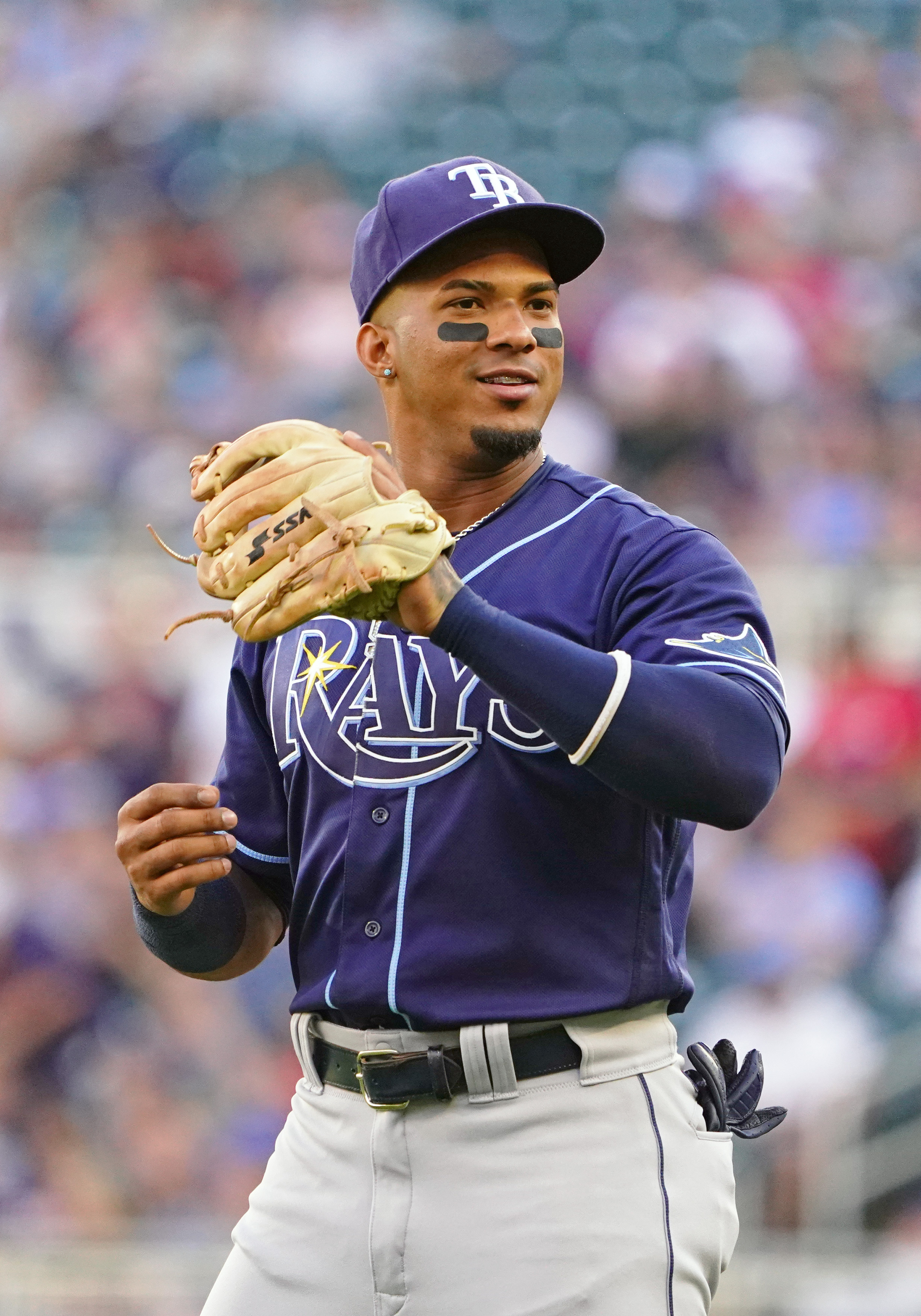
Franco’s contract is both a franchise record for the Rays, topping Evan Longoria‘s previous $100MM guarantee, and also a record for any player with less than one year of Major League service time. Ronald Acuna Jr.‘s eight-year, $100MM contract had been the largest ever signed by a player with less than a year of service, but Franco will nearly double that sum with today’s precedent-shattering agreement.
In terms of financial breakdown, Franco will receive a $5MM bonus right off the bat. The shortstop will earn $1MM in 2022, $2MM in both 2023 and 2024, $8MM in 2025, $15MM in 2016, $22MM in 2027, and then $25MM in each of the 2028-32 seasons.
Franco would receive an extra $3MM in the event of a trade, but there isn’t any no-trade protection involved in the extension. There also aren’t any provisions related to the Rays’ plan to split time between Tampa and Montreal once the team’s lease at Tropicana Field is up after the 2027 season.
Franco, who won’t turn 21 until March, ranked as the sport’s No. 1 overall prospect in each of the past three offseasons and largely justified that hype when he debuted just months after his 20th birthday. The switch-hitter slashed .288/.347/.463 with seven home runs, 18 doubles, five triples and a pair of stolen bases through 308 plate appearances.
From July 25 to Sept. 29, Franco embarked on one of the more remarkable stretches in recent memory, reaching base in a staggering 43 consecutive games in spite of his youth. During that time, he posted a combined .329/.398/.545 batting line with more walks (9.1%) than strikeouts (8.1%). Franco only appeared in 70 games this season but was impressive enough to finish third in AL Rookie of the Year voting.
Defensively, Franco received split marks for his work at shortstop, putting up six Defensive Runs Saved, average marks per Ultimate Zone Rating and a minus-3 mark in Statcast’s Outs Above Average. However, scouting reports on him have pegged him as at least an average shortstop — if not better — in addition to touting his elite hit tool, plus power and plus speed. That generally aligns with the .331/.399./535 slash he posted in his meteoric rise through 215 minor league games. Prior to Franco’s promotion, FanGraphs’ Eric Longenhagen wrote that he’d been “the best player his age on the planet since he was 14 years old” and touted him as a perennial MVP candidate. ESPN’s Kiley McDaniel, meanwhile, called him “plus at basically everything on a baseball field.” Take your pick of Franco scouting reports from the 2020-21 offseason and they’ll all generally be filled similar superlatives.
Because the Rays waited until late June to promote Franco, he was a veritable lock to fall shy of Super Two status under the current arbitration system (which could potentially change, depending on how collective bargaining talks play out). Franco wouldn’t have been arbitration-eligible until after the 2024 season and would’ve had to wait until the 2027-28 offseason to reach free agency. The 11-year length of the contract buys out all three of Franco’s pre-arbitration seasons — during which he’d likely have made under $1MM apiece — and all three arbitration years. He’s also surrendering control of six would-be free-agent seasons (though only five are fully guaranteed).
Some fans will recoil at the notion of guaranteeing $182MM to a player with just 70 big league games under his belt, but those 70 games largely confirmed what the industry has expected from Franco since he signed for a bonus of nearly $4MM as a 16-year-old: he looks the part of a budding superstar. And, a westward look toward San Diego shows what could happen by waiting to allow the player to further establish himself. Fernando Tatis Jr. didn’t sign an extension until he had accrued two years of Major League service, and his price tag ballooned to 14 years and $340MM. Franco’s price tag upon waiting would likely have extended even beyond that point and may well have become too sizable for the Rays’ typically frugal ownership.
It’s tempting to ponder just how much Franco might be “leaving on the table,” so to speak; free agent Carlos Correa has already pocketed $27MM in career salaries and is reportedly seeking a contract worth more than $300MM at the same age Franco would’ve been upon reaching free agency. Extension rumblings surrounding Juan Soto have elicited speculation of $400MM or even $500MM in total guaranteed money; Soto is 23 and has three-plus years of MLB service.
Franco would have found himself on a similar trajectory had he gone the year-to-year route, and one could certainly argue that betting on himself in hopes of setting an even more dramatic record was the more prudent path forward. That said, it’s difficult to fault anyone for accepting this type of guarantee — particularly at such a young age. Generations of Franco’s family will be financially secure because of it, and he can still take heart in knowing that he’s nearly doubled the previous precedent, thus further advancing the market for future players. Beyond that, because of his youth, Franco can still reach free agency as a 32-year-old, which is young enough to command a second substantial contract.
The possibility of “leaving money on the table” also assumes good health and continued production from Franco moving forward. Taking the extension now mitigates much of the risk associated with a career-altering injury or injuries — a danger that exists for any player. It also safeguards against Franco “merely” becoming a solid regular rather than a bona fide superstar (or, less likely, declining into a sub-par player). Promising as his beginnings were, he’d hardly be the first player to impress as a rookie before taking a few years to reach his ceiling or even stalling out entirely.
Ongoing labor talks also have to be considered. While the next collective bargaining agreement could have improved Franco’s earning power, it’s also feasible that a new CBA might have hurt him to an extent; ownership has already proposed an age-based free-agent threshold of 29.5 years, for instance, and although that particular number was a nonstarter for the players association (due to just this type of situation), the league could explore various permutations of such mechanisms. Regardless of how labor talks between MLB and the MLBPA play out, Rays president of baseball operations Erik Neander and Franco can both rest easy knowing that perhaps the most critical negotiation either will ever personally take part in has been resolved.
Any and all instances of the Rays spending money bring about the typical comments wondering how long until the player on the receiving end of the deal is traded. Such barbs are admittedly somewhat justified due to the Rays’ history of trading players — e.g. Longoria, Blake Snell, Chris Archer — in the latter stages of their extensions. But, even if that’s Franco’s ultimate fate, it’s unlikely to happen anytime soon. Extensions of this nature tend to mirror what the player would have earned absent the long-term contract; in other words, Franco may receive an up-front signing bonus, but his yearly salaries through the first six years figure are considerably lighter than they will be in the portion of his contract covering what would have been free-agent years.
In the short term, then, the Franco extension will have only minimal impact on club payroll. Tampa Bay was projected by Roster Resource’s Jason Martinez to field a payroll of around $76MM in 2021, and the Franco contract probably won’t push that mark up to even $80MM. That number still figures to drop a bit in the near future as the Rays contemplate potential trades and non-tenders related to an abnormally large arbitration class, but any trades or non-tenders of arb-eligible players in the coming days will be unrelated to Franco’s long-term pact.
At the end of the day, any contract of this magnitude involves some give and take for both sides. Any number of things could’ve gone wrong for Franco in the years to come, and the looming possibility of those pitfalls underscores the fact that the typically small-payroll Rays are taking on what is, by their standards, an unprecedented risk.
While many will be quick to declare “winners” and “losers” in Hot Stove transactions — be they trades, free-agent signings or contract extensions — there are also instances where a deal simply appears sensible for all sides. Franco receives a generational amount of money and retains the ability to reach free agency in his early 30s. The Rays secure control of a franchise cornerstone whom they hope and believe can be an all-time great. The players union surely approves of the precedent for players with under a year of service being moved forward so substantially.
Ultimately, Franco’s new contract contains positives for all parties involved — perhaps with the exception of Tampa Bay’s division rivals in the AL East who now have to wonder how to combat the emerging superstar into the 2030s.
Yancen Pujols of El Caribe reported last week that the Rays had offered a record-setting extension worth between $150-200MM. Marc Topkin of the Tampa Bay Times reported on Nov. 23 that an agreement was close, and he also had the year-to-year salary breakdown. Joel Sherman of the New York Post (Twitter link) and Hector Gomez of Z101 Sports (Twitter link) reported general parameters, and ESPN’s Jeff Passan eventually reported the specific terms of the contract (Twitter thread).
Super Two Status Set At 2.116 Years Of Service
This year’s Super Two cutoff point has been set at precisely two years and 116 days of service, MLBTR’s Tim Dierkes has learned. This marker will affect the financial value for players with between two and three years of service time.
For example, Yordan Alvarez, with two years and 113 days of service time, will just miss the cutoff, meaning the Astros slugger will not be eligible for arbitration until next offseason. On the other hand, Brewers infielder Luis Urias has two years and 120 days of service time, so he qualifies as a Super Two player and will head to arbitration for the first of four trips this winter.
Broadly, Super Two designation is one of the innumerable quirks to the ever-confounding (current) arbitration system. For the unfamiliar, Major League players earn “service time” for every day spent on an MLB roster. One year of MLB service is defined as 172 days, despite the fact that there are more days than that in the regular season.
Upon reaching three years of service time, all players become eligible for salary arbitration. Prior to that point, teams are effectively able to set (most) player salaries at any rate they wish, so long as it is north of the league minimum. Many teams have formulas they use to determine pre-arbitration salaries, and it’s quite rare for pre-arb players to earn even $1MM, barring a long-term extension. Arbitration is the first point at which players and their agents can begin negotiating with teams regarding their salary, though arbitration prices still typically fall shy of open-market value.
The “Super Two” wrinkle further complicates matters. The top 22 percent of players (in terms of total service time) with between two and three years of service also are considered eligible for arbitration and termed “Super Two” players. Any player who falls into that service bucket and spent at least 86 days of the preceding season on a 25-man roster or the Major League injured list become eligible a year early and then go through the arbitration process four times.
That fourth arb-eligible year puts a player in line for some extra salary immediately, and potentially millions more in earnings as their salaries continue to escalate through the arbitration process. Of course, since teams’ manipulation of service time has been such a point of contention for the players’ union, it remains to be seen if the current Super Two system will remain in place through the next round of Collective Bargaining Agreement talks.
For comparison’s sake, here are the Super Two cutoff points for the last 12 years….
- 2020: 2.125
- 2019: 2.115
- 2018: 2.134
- 2017: 2.123
- 2016: 2.131
- 2015: 2.130
- 2014: 2.133
- 2013: 2.122
- 2012: 2.140
- 2011: 2.146
- 2010: 2.122
- 2009: 2.139
Marlins Made “Strong” Push For Starling Marte
The Marlins were in on Starling Marte right up until the centerfielder signed the four-year, $78MM deal to join the Mets, per MLB Network’s Jon Heyman (via Twitter). The Marlins made a “strong” offer, but not one that matched the Mets’ financial commitment, per Barry Jackson of the Miami Herald (via Twitter). The Marlins weren’t the only team to be outbid by the Mets, who flexed their financial might to ink not only Marte, but Mark Canha and Eduardo Escobar, per Joel Sherman of the New York Post (via Twitter).
Centerfield remains one of the Marlins’ biggest needs, though they may need to get creative now that Marte is off the board. Utility gem Chris Taylor is the only inspiring option remaining on the free agent board with significant experience manning center. The rest of the field consists of veteran names more likely to be seen as backups. This group includes Brett Gardner, Joc Pederson, Billy Hamilton, Ender Inciarte, Odubel Herrera, Jake Marisnick, Brian Goodwin, and a few others.
If the season began today, the Marlins would have Bryan De La Cruz, Lewis Brinson, and Monte Harrison as their primary options. De La Cruz, 24, would be Plan A after putting together a strong showing in the second half of 2021. The right-handed hitter slashed .296/.356/.427 in 219 plate appearances after being acquired from the Astros along with Austin Pruitt in exchange for reliever Yimi Garcia.
With De La Cruz proving at least capable of manning the middle, the Marlins are also exploring the addition of corner bats. Nick Castellanos is a name they like, despite his potentially chunky price tag, per Jon Heyman of the MLB Network (via Twitter). Castellanos’ big bat would certainly provide a much-needed boost to Miami’s lineup, though it would be a touch surprising to see the slugger end up in Miami, given the presumed price point for his services.