
Tigers Expected To Non-Tender Matthew Boyd
The Tigers are not expected to tender a contract to veteran starter Matthew Boyd, per a report from Chris McCosky of Detroit News. Boyd, who’s pitched for the Tigers in each of the last seven seasons and twice taken the ball on Opening Day, will become a free agent once the decision is made official. Were Boyd healthy, the Tigers may have made a different decision, but he had flexor tendon surgery in September and is expected to be out until at least June.
Since arriving from the Blue Jays at the 2015 trade deadline as part of a package that sent David Price to Toronto, Boyd has been a roughly league-average starter (95 ERA+ since 2016), serving as a fairly steady innings-eater before spikes in his walk and home run rates saw him post his worst numbers since his rookie season in the small sample of the 2020 season. He actually posted a career-best 3.89 ERA (4.10 FIP) in 2021, but a June triceps strain landed him on the IL for more than two months before a September forearm injury ended his season after 78 2/3 innings.
For his career, the lefty sports a 4.96 ERA (4.69 FIP) across 784 1/3 big-league innings. Entering his age-31 season in 2022, he’ll most likely look to catch on with a team in search of a veteran back-end rotation arm. Given his recent injury history, it’s possible some teams will see Boyd as a reliever, though 145 of his 149 career games have been starts, and he hasn’t appeared in relief since 2017.
Even in spite of an injury that will keep him out for at least a third of the season, Boyd is likely a safe bet for a major league deal, though he’s unlikely to approach the $6.5MM salary he received in 2021. MLBTR projected that Detroit would have been on the hook for $7.3MM had they tendered Boyd a contract for his fourth and final year of arbitration eligibility. With the near-certainty of the Dec. 2 lockout deadline approaching, the southpaw will have very little time to catch on with a new team before transactions stop, though he may choose to wait in an attempt to show teams a relatively clean bill of health.
The Tigers face a handful of non-tender decisions beyond Boyd. McCosky mentions 2018 All-Star Joe Jimenez (slated to make $1.8MM according to MLBTR projections) and the aging but serviceable Jose Cisnero (projected at $1.9MM), both of whom have some upside; Jimenez has swing-and-miss stuff but has struggled with command (his BB% spiked to 16.7% in 2021), while Cisnero has had considerably more success over the last two seasons despite also sporting an above-average walk rate. Still, neither of these salaries would have nearly the impact on the bottom line as Boyd’s.
Of course, the financial impact of the Tigers’ non-tender decisions pales in comparison to their expected commitments on the free agent market. Since signing Eduardo Rodriguez to a market-setting five-year, $77MM deal in mid-November, the Tigers have been linked many of the biggest names on the market, including Carlos Correa (MLBTR link), Marcus Semien (link; since reached an agreement with the Rangers), Javier Baez (link), and Robbie Ray (link).
Whether or not the Tigers add an additional starter in free agency, their rotation figures to be a strength in 2022, with Rodriguez heading a a cast of high-upside young arms in Casey Mize, Tarik Skubal, and Matt Manning. Veteran righty Spencer Turnbull, who required Tommy John surgery after a hot start to the 2021 campaign, could also contribute down the stretch, though the club is unlikely to count on him until 2023.
Twins, Tigers, Giants Interested In Robbie Ray
As free agent pitchers continue to fly off the board, AL Cy Young Award winner Robbie Ray remains unsigned, though he is still drawing plenty of attention. The Angels, Red Sox, and Blue Jays have been previously linked to Ray on the rumor mill, and The New York Post’s Joel Sherman (Twitter link) also lists the Twins, Tigers, and Giants as among the clubs with interest in the left-hander. In addition, Sherman says to “keep an eye” on the Rangers, which isn’t surprising given how much Texas has already splurged on free agent talent, including another top pitcher in Jon Gray.
Of the new teams in the hunt for Ray, it isn’t surprising to see Detroit and San Francisco listed, as both clubs have already been looking for pitching and been aggressive with some early signings. The Tigers agreed to sign Eduardo Rodriguez for five years and $77MM, while the Giants re-signed Anthony DeSclafani and were reportedly close to also retaining another familiar face in Alex Wood.
While Ray would obviously be a huge help to either team, the argument can be made that San Francisco has the bigger need. Just about all of the Giants’ 2021 rotation was eligible for free agency, and leaving plenty of holes to be filled around Logan Webb. DeSclafani’s return filled one gap and Wood would fill another if he also re-signed, though Kevin Gausman left the Giants to instead sign a five-year, $110MM deal with the Blue Jays. If there is a silver lining to Gausman’s departure, it could be that Toronto would seemingly be less likely to re-sign Ray, removing some competition from the Giants’ pursuit.
The Tigers, meanwhile, have a somewhat fuller rotation in E-Rod, Casey Mize, Matt Manning, and Tarik Skubal all lined up for starting jobs, though the latter trio are is long on promise but still short on experience at the Major League level. Adding a proven veteran star like Ray makes that rotation much stronger, and also provides a full-circle moment since Ray formerly pitched for the Tigers during his 2014 rookie season. Detroit acquired Ray from the Nationals for Doug Fister in December 2013, and then flipped him to the Diamondbacks a year later as part of a three-team swap with the Yankees.
Perhaps the bigger obstacle for a Motor City reunion might be the draft pick compensation attached to Ray for rejecting the Jays’ qualifying offer, as Detroit already gave up a pick to sign Rodriguez (who also rejected a QO from the Red Sox). As a club who received revenue sharing in 2021, the Tigers’ penalty for Rodriguez was the loss of their third-highest selection, which will be either their second-round pick or their Competitive Balance Round pick, depending on which of the two CBRs the Tigers are drawn into this winter.
If the Tigers signed another QO-rejecting free agent like Ray, the Tigers would lose their fourth-highest selection in the 2022 draft. Since Detroit still seems to be considering Ray, it would appear that losing two draft picks isn’t out of the question for the club. The presence of the extra CBR selection does help ease the pain, and the Tigers have obviously built up a sturdy amount of young talent through their years of rebuilding.
Likewise, the Giants would also have to give up a draft pick for Ray. Since San Francisco isn’t a revenue-sharing team and they didn’t exceed the luxury tax in 2021, the Giants would lose their second-highest pick and $500K from their international draft pool if they signed Ray or any other QO free agents. San Francisco issued a qualifying offer to one of its own free agents this winter, though Brandon Belt ended up accepting the one-year deal to return to the team.
Minnesota is perhaps the most interesting of the new teams in the mix. Like the Tigers, the Twins are a revenue-sharing recipient and also the holder of a Competitive Balance Round pick, which could mitigate the draft capital they’d lose to sign Ray. The Twins also have a strong need for front-of-the-rotation pitching, since Jose Berrios was dealt last summer, Michael Pineda is a free agent, and Kenta Maeda will very likely miss the entire 2022 season due to Tommy John surgery.
Despite these factors, signing Ray to something close to five years and $130MM (MLBTR’s projection for the lefty’s next deal) would represent the second-largest contract in the Twins’ franchise history, and the type of financial outlay that Minnesota has traditionally preferred to avoid. However, the Twins have been open to larger spending in other free agent pursuits in recent years, and swung such a notable deal with Josh Donaldson‘s four-year, $92MM pact in the 2019-20 offseason. Additionally, Minnesota just hit the nine-figure threshold by inking Byron Buxton to a seven-year extension that will be worth at least $100MM and perhaps significantly more if Buxton hits various incentive clauses.
Spending roughly $26MM on Ray in average annual value would boost the Twins’ 2022 payroll to around the $119MM mark, but considering the club finished the 2018 campaign spending around $131MM in player salaries, Minnesota would still have room to make other additions. Plus, Miguel Sano, Taylor Rogers, and Tyler Duffey aren’t guaranteed beyond 2022, and Buxton and Randy Dobnak are the only Twins players on the books beyond the 2023 season.
Report: “Belief” That Corey Seager Will Sign Monday
Free agent shortstop Corey Seager could be nearing his next contract, as The New York Post’s Joel Sherman reports that there is a “belief” that Seager will sign on Monday. Seager was known to be leaning towards finding a new team before the Collective Bargaining Agreement expires on December 1, and interestingly, that same report indicated the same about another prominent Scott Boras client in Marcus Semien.
Just earlier today, Semien indeed did sign, inking a seven-year, $175MM agreement with the Rangers. Seager had also engaged in some talks with the Rangers, and both Sherman and The Athletic’s Ken Rosenthal feel there is a distinct chance Seager may still land in Texas. Presumably, Seager and Semien would work as the Rangers’ new middle infield combination, though it would remain to be seen exactly where either of the duo would line up.
Seager has spent virtually all of his career at shortstop but his defensive numbers aren’t great, and there is a perception that Seager might be within a few years of moving to third base or perhaps even second base. Semien, meanwhile, is the better defensive shortstop of the two, though Semien spent 2021 playing as a second baseman with the Blue Jays while Bo Bichette manned the shortstop position. Texas also has some incumbents to consider, as top third base prospect Josh Jung is ready for his MLB debut, and Isiah Kiner-Falefa is an excellent defender at either shortstop or third base.
The fact that the Rangers can now even weigh all of these possibilities is indicative of the new doors opened by the team’s willingness to spend big this winter, as the Rangers are making a sharp turn towards contention after five straight losing seasons. Texas has already signed Semien, Jon Gray, and Kole Calhoun within the last 12 hours, so adding Seager would be just the latest addition to what has already been a frenzy of activity for president of baseball operations Jon Daniels.
Trevor Story is another one of the major free agent shortstops who had been linked to the Rangers, and Rosenthal seems to frame Story as something of a backup plan, noting that Story is “also possible if Rangers cannot get Seager.” The fact that Boras represents both Semien and Seager could make coordinating such a double-signing easier, though it isn’t as if Daniels and company have never had dealings with Story’s reps at Excel (Kolby Allard is an Excel client on the Texas roster, for instance).
While Boras has a reputation for waiting until deep into the offseason to find acceptable contracts for his free agent clients, Sherman notes that at the GM Meetings in early November, teams felt Boras would have deals lined up for Seager, Semien, and Max Scherzer before December 1 and what is expected to be a management lockout following the CBA’s expiration. Beyond Semien’s deal, Scherzer also seems to be nearing an agreement with the Mets, which perhaps increases the chances that Seager will also get his contract done in short order.
Beyond the Rangers, the Tigers, Dodgers, and Yankees are other teams who have been linked to Seager’s market, though New York is reportedly planning to wait until after the lockout and subsequent transactions freeze to pursue a shortstop, as the club would prefer a shorter-term commitment. If Scherzer does sign with the Mets, it could spur the Dodgers to make a bigger push for Seager so as to not lose both of their biggest in-house free agents. Semien’s departure from the market could also spur any of the teams also looking for shortstop or general infield help (such as the Phillies, Blue Jays, or Angels) to look closer at Seager.
Mets May Be Favorite For Max Scherzer
9:47PM: The Dodgers remain in the mix for Scherzer but are “not the favorites at the moment,” as per Jorge Castillo of The Los Angeles Times. Indeed, there are “growing indications” that the Mets will sign Scherzer, as per The Athletic’s Ken Rosenthal, with the New York Post’s Joel Sherman adding that Scherzer and the Mets have made progress towards an agreement.
8:47PM: The Mets have offered Scherzer a multi-year contract, according to MLB Network’s Jon Morosi, that could be a three-year, $120MM pact.
7:16PM: The Mets’ offer to Scherzer has an average annual value of more than $40MM, according to Martino, but the length of the offer isn’t known. This would represent the largest AAV for any player in baseball history.
6:58PM: The Dodgers “are perceived as the favorite” to sign Scherzer, Heyman tweets. However, the “Mets’ full attention at [the] moment” is directed at Scherzer. If Scherzer does sign elsewhere, New York will likely turn its attention towards Gausman as the backup plan. SNY’s Andy Martino writes that the Mets hope to have either Scherzer or Gausman signed within the next 24 hours.
11:54AM: Max Scherzer is expected to make a decision about where to play next year before the impending lockout, according to MLB Network’s Jon Heyman. Heyman lists the Dodgers, Giants, Angels and Mets as some of the teams that are under consideration.
The current Collective Bargaining Agreement between MLB and MLBPA expires at 11:59 pm ET on December 1, with the general expectation being that a lockout and transaction freeze will then be implemented if no new deal is in place at that time. That has led to a flurry of activity in recent weeks, as many teams, agents and players seemingly prefer to get their business done now as opposed to waiting until some undetermined date when the lockout is finished. It would appear that Scherzer is in that camp.
The starting pitching market has easily been the busiest so far this year, as Eduardo Rodriguez, Anthony DeSclafani, Justin Verlander, Steven Matz, Noah Syndergaard, Andrew Heaney and Michael Wacha have all signed in the past two weeks, with Corey Kluber also signing today. Kevin Gausman is also reportedly planning on signing in the coming days.
Scherzer’s free agency is a very unique case, given his elite skill level and relatively older age, compared to the other top names on the free agent market. Kevin Gausman and Robbie Ray, the only two hurlers ahead of Scherzer on MLBTR’s list of Top 50 Free Agents, are both currently 30 years old, whereas Scherzer turned 37 in July. But given his tremendous track record of success in his career, his prediction was for a much higher salary on an annual basis, $120MM over three years, AAV of $40MM. That would be a new high for AAV across the league, breaking Gerrit Cole‘s record of $36MM. Gausman and Ray, on the other hand, were predicted to get to the vicinity of $25MM annually, but each over a longer term than Scherzer.
Scherzer already has an incredible career resume, with 14 seasons of quality work, including eight All-Star appearances, three Cy Young Awards, a World Series championship and various other accolades. In 2021, he logged 179 1/3 innings between the Nationals and Dodgers. His 2.46 ERA was the lowest of his career. His 34.1% strikeout rate and 5.2% walk rate were both much better than league average. In short, he would be a huge upgrade for any team in the league. But if he’s going to cost around $40MM per year, budgetary concerns will make him a better fit on some teams than others.
The Mets have already been throwing lots of money around, as they recently signed Mark Canha, Starling Marte and Eduardo Escobar. That spending spree has pushed their 2022 payroll to $225MM, per Jason Martinez of Roster Resource. That’s already well beyond last year’s opening day payroll of $195MM, which was itself a franchise high, according to Cot’s Baseball Contracts. To add someone like Scherzer would require pushing their previous boundaries even further.
The Angels also ran a franchise-high payroll on opening day last year, getting up to almost $182MM, per Cot’s. For 2022, they’re currently sitting at $157MM, per Martinez, about $25MM shy of last year. Adding Scherzer would likely involve blowing past that number, as well as changing their previous avoidance of giving out contracts of any kind of length to starting pitchers. As recently explored by MLBTR’s Steve Adams, they haven’t given a starting pitcher a deal longer than one year since Joe Blanton way back in 2012, and even that was just two years.
The Giants have lots of payroll space, but also lots of holes to fill. Cot’s pegs their 2021 opening day number just shy of $150MM, but they’ve been as high as $200MM before, in 2018. They’re currently sitting around $115MM for next year, per Martinez, but still have many areas of need. Their rotation lost four members from 2021, and though they’ve since re-signed Anthony DeSclafani, they still need to replace Alex Wood, Kevin Gausman and Johnny Cueto. (It was reported a week ago that Wood was close to deal to return, though it doesn’t seem to have been finalized yet.) They could also use a right-handed outfielder, having already been connected to Starling Marte and Seiya Suzuki. It seems more likely that they would spread their budget around to multiple arms, but if they want to make a run at a huge name like Scherzer, they have a payroll situation that could make it doable.
As for the Dodgers, whom acquired Scherzer at last year’s trade deadline, their opening day payroll in 2021 was almost $248MM, per Cot’s, easily the highest such number in the league. They’re currently sitting over $205MM for next year, according to Martinez, and could welcome Scherzer back into the fold if they’re willing to spend at similar levels this year.
Rangers Interested In Jon Gray
TODAY: Gray looks like the Rangers’ “primary pitching target at [the] moment,” Evan Grant of The Dallas Morning News writes, noting that Texas currently has an offer out to the righty. The Angels and Mets both appear to still be in the mix.
NOVEMBER 25: Several teams are showing “legitimate interest” in free agent right-hander Jon Gray, MLB.com’s Mark Feinsand reports (Twitter link), with the Rangers included in that list. Gray’s decision may come relatively soon, as MLB Network’s Jon Morosi tweets that there is some industry expectation that Gray will sign within the next week, or prior to the expiration of the Collective Bargaining Agreement on December 1.
Texas has mostly been linked to major position player free agents this offseason, but with the organization reportedly ready for a huge payroll increase, rotation help is naturally also on the radar. Justin Verlander (before he re-signed with the Astros) and Clayton Kershaw have already been linked to the Rangers, though Gray would likely require a longer-term contract. Feinsand notes that geography could also be a factor for Gray, as playing for the Rangers would put him closer to his home in Oklahoma.
Gray would immediately become the veteran ace of a young Texas staff, and quite possibly wouldn’t be the only new arm in the mix. Since the Rockies didn’t issue Gray a qualifying offer, he can be signed without any draft pick compensation, making him a particularly intriguing option for a Texas club that is looking at several big-name additions. Signing Gray would allow the Rangers to instead surrender their draft capital on one of the 10 QO-rejecting free agents still on the market, though obviously Gray holds that same appeal for any number of other teams.
Gray celebrated his 30th birthday earlier this month, and after seven MLB seasons with Colorado, could now be set to pitch elsewhere for the first time in his professional career. It remains to be seen if a return to the Rockies is still a possibility, as while the club made a push to sign Gray to a contract extension before the offseason began, Rockies GM Bill Schmidt said on November 10 that Gray’s camp hadn’t been in contact with the front office since the end of the season.
If Gray did sign within a week’s time, he would become the latest player to depart what has become a fast-moving starting pitching market. Verlander, Eduardo Rodriguez, Noah Syndergaard, Steven Matz, Anthony DeSclafani, and Andrew Heaney are some of the prominent free agent hurlers who have already signed new contracts, and Alex Wood is reportedly close to a new deal to return to the Giants. This should only help Gray’s leverage in finding a healthy multi-year pact beyond the Rockies’ reported extension offer of three years and between $35-40MM. The Tigers are the only other known suitor for Gray to date.
Free Agent Prediction Contest Leaderboard Update
Our free agent prediction contest closed for entries on November 15th. To date, 17 of our top 50 free agents have signed. Of the 6,233 people who entered our contest, only three people have as many as eight predictions correct so far.
To follow along with the contest results, check out the leaderboard here. You can also check out how 11 participating MLBTR staff members are doing here. You can search for your own name in the contest results, and you can also click on anyone’s name to see their individual picks.
Kevin Gausman Expected To Sign In Next Few Days; Blue Jays, Giants Are Finalists
7:44PM: According to multiple industry sources, Gausman will receive a five-year deal worth around $100MM in guaranteed money, Morosi reports in his latest Twitter update.
TODAY, 1:09PM: MLB Network’s Jon Morosi tweets that the Giants “have a good chance to retain Kevin Gausman, based on the current tenor of negotiations.”
NOVEMBER 27: Kevin Gausman appears to be close to picking his new team, as MLB Network’s Jon Morosi (Twitter links) reports that the free agent right-hander will likely make his decision within the next two or three days. The Blue Jays are one of the finalists for Gausman’s services, though it isn’t known how many other teams are also still in the running. The Jays, Giants, Angels, Red Sox, Mets, and Mariners have all been linked to Gausman’s market at various points this winter.
There is enough interest in Gausman that “a five-year deal is increasingly likely,” Morosi writes. This is actually less than the six-year, $138MM deal that MLBTR projected for Gausman (who ranked fifth on our list of the offseason’s top 50 free agents), but it is still a healthy commitment for a pitcher entering his age-31 season. Beyond Gausman’s strong numbers over the last two seasons, he can also be signed without any draft pick compensation required, making him an even more attractive candidate for teams.
For example, the Angels have already surrendered one draft pick in order to sign the qualifying offer-rejecting Noah Syndergaard. Therefore, Gausman is probably a more enticing addition for the Angels than Robbie Ray, who is the last remaining free agent starter who rejected a QO (though the Angels reportedly had some interest in Ray earlier in the offseason).
The Blue Jays may have two compensatory picks coming back their way should Ray and Marcus Semien sign elsewhere. That frees the Jays up to perhaps sign another QO free agent since they know they’ll be getting at least one extra pick anyway, or maybe deal a notable prospect if they feel they can replenish their farm system with extra selections in the 2022 draft.
Gausman has long been on Toronto’s radar, as the club had interest in the righty in each of the last two offseasons. Last winter, the Jays reportedly offered Gausman three years and around $40MM before he opted to bet on himself by accepting the Giants’ qualifying offer — a very wise move in hindsight, given what Gausman is now poised to earn this offseason. Should the Jays win the bidding for Gausman, he will immediately bolster a rotation that has already lost Steven Matz to the Cardinals and may also lose Ray. Gausman would join Jose Berrios, Hyun Jin Ryu, and Alek Manoah in the starting five, with other starting options like Nate Pearson, Ross Stripling, or Anthony Kay now battling for the fifth starter’s job.
Assuming he does agree to a deal soon, Gausman will join the long list of major free agent pitchers who have already landed deals before the expiration of the Collective Bargaining Agreement on December 1. Syndergaard, Matz, Justin Verlander, Eduardo Rodriguez, Anthony DeSclafani, and Andrew Heaney have signed, though obviously several other prominent arms (i.e. Ray, Max Scherzer, Marcus Stroman, Carlos Rodon, Jon Gray) are still available.
Angels Interested In Luis Castillo
The Angels and Reds have engaged in “preliminary trade talks” about right-hander Luis Castillo, MLB Network’s Jon Morosi reports (Twitter link). No deal seems close, however, as “the sides are far apart as of today.”
While the Reds are known to be listening on offers for Castillo, latest reports have indicated that Cincinnati isn’t keen to part with either Castillo and Tyler Mahle. As Morosi plainly puts it, the Reds’ “price remains very high” for Castillo’s services.
It costs the Angels nothing to just ask about Castillo, of course, and given how Los Angeles is scouring the free agent market for pitching, it isn’t surprising that the Halos are also exploring trade possibilities. Noah Syndergaard has already signed with Anaheim, but the Angels could surely use at least one more starter for what is planned as a six-man rotation. Right now, Syndergaard, Shohei Ohtani, Jose Suarez, Patrick Sandoval, Reid Detmers, and Jaime Barria sit as the Angels’ top six choices.
Castillo is a good fit for the Angels for several reasons, starting with his obvious ability to be front-of-the-rotation type of arm. Castillo is also controllable and affordable for two more seasons via the arbitration system, with Castillo projected to earn $7.6MM this winter. Since the Angels have a longstanding aversion to long-term deals for starting pitchers, keeping Castillo on a short-term deal carries obvious appeal, especially since he would also cost much less than it would take to sign a top-tier free agent arm like Robbie Ray or Max Scherzer.
Of course, obtaining Castillo carries a different kind of steep cost. The Reds’ specific demands for Castillo aren’t known, but it’s easy to imagine the team wanting a big package of high-caliber young talent. Since Cincinnati isn’t pursuing an outright fire sale in its efforts to cut payroll, one would think the Reds might want at least one young player who can contribute in 2022, since the team is still hoping to contend in the NL Central.
Castillo has garnered interest all over the L.A. baseball scene, as the Dodgers have also reportedly had some talks with the Reds about a possible swap. While it is safe to guess that multiple teams have checked in on Castillo’s availability, the Twins are one of the teams who haven’t yet shown interest, according to SKOR North’s Darren Wolfson. Minnesota may have an even more severe need for veteran pitching than the Angels, yet it has been a quiet offseason overall for the Twins, with the exception of today’s contract extension with Byron Buxton.
Twins, Byron Buxton Agree To Extension
The Twins and outfielder Byron Buxton have agreed to a seven-year contract extension worth $100MM. The Athletic’s Ken Rosenthal (Twitter links) first reported that the two sides were nearing a deal, as well the specific size and length of the contract, while ESPN.com’s Jeff Passan reported that an agreement had been reached. The extension contains a full no-trade clause. Buxton is represented by Jet Sports Management.
Rosenthal also has the breakdown of the financial particulars, which carry some notable extra incentives. Buxton will get a $1MM signing bonus and a $9MM salary for 2022, and he’ll then earn $15MM every season from 2023-28. An extra $500K in incentives is available if Buxton reaches various plate appearance thresholds (502, 533, 567, 600 and 625 PA). Some major and “believed to be unprecedented” bonus money is also available to Buxton based on his finishes in MVP voting. Buxton will earn $8MM if he wins MVP honors, $7MM for a second-place finish, $6MM for third, $5MM for fourth, $4MM for fifth, and $3MM if he finishes anywhere from sixth to tenth place in the voting.
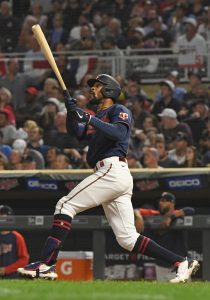 The deal secures Buxton’s future as a Twins cornerstone, and ends several months’ worth of negotiations between the two sides. Talks over the summer didn’t pan out, which then led to speculation that Minnesota might deal Buxton at the trade deadline, though that scenario also didn’t come to pass. The Twins reportedly offered Buxton an $80MM deal during the season, and more recent reports indicated that Buxton’s camp wanted extra incentives included in the contract that would push the value over $100MM.
Instead, Buxton now locks in a guaranteed $100MM, though at the cost of six free agent seasons. Buxton (who turns 28 in December) was entering his final year of team control, and was projected to earn $7.3MM in his final year of arbitration eligibility. Though that lens, this deal could be viewed as a six-year, $92.7MM commitment, though the wide range of potential bonus money could greatly increase Buxton’s earnings.
To work his way into the MVP conversation, of course, Buxton will have to stay on the field, which has been his biggest question mark over seven MLB seasons. The outfielder has battled a wide variety of injury problems over the years, with just 493 total games played in seven seasons. Buxton’s season high was 140 appearances in 2017, but his next-highest totals were only 92 games (in 2016) and 87 games (in 2019), plus he appeared in 39 of a possible 60 games during the abbreviated 2020 campaign.
With so many trips to the injured list, it isn’t surprising that it took Buxton a while to get his timing down at the plate, but his batting prowess has started to emerge over the last three years, particularly in 2021. Buxton hit .306/.358/.647 over 254 PA last season, hitting 19 home runs and stealing nine bases in 10 opportunities. Between this offensive production and his all-world defense, Buxton was worth 4.2 fWAR despite playing in only 61 of Minnesota’s games, due to a hip strain and a fracture in his left hand.
Buxton has never finished higher than 16th in AL MVP voting (in 2020). His lack of playing time has undoubtedly cost him with MVP voters and also likely cost him multiple Gold Gloves beyond his lone GG in 2017. As a result, this incentive structure seems like a decent compromise that works for both Buxton and the Twins. The team gets some flexibility in making a major financial commitment to an injury-prone player, while Buxton both guarantees himself one life-changing payday, and allows him to benefit if he is able to stay healthy and consistently produce superstar-level numbers.
Minnesota doesn’t have much long-term payroll on its books, as Randy Dobnak is the only player guaranteed beyond the 2023 season. The guaranteed portion of Josh Donaldson‘s deal is up after 2023, so Buxton will essentially replace Donaldson as the Twins’ biggest-money commitment.
Locking up Buxton also seemingly erases the possibility that the Twins were going to take a step back or rebuild entirely following their disastrous 2021 season. While Minnesota did move the likes of Nelson Cruz and Jose Berrios at the trade deadline, they didn’t engage in any kind of a full-on fire sale, preferring to try and rebound in 2022. Buxton’s no-trade clause gives him control over his own fate over the next seven seasons, though if Minnesota did change course and look to make a move with Buxton’s blessing in future years, his contract is short enough on guaranteed money that interested teams would likely still be open to absorbing the deal.
The extension also has an impact on the center field market, as Buxton is no longer a trade possibility and Starling Marte (the best everyday option in free agency) signed with the Mets on Friday. Teams looking for center field help are suddenly facing an even thinner list of possibilities.
Photo courtesy of USA Today Sports Images
Rays To Sign Corey Kluber
3:16PM: MLB Network’s Jon Heyman (Twitter link) has the breakdown of Kluber’s incentives. The righty will earn $500K bonuses for hitting the 10-start and 15-start thresholds, $1MM if he makes 20 starts, and $1.5MM for making 25 starts and 30 starts. While the Rays are known for using openers and bulk pitchers, this contract structure would seem to imply that Kluber will be normally deployed as a starting pitcher.
10:44AM: The Rays have signed Corey Kluber to a one-year deal, pending a physical. It’s an $8MM contract, plus incentives, which could take the value of the deal as high as $13MM. MLBTR had predicted a one-year, $12MM contract for Kluber, which is right in line with his earnings window, based on those incentives. Kluber is represented by Jet Sports Management.
This is yet another domino to fall in what has been an incredibly fast-moving starting pitcher market this year, as Eduardo Rodriguez, Anthony DeSclafani, Justin Verlander, Steven Matz, Noah Syndergaard, Andrew Heaney and Michael Wacha have all signed in the past two weeks.
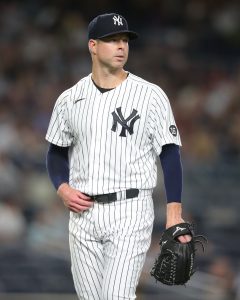
This is the second consecutive one-year deal for Kluber, after being signed by the Yankees in January. At the time, Kluber had been limited to less than 40 total innings over the previous two seasons due to various injuries. Regardless, he was still able to earn himself a guarantee of $11MM from the Yanks after demonstrating his health in a showcase. The righty was again held back by injuries in 2021, although his 80 innings pitched still were the most he’s tallied since 2018. Although he couldn’t live up to his previous Cy Young-winning form, he did manage an ERA of 3.83 with a strikeout rate of 24%.
Prior to his recent injury woes, Kluber was one of the best pitchers in all of baseball. From 2014 to 2018, he had five straight campaigns of at least 200 innings and never had an ERA above 3.50. In total, he threw 1091 1/3 innings during that time frame, second only to Max Scherzer across the league. His 1,228 strikeouts put him third, behind only Scherzer and Chris Sale. His 30.3 fWAR in that span trailed only Scherzer and Clayton Kershaw. He won the AL Cy Young in 2014 and 2017 and made the All-Star team in three straight seasons, beginning in 2016.
For the Rays, this marks another in short-term deal given to a veteran starter, in what has become something of a pattern for the low-spending organization, who signed Rich Hill, Michael Wacha and Chris Archer to one-year deals last winter. Kluber has a much higher ceiling than any of those three, based on his previous track record, but also comes with a high degree of uncertainty based on his recent injuries. The rotation is currently composed of young, highly-touted but inexperienced hurlers, such as Shane McClanahan, Drew Rasmussen, Ryan Yarbrough, Luis Patino, Shane Baz and Josh Fleming. Yarbrough is the only one of that group older than 27 years old or with more than two years’ service time. Tyler Glasnow is likely out for the entirety of 2022 after undergoing Tommy John surgery in August. Yonny Chirinos, also recovering from Tommy John, isn’t expected back until April or May. Brendan McKay just recently underwent thoracic outlet surgery but could potentially be ready by spring training. Kluber, if healthy, adds some steady veteran presence and experience into this mix.
From a financial perspective, the $8MM owed to Kluber pushes the club’s 2022 payroll close to $84MM, in the estimation of Jason Martinez of Roster Resource. This has the potential to be record-setting, as the Rays have never had an opening day payroll higher than $77MM, per Cot’s Baseball Contracts. However, it’s also possible that number comes down after the team subtracts from their substantial arbitration class, either by non-tenders or trades. They already made one such move when they recently traded Jordan Luplow and his projected $1.5MM arbitration salary to the Diamondbacks.
Ken Rosenthal of The Athletic first reported that the Rays had signed Kluber. Joel Sherman of The New York Post first added the $8MM base plus incentives framework. Marc Topkin of the Tampa Bay Times first relayed that the incentives could push the deal as high as $13MM.
Image courtesy of USA Today Sports.