
MLB, Umpires Reach Agreement On Pay Structure For Shortened Season
Major League Baseball and the Major League Umpires Association have reached an agreement on umpire salaries for the 2020 season, ESPN’s Jesse Rogers reports (via Twitter). The league had reportedly been seeking a pay cut for umpires and was pushing for an agreement to be in place this weekend. Absent an agreement, the umpires would not have been paid until play resumed.
USA Today’s Bob Nightengale tweets that the umpires will see their pay reduced by “about” 30 percent. The umpires union had made an initial offer of a 20 percent reduction, per Ken Rosenthal of The Athletic. Rosenthal reported yesterday that the league’s proposal to the umpires included a 35 percent pay reduction (including retroactive prorating of salary that was already paid out prior to the Covid-19 pandemic shutdown) as well as reduced per diems and postseason bonuses. That arrangement didn’t sit well with the umpires union.
Negotiations with the umpires were just one of the countless issues that need to be sorted as the owners, commissioner Rob Manfred and the players association work toward staging a truncated 2020 season that is unlike any we’ve seen in the past (or will see again). Decision-makers are still discussing several scenarios for a return to play and a second training camp. Among the many potential ideas being kicked around are a radical realignment scheme, intrasquad training games at each team’s home park and a potential three-state training setup between Arizona, Texas and Florida. Nothing has been agreed upon or set in place yet, but optimism that a 2020 season will be able to take place has been mounting over the past couple of weeks.
No Contract Talks Between Nationals, Dave Martinez
Nats skipper Dave Martinez spoke with reporters on a conference call this morning and, when asked whether there have been any talks regarding his contract status, replied with a simple, “Nothing” (Twitter link via Todd Dybas of NBC Sports Washington). The 2020 season is the final guaranteed year on Martinez’s contract, although the Nats do hold a club option on the 2021 season.
It’s not surprising to hear that there have been no talks during the pandemic shutdown, but it’s a bit curious that the two sides hadn’t spoken about a new deal earlier in the spring. The 55-year-old Martinez, after all, was at the helm for one of the most remarkable turnarounds any team has made in recent memory. In the absence of an extension, the Nats could’ve perhaps picked up Martinez’s 2021 option in advance; such measures are fairly common throughout the league (particularly for winning managers) in order to spare managers the dreaded “lame duck” status and the frequent questions and speculation that accompany such contractual uncertainty.
Then again, the Nationals aren’t anything close to a typical organization with regard to how they handle their managers. Martinez, for instance, became the sixth man to manage a Nationals game in an eight-year span (2011-18) when he was hired and took the field for the first time. No Nationals manager has ever lasted more than three seasons on the job, and in addition to generally having a short leash with managers, the Nats have a reputation for not compensating their skippers as well as other clubs throughout the league. (Recall that the team wanted to hire Bud Black to manage in the 2015-16 offseason but made him only a one-year, $1.6MM offer despite a nine-year run as a well-regarded manager in San Diego.)
If anyone were to buck those trends, it’s easy to imagine Martinez being the man to do so. His Nats famously surged back from a 19-31 start to the 2019 season to capture the franchise’s first World Series win and finished above .500 the season prior as well. Logically speaking, one would expect Martinez to stick around for at least the 2021 season, but the Nats’ track record in this arena illustrates that they’re difficult to predict. As the Washington Post’s Barry Svrluga highlighted in early March, general manager Mike Rizzo is in a similar spot (minus the club option), but ownership has seemingly yet to make any sort of final decision on its organization’s leaders.
Manny Ramirez Pursuing Taiwan Comeback
May 1: Ramirez’s agent, Hector Zepeda Jr., tells Rob Bradford of WEEI.com that since Ramirez made his interest in a comeback known, he’s already heard from one CPBL team. That club expressed interest but indicated that a signing wasn’t likely until midseason.
April 29: Longtime MLB star Manny Ramirez is well past his prime, but he may yet have another act. He tells Mark Buckton of the Taiwan Times that he’s hoping to appear again in the Chinese Professional Baseball League.
“My goal for 2020, is to find a roster spot in the CPBL,” Ramirez says. “I have been itching to get back in the batter’s box and be able to compete again.”
The CPBL is, of course, the only place in the world to catch a ballgame at the moment. Ramirez, who turns 48 at the end of May, previously starred briefly in Taiwan’s five-team league back in 2013.
The idea this time around, per Ramirez, is to function “as a player-coach.” That’s the same angle he took when he appeared at Triple-A with the Cubs in 2014. Ramirez also pursued an opportunity in Japan in 2017, but nothing came of it.
Why Taiwan? Ramirez says he has also considered the indie ball circuit — which isn’t active right now and may not be in 2020 — but prefers to cross the Pacific. “I have had a few offers for teams in the Atlantic League, but am more in favor of experiencing Taiwan and their delicious food,” he explains.
Ramirez produced and occasionally puzzled over 19 memorable MLB seasons, the last of which was a very brief 2011 showing. He launched 555 total long balls and compiled a ridiculous lifetime .312/.411/.585 batting line, making him one of the greatest hitters in the history of the game — albeit one who tarnished his career with multiple PED violations.
You’ll want to check out the interview for more on what Ramirez has been up to of late. The ever-interesting and exceptionally talented slugger speaks of helping quietly in the community and focusing on his family and Christian faith.
When A Can’t-Miss Prospect Misses
This isn’t how Carson Fulmer‘s career was supposed to go. The former Vanderbilt ace was one of the top-ranked prospects in his draft class back in 2015, and virtually no mock drafts compiled by Baseball America, FanGraphs, MLB.com, etc. that spring had him dropping out of the top 10. At one point, Baseball America projected Fulmer to go to the D-backs with the No. 1 overall pick. “Fulmer is the surest big leaguer on the board, with a floor of elite closer,” BA wrote of Fulmer at the time — a pretty resounding endorsement considering that three of the players eventually selected ahead of him were Dansby Swanson, Alex Bregman and Andrew Benintendi.
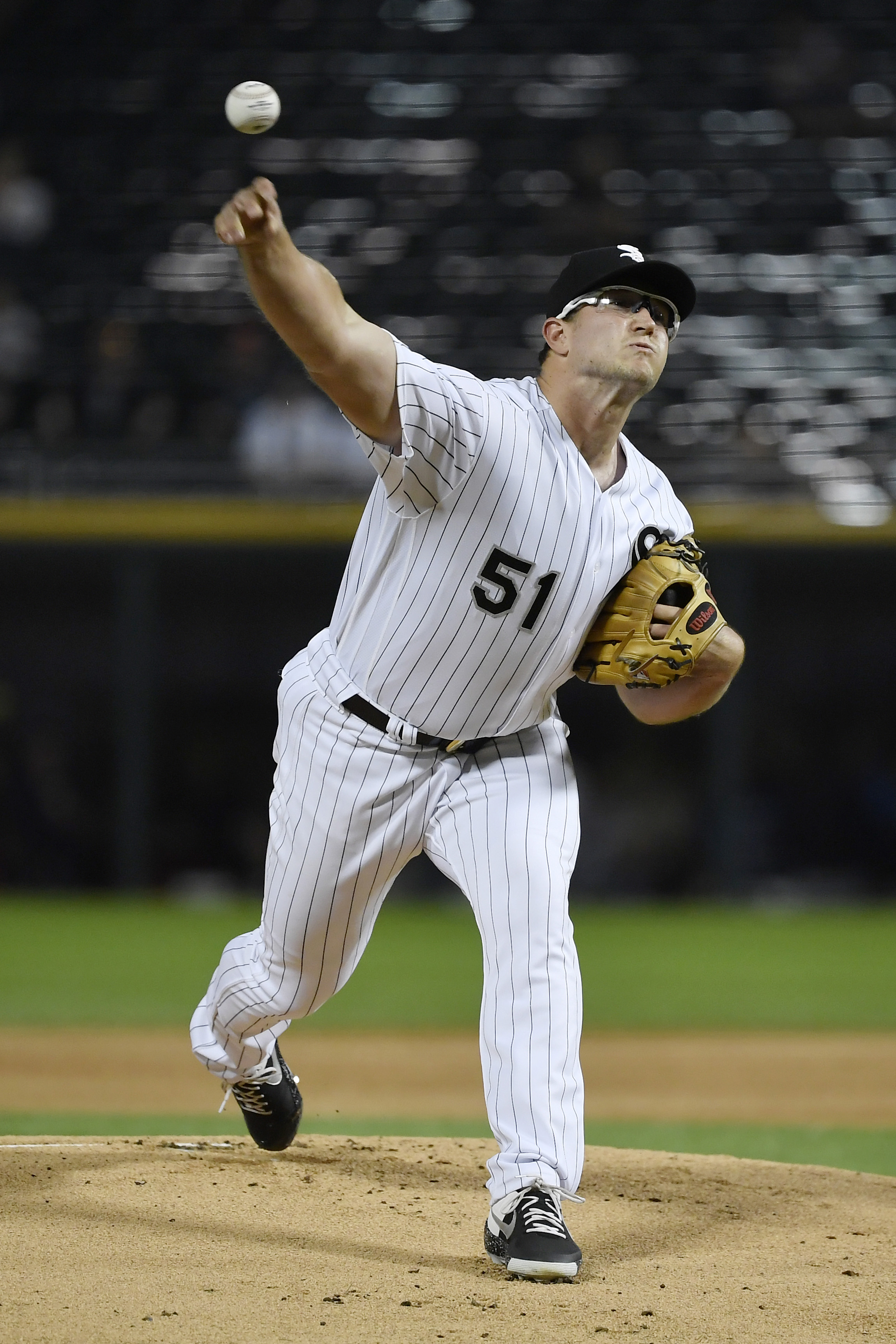
Obviously, things haven’t played out for the now 26-year-old Fulmer as hoped. Everything went according to plan following that ’15 draft. Fulmer pitched a scoreless frame in the Rookie-level Arizona League before being jumping up to the ChiSox’ Class-A Advanced affiliate. Despite being about two years younger than the average competition in that league, Fulmer allowed just five runs on 16 hits and nine walks with 25 strikeouts in 22 innings (2.05 ERA). That strong debut landed him on the top 100 lists at Baseball America (70) and MLB.com (38).
Fulmer’s numbers a year later weren’t as stout. He averaged better than a strikeout per inning but also more than five walks per nine frames while working to a 4.76 ERA out of the Double-A rotation. The Sox called him up to the big leagues that July despite the shaky numbers — just 13 months after he was drafted. Some will suggest that the organization rushed him to the Majors, but Fulmer was viewed as a potential quick mover from the time he was selected. He closed out the game in his big league debut, firing two shutout innings of relief in a loss to the Angels. The righty struggled in a handful of subsequent appearances and went back to Triple-A to finish out the season.
Since that time, Fulmer has been optioned back to the minors eight different times. He’s generally remained healthy but hasn’t succeeded either in Triple-A (5.39 ERA in 243 2/3 innings) or in the Majors (6.56 ERA in 94 2/3 innings). Now, Fulmer is out of minor league options, so the White Sox will have to carry him on the Major League roster or expose him to waivers whenever play resumes. In that regard, the likely expansion of rosters for at least part of the 2020 season will work nicely in Fulmer’s favor.
Fulmer’s velocity isn’t as high as it once was. A heater that reached 97mph “often” in college, per Baseball America, has averaged 93.2 mph in the Majors (93.7 mph in 2019). His command issues have been exploited by more advanced hitters, and his walk rate and frequency of wild pitches have spiked since reaching Triple-A.
Despite the lack of success at the game’s top levels, Fulmer isn’t without positive indicators. The spin rate on his four-seamer and curveball were both elite in 2019, ranking in the 91st percentile and 87th percentile among big league hurlers, respectively, per Statcast. He recorded healthy swinging-strike rates on his curve, cutter and changeup. In Triple-A, he racked up 51 strikeouts in just 34 innings — a 13.5 K/9 and 33.6 percent overall strikeout percentage that were both easily career-bests at any level.
Might a change in approach benefit him? A look at his career fastball usage at Brooks Baseball shows that he’s long worked down in the zone with the pitch and did so almost exclusively in 2019 — even at a time when much of the league is favoring four-seamers at the top of and above the strike zone. His avoidance of elevated fastballs would help to explain the paltry 4.2 percent swinging-strike rate on his four-seamer in 2019.
At this point, Fulmer has been leapfrogged by a host of new young arms in the Sox’ system — Lucas Giolito, Dylan Cease, Michael Kopech and Reynaldo Lopez among them. The White Sox’ initial hopes of Fulmer quickly ascending to the Majors to anchor a rotation alongside Chris Sale and Carlos Rodon have long since been dashed. There’s still room for him to carve out a long-term place in the team’s bullpen if he can piece it all together once games resume, but it’s far from certain that he’ll ever right the ship with the Sox. Chicago’s clear switch to a win-now mode should shorten whatever leash he’s been given in recent years. A change of scenery and a new outlook/approach could perhaps be best for Fulmer, but he’ll likely get one final shot to make things work with the South Siders.
Looking For A First Baseman This Winter?
For teams turning to the free agent market for a first baseman this winter, Jeff Todd has you covered in today’s video.
Cardinals’ Injured Pitchers Making Progress
Before the coronavirus pandemic struck, the Cardinals were set to begin the regular season without some notable pitchers dealing with injuries. But if a season gets underway around midsummer, the Cardinals’ pitching staff could be at or near full strength, as Derrick Goold of the St. Louis Post-Dispatch explains.
Right-hander Miles Mikolas, who underwent a platelet-rich plasma injection in his ailing forearm in February, is making progress in his recovery. The Cardinals expect him to be ready for the start of the season, according to Goold. That’s a relief for both the short and long term, as forearm issues are often a precursor to Tommy John surgery. That outcome would have been disastrous for the Cardinals, who signed Mikolas to. a four-year, $68MM extension before last season and have seen him turn in back-to-back fine campaigns after he returned to the majors following a dominant stint in Japan.
Turning to the Cardinals’ bullpen, closer Jordan Hicks and lefties Andrew Miller and Brett Cecil are also coming along. The fireballing Hicks had TJS last June, and under normal circumstances, he’d have missed a sizable chunk of this season. However, he’s now throwing at “moderate intensity,” president of baseball operations John Mozeliak told Goold, and seems to be on track for a July return. That could mean the Cardinals will get Hicks for some or all of a potential season.
Miller, who battled a mysterious arm problem before spring training stopped, now looks as if he’ll be good to go from the outset. Cecil’s status isn’t as clear. He suffered a major hamstring injury in mid-March, and while he should resume throwing within the next two weeks, it’s unknown if he’ll be shelved at the beginning of a possible season.
If they’re healthy, the Cardinals will need more from Miller and Cecil, recent free-agent signings who haven’t panned out to this point. The formerly dominant Miller struggled to a 4.45 ERA/5.19 FIP over 54 2/3 innings last season – the first of a two-year, $25MM contract. And Cecil, the recipient of a four-year, $30.5MM pact prior to the 2017 campaign, endured an abysmal 2018 and then didn’t pitch at all last season after he had surgery on carpal tunnel syndrome in his left hand. Of course, with Miller and Cecil eligible to return to free agency next winter, it’s possible neither will pitch for the Cardinals again if a season doesn’t take place.
MLBPA Rejects MLB’s 2020 Draft Proposal
Major League Baseball and the MLBPA agreed to the framework of a shortened 2020 amateur draft back in March. As of earlier this week, the event was reportedly set to take place June 10 and consist of five or 10 rounds. However, the union isn’t on board with how the league wants to handle the event.
According to Ken Rosenthal and Evan Drellich of The Athletic, the union turned down the league’s latest 10-round draft proposal. The MLBPA understandably wants as many rounds of the draft as possible to occur because it would benefit the players entering the pro ranks, so 10 instead of five would be a plus for the union. But as you’d expect, the two sides are at odds over money. The league’s plan is to keep slot values where they were last year in the first five rounds, but in six through 10, the values would be cut to 50 percent and there would be “a hard cap on the signing bonus at slot value,” Rosenthal and Drellich write. Moreover, the league would limit teams to signing five undrafted players for $20K apiece – the maximum they’ll be able to receive this year – but an unlimited amount at $5K or less.
While the union isn’t a fan of this proposal, the league could still go forward with what they agreed to a month ago. In the meantime, assuming the draft does still happen in June (it’s expected to, per Rosenthal and Drellich), both sides could continue to negotiate on changes. It would behoove the two to find as much common ground as possible and limit tension with serious talks on a new collective bargaining agreement not far away.
Teams Could Resume Spring Training At Their Home Ballparks
It goes without saying that the 2020 Major League Baseball – if it happens – will be an unusual one. We’ve heard of plenty of out-of-the-box ways for teams to get back on the field if the coronavirus pandemic gets under control, one of the latest being cutting six divisions down to three. But before a potential regular season begins, the players will have to ramp back up with the resumption of spring training.
Players will need about three weeks to ramp back up in camp if spring training restarts. However, it might not take place at its typical sites in Florida and Arizona. Rather, each of the league’s 30 teams could play at their own stadiums, Bob Nightengale of USA Today reports. Four team executives informed Nightengale that the plan is under consideration.
One of the main benefits of this idea is that it would save teams money they’d be spending on hotels and per diem at their normal spring facilities. However, as Nightengale notes, a key downside is clubs would only have access to one field as opposed to the six available to them at their training grounds.
Whether this will come to fruition is anyone’s guess. While there has been recent optimism about a season getting underway, it’s going to be an enormous challenge for MLB to pull off, no matter how many different ideas it may have.
Latest On Potential Mets Sale
Mets owners Fred Wilpon and Jeff Wilpon are considering selling the franchise, though they may not make out as well as they hope if a deal does come together. Rumored bidder Wayne Rothbaum does indeed have interest in taking the Mets off the Wilpons’ hands, but only at a reduced price, according to Thornton McEnery of the New York Post.
“I think he likes the idea of $1 billion,” a source told McEnery. “It’s a round number and the Wilpons are not holding any cards without SNY.”
That wouldn’t be an ideal outcome for the Wilpons, whose financial situation has taken a hit as a result of the COVID-19 pandemic. Even if half of a baseball season takes place this year, the Wilpons could lose up to $150MM, per McEnery.
Before the league shut down because of the coronavirus, the Wilpons nearly agreed to sell an 80 percent stake in the Mets to Steve Cohen for $2.6 billion, but those plans fell through. That transaction wouldn’t have included the SNY network, either. The Mets have recently been valued at $1.6 billion without SNY in the mix, writes McEnery, who hears that the idea of Cohen purchasing the team still isn’t off the table. A source told him “he’s the only one that makes sense” as a possible buyer.
Rothbaum, meanwhile, was part of the $1.2 billion bidding for the Marlins in 2017, but the team ended up going to a group headed by Bruce Sherman and Derek Jeter. If Rothbaum does eventually land the Mets, it’s possible one of Jeter’s former teammates could be a member of his ownership group. There has been talk of Alex Rodriguez and fiancee Jennifer Lopez owning some portion of a Rothbaum-led Mets franchise.
J.D. Martinez, Alex Bregman … Jordan Luplow?
Raise your hand if you know which three major league hitters had the most success against left-handed pitching last season. The first two names – Boston’s J.D. Martinez (242 wRC+) and Houston’s Alex Bregman (205) – don’t come as any kind of surprise. Everybody knows they’re elite offensive players. The same is not true of the third-place finisher, Indians outfielder Jordan Luplow, who put up a jaw-dropping 198 wRC+ and slashed .320/.439/.742 in 155 plate appearances versus southpaws. Nobody could have seen that coming when the Indians made a fairly under-the-radar trade for him before last year.
Heading into the 2018-19 offseason, Luplow was a Pirate who, in limited big league opportunities, didn’t produce much. At that point, the former third-round pick was the owner of a dismal .194/.274/.371 line (72 wRC+) in 190 trips to the plate. Unimpressed, Pittsburgh sent him to Cleveland in a deal that has gone the Indians’ way so far.
In exchange for Luplow and infielder Max Moroff, the Indians gave up infielder Erik Gonzalez and a couple minor league right-handers in Dante Mendoza and Tahnaj Thomas. Like Luplow, Gonzalez had been a replacement-level player and a non-threat at the plate in the majors when the trade occurred. Still, then-Pirates general manager Neal Huntington was happy to bring him aboard.
“Erik Gonzalez is an athletic middle infielder who plays solid defense and has the potential to be a productive hitter at the major league level,” said Huntington. “He gives us another quality option to play shortstop or in the middle of our infield this year and into the future.”
Gonzalez fell flat in Year 1 as a Pirate, though, as he batted an ugly .254/.301/.317 (59 wRC+) in 156 PA during an injury-shortened campaign. He’s 28 and controllable through 2022, so it’s too soon to throw dirt on Gonzalez’s career, but it’s not looking good so far. Meanwhile, the 21-year-old Mendoza has struggled in the minors, where he logged a 5.82 ERA/6.06 FIP across 43 1/3 innings in rookie ball last season. If there’s a silver lining to this trade for the Pirates so far, it’s that they got a solid prospect in Thomas, 20. Formerly an infielder, Thomas ranks as FanGraphs’ No. 5 Pirates farmhand. FanGraphs’ Eric Longenhagen wrote of Thomas two months ago, “He may be the most anonymous 100 mph arm in baseball.”
Perhaps Thomas will one day go down as a player who got away for Cleveland. For now, the team’s benefiting from the deal at the MLB level, though it’s already out one-half of its return in Moroff. He was a non-factor in the bigs last year and is now a member of the Mets organization. And, of course, Luplow doesn’t come without question marks at the plate. The righty amassed 106 PA versus same-handed pitchers in 2019, hit just one of his 15 home runs off them and could only muster a .216/.274/.299 line with a wRC+ of 48. Those are in line with the numbers he posted against right-handers in previous seasons.
Despite his shortcomings, the inexpensive Luplow has already given the Indians a substantial amount of bang for their buck. As a 2.2-fWAR performed last year, FanGraphs valued his output at $17.6MM. At the very least, the Indians appear to have found a nice platoon hitter in Luplow — one who has experience at all three outfield positions. The fact that he’s still just 26 and controllable for five more years (including two pre-arbitration seasons) only adds to his appeal from the low-budget Indians’ perspective.
Photo courtesy of USA Today Sports Images.