
2019-20 MLB Free Agent Tracker
Our 2019-20 MLB Free Agent Tracker is now available! You can filter our mobile-friendly tracker by team, position, signing status, qualifying offer status, handedness, and contract details. It’s the perfect tool to slice and dice this winter’s free agent class, and we’ll be keeping it updated throughout the offseason. Bookmark our 2019-20 MLB Free Agent Tracker today! You can also find it under the Tools menu.
For those wondering the ETA on our Top 50 Free Agents list, that will be published later today after all qualifying offer decisions come in.
Reds Outright Four Players
The Reds announced Monday that infielder/outfielder Derek Dietrich, infielder Christian Colon, right-hander Jackson Stephens and right-hander Keury Mella all went unclaimed on waivers and were set outright to Triple Louisville.
Dietrich, 30, is the most notable name of the group and will surely reject the assignment to once again become a free agent. The former Marlin parlayed a minor league deal in Cincinnati this offseason into an Opening Day roster spot and went on one of the more memorable power surges in recent memory midway through the year. Dietrich launched a dozen homers over a span of just 68 plate appearances in May and carried a 1.000 OPS into June. However, he fell into a slump that was perhaps even more remarkable than that home-run binge; in his final 71 plate appearances, he hit just .071/.257/.179.
Mella, 26, was acquired from the Giants alongside Adam Duvall in the 2015 trade that shipped righty Mike Leake to the Giants. He was considered to be among the more promising pitching prospects in Cincinnati in the couple of years following that trade but has seen his stock dip considerably. The righty yielded 15 runs in 17 Major League innings across parts of three seasons, posting an uninspiring 13-to-12 K/BB ratio during those stints. At the time of his acquisition, Mella was averaging better than a strikeout per inning against older competition in Class-A Advanced, but in parts of three Triple-A seasons he has a 4.59 ERA with 6.4 K/9 against 3.3 BB/9 in 172 2/3 innings.
The 25-year-old Stephens had a big year with Double-A Pensacola back in 2016 but has limped to an ERA north of 5.00 in three trips through Triple-A Louisville while struggling to a 4.83 ERA through multiple MLB auditions. He spent the 2019 season in Triple-A, where he logged a 5.14 ERA with an 80-to-37 K/BB ratio in 84 innings, mostly as a reliever.
Colon, once the fourth overall pick in the draft and a top prospect with the Royals, appeared in just eight games with the Reds and made eight plate appearances. He’s a career .256/.321/.218 hitter in the Majors and batted .300/.372/.443 in Triple-A with the Reds this past season.
Brewers Decline 2020 Option On Eric Thames
The Brewers announced Monday that they’ve declined their $7.5MM club option on first baseman/outfielder Eric Thames. He’ll be paid a $1MM buyout instead. While Thames doesn’t have the requisite six years of free agency to become a free agent, the three-year contract he signed upon returning to Major League Baseball from the Korea Baseball Organization stipulated that he become a free agent in the event that his 2020 option was bought out. As such, he’ll be added to the free-agent pool and is now free to sign with any club this winter.
It’s a somewhat surprising decision, as the 32-year-old Thames turned in a .247/.346/.505 batting line with 25 homers, 23 doubles and two triples in just 459 plate appearances. Thames did strike out at a 30.9 percent clip, but he also drew a walk in 11.1 percent of his plate appearances. Thames has been a pure platoon player for the Brewers of late, and the reasoning isn’t especially hard to discern; in 202 plate appearances against lefties since his return to the Majors, he’s batted .188/.287/.375. Against right-handed opponents, he’s hit .251/.354/.529 with 63 of his 72 home runs.
Thames spent the bulk of his time in 2019 at first base, though he’s no stranger to either outfield corner. Metrics like Defensive Runs Saved and Ultimate Zone Rating credited him as a solid defender at first in 2019 but less so in the outfield (-4 DRS, -1.3 UZR, -6 Outs Above Average in 490 2/3 innings since returning).
The free-agent market generally hasn’t been welcoming to bat-first corner-only options like Thames in recent seasons — particularly those on the wrong side of 30. His ability to log some innings in the outfield corners will give him a leg up on some other more limited sluggers, particularly with teams able to roster a 26th player in 2020. It’s possible that Milwaukee will look to bring him back on a lower-priced one-year deal, but other speculative fits for Thames on the open market will include the Twins, White Sox, Rangers and Nationals. Rebuilding clubs like the Marlins, Tigers and Royals could all conceivably take a look as well.
Blue Jays Acquire Chase Anderson
12:39pm: The Blue Jays and Brewers have formally announced the trade.
10:40am: The Blue Jays are sending minor league first baseman Chad Spanberger to Milwaukee to complete the deal, TSN’s Scott Mitchell tweets.
10:23am: The Blue Jays are set to acquire right-hander Chase Anderson from the Brewers, Robert Murray reports via Twitter. Anderson is under control through the 2021 season via a pair of club options, and the decision on that first option (valued at $8.5MM) is due today. The pitching-needy Blue Jays figure to pick that option up and plug Anderson into the rotation. Toronto will also have a $9.5MM option on Anderson in 2021 (with a $500K buyout).
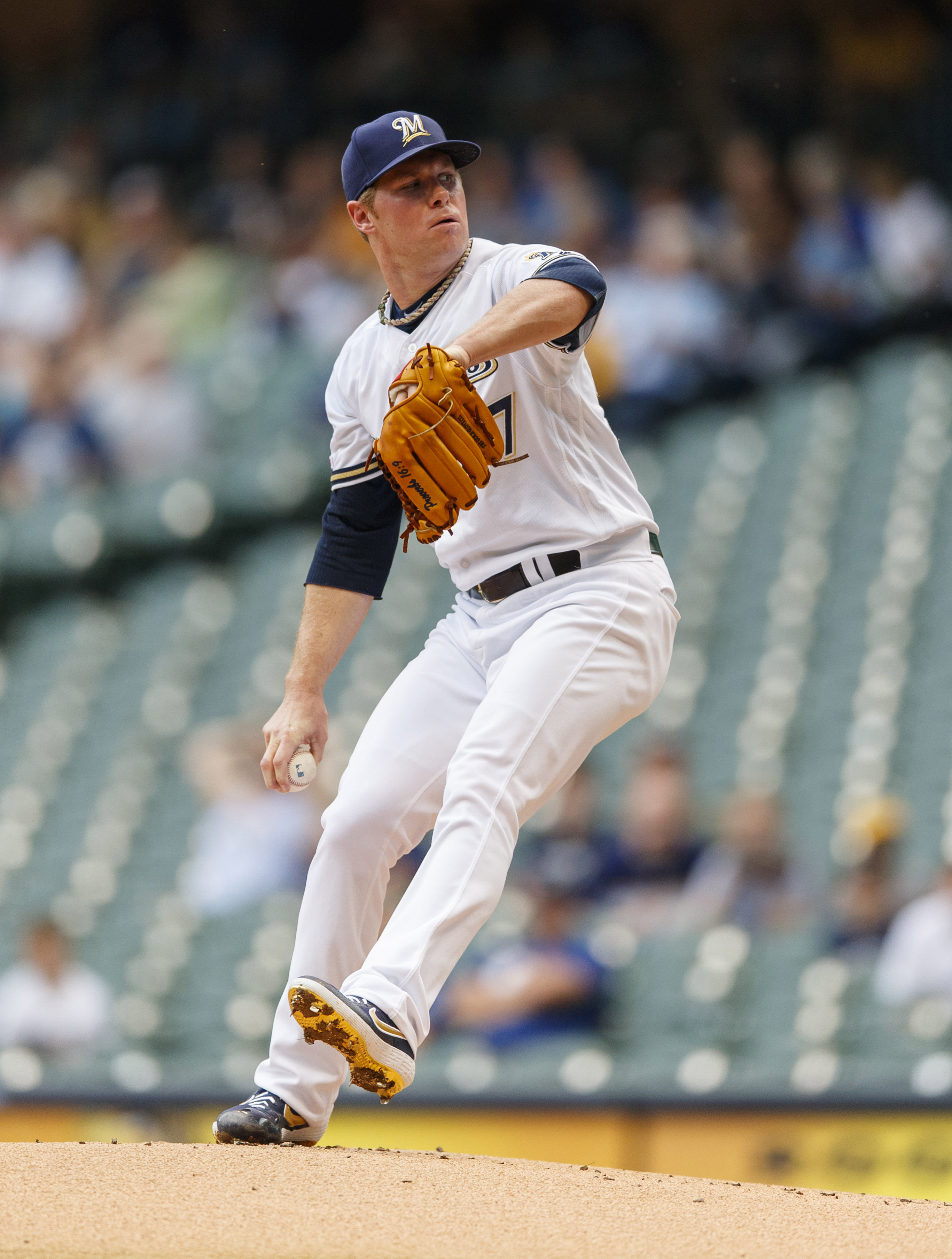
Anderson, who’ll turn 32 later this month, has been a staple on the Milwaukee staff for the past four seasons, averaging 30 appearances and 28 starts per season in that time. The Brewers have become increasingly aggressive in limiting their starters’ innings in recent seasons, which suppressed Anderson’s innings total in 2019 in particular. Five of Anderson’s 2019 appearances came in relief, but even in his 27 starts, he averaged just over 4 2/3 innings per outing (with a 4.29 ERA).
In all, over the past four seasons, Anderson has given the Brewers 590 innings of 3.83 ERA ball while averaging 7.7 K/9, 3.1 BB/9 and 1.45 HR/9 to go along with a 36.1 percent ground-ball rate. He doesn’t stand out in terms of spin rate on his fastball or curve, but Anderson’s 93.4 mph average heater in 2019 was a career-best. Anderson has also generally been well above-average in terms of limiting hard contact and opponents’ exit velocity, ranking in the 76th and 83rd percentiles, respectively, among pitchers in 2019.
Today’s trade surely signals that the Brewers weren’t sold on retaining Anderson at that $8.5MM rate. They could’ve bought him out and retained him via arbitration — Anderson has not yet reached six years of MLB service but will in 2020 — but MLBTR contributor Matt Swartz projected an even heftier salary in arbitration ($10.3MM) than he’d earn on this option. Anderson may not be given the green light to turn an opponent’s lineup over for a third time with too much frequency next year, but he’ll presumably have a longer leash on a start-to-start basis than he did with the Brewers.
The Blue Jays entered the offseason needing to add several pitchers to a beleaguered rotation that lacked even a modicum of clarity heading into 2020. Right-handers Trenth Thornton and Jacob Waguespack were the de facto members of the starting staff prior to today’s trade, but Thornton struggled to keep his ERA south of 5.00 while Waguespack threw just 65 1/3 Major League innings (4.13 ERA, 4.81 FIP). Toronto will also likely have veteran righty Matt Shoemaker back in 2020, but he’s a bit of an unknown coming off surgery to repair a torn ACL suffered early in the 2019 campaign. Righties T.J. Zeuch and Sean Reid-Foley also received auditions in 2019, as did southpaw Anthony Kay. That trio will be in the mix once again next season, as well.
Even with Anderson now on board, the Jays will surely be in the market for additional help on the starting staff — likely some higher-ed names than Anderson, who’ll be more of a back-of-the-rotation stabilizer. Toronto general manager Ross Atkins stressed at his end-of-season press conference that the Blue Jays need to find “pitching we can count on,” emphasizing that merely stockpiling depth wouldn’t be good enough. “We need to have guys that can contribute in significant ways,” he said at the time.
As for the Brewers, they’ll save themselves a $500K buyout on Anderson and turn the final two seasons of his contractual into the 24-year-old Spanberger, who was selected by the Rockies in the sixth round of the 2017 draft. Toronto had previously acquired him in the trade that sent reliever Seunghwan Oh to the Rockies. Spanberger drew praise for his 70-grade raw power over at FanGraphs prior to the season, although he didn’t post especially impressive numbers in the pitcher-friendly Eastern League, where he hit .237/.308/.399 with 13 homers and 29 doubles (108 wRC+). He spent more time in right field than at first base in 2019 and could eventually give the Brewers some bat-first corner depth.
Cubs To Decline Options On Phelps, Morrow, Graveman, Barnette
The Cubs will decline their 2020 club options on right-handers David Phelps ($5MM), Brandon Morrow ($12MM), Kendall Graveman ($3MM) and Tony Barnette ($3MM), per ESPN Chicago’s Jesse Rogers.
As we explained back in September, Phelps’ club option rose from $1MM to $5MM after he hit several escalators. Graveman, meanwhile, will become a free agent with today’s move despite the fact that he doesn’t yet have six years of Major League service time. MLBTR reported last month that the right-hander’s contract contained a clause stipulating that he be released should his 2020 option not be picked up. Phelps’ option didn’t come with a buyout, and it doesn’t appear that the $3MM options for Barnette or Graveman did either. Morrow will be paid a $3MM buyout.
Phelps, 33, posted a solid 3.18 ERA in 17 innings with the Cubs and a similarly sharp 3.41 earned run average in 34 1/3 innings on the season as a whole (between Toronto and Chicago). However, while Phelps punched out 36 hitters in those 34 1/3 frames, he also issued 17 walks — including 10 in his 17 frames as a Cub. He also posted just a 7.8 percent swinging-strike rate on the season (9.9 percent as a Cub) and 26.8 percent opponents’ chase rate (29.7 percent as a Cub) — all of which check in south of the league average and suggest that Phelps may have had a tough time replicating those strikeout numbers. On the plus side for the veteran righty, he proved himself healthy after missing 2018 due to Tommy John surgery, so he could be in line for another big league deal this winter.
Morrow, on the other hand, didn’t prove himself to be healthy at all. The right-hander was the “buzz” free agent of the 2017-18 offseason on the heels of a dominant rebound in the Dodgers’ bullpen, but he ultimately threw just 30 2/3 innings after signing a two-year, $21MM contract that winter. Back, biceps and elbow injuries all contributed to the truncated nature of Morrow’s time on the mound as the Cubs’ closer.
Like Morrow, Graveman didn’t pitch for the Cubs in 2020. He, in fact, never stepped foot on the mound as a Cub. The right-hander inked a one-year, $575K pact after undergoing Tommy John surgery in 2018 and being non-tendered by the Athletics. Chicago picked him up and helped him to rehab in 2019, with an eye toward utilizing him as an affordable starter or swingman in 2020. Whether the organization didn’t feel Graveman had progressed enough or simply didn’t wish to allocate $3MM to such a wild card isn’t clear, but he’ll head to the open market in better health than he exhibited last time around — and he’ll do so with four-plus total years of service time. In other words, any new teams that signs Graveman to a one-year deal could control him not only for 2020 but also 2021.
Barnette, meanwhile, tossed just 1 1/3 innings as a Cub after signing a $750K contract in Spring Training. He spent some time pitching with the Cubs’ Triple-A affiliate as well but was eventually placed on the restricted list for personal reasons as he sought to “reevaluate” his situation with his family while taking some time away from the game.
Pirates To Exercise Chris Archer’s 2020 Option
The Pirates will pick up right-hander Chris Archer‘s $9MM club option for the 2020 season, Nubyjas Wilborn of the Pittsburgh Post-Gazette tweets. Pittsburgh could have paid Archer a $1.75MM buyout but will now have him locked in for the upcoming season. His contract also contains an $11MM option (with a $250K buyout) for the 2021 campaign.
Archer, 31, simply hasn’t panned out as hoped in Pittsburgh. The Buccos shipped prospects Tyler Glasnow, Austin Meadows and Shane Baz to Tampa Bay in order to acquire three and a half cost-controlled seasons of Archer in what now looks like one of the more regrettable deals in recent memory. Both Glasnow and Meadows have flourished with the Rays, while Archer has given the Pirates a combined 172 innings of 4.92 ERA ball in his season and a half wearing black and yellow.
Archer was long seen as a pitcher with some yet-untapped upside, and the friendly nature of his contract surely made him all the more appealing for recently fired general manager Neal Huntington and a Pirates front office that is regularly working under some of the game’s tightest payroll restrictions. Whether the Bucs would’ve been so motivated to acquire Archer with more financial support from ownership can’t be known — just as it’s impossible to tell whether Glasnow and/or Meadows would’ve broken out to the same extent in Pittsburgh as they did in St. Petersburg. The bottom-line result, however, is a trade that has paid major dividends for the Tampa Bay organization but not for Pittsburgh. The ill-fated swap surely contributed to owner Bob Nutting’s recent organizational shakeup, which saw Huntington dismissed and assistant GM Kevan Graves tabbed as interim general manager.
The Pirates initially pushed Archer to dust off a two-seam fastball that he’d shelved years ago with the Rays, and the results weren’t pretty. The right-hander eventually scrapped that pitch over the summer and returned to a four-seam-heavy approach with his heater, though the results weren’t exactly encouraging. Archer pitched to a 4.65 ERA in 12 starts (60 innings) after ditching that pitch, although his strikeout rate (31.4 percent) and swinging-strike rate (13.6 percent) upon changing his pitch selection were markedly better than they were with the two-seamer. A shoulder injury, however, halted Archer’s season in late August.
Given his average velocity in that time (94.4 mph) and those encouraging swinging-strike trends, Archer could yet appeal to clubs who hope to coax better results out of the right-hander. Moving him now would clearly be selling low and would net a much lesser return than what the Pirates initially surrendered, but trade options for contenders seeking rotation help this winter are limited. If the Bucs opt to hold onto him in hopes of building some value in the season’s first half, Archer would likely emerge as a trade candidate next summer, so long as he proves healthy.
Van Wagenen: Mets Will Make Qualifying Offer To Zack Wheeler
The Mets will extend a one-year, $17.8MM qualifying offer to right-hander Zack Wheeler before today’s 5pm ET deadline, general manager Brodie Van Wagenen announced at today’s press conference to introduce new manager Carlos Beltran (h/t: Joel Sherman of the New York Post, on Twitter).
That’s been the expected outcome for several months now, and Wheeler is widely expected to reject the offer in search of a more lucrative deal in free agency. If and when Wheeler does sign a new contract elsewhere, the Mets will be entitled to a compensatory pick in the 2020 draft.
Wheeler, 29, should have little trouble trouncing that $17.8MM, one-year offer in free agency. The market features a pair of clear-cut No. 1 starters in Gerrit Cole and Stephen Strasburg, but Wheeler is very arguably the No. 3 free-agent arm of the winter and will likely be treated as such by several teams. As laid out recently by MLBTR’s Connor Byrne, Wheeler is the second-hardest-throwing starter on the market (trailing only Cole), and no free-agent starter limited hard contact better than Wheeler in 2019. He also ranks in the top 10 among free agents in terms of highest strikeout percentage and lowest walk percentage.
While some may point to Wheeler’s 3.96 ERA in 2019 and zero in too heavily on that figure, his overall body of work over the past two seasons is largely excellent. In his past 55 Major League starts, Wheeler has pitched to a collective 3.47 ERA (3.27 FIP) with 9.0 K/9, 2.4 BB/9, 0.82 HR/9 and a 43.1 percent ground-ball rate. He’s done so while playing in front of a porous defense that ranks 29th among MLB teams with a ghastly -169 Defensive Runs Saved across the past two seasons.
Qualifying offer notwithstanding, it’d be a surprise to see Wheeler command anything less than a strong three-year deal, and even that’s a rather cautious and conservative outlook. The demand for pitching among contenders will be strong, and Wheeler is trending up at a time when the trade market offers virtually nothing in terms of top-tier arms. For clubs looking to add a starter with front-of-the-rotation upside but unwilling to approach the $30MM+ annual salaries that Cole and Strasburg will likely command, Wheeler and lefty Madison Bumgarner are the next-best options.
Braves, Tyler Flowers Agree To New Deal
The Braves have agreed to re-sign catcher Tyler Flowers after paying a $2MM buyout on his $6MM club option, MLB.com’s Mark Bowman reports (on Twitter). Declining Flowers’ option was a purely on-paper move, as he’ll be brought back on a $4MM deal for the upcoming season. It’s a strange technicality, to be sure, particularly since the Braves don’t figure to approach the luxury tax threshold in 2020. But the restructuring of the deal now means that only $4MM of Flowers’ salary counts against the 2020 payroll — as opposed to the $6MM that would’ve counted had Atlanta simply exercised his option.
Flowers, 34 in January, didn’t have his best season at the plate but remains a highly regarded pitch framer. And while his .229/.319/.413 batting line checked in at 12 to 14 percent below that of a league-average hitter, per metrics like wRC+ (88) and OPS+ (86), it was still better than that of the league-average catcher (85 wRC+). The Atlanta organization will surely be on the lookout for catching help this offseason — their other catcher in 2019, Brian McCann, already announced his retirement — but having Flowers on hand as a quality, framing-oriented backup with some pop in his bat makes plenty of sense given the affordable nature of the contract.
Looking to other defensive components behind the plate, Flowers had his share of struggles. His 16 passed balls allowed led the league, so it’s no surprise to see that he rated near the bottom of the league in terms of pitch blocking over at Baseball Prospectus. His 19 percent caught-stealing rate was also a ways below the 26 percent league average. All that said, however, Flowers’ elite framing ranked fourth in the game, per Baseball Prospectus, who rated him as the game’s ninth-most-valuable defender in spite of those blocking and throwing woes. Flowers also drew a positive mark with four Defensive Runs Saved — his ninth straight season with a positive DRS rating.
Kenley Jansen Won’t Exercise Opt-Out Clause
Dodgers right-hander Kenley Jansen passed on the opportunity to opt out of the final two years and $38MM on his five-year, $80MM contract, as was first reported a few days back by MLB Network’s Jon Heyman (via Twitter).
It’s not a surprising decision in the least. Now 32 years old, Jansen has seen his velocity and his results decline in each of the past two seasons, and he assuredly would have been in line to receive less than $38MM on the open market.
Jansen’s strikeout and walk rates remain excellent (11.4 K/9, 2.3 BB/9), but he’s become more hittable and more homer-prone over the past 15 months in particular. Jansen carried a 2.28 ERA and a 57-to-13 K/BB ratio through 51 1/3 innings into the month of August in 2018. From that point forth, however, he surrendered 11 earned runs on the strength of seven homers in his final 20 1/3 innings. He was sharp through the NLDS and NLCS last season before being tagged with a pair of blown saves in the team’s World Series loss to Boston.
The 2019 season was Jansen’s worst as a Major Leaguer. In 63 regular-season innings, he was tagged for a 3.71 ERA with nine homers surrendered. Dating back to last August, Jansen’s overall regular-season numbers are wholly unremarkable; he’s tallied 83 1/3 innings with an even 4.00 ERA. And despite his robust strikeout totals in that time, he’s yielded an average of 1.73 homers per nine innings pitched.
Perhaps a correction of this year’s explosive ball will prove beneficial, but it’s also worth noting that Jansen’s homer troubles were greater in 2018 than in 2019. At this point, with his once-94.3 mph cutter checking in at an average of 92.1 mph, it’s equally possible that Jansen simply won’t return to the dominant force he once was. His K/BB rates still give him a chance to be a quality late-inning arm, but he’ll need to curtail the home runs to some extent — even if he can’t return to his 2016-17 form, when he yielded just nine home runs over a span of 137 innings. He’ll earn $19MM in each of the next two seasons, but in spite of that salary, the Dodgers may be forced to push him into a lower-leverage role and alter the manner in which they handle their highest-leverage situations moving forward.
Marlins Offer Coaching Position To Hensley Meulens
Nov. 4: The Marlins have made Meulens a formal offer to join their 2020 staff, MLB.com’s Jon Morosi tweets. Meulens, however, has received interest from multiple clubs since being eliminated from the Giants’ managerial search, per Morosi, so it seems he could yet have a decision on his hands.
Nov. 1: The Marlins are in talks with current Giants bench coach Hensley Meulens about a role on their staff in 2020, Jon Heyman of MLB Network tweets. Meulens has been told he’s not a finalist in San Francisco’s search for a new manager, per the report, and it seems there’s now a chance the organization will lose him entirely. SiriusXM’s Craig Mish adds that Meulens would likely step into the role of hitting coach if the two sides do work out a deal. He’d pair with bench coach and “offensive coordinator” James Rowson, recently hired away from the Twins, to work on reshaping the organization’s approach at the plate.
Meulens, 52, has spent the past decade on the Giants’ coaching staff under the recently retired Bruce Bochy. He’s been bench coach for the past couple of seasons but previously served as the club’s hitting coach and is also responsible for outfield defense and positioning instruction. Meulens was the Giants’ hitting coach for each of their three World Series titles in 2010, 2012 and 2014. He also has five years of experience as a minor league hitting coach and served as the manager for Team Netherlands in both the 2013 and 2017 World Baseball Classics.
A native of Willemstad, Curacao, Meulens would bring an important bilingual presence to a Marlins club that has a number of key players from Venezuela, Colombia, the Dominican Republic and Cuba both on the big league roster and rising through a rapidly improving farm system. Meulens played parts of seven seasons in the Majors — teaming with recently extended Marlins manager Don Mattingly as a Yankee from 1989-93 — and also played professionally in Japan (1994-96), Korea (2000) and Mexico (2001-02).