
Making Sense Of The Whit Merrifield Extension
It’s difficult sometimes to make sense of the extensions we hear about. Why is it that player A is earning so much more or less than player B? Sometimes it’s obvious; sometimes it’s not. In some cases, there are relatively unique, personal circumstances that help explain it — some of which may not even really become known publicly. In every case, the actual course of negotiations requires both sides to estimate market value at a point at which there are necessarily still key factors that are unknown. There’s plenty of variability based upon varying motivations of the particular team and player involved. Still, we like to think that market value underpins baseball contracts. Every deal is susceptible of examination from a value perspective.
Given all of that, it seems worth taking a closer look at the recently reported deal between the Royals and second baseman/center fielder Whit Merrifield. Despite two-straight All-Star seasons and an upward trajectory in his performance, he’s promised just $16.25MM over four years — less than the qualifying offer rate ($17.9MM) for a single season. He can boost that by a bit via escalators, but will also give away an option year at a $10.5MM salary. Even in the extension context, it seems like a bargain for a high-quality player who has immense versatility and a well-rounded skillset. So, how to make sense of this?
It all starts with his experience and age. Merrifield is still shy of three years of MLB service yet just recently hit his 30th birthday. Since he didn’t have enough service time to reach arbitration early as a Super Two qualifier, he was still a full season away from commanding more than the league minimum salary, with the inherent risks and limitations of the arb process to look forward to thereafter. Moreover, the recent trends in the aging curve have not been kind to elder statesmen.
Add to that the fact that Merrifield’s most notable skills — hitting for average, speed on the bases, and good and versatile glovework — are not particularly well-compensated in the arbitration process. To be sure, they do show up indirectly in earnings since the process pays players who see a lot of playing time. But power stats (homers and ribbies) have tended to pay best over time than the harder-to-quantify areas of the game. Even stolen bases, the counting stat in which Merrifield shines, aren’t considered major drivers.
Whatever one thinks of Merrifield’s particular outlook, in terms of skills and health, the overall situation was one in which his anticipated future earnings were rather limited. In arbitration, barring a huge power burst, he’d have profiled as a strong but hardly record-shattering player. And his hypothetical free agency was laden with risk. How might he look as a player four years in the future? Nobody knows, but odds are he won’t be quite in his prime, since his pre-existing arbitration control extended through his age-33 season.
Let’s dig into the numbers to see why this is the case.
First, looking at the forthcoming arb years, we can check in on some second basemen and other comps to learn about what Merrifield might have taken home had he elected to go year to year. As I’ve noted previously, DJ LeMahieu represents an interesting overall comp since he just wrapped up his own arbitration run. After starting with a $3.0MM salary, and posting one big offensive season during his arb years, he finished with a $16.3MM total — a near-exact (and perhaps not coincidental) match for what Merrifield will receive.
When I first proposed that comp last March, Merrifield had yet to post his excellent 2018 season. As things stand, it’s not hard to see a path to more than $16.25MM. Just how high Merrifield could have climbed would obviously have been dependent upon what he does in the season to come, but we can guess at some parameters.
In terms of starting point, Merrifield ought to end up with a case for much greater earning power than LeMahieu (.284/.329/.370, 15 home runs, 157 RBI, 1,901 plate appearances) and Joe Panik (.282/.345/.408, 29 home runs, 170 RBI, 1,818 plate appearances), who earned $3.45MM in his first arb year. The Dodgers’ Chris Taylor rode a breakout 2017 and solid 2018 follow-up to a first-year arb salary of $3.5MM. He’s sitting on 39 home runs and 152 RBI with a .262/.331/.435 batting line through 1490 plate appearances. Even if Merrifield isn’t able to push or top twenty long balls in 2019, he’d surely be on track to carry a much more impressive overall statistical baseline than Taylor. He already has more plate appearances (1,669) and RBI (167) and nearly as many long balls (33), with a full season left to improve upon those tallies.
On the other hand, it’s tough to foresee anything like the 34-dinger outburst and second-place MVP finish that allowed Javier Baez to achieve a $5.2MM first-year arb salary. In all likelihood, depending upon how things play out in 2018, Merrifield likely would have commanded an arb-1 salary somewhere between the numbers we’ve thrown out for consideration — say, in the realm of $3.75MM to $4.75MM.
A few other mid-arb players also help illustrate how things could have proceeded in the event that Merrifield would have kept producing throughout his arb years, quite apart from the starting point. Shortstop Marcus Semien entered arb with sixty home runs and near-average total productivity through just under two thousand plate appearances. He earned $3.125MM in his first year after an injury-limited platform season and bumped up to $5.9MM in 2019 salary after launching 15 long balls in 703 plate appearances. Scooter Gennett jumped from a $2.525MM starting point to $5.7MM and $9.775MM salaries, driven by a total of fifty dingers and robust overall productivity in his final two platform campaigns.
With good fortune and some continued improvement, Merrifield could have tracked those or even greater raises. In the best-case, reasonably realistic scenario — fully healthy seasons at the top of his prior power levels (~20 home runs annually) — he might have started at a $4.5MM level and taken home successive $3.5MM raises. That would have resulted in $24MM of total arbitration salary.
Of course, it’s imaginable that Merrifield’s performance, and/or intervening health issues, could deflect him from that sort of path. Joe Panik had set the stage for bigger earnings than that (despite suffering a major ballpark-related disadvantage vis-a-vis LeMahieu), but stumbled after taking down $3.45MM in his arb1 season. He settled for just $3.8MM for the coming campaign and has no hope of approaching LeMahieu’s overall earning level.
Obviously, any kind of significant injury would sap any player’s ability to command a raise. Since Merrifield is not even in arbitration yet, an ill-timed and significant injury (say, in camp this spring) could have been extremely damaging to his earning power. Even if things went well for a time, Merrifield would always have been vulnerable to injuries or downturns in performance. That’s the same for any player, but the risks were amplified (and the future free agent benefits diminished) by his age.
It bears emphasis that the risks still apply before Merrifield would reach arbitration, since he’s still a full season away. Don’t believe me about the variance in arb earnings? Here’s an illustration, using some big names. Francisco Lindor nearly set a first-year-eligible record when he agreed to a $10.55MM contract earlier this month. He has been healthier and more productive of late than the fellow star shortstop of the same service class to whom he’s often compared — Carlos Correa, who edged Lindor in the 2015 Rookie of the Year vote. The Astros star’s salary remains unresolved, but will fall between $4.25MM and $5MM. Despite piling up plate appearances at the outset of his career, Correa is now over five hundred shy of Lindor due to some injuries. Unsurprisingly, he has also fallen behind his contemporary in home runs and holds only a slight edge in runs batted in. Correa still holds a clear edge in overall, park-adjusted offensive productivity (128 wRC+ vs. 120 wRC+), and is still considered an elite talent, but took a down year at the wrong time. Lindor’s playing time and power ramped up in his platform years, allowing him to more than double Correa’s first-year arb earning power.
If $24MM of arbitration earnings represented a best-case scenario, then the downside was more or less unlimited. Obviously, it’s hard to imagine that Merrifield would be cut out of significant future earnings entirely, barring a truly catastrophic injury. But he’s still a full season away. And as Panik shows, it’s not hard to craft a scenario where the earnings come in well short of their anticipated trajectory. The risks are clear.
If there’s something potentially objectionable about this arrangement from Merrifield’s perspective, perhaps it’s the fact that he coughed up a free agent season. That’s where the Royals could find some real upside, since they’ll have a chance to hang onto Merrifield for only a one-year commitment, when he could in theory be in position to take down quite a bit more in free agency.
That said, just what kind of open-market earning scenarios is Merrifield really sacrificing (or, at least pushing back by one year)? It seems rather unlikely, even from four years out, that he’ll enter the 2023 season thinking he left an enormous amount of money on the table.
Take this comparison. We can all agree that Merrifield has had an outstanding pair of seasons. He’s sitting on a .296/.347/.449 cumulative slash with 31 home runs and 79 steals, with his other contributions leading to a cumulative valuation of 9.3 rWAR / 8.1 fWAR. Compare that to Jed Lowrie, who once had his own breakout season at 29 years of age. He was injured in the interim but turned things on more recently. Lowrie just hit the open market at a slightly more advanced age than Merrifield would have, sporting a two-year platform of .272/.356/.448 hitting with 37 home runs and 8.8 rWAR / 8.5 fWAR.
Lowrie’s free agent take? Two years and $20MM. That salary level is reflected in the one option year that Merrifield gave the team in his new deal, which is valued at $10.5MM — again, as with the LeMahieu arb comp, perhaps not coincidentally.
Even in a highly optimistic scenario, such as the Ben Zobrist bidding war, there’s a limit to what this sort of player can earn in free agency. Zobrist was a hot commodity entering his age-35 season, having a long track record of excellent offensive production (well outstripping Merrifield’s overall record to this point) and defensive versatility. He secured a four-year, $56MM contract.
All things considered, this seems to be rather a fair arrangement for both sides. It’s a deal that lets the team avoid a runaway arbitration salary, and perhaps gain another season of a respected veteran at a bit of a discount rate. But it’s hardly the Jose Ramirez contract — another deal involving a two-plus service class infielder who was coming off of a breakout campaign. Ramirez, of course, was just 24 years of age and was just beginning an ascendancy that has continued to levels that were perhaps not anticipated at the time. His deal conveyed a pair of valuable team options — for his age-30 and 31 seasons. The sort of upside present there just isn’t available in the Merrifield contract.
For a 30-year-old, non-slugging infielder/outfielder who is still less than three campaigns into his MLB career, this extension lands in a sensible realm in terms of both length and total guarantee. Upon sifting through some other recent contracts, it’s not hard to see how the sides landed where they did.
Twins Sign Mike Olt
The Twins have signed Mike Olt, the corner infielder announced Sunday on Instagram. It’s surely a minor league contract for Olt, who hasn’t seen action in the majors in recent years.
In fact, the 30-year-old Olt is coming off the third straight season in which he failed to appear at the game’s highest level, having spent all of 2016 in the Padres’ minor league system and both ’17 and ’18 in the high minors with the Red Sox. Before that, he received MLB time with the Rangers and both Chicago teams from 2012-15, during which he batted just .168/.250/.330 in 400 plate appearances.
Olt’s subpar major league performance has been all the more disappointing given that he was a first-round pick of the Rangers in 2010 and a former top-50 prospect, though unfortunate vision problems seemingly changed his career trajectory. To Olt’s credit, he has performed well at the Triple-A level, where he has slashed .254/.355/.464 with 115 home runs in 2,765 PAs. He went to the plate 279 times with Boston’s top affiliate in 2018 and hit .224/.357/.430 with 11 homers.
AL Central Notes: Romero, Dozier, White Sox
Young Twins hurler Fernando Romero is one of several of the club’s pitchers who could end up in a variety of roles when camp breaks, Phil Miller of the Star Tribune writes. While the rotation appears to be largely settled, perhaps it’s not out of the question that he could force his way into a job there — or, of course, take an opening if there’s an injury. Otherwise, Romero could certainly head back to Triple-A to continue developing and serve as depth. Most intriguingly, though, is the possibility that he’d stay with the MLB club as a reliever. While there’s an argument to be made that doing so now might make it less likely to capture his true upside, the Twins see several elements that make Romero a particularly interesting relief candidate. His prior injury history is one element; it also stands to reason that he’d thrive if allowed to focus on his two best pitches (fastball/slider) in shorter stints. The front office still seems to be contemplating the possibilities — closer competitor? multi-inning piggyback mate for Martin Perez? — with plans to wait and see how things look in Fort Myers.
A few more items from the AL Central …
- All indications are that the Royals believe they can rebound quickly from a down 2018 season and the loss of their prior slate of core players. That seems optimistic from the outside, but we certainly don’t know all that the club does about its own players. First/third baseman Hunter Dozier is one of several players who seems to have a big opportunity ahead of him, as John Sleezer of the Kansas City Star writes. Though he took his lumps in the big leagues last year, Dozier says he felt a change after he settled in at the game’s highest level. “Once things started clicking,” he says, “I got my confidence back and then it became a lot of fun again.” Of course, while Dozier did boost his performance later in the year, his .247/.287/.453 post-All-Star break slash line does highlight the biggest question facing him from an offseason perspective — i.e., whether he’ll consistently get on base. In the field, the team observed big strides, but it remains to be seen whether Dozier can handle third at even a roughly league-average level. He also graded as a very poor baserunner. Clearly, there’s plenty of risk in this profile, but the Royals still seem to have faith — or, at least, feel they need to use the coming season to see what they have in Dozier and a few other as-yet-unestablished players.
- As the White Sox continue to chase Manny Machado, Mark Lazerus of The Athletic (subscription link) looks at what that has meant for some of the team’s existing infielders. Yolmer Sanchez and Tim Anderson, could stand to see their own situations disrupted — whether by a loss of playing time, a change of position, or perhaps even a trade. Both Sanchez and Anderson say they are in favor of anything that moves the club closer to putting a championship contender on the field, though the latter certainly did not sound particularly inclined to hand over his slot at shortstop. “I’m not just going to give him shortstop,” says Anderson of a hypothetical acquisition of Machado. “I’m not just going to bow to him. That’ my position. … It’s mine until somebody takes it.” Just what the team’s plans would be if they do secure Machado’s services aren’t clear. Many have wondered whether a promise to play him at short would be part of the bargain, though GM Rick Hahn did suggest the star has indicated he’ll defer to the team’s positional preferences. In any event, the first order of business is to get Manny (or perhaps another star) to sign on — an ongoing priority that Hahn has made no secret of.
NL Notes: Giants, Magowan, Brewers, Pirates, Kang
Former Giants owner Peter Magowan passed away at the age of 76 on Sunday after a battle with cancer. Magowan, a New York City native whose fandom of the Giants stretched back to their days in NYC, was part of an investment team that bought the franchise for $100MM in 1992. Magowan & Co. saved the Giants from leaving San Francisco for Tampa Bay, which looked likely at the time, and also brought in outfielder Barry Bonds on a then-record six-year, $43.75MM free-agent contract in advance of the 1993 season.
Bonds stayed with the Giants for the rest of his illustrious playing career, which ended after 2007, and was the face of the organization as it moved from Candlestick Park to Pacific Bell Park (now Oracle Park) in 2000. Oracle Park, a stadium the Magowan-led Giants built largely without public funding, has been regarded as one of the game’s elite venues since its inception. Both the Giants’ signing of Bonds and their privately financed ballpark angered Magowan’s fellow owners, he told John Shea of the San Francisco Chronicle in 2016.
In addition to his run atop the Giants through 2008, Magowan was known for his charitable endeavors, especially with HIV/AIDS awareness and youth baseball. Since Magowan’s passing, there has been an outpouring of sympathy, including from commissioner Rob Manfred, Giants CEO Larry Baer, Bonds and fellow franchise icons Willie Mays and Buster Posey. MLBTR joins the baseball community in sending condolences to Magowan’s family and the San Francisco organization.
Here’s more from Magowan’s longtime league, the NL:
- The Brewers entered the winter with a need at second base, which is arguably still the case now even after they signed Cory Spangenberg to a modest contract. But while the free-agent market was rife with established second basemen at the beginning of the offseason, options are dwindling as spring training nears. The Brewers could still pick up a veteran free agent who’s remaining on the market, but they’re unlikely to offer anyone more than a one-year deal, in part because of hard-charging prospect Keston Hiura‘s presence, Todd Rosiak and Tom Haudricourt of the Milwaukee Journal Sentinel report. As things stand, it appears they’ll divide playing time among Spangenberg, Hernan Perez and Tyler Saladino at the outset of 2019, as Rosiak and Haudricourt observe, with 2018 second base option Travis Shaw heading back to third. Regarding the Brewers’ outlook at second, manager Craig Counsell admitted Sunday, “As I look at it right now, it’s definitely a job that will be shared,” though he did express confidence in the choices they have on hand.
- Although the Pirates bought out infielder Jung Ho Kang‘s 2019 option after last season, he re-signed with the team on a cheaper deal eight days later. Manager Clint Hurdle suggested Sunday that Kang drew interest from elsewhere during his short stint on the market, per Chris Adamski of the Pittsburgh Tribune-Review, but was determined to “make good” with the Pirates. The 31-year-old Kang is “thankful” to the organization, according to his interpreter, as it has stuck by him amid off-field tribulations. Kang, of course, sat out nearly all of the previous two seasons after a DUI arrest in his native South Korea rendered him unable to secure a U.S. visa. There was also a sexual assault claim against Kang in 2016, though charges were never filed.
AL Notes: Tigers, Castellanos, Twins, Rangers
Given that Tigers slugger and trade chip Nicholas Castellanos has drawn little interest this offseason, they’re unlikely to move him until the deadline approaches in the summer, Anthony Fenech of the Detroit Free Press suggests. While the Dodgers have been prominently connected to Castellanos this winter, they’ve never seriously pursued the outfielder, according to Fenech, and now appear completely out on him after signing A.J. Pollock this week. Signs are pointing to Castellanos staying in Detroit into the 2019 campaign, then, and general manager Al Avila will need to be convinced the return for him in an in-season trade outweighs the draft compensation the team would receive by keeping the soon-to-be 27-year-old and issuing him a qualifying offer next winter. With that said, Fenech wonders if the Tigers would even risk offering a pricey QO to Castellanos, who may well accept it because his well-documented defensive troubles figure to tamp down his value on the open market.
More from the American League…
- Having signed Nelson Cruz, C.J. Cron and Jonathan Schoop, Blake Parker and Martin Perez this offseason, the Twins may not make any more notable strikes in free agency. Regardless, the Twins are hopeful they’ll be able to lock up some of their in-house talent for the foreseeable future, GM Thad Levine revealed Sunday (via Betsy Helfand of the Pioneer Press). “Without getting into names, we’re actively having some of those conversations behind the scenes and we as a club would like nothing more than to be able to announce one, two, three of those types of extensions at some point here in spring training,” Levine said. Speculatively speaking, some of the Twins’ extension candidates may include Byron Buxton, Eddie Rosario, Miguel Sano, Max Kepler, Jorge Polanco, Jose Berrios, Kyle Gibson and Jake Odorizzi. Minnesota did try to lock up Buxton, Rosario, Kepler and Berrios a year ago, though the former went on to endure a nightmarish season that ended in contentious fashion.
- Arm injuries kept Drew Smyly and Edinson Volquez from pitching at all in 2018 and limited Shelby Miller to just 16 innings. That trio’s now primed to occupy 60 percent of the Rangers’ rotation in 2019, though, and GM Jon Daniels issued encouraging updates on all three Sunday, TR Sullivan of MLB.com reports. “All have clean bills of health individually,” said Daniels, who did admit there’s risk in each case and Texas will need depth behind them in the event things go haywire. Smyly, a 2017 Tommy John surgery recipient whom the Rangers acquired from the Cubs this past November, hasn’t pitched in the majors since 2016; Volquez’s most recent big league outing came July 5, 2017, owing to TJ surgery; and Miller, who also underwent the procedure in 2017, dealt with further elbow problems last season. Additionally, none of those three have been world-beaters when they have been healthy enough to take the mound in recent years.
MLBTR Poll: Have Teams Become Too Conservative In Free Agency?
As we approach February of a second straight long-gestating free agent winter, the top two free agents remain curiously unsigned. Rather than drive a bidding war, Bryce Harper and Manny Machado‘s concurrent free agencies have snailed along with only the White Sox and Phillies as definitive suitors. More so than usual, there is a growing sense of discord between the owners and players, steering these economically-opposed-but-conjoined forces towards a potentially destructive labor negotiation in 2021, per Nick Cafardo of the Boston Globe.
Teams at both ends of the competitive spectrum are contributing to this contentious ecosystem. At one end, bottom feeders like the Orioles, Marlins, and Blue Jays are realizing the long odds of winning their divisions and choosing the judicious (and totally understandable) approach to team building, largely abstaining from free agency. At the same time, there are more than a few teams with wide-open competitive windows who nonetheless remain passive in free agency, citing financial limitations or a need for future flexibility. The competitive balance tax, intended as a punitive fee to help balance the league, has instead become a scapegoat for large market teams to avoid significant free agent spending. Public opinion lands on both sides of the fence, with owners painted as evolving at best and collusive at worst, while the players are viewed, alternatively, as a whiny group of greedy millionaires or a disenfranchised labor force facing an unemployment crisis.
Receiving the brunt of the criticism at present is the Dodgers, back-to-back National League champions whom many expected to make a play for Harper. Despite their reputation as big spenders, however, it’s been quite some time since the Dodgers played the part of spendthrift, tweets Fancred’s Jon Heyman. When they hired former Rays GM Andrew Friedman before the 2015 season, there was excitement over what Friedman could do when given the reins to the Los Angeles machine. What has conspired instead brings to light a whole new question: how much revenue can the Dodgers clear under Friedman’s watchful spending? In theory, they’ve stuck a perfect balance between large market spending and small market creativity, but the reaction hasn’t been quite so laudatory.
For example, in staying true to his ever-creative roster management, Friedman shipped the erratic trio of Yasiel Puig, Matt Kemp and Alex Wood to the attraction-starved Reds for a pair of promising prospects and the remains of Homer Bailey, whom they released. We asked MLBTR readers for your opinion, and 45% thought the Reds won the deal against only 18% who pegged the Dodgers as the winner. There was another 24% who thought the trade was a win-win, but it was an overall underwhelming reaction to a move the Dodgers likely view as a creative means to acquire future assets in return for volatile performers who proffered no future value to the club beyond 2019.
The above trade, combined with their complete lack of interest in Harper and Machado gives the impression of a team disinclined towards large payroll expenditures. Accurate or not, the optics have born itself out in the public reaction – so long as Harper and Machado remain on the market, the cries for ownership to open up their wallets and “do whatever it takes to win” will not cease. And yet, the “throw money at it” approach to problem solving, long en vogue among sports franchise front offices, has gone decidedly out of style.
When pressed about the their lack of interest in Harper, Dodgers president Stan Kasten rejected any idea of frugality on the Dodgers’ part, per Dylan Hernandez of the LA Times. Kasten repeatedly cites attendance numbers to rebuke the idea of fan discontent while also railing against the public invention of false narratives. While that does sound an awful lot like another billionaire using the “fake news” moniker as blanket refutation of public sentiment, it’s worth considering his perspective. On the one hand, the Dodgers are being targeted here not because they’ve made poor decisions, necessarily, but because their market, the current competitive landscape, and traditional expectations of free agency peg them as one of the likeliest overspenders. That they aren’t taking the bait and competing literally at all costs shouldn’t necessarily make them the poster team for the current lack of spending. They did, after all, make the largest cash commitment to a position player thus far this winter.
And yet, with those sky high attendance numbers in tow, it’s certainly possible that the Dodgers are both among the highest-spending franchises in baseball and also among those most at fault for stifling the market. Keep in mind this exploration from Craig Calcaterra of NBC Sports, this isn’t simply a Dodger issue – this is a categorical questioning of the fairness, or smartness, or rightness of team spending throughout the league. The Dodgers are the team currently left holding the bag, but the Cubs, Yankees, Giants, Astros, Indians and others could all be accused of underspending, to various degrees. Only the Red Sox and Nationals had the gall (pride? guts? willingness?) to exceed the luxury tax in 2018. Of course, it’s not “crossing the tax line” at issue, it’s that the refusal to engage the free agent market leaves wins on the table. The rigidity with which large market teams are refusing to pay the tax is baffling, especially as more and more GMs attest that there’s no mandate from ownership to do so. The party line in front offices across the league isn’t that ownership won’t pay, it’s that ownership is finally hep to the fact that big contracts means big risk that sometimes turns into a big, constant reminder of ownership’s failings. In Los Angeles, the Angels have the best player in baseball, and the best argument against these monster contracts. The Dodgers, meanwhile, have a string of six straight division titles and two straight pennants. It’s easy to understand why Kasten believes in his club’s approach.
Time remains for Harper and Machado to land the types of mega-deals they’re seeking, and they will, no doubt, end up with a sum of money that, out of context, will boggle the mind. But in context, it’s more complicated. See Grandal, Yasmani. Teams are spending less in free agency than they used to and it’s incumbent upon the game’s biggest stars to set the market. Anything less would be a disservice to the players who don’t have the same leverage.
So where do MLBTR readers stand on the state of free agency in 2019? Have teams evolved to the point that’s simply frustrating for players? Are owners valuing revenue over contention in a way that threatens the underlying infrastructure of the sport? Should players readjust their expectations? Or is this the battle that’s worth going to the mattresses?
Even, is this just what a flatter marketplace looks like? With opposing sides taking longer than usual to find a middle ground? Regardless, the debate rages on. What do you think?
Have Teams Become Too Conservative In Free Agency?
-
No. Teams are evolving and players need to adjust their expectations. 45% (9,098)
-
Not necessarily. Teams and players are opposing economic forces, both behaving as they should. 24% (4,856)
-
Yes. Teams aren't prioritizing winning as much as revenue and they should open their wallets. 23% (4,613)
-
My head hurts. 8% (1,537)
Total votes: 20,104
Mariners Sign Hunter Strickland
JAN. 27: Strickland will earn a $1.3MM salary this year and could end up making nearly $2.6MM via incentives based on appearances and games finished, Greg Johns of MLB.com reports.
JAN. 24: The Mariners have agreed on a one-year contract with righty reliever Hunter Strickland, Ken Rosenthal of The Athletic reports (via Twitter). Though only a one-year contract, Seattle still retains control over Strickland through the 2021 season, via Strickland’s two remaining arbitration-eligible seasons.
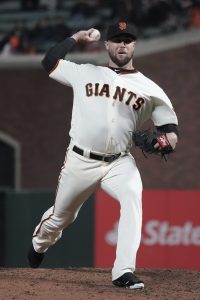
Strickland was something of a surprise addition to the free agent relief market when the Giants designated him for assignment in November, effectively releasing him prior to the non-tender deadline. MLBTR contributor Matt Swartz projected Strickland for a modest $2.5MM salary in 2019, so combined with the team control through 2021, it raised some eyebrows when the Giants parted ways with the 30-year-old.
2018 was, however, the weakest of Strickland’s four full MLB seasons. He posted career-worst totals in ERA (3.97), homer rate (9.1%), grounder rate (38.1%), strikeout rate (7.35), and swinging strike rate, while allowing far more hard contact than in past years — Strickland’s 42.3% hard-hit ball rate dwarfed his 31.7% career rate. The real lowlight was a two-month DL stint due to a fractured hand, an injury suffered when Strickland punched a door in anger after a blown save.
The Giants may have simply felt that a change in scenery was necessary, so the Mariners now get the opportunity at a potential bargain if Strickland returns to his old form. Over 173 2/3 innings and 195 appearances from 2015-17, Strickland was a quality part of San Francisco’s bullpen, posting a 2.75 ERA, 2.84 K.BB rate, and 8.6 K/9. He could find himself in line for saves as part of the Mariners’ drastically overhauled bullpen, with Cory Gearrin and Anthony Swarzak also in the mix for closer duty.
Photo courtesy of USA Today Sports Images.
Mariners Designate Max Povse
The Mariners announced that they’ve designated right-hander Max Povse for assignment. Povse’s 40-man spot will go to fellow righty Hunter Strickland, whose signing is now official.
Now 25, Povse has been with the Mariners since they acquired him in a 2016 trade with the Braves that also involved Alex Jackson and Robert Whalen. Thus far, Povse has totaled a meager 3 2/3 innings in Seattle, all of which came in his first season with the club. While Povse posted solid Double-A numbers that year, when he logged a 3.41 ERA with 8.9K/9 and 2.82 BB/9 in 60 2/3 innings and 10 starts, he hasn’t been nearly as successful in Triple-A.
Over the past two seasons at the minors’ highest level, Povse recorded a horrendous 8.17 ERA with 9.7 K/9 and 5.3 BB/9 in 68 1/3 innings and 21 appearances (13 starts). Povse does possess a mid-90s fastball and one more minor league option, though, so perhaps another organization will take a chance on him.
Baseball Blogs Weigh In: Mets, Tigers, Joc, Yanks, Sonny, Brewers, Yelich
This week in baseball blogs…
- Good Fundies implores the Mets to upgrade the back end of their rotation.
- Know Hitter wants the Tigers to trade for Joc Pederson.
- Pinstripe Alley isn’t pleased with the Yankees’ Sonny Gray trade.
- The Dugout Online regards two-way players as the next evolution of baseball.
- MLB & Fantasy Baseball Analyzed tries to fix the CBA and make things better for the players.
- Fish Stripes reflects on last winter’s Marlins-Brewers trade centering on Christian Yelich.
- Chin Music Baseball names the best and worst players of the decade thus far.
- Jays From the Couch talks with Blue Jays prospect Cavan Biggio.
- The 3rd Man In profiles and interviews young catcher Shea Langeliers, who could be the top pick in this summer’s draft.
- Foul Territory lists five teams that should sign Manny Machado.
- District On Deck lists four players who could be X-factors for the 2019 Nationals.
- Chipalatta looks at the Astros’ potential lineup for 2019.
- Statsswipe asks whether Corbin Burnes or Brandon Woodruff will have the better 2019 season.
- Cubbies Crib examines Carl Edwards’ 2018.
- Hardball Via Hardcore shares a pre-spring state of the Mariners address.
- Call to the Pen (links: 1, 2, 3) praises the Rangers’ signing of Asdrubal Cabrera, wonders if any of the Phillies’ relievers will become trade bait, and ranks the top 10 fantasy baseball catchers for 2019.
- Wander Rays ranks Tampa Bay’s 10 best right-handed pitching prospects.
- Notes from the Sally previews the 2019 Greensboro Grasshoppers, the Pirates South Atlantic League team..
- A’s Farm offers updates on some of the team’s top pitching prospects including Jesus Luzardo, A.J. Puk, Grant Holmes and James Kaprielian.
- East Village Times delves into Padres pitching prospect Chris Paddack‘s 2018 statistics.
- Mets Critic disputes the notion that Jeff McNeil is now an outfielder.
- Rising Apple sees McNeil as one of a few Mets who could break out this year.
- Rotisserie Duck reviews the 2018 leaders of several important stats.
- The Giants Cove attempts to shoot down some familiar baseball cliches.
- Everything Bluebirds expects a big year out of Randal Grichuk.
- The Point of Pittsburgh examines Barry Bonds‘ chances at getting inducted into the Hall of Fame in the future.
- The Runner Sports (links: 1, 2, 3) reacts to the Hall of Fame elections of Mariano Rivera and Mike Mussina, and the two newest members of the Twins’ HOF, and profiles Astros prospect Ryan Hartman
- Mets Daddy writes that “Hall of Fame standards have been driven down.”
- Phillies Nation searches for the club’s next Hall of Famer.
- Pinstriped Prospects (links: 1, 2) ranks the Yankees’ top five prospects at both shortstop and third base.
- Jays Journal has a piece on the worst trades in the history of the Blue Jays.
- Reviewing the Brew (links: 1, 2) presents arguments for and against the Brewers’ new stadium naming rights deal with American Family Insurance.
- The K Zone explains how each NL Central team got its name.
Submissions: ZachBBWI @gmail.com
Recovery Notes: Pineda, Nelson, Dubon, Seager, Zimmer
Michael Pineda has yet to throw a pitch for the Twins, but he’s healthy now and ready to make his Twins debut in 2019, per Betsy Helfand of the Twin Cities Pioneer Press. The Twins signed Pineda to a two-year, $10MM guarantee last December as he worked his way back from Tommy John surgery, hoping he might be ready for the latter half of the season. Just when it looked like Pineda was ready to return, he was diagnosed with a torn meniscus in his knee, ending his season before it began. Injuries have been a constant for Pineda’s career, though he did put together back-to-back healthy campaigns for the Yankees in 2015 and 2016. His overall 4.05 ERA is boosted by a particularly strong rookie campaign, but across 680 innings in Seattle and New York, he did turn in 9.1 K/9 to 2.1 BB/9. The Twins are perhaps the most wait-and-see team in the league, with many volatile assets equally capable of All-Star seasons and bottoming out (Pineda, Byron Buxton, Miguel Sano, Jonathan Schoop, among others). With no guaranteed money on the books for 2020, recent speculation has Minnesota as a sleeper team for either Manny Machado or Bryce Harper, but Thad Levine threw some water on that idea, as he believes significant acquisitions of that variety are more appropriate for frontrunners atop a division, rather than a young team on the rise, per MLB.com’s Do-Hyoung Park (via Twitter). Certainly an interesting take from the Minnesota GM. Now, some more recovery news from around the league…
- The Brewers will return an intriguing arm to their rotation this spring, as Jimmy Nelson is healthy and ready to go, per Todd Rosiak of the Milwaukee Journal Sentinel (via Twitter). Nelson will have no restrictions heading into Spring Training, and he’s not backing down from high expectations either, making clear his goal to get the nod on Opening Day – unlikely as that may be. Nelson put together an impressive campaign in 2017 that launched him to the top of the Milwaukee rotation, but it’s probably best to temper expectations after a torn labrum took his 2018. For Milwaukee, the tide is turning on what was seen as a rickety rotation leading up to the playoffs, as their starting staff now looks to be a source of potential strength. Jhoulys Chacin made himself irreplaceable in their run to the NLCS, and he’s backed by Zach Davies and Chase Anderson, both rebound candidates after subpar seasons. Add Nelson, Corbin Burnes and Brandon Woodruff, among others, as contenders to join what now looks like a high-ceiling and deep, if unstable, unit.
- Rosiak also notes (via Twitter) that prospects Keston Hiura and Mauricio Dubon are ready for a big year, rested in the former’s case and healthy after ACL surgery in the latter’s. While both will return to big league camp this spring, they’ve been told they won’t be with the team on Opening Day, per the Milwaukee Journal Sentinel’s Tom Haudricourt (via Twitter). None of this should come as a surprise, as it’s become the norm for top prospects to begin their debut seasons in Triple A, but it’s safe to say Hiura, at least, is hopeful to make an impact at the ML level sometime in 2019. Dubon, for his part, was ripping through Triple A before the surgery, hitting .343/.348/.574 in 27 games with Colorado Springs.
- Corey Seager hasn’t taken batting practice since his injury last May, but he’s long-tossing in preparation for an important spring back in the middle of the Dodgers infield, per Bill Plunkett of the Orange County Register. Seager isn’t yet mobilizing for groundballs or throwing across the diamond, but his recovery from Tommy John surgery has gone according to plan thus far and hope remains that he’ll be ready by Opening Day. He’s hitting off a tee, with the next steps being batting practice in the cage before going against live pitching. The Dodgers have the depth to cover for Seager if he’s not ready by Opening Day – with Chris Taylor the most likely stand-in – but he’s obviously a huge part of their team moving forward.
- The Royals fanbase is still waiting for the long-heralded debut of former top draft choice Kyle Zimmer, but it seems nearly time after he signed a major league contract this winter, per the Kansas City Star’ s Lynn Worthy. Zimmer was the 5th overall pick of the 2012 draft, but he missed the entirety of 2018 while training at the Driveline Baseball pitching program. Even so, he was clocked in the mid-90s this fall, and the Royals weren’t alone in competing for Zimmer’s services, hence the major league contract. Said GM Dayton Moore of the deal, “I would rather have him fail with us than go somewhere else and succeed.” While that’s not exactly a rousing sentiment, and it could be read as vindictive, that does not appear to be Moore’s intent, who praised Zimmer for his mindset and toughness. For Zimmer’s part, he spoke glowingly of the Royals longstanding support and loyalty in his continued journey to toe a major league rubber. If he can stay healthy, there’s opportunity enough for Zimmer to make his debut at Kauffman Stadium sometime in 2019, and despite Moore’s omission of Zimmer’s potential success with the Royals as one of his potential futures, that’s surely the goal for both parties.