
Rockies To Re-Sign Jairo Diaz
The Rockies have agreed to re-sign reliever Jairo Diaz to a minors deal, per Nick Groke of The Athletic (via Twitter). Diaz will head back to the team’s top affiliate.
A 27-year-old righty, Diaz has been beset with arm troubles for some time now. Tommy John surgery cost him all of 2016 and he has experienced forearm problems at the outset of the current campaign. As a result, he has turned in just thirty appearances at any level since the conclusion of the 2015 season.
The Rox designated and released Diaz recently, but he evidently did not find better opportunities elsewhere and decided to return on a new contract. When healthy, Diaz boasts an upper-nineties heater and typically generates quite a few groundballs, so he could be an intriguing asset for the Colorado organization if he’s able to get back on track.
Rangers Designate Deck McGuire
The Rangers have designated righty Deck McGuire for assignment, per a club announcement. That’s the roster move for the activation of shortstop Elvis Andrus.
McGuire was only just claimed off waivers, so the Texas organization evidently intended all along to try to sneak him back through waivers. If he clears, the 28-year-old will presumably take up a place on the depth chart at Triple-A while not occupying a 40-man spot.
Though he has seen MLB action in each of the past two seasons, McGuire hasn’t thrown enough innings to tell us much. But he does have loads of experience in the upper minors, having reached Double-A in his first season as a pro, way back in 2011. Over 335 2/3 innings at the Triple-A level, McGuire carries a 5.09 ERA with 6.9 K/9 and 3.5 BB/9.
Rangers Activate Elvis Andrus
The Rangers announced Monday that they’ve activated shortstop Elvis Andrus from the 60-day disabled list and recalled right-hander Ricardo Rodriguez from Triple-A Round Rock. Catcher Jose Trevino was optioned to Double-A Frisco in one corresponding move, while Ryan Rua was optioned to Triple-A in another. The Rangers still need to make a 40-man move to accommodate the activation of Andrus from the 60-day DL, and they’ll do so closer to game time, according to the team.
Andrus has been out since being struck by a pitch and suffering a fractured right elbow back on April 11. While the injury didn’t require surgical repair, Andrus required a lengthy period of rest and rehab leading up to today’s activation. The timing was poor for the 29-year-old impending free agent, but he’ll still have three-plus months to build his case for potentially interested teams.
Of course, Andrus is far from a lock to even reach the open market. He’s in the fourth season of an eight-year contract extension that allows him to opt out of the remaining four years. While that seemed like an impossibility after Andrus’ bat failed to develop in the first couple years of the deal, Andrus’ offense has come around in the past couple of seasons.
Dating back to 2016, he’s hitting .301/.352/.459 with 30 homers, 78 doubles, 11 triples and 49 steals (in 68 attempts). At season’s end, he’ll have to decide whether to test free agency or forgo the opt-out provision to play out the final four years and $58MM in guaranteed money on his contract.
Mets Listening To Trade Offers On Veteran Players
3:19pm: MLB.com’s Anthony DiComo tweets that while the Mets are indeed listening to offers, no deals should be expected in the short-term. Despite the recent run of poor play, the Mets will take another few weeks to see if they can turn things around before committing to a sale.
11:05am: With the Mets mired in an abysmal slump that has seen the team go 3-11 in the month of June, Ken Rosenthal of The Athletic reports in his latest notes column (subscription required) that they’re “open for business.” While the Mets understandably prefer to hang onto controllable players like Michael Conforto, Brandon Nimmo, Seth Lugo, Robert Gsellman and Jacob deGrom, Rosenthal notes that they’ll at the very least entertain offers for virtually anyone on the roster.
It’s been fewer than two weeks since Mets general manager Sandy Alderson called the chances of a major summer sell-off “very remote,” though Alderson admitted at the time of his comments that “circumstances could change” his stance. It’s perhaps telling that in the 13 days between the publication of those two stories, the Mets have gone just 3-8 and scored a paltry 25 runs in a span of 11 games. In the interim, they’ve seen Noah Syndergaard and Yoenis Cespedes suffer setbacks in their recoveries from injury and revealed that reliever AJ Ramos is weighing season-ending surgery to repair his ailing shoulder.
Of course, the two reports can also coexist without contradicting one another. Dealing some short-term pieces this summer would hardly constitute a “major” sell-off, after all. And, generally speaking, Alderson was speaking out against the possibility of a full tear-down more than he was against smaller trades around the margins of the 25-man roster.
While there’s been no shortage of speculation surrounding deGrom, there’s been little indication that the Mets would truly be open to moving their ace. In fact, Rosenthal goes so far as to write that the Mets would actually be more open to trading Syndergaard, who has an additional year of control, though that’s perhaps more a statement on their unwillingness to move deGrom than it is their willingness to part with Syndergaard. Clearly, either pitcher would require a trade partner to surrender an absolutely farm-gutting haul of talent if the Mets were to even consider budging. The Mets shouldn’t be expected to shop either player aggressively.
[Related: New York Mets depth chart and New York Mets payroll]
More realistic trade pieces would include impending free-agents Asdrubal Cabrera, Jeurys Familia and Devin Mesoraco. Struggling lefty Jerry Blevins has a lengthy track record despite poor results in 2018, and there’s time yet for him to right the ship and hold appeal to another organization. The Mets also have a number of intriguing players who are controlled only through the 2019 season, including Todd Frazier, Zack Wheeler, Anthony Swarzak and Wilmer Flores. As is the case with Blevins, lefty starter Jason Vargas has a solid track record but poor 2018 results to date, though he’s begun to turn things around of late (3.91 ERA, 23 strikeouts, seven walks in his past 23 innings).
Certainly, the focus of many readers will be on just what type of package it’d take to pry away one of the Mets’ two young aces, deGrom or Syndergaard, but it seems likelier that they’ll instead focus on moving shorter-term pieces. Rosenthal adds that, in particular, the Mets will be “motivated” to move Familia given that they’re not likely to make him a qualifying offer following the season. As such, they’d stand to lose him for nothing if he’s not dealt this summer.
Familia did just have a minimal stint on the DL for shoulder soreness, but if he can prove that to be a non-issue, he’d certainly hold appeal. He’s earning $7.925MM this season (with $4.45MM yet to be paid out) and has worked to a 2.70 ERA with 9.9 K/9, 3.0 BB/9, 0.3 HR/9 and a 48.8 percent ground-ball rate in 30 innings.
Astros Extend Jeff Luhnow Through 2023
The Astros announced on Monday that they’ve promoted Jeff Luhnow from general manager to president of baseball operations and signed him to a five-year contract extension that runs through the 2023 season.
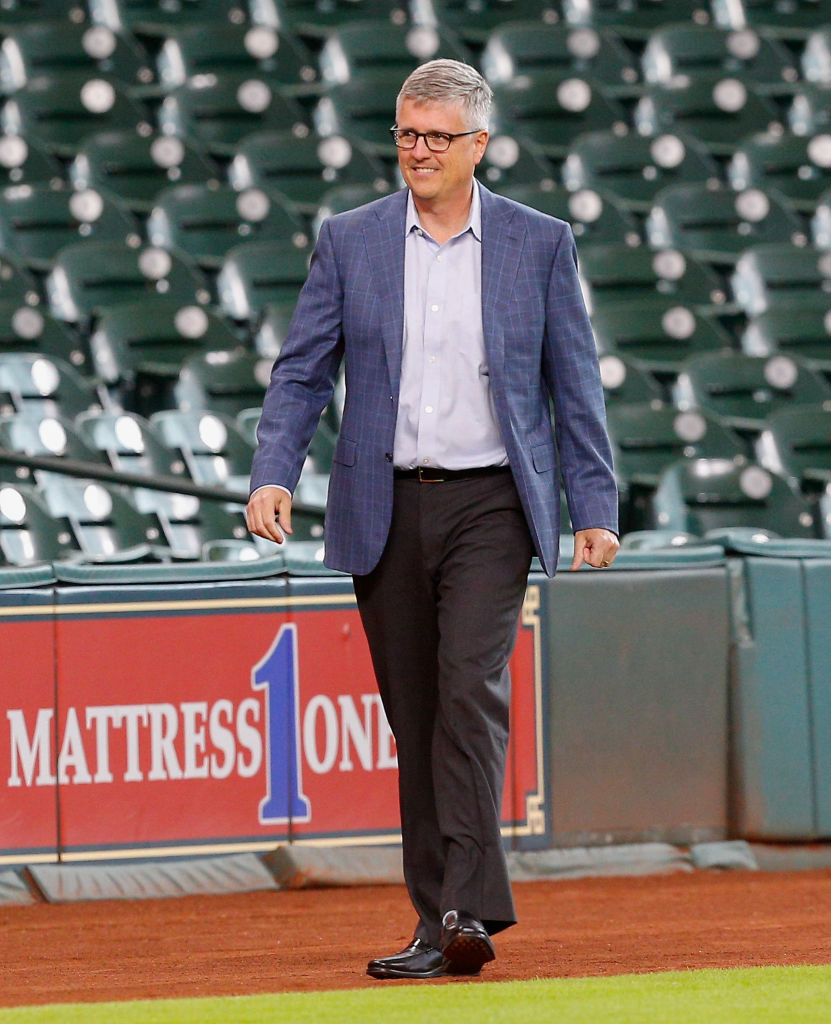
The exact length of Luhnow’s prior contract with the Astros was unclear, though owner Jim Crane plainly stated at today’s press conference that Luhnow is now under contract through the 2023 season. Financial details, of course, were not disclosed, although recent extensions signed by some of the game’s more highly regarded executives reportedly came with annual salaries ranging from a bit north of $5MM (Yankees GM Brian Cashman) to nearly $10MM (Cubs president of baseball ops Theo Epstein).
Luhnow was a polarizing figure early in his tenure with the Astros, as many raised an eyebrow and criticized from afar as he emphasized the usage of data, analytics and sabermetrics perhaps more than any executive in the game’s history. The Astros received flak not only for their heavy reliance on statistical data (often at the expense of traditional scouting) but also their aggressive utilization of defensive shifts and other, more experimental player development tactics such as tandem/piggyback starters in the minor leagues.
In the end, it’s hard to question much that the Astros have done during Luhnow’s tenure, though. The Astros are the reigning World Series Champions and have recently snapped off 11 consecutive wins to propel themselves to first place in the American League West. Their .658 winning percentage on the season trails only the Yankees and Red Sox, but the Astros will have ample opportunity to change that; they’ll play their next 19 games against teams with losing records.
Luhnow’s tenure with the Astros began with some aggressive tanking that saw the team earn the No. 1 selection in three consecutive drafts, though if there’s a notable blemish on his track record, it’s probably that two of those three instances paid little dividends. The Astros couldn’t have done any better in the 2012 draft when they surprised onlookers by selecting high school shortstop Carlos Correa over Stanford ace Mark Appel with the No. 1 pick. But Houston took Appel with the No. 1 overall pick a year later after he didn’t sign, and the team’s selection of Brady Aiken a year later led to a controversial scenario in which neither Aiken nor over-slot fifth-rounder Jacob Nix signed with the organization.
Of course, the failure to sign Aiken afforded the Astros with the No. 2 pick a year later, which the team used to draft current third baseman Alex Bregman. Bregman was added to a core of homegrown players that also featured Correa, George Springer, Jose Altuve, Lance McCullers and Dallas Keuchel. Luhnow and his lieutenants have also have plenty of successes both on the trade market (e.g. Justin Verlander, Gerrit Cole, Brad Peacock). They’ve prioritized now-popular but once-obscure elements like spin rate when adding names like Collin McHugh (via waivers) and Charlie Morton (free agency), and they struck gold with another waiver claim in Will Harris.
Exactly how long Houston will retain this core group remains uncertain, of course. Altuve recently signed a massive five-year extension, but key players like Springer and Correa have yet to sign extensions. That pair is nonetheless controllable through the 2021 season, though the rotation figures to take a very different look in the coming years, as Keuchel (this winter), Morton (this winter), Cole (post-2019) and Verlander (post-2019) are all approaching free agency.
That said, there’s clearly little doubt among ownership that Luhnow and his staff are capable of absorbing whatever losses they’ll inevitably incur and replacing that group with a promising wave of new young talent and free-agent/trade acquisitions. One of the most impressive things about this regime, after all, is that for all of the success they’ve had in recent seasons, the Astros still have a strong farm system. Right-hander Forrest Whitley and outfielder Kyle Tucker lead the way, and both are considered to be among the game’s top 20 prospects. With several impressive prospects rising through the ranks, plenty of financial firepower at their disposal and an enviable core of controllable assets at the MLB level, Luhnow’s Astros have dynasty potential despite the increasingly competitive nature of the American League West.
Phillies Option Hector Neris
The Phillies announced that they’ve optioned right-hander Hector Neris to Triple-A Lehigh Valley and selected the contract of lefty Austin Davis from Double-A Reading. Neris has spent the better part of the past two seasons serving as Philadelphia’s closer.
While Neris was dominant in a setup role in 2016 and pitched similarly well in his first season as the Phillies’ closer in 2017, the 2018 campaign has been disastrous for the 29-year-old. His season-long struggles culminated yesterday in a meltdown that saw Neris yield four runs on four hits, including two homers, in just two-third of an inning.
That latest hiccup sent Neris’ ERA soaring to an even 6.00, though his struggles have been ongoing for a considerably longer period of time; Neris has been scored upon in five of his past eight appearances and in nine of his 30 games pitched on the season overall.
The demotion will provide Neris with a lower-pressure setting in which to work to correct his struggles, and service time won’t be a consideration with regard to determining the length of his stay in Lehigh Valley. Neris entered the year with two years, 104 days of Major League service, so he’s already cleared three years of service time and remains on track to be arbitration-eligible following the current season. He’ll still be controllable through the 2021 campaign, regardless of whether his optional assignment lasts for three weeks or three months.
It’s not clear who the Phillies will utilize as their closer in the interim. Seranthony Dominguez, Edubray Ramos and Victor Arano would each figure to be among the leading candidates, as they’ve all been dominant so far in 2018. If the Phillies prefer to save those tantalizing arms for higher-leverage spots while turning to a more veteran option to enter with the bases empty in the ninth inning, though, Tommy Hunter is on hand to potentially fill that role.
Indians Sign Marc Rzepczynski
The Indians announced that they’ve signed left-handed reliever Marc Rzepczynski to a minor league contract. The southpaw, who’d recently been released by the Mariners, has been assigned to Triple-A Columbus.
This’ll mark the second stint with the Indians for Rzepczynski, who pitched for Cleveland from 2013-14 before being traded to the Padres in exchange for outfielder Abraham Almonte at the 2014 non-waiver trade deadline. Since that time, the well-traveled lefty has bounced from San Diego to Oakland to D.C. to Seattle.
[Related: Cleveland Indians depth chart]
Rzepczynski, 32, parlayed a solid 2016 season between the A’s and Nationals into a two-year, $11MM contract with the Mariners. And while he performed reasonably well in the first season of that deal, Rzepczynski struggled enormously in 2018 before being cut loose earlier this month. Nicknamed “Scrabble” due to his spellcheck-busting last name, Rzepczynski posted a 4.02 ERA in 37 1/3 innings for Seattle in 2017, though his 25-to-20 K/BB ratio lefty plenty to be desired. This year, he allowed 11 runs (eight earned) on 13 hits and nine walks with 10 strikeouts in 9 2/3 innings.
Rzepczynski has long been tough on opposing lefties, though, limiting same-handed opponents to a paltry .225/.295/.303 slash through 852 career plate appearances. For a Cleveland club whose bullpen has been among the worst in the Majors this season, he’ll add a veteran depth option that can at least be utilized in situational matchups. That could be all the more important for the Tribe in the near future, as Cleveland currently has both Andrew Miller and Tyler Olson on the disabled list.
The Mariners remain on the hook for the bulk of the $5.5MM salary that Rzepczynski is earning this year. Cleveland will only owe him the pro-rated league minimum for any time he spends at the big league level. That sum, subsequently, would be subtracted from what the Mariners owe him through season’s end.
Twins Release Taylor Featherston
The Twins have released infielder Taylor Featherston, per an announcement from their Triple-A affiliate in Rochester (h/t: Twins Daily’s Seth Stohs, on Twitter).
Featherston, 28, appeared in the Majors each season from 2015-17, providing strong defensive value around the infield but struggling with the bat. In 244 plate appearances between the Angels, Phillies and Rays, he’s managed just a .160/.221/.256 slash line. He’s also received plus ratings at second base, shortstop and third base from both Defensive Runs Saved and Ultimate Zone Rating.
A former Rule 5 pick (the Cubs selected him out of the Rockies organization in 2014 and promptly traded him to the Angels for cash), Featherston has struggled in Triple-A this season to a considerably greater extent than he ever has in prior seasons. Through 213 PAs with the Red Wings, he’s hitting just .167/.270/.278 with four homers, four doubles, two triples and seven steals (in eight tries).
Giants Re-Sign Jose Valdez
The Giants have re-signed right-hander Jose Valdez after releasing him recently, Matt Eddy of Baseball America reports as part of his latest roundup of the league’s minor transactions. Valdez was designated for assignment back on June when the Giants activated Mark Melancon from the disabled list and, apparently, was eventually released (though there was no formal announcement from the team).
Valdez, 28, was tagged for seven runs on eight hits and a walk with four strikeouts in five innings of relief for the Giants earlier this season. He’s seen time in the Majors in each of the past four seasons, including 2018, pitching to a collective 6.34 ERA with a 47-to-26 K/BB ratio in 55 innings out of the bullpens for the Tigers, Angels, Padres and Giants.
While those results aren’t exactly encouraging, Valdez has averaged just under 96 mph on his fastball so far in his big league career, and he notched a solid 11.2 percent swinging-strike rate in 18 MLB frames last season. He also comes with a more encouraging Triple-A track record, where he’s recorded a 3.70 ERA with a strikeout per inning but a more troublesome 4.9 BB/9 mark in 151 innings — all coming out of the ‘pen.
Valdez has actually already suited back up for the Giants organization, though the results weren’t pretty; in a third of an inning with the team’s top affiliate in Sacramento, he was tagged for four runs on and two hits and two walks.
Melky Cabrera Elects Free Agency
The Indians announced Monday that outfielder/designated hitter Melky Cabrera has elected free agency rather than accepting an outright assignment to Triple-A Columbus. He’d been designated for assignment last week and cleared outright waivers. The 33-year-old veteran switch-hitter will now head back to the open market in search of a new opportunity.
Cabrera, who’d signed a minor league deal with Cleveland in late April, had his contract selected in May and totaled 66 plate appearances for the Indians, though he managed just a .207/.243/.293 batting line in that small sample of work.
It should be noted, of course, that Cabrera didn’t have a full Spring Training and only logged 42 plate appearances in Triple-A before joining the big league club. It’s not especially surprising then, to see some rust at the plate after a fairly limited amount of time to ramp up.
Cabrera is only a year removed from providing roughly league-average offense at the big league level. In 666 plate appearances between the White Sox and Royals last season, Cabrera slashed .285/.324/.423 with 17 homers, 30 doubles and a pair of triples — good for a 99 OPS+ and a 98 wRC+. And, from 2014-17, Cabrera racked up 2616 plate appearances between the Blue Jays, White Sox and Royals, hitting a combined .289/.333/.431 in that time (110 OPS+). While he’s no longer a threat on the bases and doesn’t provide much value with the glove, his track record could earn him an opportunity to land on a big league roster with another organization, though he may once again have to earn that opportunity with a Triple-A stint.