
Prospect Luis Robert Leaves Cuba
Top Cuban outfield prospect Luis Robert left his home island in November, according to Ben Badler of Baseball America. His whereabouts are not given in the report, but it seems he is working towards joining a major league organization.
Clubs figure to line up for a chance at the 19-year-old Robert, a right-handed-hitting outfielder who Badler labels one of Cuba’s five best talents, citing his plus bat speed and power. Though he may ultimately turn into a corner outfielder, Robert is currently capable of playing center. Already a productive player in his age-18 season, Robert turned things up a notch in his most recent Serie Nacional action. Before he departed, Robert was hitting a robust .401/.526/.687 with 12 home runs and 11 steals over 232 plate appearances. That put him at or near the top of the leaderboard in most major offensive categories — certainly, rather a notable output given his age (even with the number of talented players that have departed Cuba’s top league in recent years).
As Badler explains at length, Robert’s timeline for obtaining clearance will play a major role in determining his earning capacity and ultimate landing spot. Because the old CBA’s international rules will apply through to the end of the current July 2 signing period — which wraps up on June 15 of this year — it’s still possible that Robert will become eligible to sign under the current system. If not, he’ll be subject to the tighter cap that is set to go into effect under the new CBA (which Badler detailed in full right here).
While Robert could certainly still land a significant payday under either regime, the current one holds out the hope for the greatest riches. That’s because it allows organizations to spend at leisure, so long as they are willing to sacrifice their ability to dole out $300K+ bonuses for two future years and pay a 100% tax on the amount they go past their pool allocation. Under the new system, all clubs will face spending caps, which can be extended only through trades for additional space. While some smaller market teams will receive slightly higher allocations, most organizations won’t be able to go past $4.75MM with their base pool and can’t trade for more than a total of $8.3MM. Plus, Badler notes, some teams have already committed portions of their 2017-18 pool space to other players.
If Robert is cleared to sign before the signing period is up, he’d at least have greater options. That would open the door to the clubs that have already gone past their limits — the Astros, Athletics, Braves, Cardinals, Nationals, Padres and Reds. Otherwise, those organizations would join others (the Cubs, Dodgers, Giants, and Royals) on the sidelines for significant international talents. Alternatively, he could join another club either before or after the signing calendar flips. Badler notes that the White Sox have been discussed as a team with possible interest; if Robert is cleared in time, Chicago (or another hypothetical team with heavy interest) could elect to spend past its 2016-17 pool limits (thus taking on penalties) or make Robert the signature piece of their 2017-18 signing group.
Cashman: Yankees Likely Done Adding To 2017 Roster
Yankees GM Brian Cashman suggested in an appearance on the YES Network that his organization is all but done with its offseason roster moves, as Jack Curry of YES reports (Twitter links). Though he’s still checking in on available free agents, Cashman says it’s 99.9 percent likely that there won’t be any significant new additions.
The long-time New York front office man also addressed the club’s reported pursuit of White Sox lefty Jose Quintana. Chicago’s asking price is simply too high, says Cashman, with Curry reporting that the rebuilding South Siders are seeking “at least 3 elite prospects” in return for the talented southpaw.
[RELATED: Yankees Depth Chart]
To date, the Yankees have made two significant additions in lefty Aroldis Chapman and outfielder/DH Matt Holliday. But the club is set to rely on quite a few younger players as it continues an effort to transition to a somewhat leaner, more sustainable roster.
It’s certainly arguable that there’s work left to do. The rotation, especially, has quite a few questions and could obviously stand to be upgraded. And there’s some reason to think another bullpen lefty might be desirable. Unless something changes, though, it appears that the Yankees are more or less prepared to head into camp with the current mix of MLB talent available to them.
Max Scherzer Diagnosed With Stress Fracture In Knuckle
Nationals righty Max Scherzer has been diagnosed with what the club is calling a “stress fracture in the knuckle of his right ring finger.” Per the organization’s announcement, Scherzer will not participate as planned in the upcoming World Baseball Classic.
Though the injury will knock Scherzer out of the international tournament, he is expected “to be a full participant” in spring camp. That’s certainly a promising element to the injury, which otherwise represents a somewhat concerning development for the 32-year-old workhorse.
Scherzer himself provided further details on his injured finger via Twitter. The issue actually arose in August, but did not prevent him from pitching (and performing quite well) down the stretch and into the postseason. Though he made plans to rest and then ramp up for the WBC, an MRI showed that he had a stress fracture which would necessitate further rest.
Given the diagnosis, it’s not at all surprising that a conservative course will be pursued. Washington will obviously want to protect its ongoing investment in Scherzer, who has earned just $30MM of the $210MM promised by the team in his seven-year contract. While deferrals reduce the overall value of that deal, there’s a lot riding on his ability to continue functioning as a top-level starter over the next five campaigns.
Beyond this newly disclosed injury, there’s plenty of reason for optimism. Scherzer has been one of the game’s most productive pitchers for some time now. After several strong but not overwhelming seasons with the Tigers, he turned in a Cy Young campaign in 2013 and has not looked back since. Scherzer most recently provided the Nats with 228 1/3 frames of 2.96 ERA ball in 2016, leading to a fourth-straight All-Star berth and another Cy Young award. He has also been exceptionally durable, making at least thirty starts in every season since 2009.
The Nationals are said to be looking to add rotation depth regardless, but any uncertainty surrounding Scherzer would certainly add to that interest. Washington dealt with injuries late in 2016 to such key staff members as Stephen Strasburg and Joe Ross, and dealt away two near-term rotation options earlier this winter (Lucas Giolito and Reynaldo Lopez) in the Adam Eaton trade.
Arbitration Records: Starting Pitchers
It’s been more than five years now since we broke down record-setting arbitration salaries on a position-by-position basis here at MLBTR. When we last ran through this exercise, it was April 2011, and Dontrelle Willis‘ $4.35MM salary from 2006 was the highest a first-time arbitration starter had ever received (although that record shockingly held up until last year). Jered Weaver‘s $7.37MM sum from 2011 was the largest sum ever earned by a second-time arb pitcher, and the third-time record was held by Big Z, Carlos Zambrano, who pocketed a $12.4MM paycheck back in 2007.
We could see one of these starting-pitcher records fall in 2017 — you can follow along with the arb class using MLBTR’s 2017 Arbitration Tracker — and there could be others to drop among relievers and position players (we’ll get to those later on). For at least the short-term, here’s a look at the current high-water marks for starting pitcher salaries via arbitration:
- First-time eligible: Dallas Keuchel, Astros, $7.25MM (2016) — Keuchel rose from fringe fifth starter to a ground-ball juggernaut with pristine command and plenty of missed bats, earning a surprise Cy Young Award prior to his first trip through arbitration. The 2015 campaign saw Keuchel toss a league-leading 232 innings with a league-high 20 wins, 216 strikeouts and two shutouts. It was his second straight 200-inning season, and his rise to elite status landed him a record payday. Obviously, his 2016 campaign fell short of those heights by a wide margin, but MLBTR contributor Matt Swartz still projects him at $9.5MM this coming year.
- Second-time eligible: Jake Arrieta, Cubs, $10.7MM (2016) — Like Keuchel, Arrieta was coming off a meteoric rise to the ranks of the elite. Many detractors cited a bizarre narrative that Arrieta had “one good half” prior to his Cy Young honors, but he posted a 2.26 ERA through his first 437 1/3 innings with the Cubs upon being traded over from Baltimore. That included a ridiculous 1.77 ERA, 22 wins and 236 strikeouts in 229 innings in 2015. Arrieta turned in a comical 0.86 ERA over his final 20 starts in ’15, allowing just 14 runs with a 147-to-27 K/BB ratio in 147 innings.
- Third-time eligible: Max Scherzer, Tigers, $15.525MM (2014) — There’s a pattern developing here, as Scherzer’s record-setting $15.525MM payday came on the heels of his first Cy Young Award back in 2013. That season saw Scherzer jump from durable mid-rotation arm to a shutdown ace, as he tossed 214 1/3 innings with a 2.90 ERA, 21 wins and a hefty 240 strikeouts. That proved to be the first of two dominant seasons with the Tigers, which served as a launching pad for Scherzer’s then-record-setting $210MM contract with the Nationals in free agency. Of course, that free-agent record has since been broken by Scherzer’s former teammate and the man who holds the record for fourth-time eligible (Super Two) pitchers…
- Fourth-time eligible: David Price, Tigers, $19.75MM (2015) — Price’s 2012 Cy Young season sent his arbitration prices soaring, and by the time he’d reached his fourth and final trip through arbitration as a Super Two player, he was working off a $14MM base salary. The 2014 season wasn’t Price’s best in terms of run prevention, but he turned in a 3.26 ERA over an MLB-leading 248 1/3 innings with 15 wins and a league-best 271 strikeouts as well, all of which combined to help seal his record payday.
Most of these records appear to be pretty safe this season, as none of the first-time arbitration-eligible pitchers is coming off a season quite like Keuchel’s 2015 campaign. The previous $4.35MM record would’ve been threatened by any of Tanner Roark, Carlos Martinez, Jake Odorizzi, Gerrit Cole, Collin McHugh or Mike Fiers. However, Roark’s $6.1MM projection is tops among first-time-eligible players, and that number falls quite a ways shy of Keuchel’s record. Similarly, there are no second- or fourth-time pitchers within striking distance of those impressive records.
However, Arrieta has the chance to enter next offseason holding two of these records, as his $16.8MM projection from Swartz is considerably higher than Scherzer’s existing record. The entire scenario would be rendered moot in the perhaps unlikely event that the Cubs and agent Scott Boras broker a new long-term deal with Arrieta rather than testing the open market a year from now, of course. But, Arrieta would need to fall considerably shy of his projection in order to miss the opportunity to establish a new benchmark for third-time-eligible starting pitchers.
As an aside: Some may wonder why Arrieta, at 2.145 days of service time following the 2013 season, was not a Super Two player and only went to arbitration three times. While Arrieta fell within the requisite top 22 percent of his service class in terms of overall service time, a player must also spend 86 days on the Major League roster in the preceding season in order to qualify as a Super Two. Arrieta accumulated just 79 days of Major League service time that season, thus causing him to fall shy of Super Two designation.
Free Agent Notes: Bautista, Blue Jays, Braves, Tigers, Indians
Speculation about Jose Bautista ultimately signing a one-year deal is growing throughout the industry, writes Sportsnet’s Ben Nicholson-Smith. The Blue Jays were recently said to be in active talks with Bautista, and Nicholson-Smith notes that he spoke with execs from two other clubs that considered Bautista the exact type of player that could end up as a significant bargain if he’s had on a one-year pact. Nicholson-Smith adds that there’s still a belief in the industry that Toronto would be perfectly happy to let Bautista depart, sign elsewhere, and collect a compensatory draft pick. However, the Jays do still need two corner outfielders, and Bautista is a known commodity among the fans, in the clubhouse and on the field for Toronto.
A few more notes on the free-agent market…
- Nicholson-Smith also reports that the Blue Jays are continuing to hunt for a backup catcher after seeing one target, Bobby Wilson, sign a minor league contract with the Dodgers. Per Nicholson-Smith, the Blue Jays wanted to sign the 33-year-old Wilson, but he elected to sign with the Dodgers after Toronto declined to offer his camp any assurances that additional catchers would not be pursued. Among the options still on the market are Chris Iannetta, Nick Hundley, Kurt Suzuki and Jarrod Saltalamacchia, to name a few.
- The Braves are still open to adding a bench bat despite having a full 40-man roster at the moment, and both Kelly Johnson and Jeff Francoeur are possibilities, per David O’Brien of the Atlanta Journal-Constitution (Twitter link). This would mark the third straight year in which the Braves signed Johnson as a free agent and his fourth overall stint with the team that originally drafted him, if an agreement is ultimately reached. It’d also represent the third stint with the Braves for Francoeur and the second consecutive offseason in which he inked a deal with Atlanta.
- The Tigers are known to be on the lookout for some help in center field, but they didn’t show interest in Ben Revere before he signed with the Angels and haven’t had any serious discussions with Austin Jackson about a return to Detroit, reports MLB.com’s Jason Beck. Last week, Anthony Fenech of the Detroit Free Press reported that the Tigers are looking for a center field option that would cost around $2MM. Jackson could fit that bill after missing the last three months of the 2016 season with a knee injury, though Beck’s report paints that as unlikely. Last week, I took a look at a few other options the Tigers could consider as well.
- Any further additions made by the Indians this winter seem likely to be low-cost in nature following the signing of Edwin Encarnacion. Cleveland GM Mike Chernoff implied to Ryan Lewis of the Akron Beacon-Journal that the team’s remaining resources are somewhat limited. “Obviously with a commitment like this, we couldn’t bring either [Mike Napoli] or [Rajai Davis] back at the dollars they would have cost,” said Chernoff. “Raj gave us a huge amount last year, too. You could see him potentially being a fit again with the role he had last year. I think we have a lot of internal pieces that can fill some of those spots.” Davis signed a one-year, $6MM deal with Oakland last week, so Chernoff’s suggestion that he was too expensive could well signal that any final additions will be rather minimal in nature. As Lewis further notes, that could lead to a bit less depth in the outfield and on other areas of the roster than Cleveland brass would otherwise prefer.
Mariners Seeking Reliever, Open To Adding Rotation Depth
The Mariners shuffled their roster on Friday, respectively swapping outfielder Seth Smith and right-hander Nate Karns in separate trades for right-hander Yovani Gallardo and outfielder Jarrod Dyson. Even after making those moves, however, Ken Rosenthal of FOX Sports writes that Seattle would still like to add another bullpen arm. He also notes that the Mariners plan to use a “revolving door” approach to the fifth spot in their rotation and are open to adding some inexpensive depth to accompany current candidates Ariel Miranda, Rob Whalen and Chris Heston.
As GM Jerry Dipoto explained last Friday (via Bob Dutton of the Tacoma News Tribune), the organization effectively looked at their pair of trades as a four-player swap that did not significantly impact the 2017 payroll. “We still have the capacity to be creative in looking to add,” Dipoto said at the time.
The April ownership shuffle in Seattle came with talk of a potential payroll increase, and that’s already transpired to some extent. The $151MM mark at which they’re currently projected would surpass last season’s Opening Day payroll by about $9MM. Further additions could still materialize, though it sounds like they’d be made on the free-agent market rather than via trades. In speaking to Rosenthal, Dipoto stated: “At this point, we won’t move anything off our major-league club.” The gels with Dipoto’s comment in the above-linked Dutton column, in which the GM noted that the team is “always looking for ways to get deeper and a little more versatile.”
Dipoto also spoke to Rosenthal about his Friday swaps, explaining that since taking over as the Seattle GM in Aug. 2015, he’s worked to develop a more athletic mix of players. “Granted, last year (Safeco Field) was favorable to the home-run ball, but we play in a ballpark that really lends itself to running it and catching it in the outfield and creating activity on the bases…” Dipoto explained. Rosenthal notes that Dipoto believes he has five outfielders — Dyson, Leonys Martin, Mitch Haniger, Ben Gamel and Guillermo Heredia — that are capable of playing center field. That represents a significant departure from the 2015 Mariners that saw both Nelson Cruz and the now-departed Smith log significant innings in the outfield. (Cruz, of course, is still in the fold but figures to be heavily limited to DH duties in 2017.)
Regarding the Smith trade, Rosenthal writes that the flood of corner bats on the market made it difficult to trade him for any form of prospect. Seattle no longer wanted Smith’s glove in the outfield, he explains, but the presence of players like Brandon Moss and Michael Saunders in free agency made it tough to deal Smith and his $7MM salary even for a marginal prospect. Rather than dump Smith’s salary and reallocate those dollars to a bounceback candidate in free agency, then, Seattle simply dealt Smith for a pitcher it feels has a chance of returning to form (Gallardo).
If the Mariners do want to add a veteran arm that can work either in relief or out of the fifth spot in the rotation, there’s no shortage of arms available. Travis Wood, Yusmeiro Petit, Bud Norris, Scott Feldman, Jorge De La Rosa and Vance Worley are among the names on the market that have recent MLB experience in both roles.
Minor MLB Transactions: 1/9/17
Some minor moves from around baseball to kick off the week…
- KBO’s Lotte Giants have re-signed left-hander Brooks Raley and signed second baseman/third baseman Andy Burns out of the Blue Jays organization, per Jee-ho Yoo of Korea’s Yonhap News Agency. Raley will receive $850K to return for his third season, while Burns will be venturing overseas for the first time in his career. Raley, 28, pitched 38 1/3 innings with the Cubs from 2012-13 and spent time in the Twins and Angels organizations after being claimed off waivers following that stint. Raley has turned in a 4.06 ERA while averaging 175 innings, 7.0 K/9 and 2.7 BB/9 in the past two seasons with Lotte. As for Burns, the 26-year-old made his MLB debut last season but tallied just seven plate appearances in Toronto. He’s a career .263/.320/.363 hitter in 237 contests at the Triple-A level.
- The Pirates announced a list of non-roster invites this morning, which includes former Rockies catcher Jackson Williams. The 30-year-old saw brief action with the Rox from 2014-15 (30 plate appearances) and has batted .232/.303/.356 in just over 1200 Triple-A plate appearances. He’s halted 36 percent of stolen base attempts against him in his minor league career and draws average to slightly below-average marks in terms of pitch framing, per Baseball Prospectus.
- Former Cardinals/White Sox right-hander Maikel Cleto has signed a minors pact with the Cubs, as his representatives at Jackson Management Group noted, on Twitter. The hard-throwing 27-year-old’s last MLB work came with the ChiSox in 2014 and resulted in a 4.60 ERA with 9.8 K/9 against an unsightly 7.1 BB/9. Cleto averaged 97.1 mph on his fastball that year and doesn’t have difficulty missing bats (10.1 K/9 in his Triple-A career), but walks have been a persistent issue for him in the Majors and in the minors. He split the 2016 season between the Mexican League and the Braves organization. In 21 innings with Atlanta’s Triple-A affiliate, he posted a 2.14 ERA with 31 strikeouts against 13 walks.
Manny Ramirez Signs In Japan
Manny Ramirez is returning to the field at the age of 44. The Kochi Fighting Dogs of the independent Shikoku Island League Plus in Japan have announced an agreement with Ramirez, whose last major league at-bat came in 2011. Ramirez’s latest action came in 2014, when he played in the Dominican Winter League and with Triple-A Iowa.
The mercurial Ramirez debuted in the majors in 1993 and ultimately became one of the most terrifying offensive forces in the history of the sport. In a combined 9,774 plate appearances with the Indians, Red Sox, Dodgers, White Sox and Rays, the outfielder slashed .312/.411/.585 with 555 home runs – which ranks 15th all-time. He also earned 12 All-Star nods and helped the Red Sox to two World Series championships, including their 2004 triumph that broke an 86-year drought. Ramirez dominated during that run en route to World Series MVP honors, and he generally thrived in the postseason with a .285/.394/.544 line in 493 career PAs.
Ramirez is currently on the Hall of Fame ballot for the first time, but it’s possible his controversial past will prevent him from ever gaining enshrinement. Major League Baseball hit Ramirez with two suspensions for performance-enhancing drugs during his career, the second of which – a 100-game ban – came in 2011. Ramirez hasn’t played in the majors since amassing 17 PAs that year with the Rays, though he did make comeback attempts with the Athletics and Rangers before joining the Cubs as a player-coach with Iowa in 2014. That led to the Cubs hiring him as a batting consultant a year later in 2015.
Ramirez will now head to Asia for the second time, having previously played in Taiwan as a member of the Chinese Professional Baseball League in 2013. His new league includes just four teams and has no connection to Nippon Professional Baseball.
Free Agent Profile: Luis Valbuena
Luis Valbuena entered free agency as arguably the second-best third baseman available, trailing only Justin Turner (by a significant margin, granted). Turner came off the board a couple weeks ago when he unsurprisingly re-signed with the Dodgers, but Valbuena remains without a deal. What’s more, there haven’t been many rumblings connecting the 31-year-old to potential employers this offseason.
Pros/Strengths
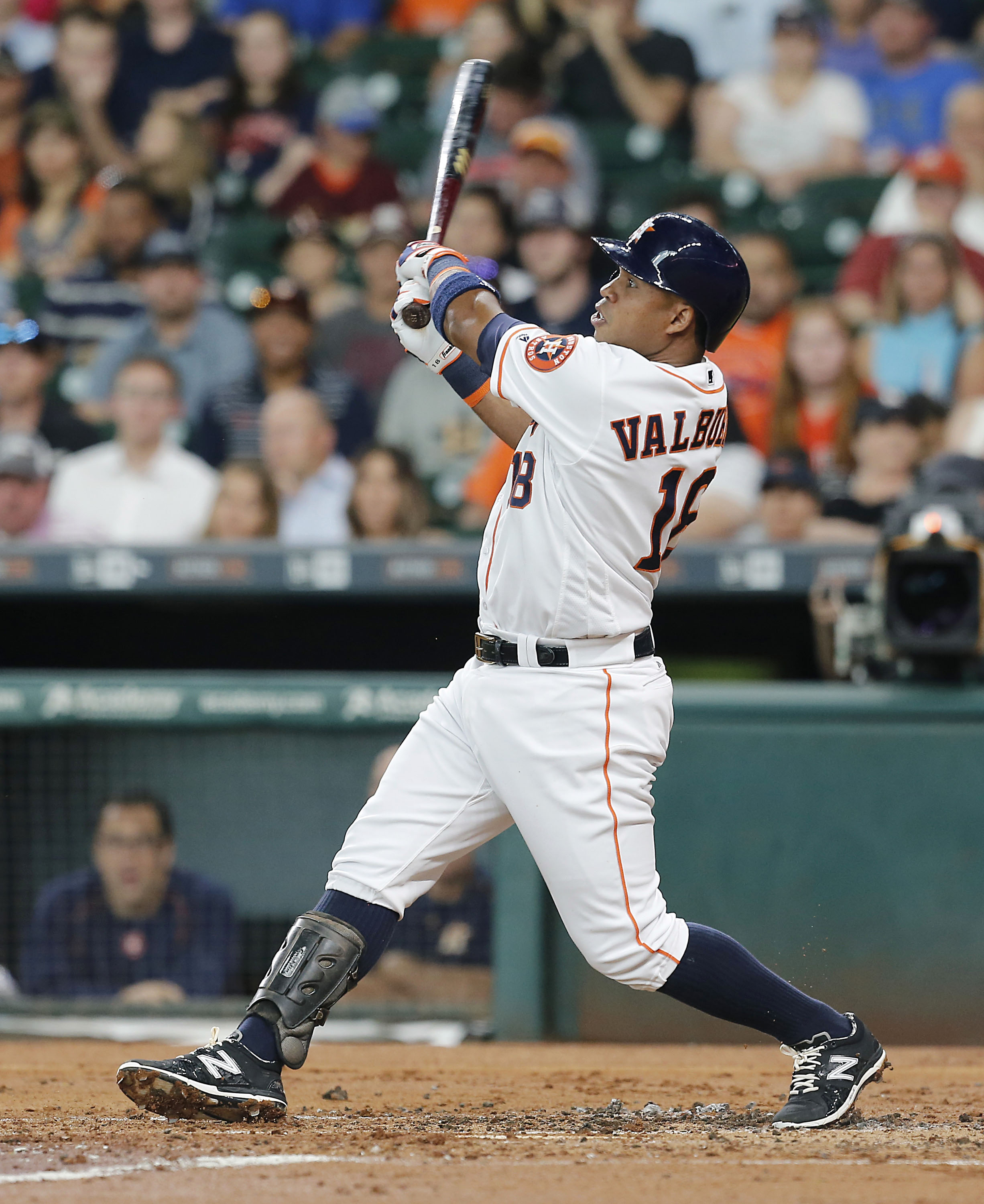
It took a few seasons for Valbuena to turn into a quality major leaguer, but he’s now coming off a four-year stretch (divided between the Cubs and Astros) in which he batted a respectable .237/.333/.428 and accounted for 8.4 fWAR in 1,773 plate appearances. Since 2014, his breakout offensive season, the lefty-swinging Valbuena has handled right-handed pitchers with a .253/.344/.473 line in 1,068 trips to the plate.
Before undergoing season-ending hamstring surgery last August, Valbuena was on track for a career year with a .260/.357/.459 line in 342 PAs. He was also amid his third straight season with an above-average isolated power number (.186 – the league mean in 2016 was .162). Valbuena’s patient, too, having posted double-digit walk rates in each season since 2012. He helped his cause last year in collecting free passes at career-high 12.9 percent clip, which ranked 19th in the majors among those with at least 300 PAs and well above the 8.2 percent average. Further, Valbuena swung at pitches outside the zone a personal-best 23.1 percent of the time, which was good for 21st in the league.
Cons/Weaknesses
While Valbuena has been terrific against righties, his bat has been virtually unplayable at times versus same-handed pitchers. In 530 career PAs, he has hit a meager .221/.310/.356 against lefties – including a lackluster .206/.299/.335 over the past three seasons. Along with his platoon issues at the plate, Valbuena isn’t a threat on the bases, which is particularly unfortunate when considering his high-OBP ways against righties. It also helps explain his history of recording low batting averages despite avoiding egregious strikeout totals. Better, faster baserunners take advantage of reaching, but Valbuena has never swiped more than two bags in a year, and he hasn’t exceeded the one-steal plateau since 2009.
Defensively, Valbuena isn’t a major liability at third, but he hasn’t been able to approach the effectiveness he showed there from 2012-13. That 1,700-plus-inning sample saw Valbuena rack up 11 Defensive Runs Saved and combine for a 21.6 Ultimate Zone Rating. He has registered minus-12 DRS to go with a minus-11.7 UZR in almost 2,500 innings since, though most of the DRS damage (minus-10) came in 2014.
Valbuena’s aforementioned hamstring surgery could also qualify as a negative, but there’s no word on whether that’s affecting his market.
Background
A native of Venezuela, Valbuena joined the Mariners organization back in 2002 as an undrafted free agent. The former middle infielder ended up debuting in the majors in 2008 with Seattle, which traded him to the Indians during the ensuing offseason. That deal also involved the Mets and included 11 other players (to name a few, Jason Vargas, Franklin Gutierrez and Joe Smith). Cleveland eventually sent Valbuena to Toronto for cash considerations in November 2011, but the Blue Jays lost him on waivers to the Cubs in advance of the 2012 season. That proved fruitful for the Cubs, who got a couple good years from Valbuena before shipping him and righty Dan Straily to the Astros in January 2015 for center fielder and 2016 World Series champion Dexter Fowler.
In his major league career, Valbuena has raked in $14,275,200 in earnings, according to Baseball Reference. He’s a client of Elite Sports Group.
Market
“Several” teams have expressed interest in Valbuena this offseason, his agent, Scott Schneider, said last month. The only reported suitors are the Yankees and Rays. Neither team looks like an obvious fit, though, given the options they have on hand at third, first (Valbuena’s occasional position since 2015) and designated hitter.
Clubs that could still stand to upgrade in the corner infield include the Braves, Red Sox, Athletics and Rangers. Atlanta might be the best choice, as Valbuena and right-handed-hitting third baseman Adonis Garcia would have the potential to make for a formidable offensive platoon. Boston has the luxury tax threshold to consider, meanwhile, and has already picked up first baseman Mitch Moreland in free agency. The Sox also seem content to roll with Pablo Sandoval and Brock Holt at third. Oakland is focused on adding a righty bat, which would rule out Valbuena, and Texas is set at third with the great Adrian Beltre. The Rangers still need first base help, but they’re zeroing in on Mike Napoli.
Expected Contract
MLBTR’s Tim Dierkes forecast a two-year, $14MM deal for Valbuena entering the offseason. That still looks reasonable, but settling for less might be in the cards because so few teams look like clear matches for Valbuena.
Photo courtesy of USA Today Sports Images.
Pirates, Jordy Mercer Have Discussed Extension
The Pirates and shortstop Jordy Mercer have discussed a contract extension, though an agreement isn’t imminent, as Rum Bunter first reported and Rob Biertempfel of the Pittsburgh Tribune-Review confirmed. The two sides have had “a little, but not a lot of talk,” a source told Biertempfel.
Mercer, a client of the Legacy Agency, is coming off a season in which he tied a career high in games played (149) and logged a personal-best 584 plate appearances. The 30-year-old wasn’t particularly effective, though, having hit a modest .256/.328/.374 (closely in line with his .257/.313/.377 lifetime mark) with 11 home runs and one stolen base. Mercer also didn’t rate well in the field, which was abnormal relative to the previous two years, as he finished toward the bottom of the majors at his position in Defensive Runs Saved (minus-9) and Ultimate Zone Rating (minus-8.4).
Mercer, who’s under control through the 2018 campaign, is scheduled to make his second trip through arbitration later this winter. MLBTR contributor Matt Swartz projects a $4MM arbitration award for Mercer, but it might not come to that. Pittsburgh doled out three extensions to regulars last year and could hand Mercer what should be an inexpensive deal early in 2017.