
Indians Designate T.J. House
The Indians have designated lefty T.J. House for assignment, per a club announcement. His roster spot will go to righty Adam Plutko, whose contract was selected.
House has provided useful innings at the major league level when called upon, but hasn’t received a full shot since his promising run in 2014. He dealt with shoulder injuries last year, and hasn’t exactly had a smooth year at Triple-A.
Over his 72 1/3 innings at the highest level of the minors in 2016, House carries a 3.98 ERA. That number isn’t concerning in its own right, but he may have been fortunate to limit the damage to the extent he has. House has coughed up 89 hits and 43 walks while retiring only fifty batters via strikeout. House also has spent significantly more time than ever before working from the pen (21 appearances) rather than the rotation (12 starts).
As for Plutko, 24, the 2016 season will now bring both his Triple-A and his major league debut. Over his 90 innings at Columbus, following a strong run early on at Double-A, Plutko caries a 4.10 ERA with 6.7 K/9 and 3.4 BB/9.
Marlins Designate Bryan Morris
The Marlins have reinstated righty Bryan Morris from the 60-day DL and designated him for assignment, per a team announcement. The 29-year-old has missed most of the year after undergoing back surgery.
Evidently, Miami decided that it would not be bringing Morris back for 2017, when he is arbitration eligible for the second time. He would have been seeking a minor raise on a reasonable $1.35MM salary this year.
Morris has done nothing but produce results at the major league level, with a 2.80 ERA over 215 career innings in the past five campaigns. And he not only has the big, mid-nineties fastball that one might associate with relief dominance, but typically generates grounders on about three of five balls put in play against him.
Look deeper, though, and the record is less impressive. Morris suffered a velocity drop this year, fell into single digits in swinging strike rate for the first time, and also lost some grounders over his 17 2/3 frames. He has never had a particularly impressive strikeout-to-walk ratio, and this season’s marks (6.6 K/9 against 5.1 BB/9) were worse than ever.
It’ll be interesting to see where Morris lands and how his career progresses from here. ERA estimators have never bought into his results, but he has succeeded over a rather lengthy span.
Central Notes: Epstein, Arrieta, Abreu, Indians, Vogelsong
ESPN.com’s Wright Thompson provides a worthwhile profile of Cubs president of baseball operations Theo Epstein. While it’s mostly an interesting look at the veteran executive, the piece also contains an intriguing look behind the scenes in the Cubbies’ front office and a few bits of information on the team’s recent maneuvering.
Here’s more from the central divisions:
- The Cubs are aware of, but not particularly concerned over, a decline in Jake Arrieta‘s fastball velocity (and recent predilection for surrendering long balls), ESPNChicago.com’s Jesse Rogers writes. Skipper Joe Maddon suggested that Arrieta was looking to dial in his command in exchange for some velo, and noted that Arrieta’s exceptional movement made him difficult to hit regardless. As for the bigger heater, Maddon says that he “really believe[s] it’s in there” for the postseason.
- Across town, White Sox slugger Jose Abreu says that the difference between his club and the Royals is less about talent than it is “desire,” as Dan Hayes of CSN Chicago tweets. Abreu took responsibility for that assessment, saying that he needed to improve his on-field approach and help lead the team in that regard. It’s certainly an interesting and candid observation from a player of Abreu’s stature.
- With Carlos Carrasco and Danny Salazar sidelined, the Indians are considering utilizing a three-prong postseason rotation mix, Jeff Passan of Yahoo Sports tweets. Corey Kluber and Trevor Bauer would take the ball as traditional starters, with Josh Tomlin and Mike Clevinger piggybacking to make for a third rotation piece. That approach may be necessary given the team’s sudden and stunning lack of depth in what had been a huge area of strength, but it seems like the organization will be forced to push its two best remaining starters rather hard.
- The Pirates aren’t willing to commit at this point to giving righty Ryan Vogelsong another start, as Bill Brink of the Pittsburgh Post-Gazette reports. GM Neal Huntington says that the team is weighing his recent span of four awful outings against the quality showing that Vogelsong had made immediately upon returning from his injury. “Ryan feels there’s a mechanical adjustment that he can and will make moving forward,” Huntington said. “It’s hard to walk away from his first stretch of starts for us.” While that won’t have much of an impact on the Bucs’ fortunes this year, continued opportunity to work from the rotation could impact Vogelsong’s upcoming free agent case.
MLBTR Mailbag: Lucroy Deal, Phillies, Yankees, CarGo
Thanks as always for this week’s mailbag questions! We can’t answer ’em all, but be sure to join us for a chat — Steve (Tuesday, 2pm CST); Jason (Wednesday, 6:30pm CST); Jeff (Thursday, 2pm CST) — if we didn’t get to yours below.
Now that the PTBNL has been announced, how would you value the package that Texas gave up as opposed to what Cleveland had in place for Jonathan Lucroy? – Jonathan R.
With outfielder/infielder Ryan Cordell going to the Brewers, he bolsters a package that already included outfielder Lewis Brinson and right-hander Luis Ortiz. All three were considered top-ten prospects on a solid Texas farm, with Brinson and Ortiz also carrying consensus top-100 leaguewide billing. Remember, though, that this group of players also landed the Rangers right-hander Jeremy Jeffress, who was a quality asset in his own right.
By comparison, reports pegged the prospective deal with the Indians as involving a four-player package: catcher Francisco Mejia, shortstop Yu-Cheng Chang, outfielder Greg Allen, and righty Shawn Armstrong. By the prospect rankings, this group isn’t quite as impressive: only Mejia has been placed in the top-100 among all the game’s pre-MLB talents (in his case, only by Baseball Prospectus).
There are a couple of things to bear in mind here, though. First and foremost, prospect valuation is always-changing and is highly dependent upon any given team’s assessment. Both Brinson and Ortiz had their share of difficulties adapting to the upper minors; though they have had better results since the deal, the former doesn’t walk much and the latter hasn’t yet produced a lot of swings and misses. There’s a ton of upside there, but also some risk, even if Brinson’s glove props up his floor. Meanwhile, Cordell is already 24 and still seems to have some development ahead of him.
The other bunch represents a different mix of assets. Meanwhile, Mejia has had a breakout offensive year. Chang’s name came up in the Aroldis Chapman talks, and he has displayed emerging power this year. Allen delivers outstanding plate discipline, while Armstrong has a promising K rate and could step right into a big league pen.
Ultimately, the inclusion of Jeffress makes it hard to make a direct comparison. Certainly, the Indians package wouldn’t have delivered a headliner on the order of Brinson. But it’s not difficult to see why Milwaukee was intrigued by the return it had lined up — which included some rising prospects who seemingly fit well with the organization’s needs and philosophies. And it’s always wise to remind oneself of just how much you don’t know when it comes to prospects (generally and specifically!).
The Phils will go from worst record last year to almost breaking out of bottom 10 this year. If they add a veteran bat to go along with Maikel Franco, Odubel Herrera, Tommy Joseph and other youngsters can they get to the .500 mark and possibly challenge for a Wild Card in 2017? – Joe P.
You can never rule out a quick turnaround, especially for an organization that has huge spending power and no guaranteed money on the books beyond the remnants of the Ryan Howard and Matt Harrison contracts. Still, though, it’s asking a lot for the club to move into contention in 2017.
A few major free agent signings could change that, of course, but where’s the incentive for the new-look front office? Fans are already aware that a rebuild is underway, with the focus on developing a new core that has shown plenty of promise. And the coming free agent market is not only largely devoid of pitching talent, but lacks for particularly youthful, high-end hitters.
There’s little doubt that the Phils will at least look into adding a productive veteran or two, with aims of bolstering their lineup and clubhouse without hamstringing the team’s future. But it’s probably too soon to wish for a dedicated effort at building out the major league roster through free agency or trade. There are just too many holes to plug, young players who’d have to immediately maximize their talent, and pitching questions (including the health of Aaron Nola and Vince Velasquez and filling out the rotation and pen) that would need to turn out favorably to make contention likely.
With the Yankees still being the Yankees, and their relief corps seeming to be imploding as of late, is a guy like Aroldis Chapman or Kenley Jansen more likely to be targeted in the off season, or are more smaller upgrades in order if any at all? – Nick A.
Are you sure they are still really the Yankees of old? GM Brian Cashman didn’t sign a single major league free agent last winter, and they just sold off parts at the deadline despite having a shot at cracking the postseason!
Honestly, I wouldn’t expect a win-at-all-costs spending spree this winter, on relievers or otherwise. That doesn’t mean the organization won’t utilize its financial advantage in its quest to add arms, but I’d bet on a thoughtful application of the cash. Though some big contracts are leaving the payroll, there’s already nearly $150MM on the books for 2017, so now may not be the time to take on many new entanglements.
For the Yankees, generally, I foresee efforts aimed at building out the current roster while avoiding parting with young talent or committing too much future payroll. For instance, signing a qualifying-offer-bound free agent may not be appealing, but taking on a relatively expensive, but short-term contract may be palatable.
Ultimately, building up the pen while also addressing the arguably-greater need in the rotation will require a multi-part strategy. Of course, with Andrew Miller joining Chapman in departing at the trade deadline, the idea of striking for a top-tier reliever is all the more appealing. But that approach likely wouldn’t be dictated by the relief unit’s current performance or be pursued in isolation.
How do y’all feel about park-adjusted stats? I feel like Carlos Gonzalez is hyped, but he benefits a great deal from playing at Coors Field. How does that impact his value? – Deke
I’ll speak only for myself, though I expect our other writers would feel similarly. Teams don’t simply look at the back of the baseball card, so neither do I. They want to look beyond the results, which includes adjusting for park, situation, and other factors but also quite a bit more — ferreting out useful information from underlying statistics, incorporating scouting analysis, considering softer factors, etc.
That is to say: yeah, I think you have to adjust his numbers to account for the fact that he plays at a launching pad. If only we had an easy way to … oh, wait, Fangraphs (wRC+) and Baseball-Reference.com (OPS+) are among the places to go to find fully adjusted and scaled (to a league mean of 100) batting statistics.
Personally, I find that more useful than just looking at home/road splits. What people don’t seem to realize is that Coors (and other hitter-friendly parks) “help” a player regardless of whether they end up with better or worse results there. (In theory — if we could fully isolate simple good fortune and differences in fielding, pitching, etc. — a poor batting line would have been even worse if the plate appearances occurred at a pitcher-friendly facility.)
So, what do the numbers say about CarGo? Though he owns a shiny .284/.338/.527 batting line over the last two seasons, with 65 home runs in 1,195 plate appearances, that’s not even quite 15% above the league average. Now, the power production is always going to draw some added attention, but Gonzalez’s overall batting effort is largely commensurate with the sort of offensive production that Josh Reddick has produced in recent years — though his line doesn’t seem nearly as impressive since he has spent so much time at the Coliseum — and isn’t anything close to the monster numbers of, say, Edwin Encarnacion.
I’ve always been a bit bearish on Gonzalez’s value, myself, not only because of those considerations but due to his extensive injury history and declining speed on the bases. Perhaps that’s one reason that the club hasn’t received huge offers for his services despite a fairly reasonable contract. It’s fair to note, though, that metrics liked his glovework this year, and the $20MM he is owed for 2017 is especially appealing since it comes in a rental scenario. (An acquiring team would be taking a much more limited risk.) The bottom line is that there’s real value in CarGo’s contract, just not as much as you might expect when looking at the counting stats and triple-slash.
Poll: Should The Marlins Shop Jose Fernandez This Offseason?
This time of year is as quiet as it gets in terms of actual baseball transactions, but that doesn’t mean there aren’t things happening beneath the surface. While postseason play remains the focus for contenders, all teams need to have at least one eye on an offseason that isn’t far away. Internal assessment and planning are obviously an ongoing task, and clubs are constantly engaged one another to see what opportunities may arise.
All that’s a way of setting up this morning’s poll question: as the Marlins enter the final two weeks of play with a .500 record that likely won’t deliver a postseason berth, should they be preparing to shop ace righty Jose Fernandez this winter? Or should they be thinking of ways to ensure that he stays in Miami for the long run?
Fernandez, who just turned 24, is an unquestioned ace. He has fully re-established himself since returning from Tommy John surgery, posting a 2.97 ERA with 12.1 K/9 and 2.6 BB/9 over 239 innings since making it back to the bigs last year.
Youth is certainly on Fernandez’s side, and he’s cheaper than he ought to be since the timing of the TJ surgery held down his first-year arbitration earnings ($2.8MM). He’ll command a huge raise on that number, of course, but still won’t be compensated at anything approaching his on-field value. The two remaining years of arb control are immensely valuable. (Remember, the Fish could’ve had another if they hadn’t placed Fernandez on the Opening Day roster back in 2013.)
That makes Fernandez a highly appealing trade candidate entering a winter in which the free agent class is historically sparse. Miami could target high-end young talent to improve a little-regarded farm system, angle for controllable major league pieces, or combine either or both of those targets with a request for some useful, reasonably-priced MLB assets at positions of need.
Of course, the same factors of affordability and performance also make Fernandez a potential extension candidate for the Marlins, who previously managed to lock up Giancarlo Stanton, Christian Yelich, and Dee Gordon. Fernandez’s late-twenties seasons won’t come cheap, but the Stephen Strasburg extension shows that it’s possible to keep a Scott Boras-repped ace so long as the player is motivated.
The question for the Marlins, ultimately, is multi-faceted. Can they win with their current roster, which has had success at times but lacks for starting pitching depth and has needs on the left side of the infield? Would they be better off — in the long-term, but perhaps also even in the short-term — to swap Fernandez out for a huge return of talent? If they want to keep him, can they afford what it might take to keep the Cuban-born star in Miami?
Figuring all that out will require an assessment not only of Fernandez, but also of the broader market situation. Starting pitching figures to be a focal point in trade talks this winter, with teams such as the White Sox (Chris Sale, Jose Quintana), Rays (Chris Archer, Jake Odorizzi, Alex Cobb), and Braves (Julio Teheran) potentially weighing whether to cash in on a pitching-starved market. Fernandez is younger and arguably better (though that’s plenty debatable) than any of those pitchers, and would certainly draw immense interest, meaning Miami at least has to be wondering about the question that you are about to answer (link for mobile app users):
What Should The Marlins Do With Jose Fernandez This Winter?
-
Try to extend him, but shop him if a deal seems unlikely. 41% (3,098)
-
Put him on the trade block. 28% (2,126)
-
Try to extend him, but keep him either way. 17% (1,300)
-
Sit back and enjoy two more years of excellence. 13% (964)
Total votes: 7,488
Injury Notes: Choo, Cozart, Reynolds, Rea
Though expectations had been that Shin-Soo Choo would be out through mid-October after surgery on a fractured forearm, MLB.com’s T.R. Sullivan reports that he may be ready to return to the Rangers for an early postseason series. Choo could be taking BP with the big league club by the weekend if he continues to progress, and would then head to the instructional league to face live pitching. Texas skipper Jeff Banister said that the team misses Choo’s presence in the leadoff spot; he could provide a nice boost if he can remain on track.
Here’s more on some injury situations around the game:
- While the Reds aren’t officially ruling out shortstop Zack Cozart from returning this year, he is shut down for the moment, Zach Buchanan of the Cincinnati Enquirer tweets. Cozart is battling a sore knee, which is somewhat additionally concerning because he missed much of last year after requiring surgery on the joint. The 31-year-old was nearly dealt at the trade deadline, and still remains prime candidate to change hands this winter, but the second half of the year hasn’t exactly boosted his value. After a highly productive first half, the slick-fielding shortstop has limped to a .223/.291/.312 batting line with just two home runs over his last 173 trips to the plate. The tepid finish will also impact Cozart’s arbitration earning power; he’ll be entering his final arb year looking to build off of a $2.925MM salary.
- Rockies first baseman Mark Reynolds will not require surgery on his fractured left hand, MLB.com’s Thomas Harding tweets. His single season contract with Colorado is nevertheless already in the books, with the 33-year-old heading back onto the open market after the year. Over 441 plate appearances, Reynolds put up a .282/.356/.450 slash line with 14 home runs — good for approximately league-average overall production given that he played his home games at Coors Field. That’s not a terribly appealing batting line for a player who is limited to first base duties at this point, but he’ll surely still draw interest at least as a bench bat.
- Injured Padres righty Colin Rea is nearing a throwing program, manager Andy Green tells MLB.com’s Carlos Collazo (via Twitter). The 26-year-old, who was traded to the Marlins and then back to the Padres after he suffered an elbow injury, is trying to stave off Tommy John surgery with treatment, rest, and rehab. His progress will be interesting to watch, as he’d presumably hold down a rotation job next year for San Diego if his ulnar collateral ligament allows.
Free Agent Stock Watch: Kendrys Morales
The second season of Kendrys Morales‘ two-year, $17MM deal with the Royals looked to be a flop as late into the season as mid-June. An 0-for-4 showing on June 10 dropped his OPS below the .600 mark (.592), and his overall batting line sat at .200/.265/.327 at that point. Fast-forward three-plus months, though, and Morales just belted his 29th homer of the season and has hit well enough that Rustin Dodd of the Kansas City Star saw fit to raise the question of whether the Royals should tender their designated hitter a qualifying offer this winter. I’ll delve into that in a bit, but first and foremost, the last three months of Morales’ season can’t simply be glossed over.
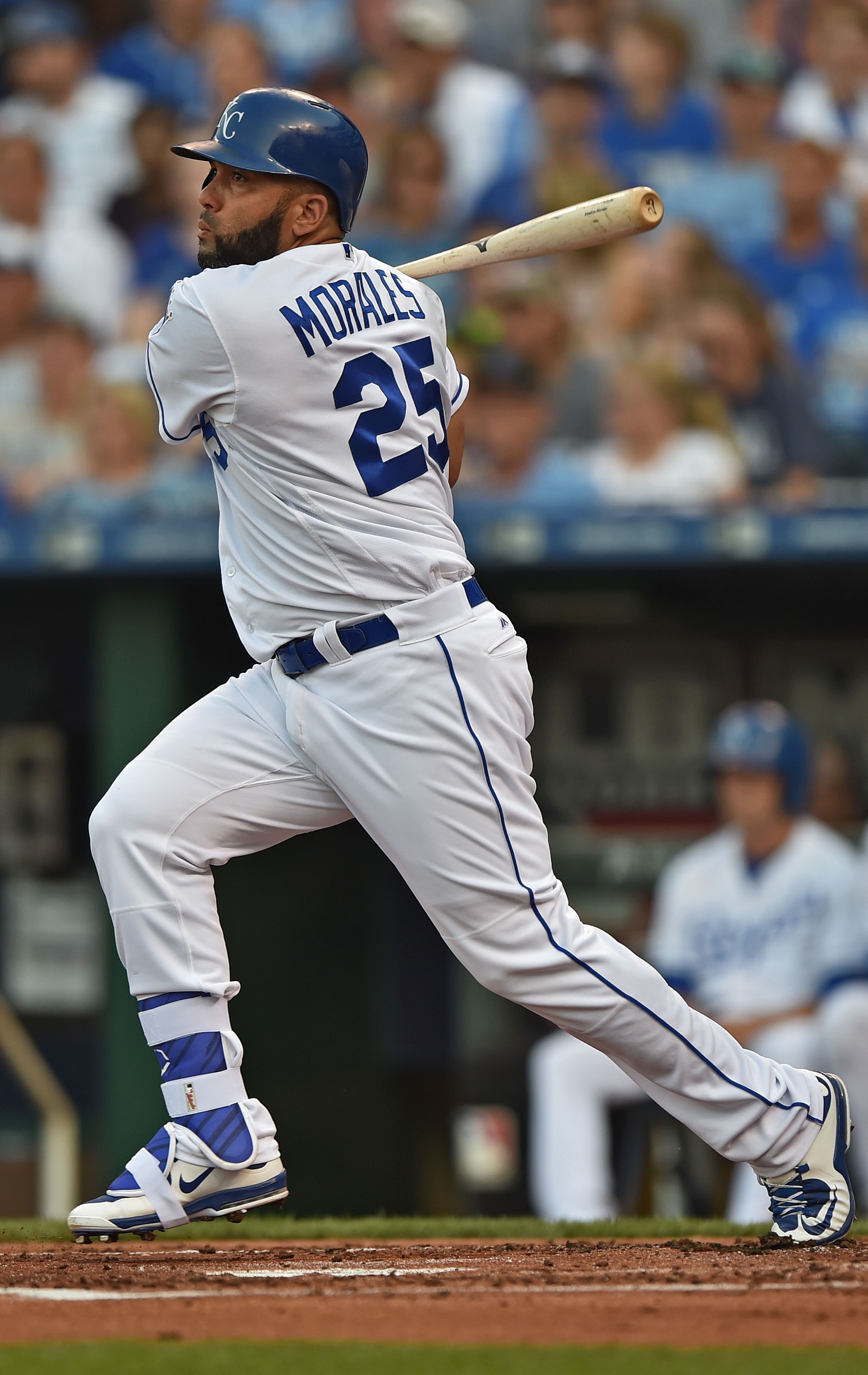
Morales went 1-for-3 with a homer on June 11, which represented a rare bright spot in a bleak season for him to that point. However, that fairly innocuous performance kicked off an eight-game hitting streak during which the switch-hitter was on fire, and Morales never really looked back. In 85 games (81 starts) between the onset of that minor hitting streak (and before tonight’s action), Morales batted an exceptional .303/.370/.563 with 22 homers and 13 doubles. He’s walked at a 9.1 percent clip and struck out at a 19 percent clip.
That Herculean stretch of games has boosted Morales’ season batting line to a plenty respectable .262/.329/.473. Those numbers grade out at about 10% above league average, with the lower OBP offsetting the pop, but they’re a far cry from his terrific debut in Kansas City when he slashed .290/.362/.485 in 639 plate appearances with the Royals last year. A strict designated hitter — which Morales is, despite the fairly stunning decision to play him in the corner outfield a bit during interleague play — with an above-average but not quite outstanding bat, however, isn’t necessarily a commodity for which teams will pay a premium price.
Morales’ value this winter, then, will in many ways hinge on whether teams are willing to simply write off the first two months of the 2016 season as an anomaly, instead choosing to focus in on the tremendous production that Morales provided throughout the 2015 season and for the bulk of the 2016 campaign. And if the 2016 season were the only time in recent history Morales looked lost at the dish, perhaps they’d be willing to do just that. However, it’s hard to imagine that clubs won’t be wary of a bat-only player that has now gone through prolonged stretches of not just below-average production but disastrously poor offensive output.
Morales, as many recall, received a qualifying offer from the Mariners on the heels of a solid 2013 season. That Seattle even tendered a QO to Morales was a surprise, but the fact that Morales and agent Scott Boras elected to decline the offer was even more shocking. Morales languished in free agency all offseason, unable to find a team willing to part with a top draft pick in exchange for his services. Ultimately, he waited until after the June draft to sign a one-year deal with the Twins that afforded him the pro-rated portion of a $12MM salary (about $7.5MM through the end of that season). Morales did virtually nothing to bolster his stock that year, batting just .218/.274/.338 with eight homers in what was unequivocally the worst season of his Major League career.
While Morales’ camp can argue that the lack of a Spring Training to get up to speed derailed any chances of having a productive year, those three and a half months, paired with the two-plus months for which he provided virtually no value to the Royals in 2016, total about a full season’s worth of considerably below-replacement-level production for Morales in the past few calendar years. He’s balanced them out with some excellent production as well, but the lack of consistency for a player whose lone job is to consistently provide offensive value serves as a red flag — especially in an age where many teams utilize the DH spot as a revolving door to play matchups and to keep various hitters fresh.
What’s clear is that Morales’ mutual option is all but certain to be torn up. Such options are virtually never exercised by both parties — either the player performs well enough to leave no doubt that he can top the option’s value in free agency, or he performs poor enough that the team doesn’t want him back at said price — and Morales’ shouldn’t be an exception. He’s performed well enough to reasonably expect that he can surpass $11MM in free agency, but has he performed at a high enough level for the Royals to risk tendering a one-year offer in the vicinity of $16.8MM? I lean toward no.
Last winter alone, we saw teams show extreme reluctance to part with draft picks to sign Ian Desmond, Dexter Fowler, Howie Kendrick and Yovani Gallardo. Meanwhile, bat-only players like Pedro Alvarez and Mike Napoli landed one-year deals worth $5.75MM and $7MM, respectively. Certainly, Morales has had a better season than Desmond, Alvarez and Napoli did in 2015, but reluctance to surrender a draft pick for players that can provide definitive defensive value and come with the offensive upside of Desmond, Kendrick and Fowler was surprising to see. Furthermore, Morales has been through this process once before and undoubtedly considers free agency when burdened by draft pick compensation to be a negative experience. Extending a QO to a player with his past experiences when it roughly amounts to the same financial guarantee he just received on a two-year deal seems like a recipe for a quick acceptance.
It seems reasonable to believe that the Royals will forgo a qualifying offer for Morales, who is all too familiar with what the QO does to a DH with an above-average but not elite bat. Assuming, then, that he’s unencumbered by draft-pick compensation, another two-year contract for Morales is a reasonable expectation — and probably one at a higher annual rate than his current agreement. Morales’ new representatives at Wasserman (he switched agencies last October) could very well see fit to push for a third year. Billy Butler, after all, got three years coming off a worse season than the one Morales is wrapping up.
Morales, though, is much older than Butler was when he signed his deal. He also hasn’t demonstrated the consistency nor the elite levels of offense that Victor Martinez did leading up to his four-year deal. Beyond that, Morales will face a slew of competition in terms of first base/DH/corner outfield types. In addition to Edwin Encarnacion (the top name in this group), the free agent market includes Alvarez, Napoli, Brandon Moss, Adam Lind, Logan Morrison, Carlos Beltran and potentially even Jay Bruce (depending on the status of his own 2017 option).
Ultimately, the third year for Morales, who will turn 34 next June, doesn’t seem likely but shouldn’t be considered impossible. However, even a solid raise on a new two-year pact would be a remarkable feat for a designated hitter that had a sub-.600 OPS through his first 56 games of the season. Morales probably won’t break the bank, but he’s salvaged his 2016 season and his offseason earning power.
Photo courtesy of USA Today Sports Images.
Astros Injury Updates: Keuchel, Bregman, McCullers
It seems rather unlikely that the Astros will receive further contributions in 2016 from lefty Dallas Keuchel or infielder Alex Bregman, according to updates from GM Jeff Luhnow, via MLB.com’s Brian McTaggart (Twitter links). There’s at least some positive momentum, though, for righty Lance McCullers Jr., who Luhnow says will throw off of a mound in the coming days, as Jake Kaplan of the Houston Chronicle tweets.
Keuchel, who is dealing with shoulder inflammation, wouldn’t be available unless the team is able to qualify for and “go pretty deep” in the postseason, per Luhnow. He has yet to begin throwing at this time, Kaplan tweets, so there’s obviously a long way to go. The 28-year-old last appeared on August 27th, so he’d certainly need to fully build back his arm strength even if the inflammation dies down.
The timeline isn’t much more optimistic for Bregman, whose hamstring injury is significant enough that it would typically require a four to six week layoff. While Luhnow suggests that it’s possible to push a recovery in this situation, even an aggressive timetable would seemingly leave the talented youngster unavailable until early October.
McCullers, meanwhile, has been out for much longer than the other two players with elbow issues. News on his progress has been limited since his last appearance on August 2nd. Presumably, the ‘Stros will continue to exercise caution with the prized 22-year-old. But it’s at least promising to hear that he is now in a position to begin working back toward mound work.
What’s clear is that Houston won’t receive any contributions from this key trio of players down the stretch. With a three-game gap between the club and a Wild Card spot entering today’s action, it’ll take a huge showing over the next two weeks just to gain a chance at the playoffs. If the Astros can somehow sneak in — and escape the one-game Wild Card play-in game — it’ll be interesting to see if any of the three are ready for activation for a full postseason series.
Blue Jays Name Paul Beeston President Emeritus
The Blue Jays announced today that long-time executive Paul Beeston has been named president emeritus of the organization, a designation that he’ll hold “in perpetuity.” Formerly the organization’s president and CEO, Beeston announced his retirement in the fall of 2015.
Beeston’s successor, Mark Shapiro, said that the honorary title was given to honor Beeston’s “incomparable” contributions. “This is simply a small token of recognition for the nearly four decades he’s given the game,” Shapiro said in the press release. “We felt it was right to honour the legacy he has built and ensure he’s a part of the future successes of this team.”
Meanwhile, the new top exec received plaudits from his predecessor. “Over the past year I have had a front row seat to observe Mark Shapiro’s innovative thinking, his professionalism and his commitment to winning and bringing a championship to Toronto,” Beeston commented in the release.
Beeston also noted his gratitude at today’s gesture. “I am fortunate to once again be welcomed back into this great organization,” he said. “To have a small role moving forward is something that I sincerely appreciate.”
It seems only fitting that Beeston will remain president emeritus for as long as the organization exists. He is, after all, its first employee. After entering the fold as vice president of administration back in 1976, Beeston oversaw the Jays as president & CEO for two separate stints — 1989 to 1997 and 2008 to 2015. The former period included the team’s memorable 1992 and 1993 World Series teams, while the latter was capped off last year with the Jays’ first return to the postseason since its back-to-back championships.
Atlanta Braves: Top 5 Bright Spots of 2016
Rebuilding season or not, falling short of the playoffs and finishing with a losing record probably means that more things went wrong than went right for a team. This series, however, will focus on those silver linings that each team can take away from an otherwise disappointing season.
[Related: “Top Bright Spots” archive]
Here are the biggest bright spots for the Atlanta Braves.
Note: Freddie Freeman‘s terrific season does qualify as a bright spot, as does Julio Teheran‘s to a lesser extent, but not major ones in regards to what was expected and how it affects the team moving forward. Since neither is expected to be a trade candidate, their performances don’t change the outlook for the offseason or for the 2017 season.
1. Ender Inciarte/ Matt Kemp/ Nick Markakis, OF
All indications are that the Braves expect to contend in 2017 and will be aggressive in their pursuit of two or three starting pitchers that could help send them in the right direction. Trading from a position of strength didn’t appear to been an option a few months ago. But thanks to the late-season success from their starting outfield trio, this is now a viable strategy. Here’s a look at the three potential trade candidates:
Inciarte: .863 OPS, 14 2B, 3 3B, 2 HR, 7 SB in 60 games; under club control thru ’20; entering first year of arbitration eligibility (Super Two).
Kemp: .914 OPS, 16 2B, 15 HR in 57 games; owed $47.25MM thru 2019
Markakis: .839 OPS, 16 2B, 7 HR in 60 games; owed $22MM thru 2018
The 25-year-old Inciarte is easily the most valuable trade chip of the three, although I wouldn’t rule out the Braves receiving a decent return for Markakis or Kemp. One of the strong motivators for the Braves in the Kemp deal was to rid themselves of Hector Olivera and his contract. Getting Kemp was an added bonus. They’d likely be more than happy to pay his close to $16MM per season salary and would likely be willing to eat a portion of that in an offseason trade if it brought back a starting pitcher who could help in 2017.
2. Jace Peterson, IF/OF
While Peterson’s season won’t likely have much effect on Ozzie Albies‘ arrival in the majors—you can probably pencil Albies into the starting lineup no later than June 1st whether Peterson is in the picture or not—his value to the Braves has increased greatly.
Since returning from a stint in the minors on June 10th, the 26-year-old has a .789 OPS with seven homers, 15 doubles, 44 walks and 46 strikeouts. In addition to functioning as a stop-gap for Albies, he could also push Adonis Garcia for playing time at third base, as well as give the Braves another option in the outfield if they were to trade Inciarte, Kemp or Markakis. That is, if he’s still in the organization on Opening Day.
Peterson’s trade value should be on the rise. Young, controllable players—he’ll be eligible for free agency after that 2020 season—who can play multiple positions (including short and center) and get on base at a high clip are at a premium. The combination of youth, talent and versatility makes him an asset for a contender or rebuilding team.
3. Mike Foltynewicz, SP
The open audition the Braves have been holding for starting pitchers in 2016 hasn’t yielded many answers in regards to who can help them out in the near future. Out of all the young, unproven pitchers who have been given the opportunity to make a start, Foltynewicz is the most likely to be penciled into the 2017 rotation.
In what might have been his last chance to prove that he could be a big league starter—many scouts believe the hard-throwing right-hander is best suited for the bullpen—Foltynewicz had more ups (seven starts with one earned run or less) than downs (five starts with five or more earned runs allowed). At just 24 years of age, there is still plenty of room for growth. Another step forward in 2017 and the Braves could have themselves a solid No. 2 or 3 starter.
4. Mauricio Cabrera, RP
It’s not out of the ordinary for a rookie to look much better than expected in the big leagues based on their Minor League track record. Small-sample success can be a matter of opposing teams not having enough information to formulate the proper plan of attack. Once the book is out, word spreads quickly and that players’ weaknesses are exposed.
In the case of Cabrera, his weakness was that he could not throw strikes consistently enough with a fastball that regularly exceeds 100 MPH. Since 2015, his first year as a full-time relief pitcher in the Minor Leagues, he combined to walk 57 batters in 82 innings (5.7 BB/9) between High-A and Double-A. In the majors, where he’s been since the Braves called him up on June 27th, he’s walked only 14 hitters in 34.2 innings (3.6 BB/9) en route to a solid 3.12 ERA with four saves and eight holds in his 35 appearances. If he can throw a 102 fastball for strikes and employ a secondary pitch or two that somewhat resembles the fastball coming out of his hand, extensive scouting reports probably won’t help much.
While their have been a few expected bumps along the way, the 22-year-old has earned a shot to challenge Arodys Vizcaino (any any other competitors who are brought into the picture) for the closer’s job in 2017 and should at least be penciled into a setup role.
5. Ozzie Albies, 2B/SS (MiLB)
The 19-year-old Albies, who spent the entire 2015 season in Low-A ball, was on the doorstep to the Major Leagues before fracturing his elbow earlier this month. We’ll never know whether the Braves were willing to add him to the 40-man roster and start his service time clock as they did with Dansby Swanson. GM John Coppolella suggested the team didn’t think he was quite ready, but it wouldn’t have been a major surprise. He would’ve been the 2nd player in team history from Wilemstad, Curacao to debut at age 19. The other was center fielder Andruw Jones, a five-time All-Star who won 10 Gold Glove awards as a Brave.
A jump over High-A and to the upper minors wasn’t much of a challenge for the switch-hitting Albies, who finished the season with a .778 OPS, 49 extra-base hits (33 2B, 10 3B, 6 HR) and 30 stolen bases between Double-A and Triple-A. The fast-rising prospect should make his MLB debut early in the 2017 season, teaming with Swanson to form one of the more intriguing young double-play duos in baseball.