
AL Notes: Sandoval, Zunino, Yankees
The ongoing saga between the Red Sox and Pablo Sandoval seemingly took another odd turn today. As Jason Mastrodonato of the Boston Herald reports, manager John Farrell says that the third baseman’s scheduled examination by Dr. James Andrews was punted because his ailing left shoulder was too sore. Sandoval did receive a cortisone shot to treat the inflammation, and is set for another visit to Andrews in a “couple weeks.” Sandoval will obviously remain on the DL at least until that time, though it remains unclear what kind of activity (if any) he’ll participate in during the interim.
Here’s more from the American League to round out a quiet night:
- The Mariners‘ offseason moves at the catching position are working out well in the early going, writes Ryan Divish of the Seattle Times. Free agent signee Chris Iannetta has been productive at the major league level, providing a consistent presence that the team lacked in 2015. Meanwhile, Mike Zunino — the young backstop of the past and, hopefully, the future — is off to a scorching start at Triple-A after struggling badly in the bigs last season. The success of the former is allowing the team to remain patient with the latter, and Divish says not to expect a quick call-up for the 25-year-old Zunino. (It’s worth bearing in mind, too, that Zunino entered the year with 2.084 years of service on his clock, meaning that Seattle could pick up an additional year of control if he stays down long enough.)
- The pre-season expectations of the Yankees‘ pitching staff have largely been borne out in the regular season thus far, as George A. King III and Joel Sherman of the New York Post write in separate pieces. Both the depth and quality of the rotation remains a major concern, says King. And Sherman wonders whether the summer trade market will provide an avenue for the organization to add to the rotation mix while parting with one of Aroldis Chapman, Andrew Miller, or Dellin Betances. While GM Brian Cashman says that “the plan is to have those three guys the whole way,” it’s something that the club has seriously considered before. Of course, pulling off such a deal with another contending team in the middle of a season would surely be a tricky proposition.
NL Notes: Heyward, Schwarber, Fried
Jason Heyward received a bit of a rough welcome back to St. Louis today, as he appeared there for the first time since leaving the Cardinals for the rival Cubs. But that didn’t seem to bother him; as he told reporters, including MLB.com’s Carrie Muskat (Twitter link): “If somebody boos me here, that means they weren’t happy to see me leave. I’m glad people weren’t happy to see me leave.” He’s already covered his decision to move on to Chicago in some detail, of course, but the occasion offered a chance to revisit the winter market once again. As Derrick Goold of the St. Louis Post-Dispatch reports, Heyward ultimately spurned the Cards not out of any failure to see eye-to-eye on a contract, but because he had found another spot he preferred. “It came down to Chicago was really where I would like to be at the time,” Heyward said. “… I feel like [the Cardinals] had every intention of keeping me here. They said that. And they followed that through with their actions. It didn’t come down to contract. Whether it was the opt-out, whether it was the full no-trade (clause), or what have you — it came down to taking the opportunity to be where I wanted to be and for the first time in my life having the choice.”
Here are a few more notes from the National League:
- Cubs catcher/outfielder Kyle Schwarber is set for surgery this week on his injured left knee, Jesse Rogers of ESPNChicago.com was among those to tweet. It’s already clear that he’ll miss the entire season with ACL and LCL tears, but a broader recovery timeline remains unknown and will presumably depend in part upon how the procedure goes.
- Young Braves lefty Max Fried is showing promise in his return from Tommy John surgery, Carroll Rogers Walton of the Atlanta Journal-Constitution reports. The 22-year-old was a highly-regarded prospect before running into elbow troubles, and remains a high-upside arm for an Atlanta organization that is full of them. He came over in the Justin Upton trade, but has only just returned to action. Fried was not only the high school teammate of Lucas Giolito — who is now the top-rated pitching prospect in baseball — but ended up being taken higher in the 2012 draft when the Nationals’ right-hander fell due to his own elbow troubles.
Twins Notes: Polanco, Perkins, Murphy
The Twins are set to promote top infield prospect Jorge Polanco to the Majors, a source tells Darren Wolfson of 1500 ESPN (Twitter link). It appears that third baseman Trevor Plouffe, who left yesterday’s game with an intercostal strain, is likely heading to the disabled list, thus necessitating the move. Polanco is one of the more highly regarded infield prospects in baseball, ranking 66th on Keith Law’s preseason Top 100 list at ESPN, 95th on MLB.com’s Top 100 and 99th on Baseball America’s Top 100. Polanco has played shortstop in the minors but is said to be best suited for second or third base. The switch-hitting Polanco draws praise for above-average speed, very good contact skills and modest pop, with Law writing that he could hit 12-15 homers and be a defensive asset at second or third. The promotion is likely to be temporary, as Plouffe, Eduardo Escobar and Brian Dozier line up at third base, shortstop and second base respectively. The Twins have Eduardo Nunez and Danny Santana (who is currently on the DL himself and, notably, is out of minor league options) as utility options.
A few more notes on the Twins…
- Injured closer Glen Perkins tells 1500 ESPN’s Phil Mackey that a second opinion confirmed that he won’t require surgery to repair his ailing shoulder, but he’s still “at least” a few weeks away from pitching (Twitter link). Considering the fact that Perkins would need a rehab assignment after a lengthy layoff, that would seem to suggest that he could be out until early May at the earliest, and a lengthier absence sounds possible based on that timeline as well. Right-hander Kevin Jepsen is filling in for Perkins in the ninth inning, as I mentioned earlier today when looking at some bullpen shakeups that could have an impact on some players’ salaries in arbitration and free agency.
- Outfielder David Murphy can opt out of his contract with the Twins on May 1st, Mike Berardino of the St. Paul Pioneer-Press reports on Twitter. The veteran came to the organization on a minor league deal with hopes of a quick call-up, and it seems that the contract’s out clause was designed to give him some leverage in that regard. Murphy has said he has little interest in a lengthy minor league stint, and he could seek another opportunity elsewhere if he’s not on the MLB roster in two weeks’ time.
Phillies Acquire Alfredo Marte
The Phillies have acquired outfielder Alfredo Marte from the Orioles, according to announcements from both clubs. A player to be named later or cash considerations will go back to Baltimore in the swap.
Marte, 27, had been playing at Triple-A in the Baltimore organization after signing as a minor league free agent, but had seen scant action in the early going. He has taken 170 plate appearances over parts of three MLB campaigns, compiling a meager .181/.249/.284 slash. But Marte owns a much more appealing .304/.372/.468 batting line in over 1,000 trips to the plate in his time at the highest level of the minors.
Philadelphia is obviously looking to add depth in an area of need. The club recently dropped Cedric Hunter to the minors after his rough start, bringing up veteran reserve David Lough. It has also received little thus far from Peter Bourjos, Emmanuel Burriss, and Rule 5 pick Tyler Goeddel, so there’s plenty of opportunity at the major league level.
Orioles Have Made Offer To Kyle Lohse; Reds, Tigers Also Interested
5:18pm: Detroit does not appear to have present interest in Lohse, Chris Iott of MLive.com tweets.
4:47pm: Free agent right-hander Kyle Lohse is drawing interest from the Tigers, Reds and Orioles, and Baltimore has made an offer to the Scott Boras client, reports MLB Network’s Jon Heyman (via Twitter). It’s not known whether the 37-year-old has received any other contract offers.
Lohse hit the open market after arguably the worst season of his career — the final campaign of a three-year, $33MM deal with the Brewers. Though Lohse had logged a 3.28 ERA in his four prior seasons combined (796 1/3 innings), his production evaporated entirely, as he lost his spot in the rotation following a 6.31 ERA over his first 124 innings (22 starts). Lohse was said to take the demotion professionally and, to his credit, turned his season around to an extent once he was transferred to the bullpen. In 28 1/3 relief innings to close out 2015, Lohse posted a much more characteristic 3.81 ERA with 22 strikeouts against 13 walks.
Over 15 years in the majors, Lohse has worked to a 4.37 ERA. But his best work has come relatively late in his career; since 2008 (his age-29 season), that ERA is a much stronger 3.99 over 1358 1/3 innings. Teams looking at his potential to contribute even at a fairly advanced age will surely also note that Lohse has maintained his roughly 89 mph fastball velocity rather consistently, and has even managed to elevate his swinging strike rate over recent years (topping out at 9.1% last season). To some extent, his struggles in 2015 trace to an uncharacteristically high 15.3% HR/FB rate, a somewhat elevated .314 BABIP, and a 68.7% strand rate that fell below the league average of 73.4%.
Heyman notes that Lohse is looking for the “right fit,” though it’s not clear what exactly that would mean for him. Veterans in his situation could prioritize any number of factors, such as the promise of a rotation spot (or at least the opportunity to earn one in relatively short order), playing near their home, and/or signing with a team that is a postseason contender (to name a few). Wherever he ends up, Lohse seems likely to sign a minor league deal, which would allow him to head to Triple-A to see some work in a game setting, though he may not need to build up too much durability, as Heyman also tweets that Lohse has been throwing weekly simulated games that consist of 90 pitches.
Any of the three listed clubs makes some sense for Lohse. The Orioles have a questionable big league rotation, and while Lohse is hardly a lock to add any form of stability, he’d give Baltimore a much-needed depth option, as their collection of MLB-ready arms in the minors is limited. The Reds have a number of rotation options, but few that have much in the way of big league experience, and Lohse could help to shoulder the load. The Tigers, meanwhile, have a full rotation at the Major League level, but Mike Pelfrey has struggled early, and others such as Anibal Sanchez and Justin Verlander have dealt with injuries in recent seasons, so Lohse could serve as a depth option there as well.
Minor MLB Transactions: 4/18/16
Here are the day’s minor moves from around the league…
- The Phillies announced on Monday that they’ve optioned outfielder Cedric Hunter to Triple-A Lehigh Valley and selected the contract of veteran outfielder David Lough. The 30-year-old Lough will be added to a Phillies outfield mix that also features Rule 5 pick Tyler Goeddel, Odubel Herrera, Peter Bourjos and Darin Ruf (though Ruf has seen just nine innings in left field). Lough hit .280/.308/.320 in his brief time at Triple-A this year and is a lifetime .255/.295/.377 hitter in 741 big league plate appearances. He struggles against lefties but has shown solid ability versus right-handed pitching in his career and also draws praise for his outfield defense.
- The Blue Jays have released veteran catcher Humberto Quintero from their Triple-A affiliate in Buffalo, per a club announcement. The 36-year-old Quintero was enjoying a productive start to the season, having gone 4-for-15 with three doubles for the Bisons. His last extended stint in the Majors came in 2013 when he hit .237/.275/.366 in 140 plate appearances between the Mariners and Phillies. Quintero is a career .234/.267/.327 in 1423 Major League plate appearances.
- Infielder Steve Lombardozzi has signed a contract with the Southern Maryland Blue Crabs of the independent Atlantic League, the team announced. The 27-year-old Lombardozzi, who went to high school in Maryland, has spent parts of the past five seasons in the Major Leagues, splitting that time between the Nationals, Orioles and Pirates. A second-generation big leaguer, Lombardozzi is a career .263/.294/.336 hitter in 840 MLB PAs and has played second base, shortstop, third base and left field at the Major League level. He’ll look to use the Atlantic League as a launching point back into affiliated ball, as so many players before him have done.
Jed Hoyer Discusses Wesleyan University: MLBTR College Series
MLBTR continues a series where we interview top baseball executives about their college years. We’ll ask about why those chose their school, memorable moments, their favorite professor, important connections made, college learnings they still use today, and more.
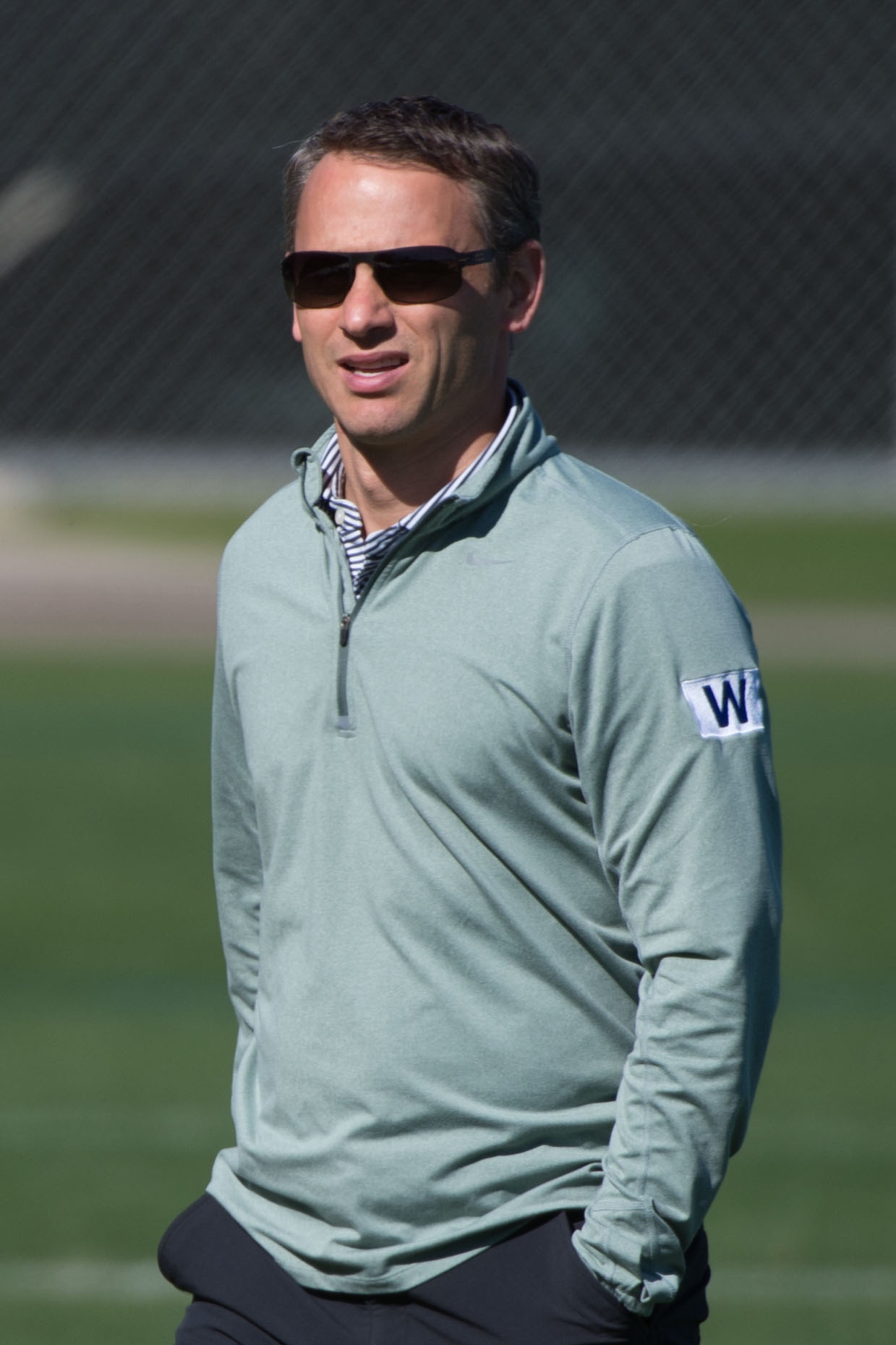
We’ve already spoken to Reds GM Dick Williams, and next up in our question-and-answer series is Chicago Cubs Executive Vice President and General Manager Jed Hoyer – a graduate of Wesleyan University (Middletown, CT).
* * * * *
Hi Jed, thanks for taking the time to speak with MLBTR. You have a little different path than some others, as you were an athlete, pitcher AND pitching coach at Wesleyan University. What led you to Wesleyan?
“The over-arching goal of my college search was to combine three factors – great academics, the ability to continue playing baseball, and a campus environment that would broaden my limited horizons. I looked at a lot of different schools and the best combination of those factors was Wesleyan. In hindsight, I was less intense and strategic about that decision than I would have been later in life. I simply had a great feel for the school, loved my interactions with the baseball coach (Pete Kostacopoulos), and could picture myself on campus. I had a wonderful four years at Wesleyan and will always be thankful that my instincts were right.”
When you look back at your Wesleyan days, what special moments can you share?
“My favorite moments from Wesleyan come from our baseball team my sophomore year. We advanced to the (Division III) College World Series and ended up losing in the national title game to Jarrod Washburn (Wisconsin-Oshkosh). Despite the disappointment of losing at the end, it was an incredible experience. We were already a close-knit group, but the intensity of the postseason that year only brought us all closer.”
I’m going to get to some student-athlete questions, starting with the academic side. But first, can you tell me about your immediate post-graduate career? I know you initially stayed in school, so to speak.
“My first job after college, I worked as an assistant director of admissions at Kenyon College (Gambier, OH). I also was an assistant baseball coach. I left Kenyon after a year and returned to Wesleyan in a similar capacity. I was really fortunate that my bosses at both schools allowed me the time away from the office to coach. At the time, I simply did it because I wanted to stay on the field. In hindsight, it was an invaluable experience for me to learn about the game from a different angle. I had never thought about how to teach fundamentals or how to motivate players prior to coaching. The three years I spent coaching has benefited me in ways I never would have imagined at the time.”
What was your college major?
“American History.”
I didn’t know that! Have you been able to apply your major to baseball?
“I loved being a history major. I loved the professors I had. I really enjoyed the reading material. Even today, if I get a chance to sit down and read a book, I’m going to grab a biography or something about a historical period. But I will say if I knew I’d be where I’m sitting right now, I certainly would have angled myself more towards economics or something more quantitative. I do think that’s important when you start your life after college to know that every move you make doesn’t have to be planned so specifically. I was kind of referencing that before in regards to coaching. I coached baseball because I loved being out there, and I wanted to stay involved with the game. It gave me an awesome perspective on the game that I never had. I worked for a couple consulting firms later on, and that really helped me learn how to build business models and advanced my quantitative skills. I think every job I’ve had has provided me with different skills or knowledge that I can use every day in baseball.”
You might have a different perspective on this question as a former admissions official and former coach. What advice do you give high school and college students who want to work in a front office someday?
“I always tell aspiring baseball people the same thing – get involved in baseball in every way you possibly can. For me, it was playing until I wasn’t good enough to play anymore and then coaching. Baseball was my athletic love, and now I’m fortunate enough to be able to come to work every day and apply that. Ultimately, when I come into work, my entire day is spent dealing with baseball in various forms – whether it’s contractual, whether it’s rules, whether it’s player evaluation. Sports science … analytic stuff … whatever it might be, it’s all baseball all day. If you don’t absolutely love baseball, this is never going to work for you.”
Were there lessons you learned at Wesleyan that you utilize today as part of this day-to-day routine?
“I think the two things that come to mind right away are – No. 1, there’s nothing better than team sports. The camaraderie that’s built among a group of people fighting for a common goal is really something special. I know I experienced that playing in college. I don’t think that’s any different when you’re getting paid to play in the big leagues. Creating a great culture in the clubhouse, getting everyone pulling in the same direction, there’s no doubt that the teams that do that best have a big advantage. The second thing, on a more academic level, is that lifelong learning is something that’s exceptionally important. The most impressive thing about Wesleyan to me was that there was this eclectic group of intellectually curious 19-22 year olds– and those were the type of people I wanted to be around on a day-to-day basis. The school was filled with people that are constantly learning, always curious, and consistently pushing the boundaries. Those are the type of people I wanted to be surrounded by when I was 20 and they are the same people I want to fill our front office with at 42.”
As you reflect back on Wesleyan and being a student there, did you have a favorite professor?
“The most vivid memory of the classroom at Wesleyan – and I think back on this quite a bit – there was a professor named Richard Slotkin, and he taught American Literature. His classes were incredibly hard to get into because he was such an amazing lecturer. I remember sitting in his lectures and thinking … I hope someday I can be as good at my job and as passionate about my job and as knowledgeable about the field of study as this guy is. Candidly, I think I’m still trying to get there. I think it’s great when you see anyone in any walk of life that so dominates their field – and you can tell that it brings them so much joy to share it.”
Baseball-wise, did you make any important connections at Wesleyan that helped you in your baseball career?
“Ben Cherington played at Amherst, and they were our rival. My closest friend from high school played at Amherst with Ben, so I got to know those guys very well. It was a really fun and great rivalry. When I tried to get an internship with the Red Sox a few years later, the connection with Ben really helped me. Ben is an incredible talent. I was really fortunate to get to know him at age 19 in a setting that neither of us ever would have imagined would have led to a professional relationship and friendship.”
You set Wesleyan’s all-time school saves record – and were also the everyday shortstop. Can you talk about your playing days?
“If I had any strength in baseball at all, it was that I was really versatile. My sophomore year, I played left field and was the closer. My junior year, I played shortstop, was a starting pitcher, and even played catcher a few games when our catcher got hurt. My senior year, I played shortstop and was the closer. In general, I felt comfortable moving around the diamond. I knew I wasn’t going to play in the big leagues. I was self-aware enough to realize that. I played in the Cape Cod League after my junior year and was teammates with Mark DeRosa, John McDonald and Dan Reichert. It was a great experience and also a humbling experience. I realized that if I was going to have a future in baseball, it wasn’t going to be playing on TV.”
Do you ever get a chance to go back to visit campus?
“I’m actually going back soon. My 20th reunion is in the middle of May, so I’m going back for that – which will be fun. When I was with the Red Sox, I went back often; it was only a three-hour drive. I could get down there for a game or to visit people. But after I left the Red Sox, I haven’t been back since. I’m excited to be back on campus.”
Final question, as we tie together your college major and your professional career. Did obtaining a history degree pique your interest in learning more about the histories of the Red Sox and the Cubs?
“No doubt. I’ve been fortunate that two of the three teams I’ve worked for have incredibly rich, deep histories. Those two teams are more than just baseball teams to their cultures … they’re a way of life that’s passed down generation to generation. I think I’d be doing a disservice to the job if I didn’t completely embrace the history of the Red Sox or the Cubs. There are so many similarities between the two teams. The Red Sox ended their long suffering. Now we get the incredible opportunity to try to do the same thing in Chicago.”
– – –
Chuck Wasserstrom spent 25 years in the Chicago Cubs’ front office – 16 in Media Relations and nine in Baseball Operations. Now a freelance writer, his behind-the-scenes stories of his time in a big league front office can be found on www.chuckblogerstrom.com.
Photo courtesy of USA Today Sports Images.
Twins Hire Ron Gardenhire As Special Assistant To GM Terry Ryan
The Twins announced on Monday that they’ve hired Ron Gardenhire, who managed the club from 2002-14, as a special assistant to general manager Terry Ryan. According to the team’s press release, Gardenhire will serve as a roving instructor and evaluator throughout the club’s minor league affiliates.
Gardenhire, 58, spent 13 seasons as the Twins’ manager, accumulating a 1068-1039 record in that time and also won six division championships. From 2002-10, the Twins were a perennially competitive club in the AL Central, but Minnesota fell off the map beginning in 2011, and following the club’s fourth straight losing campaign, it announced that Gardenhire would be relieved of his duties. (Hall of Famer and Minnesota native Paul Molitor was eventually hired as his replacement.) Even at the time of his firing, though, it was clear that Gardenhire was still in good standing with the club. He sat alongside Ryan at the press conference to announce his dismissal, with Ryan telling the Twin Cities media that he likened Gardenhire to a brother.
Gardenhire has been a managerial candidate for other clubs since being fired in Minnesota, most notably being one of the reported finalists for the Padres job this offseason alongside Pirates coach Rick Sofield and D-backs third base coach Andy Green, who eventually won the job and is now in his first season with the Friars. Gardenhire is widely respected among baseball executives and his former players. While his in-game tactics were more traditional in nature, he drew strong praise for his communications skills and attention to fundamentals, and he was exceptionally popular in the Twins’ clubhouse over the duration of his dugout tenure.
Tigers Designate Logan Kensing For Assignment
The Tigers have designated right-hander Logan Kensing for assignment in order to clear a spot on the roster for lefty Blaine Hardy, who was activated from the disabled list today, as MLB.com’s Jason Beck tweets.
The veteran Kensing, 33, appeared in three games with the Tigers, allowing a run on eight hits and two walks with one strikeout in 4 2/3 innings of work. The longtime Marlins hurler was absent from Major League Baseball from 2010-12, during which time he pitched in indy ball and the minor leagues with the Pirates and Yankees. He’s totaled just 20 2/3 innings in the Majors since his return in 2013, working to a 4.79 ERA. Kensing has also pitched at the Triple-A level for parts of nine minor league seasons, putting together a 3.46 ERA with 8.6 K/9 against 3.7 BB/9 in 276 innings.
Hardy, 29, gives the Tigers a solid left-handed arm to join manager Brad Ausmus’ bullpen. He’s spent the past two seasons as an effective reliever in Detroit, working to a 2.87 ERA in 100 1/3 innings. He’s averaged 7.7 K/9 against 3.8 BB/9 in that time while holding opposing left-handed batters to a pedestrian .227/.302/.301 batting line (202 plate appearances).
Bullpen Decisions That Have Potentially Impacted Earning Power
The 2016 season is still rather young, but decisions made late in Spring Training or early in the year can have lasting impact not only on a team’s results but also on the long-term earning power of players who find themselves in new roles due to injury or poor performance. This is perhaps most true when looking in the bullpen, where middle relievers are modestly compensated in arbitration (and, to a lesser extent, free agency) while their ninth-inning brethren receive significantly higher salaries due to the accumulation of saves. This past winter, we saw significant paydays for Trevor Rosenthal ($5.6MM), Hector Rondon ($4.2MM), Cody Allen ($4.15MM), Jeurys Familia ($4.1MM) and Shawn Tolleson ($3.275MM) 1in each reliever’s first trip through arbitration. Liken those figures to the arbitration salaries awarded to quality middle-relief/setup options like Justin Wilson ($1.525MM) and Bryan Morris ($1.35MM), and it’s clear that the ninth inning comes with clear financial benefit for relief arms. Even Allen’s setup man, Bryan Shaw, took home $2.75MM in his second trip through arbitration. Granted, many of the closers listed also possess gaudy strikeout rates, which do help to improve their earning capacity, but the saves are the most notable factor working in the favor of closers over setup men.
With all of that said, let’s take a look at a few early bullpen shifts that have bolstered (or, in some cases, hindered) the earning power for relievers around the game…
- Arodys Vizcaino, Braves: Jason Grilli opened the 2015 season as Atlanta’s closer and pitched well in that role until an Achilles injury ended his season. Vizcaino stepped into the ninth inning and performed quite well in his stead, and while Grilli received the Braves’ first save opp of 2016, it took one blown save for Vizcaino to move up the ladder. Vizcaino is earning just under $900K as a Super Two player this season, but if he can add a full season’s worth of saves to the nine that he tallied last year, he’ll have a case for a markedly improved salary in his second trip through arb this winter.
- Ken Giles, Astros: Conversely, the Astros’ decision to put Giles in the eighth inning after parting with a steep package to acquire him this offseason was a surprise to many. Houston’s decision has looked wise early on as Giles has struggled with home runs, but his troubles don’t figure to last long based on his track record and a strong 9-to-1 K/BB ratio through his first six appearances. Had Giles been placed into the ninth inning right away, he’d have hit arbitration following the 2017 season with nearly three full seasons as a closer under his belt and potentially had a case to top Rosenthal’s first-time record. Keeping him in the eighth inning could keep his future arbitration earnings more manageable and also allows manager A.J. Hinch to use him in higher-leverage situations as opposed to holding out for the ninth inning, as many managers tend to do with their best relievers.
- Jeremy Jeffress, Brewers: The 28-year-old Jeffress was originally slated to share the ninth inning with Will Smith, but when Smith suffered a torn LCL in Spring Training, Jeffress received sole ownership of the ninth inning and has run with it through the first two weeks of the season. A full year of saves won’t get him into Rosenthal territory, but Jeffress could compare nicely with Tolleson if he holds onto the ninth inning all season. Smith, of course, is still attempting to return, but it’s easy enough to imagine Jeffress simply holding onto the ninth, if he’s pitching well, even if Smith proved able to pitch in 2016. Jeffress arbitration eligible for the first time in the 2016-17 offseason.
- Jeanmar Gomez, Phillies: The 28-year-old received a save opp only after David Hernandez and Dalier Hinojosa blew their first opportunities, but he’s converted on four straight since getting his first chance. Gomez doesn’t have the traditional high strikeout rates or hard velocity that come with most closers, but he’s been an effective reliever and could cash in significantly this winter if the Phillies entrust him with ninth-inning duties all year. Gomez personifies the lack of earning power for low-leverage middle relievers; he’s earning $1.4MM this season after his second trip through arbitration despite a combined 3.19 ERA in 217 1/3 relief innings across the past three seasons. The Phillies ‘pen could be the biggest carousel of any listed here (or of any in MLB), so perhaps Gomez’s mention here merits the “barring a change” caveat more than any of the others. For now, the ninth inning appears to be his, though.
- Roberto Osuna/Drew Storen, Blue Jays: Toronto went the opposite route of the Astros, allowing their excellent young reliever to continue to pitch in the ninth inning despite having an experienced veteran alternative in Storen. Assuming he holds the job and isn’t sent down to the minors at any point, Osuna will hit arbitration following the 2017 season with three seasons’ worth of saves under his belt. That’s a recipe for a significant payday, but the Jays opted not to tinker with a role that worked quite well for Osuna in 2015. I listed Storen also due to the fact that while the impact on free agency is lesser, there’s no doubt that he’d have had a more compelling free agent case this coming winter were he coming off a full season as a closer. Instead, he’s slated to hit the open market one and a half seasons removed from his most recent ninth-inning work.
- Kevin Jepsen, Twins: Jepsen is in the ninth inning out of necessity for the Twins following another injury to Glen Perkins. There’s no timetable on Perkins’ return, and while Jepsen isn’t likely to stick in this role all season, another successful run as an interim closer — he filled this role quite well for the Twins last year when Perkins was also hurt — would be a nice added bonus to his free-agent stock this coming offseason.