
A’s Not Discussing Rotation Move For Mason Miller
Last offseason, the Athletics moved Mason Miller from the rotation to the closing job. General manager David Forst said at the time that the A’s were open to building the right-hander back up as a starter after one season in relief. That doesn’t seem to be on the table for now.
“We’re not talking about moving him back into a starting role,” Forst told John Shea of the San Francisco Chronicle this week. While that doesn’t preclude having the conversation at some point during the offseason, it appears the likelier outcome is that Miller will remain in the ninth inning.
Stretching Miller back out would be a huge risk-reward play for the A’s. A few teams have had success with converted relievers in recent seasons. Garrett Crochet immediately looked like a budding ace when the White Sox gave him a starting job. Seth Lugo and Michael King have gone from setup relievers to borderline top-of-the-rotation starters. Reynaldo López and José Soriano found success but battled injury issues in their returns to starting. Free agent righty Jeff Hoffman has drawn interest as a potential rotation conversion.
Miller is talented enough that a Crochet arc would be within the realistic range of outcomes. The A’s are concerned that a starter’s workload would weigh heavily on his arm, though. Miller has battled shoulder and elbow injuries and pitched fewer than 40 innings in the minor leagues. He started six MLB games as a rookie in 2023. Miller was pitching well but forearm tightness shelved him between mid-May and the start of September. The A’s used him out of the bullpen for the season’s final month and kept him in that capacity this year.
The 26-year-old’s first full season as a closer could hardly have gone better. Miller’s already elite velocity jumped in short stints. His fastball averaged nearly 101 MPH and routinely got into the 103-104 range. Between that kind of life and a wipeout slider, Miller was almost untouchable. He turned in a 2.49 ERA while striking out almost 42% of opposing hitters through 65 innings. Opponents swung and missed at nearly a fifth of his offerings. Among relievers with 50+ innings, only Josh Hader and Braves’ breakout lefty Dylan Lee got swinging strikes more frequently. Miller locked down 28 of 31 save attempts.
Most importantly, Miller’s arm held up. His only injury this year was a three-week absence due to a small fracture in his non-throwing hand. (He reportedly sustained that injury when he struck a training table in frustration after a poor outing.) It took all of a few weeks for Miller to establish himself as an elite late-game weapon.
Relievers aren’t immune to injury, but the A’s clearly feel better about his chances to stay healthy working in 1-2 inning stints. Assuming they don’t reverse course later in the offseason, he’ll project as one of the best closers in baseball. Other teams called on Miller at the deadline and surely will do so again this winter, but a trade would be a surprise. He’s still a year from arbitration and under club control for five seasons. The A’s are no longer aggressively tearing down the roster. They were relatively quiet at the deadline. Forst has already declared they’re keeping Brent Rooker, their best trade chip aside from Miller.
The A’s will need to add multiple starting pitchers. Their rotation is among the thinnest in the league. Players like JP Sears, Mitch Spence and Joey Estes headline the group. They all look like back-of-the-rotation arms at best. With almost nothing on the books for next season, Forst and his staff should be able to take on money via trade and/or a mid-level free agent strike to add innings.
Breslow: Red Sox Looking To “Raise The Ceiling” In Rotation
The Red Sox look to be one of the top suitors for impact starting pitching. As teams laid the groundwork for the offseason at this week’s GM Meetings, chief baseball officer Craig Breslow suggested the Sox are evaluating ways to land a top-flight starter.
“We know we need to raise the ceiling of the rotation,” Breslow said (link via Alex Speier of the Boston Globe). “I think there are a lot of ways to do that, but we’re going to be really, really open-minded.”
The most straightforward solution is through free agency. Corbin Burnes and Blake Snell headline the rotation class. Max Fried and Jack Flaherty aren’t far behind. Nathan Eovaldi, Yusei Kikuchi and Sean Manaea all project as mid-rotation arms and should be available on shorter-term deals based on their ages. Eovaldi is probably looking at a two-year pact with a lofty annual value, while Manaea and Kikuchi should get three or four years.
Snell and Burnes are the unquestioned aces. Fried is a little more of a borderline ace but he’d slot into the top two spots in any rotation. Flaherty has flashed ace-caliber ability, albeit with less consistency. They’d all project as the #1 starter in Boston. The Red Sox have a group of quality mid-rotation starters but don’t have a true #1 arm.
Tanner Houck is the closest thing to an ace among the internal options. He’s coming off an excellent year, turning in a 3.12 ERA through 30 starts. Houck’s profile is built more around huge ground-ball numbers than swinging strikes. Brayan Bello and Kutter Crawford each took 30+ starts with earned run averages narrowly below 4.50. They fit into the middle of a rotation. So does Lucas Giolito, who’ll be back after missing all of 2024 due to elbow surgery. Giolito has performed like a #2 starter at his best, but home run issues led him to post an ERA approaching 5.00 in both 2022 and ’23.
The Sox are awaiting word from Nick Pivetta on whether he’ll return. Boston somewhat surprisingly tagged Pivetta with a $21.05MM qualifying offer. The right-hander has until November 19 to decide whether to accept. (Jon Heyman of the New York Post wrote yesterday that while Pivetta is weighing the QO, he has found a nice market in free agency’s opening days.) As with the rest of the Sox’s in-house options, he projects as more of a third or fourth starter. Pivetta has the strikeout and walk profile of a top-end arm, but he has been very susceptible to the longball over his career. He has been a durable source of innings but doesn’t have a single sub-4.00 ERA showing on his résumé.
Boston has a few interesting depth arms beyond that. Cooper Criswell and Richard Fitts performed well when called upon. Garrett Whitlock could be back from UCL surgery in the second half, though his injury history could point to a return to the bullpen. Quinn Priester is a former top prospect who hasn’t put things together at the MLB level.
The Red Sox have good rotation depth, especially if Pivetta accepts the QO. There’s certainly value in not giving starts to sub-replacement level pitchers. The Sox are well positioned to do that, but it’d be difficult to compete for an AL East title without having a legitimate #1 starter.
Boston should have the payroll capacity to make a run at one of the top starters. They also have the high-end prospect capital to push for any trade candidates. Garrett Crochet could be the prize of the rotation trade market. He flashed ace upside in his first season as a starting pitcher. The White Sox are likely to move him this offseason. Chicago GM Chris Getz said they’ll target position player help in trade returns.
Boston has four hitters who landed among Baseball America’s top 25 prospects. A trade involving top 10 talents Roman Anthony and Marcelo Mayer would be a shock, but catcher Kyle Teel or breakout infielder Kristian Campbell could center a return for a high-end starter. Boston could also deal lefty-hitting outfielder Wilyer Abreu for pitching help if they’re confident Anthony will be a productive MLB player next year.
There’s been some speculation about the Sox moving young first baseman Triston Casas as well, but Breslow shot that notion down this week. “I’m not sure where that’s coming from,” Boston’s front office leader said (X link via Christopher Smith of MassLive). “Casas is a guy that we think has 40-home run potential. He’s young and also has a great strike zone discipline and controls an at-bat. We’re excited he’s on our team.”
In addition to the rotation pursuit, Boston needs to land bullpen help. Kenley Jansen and Chris Martin each hit free agency. While a Martin return is possible, Jansen is almost certainly signing elsewhere. Liam Hendriks should be back from Tommy John surgery and could pitch in the ninth inning behind Rule 5 breakout Justin Slaten. There’s room for another leverage arm, especially one who throws left-handed.
Breslow acknowledged that the Red Sox are looking for lefty bullpen help to add a late-inning arm alongside Cam Booser and Brennan Bernardino (Smith link). Breslow also spoke generally about wanting to add velocity and a swing-and-miss element to the relief group. Boston relievers ranked 23rd in strikeout rate and 26th in swinging strike percentage this year. Free agency’s top reliever, Tanner Scott, is a lefty who throws in the upper 90s and misses bats in bunches. He’s well above the rest of the left-handed class, so he could command a four-year deal that exceeds $50MM.
Angels Sign Kyle Hendricks
The Angels announced the signing of veteran right-hander Kyle Hendricks to a one-year deal. The Wassrman client reportedly receives a $2.5MM base salary.
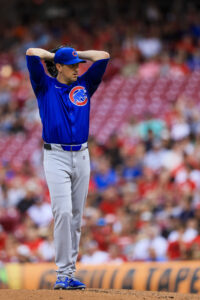
Hendricks, 35 in December, will be suiting up for a team other than the Cubs for the first time if the deal gets finalized. Though he was drafted by the Rangers in 2011, he was traded to the Cubs prior to his major league debut, as part of the July 2012 trade that sent Ryan Dempster to Texas.
He was able to get to the big leagues by 2014 and quickly established himself as a solid rotation piece. He didn’t have overpowering stuff but showed a knack for limiting damage, earning the nickname “The Professor”. He made 13 starts and logged 81 1/3 innings in his debut, allowing just 2.46 earned runs per nine innings despite a low strikeout rate of 14.6%.
From there, he found a few more punchouts but his success was generally built around weak contact. From 2014 to 2020, he tossed over a thousand innings for the Cubs with a 3.12 ERA, 20.8% strikeout rate, 5.3% walk rate and 47.5% ground ball rate. He was a pillar of the Cubs in that time, helping them become a perennial contender and break their World Series curse in 2016.
The last few years have been a bit more rocky, however. In 2021, his strikeout rate dipped to 16.7% and his ERA climbed to 4.77. In 2022, a capsular tear in his right shoulder limited him to 16 starts with a 4.80 ERA. He didn’t require surgery but was out of action until May of 2023.
He managed something of a rebound when he got back on the hill. Last year, he posted a 3.74 ERA over 24 starts after recovering from that shoulder injury. His 16.1% strikeout rate was still low but he only walked 4.7% of batters faced and prevented batters from producing big exit velocity.
The Cubs were encouraged enough to trigger a $16.5MM club option to bring him back for 2024, part of the extension the two sides agreed to ahead of the 2019 season. But that’s a move they likely regret, as Hendricks couldn’t keep his bounceback going in 2024. He struggled out of the gate and got bumped to the bullpen. Though he eventually retook a rotation role, he finished the year with a 5.92 ERA.
There might be a bit of bad luck in there, as Hendricks was only able to strand 64.2% of baserunners this year, well below the 72.1% league average. His 4.98 FIP and 4.83 SIERA on the season suggest he deserved better than his ERA would suggest, but still aren’t outstanding numbers.
Putting those recent ups and downs together, Hendricks has a 4.80 ERA since the start of 2021. His 43.3% ground ball rate in that time is around league average and his 6% walk rate quite strong, but his 16.5% strikeout rate well below par.
Perhaps the Angels see a way to get him back on track or simply want some affordable veteran innings on what may have been a hometown discount. Veteran innings eaters can often secure deals close to eight figures, even without strong overall results. 43-year-old Rich Hill got $8MM from the Pirates going into 2023 on the heels of a season in which he posted a 4.27 ERA. Jon Lester got $5MM from the Nationals for his age-37 after posting a 5.16 ERA. Corey Kluber got $10MM from the Red Sox after putting up a 4.34 ERA in his age-36 season.
Hendricks is younger than those guys but signing for less, very early in the offseason of his very first trip to free agency. Since he grew up in Orange County, perhaps he wanted to be close to home and quickly got a deal done with the Halos, though that’s totally speculative.
Signing Hendricks would fit with the club’s longstanding aversion to spending on the rotation. As shown on MLBTR’s Contract Tracker, the most they’ve spent on a starting pitcher in the past decade was three years and $39MM for Tyler Anderson. Apart from that and a two-year arbitration deal for Shohei Ohtani, they haven’t given any starting pitcher a multi-year deal in that time frame.
That tendency along with struggles to develop pitching internally have led to ongoing starting pitching deficiencies in Anaheim. The club has a 4.54 rotation ERA over the past decade, 24th in baseball for that stretch, mostly ahead of clubs that underwent yearslong rebuilds. 2024 was no exception as the Angels starters had a collective 4.97 ERA this year, which was better than only the Marlins and Rockies. One of their more talented starters is going to be on the shelf for a while, as Patrick Sandoval had UCL surgery in June.
Going into 2025, the rotation mix has plenty of uncertainty. Anderson, José Soriano, Jack Kochanowicz, Reid Detmers, Caden Dana, Sam Aldegheri and Chase Silseth are some of the options, though there are question marks with each. Anderson had a 3.81 ERA but outperformed his peripherals and had a 5.43 ERA the year before. Soriano seemingly had a breakout campaign this year but didn’t pitch much in the 2020-2023 period thanks to two Tommy John surgeries. Detmers has shown promise at times but had a 6.70 ERA in the majors this year and wasn’t much better in Triple-A. Silseth spent most of 2024 battling an elbow injury. Kochanowicz only has 11 MLB starts while Dana and Aldegheri each have just three.
For a club that hopes to compete in 2025, adding to that rotation is a sensible path. There are more exciting options than Hendricks out there but his track record of reliability is quite strong. His modest earning power lined up with the club’s track record when it comes to not spending much on the rotation, so the stars have aligned to have Hendricks be close to home this year. For the Cubs, they no longer have any connection to their curse-breaking team on the roster, as Hendricks was the final holdout from that club.
Bruce Levine of 670 The Score (X link) first relayed that the two sides were nearing a one-year deal. Jon Heyman of The New York Post (X link) pegged the value around $3MM. Joel Sherman of The New York Post (X link) first reported the $2.5MM number.
Cardinals Reach New Broadcast Deal With Diamond Sports Group
The Cardinals announced this afternoon that they’ve reached a new multi-year contract with FanDuel Sports Network to continue carrying in-market broadcasts. The deal includes a streaming partnership that’ll allow consumers in the St. Louis area to access games on the FanDuel app. Hannah Wyman and Derrick Goold of the St. Louis Post-Dispatch write that app subscribers can view the games without a television provider, which should drastically reduce blackouts.
FanDuel Sports Network, which is a property of Diamond Sports Group, is the same TV network that had broadcasting rights to Cardinals games under the previous Bally Sports moniker. Last month, Diamond abandoned its previous deals with the Cards and 11 other teams as it continues to navigate bankruptcy. Diamond expressed openness to renegotiating at least some of those deals at reduced fees.
The Cards were willing to do so despite the associated revenue losses. Wyman and Goold report that they’ll take a 23% reduction next season compared to what they would’ve made on the prior contract. With the previous deal calling for roughly $75MM in rights fees, the Cardinals stand to drop roughly $17.25MM to the $57-58MM range. The team did not specify the length of this contract beyond calling it a multi-year partnership. Evan Drellich and Katie Woo of the Athletic report that the deal does not stretch into the 2030s and affords some measure of flexibility depending on the future state of sports media.
For fans, the streaming addition is the biggest direct news. The deal is indirectly relevant to the fanbase by providing the organization with a bit of clarity on their revenue situation. The expected revenue losses have long pointed to a dip in spending. That was reinforced by the decision to decline a few team options, most notably a $12MM call on Kyle Gibson. They’re not expected to pursue reunions with free agents Paul Goldschmidt and Andrew Kittredge.
That could account for most of the payroll reduction. St. Louis has a little less than $110MM committed. Their arbitration class is projected for something in the $19MM range. That leaves the Cards nearly $50MM south of this past season’s Opening Day spending. The Cardinals are going to get trade interest on a number of veterans as they embrace a retooling effort and evaluate younger players. Speculation about a complete teardown was quieted this week with reports that Willson Contreras and Sonny Gray, both of whom have no-trade clauses, are unlikely to move after suggesting they preferred to stay in St. Louis.
The Cardinals become the second team to negotiate a new deal with Diamond after its previous broadcasting agreement was dropped. The Marlins reportedly reached a contract to stay on FanDuel Sports Network last month, though Miami hasn’t made any official announcement. Diamond is abiding by its original contract with the Braves, so it’ll carry at least three teams next year.
ESPN’s Alden González writes that MLB will carry broadcasts for the Twins, Guardians and Brewers — all of whom were dropped by Diamond. (They join the Padres, Diamondbacks and Rockies in that regard.) The Rangers said they have no plans to renegotiate with Diamond but are still exploring other opportunities. Plans for the other five teams — the Reds, Rays, Tigers, Angels and Royals — are still undetermined.
White Sox Targeting Position Players In Garrett Crochet Trade Talks
Left-hander Garrett Crochet figures to be one of the top trade candidates this offseason, recently getting the top spot on MLBTR’s list. White Sox general manager Chris Getz doesn’t seem to be too concerned with hiding Crochet’s availability, telling Bruce Levine of 670 The Score that Sox are looking to get position players back in return.
“We are focusing on position player return,” Getz said. “That is our primary focus in any trade talks. The right players have to be there. We can’t force anything. We certainly need to improve our offense. That is very clear.”
The Sox obviously need to improve everything, since they just wrapped up the worst season of the modern baseball era, but the offense could definitely be upgraded. The club hit a collective .221/.278/.340 in 2024. Their wRC+ of 75 indicates that the team as a whole was about 25% worse than the league average hitter. That was easily the worst mark in the league, with the Rockies a distant second-last with a wRC+ of 82. The Sox also subtracted from their lineup by trading Tommy Pham, Eloy Jiménez and Paul DeJong at last year’s deadline.
Upgrading that offense is an understandable priority, though they will have to assess any trade offers on their overall merits. The club presumably wouldn’t take a package of mediocre position players over really good pitchers just because that’s their target, but the preference could be notable.
It’s also understandable since pitching can be mercurial. Many hyped-up prospects get injured or simply don’t live up to their pedigree. Even the prospects that do pan out can have lengthy absences due to elbow or shoulder surgeries. As such, it’s not uncommon for rebuilding clubs to focus on building a position player core, later adding pitching through trade or free agency.
The Sox also don’t really have any core position players that would block any new guys that would come over in a potential trade. Andrew Benintendi, Andrew Vaughn and Luis Robert Jr. are set for free agency after three more years and the club is surely willing to listen to offers on any of them. The rest of the roster doesn’t have many other guys that could really be called established major leaguers.
Whatever the eventual trade package, it seems highly likely that Crochet will be available and highly coveted, which is why MLBTR gave him the top spot on our trade candidates list. Crochet was a high draft pick that quickly made his major league debut, but spent a few years either working out of the bullpen or being injured. Coming into 2024, he had just 85 1/3 professional innings on his track record over the 2020 through 2023 seasons. The Sox stretched him out in 2024 and he eventually tossed 146 innings with a 3.58 earned run average, 35.1% strikeout rate, 5.5% walk rate and 45.1% ground ball rate.
Those unique circumstances contribute to his availability. Despite the limited track record, he has racked up over four years of service time and is now just two years away from the open market. Given how bad the Sox were in 2024, it’s hard to envision them returning to contention in that time frame.
They could sign Crochet to an extension but he is on track to hit free agency after his age-27 season. That means he has a massive amount of future earning power and may not want to give that up, especially to stay with a franchise that is in disarray and reportedly for sale. Crochet did say he’s open to extension conversations but also seemed to acknowledge that it wasn’t likely to come together. Looking at MLBTR’s Contract Tracker, the White Sox have never given any player more than the $75MM deal they gave to Benintendi.
If Crochet isn’t a part of the long-term plans, then it makes sense to listen to trade offers. The Sox were already shopping him at the deadline a few months ago but couldn’t nail down a deal. Given that Crochet was pushing his workload beyond his previous levels, there were concerns about how he would hold up down the stretch and into a playoff run in October.
The lefty and his camp indicated that they would want to sign a contract extension before risking his health by being a part of such a postseason push, which seemed to scuttle the chances of a deal coming together. The Sox kept him and backed off his usage as they played out the string on their woeful season, not letting Crochet pitch more than four innings in any outing after the month of June.
Those concerns figure to be dissipated now. Crochet held up enough to get his innings total reasonably close to a full starter’s workload, meaning he and any team employing him could reasonably expect him to hold up for a full season, even if that means taking the ball in the month of November. The Sox now have the advantage of potentially marketing him to all teams, whereas presumably the clubs contending in 2024 had more interest at the deadline.
His appeal to other clubs will go beyond his performance. Due to missing so much time earlier in his career due to injury, he hasn’t yet been able to push his salary up too high. He qualified for arbitration for the first time a year ago but only made $800K, barely above this year’s $740K league minimum. MLBTR contributor Matt Swartz projects a $2.9MM salary for Crochet next year, with the lefty due for another bump via arbitration in 2026.
For a pitcher of Crochet’s caliber, there’s tremendous surplus value there. Veteran back-end guys like Martín Pérez, Wade Miley and Alex Wood signed deals in the $8-8.5MM range last winter while the top pitchers have gone beyond $40MM in terms of average annual value. To get an ace-like performance for a salary barely above the league minimum is a tremendous bargain.
It also could be hugely important for clubs that pay the competitive balance tax. There are varying tax levels depending on how many consecutive years a club has been a tax payor and how far above the base threshold they are, but ticking all the boxes can get a club to a 110% tax rate. That means that paying a pitcher a deal with a $20MM salary would add another $22MM in taxes, just as a hypothetical example. Saving that money and getting Crochet instead would naturally be very attractive.
All of that adds up to make Crochet one of the most interesting players for the coming months and it gives Getz an incredibly important decision in shaping the future of his franchise. He is likely going to be spending a good deal of his winter on the phone, assessing different offers from all over the league.
Red Sox, Orioles, Dodgers Interested In Teoscar Hernández
Free agent Teoscar Hernández just won a World Series and is now drawing interest in the early days of the offseason. The Red Sox and Orioles are interested in the outfielder, reports Jon Morosi of MLB Network on X. The Dodgers and Hernández also have mutual interest in a reunion, per Russell Dorsey of Yahoo Sports.
Hernández, 32, was a free agent a year ago and received interest from the Red Sox at that time. Chris Cotillo of MassLive (X link) reported that the Sox offered him $28MM over a two-year deal, numbers that were later confirmed by the player himself when speaking to Rob Bradford of WEEI and the Baseball Isn’t Boring Podcast.
He turned down that offer and instead took a slightly smaller guarantee on a one-year pact with the Dodgers. That deal paid him $23.5MM with some deferrals, but perhaps most importantly, allowed him to return to free agency after hopefully having a bounceback year.
That bet on himself looks like it will pay off well. From 2020 to 2022, he slashed .283/.333/.519 for the Blue Jays, production that led to a 132 wRC+. His defense wasn’t great but he did steal 24 bases in that stretch and the offense was undeniable. He was traded to the Mariners prior to 2023 and had a down year at the plate, hitting .258/.305/.435 for a 106 wRC+. With that weak platform year, his free agent market was fairly tepid, including the aforementioned offer from Boston.
But his year with Los Angeles could hardly have gone much better, as he hit .272/.339/.501 for a 134 wRC+, right back to his previous form. His defensive metrics still weren’t great but he swiped another 12 bags. He got into 16 playoff games and hit .250/.352/.417 for a 119 wRC+. On MLBTR’s Top 50 Free Agents post, we predicted that he could secure a three-year, $60MM deal this time around.
Whether he can get that deal or not, the Sox would almost certainly have to increase their offer from a year ago. If they are willing to do so, his right-handed swing would fit well on a roster with plenty of left-handed bats. Rafael Devers, Triston Casas, Masataka Yoshida, Jarren Duran and Wilyer Abreu all hit from the left side, as do prospects Kyle Teel, Marcelo Mayer and Roman Anthony.
Last year, the Sox complemented their lefty outfielders by having Tyler O’Neill, who had a good season in a specific way. He was injured a few times, struck out a bunch and did most of his damage against lefties, but still had a strong season overall. He hit 31 home runs in 113 games for a .241/.336/.511 slash line and 131 wRC+, all that despite a 33.6% strikeout rate and a meager 91 wRC+ against righties.
Hernández should be ranked a bit above O’Neill as he has a slight edge in most of those areas. His 28.8% strikeout rate in 2024 was high but not as bad as O’Neill’s. He does have platoon splits, though not to the same extent as O’Neill. Hernández has a 140/113 wRC+ split in his career and was at 154/126 in 2024. He’s also far more durable, having played at least 125 games in each of the past six full seasons, whereas O’Neill has only hit that number once in his career.
Either could work as the needed righty for Boston. Hernández would arguably be better but would also likely cost more. O’Neill was predicted by MLBTR for a three-year deal just like Hernández but with a lesser guarantee of $42MM. However, Hernández received a qualifying offer from the Dodgers and is therefore tied to draft pick forfeiture, whereas O’Neill is not. Per Pete Abraham of the Boston Globe on X, the Sox remain engaged with O’Neill’s camp and could potentially bring him back.
Either should fit in the club’s budget. RosterResource projects the club for a payroll of $136MM right now, more than $50MM below where they were in 2024. They’re about $70MM below the competitive balance tax line. They have needs on the pitching staff but could certainly spend on an outfielder if they want.
For the Orioles, they are a logical fit for similar reasons. Their lineup features lefties Gunnar Henderson, Ryan O’Hearn, Cedric Mullins, Colton Cowser, Heston Kjerstad and Jackson Holliday. Prospects Samuel Basallo and Dylan Beavers are also lefty swingers. Their outfield just lost switch-hitting outfielder Anthony Santander to free agency, so Hernández could slot in as Santander’s replacement if the O’s don’t re-sign him.
Orioles general manager Mike Elias recently identified a right-handed hitting outfielder as an offseason target, per Jake Rill of MLB.com. The big question is how much spending capacity the club will have this winter. In the past six years, they haven’t given a free agent a multi-year deal, with Craig Kimbrel‘s $13MM guarantee on a one-year pact their largest expenditure.
For much of that time, they were rebuilding and then the club was up for sale. David Rubenstein took over ownership officially just as the 2024 season was getting started. It has been expected that the club will get a bit more aggressive and their trade deadline behavior gave some encouraging signs in that regard. They took on notable money to acquire Zach Eflin and Seranthony Domínguez, but it’s still unknown exactly how far they plan to go this winter.
“Whether it’s free-agent spending or it’s support for my staff or the baseball organization, I think we have everything that we need financially to make the optimal decisions for the long-term health of the franchise. And a lot of that’s going to be in my judgment,” Elias said this week. “But certainly, if we have something that we want to do and we need financial support for it, I’m exceedingly confident that that’s going to be there.”
Returning to the Dodgers is also easy to see, especially with the club planning to move Mookie Betts back to the infield next year. That means the projected outfield currently consists of Andy Pages, James Outman and utility guys like Tommy Edman and Chris Taylor. While the Dodgers could easily fit Hernández in there, they will probably first see how things play out with their reported interest in Juan Soto.
Phillies Exploring Outfield, Right-Handed Relief Markets
The Phillies head into the offseason with a star-studded roster and substantial payroll obligation, though owner John Middleton has already expressed confidence that the 2025 payroll will increase. President of baseball operations Dave Dombrowski has at multiple points hinted at potential trades rather than free agent pursuits, speaking of a need to be “open-minded” as he looks to augment a roster that’s been a perennial playoff club but fallen shy of a World Series win (or even a World Series appearance). The Athletic’s Matt Gelb reports that the Phils have signaled a desire to add an outfielder and at least one right-handed reliever.
As laid out in our Phillies Offseason Outlook, adding in the outfield is one of the most logical pursuits for a Phillies club that has established contributors at catcher (J.T. Realmuto), first base (Bryce Harper), second base (Bryson Stott), shortstop (Trea Turner), third base (Alec Bohm), right field (Nick Castellanos) and designated hitter (Kyle Schwarber). Brandon Marsh and Johan Rojas offer options in the remaining two outfield spots, but the Phils aren’t likely to simply roll the same lineup back out in 2024 after another shorter-than-hoped season. Marsh and Rojas could form a platoon, as Marsh bats left-handed to the more defensively gifted Rojas’ right-handed bat. That’d open a path for one incoming outfielder, but Dombrowski’s repeated chorus of “open-minded” approaches to reshaping his offense have prompted natural speculation about trades.
From that standpoint, it’s hard to imagine deals involving Realmuto, Harper, Turner and Schwarber. All have been viewed as core pieces in Philadelphia. The Phillies would probably love to move on from the final two years and $40MM on Castellanos’ contract, but Castellanos is a poor defender who hasn’t hit nearly as well in Philadelphia as he did in his free-agent platform season with the Reds. The Phils would need to pay down a good portion of that contract and/or include a prospect to find a taker.
Bohm, Marsh, Stott and to a lesser extent Rojas are the big league position players who could more plausibly be flipped elsewhere as the Phillies try to reshape their identity. Gelb also lists lefty starter Ranger Suarez as a possibility. Their contractual statuses are as follows:
- Suarez: Controlled through 2025 via arbitration, projected to earn $8.9MM in 2025 (via MLBTR contributor Matt Swartz)
- Bohm: Controlled through 2026 via arbitration, projected to earn $8.1MM in 2025 (via Swartz)
- Marsh: Controlled through 2027 via arbitration, projected to earn $3MM in 2025 (via Swartz)
- Stott: Controlled through 2027 via arbitration, projected to earn $3.5MM in 2025 (via Swartz)
- Rojas: Controlled through 2029, pre-arbitration in 2025
Obviously, the valuation on each player will vary. Suarez would be a one-year rental for a club and would require the Phils — already in need of a starter and likely hoping to dump the remaining two years and $36MM on Taijuan Walker‘s contract this offseason — to replace him. He posted a 3.46 ERA with strong strikeout (23.2%) and walk (6.5%) rates in 150 2/3 innings this season but also missed a month with a back injury and struggled from July through September. Plenty of teams would still love to plug him into their rotation.
Bohm is the most consistently productive but has the highest salary and lowest amount of club control remaining of the position players. He also cooled off considerably after a blistering start to the season. He was one of the game’s most productive hitters through early March (.360/.430/.576 in 142 plate appearances) before reverting to his usual brand of roughly average offense for the remainder of the season (.256/.302/.410 over his next 464 plate appearances). Bohm improved his glovework this year and hit righties better than usual but was still notably more productive against left-handed pitching.
Marsh can handle all three outfield spots but is best suited for left field. He’s never hit lefties well but is well above-average versus righties. He runs well and could probably pop 20 homers with a full season of at-bats, though that’d mean lesser rate stats and more plate appearances versus lefties. He’s hit 28 homers in 948 plate appearances across the past two seasons. Marsh is a useful part-time player, but his 31% strikeout rate since 2023 (and 32.8% career mark) is rather concerning, especially since he’s been platooned so often.
Stott is a plus defender and strong baserunner with 15-homer pop. He makes plenty of contact but has really only had one average season at the plate (2023), in addition to a pair of below-average campaigns during which he’s still been a solid overall contributor because of his glove and speed. If a team with budget problems and no concrete option at shortstop would view him as an outside-the-box candidate at short, his market could expand. Stott hasn’t graded as well there in 770 big league innings but has more than 2000 professional innings at short.
Rojas is an even more extreme case of the speed-and-defense skill set. He’s a plus center fielder with excellent speed but turned in just a .243/.279/.322 slash in 2024 (68 wRC+) and is a career .261/.298/.355 hitter (81 wRC+) in 527 big league plate appearances.
Dombrowski has publicly suggested that he needs to be open to trading “good players” in order to get talent in return. Speculatively speaking, Bohm feels like the most plausible fit, as he’s set to earn the most money, has the least club control remaining and plays a position (third base) where the free-agent market is quite thin this offseason. There could be paths to flipping Bohm for a bullpen arm, a back-of-the-rotation starter or an outfielder, and shedding his payroll could also free the Phillies to pursue other options at the hot corner or give them more money to address needs elsewhere on the roster.
Former Phillies GM Ruben Amaro Jr. and longtime Phils beat writers Todd Zolecki and Jim Salisbury took a deep dive into the possibilities on the latest episode of their podcast. All three acknowledged that Dombrowski’s repeated phrases this offseason have not-so-quietly signaled a trade is likely. In addition to repeating the “open-minded” line on several occasions, Dombrowski has at least twice suggested the Phillies have enough star players on the roster. At his end-of-season press conference, Dombrowski said his club has “as many star players as about anybody in baseball” before adding that sometimes “the supporting cast” is where the biggest need sits.
Gelb notes in the previously referenced piece that Dombrowski doubled down on that thinking at this week’s GM Meetings. Asked if the Phils would be “big-game hunting” this winter, the Phils’ president replied: “Our ownership allows us to do a lot of things. But sometimes that’s not what you want. We have a lot of good star players on our team. So, read that as you would.”
MLBTR Podcast: Breaking Down The Top 50 Free Agents List
The latest episode of the MLB Trade Rumors Podcast is now live on Spotify, Apple Podcasts, and wherever you get your podcasts! Make sure you subscribe as well! You can also use the player at this link to listen, if you don’t use Spotify or Apple for podcasts.
This week, host Darragh McDonald is joined by Tim Dierkes, Steve Adams and Anthony Franco of MLB Trade Rumors to discuss our annual Top 50 Free Agents post. The conversation veered into these specific topics…
- the prediction for Juan Soto and his market (2:35)
- Blake Snell (22:35)
- Pete Alonso (32:10)
- The difficulty with team predictions (46:05)
- Jack Flaherty (54:35)
- Corbin Burnes (1:02:30)
- Alex Bregman (1:12:20)
- Willy Adames (1:19:30)
- The high number of players we predicted would go to the Athletics (1:23:45)
- Yusei Kikuchi (1:30:00)
- Jurickson Profar (1:32:15)
- Joc Pederson (1:37:50)
- Nick Pivetta, Nick Martinez and Luis Severino (1:40:00)
- Is this offseason going to be better for players than the last one? (1:47:40)
Check out our past episodes!
- The Mets’ Spending Power, Juan Soto Suitors, And The Rangers’ Payroll Limits – listen here
- The World Series, The White Sox Reportedly For Sale, And Tropicana Field – listen here
- Changes In Minnesota, Cubs’ Prospect Depth, And Possibilities For The O’s – listen here
The podcast intro and outro song “So Long” is provided courtesy of the band Showoff. Check out their Facebook page here!
Jeff Hoffman Garnering Interest As Starter
Jeff Hoffman‘s breakout as an elite reliever in the Phillies’ bullpen over the past two seasons played a huge role in the team’s success, but now that he’s a free agent it’s possible he’ll sign in a completely different role. ESPN’s Kiley McDaniel reported within his ranking of the offseason’s top free agents that some clubs have considered pursuing Hoffman as a starting pitcher. The Athletic’s Matt Gelb backs that up in his own report, further pointing out that Hoffman is represented the same agency (CAA) that represented Reynaldo Lopez during his own switch from the bullpen to the rotation last winter.
Hoffman, 32 in January, has quietly been a dominant force in the Philadelphia bullpen since signing a minor league deal early in the 2023 season. Recency bias might conjure up the unflattering memory of the right-hander’s NLDS meltdown against the Mets, but from 2023-24, Hoffman compiled 118 2/3 innings of 2.28 ERA ball while punching out a gaudy 33.4% of his opponents against a 7.4% walk rate. This postseason’s pair of regrettable outings against the Mets isn’t an ideal final memory, but Hoffman also snapped off six shutout innings of relief with eight strikeouts and no walks during the 2023 NLCS.
Excellent as Hoffman has been in relief, there’s reason to believe he could succeed in a lengthier role. First and foremost, the former No. 8 overall draft pick was a starter in his college days at East Carolina University and began his pro career in a rotation role. He started 11 big league games as recently as 2021 with Cincinnati and didn’t move to a full-time relief role until his 2022 season with the Reds. Hoffman has appeared in 361 professional games (majors and minors combined); 145 of them (40%) have been starts.
Beyond his familiarity with the role, Hoffman still uses a four-pitch repertoire even when working out of the bullpen. Many relievers who were once starters narrow their arsenal down to two pitches when they move to a short relief role. Hoffman still threw four pitches at least 8% of the time in 2024: a four-seamer (39%), slider (40.8%), splitter (12%) and sinker (8.2%). He averaged a fiery 96.6 mph on that four-seamer and 96.7 mph on his sinker. Those numbers would surely go down were Hoffman to begin working five, six and seven innings at a time, but even with reduced life on his fastballs he could still have average or better velocity. The league-average starting pitcher in 2024 sat 94.2 mph with his four-seamer, per Statcast.
Among those four pitches, Statcast has ranked them all as plus offerings over the past two seasons. Hoffman’s slider has easily been the best of the bunch, producing a huge 20.6% swinging-strike rate and limiting opponents to a .160/.201/.215 batting line when finishing off a plate appearance with that offering (dating back to Opening Day 2023). Again, whether he could sustain that level of dominance when facing opponents a second and third time through the order isn’t certain, but Hoffman’s wipeout slider has played an enormous role in his breakout since signing with the Phillies.
There are health and performance risks when taking a reliever and stretching him out. Hoffman hasn’t reached even 100 innings (majors and minors combined) in a season since 2019. Even among the reliever-to-starter experiments that panned out nicely in 2024, no one from the bunch worked what could be considered a full workload.
Garrett Crochet came the closest, compiling 146 innings across 32 starts, but the White Sox didn’t allow him to pitch more than four innings in a start after the calendar flipped to July. The aforementioned Lopez reached 135 2/3 innings but had a pair of IL stints owing to forearm and shoulder inflammation. Angels righty Jose Soriano went from 65 1/3 innings in 2023 to 113 in 2024 but was shut down for the season on Aug. 17 due to arm fatigue. Giants righty Jordan Hicks thrived in the rotation through late May before stumbling to an ERA over 6.00 in the early summer and being dropped back to the ‘pen in mid-July. He finished at 109 2/3 innings with a 4.10 ERA. Seth Lugo is perhaps the best recent example of success in this transition. He jumped from 65 innings with the 2022 Mets to 146 innings with the 2023 Padres and 206 innings with this past season’s Royals.
Notably, McDaniel opines that Hoffman is still likelier to sign as a reliever. It’s the role in which he’s dominated over the past two seasons, and while he’s not the No. 1 reliever in this offseason’s free agent class — most publications, including MLBTR, assigned that honor to lefty Tanner Scott — Hoffman has a case to be considered the No. 2 or No. 3 bullpen arm on the open market this winter.
Gelb suggests Hoffman may prefer the relief role, though logically speaking, one would imagine he’d simply take the best offer possible. This is Hoffman’s first real crack at a notable MLB contract. He took home a signing bonus of just over $3MM in the draft but was non-tendered throughout his arbitration years and earned a relatively modest $2.2MM this past season in his final arb season. Even with that draft bonus, Hoffman’s career earnings fall shy of $8MM. He’ll presumably prioritize top dollar, regardless of location or role.
Alex Bregman Willing To Move To Second Base
Earlier this month, Alex Bregman was awarded a Gold Glove for his defense at third base. He has been an All-Star, a Silver Slugger, and a World Series champion, but this was the first Gold Glove of his nine-year career. The honor was well deserved. According to Baseball Savant, Bregman set new career highs in Outs Above Average (OAA) and Fielding Run Value (FRV). The metrics at FanGraphs and Baseball Prospectus agree he was the most valuable defensive third baseman in the American League. Yet, Bregman’s agent Scott Boras revealed at the GM meetings this week that multiple teams have asked about his client’s willingness to move to second base – and Boras confirmed that Bregman would indeed be willing to make the change (per Bob Nightengale of USA Today).
It’s not necessarily surprising that Bregman would be amenable to switching positions. Extra versatility will only make him more appealing as a free agent. The more suitors he can attract, the more money he can command. Similar reports came out this week about fellow top free agent Willy Adames, a talented shortstop who would be willing to move to second or third base on the right deal. Moreover, it’s not as if Bregman would be completely new to the keystone. He played a handful of games at second base in each of his first three MLB seasons. He also has plenty of experience at shortstop from college and his early professional years.
What is slightly more surprising is the fact that teams would be interested in Bregman playing second base in the first place. He’s a good enough hitter that his bat could play anywhere around the diamond, but he is an experienced third baseman coming off the best defensive season of his career. It’s hard to imagine his glove would be quite as valuable at a new position – nor would his bat necessarily play any better at second base. Historically, second base has been a weaker offensive position than third, but the gap has nearly disappeared over the last two years. From 2023-24, second basemen have produced a .308 wOBA. Third baseman have put up a .309 wOBA in that time. Finally, there is more competition on the free agent market at second base than third. Adames and Ha-Seong Kim can play both positions, but each has more big league experience at second. In addition, two of MLBTR’s top 50 free agents are primary second basemen: Gleyber Torres and Hyeseong Kim. Bregman is the only primary third baseman on our top 50 list.
On the other hand, Bregman has never had a good arm for a third baseman. What’s more, it’s quite possible he would have been a second baseman all along if it weren’t for Jose Altuve blocking the position in Houston. Considering Bregman’s arm looked weaker than usual in 2024 (and that he just had surgery on his throwing elbow), perhaps some of his suitors think he’ll be a better defender at second base in the long run. Alternatively, they might just be hedging their bets in case his elbow problems linger into next season.
Regardless, Bregman continues to be most strongly linked to Houston this offseason. GM Dana Brown told reporters (including Jon Heyman of the New York Post) at the GM Meetings that he thinks the Astros have “a really good chance” of re-signing their homegrown star. In that case, there is no doubt he would resume his duties at the hot corner in 2025. Altuve is coming off another All-Star season at second, and the face of the Astros franchise is under contract for another five years and $125 million.