
Extension Candidate: J.T. Realmuto
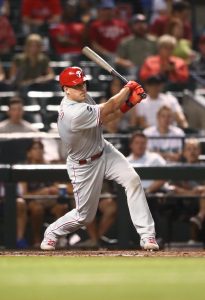
It has been almost exactly one full year since J.T. Realmuto became a member of the Phillies, and needless to say, the Phils didn’t swing that trade with the intention of only keeping Realmuto for two seasons. There has been talk of a potential contract extension between the two sides for several months, with mutual interest between both Realmuto and the club in a long-term commitment.
First things first, however, the All-Star catcher and the team are headed towards an arbitration hearing after a rather large difference in their submitted salary figures. The Phillies offered Realmuto $10MM, while the backstop and his camp are looking for $12.4MM, in part out of a desire to move the line forward for future catchers going through the arb process.
It’s possible that this hearing could be avoided altogether if a Realmuto extension includes the 2020 season, though the Phillies could prefer to deal with Realmuto’s 2020 salary as a separate matter for luxury tax purposes. Since every player’s tax number is determined by the average annual value of their contact, an extension that covers the 2020 season would put Realmuto’s value for the coming year at a much higher total than $10MM or $12.4MM, and thus would put the Phillies much closer to the $208MM Competitive Balance Tax threshold. As per Roster Resource, the Phillies are already close to the line with a projected tax number of roughly $204.6MM.
As NBC Sports Philadelphia’s Jim Salisbury noted back in November, a Realmuto extension that didn’t begin until the 2021 season would give the Phillies some extra breathing room under the tax limit. Jake Arrieta, Didi Gregorius, and (if a club option isn’t exercised) David Robertson are all scheduled for free agency, which removes $45MM in salary obligations off the books.
If Realmuto’s extension doesn’t begin until 2021, however, that also changes the earning framework. Realmuto turns 29 in March, so an extension would therefore begin with his age-30 season, knocking one year of his prime out of the contractual conversation.
That said, being out of his 20’s won’t stop Realmuto from landing one of the richest contracts ever awarded to a catcher. The Oklahoma native has delivered four straight years of outstanding play, hitting .283/.335/.464 with 74 home runs over 2248 plate appearances for the Marlins and Phillies since the start of the 2016 season. Defensively, Realmuto has been an above-average catcher over that stretch, and his glovework took a big step forward in 2019, as Baseball Prospectus ranked him at or near the top of the list in framing, blocking, and throwing out baserunners. (Realmuto won his first career Gold Glove for his efforts.)
Health-wise, there isn’t too much concern for Realmuto after six MLB seasons. While he underwent right meniscus surgery in September, the procedure was considered to be more of a general cleanup, and nothing that would keep Realmuto from missing any time this season or even in Spring Training. His only injured list appearance was a three-week stint in April 2018 due to a back contusion, and both the Marlins and Phillies have sporadically played Realmuto at first base to help keep him fresh while still keeping his bat in the lineup.
Yasmani Grandal‘s four-year, $73MM free agent deal with the White Sox from November provides a fresh comparable for a Realmuto extension, and gives Realmuto’s agents at CAA Sports a clear floor for negotiations. Grandal received his deal entering his age-31 season, so an easy case could be made for Realmuto to receive at least a five-year, $91.25MM pact.
As we saw with Realmuto’s arbitration case, he has an eye towards helping catchers of the future, so it wouldn’t be surprising to see him seek an extension that hits a couple of notable benchmarks — a deal that would make him the third catcher to both earn a contract worth $100MM or more (after Joe Mauer and Buster Posey) and also earn $20MM in average annual value (after Mauer and Yadier Molina). Something as simple as a five-year, $100MM extension would check both of those boxes, though I could see Realmuto seeking a bit more in order to top Molina’s $20MM AAV.
Matching or surpassing the $23MM average annual value of Mauer’s contract probably isn’t feasible, as that record-setting eight-year/$184MM deal began with Mauer’s age-28 season. Offering a higher AAV over a shorter timeframe has some advantages for Philadelphia, as the team wouldn’t be paying Realmuto too deep into his mid-30’s, though the Phillies might prefer to spread Realmuto’s value out to lessen his luxury tax hit.
Could a six-year deal be palatable for the Phillies? Realmuto has been a durable performer, as mentioned earlier, and he could be transitioned into a first base role as he approaches his mid-30’s. Depending on what the Phillies decide to do with Rhys Hoskins in terms of a future extension, Realmuto could even be a candidate to take over first base after the 2023 season, which is Hoskins’ final year of team control. Philadelphia has a few interesting but non-elite catching prospects (Rafael Marchan, Deivy Grullon, Rodolfo Duran) who could be groomed as Realmuto’s eventual backup or successor, or perhaps even turned into trade chips if Realmuto ends up having the catcher position on lockdown for first half of the decade.
Six years could end up being a bridge too far for the Phillies, though Realmuto could have some leverage in pointing out the weakness of the projected 2020-21 free agent catching market. While some decent backstops will be available, none are anywhere near Realmuto’s level, and his departure would leave Philadelphia back at square one behind the plate. For a Phillies team that plans to become a consistent contender and has already shown its willingness to spend, letting arguably the sport’s best catcher walk away in free agency would seem like a curious move, especially given the significant package of young talent (Sixto Sanchez, Jorge Alfaro, Will Stewart) the Phils gave up to get Realmuto from Miami in the first place.
Photo courtesy of USA Today Sports Images
Quick Hits: Hoyer, Cubs, Moreland, Jays, Phillies
“The activity of our offseason isn’t indicative of how much we’ve been on the phone and have been working,” Cubs general manager Jed Hoyer told ESPN Chicago’s Jesse Rogers as part of a Q&A session. It has been a quiet winter in Wrigleyville, as the Cubs have been limited to minor league signings and a couple of low-cost MLB contracts as the club is seemingly operating with a very limited amount of available payroll. The Cubs have yet to make any major acquisitions or trade away any big in-house contracts to free up more luxury tax space, though while Hoyer admitted “this is obviously likely to be one of our less active offseasons,” more transactions could be on the horizon. “We’ve been incredibly active making calls and exploring options,” the GM said, adding that he expects “the trade market will continue to be an active place well into February.”
Here are some more notes to kick off both Groundhog Day and Super Bowl Sunday….
- Before re-signing with the Red Sox, Mitch Moreland received offers from at least two other clubs, the Boston Globe’s Peter Abraham writes. “The biggest thing for me was I’ve enjoyed my time in Boston. It feels like home for us and there’s a good group of guys. I’m comfortable there,” said Moreland, who has played the last three seasons with the Sox. “It’s a good family atmosphere, too, and that means a lot to me.” Moreland was eager enough to return to Fenway Park that he re-signed despite the fact that the Sox don’t yet have a manager in place in the wake of Alex Cora‘s firing.
- Blue Jays bullpen coach Matt Buschmann has been named as director of pitching development, the team announced. Buschmann will work in both roles for the 2020 season. A veteran of 11 pro seasons (including a brief stint of 4 1/3 innings with the Diamondbacks in 2016), Buschmann retired after the 2017 campaign to take on an assistant director post with the Giants before joining the Jays for the 2019 season.
- The Phillies‘ lack of starting pitching upgrades have left David Murphy of the Philadelphia Inquirer pessimistic about the club’s chances of competing in 2020. Though the Phils landed one of the winter’s biggest free agent arms in Zack Wheeler, Murphy feels much more rotation help was necessary given how Jake Arrieta, Vince Velasquez, and Zach Eflin posted middling numbers last year, and even Aaron Nola‘s solid year was a step back from an outstanding 2018 season. The shortage of pitching especially stands out in the NL East, where the Nationals, Braves, and Mets are all deep in rotation options.
MLBTR Poll: NL East Favorite
The World Series champions came from the National League East in 2019, when the appropriately named Nationals took home their first-ever title. It has been an active few months in the division since then. Even the notoriously low-budget Marlins have gotten in on the act, having added multiple veterans in an attempt to climb out of the gutter in 2020. Odds are that the Marlins still won’t be in the race, though, so who’s the front-runner among the other four to win the division this year? It appears they’re all legitimate candidates.
Although the Nationals just won it all, they did so by getting into the playoffs by way of a wild-card berth, not an NL East title. That honor went to the Braves for the second year in a row. The Braves still have not been victorious in a playoff series since 2001, and they lost their No. 1 free agent, third baseman Josh Donaldson. However, even in the wake of Donaldson’s departure, they still bring a formidable roster to the table. Outfielder Ronald Acuna Jr., first baseman Freddie Freeman, second baseman Ozzie Albies and right-hander Mike Soroka haven’t gone anywhere. They’re now complemented by free-agent additions in outfielder Marcell Ozuna, lefty Cole Hamels and reliever Will Smith, among others.
Like the Braves, the Nats lost their marquee free agent, another third baseman in Anthony Rendon. There’s no easy way to replace him, though the team does have Asdrubal Cabrera on hand as a stopgap until standout prospect Carter Kieboom is ready to assume the reins. Rendon’s exit hasn’t deterred Washington from trying to go for a second straight title in 2020, as the club has re-signed righty Stephen Strasburg, to name one of several players, and picked up first baseman Eric Thames, second baseman Starlin Castro and reliever Will Harris from outside.
The Mets and Phillies were the next best teams in the division last season, and both clubs have new managers (Luis Rojas for New York, Joe Girardi for Philadelphia). They also have different-looking rosters compared to then. The Mets lost righty Zack Wheeler to the Phillies, whose $118MM guarantee ranks among the richest of the offseason. They still boast a quality rotation, though, with Noah Syndergaard, Marcus Stroman, Steven Matz and the newly signed Rick Porcello and Michael Wacha in the mix to complement back-to-back Cy Young winner Jacob deGrom. They also continue to feature a solid lineup headlined by the powerful Pete Alonso, last season’s NL Rookie of the Year, as well as Michael Conforto and Jeff McNeil.
The Phillies did far more heavy lifting last offseason than this winter, but they’ve still been aggressive with the signings of Wheeler, who should give them a true No. 2 starter behind Aaron Nola, and shortstop Didi Gregorius. On paper, they look like a better team than the one that finished an even 81-81 a season ago.
Philly was a fourth-place squad in 2019, but it may be in line to push for a division title this year. However, it’ll have to overcome three strong clubs in the Braves (97-65), Nats (93-69) and Mets (86-76). The offseason isn’t over yet, but as of now, which team do you think is the favorite?
(Poll link for app users)
Who's the NL East favorite?
-
Braves 59% (15,399)
-
Nationals 17% (4,292)
-
Mets 16% (4,062)
-
Phillies 9% (2,244)
Total votes: 25,997
Phillies Claim Reggie McClain
The Phillies announced Friday that they’ve claimed right-hander Reggie McClain off waivers from the Mariners and designated fellow righty Trevor Kelley for assignment in order to open space on the 40-man roster.
McClain, 27, was designated for assignment by Seattle last week when the club claimed lefty Nick Margevicius from the Padres. McClain made his big league debut in 2019 but struggled to a 6.00 ERA in 21 innings with the Mariners. McClain had a big season in the minors last year, however, skyrocketing across three levels and notching a combined 2.23 ERA with 8.9 K/9, 2.7 BB/9 and 0.5 HR/9 in 72 2/3 innings.
McClain averages just under 94 mph on a heavy sinker that led to a huge 64.8 percent ground-ball rate in his 21 MLB innings, and his grounder rate in the minors checked in at nearly 60 percent as well. McClain still has all three minor league option years remaining, so if he sticks with the Phillies, they’ll be able to shuttle him back and forth between Philadelphia and Triple-A Lehigh Valley as often as they see fit.
The 26-year-old Kelley was also a waiver claim by the Phillies, coming over from the Red Sox organization in early December. Like McClain, he struggled in his MLB debut this past season (eight runs in 8 1/3 innings) but posted impressive minor league numbers in 2019 (1.79 ERA, 8.7 K/9, 2.9 BB/9 in 65 2/3 innings).
Giants To Sign Nick Vincent
The Giants have agreed to terms with veteran reliever Nick Vincent, per Chris Cotillo of MassLive.com (via Twitter). It’s a minors deal with a spring invite.
Vincent opened the 2019 season in San Francisco but struggled before being cut loose. He ended up turning in 14 good innings down the stretch with the Phillies, though, running up a 17:4 K/BB ratio and allowing just three earned runs.
Now an eight-year MLB veteran, the 33-year-old has compiled quite an impressive track record. Through 376 2/3 career innings, the soft-tossing Vincent carries a 3.32 ERA. While teams haven’t been willing to stake much on a continuation of that performance level, he’s certainly a nice player to have on hand for this level of commitment.
Free Agent Spending By Team: National League
With the clear exception of the still-unsigned Yasiel Puig, free agency is almost devoid of high-upside contributors at this point. The majority of players capable of securing guaranteed contracts have already come off the board, making this a good time to check in on which teams have spent the most and which clubs have paid the least via the open market. We’ve already gone through the same exercise for the American League, where the Yankees have returned to the top of the heap as the biggest spenders in their league and in the sport in general. Meanwhile, over in the Senior Circuit, reigning world champion Washington clearly isn’t resting on its laurels after a storybook playoff run…
Nationals: $316.75MM on 10 players (Stephen Strasburg, Will Harris, Daniel Hudson, Starlin Castro, Yan Gomes, Howie Kendrick, Eric Thames, Asdrubal Cabrera, Ryan Zimmerman and Kyle Finnegan; financial details unclear for Finnegan; top 50 MLBTR signings: four)
Reds: $164MM on four players (Nick Castellanos, Mike Moustakas, Shogo Akiyama and Wade Miley; top 50 signings: four)
Phillies: $132MM on two players (Zack Wheeler and Didi Gregorius; top 50 signings: two)
Braves: $116.25MM on nine players (Will Smith, Marcell Ozuna, Cole Hamels, Travis d’Arnaud, Chris Martin, Nick Markakis, Tyler Flowers, Darren O’Day, Adeiny Hechavarria; top 50 signings: five)
Diamondbacks: $109.65MM on five players (Madison Bumgarner, Kole Calhoun, Hector Rondon, Stephen Vogt and Junior Guerra; top 50 signings: two)
Brewers: $48.38MM on eight players (Avisail Garcia, Josh Lindblom, Justin Smoak, Brett Anderson, Eric Sogard, Alex Claudio, Ryon Healy and Deolis Guerra; financial details unclear for Healy and Guerra; top 50 signings: two)
Padres: $48MM on three players (Drew Pomeranz, Craig Stammen and Pierce Johnson; top 50 signings: three)
Mets: $24.35MM on four players (Dellin Betances, Rick Porcello, Michael Wacha and Brad Brach; top 50 signings: three)
Marlins: $23.855MM on five players (Corey Dickerson, Brandon Kintzler, Francisco Cervelli, Matt Joyce and Yimi Garcia; financial details unclear for Joyce; top 50 signings: one)
Giants: $17.775MM on four players (Kevin Gausman, Drew Smyly, Tony Watson and Tyler Anderson; top 50 signings: one)
Dodgers: $15.25MM on three players (Blake Treinen, Alex Wood and Jimmy Nelson; top 50 signings: one)
Cardinals: $15MM on three players (Adam Wainwright, Kwang-hyun Kim and Matt Wieters; top 50 signings: one)
Cubs: $2.5MM on three players (Steven Souza Jr., Jeremy Jeffress and Ryan Tepera; top 50 signings: zero)
Pirates: Signed OF Guillermo Heredia and C Luke Maile (financial details unclear; top 50 signings: zero)
Rockies: Signed RHP Jose Mujica (financial details unclear; top 50 signings: zero)
Teams That Gained Or Lost Draft Picks Via Qualifying Offer Free Agents
Now that Marcell Ozuna has signed, all 10 of the players who were issued a one-year, $17.8MM qualifying offer in November have settled on teams for the 2020 season. Of that group, two (Jose Abreu of the White Sox and Jake Odorizzi of the Twins) accepted their qualifying offers and returned to their clubs — Abreu, in fact, topped off his QO by signing a contract extension that will run through the 2022 season. Stephen Strasburg also isn’t changing uniforms, as the longtime Nationals ace rejected the club’s qualifying offer but eventually re-signed with Washington on a seven-year, $245MM deal.
That leaves us with seven QO players who will be playing on new teams in 2020, and as such, the draft compensation attached to those seven players has also now been allotted. Under the rules of the Collective Bargaining Agreement, the same compensation was handed out to all six teams who lost those players, as the entire sextet fell under the same financial criteria. The Mets, Cardinals, Braves, Giants, Nationals, and Astros all aren’t revenue-sharing recipients, nor did they exceed the luxury tax threshold in 2019, so all six teams will receive a compensatory draft pick between Competitive Balance Round B and the third round of the 2020 draft.
Here is how the so-called “Compensation Round” breaks down. The order of the picks is determined by worst record-to-best record from the 2019 season.
68. Giants (for Madison Bumgarner)
69. Giants (for Will Smith)
70. Mets (for Zack Wheeler)
71. Cardinals (for Marcell Ozuna)
72. Nationals (for Anthony Rendon)
73. Braves (for Josh Donaldson)
74. Astros (for Gerrit Cole)
San Francisco now possesses five of the first 87 picks in next June’s draft. With the Giants still in the NL wild card race last summer, president of baseball operations Farhan Zaidi opted to hang onto Bumgarner and Smith rather than trade either player, a decision that led to some criticism since San Francisco was widely considered to be closer to rebuilding than truly contending. The critics’ judgement grew even harsher after the Giants went 22-32 record in August and September and fell well short of the postseason. Still, given that teams were reluctant to part with top-flight young talent for even controllable players (let alone rentals like Bumgarner and Smith) at the trade deadline, Zaidi clearly felt that the two picks he could recoup from the qualifying offer process were more valuable than anything offered for the two Giants pitchers last July.
It’s worth noting that the 74th overall pick will be Houston’s first selection of the 2020 draft, after the Astros lost both their first- and second-highest selections in both 2020 and 2021 as part of their punishment for the sign-stealing scandal. Since the Red Sox are also under league investigation for their own alleged use of electronics to steal opponents’ signs in 2018, Boston could also potentially lose at least one pick in this year’s draft, so we can’t yet say that the 2020 draft order is finalized. Of course, the order could be further muddled if more trades occur involving picks from the two Competitive Balance Draft rounds, which are the only types of draft picks that can be traded. We’ve already seen the Rays and Cardinals swap their picks in Rounds A and B as part of the multi-player trade that sent Jose Martinez and Randy Arozarena to Tampa Bay earlier this month.
Let’s now look at the six teams who signed the seven QO-rejecting free agents, and see what those clubs had to give up in order to make the signings.
Yankees, for signing Gerrit Cole: Since New York exceeded the luxury tax threshold in 2019, they gave up their second- and fifth-round picks in the 2020 draft (a.k.a. their second- and fifth-highest selections). The Yankees also gave up $1MM in funds from their international signing bonus pool.
Diamondbacks, for signing Madison Bumgarner: As a team that didn’t exceed the luxury tax threshold and was a revenue-sharing recipient, the D’Backs had to give up their third-highest draft choice to sign Bumgarner. This ended up being Arizona’s second-round selection — the team’s first two picks are their first-rounder (18th overall) and their pick in Competitive Balance Round A (33rd overall).
Twins, for signing Josh Donaldson: Minnesota also received revenue-sharing and didn’t exceed the luxury tax threshold, so signing Donaldson put the Twins in position to give up their third-highest draft selection. However, the Twins are actually giving up their fourth-highest pick in the 2020 draft, which is their third-round selection. The Twins’ actual third selection is their pick in Competitive Balance Round B, but those picks aren’t eligible to be forfeited as compensation for QO free agent signings.
Angels, for signing Anthony Rendon: Since the Halos didn’t receive revenue-sharing funds and also didn’t pay any luxury tax money, they had to give up their second-highest draft pick (their second-rounder) and $500K in international bonus funds to sign Rendon.
Phillies, for signing Zack Wheeler: The Phillies surrendered their second-highest selection (their second-round pick) and $500K of their international bonus pool, since they were another team that didn’t exceed the luxury tax line and didn’t receive revenue-sharing money.
Braves, for signing Will Smith and Marcell Ozuna: The dual signings put Atlanta in line for a dual penalty. The Braves didn’t exceed the luxury tax threshold and also didn’t receive revenue-sharing money, so they gave up their second-highest draft pick (their second-rounder) and $500K of international bonus money for Smith. In landing Ozuna, the Braves then had to also forfeit their third-round pick (their third-highest selection) and another $500K from their international bonus pool.
Losing two draft picks and $1MM in international pool money isn’t nothing, though these particular sanctions had less impact on the Braves than on other teams, which undoubtedly influenced their decisions. First of all, the compensatory pick Atlanta received for Donaldson is higher in the draft order than their third-round pick, so the net loss is only a second-round pick. Secondly, the Braves’ movement in the international market is still limited by the punishment handed out by Major League Baseball in November 2017 for Atlanta’s past international signing violations. Part of that punishment included the Braves’ pool for the 2020-21 international market being reduced by 50 percent — being so handcuffed in the international market anyway, the Braves probably felt $1MM in pool money was no great loss.
Phillies To Sign Neil Walker
The Phillies have reached a minor-league deal with veteran infielder Neil Walker, according to MLB.com’s Mark Feinsand (via Twitter). There’s a big-league camp invite; other details remain unknown.
Walker, 34, was once a sturdy MLB regular at second base. But he has functioned as more of a part-time corner player — first, third, and the outfield as well — over the past two seasons. He could battle with former Pirates teammate Josh Harrison and others for a utility role in Philly.
It’s a reasonable opportunity, but this still represents yet another suboptimal trip onto the open market for Walker. He took a qualifying offer from the Mets in 2017 and seemingly made good on the bet with another season of solidly above-average hitting. To that point of his career, Walker was a .272/.341/.437 hitter through more than four thousand MLB plate appearances. But he ran into the same headwinds that impacted so many others and ultimate landed with the Yankees on a surprisingly light, late-breaking contract. Hamstring and back issues no doubt hurt his market standing as well.
As it turned out, Walker hit a wall at the plate in the 2018 campaign. He was left with a $2MM deal with the Marlins. The results were improved in 2019, as Walker turned in an approximately league-average .261/.344/.395 output in 381 plate appearances. But that came despite judicious platoon deployment by the Fish. Walker has long carried yawning platoon splits and is best held to facing right-handed pitching.
Phillies To Sign Francisco Liriano
The Phillies have reached agreement on a deal with veteran lefty Francisco Liriano, per Robert Murray (via Twitter). Jon Heyman of MLB Network had tweeted that a deal was close.
It’s said to be a minor-league pact and will obviously include an invitation to MLB camp. Liriano can earn $1.5MM in the majors and double that through incentives.
The 36-year-old Liriano spent last year working exclusively as a reliever, but had previously functioned primarily as a starter. Odds are he’ll be looked at primarily as a pen candidate by the Philadelphia organization, but his wealth of experience in multi-inning situations surely doesn’t hurt.
While he pitched to a 3.47 ERA over seventy frames in 2019, it’s not hard to see why Liriano was forced to settle for a minor-league arrangement. He posted 8.1 K/9 against 4.5 BB/9 along with a 50.3% groundball rate. Fielding-independent pitching metrics weren’t overly enthused (4.52 FIP; 4.92 xFIP; 4.76 SIERA) and Statcast indicates that Liriano gave up loads of hard contact.
Then again, it wouldn’t be much of a surprise to see Liriano in the picture with the Phils. He was able to generate a 13.5% swinging-strike rate last year, his loftiest mark since 2015. And lefties that can handle right-handed batters are perhaps more in demand than ever before, given the onset of the 3-batter minimum rule.
Phillies, Bud Norris Agree To Minor League Deal
The Phillies have agreed to a minor league contract with right-hander Bud Norris, tweets Robert Murray. He’s the second well-known veteran to join the organization on such a pact today, as the club reportedly agreed to a minor league deal with Drew Storen this morning. Norris is represented by the Ballengee Group.
Norris, 34, didn’t pitch in the Majors or minors in 2019. He went to Spring Training with the Blue Jays on a minor league pact and received a $100K retention bonus, but the two sides agreed to a release when Norris felt he was ready to join the big league roster but the Blue Jays wanted him to spend more time in the minors building up arm strength. He was in talks with the Nationals not long after, but the two sides never finalized their agreement due to similar reasons; the Nats felt Norris was as much as a month away from being ready.
Ultimately, Norris didn’t sign anywhere else, so he’ll now be aiming for an MLB return after a yearlong absence from the Majors. The right-hander posted solid numbers from 2017-18 with the Angels and Cardinals, working to a combined 3.91 ERA and nearly identical 3.94 FIP with 141 strikeouts against 48 walks in 119 2/3 innings.