
Braves Extend Spencer Strider
The Braves have extended yet another key member of their impressive young core, this time announcing a six-year, $75MM contract for right-hander Spencer Strider. The contract, which covers the 2023-28 seasons, also contains a $22MM club option for the 2029 season. The six-year guarantee buys out Strider’s final two pre-arbitration seasons, all three arbitration years and what would have been his first free-agent season. The 2029 club option gives the Braves control over what would’ve been Strider’s second free-agent campaign. Strider is represented by Frontline.
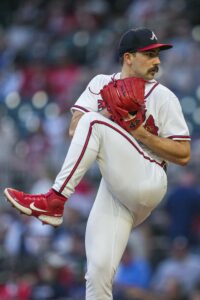
Strider, 24 later this month, will earn $1MM both in 2023 and 2024. He’ll be paid a $4MM salary in 2025 before jumping to $20MM in 2026 and $22MM in 2027 and 2028. The 2029 option comes with a $5MM buyout, which is factored into the guaranteed portion of the contract. If the Braves pick up that net $17MM option for the ’29 campaign, Strider will earn a total of $92MM over seven years.
Strider becomes the fourth young Braves star to be extended this season alone, joining first baseman Matt Olson (eight years, $168MM), center fielder Michael Harris II (eight years, $72MM) and star third baseman Austin Riley (ten years, $212MM). Atlanta, of course, had previously already signed outfielder Ronald Acuna Jr. and second baseman Ozzie Albies to club-friendly extensions. All six of those players are now under club control through at least the 2027 season, giving the Braves a level of continuity and cost certainty that is unparalleled throughout the league.
A fourth-round gem in the extremely truncated 2020 draft (five rounds), Strider skyrocketed through the Braves’ system despite a lack of minor league games in 2020, ultimately making his Major League debut late in the 2021 season. The Clemson product cracked the Braves’ Opening Day roster in 2022, initially working multi-inning stints out of the bullpen before ascending to the starting staff, where he not only found success but emerged as a bona fide front-of-the-rotation arm.
Overall, Strider broke out with 131 2/3 innings of 2.67 ERA ball and a 38.3% strikeout rate that paced all big leaguers who pitched at least 100 innings. Command was an issue at times in the minors and early in the season, but Strider markedly scaled back on the number of free passes he yielded as the season wore on, finishing out the year with an 8.5% walk rate that was scarcely north of the league average. For someone who walked 13.5% of his opponents over the first two months of the season, the improvement was as remarkable as it was rapid; from June 10 onward, Strider walked just 6.8% of his opponents.
Strider’s dominance has positioned him as one of the two favorites for National League Rookie of the Year honors, as he and teammate Harris are widely viewed as the presumptive first- and second-place finishers in an extremely strong year for rookies (both in the NL and in MLB as a whole).
The $75MM guarantee for Strider shatters any prior precedent for pitchers with such limited experience. Prior to this deal, the five-year, $35MM contract Madison Bumgarner signed with the Giants more than a decade ago stood as the record extension for a pitcher with between one and two years of service time. (Strider is currently at 1.003 years.) This new contract not only finally topples that dated mark (in decisive fashion), it also surpasses the established extension records for pitchers with two to three years of service time (Blake Snell‘s five-year, $50MM deal) and even with three to four years of service (Sandy Alcantara‘s five-year, $56MM deal).
Because extensions, more so than free-agent contracts, draw heavily from recent comparables, the Strider deal in many ways paves the way for new precedent to be established in multiple service classes. That’s not to say every pitcher with between one and four years of service time will now require $75MM+ to sign an extension, of course; Strider’s case as a Rookie of the Year frontrunner and budding ace is far from the norm.
Nonetheless, as we’ve seen with young position players in recent years, the market for these types of extensions can still advance rapidly. Back when Acuna signed his eight-year, $100MM extension, that was the largest deal ever for a position player with under a year of big league service. That mark was quickly smashed by Wander Franco (11 years, $182MM) and further surpassed this summer by Julio Rodriguez (12 years, $210MM).
With Strider’s salaries now set through the 2028 season, the Braves, incredibly, already have $76MM on the books six years down the line. That’s more than any other team in baseball. The Padres have about $57MM on the ’28 books between Manny Machado and Fernando Tatis Jr., while the Rangers have about $51MM on the books between Corey Seager and Marcus Semien. (Machado can opt out of his deal with the Friars after next year, so the Padres’ 2028 commitments may not end up being quite so large.) Obviously, $76MM in 2028 will carry less weight than $76MM in 2022, but it’s still a hefty commitment to have so far down the line.
There’s some degree of risk for the Braves in laying out such lengthy commitments, even if each looks quite team friendly in a vacuum. Injuries and regression could always push any of these extensions from “bargain” to “burden” — particularly in the later stages of the deals, when the salaries are come with more heft. Still, given the general excellence of this group, it’s impossible not to be bullish on the team’s future.
Looking more immediately down the line, the Braves already have $153MM on next year’s payroll and nearly $110MM on the 2024 payroll. That’s before considering a slate of arbitration-eligible players headlined by lefty Max Fried, who’s projected by MLBTR contributor Matt Swartz to earn more than $12MM in 2023. Atlanta would have a franchise-record payroll in 2023 even if the only moves made by the front office were to simply tender arbitration contracts to their eligible players.
Of course, that’s certainly not all the Braves will do this winter. First and foremost on the agenda will be negotiations with shortstop Dansby Swanson, who’ll be a free agent once the postseason concludes. The Braves and Swanson have publicly expressed mutual interest in a new contract, but getting something done would likely send the Braves soaring over the $200MM mark in terms of their bottom-line payroll while also pushing them into the general vicinity of the first luxury tax threshold for the first time ever. The Braves also surely are still hopeful of extending Fried, who’s controlled through the 2024 season. If they succeed in signing both Swanson and Fried, there’s virtually no path to avoiding the luxury tax.
On the one hand, while contracts like this Strider extension are cause to celebrate in the long-term, they do also create some shorter-term considerations. Strider would’ve only counted around $750K toward the luxury tax in 2023, had he not signed this extension. He’ll instead now carry a sizable $12.5MM luxury hit — the average annual value of his new contract. It’s still a win for both player and team, but the glut of long-term deals does inflate the Braves’ luxury ledger more quickly than a year-by-year approach would.
On the other hand, that’s a trivial concern when juxtaposed with the benefit of having so many high-end players signed for the next six-plus seasons. And with a World Series win in 2021 and another postseason run forthcoming, the NL East-champion Braves will no doubt see a boost to their revenues, lessening the sting of any luxury penalties that may arise in the next couple years. Atlanta already arguably boasted the best cost-controlled core of any team in baseball over the next half decade, and adding Strider to the preexisting quintet of Harris, Olson, Riley, Albies and Acuna only furthers their case. Waves of injuries can derail any team at any time, but health-permitting, the Braves are going to be good for a long, long time.
NL East Notes: Alcantara, Marte, Strider
Sandy Alcantara‘s season is officially over, as Marlins manager Don Mattingly told reporters (including the Miami Herald’s Jordan McPherson) today that the star right-hander won’t be pitching in the Marlins’ season finale on Wednesday. Alcantara pitched yesterday and would’ve been lined up to make his 33rd start in Wednesday’s game against the Braves, but Miami will instead close the book on what might end up as a Cy Young Award-winning campaign for the 27-year-old righty.
Over a league-high 228 2/3 innings, Alcantara has looked like an old-school workhorse in a sport increasingly dominated by pitch counts and bullpen usage. Alcantara has a 2.28 ERA, 53.6% grounder rate, and 5.6% walk rate to go along with that big workload, and he earned his second All-Star nod. While Miami is reportedly open to trading from its pitching depth this winter, Alcantara is known be off-limits, as his five-year, $56MM extension signed last November has made him a Marlins cornerstone.
More from the NL East….
- Starling Marte is still recovering from his fractured right middle finger, as Mets manager Buck Showalter told Newsday’s Tim Healey and other reporters that Marte’s finger still hasn’t healed enough for the outfielder to start swinging or throwing. Marte hasn’t played since September 6, but his attempts at making it back before the end of New York’s season have already resulted in one cessation of baseball activities, as Marte’s continued discomfort in his finger has prevented him from being able to properly ramp up his readiness. With the regular season winding down, there must now be concern whether or not Marte will be ready when the Mets start the playoffs, whether that is on Friday (if the Mets are a wild card) or perhaps even on October 11 (if the Mets win the NL East). Naturally, that latter date would give Marte more time to heal, but the Mets and Braves might be battling for the division title until the final day of the schedule.
- The Braves are also missing a key figure from the pennant race, as Spencer Strider‘s stint on the 15-day injured list will last until that 162nd and final game. Strider has been dealing with an oblique strain, and manager Brian Snitker told reporters (including Justin Toscano of the Atlanta Journal-Constitution) that there isn’t any update on whether or not Strider will be able to return for that last game. The rookie right-hander has been getting treatment and doing core exercises, but while Snitker said that has been some improvement, Strider hasn’t yet started throwing.
Poll: National League Rookie Of The Year
This year’s National League Rookie of the Year voting will be a particularly fun one because the two front-runners happen to be teammates. Braves right-hander Spencer Strider and center fielder Michael Harris II both burst onto the scene in 2022 and both cemented themselves as building blocks in Atlanta. Wins above replacement is far, far from the be-all and end-all in ascertaining player value, but it’s still telling that Strider and Harris are both north of four WAR on the season (per both Baseball-Reference and FanGraphs), while no other NL rookie has even three wins above replacement per either version of the metric.
Harris and Strider have both played at an All-Star level this season, though neither actually made the All-Star team this summer. That’s due largely to the fact that Strider began the season in the bullpen and Harris didn’t make his debut until late May. Given their play in 2022, that could change as early as next summer.
There’s still a bit of time for the bottom line to change, although with Strider on the 15-day injured list due to an oblique strain, his regular season is likely over. Harris will have another nine games to build his case, pending any off-days or an untimely injury of his own. Let’s take a quick look at each player’s candidacy.
A Quick Case for Strider
Dominant this season as both a reliever (2.22 ERA in 24 1/3 innings) and a starter (2.77 ERA, 107 1/3 innings), Strider leads all National League rookies with 131 2/3 innings pitched. Cincinnati’s Hunter Greene, a popular ROY pick prior to the season, is a distant second place at 113 2/3 innings. Strider’s gaudy 38.3% strikeout rate isn’t just the best among rookie pitchers in 2022 — it’s the best among all Major League pitchers who have thrown at least 100 innings. Shane McClanahan is the only pitcher in Major League Baseball (again, min. 100 innings pitched) who has induced swinging strikes at a higher clip than Strider’s 15.5%.
Strider’s overall numbers — 131 2/3 innings, 2.67 ERA, 38.3% strikeout rate, 8.5% walk rate — are so dominant that if he had a few more innings on his resume, he’d be in the mix for some down-ballot Cy Young votes. (He may still get a handful, but he’s not going to stack up alongside the current leaders.)
A common argument against Strider is that he shouldn’t be favored because he plays less often than an everyday player (e.g. Harris). Firstly, unlike most of even the fringe ROY candidates, Strider broke camp with the Braves this year. He’s been on the roster since Opening Day, which Harris and others can’t claim.
Secondly, Strider has faced 528 batters this season and, were it not for the oblique injury, would’ve pushed that number close to 600. Even that 528 mark is greater than the total number of plate appearances for any National League rookie hitter. Strider (and pitchers in general) may appear in a fewer number of their team’s overall games, but as a pitcher, he has more direct influence on the outcome of every single plate appearance than any of the defenders behind him. On average, he faced 21.7 hitters per start. That’s nearly a week’s worth of plate appearances for a position player.
Put more succinctly, the counter-argument to that common knock on Strider is that hitters play a smaller role in determining the outcome of a large number of their team’s games; pitchers play a larger role in determining the outcome of a small number of their team’s games.
A Quick Case for Harris
In terms of wins above replacement, Harris trails only Julio Rodriguez for the rookie lead, per FanGraphs (4.8), and only Rodriguez and Cleveland’ Steven Kwan, per Baseball-Reference (5.1). He’s a dynamic player in all facets of the game, hitting .305/.346/.535 with 19 home runs and 19 steals apiece. Harris doesn’t walk much (4.7%) and strikes out a bit more than average (23.8%), but that hasn’t stopped him from being 43% better than the average hitter, by measure of wRC+ (or 42%, per OPS+).
Defensively, Harris looks like a future Gold Glover. He might not win one this season, as his cumulative defensive contributions are impacted by the fact that he spent nearly two months in the minors, but every publicly available metric is in agreement that he’s a plus, if not elite defender. In 949 innings of center field work, Harris has received standout marks from Defensive Runs Saved (7), Ultimate Zone Rating (3.9) and Statcast (6 Outs Above Average, 5 Runs Above Average), to name a few. Harris ranks in the 92nd percentile of Statcast’s Outs Above Average, the 87th percentile for his jumps on balls hit to the outfield, and in 94th percentile for pure sprint speed.
It’s true that Strider has more batters faced than Harris has plate appearances, but Harris has fielded far more balls in play in center field than Strider has on the mound. His value as a defensive player is far superior, particularly given his elite results in 2022. Harris also provides baserunning value that Strider doesn’t have the ability (or even the opportunity) to match. Despite appearing in just 106 games so far, Harris ranks 17th among all big leaguers in baserunning runs above average, per FanGraphs’ — a cumulative stat that incorporates more than just his impressive 19-for-21 showing in stolen bases.
—
There’s really no wrong answer; both players have had sensational starts to their career and both have been absolutely vital pieces of a Braves team that trails the Mets by 1.5 games for the National League East lead. Still, only one of the two is going to take home Rookie of the Year honors in November. Who should it be?
Who should win National League Rookie of the Year honors?
-
Spencer Strider 50% (4,563)
-
Michael Harris II 44% (3,954)
-
Someone else (specify in comments) 6% (547)
Total votes: 9,064
Braves Place Spencer Strider On IL With Oblique Strain
The Atlanta Braves announced they have placed starting pitcher Spencer Strider on the 15-day IL with a strained left oblique muscle, backdated to September 21st. RHP Alan Rangel will be recalled in a corresponding move. The Braves have also reinstated Ehire Adrianza from the 10-day IL and have optioned infielder Rylan Bannon to Triple-A Gwinnett.
Strider has been nothing short of sensational for Atlanta in 2022. Slotted as a bullpen arm to start the season, Strider dominated in relief, posting a 2.22 ERA in 24 1/3 innings out of the ‘pen. The Braves transitioned the rookie to the rotation in May 30, where he has been one of the most effective starters in baseball. In 107 1/3 innings over 20 starts, Strider has held opponents to a .183 BA and a minuscule .274 slugging. He was named NL Rookie of the Month in July and has amassed 202 strikeouts between his work in the bullpen and the rotation, good for fourth in the senior circuit.
Strider’s move to the IL follows a brilliant outing on September 18th against the Phillies, in which he struck out 10 batters and gave up one run over six innings. He left the game with a tender left oblique, which prompted the Braves to preemptively push back his next start as a precaution. Strider will remain on the IL until the final day of the regular season, calling his readiness for the postseason into question should he suffer any setbacks. For the time being, it seems likely that right-hander Bryce Elder will continue to fill Strider’s spot in the rotation, as he did when Strider was initially pushed back. Alan Rangel will be recalled to account for the Braves’ hole in their pitching matrix. Rangel has started 26 games in 2022 for Double-A Mississippi and has accumulated a 5.26 ERA.
It will be a massive loss for Atlanta if Strider is unable to pitch in the postseason. This will hold especially true if the Braves are unable to win the NL East and are forced to compete in one of the NL Wild Card Series, where a 1-2 punch of Strider and Max Fried would be particularly formidable. Should Strider not be available for the Wild Card Series, the Braves rotation figures to be Fried in Game 1, Kyle Wright in Game 2, and Charlie Morton in the decider. There is also the scenario in which Strider, without the luxury of a traditional minor league rehab process, comes out of the bullpen for Atlanta for one or more postseason series. Regardless of what transpires, Brian Snitker and his staff will have their hands full as they balance the Braves’ immediate postseason aspirations with the future health of their budding ace.
Adrianza will return to Atlanta’s bench after being placed on the 10-day IL with a left quad strain. The 33-year old utility infielder began 2022 with the Nationals before being returning to the Braves via a trade deadline swap. Adrianza has only logged eight at-bats for the Braves since his arrival in August, collecting a singular hit. Adrianza takes the place of infielder Rylan Bannon, who the Braves claimed off waivers in August. Bannon only played in one game during his time with the Braves and made no plate-appearances.
MLBTR Poll: Predicting The NL East Winner
As the regular season nears its conclusion, the playoff picture has mostly come into focus. Of the 12 teams currently in playoff position, 10 have a cushion of at least 4 1/2 games. The Padres and Phillies are working to hold off the Brewers for the final two Wild Card spots in the National League, but the rest of the teams currently in playoff position have put themselves in a great spot to reach the postseason barring a major collapse. There’s an outside shot the White Sox track down the Guardians in the AL Central or the Orioles get back into the AL Wild Card race, but it’d take a major turn of events over the next two weeks.
There’s a similar lack of intrigue in most of the division races. The Astros and Dodgers have already clinched their respective divisions. The Yankees, Guardians and Cardinals all hold leads of six-plus games in theirs. The only division race that promises plenty of intrigue down the stretch: the battle for the NL East.
Both the Mets and Braves are already guaranteed to make the postseason. They’re each likely to surpass 100 wins. Yet one of those teams will come up just shy of a division title, leaving them as the #4 seed in the National League. That means a three-game series against the #5 seed in a first-round Wild Card set under the playoff format introduced in this spring’s collective bargaining agreement. Obviously, both teams would much prefer to secure the division title (and almost certainly the NL’s #2 seed and accompanying first-round bye). Which one is the frontrunner for the division crown? Let’s take a look at the remaining road for each and their current health outlook.
Mets (95-56 record, +147 run differential)
Remaining schedule: at Oakland (three games), vs. Miami (two games), at Atlanta (three games), vs. Washington (three games)
The Mets have 11 games remaining. Eight of them are against teams 28 games or more below .500. The other three: a crucial series next weekend in Atlanta. New York welcomed back Max Scherzer from a brief injured list stint on Monday. He came out with six perfect innings against the Brewers, striking out nine, before being lifted due to a pitch count limitation. The Mets rotation is at full strength at the right time, pushing players like Tylor Megill and David Peterson into the bullpen.
The biggest current injury for the Mets is on the position player side. Right fielder Starling Marte has yet to return after suffering a non-displaced fracture in his right middle finger two weeks back. Anthony DiComo of MLB.com tweeted this afternoon that the All-Star outfielder is hopeful he’ll be back in time for next weekend’s series with the Braves. Center fielder Brandon Nimmo, meanwhile, left today’s game with left quad soreness. Mike Puma of the New York Post relays that he’s likely to go for imaging tomorrow but Nimmo downplayed the severity of the issue postgame.
Braves (93-56 record, +171 run differential)
Remaining schedule: at Philadelphia (four games), at Washington (three games), vs. Mets (three games), at Miami (three games)
The defending champions dug themselves an early hole with a mediocre first two months, but they’ve been incredible since the calendar flipped to June. They’re a staggering 70-28 over the past three and a half months, nearly erasing a deficit that was once as high as 10 1/2 games in the process. They’ve pulled even with the Mets in the loss column but have two fewer wins, leaving them with a bit more work to do to get ahead in the standings.
The Braves kick off a four-game set with the Phillies tomorrow. That’s a much more difficult series than any the Mets will play (aside from the Braves themselves), but Atlanta just swept Philly last weekend.
Like the Mets, Atlanta doesn’t have any key starting pitchers currently on the injured list. Rookie star Spencer Strider is battling some oblique soreness and had today’s scheduled start pushed back slightly, but there’s no indication an IL stint is currently under consideration. As with New York, Atlanta is down one star position player thanks to a fractured finger though. The Braves lost Ozzie Albies to a right pinky fracture over the weekend. There’s a chance he returns in the postseason but he’s not expected back before the end of the regular season. Rookie Vaughn Grissom filled in well in recent weeks while Albies was rehabbing a broken foot; he’ll be asked to do the same for the stretch run.
Tiebreaker procedure
The final three games between the Mets and Braves obviously loom as the largest remaining on the schedule for both clubs. Not only are they the most directly impactful in the standings, they also carry implications for the tiebreaker. The new CBA did away with the traditional Game 163 in favor of a tiebreaker system. If two clubs finish the season with the same record, the team with the better head-to-head mark gets the nod in the standings. The Mets lead this year’s season series 9-7, meaning Atlanta would need to sweep their final meeting to secure the tiebreaker.
How does the MLBTR readership expect things to play out? Which team will celebrate an NL East crown two weeks from now?
(poll link for app users)
Which Team Will Win The NL East?
-
Mets 53% (6,340)
-
Braves 47% (5,574)
Total votes: 11,914
The Braves’ Star Rookie Starter
With just a month remaining in the 2022 regular season, some of the awards races are coming into view. The National League Rookie of the Year balloting will be a two-man show, with Braves teammates Spencer Strider and Michael Harris II battling one another for the hardware. Neither player entered the season as a favorite, but they’ve pulled away from the field with spectacular performances.
Harris didn’t even reach the majors until a few days before June, but he’s started his career on a .309/.352/.538 tear. That’s elite offensive output, and while it’ll probably be difficult to keep hitting at that level while swinging and missing as often as he does, there’s far more to his game. Harris has rated as a plus defensive center fielder, and it wouldn’t be a surprise if he eventually takes home a Gold Glove Award. He’s also a plus baserunner who has gone 16 of 17 as a base-stealer. The Braves cemented Harris as a key piece of the core by signing him to an eight-year extension last month.
Great as Harris has been, he may be trending towards a runner-up finish in the ROY race. That’s a testament to how dominant his teammate has been on the mound. Unlike Harris, Strider got his feet wet in the big leagues last season. Atlanta called him up in October, and he came out of the bullpen twice during the final week of the regular season. The call-up was seemingly geared towards gauging whether Strider would be a playoff option, but the Braves left him off the postseason roster. After winning the World Series, they’re certainly not quibbling about that decision, but there’s no question he’ll be a major factor in the playoffs this time around.
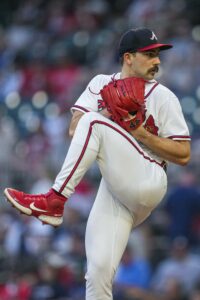
Strider didn’t open the season in the rotation. Atlanta initially turned to a primary five of Max Fried, Charlie Morton, Ian Anderson, Kyle Wright and Huascar Ynoa, with Strider on hand as a multi-inning relief option. The 23-year-old thrived in that capacity, pitching to a 2.22 ERA while holding opponents to a pitiful .167/.263/.214 line through 24 1/3 frames. It may have been tempting to keep him in that role, particularly since many scouting reports on Strider had suggested a bullpen future may be his best fit.
Through two months, however, the Braves weren’t getting great results from the bulk of the rotation. Fried was excellent, as was Wright. Yet Morton and Anderson had some early-season struggles, and the fifth spot proved a revolving door between Ynoa, Bryce Elder and Tucker Davidson. On May 30, the Braves turned to Strider to make the first start of his big league career. He struggled, allowing five runs in 4 1/3 innings in a loss to the Diamondbacks. The Braves stuck with him, and he reeled off three solid starts in a row. Strider then took a six-run drubbing at the hands of the Giants on June 21, but he’s been arguably the best pitcher in the game since that point.
Strider twirled six scoreless innings against the Dodgers his next time out, kicking off an ongoing stretch of 10 of 12 starts in which he’s allowed two or fewer runs. Over that time, Strider has a 2.15 ERA and surrendered only a .176/.233/.258 slash line. He’s struck out nearly 40% of batters faced while only walking 6.1% of opponents. The righty has eclipsed double digit punchouts on four occasions, including a masterful 16-strikeout gem against the Rockies last week.
While Strider’s late entrance to the rotation has kept him from accruing as many innings as the game’s top arms, he’s been among the league’s best hurlers on a rate basis. No other starting pitcher with 90+ innings has a strikeout rate anywhere near his 37.8% mark since he moved to the rotation. The next closest pitcher, Shohei Ohtani, checks at 33%. Strider’s among the top 20 starters in ERA (2.79), has allowed the fourth-lowest opponents’ on-base percentage (.249) and the lowest slugging percentage allowed (.276). Only Shane McClanahan, Dylan Cease, Kevin Gausman and Ohtani are generating swinging strikes at a better clip than Strider, who’s gotten a whiff on 15.2% of his total pitches out of the rotation.
Strider’s approach is a bit atypical for a starting pitcher, a big reason evaluators questioned whether he could stick in a rotation. He leans extremely heavily on his fastball, turning to the four-seam more than two-thirds of the time. Strider pairs that with a slider and barely turns to a third offering, rarely deploying his changeup. It can be tough to navigate big league lineups with only two pitches, but the fastball-slider pairing has been dominant. Strider is averaging an absurd 98.2 MPH on his heater, while hitters have come up empty more than half the time they’ve swung at his mid-80’s slider. The shallower repertoire has neither inhibited Strider from handling left-handed opponents (who have a .200/.256/.284 line against him this season), nor from maintaining his effectiveness multiple times through a lineup.
It’s probably too soon to call Strider a true ace. A 2020 draftee, he’s still only in his second full professional season. This year’s 114 2/3 innings are already a personal-high, and it remains to be seen whether he can maintain this kind of form through a 162-game schedule and into the postseason. On an inning-for-inning basis, though, Strider has performed right alongside the game’s best. He’s already been far better than the Braves could’ve reasonably anticipated, and he has certainly secured a spot in the playoff rotation alongside Fried and at least one of Morton or Wright.
The addition of Harris and Strider to a core that is coming off a championship gives them one of the league’s more complete rosters. Atlanta is playing at a 101-win pace, and they’ve pulled within half a game of the much improved Mets for first place in a top-heavy NL East. Which team will secure the division title and accompanying first-round bye will be one of the most intriguing storylines of the season’s final couple weeks. Strider will play a big role in those efforts and in whatever postseason run the Braves can mount to follow.
Note: All stats through play Tuesday.
Image courtesy of USA Today Sports.
Braves Notes: Rotation, Jackson, Freeman
During last year’s World Series run, the Braves found themselves mixing and matching at the back of the rotation behind Max Fried, Charlie Morton and Ian Anderson. Atlanta hasn’t done much to solidify that group this winter, leaving themselves to again count on a handful of less-proven arms at the back end.
Manager Brian Snitker told reporters (including Justin Toscano of the Atlanta Journal-Constitution) over the weekend that righties Kyle Wright and Huascar Ynoa look like the favorites for the fourth and fifth spots. Ynoa always seemed to have a leg up after posting a 4.05 ERA/3.62 SIERA in 18 appearances last season. Wright, on the other hand, made just two regular season starts in the majors. The 26-year-0ld had a nice showing at Triple-A Gwinnett, where he worked 137 frames of 3.02 ERA ball. A former top five pick and highly-regarded prospect, Wright hasn’t yet had a ton of MLB success, but his minor league production and the quality of his arsenal still offer reason for Atlanta brass to believe in him as a long-term option.
The Braves are scheduled to play every day from their April 7 opener through April 20. With that heavy workload to start the year, Toscano writes the club could lean on a six-man starting staff early on. If that bears out, rookie Spencer Strider — who climbed four minor league levels last season to reach the majors in September — could assume the final spot, Toscano writes, with lefties Tucker Davidson and Kyle Muller also in that mix.
All those pitchers outside the Braves top three starters have minor league option years remaining, so any of that group could be sent back to Gwinnett throughout the season. They could also spill over into a multi-inning role out of the bullpen. Atlanta has one of the league’s strongest relief units on paper, but a key member has yet to pitch this spring.
Luke Jackson has been dealing with some forearm tightness, the team told reporters (including David O’Brien of the Athletic). The 30-year-old has been throwing on the side, so the Braves clearly aren’t concerned he’s facing a significant absence, but it’s not known whether he’ll have time to get into regular season game shape by next week. Jackson has been in the Atlanta bullpen for the past five years, but he had a particularly successful showing in 2021, pitching to a 1.98 ERA/3.75 SIERA in 63 2/3 frames.
While the Braves rotation looks much the same as it did last season, their position player shakeup was one of the stories of the offseason. Atlanta acquired Matt Olson and let Freddie Freeman walk in free agency. General manager Alex Anthopoulos and the front office were no doubt aware that decision would be a divisive one among the fanbase, and Freeman himself suggested in the immediate aftermath he was taken aback by the Olson trade. At his introductory press conference with the Dodgers, Freeman suggested Braves brass wasn’t as communicative as he’d expected they’d be throughout his stint on the open market. He also seemed to dismiss Anthopoulos’ assertion the Olson trade was the most difficult move of his executive career.
Chatting with the Journal-Constitution’s Gabriel Burns over the weekend, Freeman walked back those comments and took a brighter tone. The five-time All-Star said he chatted with the Braves baseball ops head last week and apologized for the comments he’d made at his introductory presser. “It helped to hear his side of things,” Freeman told Burns. “I won’t divulge what we talked about. But you can imagine what we talked about in three hours. It was good for us to now be good again. Now, when we see each other, we can just hug. I asked him to come to LA (for the series in April). I don’t think he was going to come to the LA series when they came out. I said, ‘Please, I want to see you and give you a hug because we did so many good things together.’”
Regardless of whether the fences are mended, the Braves and Dodgers figure to have plenty of memorable clashes over the coming seasons. The pair met in last year’s NL Championship Series, and they again look to be two of the top teams in the Senior Circuit. FanGraphs’ projections indeed forecast Los Angeles and Atlanta as the NL’s top two clubs heading into the year.
Braves Promote Spencer Strider
The Braves are set to promote right-handed pitching prospect Spencer Strider to the Majors this weekend, as first reported by Eric Cole of Talking Chop. He’ll work out of the Atlanta bullpen and give the Braves a highly intriguing postseason option. More specifically, MLB.com’s Mark Bowman tweets that he’ll be added to the big league roster today.
It’s the culmination of a remarkable, meteoric rise through the Braves’ farm system. Strider, 22, was selected in the fourth round of the 2020 draft and barely pitched in 2020 due to the NCAA shutdown and the canceled minor league season. He opened the 2021 season with the Braves’ Low-A affiliate but has skyrocketed to the Majors with outrageous strikeout numbers across four different minor league affiliates. The Clemson product pitched to a 0.59 ERA in Low-A, a 2.45 ERA in Class-A Advanced, a 4.71 ERA in Double-A and recently struck out the side in his Triple-A debut.
While the combined 3.64 ERA doesn’t necessarily jump out, Strider’s power arsenal certainly does. He’s punched out 153 batters in 94 innings this season — 39.3 percent of the 389 hitters he’s faced overall. David O’Brien of The Athletic tweets that Strider’s fastball was up to 101 mph in his recent Triple-A debut.
In the long run, the Braves will likely give Strider the opportunity to continue developing as a starting pitcher. That Triple-A debut this week was the lone relief appearance of the season, as all 21 of his other outings have been starts. That said, Baseball America noted when listing Strider sixth among Atlanta farmhands on their midseason rankings that because of his Tommy John surgery in college, a relatively slight size (six feet tall) and below-average command, he may ultimately settle in as a power reliever anyhow.
For now, Strider gives Braves fans even more to be excited for over the final weekend and gives manager Brian Snitker a potential relief weapon that postseason opponents won’t have had a first-hand look at. He’ll technically require commissioner approval to be added to the postseason roster as an injury replacement, because he wasn’t on the 40-man roster on Sept. 1. However, such replacements are reasonably common, and it seems unlikely the Braves would’ve called Strider up for the final three games if they weren’t at least contemplating him as an option for the looming NLDS.