
Braves, Dominic Smith Agree To Minor League Deal
The Braves have agreed to a minor league deal with first baseman Dominic Smith, per Chad Bishop of the Atlanta Journal-Constitution. The Roc Nation client will be a non-roster invitee in big league camp.
A former first-round pick and top prospect, Smith looked to be breaking out in 2019-20, when he slashed a combined .299/.366/.571 with 21 homers in only 396 plate appearances for the Mets. He tried to play through a small tear in his right shoulder’s labrum the following season and saw his numbers unsurprisingly crater. In 2024, Smith suffered a broken hamate bone in his right hand that required surgical repair, and surgeons suggested at the time that he may have had a stress reaction in that hand for several seasons, based on the way things looked in the aftermath of the injury.
From 2021-24, Smith tallied 1538 major league plate appearances but hit only .241/.311/.360 — nowhere close to that 2019-20 peak. Some degree of regression always seemed likely, but a decline so precipitous was nonetheless a bit surprising. Knowing with the benefit of hindsight that Smith was playing through multiple injuries of note help to explain that yearslong dip.
The 2025 season wasn’t back to peak levels, but Smith took 225 plate appearances with the Giants and posted an above-average .284/.333/.417 batting line (111 wRC+). He was heavily shielded from lefties and hit only .200/.259/.280 in 27 plate appearances versus southpaws, but Smith tagged righties at a stout .296/.343/.436 clip. He also posted a respectable .255/.333/.448 line in 45 games with the Yankees’ Triple-A club before landing in San Francisco.
There’s no obvious path to regular playing time in Atlanta for Smith — not with Matt Olson entrenched at first base and a rotation of four veterans to split time between the outfield and designated hitter (Jurickson Profar, Ronald Acuña Jr., Mike Yastrzemski and Michael Harris II). Smith gives Atlanta some depth at first base in the event of an Olson injury, however, and he could step into a more prominent DH role if there’s an injury to any of those four outfielders.
The Braves’ bench is also pretty light on offense, with utilityman Brett Wisely and fourth outfielder Eli White penciled into roles at present due to both being out of minor league options. Smith isn’t your quintessential big lefty bat off the bench, but he’s coming off an above-average season at the plate (particularly against righties) and at least has some minimal experience in left field in addition to his large sample of work at first base.
The Braves only just reacquired Wisely last week (for cash) and as such certainly are not fully committed to giving him a roster spot. White can handle all three outfield positions while Jorge Mateo and Mauricio Dubon (who’ll start at shortstop while Ha-Seong Kim is on the injured list) give the Braves plenty of defensive versatility if they want to carry a more limited lefty bat like Smith on the bench to begin the season.
Mets, Mike Tauchman Agree To Minor League Deal
The Mets are in agreement with veteran outfielder Mike Tauchman on a minor league contract, report Ken Rosenthal and Will Sammon of The Athletic. The Meister Sports Management client will be in camp as a non-roster invitee once he completes a physical.
It’s a good landing spot for Tauchman, who has a path to breaking camp. The Mets are moving Juan Soto to left field and have Luis Robert Jr. in center. That leaves right field as the biggest question going into the season. New York signed former Royals outfielder MJ Melendez last week. He’s on the 40-man roster but has a minor league option remaining. Melendez signed a split contract that’d pay him at a lower rate for time spent in Triple-A. He’s hardly a lock to make the team.
Tauchman’s biggest competition probably comes from top prospect Carson Benge. The door is open for the 23-year-old, whom most scouts consider the top position player in the system. Benge, a first-round pick in 2024, raked at both the High-A and Double-A levels last year. He didn’t have good numbers in his first 24 Triple-A contests, slashing .188/.272/.311 there to close the year. That’d point toward him beginning this season in the minors. However, Benge’s 18% strikeout rate and 92 mph average exit velocity against Triple-A pitching suggest the results may have simply been bad luck rather than any kind of speed bump.
Benge’s play in Spring Training might be a bigger factor in whether Tauchman makes the team than how well the veteran outfielder performs. The Mets don’t have many bench spots available. Tyrone Taylor is locked into the fourth outfield role, while Mark Vientos will be on the MLB roster barring a surprise trade. Backup catcher Luis Torrens has a third bench spot secure, and they’ll likely want a depth infielder who can play shortstop regardless of whether Francisco Lindor returns from a hamate injury by Opening Day. Vidal Bruján and Ronny Mauricio are the top competitors for that job.
The Mets have a good idea of what to expect from Tauchman if he breaks camp. He’s a high-OBP corner outfielder who has been a little better than average at the plate in three consecutive seasons. The lefty hitter is coming off a .263/.356/.400 showing with nine home runs across 385 plate appearances for the White Sox. Teams have viewed him more as a quality depth piece than a roster fixture, and he has been non-tendered by the Cubs and White Sox over the past two offseasons.
Yankees Outright Yanquiel Fernandez
The Yankees are outrighting Yanquiel Fernandez to Triple-A Scranton/Wilkes-Barre, the team announced. The outfielder was designated for assignment last week, shortly after the team claimed him off waivers from the Rockies. Fernandez will be in MLB Spring Training with New York.
New York was able to get the former top prospect through waivers, allowing the club to retain him as depth. With Trent Grisham and Cody Bellinger back, it’s a crowded position for the Yankees. The plethora of veteran outfielders could leave Jasson Dominguez without a roster spot. Triple-A standout Spencer Jones is also on the verge of contributing in the majors. It’s a lengthy list for Fernandez to leapfrog, but he has the pedigree to make an impact if everything breaks his way.
The 23-year-old Fernandez was one of the organization’s brightest stars heading into last season. He ranked third on MLB.com‘s list of Colorado’s top prospects. Eric Longenhagen of FanGraphs had the outfielder at fifth coming into the year. Fernandez has seemed to hit a roadblock at the upper levels, though. He’s slashed a mediocre .259/.320/.437 in 97 games at Triple-A the past two years. A .757 OPS is far from a failure, but the stat line did come at the extremely hitter-friendly Pacific Coast League.
Fernandez got his first look in the big leagues this past year, and it went poorly. He delivered a 55 wRC+ across 147 plate appearances. Fernandez’s strikeout rate pushed 30% with the Rockies. The one positive for the outfielder was getting to show off his absolute cannon of an arm. Fernandez averaged an absurd 97.2 mph on his throws from right field, which ranked in the 100th percentile. He was a slightly negative defender by Outs Above Average, but the arm strength was apparent.
Photo courtesy of Isaiah J. Downing, Imagn Images
Cardinals To Claim Zak Kent, Designate Bryan Ramos
The Cardinals have claimed right-hander Zak Kent off waivers from the Rangers, reports Derrick Goold of the St. Louis Post-Dispatch. Texas had designated Kent for assignment last week to clear space for left-hander Jordan Montgomery. Both teams have confirmed the move.
St. Louis designated infielder Bryan Ramos for assignment to add Kent. Ramos was claimed off waivers from the Orioles in early February.
It’s Kent’s second stint this offseason with the Cardinals. His transaction carousel began in December, when St. Louis grabbed him off waivers from the Guardians. He lasted about a month, then was bumped off the roster when the Cardinals acquired left-hander Justin Bruihl. The Rangers claimed him shortly thereafter.
Kent was drafted by Texas in 2019. The 28-year-old had spent his entire career with the organization until a cash deal sent him to Cleveland. Kent made it up for his big-league debut in April of this past season. He notched a 4.58 ERA across 12 appearances with the Guardians. Kent posted a 21.1% strikeout rate to go with a double-digit walk rate.
While his numbers were somewhat underwhelming with the Guardians, Kent put up a strong campaign at Triple-A in 2025. He cruised to a 2.84 ERA with a strong 31.4% strikeout rate. Kent picked up his first two professional saves with the Clippers.
The Cardinals now send Ramos back to DFA limbo just 10 days after claiming him. The 23-year-old infielder had spent his entire career in the White Sox organization before being dealt for cash to the Orioles a couple of weeks back. He’ll provide depth in the minors if St. Louis can get him through waivers.
Ramos has appeared in each of the past two seasons with the White Sox. He’s totaled 120 plate appearances as a big leaguer, slashing .198/.244/.333 in the brief sample. Ramos has only appeared at third base with Chicago, but he has minor league experience at first base, second base, and left field.
Photo courtesy of Ken Blaze, Imagn Images
Nationals To Sign Drew Smith To Minor League Deal
Right-hander Drew Smith is heading to the Nationals on a minor league deal, reports Michelle Margaux of SNY Sports. The Roc Nation Sports client can earn a base salary of $1.75MM if he makes the big-league club. Margaux adds that Smith can earn another $1.25MM through performance bonuses.
Smith missed the entirety of the 2025 season as he recovered from Tommy John surgery. The Mets declined their $2MM club option on the reliever for 2026, sending him to free agency. Smith has pitched in parts of six big-league seasons, all with New York.
The 32-year-old has put together a 3.48 ERA across 191 MLB games since his debut in 2018. The elbow surgery cut short what was shaping up to be his best season with the Mets. Smith bumped his strikeout rate to a career-best 29.1% over 17 2/3 innings with the club in 2024. He chipped in two saves while providing an ERA of just over 3.00. The July 2024 procedure was the second TJ of Smith’s career.
Smith has typically relied on a fastball/slider combo, with the occasional changeup and curveball. After throwing just one cutter from 2022 through 2023, he made the pitch a more regular part of his arsenal in 2024. Smith’s cutter put up a 35.8% whiff rate and propelled him to a strong 14.3% swinging-strike rate. The one concern when looking at the righty’s repertoire is the four-seamer, which averaged less than 95 mph for the first time in 2024. Smith didn’t progress to a rehab assignment last season, so there’s no indication of where his velocity stands after the second major elbow injury.
Landing in Washington gives Smith a solid shot at a big-league gig, assuming health. The Nationals ranked dead last by a significant margin in bullpen ERA last season. One of the club’s few reliable relievers, Jose A. Ferrer, was dealt to Seattle for catching prospect Harry Ford. Smith joins a lengthy list of non-roster invitees competing for a bullpen job in Spring Training, including Trevor Gott, Cionel Perez, and Zach Penrod.
Photo courtesy of Jim Cowsert, Imagn Images
Mariners Acquire Josh Simpson
The Mariners have acquired left-hander Josh Simpson from the Marlins, both teams announced. Miami is receiving cash in the deal. Simpson was designated for assignment last week. Right-hander Logan Evans was placed on the 60-day IL in a corresponding move.
Evans underwent UCL surgery in late January and will miss the entire 2026 season, so his 60-day IL placement is no surprise. With Simpson taking Evans’ spot, Seattle’s 40-man roster remains full.
Simpson missed the majority of the 2024 campaign with an elbow injury. He put together three months of a 3.41 ERA at Triple-A this past year, earning his first big-league callup. Simpson was tagged for four earned runs across two innings in his MLB debut against the Braves, but settled in from there. He delivered eight straight scoreless appearances out of the Miami bullpen after the rough first outing. The lefty struggled over his next 12 appearances, ceding 17 earned runs. He capped off September with a seven-run debacle, once again while facing Atlanta.
The final result in Simpson’s first taste of the majors was a 7.34 ERA, though there were positive indicators. The reliever posted an xFIP and SIERA below 4.50. He punched out big-league bats at a near-24% clip. Simpson coaxed ground balls at a well above average 53.9% rate.
Photo courtesy of Bill Streicher, Imagn Images
Dodgers To Sign Santiago Espinal To Minor League Deal
The Dodgers are adding Santiago Espinal on a minor league deal, per Fabian Ardaya of The Athletic. Espinal is in big-league camp with the team. The veteran infielder is a client of Rimas Sports Agency.
The Espinal news comes on the heels of the announcement that Tommy Edman will begin the year on the IL, which manager Dave Roberts shared with reporters (including Ardaya) this morning. Edman is coming off ankle surgery and was known to be taking a gradual approach to building up for the regular season.
Roberts mentioned Miguel Rojas, Alex Freeland, and Hyeseong Kim as candidates to pick up work at second base (relayed by Sonja Chen of MLB.com). Espinal could join that mix if he makes the team.
The 31-year-old Espinal struggled mightily with the Reds last season. He posted a 58 wRC+ while spending time at all four infield positions, plus both corner outfield spots. Espinal, never known for his power, amassed 328 plate appearances without a home run. Cincinnati sent Espinal outright to Triple-A Louisville at the end of October. He rejected the assignment and entered free agency.
After a brief debut with Toronto in the shortened 2020 season, Espinal became an important part of the Blue Jays’ lineup in 2021. He slashed .311/.376/.405 in 92 games as Toronto’s semi-regular third baseman. Espinal slid over to second base the following year, delivering a perfectly league-average 100 wRC+ in a career-high 135 games.
Espinal’s production tailed off in 2023. His OPS fell to .644 in a utility role. Toronto traded him to Cincinnati for right-hander Chris McElvain shortly before the 2024 campaign. He added both corner outfield spots and first base to his lengthy list of defensive positions while with the Reds, but his tenure with the team was otherwise forgettable.
The main draw for Espinal is the ability to provide credible defense in several areas. He hasn’t been a plus-defender in terms of Defensive Runs Saved in recent seasons, but he’s kept his head above water in both the infield and outfield. Outs Above Average had Espinal as a +2 in 2025.
Photo courtesy of Katie Stratman, Imagn Images
Angels To Sign Adam Frazier To Minor League Deal
Veteran infielder Adam Frazier is heading to the Angels, reports Rhett Bollinger of MLB.com. It’s a minor league agreement with an invitation to MLB Spring Training. Frazier is represented by McKinnis Sports.
Frazier has been with five teams in his 10-year MLB career. He split last season between the Pirates and the Royals. After struggling with Pittsburgh, Frazier delivered near league-average offensive production while chipping in at four different spots in the field with Kansas City.
It’s been half a decade since Frazier pushed his wRC+ above 100, but he was once a reliable bat with positional versatility. He was drafted by Pittsburgh in 2013 and made it to the big leagues three years later. Frazier emerged as a regular in 2017, splitting time between second base and the outfield. He remained a fixture in the lineup for the next four seasons.
A career year in 2021 led to Frazier’s lone All-Star selection. It also led to his departure from Pittsburgh. The infielder hit .324 in the first half as the table setter for the Pirates. Frazier was then dealt to San Diego ahead of the trade deadline for Tucupita Marcano, Michell Miliano, and Jack Suwinski.
Frazier has bounced around since leaving Pittsburgh, including a repeat stint with the club. He was traded to Seattle following his half-season in San Diego. He signed with the Orioles after a year with the Mariners, and then inked a deal with the Royals after his time in Baltimore. Frazier found his way back to the Pirates this past offseason. Pittsburgh swapped him for Cam Devanney in a midseason deal with Kansas City.
The Angels have an uncertain situation at second base. Their approach this offseason has been to gather a large quantity of veterans. Frazier joins Chris Taylor, Nick Madrigal, Yolmer Sanchez, and Donovan Walton as non-roster invitees with big-league experience at the keystone. The current outlook at the position includes some combination of Christian Moore, Vaughn Grissom, and Oswald Peraza. As a left-handed bat, Frazier might have the inside track to a roster spot. Moore and Peraza are both right-handed.
Photo courtesy of Jay Biggerstaff, Imagn Images
Pirates Sign Marcell Ozuna
Feb. 16: Pittsburgh has officially announced the Ozuna deal. Outfielder Jack Suwinski was designated for assignment to clear a 40-man roster spot for the new DH.
Feb. 9: The Pirates and slugger Marcell Ozuna are reportedly in agreement on a one-year, $12MM contract, pending a physical. The CAA client will be paid a $10.5MM salary this year, plus a $1.5MM buyout on a $16MM mutual option for the 2027 season. A mutual option hasn’t been exercised by both parties since 2014, so that option effectively just kicks a portion of the guarantee down the road by a year.
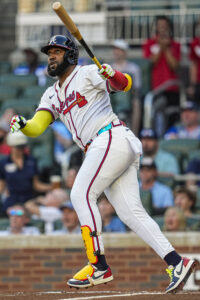
Ozuna turned 35 in November. The 2025 season was a down showing by his standards, but he was still a better-than-average offensive performer overall down in Atlanta. He batted .232/.355/.400 with a career-high 15.9% walk rate, a 24.3% strikeout rate, 21 homers and 19 doubles in 592 plate appearances. That overall line was weighed down by a brutal stretch in the middle of a roller-coaster season. Ozuna raced out to a scorching start in April and May, was one of the league’s worst hitters in June, and then settled in as a slightly above-average hitter for the season’s final three months.
The downturn in production dovetailed with a hip injury through which Ozuna continued to play at less than 100%. It’s impossible to say for certain whether that, age, or a combination of both was the driving factor in last season’s dip in bat speed, but Statcast measured his bat speed at 75 mph in 2023 (86th percentile of MLB hitters), 74 mph in 2024 (81st percentile) and 72.9 mph in 2025 (64th percentile). Accordingly, his typically elite exit velocity and hard-hit rate both fell. Ozuna averaged 89.9 mph off the bat and logged a 44.4% hard-hit rate in 2025. Both are still decent marks, but they’re down considerably from the 92.2 mph and 53.3% marks he posted as recently as 2024.
While Ozuna ought to be an upgrade to Pittsburgh’s lineup overall, the fit isn’t exactly perfect. Beyond the fact that PNC Park is perhaps the worst environment in MLB for right-handed power, the Buccos’ roster is a bit cluttered with corner bats who could use some of the DH time that Ozuna will now command on an everyday basis. Spencer Horwitz and Ryan O’Hearn had been lined up to share time at first base and designated hitter, with O’Hearn perhaps seeing some time in left. Horwitz, after a slow start to his season in 2025, finished the year out on a blistering .314/.402/.539 tear in his final two-plus months of play. He’s locked into an everyday role. O’Hearn can play in the outfield corners, but Bryan Reynolds has one of those two spots locked down.
Signing Ozuna, who has hasn’t played in the field at all in either of the past two seasons (and only logged 14 innings in 2023), likely pushes O’Hearn into an everyday role in the outfield. He has plenty of experience on the grass but rates as a sub-par defender there, whereas he’s an above-average defender at first base. Horwitz does have 604 professional innings in left field to his credit, so he could perhaps be on option in left as well, but all 604 of those frames have been in the minors — half of them back in 2019 and 2021. He’s played some second base, too, but that was a short experiment and the Pirates already acquired Brandon Lowe to man that position.
Presumably, the primary alignment moving forward will have O’Hearn in left field, Lowe at second, Horwitz at first base and Ozuna at designated hitter. It’s not Pittsburgh’s ideal setup from a defensive standpoint, but the Pirates will make that sacrifice in the name of getting some quality bats into the middle of what has typically been one of MLB’s weakest lineups over the past decade-plus. Newcomers O’Hearn, Lowe and Ozuna will join holdovers like Reynolds, Horwitz and Oneil Cruz, giving the Bucs a potentially strong top six in their order at the very least — and that’s before counting shortstop Konnor Griffin, who is the sport’s consensus No. 1 overall prospect and should debut in 2026.
Bringing Ozuna into the fold also seems to formally put an end to Andrew McCutchen‘s second act in Pittsburgh. He could feasibly be a right-handed bench bat who takes some occasional corner outfield reps, but McCutchen played 120 games at designated hitter in 2025. Signing Ozuna clearly displaces him from that role, and it’s hard to see the two fitting together on the same roster. McCutchen recently met with Pirates owner Bob Nutting, Ken Rosenthal of The Athletic reported last week — a meeting that came on the heels of the franchise icon voicing some frustration with the manner in which the team had handled offseason talks.
Adding Ozuna pushes the Pirates’ payroll to $102.25MM, per Ethan Hullihen, which will somewhat remarkably establish a new franchise-record for Opening Day payroll. It’s still a very modest total relative to the rest of the league, but the Bucs have spent more than $50MM in free agency overall and also taken on Lowe’s $11.5MM salary in a trade with the Rays. It’s possible there are additional moves to come. The Pirates have been in the market for third base upgrades as well. That market has been largely picked over, but there are still surely some creative options they can pursue on the trade market.
It’s not clear exactly how much more ownership is willing to boost the payroll, but the team’s reported four-year, $120-125MM offer to Kyle Schwarber and the flurry of subsequent additions pretty clearly indicates that Nutting is willing to spend at levels he has not considered approaching in the past. The Bucs currently have a plus defender at the hot corner in Jared Triolo, but he’s a well below-average hitter who’s capable of fielding multiple spots around the infield, so he could fit nicely in a utility/bench role if GM Ben Cherington can find a third base acquisition to his liking on the trade market.
Jon Heyman of The New York Post first reported Ozuna and the Pirates agreed to a $12MM deal. ESPN’s Jeff Passan reported the $10.5MM salary and $1.5MM buyout on a $16MM mutual option.
Padres To Sign Ty France To Minor League Deal
The Padres are expected to sign first baseman Ty France to a minor league deal, reports Dennis Lin of The Athletic. The agreement includes an invitation to MLB Spring Training. France would be paid at a $1.35MM rate if he makes the MLB roster, reports Kevin Acee of The San Diego Union-Tribune. The veteran infielder is a client of Equity Baseball.
France had interest from multiple teams, but ultimately landed back in San Diego, where it all started. The 31-year-old Southern California native was selected by the club in the 2015 draft. France debuted for the Padres in 2019, but was dealt to the Mariners the following season. He was part of the swap that netted Seattle’s future closer Andres Munoz. Catcher Austin Nola headlined the package that went back to San Diego.
The Padres add another right-handed bat to factor into the first base/DH mix that includes Miguel Andujar and Nick Castellanos. Gavin Sheets is slated to be San Diego’s primary first baseman. The lefty swinger posted an underwhelming .669 OPS against same-handed pitching last season.
France has bounced around since he first broke into the league, but he always seems to compile regular playing time. His 490 plate appearances between Minnesota and Toronto were his fewest since the shortened 2020 season. France posted a 92 wRC+ across 101 games with the Twins. He was dealt to the Blue Jays at the trade deadline along with reliever Louis Varland. France matched that 92 wRC+ in 37 games with Toronto. He went 1-for-4 in brief postseason action.
Despite his perception as a platoon bat, France doesn’t have noticeable splits for his career. Just 12 points separate his OPS against lefties compared to righties. His batting average and on-base percentage are both within 10 points of each other. France has shown a bit more power when facing southpaws, though he’s also struck out more frequently.
France is coming off the best defensive season of his career. He was credited with 9 Defensive Runs Saved and 10 Outs Above Average for his work at first base. The standout performance earned France his first Gold Glove award. Sheets graded out as a neutral defender last season. Andujar is more of a bat-first option. Castellanos received poor marks for his work in right field and has yet to appear in a big-league game at first base. If France makes the team, he’ll be the best defensive option at the cold corner.
Photo courtesy of Jayne Kamin-Oncea, Imagn Images