
D-Backs’ Outfielders Drawing Widespread Trade Interest
The Diamondbacks have an interesting stockpile of upper level outfielders from which they’re largely expected to deal. General manager Mike Hazen and his staff have long signaled a willingness to field offers to upgrade other areas of the roster and they’re unsurprisingly drawing attention from a host of teams.
Nick Piecoro of the Arizona Republic reports roughly 10 clubs have been in touch with Hazen and company regarding at least one of the team’s outfielders. Piecoro lists the Yankees, Brewers, Blue Jays, A’s, Marlins, White Sox and Reds as clubs with interest, while both Piecoro and Chandler Rome of the Houston Chronicle report the Astros are in the mix.
Arizona has a number of players that could draw interest, and it stands to reason different teams have varied preferences on the group. Corbin Carroll is arguably the top prospect in baseball, and both Piecoro and Ken Rosenthal of the Athletic have suggested recently he’s off the table in trade discussions. Carroll’s presence gives the Snakes a potential franchise center fielder, though, freeing them up to listen to offers on their other outfielders.
Daulton Varsho is the most established of the group, and he’d be the toughest to pry from the desert. The 26-year-old got off to a slow start offensively in the majors, but he broke through in his third season. Varsho connected on 27 home runs with a .235/.302/.443 line across 592 plate appearances in 2022. That’s slightly better than average production at the plate, and he offers immense value in other areas. Varsho stole 16 bases (albeit with six failed attempts as well), and he has emerged as one of the game’s best defensive outfielders.
Also an intermittent catcher at times in his career, he’s acclimated to outfield work incredibly well. Varsho’s an above-average runner, and Statcast credits him with elite reads off the bat. By its Outs Above Average metric, Varsho made an estimated 18 more plays than expected in his 920 1/3 innings between center and right field this year. Defensive Runs Saved pegged him a combined 19 runs above par, with both metrics grading him highly in both center and the corner outfield. Varsho doesn’t have a great throwing arm — part of the reason he’s increasingly moved off catcher in the first place — but he’s an athletic, rangy defender who can cover anywhere in the outfield and occasionally factor in at catcher if needed.
Varsho qualified for early arbitration as a Super Two player this winter. MLBTR contributor Matt Swartz projects him for an affordable $2.8MM salary, and he comes with four remaining seasons of club control. Between the all-around production and affordable window of control, the trade appeal with Varsho is immense.
That’s not true to the same extent for the Snakes’ other outfielders, but there’s still a fair amount of appeal. Jake McCarthy is a former supplemental first-round draftee, but most prospect evaluators believed he’d be better suited for fourth outfield duty. While that may wind up being the case, the 25-year-old outperformed that projection in 354 plate appearances this past season. McCarthy hit .283/.342/.427 with eight home runs and stole 23 bases on just 26 tries. His average exit velocity and hard contact percentage are a bit below-average, and the offensive profile was propped up by a .349 batting average on balls in play. The Virginia product is an excellent baserunner who’s athletic enough to cover all three outfield spots, though, and he generally has a solid offensive track record in the minors. McCarthy still hasn’t reached a full year of service time and is controllable through 2028.
Alek Thomas offers a similar profile but is a different story, in that he’s been a top prospect who has yet to find much MLB success. The sport’s #32 prospect heading into 2022 according to Baseball America, Thomas debuted in May. He spent most of the year as their primary center fielder but struggled, hitting .231/.275/.344 through 411 plate appearances. He didn’t draw many walks or drive the ball with much authority, and the tough line led to a demotion back to Triple-A at the end of the season. Thomas won’t turn 23 until next April and is a career .313/.389/.499 hitter in the minor leagues, though. He’s regarded as a potential plus defensive center fielder with strong contact skills. Like McCarthy, he has yet to reach even one year of MLB service.
The trio of Varsho, McCarthy and Thomas is certain to draw the most trade interest, but Arizona also has Pavin Smith and Dominic Fletcher as depth options on the 40-man roster. Smith hasn’t done much at the MLB level but is a former top ten pick. Fletcher is a .296/.358/.467 hitter in the minors and was added to the 40-man at the end of the season to keep him out of the Rule 5 draft. A trade involving either player wouldn’t be as significant as a move involving their top trio, but it’s possible the Snakes find some interest in both.
The extended windows of club control for each of McCarthy, Varsho and Thomas could make them of interest to teams at varying levels of the competitive cycle. That’s highlighted in the wide array of clubs that have checked in with Arizona. Milwaukee, Houston, Toronto, the White Sox and the Yankees are all win-now teams known to be looking for ways to plug a gap in center and/or a corner outfield spot. Houston is known to be in search of a left-handed bat, in particular.
Miami is behind that quintet from a competitive perspective. Still, the Fish are hoping to improve their offense to take a step forward in 2023, likely by subtracting from their enviable rotation depth. The Marlins are without an obvious center fielder on their MLB roster at present, with players like Jesús Sánchez, Bryan De La Cruz and JJ Bleday stretched there defensively. Miami and the D-Backs have linked up on a swap of young players before with the Jazz Chisholm/Zac Gallen deal, although that was orchestrated by the previous Marlins front office.
Oakland and Cincinnati are firmly amidst rebuilds, making them somewhat surprising fits at first glance. Yet the opportunity to acquire a pre-arbitration key piece at least opens the door for teams that are more traditionally “sellers” to gauge the market. A’s GM David Forst told reporters this week that acquiring players at or near the majors is “at the top of our to-do list” (via Melissa Lockard of the Athletic). Reds GM Nick Krall similarly indicated at the GM Meetings the team was considering trade possibilities involving prospects or “lower cost, more controllable players in the big leagues” (link via Bobby Nightengale of the Cincinnati Enquirer).
There are a number of ways the discussions could go, but it seems clear Arizona would want MLB-ready talent in return. Hazen flatly rejected the notion of trading any of their outfielders solely for prospects last month, and Piecoro writes they could look for infield or catching help in discussions — with particular emphasis on adding some right-handed punch to the lineup.
Diamondbacks Sign Austin Brice To Minor League Deal
The Diamondbacks added a bit of minor league pitching depth over the weekend, signing right-hander Austin Brice to a minor league deal, per an official announcement. The deal comes with an invite to big league spring training.
A ninth round pick in 2010 by the Marlins, Brice has spent parts of seven big league seasons across four teams. He struggled initially with Miami after coming up in 2016 and was sent to the Reds as part of the Dan Strailly trade (that also got the Reds Luis Castillo). He tossed 70 innings across two seasons in Cincinnati, pitching to a 5.40 ERA while displaying slightly below league-average strikeout rates.
He bounced around on waivers a bit prior to the 2019 season, but ultimately landed back with the Marlins and turned in his best big league season. That year, Brice pitched 44 2/3 innings of 3.43 ERA ball, striking out 23.1% of batters against a 9.1% walk rate. The Marlins traded him to the Red Sox before the 2020 season, but he’d struggle in Boston, turning in a 6.21 ERA across 33 1/3 innings of work over two seasons.
He spent the past season with the Pirates, mostly pitching at Triple-A where he had a 5.56 ERA in 37 2/3 innings. He did spent some brief time in the big leagues, tossing 6 2/3 innings of relief for the Pirates.
All told, Brice owns a 5.12 ERA across 168 2/3 major league innings. His career strikeout rate of 21.8% is a fraction under the major league average, while his career walk rate of 9% is slightly over it. Brice has a two-pitch mix, combining a low-90s fastball with a low-80s slider. The 30-year-old will provide some valuable minor league pitching depth for Arizona, though given the volume of relief pitching teams often require over the course of a season, there’s every chance he’s back in the big leagues again at some point in 2023.
2022 Rule 5 Draft Results
The 2022 Rule 5 draft will begin at 4pm Central time today at the Winter Meetings in San Diego. This will be the first time since 2019 that the meetings will be held in person, as the 2020 edition was virtual because of the pandemic and the 2021 draft was cancelled entirely due to the lockout.
As a refresher, the Rule 5 draft is a way for players potentially talented enough for the big leagues but blocked by their current clubs to find opportunities elsewhere. Any players that were 18 and under at the time of their original signing and were signed in 2018 or earlier, and any players 19 or older and signed in 2019 or earlier, who are not on a club’s 40-man roster are eligible to be selected in the Rule 5 draft.
The clubs will draft in reverse order of the 2022 standings, with no club obligated to make a selection when it’s their turn. If they do make a pick, they will have to pay $100K to the team they select from. The selected players must stay on the active roster (or injured list) for the entire 2023 season or else be placed on waivers. If they clear waivers, they must be offered back to their original team. They cannot be optioned to the minors. The most recent edition in 2020 saw some notable names move around, such as Akil Baddoo going from the Twins to the Tigers while Garrett Whitlock went from the Yankees to the Red Sox.
This post will be updated with the results as they come in…
First Round
1. Nationals: RHP Thad Ward (Red Sox) (hat tip to Jonathan Mayo of MLB.com)
2. A’s: 1B Ryan Noda (Dodgers)
3. Pirates: LHP Jose Hernandez (Dodgers)
4. Reds: OF Blake Sabol (Pirates); Reds later traded Sabol to Giants for cash or a player to be named later
5. Royals: pass
6. Tigers: RHP Mason Englert (Rangers)
7. Rangers: pass
8. Rockies: RHP Kevin Kelly (Guardians); Rockies later traded Kelly to Rays for cash considerations
9. Marlins: RHP Nic Enright (Guardians)
10. Angels: pass
11. D-backs: pass
12. Cubs: pass
13. Twins: pass
14. Red Sox: pass
15. White Sox: RHP Nick Avila (Giants)
16. Giants: pass
17. Orioles: RHP Andrew Politi (Red Sox)
18. Brewers: RHP Gus Varland (Dodgers)
19. Rays: pass
20. Phillies: RHP Noah Song (Red Sox)
21. Padres: LHP Jose Lopez (Rays)
22. Mariners: RHP Chris Clarke (Cubs)
23. Guardians: pass
24. Blue Jays: pass
25. Cardinals:RHP Wilking Rodriguez (Yankees)
26. Yankees: pass
27. Mets: RHP Zach Greene (Yankees)
27. Braves: pass
29. Astros: pass
30. Dodgers: pass
Second Round
- All teams passed
The minor league phase of the Rule 5 draft also occurred this afternoon. Those players will not go onto the selecting teams’ 40-man roster. A few former major leaguers changed uniforms. They include Hector Perez from Baltimore to the Rays, Josh Palacios from the Nationals to the Pirates, Jared Oliva from the Pirates to the Angels, Nick Burdi from the Padres to the Cubs, Peter Solomon from the Pirates to the D-Backs and Jonathan Arauz from the Orioles to the Mets.
Diamondbacks Interested In Sean Murphy
The Diamondbacks are the latest team linked to A’s catcher Sean Murphy, as Nick Piecoro of the Arizona Republic reports that the D’Backs and Athletics have had some talks about Murphy’s availability.
Back in October, Arizona general manager Mike Hazen suggested that catcher might be a target area for the D’Backs this winter, as part of the team’s broader plans to improve its offense. Free agent Christian Vazquez is another backstop who has reportedly drawn from interest from the desert, while the D’Backs also made a lower-level depth move in claiming Ali Sanchez off waivers.
As Piecoro notes, the Diamondbacks have a starting catcher already in place in Carson Kelly. However, Kelly has hit a modest .231/.318/.405 over his 1207 plate appearances and four seasons in Arizona, with a lot of that offense coming back in 2019. Most recently, Kelly hasn’t really been able to get on track at the plate since suffering a wrist fracture in June 2021.
With Daulton Varsho moving from “catcher of the future” to outfielder of the Diamondbacks’ present, the catching depth is suddenly a little thin in Arizona, and acquiring Murphy would soundly resolve that issue. The former All-Star is a solid offensive and defensive performer, and is under team control through the 2025 season. Since the Athletics are firmly in rebuild mode, Murphy has been one of the top trade targets in all of baseball, with essentially every catching-needy team (i.e. the Cardinals, Cubs, White Sox, Guardians, Twins, Rays, Red Sox) all linked to his market. Even the Braves had some interest despite their own catching depth, but they no longer appear to be pursuing Murphy’s services.
This widespread interest has given the A’s plenty of leverage in talks. The Athletic’s Ken Rosenthal reports that Oakland is looking to add Major League players rather than prospects in exchange for Murphy, with these big league-ready players presumably being younger and cost-controlled rather than established veterans.
With this asking price in mind, the Diamondbacks could be a particularly good fit for a Murphy trade. There has been plenty of speculation that the D’Backs might trade from their surplus of young outfielders, and while top prospect Corbin Carroll seems untouchable, any of Varsho, Alek Thomas, or Jake McCarthy could potentially be shopped to Oakland as part of a trade package.
If the D’Backs did land Murphy, they could themselves enter the catching market by shopping Kelly. Teams who miss out on Murphy could still see Kelly as a possible upgrade, and naturally his trade cost would be far less than the Athletics’ asking price for Murphy. Kelly is arbitration-controlled through the 2024 season, and is projected to earn $4.1MM via the arb process in 2023.
Padres, D-Backs, Guardians Among Teams Interested In Christian Vazquez
8:08pm: The Diamondbacks and Giants are also in the mix for Vázquez, Abraham reports (on Twitter). The Boston Globe writer also suggests he’s likely to find at least three years and floats the possibility of a four-year pact materializing.
4:07pm: Christian Vázquez is the second-best catcher available in free agency this offseason, the top option for teams not willing to meet a much loftier asking price and surrender a draft choice for Willson Contreras. It’s little surprise the two-time World Series winner is generating a fair bit of attention from clubs, with Ken Rosenthal of the Athletic reporting the Padres, Guardians and Twins are all in the mix. Rosenthal also lists the Cubs and Cardinals — each of whom has been previously linked to the veteran backstop — and the incumbent Astros as teams in the bidding.
None of the new suitors is all that surprising, as they could each stand to upgrade behind the dish. That’s arguably not as pressing a concern for San Diego as it may be for some other teams, as the Friars do have Austin Nola and Luis Campusano as a viable catching tandem. Neither player should necessarily be a roadblock to surveying the market for a team as aggressively motivated to win now as San Diego.
Nola, 33 this month, has spent two-plus seasons in Southern California. He looked like a late-blooming breakout player with the Mariners in 2019-20, leading San Diego to acquire him at the 2020 deadline in a now-regrettable swap that landed Ty France, Taylor Trammell and Andrés Muñoz in Seattle. Nola’s offensive production has dropped off since the trade, and he owns a .254/.327/.348 line in 665 plate appearances as a Padre. That’s fine production for a catcher but it’s not overwhelming, with Vázquez coming off a superior .274/.315/.399 showing. Campusano is a longtime top prospect with a strong Triple-A track record, but he has all of 28 MLB games under his belt.
Pursuing Vázquez could also be a way for the Friars to more indirectly upgrade their roster, as signing a catcher would free them up to market Nola or Campusano in trade talks. The 24-year-old Campusano still has six seasons of remaining club control and would have a fair bit of value on the trade market, able to appeal to win-now clubs and teams with further off contention windows alike. Nola has three seasons of arbitration-eligibility and is projected by MLBTR contributor Matt Swartz for a $2.2MM salary next season. He’s not as appealing as Campusano but could still attract some attention if the Friars made him available.
The Guardians, meanwhile, are certain to add a catcher this offseason. Austin Hedges hit free agency, leaving the unproven Bryan Lavastida and Bo Naylor as the only backstops on the 40-man roster. Naylor is a highly-regarded prospect, but turning everyday reps behind the dish over to a 23-year-old could be too risky for a team looking to defend their AL Central title. The Guardians have been one of the more frequently mentioned suitors for A’s backstop Sean Murphy, who seems highly likely to be dealt. Vázquez isn’t that caliber of player, but he wouldn’t force the team to surrender any young talent to add him. A highly-regarded game-caller with consistently strong defensive metrics and a plus arm, Vázquez would be a sensible target for a Cleveland team that has prioritized catcher defense.
The Twins have made no secret of their desire to add another catcher to pair with 25-year-old Ryan Jeffers. Both president of baseball operations Derek Falvey and GM Thad Levine have spoken of the appeal of bringing in another catcher capable of starting 100-plus games to take some of the responsibility off Jeffers. They’re not so much trying to supplant their internal catcher as find a strong complement to him. Vázquez would surely qualify, although it’s unclear if the Twins are prepared to offer him as many at-bats as he’d like.
Late in the season, Vázquez suggested to Pete Abraham of the Boston Globe he’d prioritize finding a primary job in free agency. A longtime #1 catcher in Boston, he took a bit of a backseat to Martín Maldonado during his final couple months in Houston, starting just 23 games in the season’s final two months.
That desire for playing time would seem to reduce the chances Vázquez ends up back in Houston. Maldonado is under contract for another season and beloved for his ability to work with the pitching staff. The Astros have been wary of usurping him as their top catcher, and Rosenthal suggests they’d pursue a Vázquez reunion as part of a broader playing time split with Maldonado. Houston has been strongly linked to Contreras a few times this winter, with the thought that the longtime Cub’s bat plays well enough he could see extended time at designated hitter or in left field in addition to his time behind the plate. That’s less appealing for a glove-first player like Vázquez, who’s a good hitter for a catcher but a below-average offensive threat compared to players at less demanding positions.
There should be more than enough interest for Vázquez to find a #1 job again if that’s indeed his priority. He also looks in position to land a solid payday, as Rosenthal writes he’s likely to find a three-year commitment. At the start of the offseason, MLBTR predicted the MDR Sports Management client for a three-year, $27MM contract.
Diamondbacks To Sign Miguel Castro
9:22pm: The 2024 option would vest at $5MM if Castro appears in 60 games next year and passes a physical at the end of the season, reports Ken Rosenthal of the Athletic (Twitter links). Should Castro finish 40 games next season, it’d become a player option. The deal also contains various incentives based on appearances and games finished that could tack on as much as $2.75MM per season to the deal.
9:00am: The Diamondbacks have agreed to a one-year deal with free-agent righty Miguel Castro, Robert Murray of FanSided reports (via Twitter). The Ballengee Group client will be guaranteed $3.5MM. Jon Heyman of the New York Post adds that the one-year deal also contains incentives to boost that guarantee, as well as an option for the 2024 season.
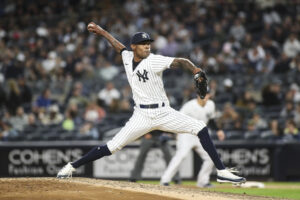
Castro, 28 next month, is one of the youngest free agents on this year’s market, which surely appealed to the D-backs and other interested parties. However, he’s also coming off an injury-marred season in which a shoulder strain limited him to just 29 innings for the Yankees. That injury sidelined Castro for most of July and for all of August and September, though he did return to toss two innings in October. He added another pair of scoreless frames during the ALCS.
Since making his Major League debut with the Blue Jays as a 20-year-old back in 2015, Castro has been traded multiple times and struggled to find consistent success. The flamethrowing righty, who averaged 97.9 mph on his sinker in 2022, has at times looked brilliant but has also battled high walk rates and been occasionally susceptible to home runs. His 2022 season in the Bronx was solid, as he pitched to a 4.03 ERA with above-average strikeout and ground-ball rates (23.7% and 47.5%, respectively) in his 29 frames. However, Castro walked 11.5% of his opponents in his lone season as a Yankee — the fifth straight year in which he’s logged at least an 11% walk rate.
For all the ups and downs with his command, Castro has logged a composite 3.93 ERA in 350 innings across the past six Major League seasons while pitching for the Orioles, Mets and Yankees. His strikeout rate has trended upward over the past three seasons, in particular, sitting at 26.6% in that time. That’s backed up by an above-average 12.8% swinging-strike rate, and Castro has added a hearty 50.8% grounder rate in that time.
Between his age, velocity, ground-ball rate and ability to miss bats, there’s plenty to like in Castro’s game even if his command never turns a corner. The D-backs will surely hope to curtail his proclivity for free passes, but Castro has pitched for five different Major League teams and only once turned in a walk rate under 10% — and that came in 2016 when he threw just 14 2/3 innings with the Rockies. Listed at a lanky 6’7″ and 205 pounds, Castro’s long levers give him excellent extension on his pitches (77th percentile, per Statcast) which can make his perceived velocity even stronger than his already impressive 98mph average — but maintaining control over those long levers has been a persistent challenge that no team has been able to help him overcome to this point.
Castro is the second addition to the Arizona bullpen in the relatively young offseason, as the Snakes also claimed righty Cole Sulser off waivers from the Marlins late last month. Improving a suspect bullpen has been a stated priority for the D-backs, and Castro will give them a youthful veteran to pair with incumbent options Joe Mantiply, Kyle Nelson, Kevin Ginkel and Mark Melancon, the latter of whom will be seeking a rebound after a frustrating 2022 campaign that saw him lose his grip on the closer’s job in Arizona.
Castro’s $3.5MM guarantee will nudge the Diamondbacks’ projected payroll north of $100MM for what would be just the fourth time in franchise history and the first time since 2019. General manager Mike Hazen recently cast doubt on whether ownership would take payroll back to that 2018-19 level ($131MM in 2018, $124MM in 2019), but he did suggest that a bump over last year’s $90MM Opening Day mark was likely. It stands to reason that the D-backs will remain in the market for further bullpen help, and Hazen has previously spoken about the possibility of finding an offensive upgrade behind the dish and perhaps adding a right-handed bat to the lineup.
Diamondbacks Claim Ali Sánchez
The Diamondbacks announced they have claimed catcher Ali Sánchez off waivers from the Pirates.
Sánchez, 26 in January, has gotten a couple of cups of coffee in the big leagues so far, as he played five games with the Mets in 2020 and two more with the Cardinals in 2021. The Cardinals kept him in the minors this year and designated him for assignment in June. He was claimed by the Tigers and then designated for assignment again in October. He then went to the Pirates and now the Diamondbacks on further waiver claims.
He has a reputation as a strong defensive catcher but also had a decent season with the bat in the minors. In 74 Triple-A games this year, he hit .262/.354/.389 for a wRC+ of 101.
The D-Backs only had two catchers on their 40-man roster prior to this move and have been reportedly looking to add in that department. Carson Kelly has been the club’s regular backstop for a few years now but Jose Herrera has just 47 games of MLB experience. Sánchez is out of options but Herrera still has a couple of option years remaining.
As for the Pirates, this leaves prospect Endy Rodriguez as the only backstop on their 40-man roster.
Padres Claim Sean Poppen From Diamondbacks
The Padres announced that they have claimed right-hander Sean Poppen off waivers from the Diamondbacks.
Poppen, 29 in March, has seen some time in the majors in each of the last four years with the Twins, Pirates, Rays and Diamondbacks. Over those four seasons, he’s thrown 67 1/3 innings with a 5.08 ERA, 22.3% strikeout rate, 10% walk rate and 42.9% ground ball rate.
Poppen was frequently optioned by the D-Backs this season and also threw 25 1/3 innings in the minors. In that time, he posted a 4.62 ERA, with a 17% strikeout rate, 6.3% walk rate and 41% ground ball rate. He’s now out of options, meaning the Padres will have to keep him on the major league roster or else place him back on waivers at some point.
There had been no previous indication that Poppen had been designated for assignment but Arizona evidently put him on waivers in recent days. Their recent signing of Miguel Castro gave them a full 40-man roster but this claim drops them to 39. That move was perhaps made with an eye towards next week’s Rule 5 draft.
Padres, Diamondbacks Among Teams Interested In Xander Bogaerts
11:40am: The Athletic’s Peter Gammons cites front office officials from three other teams who are of the belief that Bogaerts will not return to Boston (Twitter link). As he did with regard to Bogaerts playing another position, however, Boras outwardly denied the report, telling Alex Speier of the Boston Globe that Bogaerts is “open to any and all voices in the free agent market” and adding that he and Bogaerts “have not closed any doors on anyone.”
10:04am: Next week’s Winter Meetings are generally expected to serve as a catalyst for what’s been a slow-moving free agent market. As the league’s biggest offseason convention approaches, the interest for some of the top players available is beginning to come into focus.
Xander Bogaerts is part of a loaded shortstop class, and a number of teams have checked in with his representatives at the Boras Corporation. Jeff Passan of ESPN reports the Diamondbacks and Cubs have expressed interest, while adding that previously-reported suitors like the Phillies and Dodgers are in the mix. Meanwhile, Ken Rosenthal of the Athletic reports Padres president of baseball operations A.J. Preller recently checked in with Scott Boras about Bogaerts’ willingness to play a position other than shortstop. Boras, however, flatly rejected the possibility; the agent tells Rosenthal “Xander is playing shortstop” and denied that San Diego would prefer to move him off the position.
San Diego’s interest in Bogaerts isn’t a new development. Marino Pepén listed the Padres as a suitor last week, while Jon Heyman of the New York Post has suggested they’re involved in the top of the shortstop market more generally. The Friars are seemingly serious enough in their pursuit to gauge Bogaerts’ amenability to move off the position.
The infield mix at Petco Park is already crowded, although there are a number of multi-positional options who can move around. Manny Machado is locked in at third base, while the rest of the current infield figures to be made up by some combination of Fernando Tatis Jr., Ha-Seong Kim and Jake Cronenworth. Kim has proven himself an excellent defensive shortstop and earned an everyday role with a .251/.325/.383 showing this past season. Tatis was expected to be the franchise shortstop after a brilliant start to his career earned him a $340MM extension, but he’s now under consideration for a move to second base or the outfield after missing all of 2022 due to injury and a performance-enhancing drug ban. Cronenworth is a quality defender at the keystone, but the Friars have floated the possibility of kicking him over to first base with Josh Bell and Brandon Drury hitting free agency.
Adding a first base/designated hitter type might be the most straightforward path to building out the offense, but there’s no harm for Preller and his staff in considering other avenues. Adding another middle infielder while kicking Cronenworth to first base would give San Diego an elite defensive infield, while Bogaerts is among the top offensive players available regardless of position. He’s long been mentioned as a candidate to move off shortstop towards the end of a free agent deal after years of subpar defensive marks, but he quieted those concerns (at least in the short term) with arguably the best season of his career with the glove. Bogaerts rated as four runs above average in more than 1200 shortstop innings by both Defensive Runs Saved and Statcast this past season. He hasn’t played anywhere else since 2014 and while there’s little question he could handle a less demanding position like second or third base, it doesn’t seem he’s willing to do so.
There are a number of other teams with worse internal options than the Padres that’d surely be willing to plug Bogaerts in at his longtime position. The Diamondbacks relied on rookie Geraldo Perdomo this year, and he looked overmatched to the tune of a .195/.285/.262 line in 500 plate appearances. Nick Ahmed is under contract and can play excellent defense, but he’s always been a below-average hitter and lost almost all of this past season to surgery on his throwing shoulder.
Arizona general manager Mike Hazen is plenty familiar with Bogaerts from his previous work in the Red Sox’s front office, so it’s little surprise they’re interested in adding him given the uncertain shortstop outlook. The question is whether a Diamondbacks team that has had a payroll south of $100MM in each of the past two seasons would be willing to commit a deal of that magnitude. MLBTR predicts a seven-year, $189MM contract for Bogaerts. The D-Backs already have roughly $98MM in salary commitments for next season, per Roster Resource, so adding a salary in the realm of $27MM annually would require owner Ken Kendrick signing off on a major spending hike relative to recent levels.
The Cubs have a cleaner long-term payroll outlook that makes them a viable fit for any of the top shortstops. Nico Hoerner is a quality incumbent, but he’s already expressed a willingness to move to second base to accommodate a big-ticket acquisition. Roster Resource projects Chicago’s 2023 commitments around $127MM, and they’ve opened each of the past two seasons with payrolls in the $140MM to $150MM range. Chicago has pushed spending north of $200MM in the past. There’s room for an aggressive offseason, but president of baseball ops Jed Hoyer and his front office have to weigh whether to invest in the middle infield against other weak points on the roster like center field, first base, catcher and the back of the rotation.
Bogaerts rejected a qualifying offer from the Red Sox, so any signing team will have to forfeit draft choice(s) and/or international bonus pool space to sign him. Boston has consistently maintained retaining him is their top priority, though extension talks dating back at least to Spring Training haven’t gotten anywhere. The Phils are widely expected to be in play for a top shortstop, but reports suggest they’re more dialed in on Trea Turner at the moment. The Dodgers could certainly turn to any of the other shortstops if Turner walks, while the Twins reportedly have Bogaerts as their top fallback if they can’t retain Carlos Correa.
National League Non-Tenders: 11/18/22
The deadline to tender contract to arbitration-eligible players is tonight at 7:00pm Central. Here’s a rundown of the players on National League teams that have been non-tendered today. This post will be updated as more decisions are revealed. All players non-tendered go directly to free agency
MLBTR contributor Matt Swartz projected salaries for all arb-eligible players last month.
Later Updates
- The Reds have non-tendered righty Daniel Duarte and minor league outfielder Allan Cerda, taking both off the 40-man roster. Neither had been eligible for arbitration, but Cincinnati will send both into free agency without having to place either on waivers. Duarte made three relief appearances this year, his first as a big leaguer. Cerda, 23 next month, has yet to reach the majors. He hit .198/.350/.401 in 257 plate appearances in Double-A. Cincinnati also announced that six players designated for assignment earlier this week — Aristides Aquino, Jared Solomon, Kyle Dowdy, Derek Law, Art Warren and Jeff Hoffman — were all let go. Both Duarte and Cerda have already agreed to re-sign with Cincinnati on minor league deals, reports Mark Sheldon of MLB.com (Twitter link).
Earlier Moves
- The Braves freed a pair of 40-man roster spots by non-tendering minor league pitchers Brooks Wilson and Alan Rangel. Rangel spent most of this past season in Double-A, while Wilson didn’t pitch in 2022. Atlanta also announced that three players non-tendered earlier this week — Guillermo Heredia, Jackson Stephens and Silvino Bracho — have been let go.
- The Giants have non-tendered relievers Mauricio Llovera and Alex Young and infielder Donovan Walton, clearing three spots on the 40-man roster. Walton was acquired from the Mariners midseason and hit .158/.179/.303 in 24 games with San Francisco. Young made 24 appearances after his contract was purchased from the Guardians. Llovera pitched 17 times after signing a minor league deal last offseason. Additionally San Francisco non-tendered seven players who’d been designated for assignment earlier this week: Drew Strotman, Meibrys Viloria, Colton Welker, Jarlin Garcia, Dom Nunez, Sam Delaplane and Jason Vosler.
- The Pirates non-tendered lefty Manny Banuelos and catcher Tyler Heineman. Both had been designated for assignment earlier this week.
- The Diamondbacks non-tendered righty Reyes Moronta, the team announced. The reliever posted a 4.50 ERA in 17 outings with the Snakes after being claimed off waivers from the Dodgers.
- The Padres announced they’ve cut loose catcher Jorge Alfaro and righty Efrain Contreras. Alfaro had been projected at a $3.6MM salary this season, a hefty amount after a .246/.285/.383 season. Contreras hasn’t pitched in the majors; he had a tough year in High-A and loses his 40-man spot spot as a result.
- The Cubs have non-tendered center fielder Rafael Ortega, as well as minor league pitchers Brailyn Marquez and Alexander Vizcaino. Ortega has seen a decent amount of action the last two years and had a respectable .241/.331/.358 line through 371 plate appearances this past season. Nevertheless, the Cubs opted against a salary in the $1.7MM range for next year. Marquez has been a top pitching prospect but has battled injury issues for the past few years. Vizcaino was part of the Anthony Rizzo trade with the Yankees but didn’t pitch in the minors this year.
- The Nationals non-tendered righty Tommy Romero. He’d been designated for assignment earlier this week. Washington confirmed the previously-reported decisions to part with Luke Voit and Erick Fedde.
- The Brewers cut loose right-handers Trevor Gott, Jandel Gustave and Luis Perdomo. All three were part of Milwaukee’s middle innings mix, with Gustave’s 45 appearances the most among that group. Gott had a 4.15 ERA over 45 2/3 innings after signing a free agent deal last offseason.
- The Rockies non-tendered infielder/outfielder Garrett Hampson, the club announced. The 28-year-old had been projected for a $2.1MM salary. A speedster with the ability to play anywhere up the middle, Hampson just hasn’t hit at the big league level. He’s coming off a .211/.287/.307 showing through 226 plate appearances.
- The Mets announced they’ve non-tendered Sean Reid-Foley and confirmed they’re letting go of Dominic Smith, who’s non-tender was previously reported. This year, Reid-Foley made seven MLB appearances, tossing 10 innings of relief.
- The Dodgers have non-tendered infielder Edwin Rios and utilityman Luke Williams, per a club announcement. Los Angeles also confirmed the previously reported non-tender of former MVP Cody Bellinger. Rios has shown some offensive promise in the past and owns a .212/.299/.492 line through 112 big league games. He missed a good chunk of this past season with a hamstring strain. Williams was claimed off waivers from the Marlins recently; the Dodgers could look to bring him back on a minor league deal.