
Orioles Acquire Corbin Burnes
The Orioles got their ace. Baltimore announced the acquisition of 2021 NL Cy Young winner Corbin Burnes from the Brewers for rookie infielder Joey Ortiz, left-hander DL Hall, and their 2024 Competitive Balance Round A draft pick (#34 overall). Milwaukee designated lefty Ethan Small for assignment to clear the necessary 40-man roster spot.
There’d been speculation as far back as last offseason about the possibility of the Orioles acquiring a top-end starting pitcher. Baltimore has a loaded farm system that has graduated plenty of young talent over the past two seasons. Most of that has been concentrated on the position player side, making it a natural fit for them to leverage that farm depth to bring in an impact starter.
Burnes certainly qualifies. He established himself in the Milwaukee rotation during the shortened 2020 campaign. The righty has finished in the top 10 in NL Cy Young balloting in each of the past four seasons. He won the award in ’21 thanks to an MLB-best 2.43 ERA across 167 innings. Burnes followed up with a National League-leading 243 strikeouts and a 2.94 ERA across 202 frames the following season.
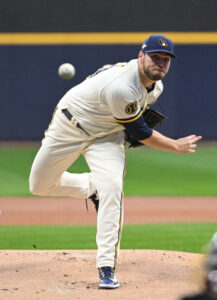
Last season was perhaps his least impressive showing since his 2020 breakout. Yet it could only be classified as a “down” year by Burnes’ immense standards. He remained a top-of-the-rotation pitcher, turning in a 3.39 ERA while logging 193 2/3 innings across 32 starts. His 25.5% strikeout rate was still a few points better than league average, as was his 12.2% swinging strike percentage. He finished eighth in Cy Young voting.
It wasn’t the same level of dominance that Burnes had shown in the preceding three years. He had fanned more than 30% of opponents with a swinging strike rate above 14% in every year from 2020-22. Burnes looked more like his old self down the stretch, however. He carried a 3.94 ERA and a 23.1% strikeout rate into the All-Star Break. In the second half, he fanned 28.6% of opponents while allowing only 2.71 earned runs per nine. Opposing hitters had a pitiful .187/.259/.294 slash line after the Midsummer Classic.
Going back to the start of 2020, Burnes has a 2.86 ERA over 105 appearances. He has punched out nearly 31% of batters faced against a modest 7.1% walk rate. Batters are hitting .197/.262/.308 in nearly 2500 trips to the plate. Neither left-handed nor righty-hitting opponents have had success against him. Outside of a two-week injured list stint early in 2021 because of a finger contusion, he hasn’t missed any time within the last three years.
Burnes is a true ace, one of the 5-10 best pitchers in baseball. He jumps to the top of a rotation that has suddenly gone from Baltimore’s biggest question to one of the higher-upside staffs in the league. Kyle Bradish slots in as the #2 arm after a breakout 2023 campaign in which he worked to a 2.83 ERA over 30 starts. Grayson Rodriguez looks to have turned a corner in the second half. The former top pitching prospect worked to a 4.35 ERA in his rookie season. After being tagged for a 7.35 ERA in his first 10 MLB outings, he turned in a 2.58 mark in his final 13 regular season starts (although he was hit hard in his lone playoff appearance).
That’s a potentially elite top three. Former All-Star John Means returned from Tommy John surgery late last season. Some residual elbow soreness kept him off the club’s playoff roster, but he’s expected to be fully healthy for 2024. If that’s true, he slots in well as the #4 starter. Dean Kremer would likely occupy the final spot, with Tyler Wells and Cole Irvin pushed into season-opening relief roles.
While the O’s could perhaps benefit from another depth addition or two, they’ve landed the true #1 that should represent the finishing move on an already great roster. Baltimore’s loaded young lineup and excellent relief corps led the team to 101 wins and an AL East title a year ago. The O’s lost star closer Félix Bautista to Tommy John surgery at year’s end but moved early in the offseason to sign Craig Kimbrel as a replacement.
It’s likely a one-year acquisition. Burnes will hit free agency next offseason shortly after his 30th birthday. With anything like his typical levels of production, he’ll be in line for a massive contract that could top eight years and $200-250MM. Burnes has been clear about his desire to test his value on the open market. Asked in December about the possibility of signing an extension if he were traded this winter, he said such an offer “would have to be something that would just absolutely blow you away to get you away from testing the free agent market.”
As recently as last week, O’s fans wouldn’t have been able to dream about the organization putting that kind of proposal on the table. Baltimore has dramatically scaled back spending since John Angelos assumed control of the franchise. On Tuesday, the Angelos family agreed to sell the organization to private equity mogul David Rubenstein. How that’ll impact the long-term payroll outlook remains to be seen, but Baltimore fans can be more optimistic about the chances of making significant investments once Rubenstein takes control of the franchise after the sale is approved by MLB in the coming months.
In any case, the primary focus is installing Burnes atop next year’s rotation. The three-time All-Star had settled on a $15.637MM contract with Milwaukee to avoid arbitration in his final season of eligibility. That makes him the highest-paid player on Baltimore’s roster and pushes their 2024 payroll projection to roughly $96MM, as calculated by Roster Resource. It’ll be their highest season-opening payroll since 2018 and is a marked increase over last year’s approximate $60MM mark.
Still, they’re in the bottom third of the league in projected spending. They’re making a push to defend a title in what is annually one of the sport’s most competitive divisions. Their only commitments beyond this season are a $1MM salary for Bautista and a handful of inexpensive option buyouts. Even if this takes them near their spending limit this offseason, they should have flexibility to further bolster the roster near the deadline.
That Baltimore did so without surrendering any of their true top-tier prospects reflects both the strength of their talent pipeline and the value ceiling for any player who is only one year from free agency. Ortiz and Hall are each highly-regarded young players but placed in the back half of Baltimore’s top 10 prospects at Baseball America.
Ortiz, 25, was a fourth-round pick in 2019 out of New Mexico State. He’d drawn praise for his defensive acumen dating back to his time in college. The right-handed hitter has been more productive at the plate than many amateur scouts anticipated. He owns a .286/.357/.449 slash in his minor league career. Ortiz posted even better numbers between the top two levels of the minors a year ago.
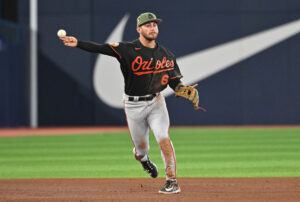
In 389 plate appearances in Norfolk, he hit .321/.378/.507 with nine homers and 30 doubles. Ortiz spent most of his time at shortstop while logging some action at both second and third base. Baltimore promoted him for the first time at the end of April. He nevertheless spent most of the season on optional assignment, appearing in only 15 big league contests. With Jackson Holliday and Gunnar Henderson as the projected left side infield for the foreseeable future, Ortiz would have had a hard time finding much playing time.
Baseball America’s scouting report rates Ortiz as a potential 70-grade (plus-plus) defensive shortstop. Assuming he’s not traded in the next six weeks, Willy Adames will open the season at shortstop. Milwaukee is likely to lose Adames to free agency next winter at the latest, though, leaving a clear path for Ortiz to emerge as the long-term answer. In the short term, he should battle Andruw Monasterio and Owen Miller for playing time at third base. If Monasterio or Miller warrant extended run at the hot corner, Ortiz is an alternative to Brice Turang at second. Turang is a gifted defender but struggled at the plate during his rookie year.
Hall, also 25, was a first-round pick out of a Georgia high school seven years ago. The 6’2″ southpaw has had the same general profile for his entire professional career: huge stuff with worrying control issues. Hall made his MLB debut in 2022 and has logged 33 big league innings over the past two seasons. He owns a 4.36 ERA with a 29% strikeout rate while working almost exclusively in relief.
His 7.6% walk percentage at the MLB level isn’t out of the ordinary. Hall has been a lot less consistent at throwing strikes in the minors, however. He handed out free passes to over 13% of batters faced in 49 innings at Norfolk a year ago, which is right in line with the 13.4% walk rate he owns in his minor league career.
That he also punched out nearly a third of batters faced in Triple-A hints at the excellent arsenal he owns. His fastball averaged nearly 96 MPH in his big league relief work. Hall also worked with a mid-80s slider and changeup while occasionally mixing in a curveball. BA’s scouting report notes that all four of those offerings could be plus or better.
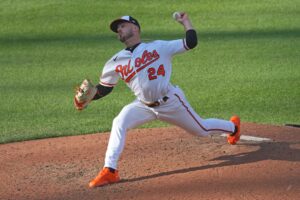
It’s top-of-the-rotation caliber stuff, but Hall’s strike-throwing has led many evaluators to project him as a high-octane reliever. Milwaukee could use him in either capacity. The Brewers have ample opportunity in the rotation behind new staff ace Freddy Peralta. Veteran lefty Wade Miley is a steadying presence. After that, Milwaukee could lean on any of Colin Rea, injury returnees Joe Ross and Aaron Ashby and prospects like Hall and Robert Gasser in the rotation.
Neither Ortiz nor Hall has reached one year of major league service. They’re each under club control for at least six seasons and three years away from arbitration. They’re the kind of high minors players that Milwaukee frequently targets. Their organizational philosophy, much like that of other small-market franchises like the Rays and Guardians, is to eschew traditional competitive windows while building the farm system by trading veterans as they get close to free agency.
GM Matt Arnold stated that trading Burnes isn’t the signal of a traditional rebuild (relayed by Curt Hogg of the Milwaukee Journal-Sentinel). Last week’s signing of Rhys Hoskins to a $34MM free agent deal that allows him to opt out after next season makes clear they’re not giving up on contending in a wide open NL Central. They’ve shown time and again they’ve nevertheless open to offers on most players to try to remain consistently competitive. After trading Josh Hader at the 2022 deadline led to discontent within the clubhouse, the front office suggested they were less inclined to make those kinds of trades during the season.
Between the shoulder injury that led Milwaukee to non-tender Brandon Woodruff and tonight’s move, the Brewers have subtracted their top two starters this offseason. Milwaukee’s payroll projection drops to around $102MM, per Roster Resource. That’s well below last year’s $118MM season-opening mark. That leaves open the possibility of Milwaukee backfilling the rotation in free agency. Arnold was noncommittal as to whether the team planned to reinvest their payroll savings (via Hogg).
Milwaukee should add a third notable young player with the draft choice they acquired. Milwaukee would have received a compensatory pick had they let Burnes depart in free agency — he’ll surely reject a qualifying offer — but that wouldn’t have been until 2025. Baltimore can make Burnes a QO next offseason (and will, unless he suffers a serious injury). As a revenue sharing recipient, they’d land a compensation pick after the first round in 2025 if he signs elsewhere for at least $50MM.
Ken Rosenthal of the Athletic first reported the Orioles were nearing a deal to acquire Burnes. Jon Heyman of the New York Post indicated the deal was agreed upon. ESPN’s Jeff Passan reported that Ortiz and Hall were among the pieces headed to the Brewers. Mark Feinsand of MLB.com reported the inclusion of the draft pick to complete the deal.
Images courtesy of USA Today Sports.
Brewers Designate Ethan Small For Assignment
The Brewers have designated left-hander Ethan Small for assignment, tweets Adam McCalvy of MLB.com. That’s the corresponding 40-man roster move for the two players acquired from Baltimore in the Corbin Burnes trade.
Small was Milwaukee’s first-round pick in 2019 after an excellent college career at Mississippi State. He was initially regarded as one or the better prospects in the organization, but his stock had dipped as he reached the upper minors. Small posted a 4.46 ERA in Double-A in 2022. Milwaukee moved him to the bullpen last year.
The 26-year-old (27 this month) posted decent numbers in relief for Triple-A Nashville. He worked to a 3.18 ERA through 51 innings, striking out 28.5% of opposing hitters. Small also walked 11.2% of batters faced and the Brewers didn’t give him much of an opportunity at the big league level. He pitched twice in the majors last season and has four MLB appearances for his career.
Small doesn’t throw especially hard, averaging 92 MPH on his fastball in his limited MLB work. Prospect evaluators credited him with a plus changeup and his atypical, over-the-top delivery makes him an unconventional look for opposing hitters.
The Brewers will have one week to trade Small or place him on outright waivers. It’s likely he’ll draw interest from another team given his draft pedigree and decent Triple-A résumé. Small has one minor league option remaining. If another team is willing to give him a spot on the 40-man roster, they could keep him in Triple-A for another season.
Nationals, Richard Bleier Agree To Minor League Deal
The Nationals are in agreement with veteran reliever Richard Bleier on a minor league contract, reports Andrew Golden of the Washington Post (X link). It seems likely the left-hander will get a look as a non-roster player in big league Spring Training.
Bleier, 37 next month, is looking to get to the majors for a ninth straight year. Despite well below-average velocity, he has managed a sub-3.00 ERA in five of his eight MLB campaigns. Bleier has never missed many bats, but he induces plenty of ground-balls behind his upper 80s sinker.
As recently as 2022, that translated to solid results. Bleier worked to a 3.55 ERA behind a 52.5% grounder percentage over 50 2/3 innings with the Marlins two years ago. The Red Sox acquired him in a reliever swap sending righty Matt Barnes to Miami last offseason, but Bleier had arguably the worst year of his career in Boston.
In 30 2/3 frames across 27 appearances, the Florida Gulf Coast product allowed 5.28 earned runs per nine. His 55.2% ground-ball rate was still well higher than average, but opponents did an uncharacteristic amount of damage when they did manage to get the ball in the air. Bleier surrendered five homers (1.47 per nine innings), the first time in his career he allowed more than a homer over every nine frames. Without his typical level of weak contact, Bleier’s subpar 12.1% strikeout rate became a more significant problem.
Boston designated him for assignment at the beginning of August. He cleared waivers and was released, setting the stage for a minor league contract with the Cubs. Bleier pitched five times for Chicago’s Triple-A team, allowing six runs with five walks and a pair of strikeouts over 5 2/3 innings. That wasn’t enough for a return to the majors.
Washington’s bullpen skews heavily to the right side. The Nats have Kyle Finnegan, Hunter Harvey, Jordan Weems, Tanner Rainey and offseason pickup Dylan Floro locked into bullpen roles. All those players throw right-handed. Lefty options include Robert Garcia, José A. Ferrer and fellow non-roster player Joe La Sorsa, all of whom still have minor league options remaining.
Guardians Sign Tyler Zuber To Minor League Deal
The Guardians have signed reliever Tyler Zuber to a minor league contract with an invitation to MLB Spring Training, the team announced. The righty joins the third organization of his professional career.
Zuber’s major league time has come exclusively in the AL Central. He was a sixth-round pick of the Royals in 2017. He made Kansas City’s roster during the shortened 2020 season, appearing in 23 of their 60 games as a rookie. He pitched 31 times the following year, working 27 1/3 innings.
Between the two seasons, he pitched to a 5.29 ERA over 49 1/3 frames. Zuber fanned around a quarter of opposing hitters but didn’t show the kind of control necessary to hold an MLB spot. He walked almost 17% of batters faced. Zuber also allowed home runs at an elevated 1.82 per nine clip.
Zuber has not pitched at the MLB level since that point. He opened the 2022 season on the injured list due to an impingement in his throwing shoulder. He underwent surgery that May and missed the whole year. K.C. waived him at season’s end and he landed with the Diamondbacks when they placed a claim. Arizona ran Zuber through outright waivers themselves a couple weeks later.
The Arkansas State product stuck with the organization into 2023. He pitched in 16 games for Triple-A Reno, turning in a 5.23 ERA across 20 2/3 frames. His strikeout rate dipped to 20% while he handed out free passes at an 11.1% clip. The Snakes released him at the start of July. He spent the rest of the year in free agency but has pitched this winter in the Dominican Republic.
While injuries and command issues have sidetracked him in recent years, Zuber posted solid minor league numbers during his time in the K.C. system. He owns an impressive 3.20 ERA in parts of five minor league seasons despite last year’s middling production in Reno. Before the surgery, he worked primarily with a 94-95 MPH fastball and a mid-80s slider at the MLB level.
Diamond Sports Group Expected To Retain Guardians, Rangers, Twins Broadcasts For 2024
Diamond Sports Group has been renegotiating its in-market deals with the Guardians, Rangers and Twins as part of its ongoing bankruptcy proceeding. Evan Drellich of the Athletic reported this morning that MLB expects all three organizations to sign one-year deals to remain on Diamond’s Bally Sports networks for the 2024 season. None of those contracts have yet been finalized.
The Twins’ TV deal expired at the end of the 2023 season. The Rangers and Guardians still had contracts with Diamond, but the broadcasting conglomerate had called those deals unprofitable and threatened to abandon them if they weren’t renegotiated at a lesser fee. Diamond already dropped contracts with the Padres and Diamondbacks during the ’23 season.
That left Cleveland, Texas and Minnesota to discuss reduced terms or to risk losing their local broadcasting fees entirely. According to various reports, Cleveland made $55MM off their TV deal a year ago. Texas took in around $111MM from Diamond, while Minnesota’s contract paid $54MM in its final season.
The specific terms under discussion aren’t known. However, Drellich reports that the Guardians and Rangers are expected to lose 15% or less of what they otherwise would have received in 2024. It’s unclear how much of a reduction Minnesota might need to take on their next contract. On the one hand, that’s still an unenviable position for those organizations. A 15% reduction could knock roughly $8.25MM off the Guardians’ expected revenues, while the Rangers’ deal could be reduced by something in the $17MM range by that criteria. (The precise figures are unclear, since the teams’ anticipated rights fees in 2024 were not necessarily the same as what they’d made in ’23).
At the same time, recouping 85+% of their expected fees is still a better outcome for those teams than moving on from Diamond entirely, which likely would have required the teams to turn to MLB to handle in-market broadcasting. That’s particularly true for Texas, which had one of the game’s more profitable RSN agreements. A one-year deal will still leaves the teams with long-term uncertainty, but they appear on track to remain on the Bally Sports networks for at least one more year.
If/when the new deals are finalized, Diamond will again be responsible for in-market televising for 12 teams. The company has already stated it’ll honor next season’s commitments at full price for the Angels, Braves, Brewers, Cardinals, Marlins, Rays, Reds, Royals and Tigers. Whether Diamond will be able to operate beyond the ’24 MLB season remains to be seen. Its recent restructuring agreement to sell its in-market streaming rights to Amazon for an influx of $450MM is designed to keep the company afloat beyond this year. That is still pending approval from the bankruptcy court. Drellich notes that some within the baseball industry remain skeptical about Diamond’s long-term viability even if the court signs off on its streaming deal with Amazon.
A.J. Hinch Discusses Tigers Infield Plans
Tigers manager A.J. Hinch was a guest on the New York Post’s podcast with Jon Heyman and Joel Sherman this afternoon. The veteran skipper addressed the team’s infield as part of a wide-ranging conversation.
Detroit heads into Spring Training with some uncertainty at both second and third base. The Tigers didn’t have a set starter at either position last season. No single player even reached 250 plate appearances while manning one of those spots. The Tigers haven’t gone outside the organization for any infield acquisitions aside from corner outfielder/first baseman Mark Canha.
On the heels of last week’s near-$29MM extension, top prospect Colt Keith appears the presumptive starter at the keystone. Asked by Sherman whether Keith could make the Opening Day roster, Hinch replied the 22-year-old will “have to come and earn it.” Hinch called it the organization’s expectation that Keith will perform well enough in Spring Training to break camp but stressed the contract alone won’t guarantee him a season-opening job.
As one would expect, Hinch went on to speak effusively of Keith’s offensive upside. The left-handed hitter is coming off a huge year in the upper minors. Keith opened the year with a .325/.391/.585 showing over 59 games at Double-A Erie. He continued hitting after a late-June promotion to Triple-A Toledo. Keith ran a .287/.369/.521 slash in 67 contests with the Mud Hens. He walked at a strong 11.9% clip while keeping his strikeouts to a modest 19.3% rate. Overall, he connected on 27 homers and 38 doubles with a .306/.380/.552 batting line to cement himself among the sport’s most promising offensive prospects.
Keith’s defensive fit isn’t as clear. He’d been a third baseman for the bulk of his career but has seen increasing large portions of time at second in recent years. Hinch confirmed that Keith would play mostly at the keystone moving forward, although he indicated the young infielder could still see occasional reps at the hot corner.
If Keith indeed grabs hold of the second base job, that could push a handful of Detroit’s multi-positional infielders more frequently to third. Zach McKinstry, Andy Ibáñez and Nick Maton all took reps at both positions a year ago. Matt Vierling made 27 starts at third while opening 94 contests throughout the outfield.
Hinch suggested the Tigers were content to mix and match at third base. In response to an inquiry from Heyman about the possibility of going outside the organization for a clearer upgrade, the manager spoke of the team’s comfort with “optionality for (players) to emerge.” Hinch said the team planned to give playing time to each of Ibáñez, McKinstry and Vierling — in addition to any reps which Keith might pick up — and opined they’ll “be able to piece it together and maybe have a better player than (they would’ve with) one singular guy.”
Specifically, the manager pointed out the possibility for “a natural platoon” between the right-handed hitting Ibáñez and the lefty-swinging McKinstry. Ibáñez, claimed off waivers from the Rangers last offseason, had a quietly effective season after being promoted to the majors at the end of April. He hit .264/.312/.433 over a career-high 383 trips to the plate. He did most of his damage against left-handed pitching, connecting on six homers and nine doubles with a .261/.297/.523 line over 118 plate appearances versus southpaws.
Detroit acquired McKinstry on the eve of Opening Day. While he got out to an excellent start, his production cratered from June onwards. He ended the season with a well below-average .230/.297/.356 slash through 472 plate appearances against right-handers. That’s not enough offense for a strong side platoon player, so he’d need to put together better results if he’s to log that kind of playing time now that Detroit has more serious postseason aspirations.
Vierling, a righty hitter, profiles as both a third base option and a fourth outfielder behind Canha, Parker Meadows and Riley Greene. The former Phillie was a league average player in his first season in Detroit, hitting .261/.329/.388 with 10 homers across 530 plate appearances.
Prospects Justyn-Henry Malloy and Jace Jung have third base experience, but neither is sure to make an impact at the position in 2024. Baseball America’s scouting report on Malloy suggests he’s likelier to play the corner outfield because of throwing accuracy issues on the infield dirt. Jung, the 12th overall pick in 2022, finished last year in Double-A. He could play his way into the mix at some point in the year but will start the season in the upper minors.
Nationals, Robert Gsellman Agree To Minor League Contract
The Nationals have agreed to a minor league contract with reliever Robert Gsellman, reports Jon Heyman of the New York Post (X link). He’ll be paid at a $900K rate for any time spent on the MLB roster.
Gsellman returns to affiliated ball after a year and a half in Japan. The right-hander initially signed with the Yokohama BayStars midway through the 2022 campaign. He turned in a 2.66 ERA in 20 1/3 innings down the stretch to secure a new contract last winter.
His second season in Yokohama wasn’t as successful. He allowed 4.45 earned runs per nine over 64 2/3 frames at the highest level. The BayStars sent him to the minors for a point, where he posted a 4.85 ERA through 52 innings. Throwing strikes was an issue for the 30-year-old hurler. He walked 11.3% of batters faced in his time at the NPB level. He paired that with a middling 14.7% strikeout percentage.
The Southern California native has spent over a decade in the professional ranks. Drafted by the Mets in the 13th round in 2011, he pitched his way towards the top of the New York farm system before his 2016 debut. He spent parts of six seasons in Queens, moving to the bullpen by 2018. Gsellman pitched to a 4.59 ERA over 350 2/3 frames as a Met. New York non-tendered him after the 2021 campaign. He saw limited action with the Cubs in ’22 before signing with the BayStars.
Washington had a well below-average bullpen last season, which isn’t surprising for a rebuilding team. The Nats finished 27th with a 5.02 ERA from their relief corps. Kyle Finnegan, Jordan Weems, Dylan Floro, Hunter Harvey and Tanner Rainey are strong bets to hold Opening Day jobs. That could leave two or three middle relief spots up for grabs, although they’re likely carry at least one left-hander in the group.
Dodgers Sign James Paxton
Jan. 31: The guarantee on Paxton’s deal is actually just $7MM, reports Ken Rosenthal of The Athletic. That comes in the form of the previously reported $3MM signing bonus and a $4MM salary. Additionally, Paxton will receive a $2MM bonus for being on the roster for either (but not both) the roster for the Dodgers’ season opener in South Korea against the Padres on March 20 or their domestic opener against the Cardinals on March 28. If not, he’d earn a $1MM bonus if added to the roster before April 15.
Paxton will also earn a $600K bonus for making his sixth, eighth, tenth, 12th and 16th starts of the season, plus a $1MM bonus for reaching 18 starts. In all, there’s an additional $6MM available in incentives. Essentially, if he’s healthy enough for to make the Opening Day roster and make 18 starts, he’ll earn $13MM on the one-year arrangement.
Jan. 23: An active offseason continues, as the Dodgers announced they have signed left-hander James Paxton to a one-year deal. The Boras Corporation client is reportedly guaranteed $11MM, taking the form of a $3MM signing bonus and an $8MM salary. He’d also receive a $1MM roster bonus if he’s healthy enough to be active on Opening Day (or $500K if he starts the year on the injured list but returns by April 15).
The deal also contains up to $1MM in performance bonuses. He’d lock in an extra $250K for making 16 and 18 starts apiece and would max out the deal with another $500K for reaching 20 starts. Los Angeles has yet to formally announce the contract, but they already have a vacancy on the 40-man roster.
Los Angeles has been MLB’s most aggressive team. While they’ve committed upwards of a billion dollars in free agency, the rotation depth still stands as a bit of a question mark. Shohei Ohtani won’t pitch in 2024 as he works back from elbow surgery. The Dodgers signed Yoshinobu Yamamoto and acquired Tyler Glasnow to join Walker Buehler and Bobby Miller atop the starting staff.
There’s huge upside with that quartet, but it’s also a group that carries some risk. Excellent as Yamamoto has been in Japan, he has yet to pitch in the majors. Glasnow’s career high in innings at the MLB level, established last season, is only 120 frames. Buehler missed all of last season recovering from his second Tommy John surgery. Miller had a very good rookie season but only has 22 MLB starts to his name.
L.A. had a few notable departures from the rotation. Julio Urías is a free agent and unlikely to return as MLB investigates domestic violence allegations against him. Clayton Kershaw is still unsigned. While the Dodgers would surely welcome him back, he wouldn’t be an option until at least midseason as he rehabs from shoulder surgery. Ryan Pepiot was dealt to Tampa Bay in the Glasnow deal.
Tony Gonsolin could miss all of next season after undergoing his own TJS procedure in late August. Dustin May will be sidelined into the season after a flexor tendon surgery in early July. With both pitchers starting the season on the injured list, Los Angeles may have had to turn the fifth starter role to one of Emmet Sheehan, Michael Grove, Ryan Yarbrough or Gavin Stone.
Should they finalize a deal with Paxton, he’d take the final spot in the Opening Day staff. He’s certainly not a bankable source of innings either. The 35-year-old has battled myriad injuries throughout his career, particularly over the last four years. He was limited to five starts during the shortened 2020 season. His elbow gave out during his first start of the ’21 campaign, necessitating Tommy John surgery. His efforts to make a comeback late in the ’22 season were derailed when he tore his lat on a minor league rehab stint.
A right hamstring strain forced the 6’4″ southpaw to open last year on the IL as well. He finally made it back on the mound in the second week of May. Despite the long layoff, Paxton brandished the 95 MPH fastball he’d owned before the surgery. For a while, that was translating into excellent results. The Canadian hurler worked to a 2.73 ERA while striking out more than 29% of opposing hitters in 56 innings through the All-Star Break.
He couldn’t maintain that form. Paxton allowed nearly seven earned runs per nine over 40 innings after the Midsummer Classic. His strikeouts plummeted to a modest 19.4% clip, while his walks jumped a few percentage points relative to the first half. Right knee inflammation sent him back to the IL in early September and ended his season a few weeks early. He finished the year with a 4.50 ERA in 96 innings covering 19 starts. His 24.6% strikeout rate was slightly above par, while he walked an average 8% of batters faced.
Given the volatility associated with the Dodgers’ collection of in-house arms, there’s an argument they should’ve pursued a more stable source of volume innings. That’s generally not how they’ve preferred to construct pitching staffs, however. The L.A. front office has shown a willingness to roll the dice on upside plays while accepting health risks. Paxton would be another acquisition of that ilk.
Of course, the Dodgers have the freedom to place those kinds of bets thanks to their spending capacity. Roster Resource projects the organization’s luxury tax commitments for the upcoming season at a staggering $301MM. Signing Paxton would push that number around $313MM, moving ahead of the Yankees and alongside the Mets for the highest payroll in the sport. That comes with a hefty tax bill.
The Dodgers are in the final tier of luxury penalization and have exceeded the threshold in each of the last two years. As a result, they’re taxed at a 110% rate on any spending at this point. Paxton’s deal would come with a $13.2MM fee, bringing their total expenditure to $25.2MM for one year of his services.
That’s a mark that few teams, if any, would come close to matching. Yet it’s the latest reflection of their all-in approach. Paxton would join Ohtani, Yamamoto, Glasnow, Teoscar Hernández, Manuel Margot and returnees Jason Heyward and Joe Kelly as notable offseason pickups as the Dodgers push for an 11th NL West title in the last 12 years.
Jon Heyman of the New York Post first reported the Dodgers and Paxton were working on an agreement. Alden González of ESPN reported the approximate $11MM guarantee. Fabian Ardaya of the Athletic reported the presence of performance bonuses. Heyman was first to confirm the deal was done and the presence of the Opening Day roster bonus, while The Associated Press specified the performance bonus terms and the contract breakdown.
Image courtesy of USA Today Sports.
Padres Hire Craig Stammen For Player Development Role
The Padres have added former MLB reliever Craig Stammen in a player development capacity, reports Jeff Sanders of the San Diego Union-Tribune. The 39-year-old will work as an assistant to both the coaching staff and baseball operations department in a role that sees him interact with the MLB team and minor league affiliates. Sanders notes that former big leaguers Allen Craig and A.J. Ellis — each of whom have worked for the Padres for a few seasons — are taking similar positions.
Stammen had a 13-year playing career in the majors. Despite falling to the 12th round of the 2005 draft, he was a consistently effective reliever for the bulk of that run. Stammen pitched to a 3.91 ERA in parts of seven seasons with the Nationals before signing with San Diego. He played on a series of short-term contracts with the Friars, combining for a 3.36 ERA through 394 1/3 frames in a San Diego uniform.
The Padres re-signed Stammen to a minor league contract last January. Unfortunately, his playing days came to an end in Spring Training. The right-hander sustained a torn capsule in his throwing shoulder during exhibition play. He acknowledged at the time that was likely to end his career and officially announced his retirement in August. Stammen sticks with the organization as he transitions to his post-playing endeavors.
Five Potential Trade Fits For Joey Bart
Joey Bart has been a speculative trade candidate for at least a year. The Giants selected him with the #2 overall pick in the 2018 draft. A few months later, they changed front offices, tabbing Farhan Zaidi to lead baseball operations. Two seasons thereafter, the front office drafted another catcher in the top 15.
That player, Patrick Bailey, now seems the organization’s long-term answer. He reached the big leagues last year and impressed defensively. Bailey rated as a high-end framer and cut down an excellent 28.4% of basestealers. His bat faded after a hot start, but he was impressive enough behind the dish to secure a seventh-place finish in NL Rookie of the Year balloting.
Bart, on the other hand, has not performed at the level expected of such a high draft choice. He has rated as a below-average defender by most public metrics. In 503 MLB plate appearances spread over the last four seasons, he’s hitting .219/.288/.335. Bart has hit 11 home runs but has punched out in over 35% of his trips to the plate.
As a result, he hasn’t secured a lasting spot on the MLB roster. He spent most of last year’s second half on optional assignment to Triple-A Sacramento. Bart’s .248/.357/.393 showing in 244 plate appearances at the top minor league level was below-average. Having turned 27 last month, he’s running out of opportunities to establish himself.
With Bailey having clearly surpassed Bart on the depth chart, the latter was floated as a trade candidate last winter and in advance of the ’23 deadline. San Francisco never found an offer to their liking and held him as minor league depth. That’s no longer possible. Last season was Bart’s final option year. The Giants can’t send him back to Triple-A without first exposing him to waivers.
They have three possibilities: carry him on the MLB roster, waive him, or trade him. It’s unlikely they’ll choose the first course of action. The Giants added Tom Murphy on a two-year, $8.25MM free agent deal to serve as Bailey’s backup. Last year’s Rule 5 selection Blake Sabol is still on the 40-man roster, although he can now be optioned to the minors (which isn’t possible for a Rule 5 pick in their rookie season). Bart is arguably fourth on the organizational hierarchy. Unless San Francisco plans to carry three catchers, he’s not going to make the team barring a spring injury to Bailey or Murphy.
While there’s some chance that his stock has fallen to the point that San Francisco could simply run him through waivers, they’d surely prefer to recoup something in trade rather than risk losing him for nothing. While this isn’t meant to be an exhaustive list, we’ll highlight a few teams that might consider Bart an upgrade over their current backup catcher.
- Brewers: Milwaukee lost Víctor Caratini to the Astros in free agency. They already have their franchise catcher in William Contreras but could consider a depth addition. Milwaukee signed Eric Haase to a big league free agent deal. He’s currently penciled in for the job, but he signed for just $1MM and is coming off a dismal .201/.247/.281 showing in 89 games between the Tigers and Guardians. Haase is already 31 and not a highly-regarded defensive catcher, so the Brewers probably aren’t firmly committed to him holding the backup job. Bart’s mediocre framing metrics might not be a huge concern for a team that has done an excellent job developing the receiving skills of Omar Narváez and Contreras in recent years.
- Diamondbacks: Arizona is going into camp with a competition for the backup job behind Gabriel Moreno. The Snakes have added Tucker Barnhart and former highly-regarded prospect Ronaldo Hernández on minor league deals. They’re trying to push José Herrera, who is on the 40-man roster but only carries a .198/.272/.231 slash line at the MLB level. Herrera has one more option year.
- Marlins: New president of baseball operations Peter Bendix has made one addition behind the plate, acquiring Christian Bethancourt in a cash trade with the Guardians. He joins Nick Fortes, who hit just .204/.263/.299 last season, as the only catchers on the 40-man roster. Barry Jackson of the Miami Herald wrote last week the Fish would be content with a Bethancourt-Fortes tandem, but they could jump on an opportunity to add Bart for a minimal cost. Fortes still has two options remaining.
- Pirates: Pittsburgh lost presumptive starter Endy Rodríguez for the season thanks to an elbow injury suffered in winter ball. Former first overall pick Henry Davis should get the majority of the playing time behind the dish. Pittsburgh’s backup options are Ali Sánchez (who is out of options but signed a major league deal in December) and Jason Delay. The Bucs would probably have to waive Sánchez if they add Bart. The question is whether they prefer the former’s defensive stability over the latter’s potentially higher ceiling.
- Rays: Tampa Bay is going to do something at catcher. Waiving Bethancourt left them with defensive specialist René Pinto as the only backstop on their 40-man roster. Rob Brantly and Alex Jackson are in the organization as non-roster players. The Rays typically emphasize defense behind the dish, so perhaps they’re not enamored with Bart, but no one has a clearer ability to carry him on the MLB team.