
Bill Mazeroski Passes Away
The Pirates announced this morning that Hall of Famer Bill Mazeroski passed away yesterday at age 89. The team’s statement included a tribute from chairman Bob Nutting, who described Mazeroski as “one of a kind — a true Pirates legend, a National Baseball Hall of Famer and one of the finest defensive second basemen the game has ever seen.”
“His name will always be tied to the biggest home run in baseball history and the 1960 World Series championship, but I will remember him most for the person he was: humble, gracious and proud to be a Pirate.”
A career Pirate who played 17 seasons in the big leagues from 1956-72, Mazeroski is best-known for his legendary walk-off home run in Game 7 of the 1960 World Series. The Pirates had won their first National League pennant since 1927 on the strength of eight All-Star players, including Mazeroski. Still, they faced a challenge in overcoming a powerful Yankees roster featuring Mickey Mantle, Roger Maris, Whitey Ford, and others.
With the Series tied at three games apiece, it was Mazeroski who delivered the winning blow in the bottom of the 9th of a wild Game 7. On a 1-0 count against Yankees pitcher Ralph Terry, Mazeroski drilled a high fastball over the left-center field wall to clinch the Pirates’ 10-9 victory and the championship. It was their first World Series title since 1925 and the first time a World Series ended on a walk-off home run. To this day, Mazeroski’s blast stands as one of the most iconic home runs in the history of the sport.
Mazeroski joined the Pirates organization out of high school in 1954, and made his MLB debut in July 1956 at the age of 19. He played his first full season in 1957 and established himself as a contact-oriented second baseman, batting .283 with 149 hits and 59 runs scored. His 1958 season was arguably his best, as Maz batted .275/.308/.439 in 607 plate appearances with 156 hits and 19 home runs, the latter being a career high. He was an All-Star for the first time and also earned his first Gold Glove while finishing eighth in NL MVP voting.
In addition to being a contact hitter, Mazeroski’s career came to be defined by his defense. He won a total of eight Gold Gloves, including five straight from 1963-67. His defense alone was valued at 24.0 bWAR, which ties him for 23rd all-time. Mazeroski holds the record for most double plays turned (1709) as a second baseman, and his 6685 assists from the keystone ranks fifth all-time. No discussion of the game’s best defensive players is complete without mention of Mazeroski’s accomplishments.
In an 11-year stretch from 1958-68, Mazeroski tallied 1,608 of his 2,016 career hits while batting .263/.300/.374 and accumulating 32.1 bWAR. He was remarkably durable, playing at least 130 games with 527 PA or more every year from 1957-68. He earned a total of seven All-Star nods, the last of those coming in 1967 when he led the NL in games played and tallied a career-high 167 hits. He became more of a part-time player at the end of his career and won a second World Series in 1971 against the Orioles. He retired in 1972 at the age of 35.
Overall, Mazeroski batted .260/.299/.367 with 2,016 hits, 138 home runs, and 853 runs batted in. He became eligible for Hall of Fame admission in 1978 but did not meet the required threshold before falling off the ballot in 1992. Most pointed to his lower-than-usual offensive output as a reason for exclusion, but the Veterans Committee disagreed in 2001, admitting Mazeroski to the Hall in recognition of his defensive excellence.
We at MLBTR extend our condolences to Mazeroski’s family, friends, loved ones, former teammates, and baseball fans around the world.
Injury Notes: Simpson, Freeman, Junk, Pereira
Outfielder Chandler Simpson is experiencing left hamstring tightness in early camp, according to Marc Topkin of the Tampa Bay Times. The Rays will keep him out of the first few exhibition games to allow him time to rest. “Right now, we’re going to slow play him, just get his legs underneath him,” said manager Kevin Cash on Friday. Cash went on to emphasize the value of Simpson’s speed and the importance of getting him back to 100% rather than risk further injury.
Indeed, Simpson is one of the fastest players in the game. His 29.6 MPH sprint speed ranked in the 97th percentile according to Statcast. Meanwhile, his 44 stolen bases in 2025 tied with the Guardians’ Jose Ramirez for second in the majors, with Simpson achieving that in 49 fewer games. That said, while he has value as a speed and contact guy, he’s also limited by on-base and defensive issues. His outfield glovework was viewed negatively by Defensive Runs Saved (-9) and Outs Above Average (-5) in 2025. Continued hamstring issues might hamper his defense even more, so it makes sense for the Rays to ease him into game action.
A few other injury updates around the game:
- Rangers infielder Cody Freeman will be out for 4-6 weeks with a lower back fracture, according to manager Skip Schumaker (link via Shawn McFarland of Dallas Morning News). Freeman felt some discomfort a few days ago that lingered into yesterday, at which point scans revealed the fracture. The 25-year-old made his big-league debut last year, though his line of .228/.258/.342 in 121 plate appearances was underwhelming. He did much better at Triple-A, grading out 31% better than average by wRC+. Freeman was set to compete for an Opening Day roster spot but will now be out until late March at best. He’ll be re-evaluated at that point and will obviously need time to ramp up, so he won’t be ready for Opening Day.
- Marlins right-hander Janson Junk rolled his ankle in team workouts earlier this week. He was diagnosed with a Grade 1 sprain after undergoing testing, though he is now out of his walking boot and playing catch (video from Christina De Nicola of MLB.com). For his part, Junk said on Thursday that he doesn’t expect to miss multiple weeks. The 30-year-old impressed in a swingman role last year, accruing 2.5 fWAR in 110 innings thanks to his sweeper (+8 run value according to Statcast) and a microscopic 2.9% walk rate. He had been building up as a starter thus far. Manager Clayton McCullough confirmed that is still the case and that the team will “just see how this setback… affects what he can end up getting to by the end of camp” (link via De Nicola).
- White Sox outfielder Everson Pereira is currently day-to-day with right side tightness, per James Fegan of Sox Machine. The 24-year-old was acquired in a four-player trade with the Rays in November which saw the team part with a solid reliever in Steven Wilson. On that basis, the team was expected to carry the out-of-options Pereira on the roster as a backup outfielder. That may still be the case since Pereira is merely day-to-day and hasn’t been placed on the injured list. Luisangel Acuña is also on hand, though he will split time between the infield and outfield and shouldn’t affect Pereira’s roster spot if the latter is healthy by the end of camp.
Photo courtesy of Kim Klement Neitzel, Imagn Images
Three Starting Pitchers Looking To Bounce Back In 2026
Many teams added to their rotations this offseason. Some opted to raise their ceiling by signing big-name free agents. The Blue Jays brought in Dylan Cease, the Red Sox signed Ranger Suarez, and the Tigers added Framber Valdez, to name a few. Others tried to maintain their floor by retaining existing starters and acquiring depth. The Padres fit the latter mold, as they brought in Griffin Canning, Germán Márquez, and Walker Buehler on low-cost deals this week.
While starting pitchers aren’t quite as volatile as relievers, injuries and underperformance still led many to post tough seasons in 2025. Tonight, we take a look at three bounce-back candidates: a top free agent, a veteran starter, and a minor-league signing.
Top Free Agent: Zac Gallen
Gallen has been a front-of-the-rotation arm at his best. From 2022-23, he posted a 3.04 ERA in 394 innings for the Diamondbacks. He struck out 26.4% of hitters in that span and ranked eighth among qualified starters with a 20.4% K-BB rate. His 9.3 fWAR ranked sixth ahead of Giants ace Logan Webb. Entering his age-28 season in 2024, there was reason to believe Gallen would continue to pitch at his prime level.
His numbers that year were still solid, if a step down from ace territory. Gallen missed a month with a right hamstring strain but still made 28 starts with a 3.65 ERA. He actually upped his groundball rate from 41.8% in 2023 to 46.2% in 2024. That said, his strikeout and walk rates both trended in the wrong direction, the latter now closer to average after two years of excellent control. Gallen slipped further in 2025. Though he stayed healthy and covered 192 innings in 33 starts, his ERA jumped to a career-high 4.83, his first below-average mark since 2021. The strikeouts slipped further to 21.5%, while his expected stats (4.28 xERA) suggest he was better than the surface numbers, but not by much.
Gallen entered the offseason as a buy-low candidate, as far as former aces go. We at MLBTR projected him for a four-year, $80MM contract even after his down year. In the end, his market didn’t develop as hoped. Gallen settled for a one-year, $22.025MM reunion with Arizona that nominally matched the value of the team’s qualifying offer in November.
Obviously, the team would love to see him return to his 2022-23 form. At the very least, Gallen figures to provide 30 starts of mid-rotation production, though he’ll undoubtedly aim for more in hopes of securing a multi-year contract next time around. The key for Gallen will be refining his breaking pitches, which graded out poorly in 2025 by Statcast’s run value metric. His curveball was worth 15 runs above average in 2024, but that fell to -4 this year, with opponents slugging over .200 more on the pitch. He’ll also look to bring up the strikeouts and keep the ball in the yard, having allowed the third-most home runs (31) of any qualified starter in 2025.
Veteran Starter: Sean Manaea
Manaea re-signed with the Mets on a three-year, $75MM deal during the 2024-25 offseason. At the time, he was coming off a strong 3.47 ERA in 181 2/3 innings in his return to full-time starting pitching (having mostly been a reliever for the Giants in 2023). With New York in 2024, Manaea struck hitters out at a 24.9% clip and did a decent job at keeping the ball in the yard compared to his career numbers. His .249 BABIP suggested he benefitted from good luck, but even so, he figured to provide solid, mid-rotation value on his new deal.
Unfortunately, his 2025 season was the exact opposite of his 2024. Manaea went down with a right oblique strain in March and missed the first three and a half months of the season. At one point, he experienced a setback when the team found loose bodies in his throwing elbow. Finally debuting on July 13, he made 15 appearances (12 starts) with a 5.64 ERA. Curiously, he posted that high ERA despite striking out a career-best 28.5% of hitters and walking a career-low 4.6%. Meanwhile, his expected stats (4.00 xERA and 3.30 xFIP) painted a much better picture than his surface-level numbers.
On the other hand, Manaea struggled badly with the long ball in 2025, allowing 13 in just 60 2/3 innings (1.93 HR/9). He also curiously ditched his sinker, which was worth 10 runs above average in 2024, to instead throw his four-seamer over 60% of the time. Opponents slugged .129 higher against the four-seamer compared to 2024, when he used it half as much. Manaea also upped his sweeper usage but saw diminished results, including a 9.6% drop in strikeout rate and a .148 increase in slugging.
Perhaps that was a mechanical problem. Manaea adopted a lower arm slot in 2024 and had a very productive second half. The combination of his oblique injury and further attempted mechanical adjustments may have contributed to his poor 2025 numbers, per Mets manager Carlos Mendoza (link via Alex Smith of SNY). The keys for him in 2026 will be regaining his pre-injury mechanics, differentiating the two fastballs like he did in 2024, and continuing to get chases on the sweeper.
Minor-League Signing: Walker Buehler
The current version of Buehler is far from the one who finished fourth in NL Cy Young voting in 2021. The now 31-year-old has pitched 266 1/3 innings since the end of that campaign. He missed all of 2023 while recovering from August 2022 Tommy John surgery. He returned for 16 starts in 2024, but the results were decidedly poor. Buehler struck out just 18.6% of hitters against an 8.1% walk rate and allowed nearly two home runs per nine innings. His once-vaunted four-seamer was now his least valuable pitch at 13 runs below average. Buehler pitched well in the postseason for the World Series-winning Dodgers, though. The Red Sox then took a chance on a one-year, $21.05MM deal.
Unfortunately, 2025 was not kind to him either. Buehler pitched 126 innings in 26 appearances (24 starts) with a 4.93 ERA. His velocity was down on every pitch except his slider. His strikeout rate fell to just 16.3%, while his 5.5% K-BB rate was fifth-worst among starters with at least 100 innings pitched. Boston released him at the end of August. Though he did alright in a small sample with the Phillies after that, it was clear that Buehler wouldn’t do nearly as well on the market this time around.
Now competing for a back-of-the-rotation spot in San Diego, Buehler will have to work hard to regain some value. He could start with adjusting his pitch mix. He has already steadily decreased his four-seam usage as it continues to lose velocity. Meanwhile, Buehler’s sinker was well-regarded by Statcast in 2025, grading out as 6 runs above average. Making the sinker his primary fastball might help him evolve into a soft-contact, groundball pitcher. His hard-hit percentage and average exit velocity were in the 70th percentile or better in 2025, so building on that might be his best path to prolonging his career.
Photo courtesy of Benny Sieu, Imagn Images
Padres Sign Germán Márquez
February 17th: According to Kevin Acee of the San Diego Union-Tribune, Marquez gets a $1MM salary followed by a $750K buyout on the mutual option. Marquez will also have the chance to unlock an extra $3.25MM in performance bonuses.
February 16th: The Padres announced Monday that they’ve signed right-hander Germán Márquez to a one-year deal with a mutual option for 2027. The L.A. Sports Management client is reportedly guaranteed $1.75MM. San Diego placed righty Jhony Brito, who underwent internal brace surgery last May, on the 60-day injured list to open a spot on the 40-man roster.
The team was known to be looking for low-cost rotation pieces and a complementary bat, per comments from president of baseball operations A.J. Preller a few days ago. They achieved the latter by bringing in Nick Castellanos on a one-year deal upon his release from the Phillies. Now, they’ve addressed the rotation side through one-year-deals for Márquez and fellow right-hander Griffin Canning. Canning is coming off an Achilles injury and projects as a back-end starter once he is healthy enough to return. Márquez figures to serve as back-of-the-rotation depth as well.
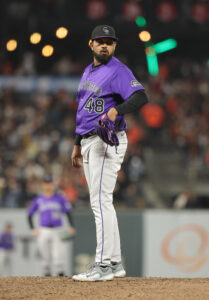
The 30-year-old (31 later this month) is coming off a ten-year major-league run with the Rockies. After a brief debut in 2016, he settled in as one of the team’s most reliable starters from 2017-21. In that span, he totaled 793 2/3 innings over 135 starts and posted a 4.25 ERA, a 24.0% strikeout rate, and a 6.9% walk rate. Márquez excelled through a combination of control and strong groundball tendencies. He was worth 15.5 fWAR in those five years and continually posted groundball rates in the mid-40s and low-50s, including a career-high 51.6% in 180 innings in 2021.
His performance began to wane from 2022 onward. He still made 31 starts in 2022, but his strikeout rate fell below 20% for the first time since his 20 2/3-inning sample in 2016. His run prevention slipped as well, with Márquez posting a below-average 4.95 ERA and elevated peripheral stats. He then underwent Tommy John surgery in May 2023, costing him the rest of that year and the first few months of 2024. His return in July 2024 only lasted one start, and he spent the rest of the season on the injured list with elbow inflammation, although his UCL was reportedly fine.
In 2025, Márquez pitched 126 1/3 innings over 26 starts but was clearly working with diminished stuff. His four-seamer was down to 94.8 MPH after averaging 95.6 MPH in his most recent healthy season in 2022. His sinker, which used over 20% of the time, also slipped from 95.1 MPH to 94.3 MPH. Statcast graded his fastballs in just the first percentile by run value, while his knuckle curve, formerly his best pitch, also earned career-worst grades. The strikeouts dried up even further, with Márquez’s 14.0% strikeout rate ranking third-worst among starters with at least 100 innings. The Rockies decided to move on as Márquez reached free agency.
Perhaps a change of scenery will help Márquez recover some of his strikeout and groundball tendencies as he moves further from injury. He’ll get that chance with the Padres, who now have a decent amount of rotation depth. The team saw Dylan Cease depart for the Blue Jays but re-signed Michael King on a three-year deal in December. Yu Darvish will miss 2026 while recovering from an internal brace procedure, and he is reportedly contemplating retirement. Joe Musgrove is returning from Tommy John surgery and will be guaranteed a spot if healthy. That leaves King, Nick Pivetta, and Musgrove in the top three spots, with some combination of Márquez, Canning (when healthy), Randy Vásquez, and JP Sears taking the last two spots.
Each of King, Musgrove, Márquez and Canning comes with injury risk, though the Padres always seemed likelier to stockpile depth than bring a big-name starter at this stage in the offseason. Zac Gallen was the last impact starter in free agency before re-signing with the Diamondbacks. Either way, his $18.7MM luxury tax number might have been too much given the team’s reported payroll constraints. Low-cost signings like Canning and Márquez seem easier to accommodate, barring a potential buyout agreement for Darvish.
RosterResource has the team at a $264.7MM luxury tax payroll for 2026, putting them in the second tier of penalization. The Padres paid the luxury tax in 2025 and would count as second-time payors in 2026. Thus, any money guaranteed to Canning and Márquez would come with an additional 42% surcharge.
Alden González of ESPN first reported the Padres were signing Márquez to a one-year deal. Ken Rosenthal of The Athletic reported the mutual option. The Associated Press reported the $1.75MM guarantee. Photo courtesy of Kelley Cox, Imagn Images
Nationals, Cionel Perez Agree To Minor-League Deal
The Nationals have agreed to a minor-league deal with left-hander Cionel Perez, according to Francys Romero of Beisbol FR. Perez earns an invite to major-league Spring Training. He will earn $1.9MM if he makes the roster, with $700k in incentives, per Jon Heyman of the New York Post. Perez is represented by Octagon.
Perez is an eight-year big-league veteran. After stints with the Astros and Reds from 2018-21, he was claimed off waivers by the Orioles in November 2021 and subsequently earned a larger role. His first season in Baltimore was his best. Perez posted a shiny 1.40 ERA in 57 2/3 innings across 66 appearances in 2022. His expected stats weren’t quite as high on him, though his 3.63 xERA and 2.80 FIP still painted the picture of an above-average reliever. Perez excelled that year by keeping the ball in the park and getting plenty of groundballs. His 51.3% groundball rate was tied for 33rd among 152 qualified relievers that year. His 0.31 HR/9 rate was 11th-best.
Perez’s 2023-24 numbers were more serviceable than great. His strikeout and walk numbers both trended in the wrong direction from 2022, leaving him with a 7.2% K-BB rate. He still excelled at inducing grounders, with a 58.3% groundball rate across those two seasons (including a career-best 60.7% mark in 2023). Altogether, he posted a 4.04 ERA in 107 innings from 2023-24.
Batters teed off on Perez in 2025. In 19 appearances in the season’s first two months, he posted an ERA of 8.31 with an elevated 16.4% walk rate, his highest since 2021 with the Reds. More surprisingly, after allowing just four home runs in total from 2022-24, Perez allowed three in only 21 2/3 innings in 2025. A .379 BABIP and 3.93 xERA suggest he was the victim of bad luck, but his 5.77 FIP implied he was doing poorly independently of his defense. By the end of May, the Orioles had seen enough. Perez was designated off the 40-man roster and spent the rest of the year at Triple-A, pitching to a 6.85 ERA in 22 1/3 innings.
Despite the disappointing end to his Orioles tenure, a look at Perez’s Statcast page gives some reason for optimism. His fastball velocity, expected batting average, barrel rate, and groundball rate all would have ranked in the 71st percentile or better had he pitched enough to qualify. As recently as 2024, Perez’s slurve and sinker were above average pitches by run value. Opponents slugged just .282 and .314 against those pitches, respectively.
For the rebuilding Nats, there is no risk in bringing Perez into the fold of what is otherwise a young, inexperienced bullpen. Julian Fernandez and waiver claim Richard Lovelady are the only projected members with even two years of service time, per RosterResource. At the least, Perez is an experienced lefty with a high groundball rate who could turn into a trade candidate by the deadline if he rebuilds his value. Assuming he makes the roster, his $1.9MM salary would bring the Nationals’ payroll to $95.38MM and their luxury tax payroll to $118.18MM.
Photo by Daniel Cusin Jr., Imagn Images
Orioles Acquire Jackson Kowar
The Orioles have acquired right-hander Jackson Kowar from the Twins in exchange for cash considerations, according to Roch Kubatko of MASN. The team placed fellow right-hander Colin Selby on the 60-day injured list with right shoulder inflammation in a corresponding move. Both teams have announced the move.
Kowar was designated for assignment by the Twins on Thursday. Prior to that, he had only recently been claimed off waivers from the Mariners. Kowar spent most of 2025 shuttling back and forth from Triple-A, though he did make 15 appearances (17 innings) at the big-league level. He had a 4.24 ERA in that sample, along with a 21.1% strikeout rate and a 9.9% walk rate. Kowar’s expected stats were more pessimistic, with his 5.15 xERA and 5.84 FIP suggesting he benefited from good luck.
Since his debut in 2021, Kowar has thrown 91 innings over 54 appearances (eight starts) between the Royals and Mariners. Unfortunately, he owns an unsightly 8.21 ERA in that time, with his expected numbers putting him in the upper-5.00s. His 20.3% strikeout rate is serviceable, but the righty has struggled with control to the tune of a 13.1% career walk rate. He also struggles to keep the ball in the yard, having allowed 19 home runs throughout his career (1.88 HR/9). Injuries certainly haven’t helped his performance. In March 2024, he suffered a torn ulnar collateral ligament and underwent Tommy John surgery while with the Mariners. Though he returned in May 2025, he missed the last month and a half of the season with a right shoulder impingement.
Kowar makes for an interesting low-cost flier for the Orioles’ bullpen mix. Statcast graded his fastball velocity in the 90th percentile and valued the pitch at two runs above average in 2025. Unsurprisingly, Kowar leaned on the pitch 57.7% of the time. The key for him will be improving his location and avoiding hard contact, as hitters slugged .476 against the pitch in 2025. His mid-80s slider was his second most-used pitch could be a plus pitch going forward. While it had a -1 run value this year, Kowar struck out 39.1% of hitters on that pitch. He has less than three years of service time and is out of options, so the club would need to pass him through waivers if he doesn’t make the roster.
Recent reports indicated that Selby was dealing with shoulder inflammation. He’ll now open the season on the injured list and will stay there until at least late May. Selby was acquired from the Royals in a July 2024 cash trade. He has thrown 18 big-league innings for Baltimore since then, 14 of them coming in 2025. In that small sample, he impressed with a 3.21 ERA and a microscopic 3.3% walk rate (which was admittedly an outlier from his career numbers). Selby’s sinker, slider, and knuckle curve all graded slightly above average in terms of run value. He has less than a year of service time and is also out of options, so he’ll need to perform well upon his return or else risk being placed on outright waivers.
Photo courtesy of Dennis Lee, Imagn Images
Giants Sign Luis Arraez
Feb. 10: The Giants officially announced the signing of Arraez on Tuesday morning. Right-hander Randy Rodriguez, who underwent Tommy John surgery last September, moves to the 60-day injured list to open a spot on the 40-man roster.
Jan. 31: The Giants and infielder Luis Arraez are in agreement on a one-year contract, according to Jorge Castillo of ESPN. Arraez will earn $12MM and is expected to play second base, according to Daniel Alvarez-Montes of El Extrabase. The deal is pending a physical. Arraez is a client of MVP Sports Group.
Arraez entered the offseason seeking a multi-year deal and was reportedly prioritizing teams that would play him at second base. He now gets his wish, as the Giants will slot him in at the keystone to round out their infield mix. Arraez passed up multi-year offers from other teams in order to play second base, according to multiple reports, including from Bob Nightengale of USA Today. We at MLBTR projected Arraez for a two-year, $24MM contract at the start of the offseason. This deal matches that in terms of annual value and allows Arraez to return to free agency following the 2026 season.
The addition of Arraez brings the Giants’ 2026 payroll to $206MM, according to RosterResource, nearly $30MM above last year’s payroll. Their CBT payroll for 2026 now stands at $232.7MM, which leaves about $11.3MM for future additions before the Giants reach the first luxury tax threshold. Arraez represents the second eight-figure signing this week for the club, after they inked Harrison Bader to a two-year, $20.5MM deal on Monday.
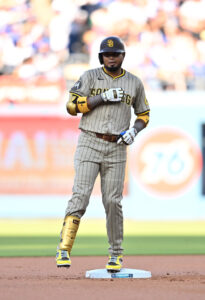
Arraez will add a contact-oriented bat to a power-heavy infield. Matt Chapman and Willy Adames combined for 51 home runs last season. Rafael Devers added 20 homers in his 90 games with the team. Top prospect Bryce Eldridge is waiting in the wings to add another big bat to the mix. Each of those hitters comes with varying degrees of strikeout concerns, and Arraez should help balance out some of the swing-and-miss in the middle of the lineup.
The 28-year-old Arraez is coming off a relatively poor season by his lofty batting average standards. He hit .292 in his lone full season in San Diego. That mark still ranked in the top five in the National League, but it was the lowest of his seven-year career. A .289 BABIP could be to blame for the dropoff, though Arraez’s batted ball profile also took a step back.
Arraez has never hit the ball hard, instead relying on a ridiculously low strikeout rate and an all-fields approach to rack up hits. He reached new depths with the hard-hit rate in 2025, ranking dead last among qualified hitters at 16.7%. His previous career low was a 22.7% hard-hit rate as a rookie with Minnesota. He still squared the ball up at one of the highest rates in the league (42.6%), but that doesn’t mean much when you have an extremely low bat speed. Arraez’s average bat speed was about 9 mph below league average last season.
The defensive fit is an unsettling one. Arraez earned poor grades in the field in 2023 and 2024, combining for -26 Outs Above Average across the two seasons. He served as Miami’s primary second baseman in 2023, but moved to first base after getting dealt to the Padres in May 2024. The vast majority of Arraez’s defensive reps came at first base this past season. He posted -9 OAA, though Defensive Runs Saved had him at +3. Arraez will now slot in alongside Devers, who has also earned ugly fielding grades over the past few seasons. Scouts are not excited about Eldridge’s defensive ability, either.
As multiple Cardinals reporters pointed out, including Jeff Jones of the Belleville News-Democrat, the addition of Arraez might remove the Giants from the Brendan Donovan trade discussion. The same goes for Nico Hoerner of the Cubs. San Francisco was known to be working hard on finding a second base upgrade and had engaged in trade talks for both players.
The club’s second basemen finished 26th in OPS in 2025. Tyler Fitzgerald, Casey Schmitt, and Christian Koss handled the majority of the at-bats at the position. Schmitt is the only one trending toward a role with the big-league club next season, assuming he’s recovered from offseason wrist surgery. Given his defensive versatility and underwhelming production at the plate, he’s best-suited for a utility role. Schmitt could conceivably earn second base starts over Arraez against lefties, though his .674 career OPS vs. southpaws is nearly identical to Arraez’s .673 mark.
Photos courtesy of David Frerker and William Liang, Imagn Images
Poll: How Will The Yankees’ Rotation Fare In 2026?
Much has been made of the Yankees’ apparent offseason strategy of “running it back.” While retaining Trent Grisham and especially Cody Bellinger surely count as successes, some fans were hoping for more tangible improvements. Aaron Judge will be 34 in April, and there are only so many years left in his prime (at least as a perennial MVP candidate). The Blue Jays, Orioles, and Red Sox have all upgraded their rosters, meaning the Yankees will have their work cut out for them in 2026.
One area with a range of potential outcomes is the rotation. The group performed quite well in 2025, placing eighth in the league with a combined 13.5 fWAR. Max Fried and Carlos Rodón were the biggest reasons for that success. Fried excelled in a career-high 195 1/3 innings, showcasing his signature control and groundball tendencies en route to a fourth-place finish in AL Cy Young voting. Rodón matched Fried’s innings total in his best season as a Yankee, posting a 3.09 ERA with an above-average 25.7% strikeout rate and cutting down on home runs. Rookie Will Warren made 33 starts and showed promise, as did Cam Schlittler in a second-half callup.
The ceiling is clearly high, especially if Warren and Schlittler do well in their sophomore campaigns. Still, there are downside risks related to injuries, underperformance, and depth. Starting with injuries, Gerrit Cole will be back at some point after missing last year due to Tommy John surgery. Prior to that, he only pitched half a season in 2024 due to elbow inflammation. He is now 35 years old with his last full-season workload coming in 2023, when he won the AL Cy Young award.
Manager Aaron Boone said last week that Cole has “had a good rehab” with “no hiccups” (link via Manny Randhawa of MLB.com). It’s not a matter of whether he will perform well when he returns. The question is whether he will sustain his ace-level, pre-injury performance now that he is in his mid-30s and coming off of injury. There is also the matter of volume, as even a June return from Cole would leave several months’ worth of innings for other starters to cover.
Rodón is in a similar spot after undergoing surgery in October to remove loose bodies in his elbow. He is more likely to avoid starting 2026 on the 60-day injured list than Cole, with Rodón aiming to return in late April or early May. He is two years younger than Cole, so he’s less of a risk to suddenly decline. The question with Rodón is whether he can repeat his 2025 performance. A look at his Statcast page offers reason for optimism, with his fastball, breaking, and offspeed run values all grading in the 91st percentile or better. That said, he was more of a mid-rotation starter in 2024, when he posted a 3.95 ERA and allowed 1.59 home runs per nine innings. Both he and Cole are under contract through 2028.
As for the younger arms, a lot of the rotation’s success depends on improvement from Warren and Schlittler maintaining his performance over a larger sample. For Warren, that comes down to improving his secondary offerings. While his fastball graded out in the 95th percentile by run value, his breaking and offspeed pitches were points of struggle. His slider was his main breaking pitch, but Statcast considered it 10.6 runs below average. His curveball and changeup were both at least 4.6 runs below average. His 24.1% strikeout rate was impressive, but he’ll need to sharpen his secondary offerings and cut back on hard contact if he wants to become a true mid-rotation starter.
Schlittler was a revelation in 14 starts last year. He had a 2.96 ERA and a 27.3% strikeout rate in 73 innings during the regular season and turned in an all-time rookie performance in Game 3 of the Wild Card Series against the Red Sox. His ceiling is arguably higher than Warren’s, although there are similar questions regarding his secondary offerings and control. Statcast took a negative view of his curveball and slider, which he only used a combined 17.3% of the time. Meanwhile, his 10.2% walk rate could use some improvement. None of that diminishes the value of his plus fastball, of course. Still, he’ll need to make adjustments in order to sustain last year’s performance.
Outside of those arms, the club has Luis Gil and newly-acquired Ryan Weathers on hand. Gil won the AL Rookie of the Year award in 2024 but only threw 57 innings over 11 starts last year due to a right lat strain. His 3.32 ERA was good on the surface, but his peripheral numbers – 4.94 xERA and 4.63 FIP – painted him about a run and a half higher. His struggles with control are well-known at this point, and he also suffered a 10.0% drop in strikeout rate in 2025.
Weathers has 86th-percentile fastball velocity, but he has only thrown 281 big-league innings since debuting in 2021. Last year, he was limited to eight starts and 38 1/3 innings due to left flexor and lat strains. The Yankees shelled out four prospects to acquire him, so they’ll give him a chance to harness his fastball while betting on better health. Otherwise, the team has Ryan Yarbrough and Paul Blackburn as depth options. Yarbrough did well enough last year, but neither option inspires much confidence if they need to cover significant innings. Meanwhile, Clarke Schmidt underwent UCL surgery in July, so he won’t be an option until the second half, if at all.
How do you think the Yankees’ rotation will fare in 2026? Be sure to let us know in the poll.
How Will The Yankees' Rotation Fare In 2026?
Photo courtesy of Rafael Suanes, Imagn Images
Looking At The Angels’ Internal Infield Options
The Angels have had a quiet offseason. It can be argued their biggest move was restructuring Anthony Rendon‘s final year under contract, with the two parties deferring his $38MM salary over five years. In terms of adding to the roster, the club signed Jordan Romano, Drew Pomeranz, Kirby Yates, and recently Brent Suter for the bullpen. They’ve also bought low on Alek Manoah, Grayson Rodriguez, and Josh Lowe (the latter two by trade) and re-signed Yoan Moncada to play third base.
With Moncada being a returning player, the Angels’ infield hasn’t seen much of an upgrade. Perhaps that’s due to financial uncertainty. The club recently terminated its contract with Main Street Sports and may consider turning over their broadcasts to MLB – generally a less-lucrative arrangement. Whatever the reason, the team’s infield still has some question marks, especially at second base. What options do the Angels have at present? Let’s take a look at the possibilities:
Moore is the incumbent at the keystone after Luis Rengifo, who led Angels second basemen with 260 plate appearances last year, became a free agent. He was the club’s first-round draft pick in 2024 and will get plenty of opportunities on that basis alone. That said, Moore struggled mightily at the plate in his debut season in 2025. In 184 PA across 53 games, he batted .198/.284/.370 and graded out 18% below average by wRC+. His 10.3% walk rate was a positive, but that was outweighed by a 33.7% strikeout rate. Moore also has room for improvement on defense, with Defensive Runs Saved and Outs Above Average both taking a negative view of his work at the keystone. The key for him in 2026 will be making more consistent contact and getting on base so he can take advantage of his 78th-percentile speed.
Grissom was acquired from the Red Sox two months ago. He owns a career line of .255/.309/.346 with an 82 wRC+ in 350 PA for the Braves and Red Sox from 2022-24. Unfortunately, he didn’t play at all in the majors in 2025, instead spending the year at Triple-A. While he was above-average there and posted good strikeout and walk numbers, time is running out for him to prove himself at the big-league level. Grissom’s defense at second base is on par with Moore’s (-3 DRS and -8 OAA in 613 innings), so he’ll need to outhit Moore to compete with the recent draftee for playing time. Grissom is out of options and comes with five additional years of team control.
Peraza is a former Yankees prospect who has yet to make an impression in the majors outside of a late-season callup in 2022. In 524 PA from 2022-25, Peraza has batted just .189/.260/.282 with a 54 wRC+. He has also struck out at a 27.1% clip in his career, including 34.7% of the time in 95 PA with the Angels in 2025. He has only played 205 career innings at second base, although DRS and OAA both see him as slightly above average. Apart from his range, Peraza also has 81st-percentile arm strength, so the Angels might take advantage by playing him across the infield. Of course, he’ll need to cut back on the strikeouts and get on base more frequently to justify a bigger role than “defensive replacement.”
Guzman was an international signing in 2021 and made his big-league debut at the end of last year, albeit for just 43 PA. He batted .247/.343/.426 with a 119 wRC+ across Double-A and Triple-A in 2025, showing decent power with 17 home runs. Paris was the Angels’ second-round draft pick in 2019 and has made 245 PA in the majors from 2023-25. He is a steady defender but hasn’t shown anything with the bat, with a career wRC+ of 50 and an extremely high 42.1% strikeout rate in 140 PA last year. Even as depth pieces, Guzman and Paris are lower on the pecking order than Grissom and Peraza. Both have at least one option remaining, so they’re likely ticketed for Triple-A.
Minor-League Signings
Trey Mancini and Jeimer Candelario are in the organization on minor-league deals and will likely attend big-league Spring Training. Both are veterans with minimal track records in recent years. Mancini was out of baseball entirely in 2024 and spent 2025 with the Diamondbacks’ Triple-A affiliate, hitting 10% better than average by wRC+ in 335 PA. His last productive big-league season was in 2022 (105 wRC+). Candelario was released by the Reds mid-way through last year after seeing his offense crater compared to the heights of his 2023 campaign. In 554 PA since the start of 2024, he owns a wRC+ of just 76 and has struggled badly to get on base. Candelario is limited to the infield corners and Mancini to just first base, so their ceilings are essentially as backups if Moncada or Nolan Schanuel get injured.
Photo courtesy of Gary A. Vasquez, Imagn Images
Keegan Akin Loses Arbitration Hearing
Left-hander Keegan Akin lost his arbitration hearing against the Orioles, per Mark Feinsand of MLB.com. He will earn $2.975MM in 2026. Akin filed at $3.375MM but will earn $400K less than that figure in his final trip through arbitration. Akin is a client of All Bases Covered Sports Management.
The 30-year-old (31 in April) has thrown 368 innings for the Orioles since debuting in 2020. He spent his first two seasons in 2020-21 as a swingman before converting to a full-time reliever in 2022. He had a 3.20 ERA in 81 2/3 innings that year and stood out with a 49.3% groundball rate and just a 6.1% walk rate. He struggled mightily in 2023, posting a 6.85 ERA in 23 1/3 innings and missing most of the season with a lower back injury. He had his best season in 2024. Akin had a 3.32 ERA in 78 2/3 innings that year while posting career-best strikeout and walk numbers (24.9% K-BB rate).
This is the first instance of a team winning an arbitration hearing this offseason. Players had been 5-for-5 before Akin’s defeat. The left-hander is in his final year of arbitration. He made $825K in his first trip through the process, then $1.475MM last season. Akin and the Orioles were able to come to an agreement before heading to an arbitration hearing the first two times.
Akin stepped into the closer’s role over the final two months of the 2025 campaign after Felix Bautista went down with a shoulder injury and Seranthony Dominguez was shipped to Toronto at the trade deadline. The lefty picked up eight saves across August and September, though he also blew three opportunities. Akin’s handedness and middling velocity don’t make him an obvious closer candidate, but he entered the offseason as the potential favorite for the role. Baltimore then added a pair of backend arms in Ryan Helsley and Andrew Kittredge, all but guaranteeing Akin will slide back into a role geared toward the 7th and 8th innings.
Last season saw Akin make a pair of pitch arsenal adjustments. He bumped his changeup usage to a career-high 19.9%. The pitch held opponents to a measly .103 batting average. It was his most effective offering in terms of Run Value (+6). Akin also tweaked the movement of his fastball, adding two inches of horizontal break and more than an inch of vertical drop. That tweak did not go so well, as hitters slugged .566 against Akin’s heater. It generated a negative Run Value for the first time in his career.