
Twins Have Made 4-Year Offer To Josh Donaldson
The Twins entered the offseason seeking “impact” starting pitching, but it doesn’t appear they’ll succeed in that quest. They agreed to one-year deals with Rich Hill and Homer Bailey on Tuesday, and with no high-end starters left on the market, their heavy lifting could be done in that area after also retaining Jake Odorizzi and Michael Pineda.
Although the Twins may be finished picking up notable starters, that doesn’t mean the reigning AL Central champions are content to enter next season without adding at least one more established contributor to the roster. On the contrary, they’re still chasing the premier free agent available, Josh Donaldson, and have made the third baseman a four-year offer, Dan Hayes of The Athletic reports (subscription link).
Financial details of the Twins’ proposal are unknown, but it could well be in the neighborhood of $90MM. As of two weeks ago, the Nationals were reportedly willing to go to that range for Donaldson, who has also drawn attention from his previous team, the Braves, as well as the Dodgers, Phillies and Rangers this winter. All of those clubs could still conceivably make a splash at the position.
Considering Donaldson has been an elite-level player for a large portion of the past several seasons, he’d increase any team’s title chances on paper. However, his age (34) could make at least some teams wary of handing him a long-term, big-money accord. The Twins appear unafraid, though.
For Minnesota, signing Donaldson would likely mean soaring past the ~$120MM Opening-Day payroll they posted last season, as Jason Martinez of Roster Resource estimates the team’s already in that vicinity. But a significant amount of that money’s due to come off the books a year from now with Hill, Bailey, Odorizzi, Nelson Cruz and Marwin Gonzalez among the Twins’ players who are scheduled to become free agents then.
For now, reeling in Donaldson would surely mean shifting third baseman Miguel Sano to first, where the Twins don’t appear to have a clear solution after cutting ties with C.J. Cron, their previous starter. Cron’s now a member of the division-rival Tigers, while the versatile Gonzalez may be the Twins’ leading in-house candidate to man first.
Mike Hazen On Diamondbacks’ Payroll, Needs
The Diamondbacks have followed up an 85-win season in 2019 with a trio of noteworthy signings this winter. So far, they’ve added left-hander Madison Bumgarner for five years and $85MM, right fielder Kole Calhoun for two years and $16MM, and catcher Stephen Vogt on a one-year, $3MM pact.
The Bumgarner, Calhoun and Vogt moves have left the Diamondbacks with an estimated $115MM Opening-Day payroll for 2020, per Jason Martinez of Roster Resource, after they began each of the previous two years from $123MM to $131MM. With that in mind, there appears to be wiggle room remaining. As Nick Piecoro of the Arizona Republic writes, the Diamondbacks have indicated they plan to start next season in the $125MM range. As for how much money the club still has available, general manager Mike Hazen revealed it’s less than $12MM to $14MM.
“I’m not going to confirm one way or another what it is, but you’re off there high,” Hazen told Piecoro. “We still have flexibility to operate both within the free-agent market and the trade market to add pieces to our team.”
It seems adding a center fielder is still a priority for the Diamondbacks, with Hazen once again noting he’d “prefer” for Ketel Marte to handle second base instead. Marte – one of the most valuable players in baseball a season ago – spent the majority of 2019 in center, but he’s a middle infielder by trade.
At this point, one major problem for the Diamondbacks is that center field possibilities in free agency continue to decrease. They showed interest in Japanese import Shogo Akiyama, but he agreed to join the Reds on Monday. With Akiyama and the Yankees’ Brett Gardner off the board, it may be tough to find an everyday-caliber center fielder on a free-agent market that wasn’t overrun with them in the first place. Kevin Pillar‘s unsigned after the NL West rival Giants non-tendered him Dec. 2, but there hasn’t been reported interested in him since from the Diamondbacks or anyone else.
All things considered, it could be trade or bust for Arizona, which has been connected to the top CFer on that market – the Pirates’ Starling Marte – this winter. Speculatively, the Red Sox’s Jackie Bradley Jr. could also be a target. Hazen’s familiar with Bradley from Boston, as he was part of the team’s front office when it drafted Bradley 40th overall in 2011 and remained part of its brain trust through 2016.
Marte and Bradley figure to each earn in the vicinity of $12MM next year, which means they should fit (barely) in Arizona’s payroll. But it remains to be seen whether the D-backs are willing to surrender the necessary assets to acquire either.
Will Harris: Overlooked Free Agent?
For the most part, the upper end of the free-agent relief market emptied out quickly this offseason. Aroldis Chapman stuck with the Yankees, Will Smith and Chris Martin signed with the Braves, Drew Pomeranz reunited with the Padres, and Dellin Betances switched from the Yanks to the crosstown rival Mets. Now, going by the contract predictions MLBTR made at the beginning of the offseason, former Astros right-hander Will Harris looks like the No. 1 reliever left on a board that also includes Daniel Hudson, Steve Cishek and Craig Stammen near the top of a shrinking class. We called for a two-year, $18MM payday for Harris, and although that still seems reasonable, he hasn’t generated much public attention this winter.
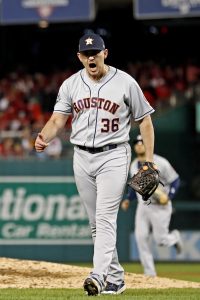
Almost two months since free agency opened, just one team – Minnesota – has come up as a rumored suitor for Harris. There could be unreported clubs chasing Harris, though it’s surprising that there hasn’t been more speculation centering on the 35-year-old. After all, since his 2013 breakout with the Diamondbacks, not many relievers have been more productive. Going back to then, Harris has pitched to a 2.59 ERA/2.97 FIP with 9.58 K/9, 2.28 BB/9 and a 50.4 percent groundball rate across 378 2/3 innings.
There was no let-up last season for Harris, who posted a career-best 1.50 ERA in 60 frames. Judging relievers by ERA is dangerous, granted, and Harris was fortunate to prevent runs at such a stingy rate. But the rest of his numbers were also quite impressive, as he managed a 3.15 FIP/3.04 xFIP/3.18 SIERA, 9.3 K/9, 2.1 BB/9 and a 54.6 percent grounder rate.
Altough Harris didn’t blow anyone away with his cutter-curve mix, both pitches were among the best of their kind, according to FanGraphs. Excellent spin rates had something to do with it. Harris ranked in the game’s 96th percentile in fastball spin and in its 86th percentile with the curve, per Statcast. Hitters had immense difficulty squaring up either offering, as shown by the lack of damaging contact Harris surrendered. He finished in the majors’ 84th percentile in hard-hit rate and in the 89th percentile in expected weighted on-base average against.
Once the playoffs rolled around, Harris’ lights-out performance continued. It’s true the Nationals did get the better of Harris in their Game 6 and 7 World Series wins over Houston, which wasn’t the way he wanted to go out last season. Still, Harris concluded the postseason with 9 2/3 innings of two-run ball, striking out 11 and issuing just one walk along the way.
Harris undoubtedly made a strong case for a quality payday throughout the year, but with 2019 about to turn to 2020, he remains on the market. Youth isn’t on Harris’ side, of course, and he doesn’t carry much experience as a closer. Those factors could be scaring off some teams, but as a hurler who has averaged 50-plus innings of terrific results for the past seven seasons, he has established himself as a high-end setup man. Perhaps Harris will be paid accordingly when the new year arrives.
Photo courtesy of USA Today Sports Images.
Minor Transactions: 12/30/19
The latest minor moves from around baseball…
- The KT Wiz of the Korea Baseball Organization announced the re-signing of outfielder Mel Rojas Jr., Dan Kurtz of MyKBO.net tweets. Rojas entered the pro ranks as a third-round pick of the Pirates in 2010, but he didn’t reach the majors with the Bucs or his next team, the Braves, through 2017. He then went to Korea and has since established himself as a serious offensive threat, having combined for 85 home runs over 1,190 plate appearances. The 29-year-old Rojas totaled 24 HRs and recorded a .322/.381/.530 line across 578 PA in 2019, and had been hoping to parlay that production into a guaranteed contract with a major league team this offseason. Instead, he’ll remain in the KBO.
Trade Candidate: Dominic Smith
Plenty went wrong for the Mets in 2019, their third straight season without a playoff berth, but the oft-maligned franchise nonetheless turned in a fairly respectable campaign. They got off the mat after an awful start to win 86 games, right-hander Jacob deGrom won his second consecutive National League Cy Young Award, and slugging first baseman Pete Alonso burst on the scene to mash 53 home runs en route to NL Rookie of the Year honors. Aside from Alonso, there were other legitimately encouraging developments among the Mets’ position player group, including the performance of fellow first baseman Dominic Smith.
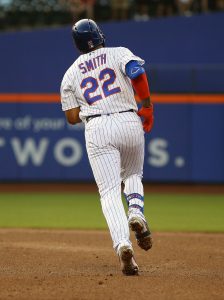
It appeared entering the season that Smith was teetering on the brink of irrelevance, even though he wasn’t far removed from his days as a touted prospect. The 11th overall pick of the Mets in 2013, Smith debuted in the majors in 2017 as one of the game’s 100 best farmhands, but he fell way short of the hype at the outset of his career.
From 2017-18, a 332-plate appearance span, the lefty-swinging Smith put up a dismal .210/.259/.406 batting line. Smith’s minus-1.0 fWAR in that time frame ranked dead last among all 79 Mets who racked up at-bats, and he also struggled badly at the Triple-A level during the latter of the two seasons. As a result, fans, media and maybe even the organization were down on Smith, though he came back in 2019 to produce far better results than the average major league hitter.
Alonso’s presence and injuries to Smith helped keep him from playing a full season, but he still impressed during an 89-game, 197-PA sample. Playing his age-24 season, Smith batted .282/.355/.525 (133 wRC+) with 11 home runs and a lofty .243 ISO. Plus, after combining for a 28.4 percent strikeout rate with a 5.4 percent walk rate during the prior two years, he made serious strides in those departments. Smith went down on strikes at a 22.3 percent clip and drew free passes 9.6 percent of the time. He also chased fewer pitches outside the zone, made more contact and was equally effective against southpaws (132 wRC+) and righties (133 wRC+), though his success versus same-handed pitchers came over a much smaller sample size.
While Smith did take real steps forward last season, it appears there was some good fortune involved. Smith finished the season with a .368 weighted on-base average, but his .327 xwOBA (via Statcast) didn’t measure up. Even if you’re unconcerned by that and regard Smith as someone who could be a long-term offensive linchpin, it’s up in the air whether he’ll play another game for the Mets. Consider: Alonso has first base on lockdown, there’s no designated hitter option in the NL, and although Smith did get most of his playing time last season in the corner outfield, he’s part of a logjam there for the Mets. Not only could Yoenis Cespedes come back after a couple injury-crushed seasons, but the corner OF-capable foursome of Michael Conforto, Brandon Nimmo, Jeff McNeil and J.D. Davis remains on hand. Those players’ presences could help push Smith to the trade block and out of Queens.
As mentioned, Smith’s coming off a season in which he made clear progress. He also has another pre-arbitration season left and isn’t on track to reach free agency until after the 2024 campaign. All of those factors should buoy Smith’s trade value, as should the dearth of high-end first basemen in free agency, yet he’s still not going to bring back any kind of haul. Smith’s position, his lack of a track record in the bigs and a lack of demand for first basemen have likely tamped down his appeal on the market. Ultimately, it seems possible New York will use Smith to get rid of one of its undesirable contracts (Jed Lowrie? Jeurys Familia?), as Ken Rosenthal recently reported the Mets and Rangers were in talks on such a deal. The Rangers still haven’t upgraded at first, where Ronald Guzman was a disaster in 2019, so they might remain interested in Smith. The Red Sox, Royals and Twins also make for a few debatable landing spots.
For now, Smith looks like one of the most logical trade candidates in baseball. However, if the Mets don’t receive an offer to their liking, they keep Smith as a bench player or stash him as depth in Triple-A ball. Smith still has a pair of minor league options left, but he seems overqualified for anything below the majors at this point. Regardless, it doesn’t appear Smith will be able to carve out a regular role for himself as a Met, so a trade could be the best move for his career.
Photo courtesy of USA Today Sports Images.
MLBTR Poll: Should Rockies Shop Nolan Arenado?
In five-time All-Star third baseman Nolan Arenado, the Rockies unquestionably have one of the majors’ blue-chip players. At the same time, though, Arenado’s on-field value could place him among the game’s most appealing trade chips. The Rockies did make a franchise-record commitment last offseason to Arenado, adding a guaranteed seven years and $234MM to the $26MM he was already set to rake in during the 2019 campaign. Based on that, Arenado should be a member of the Rockies for the long haul, but it’s not out of the realm of possibility that they’ll go in another direction this winter.
[RELATED: Remaining Needs – NL West]
As of a few weeks ago, the Rockies and general manager Jeff Bridich were reportedly open to listening to offers for the 28-year-old. The Braves and Rangers, teams that still haven’t filled their third base needs as the new year approaches, showed interest thereafter in Arenado. Meanwhile, the Nationals, Phillies, Dodgers and maybe the Twins come to mind as teams that could at least kick the tires of Arenado if they lose out on the top free-agent third baseman left on the board, Josh Donaldson, or fail to swing a trade for someone like Kris Bryant of the Cubs. (Bryant looks like a more realistic trade candidate than Arenado right now, though the service-time grievance the former filed against the Cubs – does he have one year of control left or two? – has helped prevent his market from heating up thus far.)
On the other hand, considering Arenado has established himself as one of the sport’s most valuable players, Colorado would likely be content to keep him. Indeed, Buster Olney of ESPN has recently heard that the Rockies aren’t aggressively shopping Arenado. While the team was woeful last season during a 71-win showing, Arenado did help the Rox to playoff berths in each of the previous two years. So, Bridich could regard the Rockies’ failed 2019 as a fluke and look for a bounce-back effort from his Arenado-led roster next season.
Even if the Rockies are willing to part with Arenado, though, an offer they deem palatable may not be easy to find. After all, Arenado’s contract still contains a boatload of money – the deal he signed before last season hasn’t even kicked in yet, though it looks reasonable enough in light of fellow third baseman Anthony Rendon‘s seven-year, $245MM pact with the Angels. Beyond that, Arenado has a full no-trade clause that gives him the right to veto any move. He also has the ability to opt out after the 2021 campaign, and if interested teams are worried he’ll take advantage of that, it’ll tamp down his trade value.
If not for Arenado’s opt-out clause, the Rockies would be in the catbird seat here. There wouldn’t be any real pressure to part with the face of their franchise and one of the greatest players they’ve ever had. But if the Rockies don’t expect to contend prior to Arenado’s opt-out chance, maybe they ought to market one of baseball’s leading superstars now.
(Poll link for app users)
Should the Rockies aggressively shop Nolan Arenado?
-
Yes 53% (6,004)
-
No 47% (5,279)
Total votes: 11,283
MLBTR Chat Transcript: 12/30/19
Click here to read a transcript of tonight’s live chat with Connor Byrne of MLBTR.
Diamondbacks Sign Kole Calhoun
The Diamondbacks officially have a new right fielder, as they formally announced Monday that they’ve signed Kole Calhoun to a two-year deal with a club option for a third season. The PSI Sports Management client will earn a reported $16MM in guaranteed money: $6MM in 2020, $8MM in 2021 and at least a $2MM buyout on a $9MM option for the 2022 season.
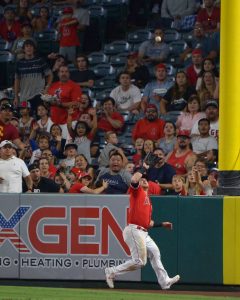
The 32-year-old Calhoun reached the open market Nov. 4 when the Angels declined his $14MM club option in favor of a $1MM buyout. However, for the Angels, that decision likely had more to do with a desire to spread that money around to other need areas (and star outfield prospect Jo Adell‘s forthcoming arrival) than deficiencies on Calhoun’s part. After all, for the most part, Calhoun was a solid producer with the Angels. From his first full season in 2014 through last year, he posted at least 2.0 fWAR five times.
Last season was another quality showing for Calhoun, who logged 2.5 fWAR while mashing a career-high 33 home runs across 632 plate appearances. While Calhoun did strike out a personal-high 25.6 percent of the time, he also drew walks at an all-time clip of 11.1 percent. In all, his .232/.325/.467 batting line came in 8 percent above the league average, per FanGraphs’ wRC+ metric, and fell in line with his career mark of 105.
Calhoun has established himself as a useful hitter, though defense is likely his calling card. Defensive Runs Saved assigned the big-armed Calhoun a minus-1 mark in right field last season, but his career has been a different story (plus-12). Meanwhile, as has typically been the case, Ultimate Zone Rating was fond of his most recent performance in right (plus-5.1 in 2019, plus-30.0 overall).
Calhoun’s now heading to his home state, where he once thrived for the Arizona State Sun Devils, and figures to enter 2020 as the Diamondbacks’ No. 1 option at his customary position. He’s set to join Ketel Marte (center) and David Peralta (left), essentially replacing 2019 starter Adam Jones, who’s now playing in Japan. Considering the way their careers have gone of late, Calhoun should provide an upgrade over the replacement-level numbers Jones gave the Diamondbacks in 2019. Beyond that, the hope for Arizona is that he and the team’s highest-profile offseason pickup, left-hander Madison Bumgarner, will help push an 85-win roster from last season into the playoffs next year.
MLB.com’s Jon Morosi first reported the agreement (via Twitter). Joel Sherman of the New York Post and Nick Piecoro of the Arizona Republic reported financial terms (Twitter links).
Photo courtesy of USA Today Sports Images.
Ryosuke Kikuchi To Stay In Japan
SUNDAY: Given the deep free agent market for second basemen this offseason, it was plausible Kikuchi would again explore his MLB options next winter. That no longer seems to be the case. Kikuchi instead agreed to a four-year contract extension with the Carp on Friday, reports the Japan Times. The deal will reportedly pay him $2.7MM per year, with unspecified additional incentives available.
THURSDAY: Japanese infielder Ryosuke Kikuchi won’t be coming to the majors in 2020. Kikuchi’s Nippon Professional Baseball team – the Hiroshima Carp – posted him Dec. 3, which gave him a chance to sign with a big league club through Jan. 2. But Kikuchi announced this week that he’ll remain in his homeland, according to Sanspo (hat tip to Patrick Newman of NPB Tracker).
“The market moved slowly, so I took the decision that it would be better to inform the team early that I would stay,” Kikuchi said. “I was really torn.”
Kikuchi spent the previous eight years as a member of the Carp, with whom he developed a strong defensive reputation at second base. The soon-to-be 30-year-old’s offense hasn’t quite been up to par, though, as evidenced by his .271/.315/.391 line across 4,695 plate appearances in NPB.
Unfortunately for Kikuchi, his lack of offensive prowess no doubt worked against him as he tried to find a major league deal. Moreover, it surely didn’t help Kikuchi’s cause that he was an unproven commodity in a free-agent class of second basemen that’s loaded with familiar names. Starlin Castro, Brian Dozier, Ben Zobrist, Neil Walker, Jason Kipnis, Brock Holt, Scooter Gennett, Asdrubal Cabrera and Wilmer Flores are just some of the veteran second basemen who are still without contracts as the new year nears.
Free Agent Faceoff: Castellanos Vs. Ozuna
The elite class of free agents – those capable of landing significant multiyear contracts – has shrunk to almost nothing since the market opened at the beginning of November. Third baseman Josh Donaldson, who could wind up with a contract in the $80MM vicinity (if not more) before next season begins, stands out as by far the No. 1 player available. For the most part, impact players without teams are a lot harder to find thereafter, though there are a couple other hitters who should join Donaldson in cashing in during the coming weeks.
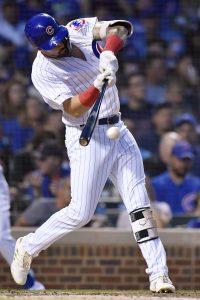
Outfielders Nicholas Castellanos and Marcell Ozuna entered the offseason as two of the top outfielders sans contracts. Almost two months later, they’re still looking for jobs. At the outset of the winter, MLBTR predicted a four-year, $58MM guarantee for Castellanos and a three-year, $45MM guarantee for Ozuna. Several teams have been connected to the two since, but neither player has found an offer to his liking. Now, it’s worth wondering who’s the more desirable player of the pair.
Castellanos, who will turn 28 in March, broke out with the Tigers in 2016 and has been a well-above-average offensive player since. During that four-year, 2,454-plate appearance span spent with the Tigers and Cubs, Castellanos slashed .286/.336/.504 with 94 home runs, a 6.5 percent walk rate and a 22.3 percent strikeout rate en route to a 121 wRC+ (meaning his production came in 21 percent above the average hitter’s) and 9.7 fWAR.
As has been covered time and again, Castellanos’ defensive limitations have somewhat offset his work at the plate. Castellanos couldn’t hack it at third base, which led the Tigers to move him to right field late in 2017. He has also endured no shortage of troubles in the outfield, having accounted for minus-35 Defensive Runs Saved and a minus-25.7 Ultimate Zone. Although Castellanos did show some improvement last season, he still stumbled to a minus-9 DRS with a minus-5.2 UZR. So, if you’re adding him to your team, you’re probably not expecting much in the field.
On the other hand, DRS (plus-28) and UZR (plus-28.3) have given high marks to Ozuna in the outfield (primarily left) since his career began with the Marlins in 2013. Dating back to then, Ozuna has batted .273/.329/.455 with 148 homers (112 wRC+), a 21 percent strikeout rate against a 7.5 walk percentage, and 20.3 fWAR over 3,861 trips to the plate divided between Miami and St. Louis.
The 29-year-old Ozuna has been a more valuable player overall than Castellanos, though the latter has closed the gap in the past couple years. Castellanos was clearly the more productive batter in that span, as his 126 wRC+ trumped Ozuna’s 108 mark. But both players have been perennial Statcast favorites, evidenced in part by Castellanos’ .364 expected weighted on-base average and Ozuna’s even better .382 figure from 2019.
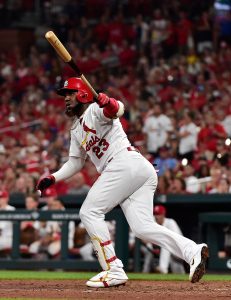
Bottom-line production aside, Castellanos and Ozuna have shown themselves to be pretty durable throughout their careers. Since his first full year in 2014, Castellanos has put up seasons of 148 games or more five times (including 151 in 2019). While Ozuna did miss 32 games because of broken fingers last season, he does have four years of 148-plus games on his resume.
Castellanos and Ozuna have looked similarly valuable of late, though the comparison between the two is admittedly imperfect. After all, they do line up at different positions, and Castellanos – unlike Ozuna – had the benefit of reaching free agency without a qualifying offer hanging over his head. Still, as the two top outfielders on the market, it at least makes some sense to group Castellanos and Ozuna together. Which player would you rather sign?
(Link for app users)
Who's the more appealing free-agent outfielder?
-
Nicholas Castellanos 50% (6,089)
-
Marcell Ozuna 50% (6,025)
Total votes: 12,114
Photos courtesy of USA Today Sports Images.