
White Sox Designate Tayron Guerrero
The White Sox have designated right-hander Tayron Guerrero for assignment, the team announced. The move makes room for outfielder Luis Robert, whom the White Sox signed to a long-term contract Thursday.
This ends a very short run with the White Sox for the 28-year-old Guerrero, whom the White Sox claimed off waivers from the Marlins on Dec. 6. Although Guerrero’s average fastball approaches 100 mph, he hasn’t been effective in the majors since he debuted in 2016 with the Padres. Through 106 innings, including 46 in 2019, Guerrero has only managed a 5.77 ERA/5.08 FIP with 9.42 K/9 and 5.69 BB/9.
White Sox Sign Luis Robert To Long-Term Deal
1:33pm: The White Sox have announced the contract. Robert will earn $1.5MM in 2020, $3.5MM in 2021, $6MM in 2022, $9.5MM in 2023, $12.5MM in 2024 and $15MM in 2025.
12:07pm: The White Sox have reached a long-term agreement with center field prospect Luis Robert, Bob Nightengale of USA Today reports. The deal includes $50MM in guaranteed money over six years, and it features two club options, per Jeff Passan of ESPN. The max value is $88MM over eight years, including $20MM club options for 2026-27 with $2MM buyouts in each of the two seasons, Passan adds. It’s a record-setting accord for a player who hasn’t yet debuted in the majors.
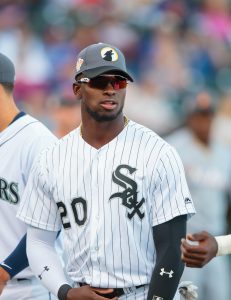
This will already be the second lucrative contract for the 22-year-old Robert, whom the White Sox signed out of Cuba for a $26MM bonus a couple months into the 2017 season. Robert has justified his payday since then, as he’s now regarded as one of the majors’ premier prospects. He ran roughshod over the high minors last season, batting .297/.341/.634 with 16 home runs in 223 plate appearances during his first (and maybe only) taste of Triple-A action.
As MLBTR’s Mark Polishuk recently noted when exploring a potential extension for Robert, he’s the latest White Sox outfielder to land a new deal before ever playing in the majors. The club signed outfielder Eloy Jimenez to a six-year, $43MM pact – then a record for an early career extension – shortly before last season started. Jimenez has more than lived up to the decision so far, having finished 2019 among the majors’ most successful rookies.
The Robert pact gives the White Sox an extra year of control over him, as they’re now slated to keep him through 2027 instead of ’26. Plus, if all goes well, it could tamp down massive arbitration earnings for Robert. Regardless, the White Sox now have at least two-thirds of an extremely enviable young outfield between him and Jimenez. And if recent trade acquisition Nomar Mazara, 24, begins living up to his vast potential, Chicago could possess one of the sport’s premier outfields for the foreseeable future.
Now that there’s no need to manipulate his service time, it seems likely Robert will open 2020 as the White Sox’s everyday center fielder. So, for the most part, the team’s Opening-Day lineup for the upcoming season appears set. The White Sox also have Jimenez (left), Mazara (right), Yoan Moncada (third base) and Tim Anderson (shortstop) as key members of their young offensive core. Sluggers Jose Abreu and Edwin Encarnacion (DH/1B) and catcher Yasmani Grandal will supplement that group, with a potential-packed rotation set to consist of some combination of Lucas Giolito, Dallas Keuchel, Reynaldo Lopez, Dylan Cease, Gio Gonzalez, Michael Kopech and Carlos Rodon.
Last decade was one to forget for the White Sox, who haven’t made the playoffs since 2008 or finished above .500 since 2012. But judging by general manager Rick Hahn’s actions this winter, including Robert’s contract, they’re all-in on changing their fortunes as early as this year.
Photo courtesy of USA Today Sports Images.
Red Sox To Sign Kevin Plawecki
The Red Sox have reached an agreement with free-agent catcher Kevin Plawecki, Robert Murray reports. It’s a major league contract, per Alex Speier of the Boston Globe. Joel Sherman of the New York Post adds that it’s for one year. Plawecki, an ACES client, will earn $900K, Bob Nightengale of USA Today tweets.
The 28-year-old Plawecki seems likely to serve as the backup in Boston to starting catcher Christian Vazquez. However, Plawecki – once a 35th overall pick (2012) and a top 100 prospect of the Mets – hasn’t been especially effective in the majors since he debuted in 2015. Plawecki put up a .218/.308/.330 line in 804 plate appearances with the Mets from 2015-18 before they moved on from him last winter. The club traded Plawecki to the Indians almost exactly one year ago, on Jan. 6, 2019.
The Plawecki acquisition didn’t work out as hoped for the Indians, with whom he batted a dismal .222/.287/.342 across 174 PA as Roberto Perez‘s backup. On the other hand, Plawecki was a standout behind the plate, where he ranked near the top of the majors in Baseball Prospectus’ Fielding Runs Above Average metric.
Free Agent Faceoff: Wood Vs. Walker
The market for starting pitchers has shrunk substantially since free agency opened at the beginning of November. Gerrit Cole, Stephen Strasburg, Zack Wheeler, Madison Bumgarner, Hyun-Jin Ryu, Dallas Keuchel and Cole Hamels have all found contracts. Jake Odorizzi, whom MLBTR ranked as the game’s 10th-best free agent at the outset of the winter, accepted a qualifying offer from Minnesota. The Twins also re-signed Michael Pineda and just picked up two more starters in Rich Hill and Homer Bailey.
With all of those pitchers and several others (Kyle Gibson, Tanner Roark and Julio Teheran, to name some) off the board, it looks like a pretty bare-bones group at this point. So, if you’re still banking on finding a No. 1, 2 or 3 type of starter in free agency, you may be out of luck. Even a surefire No. 4 or 5 seems like a lot to ask right now, but there are at least a few unsigned starters with upside who won’t cost a bank-breaking amount to sign. Left-hander Alex Wood and righty Taijuan Walker are two examples.
Between Wood and Walker, the former wins this battle in a landslide as far as major league track record goes. The 28-year-old flew under the radar to some degree from 2013-18, an 803 1/3-inning stretch in which he combined for a sterling 3.29 ERA/3.36 FIP with 8.27 K/9, 2.57 BB/9 and a 49.5 percent groundball rate with the Braves and Dodgers. Thanks to that run, the Reds acquired Wood last offseason with the expectation he’d give them front-line production. Instead, though, back problems limited the relatively soft-tossing Wood to seven starts and 35 2/3 frames of 5.80 ERA/6.38 FIP ball. Since then, there hasn’t been any reported interest on MLBTR’s pages in Wood, who has quickly gone from coveted starter to buy-low candidate.
Walker’s in a similar position – someone who could be a high-reward pickup at a reasonable cost. Now 27, Walker was an extremely hyped prospect with Seattle, which chose him 43rd overall in 2017. However, Walker didn’t prove to be irreplaceable to the Mariners over a fairly small sample of action, and they wound up trading him to the Diamondbacks in a late-2016 blockbuster.
Walker and his ~94 mph fastball were quite effective in his first season in Arizona – 3.49 ERA/4.04 FIP with 8.35 K/9, 3.5 BB/9 and a 48.9 percent grounder rate in 157 1/3 innings – but he has barely pitched since. He tossed 13 innings in 2018 before undergoing Tommy John surgery that May, and totaled just one frame last season (in the D-backs’ final game) after shoulder injuries stunted his TJS recovery. Arizona then cut Walker loose via non-tender instead of paying him a projected $5MM-plus in arbitration. Since then, at least one team – Walker’s old employer in Seattle – has shown interest in signing him.
Walker and Wood appear as if they’d be sensible additions for the Mariners or any other team that wants to take a back-of-the-rotation risk on a short-term deal. Odds are that neither player will secure a multiyear guarantee, though a one-season contract with a club option for 2021 could be a worthwhile gamble. Wood seems likely to rake in more money (MLBTR predicted he’d get a one-year, $8MM pact), but does that make him a better bet than Walker? Which of the two would you sign?
(Poll link for app users)
Which bounce-back candidate do you prefer?
-
Alex Wood 56% (5,366)
-
Taijuan Walker 44% (4,298)
Total votes: 9,664
The All-Decade Lineup
Another decade just concluded, which makes this an opportune time to review baseball’s best players at each position over the prior 10 years. This is certainly a debatable topic, and it’s just one person’s opinion, so feel free to make any disagreements known in the comments section below…
Catcher: Buster Posey, Giants
- Father Time has seemingly caught up with Posey in recent seasons, but it doesn’t diminish the 32-year-old’s overall excellence. From 2010-19, he was an instrumental member of three World Series-winning Giants teams, an NL MVP winner and a six-time All-Star. Posey slashed .302/.371/.458 with 140 home runs and 53.0 fWAR during that span, potentially putting himself on a Hall of Fame course.
First base: Joey Votto, Reds
- Votto – now 36 and in the twilight of his career – should go down as one of the greatest and most intelligent hitters in the history of the game. He ran roughshod over pitchers throughout the prior decade, batting .306/.428/.516 with 231 homers and 48.0 fWAR, and joined Posey in earning six All-Star nods and an NL MVP.
Second base: Jose Altuve, Astros
- Hey, another six-time All-Star and a former MVP. But unlike Posey and Votto, who have faded of late, Altuve’s still a high-end performer. The diminutive 29-year-old’s fresh off his sixth straight outstanding season after beginning his career as a fairly non-threatening hitter. Between 2014-19, Altuve hit .327/.380/.497 with 114 dingers and helped his team to a championship. He ranked fourth in the majors in fWAR (32.4) and fifth in stolen bases (179) during that span.
Shortstop: Francisco Lindor, Indians
- Mr. Smile has been the focus of significant trade speculation over the past couple months, which tends to happen when you’re an elite player who seems unwilling to sign an extension with a small-market club. Regardless of where Lindor plays in the future, there’s no denying the four-time All-Star has an incredible past. Lindor, 26, has posted a .288/.347/.493 line with 130 homers, 93 steals and 27.2 fWAR since he debuted in 2015.
Third base: Josh Donaldson, Free Agent
- Fresh off a tremendous several years, the 34-year-old Donaldson’s now the No. 1 free agent on the market. Donaldson rose to prominence as a member of the Athletics in 2014 and has since played for three other teams (the Blue Jays, Indians and Braves). Between his breakout campaign and last season, the Bringer of Rain finished third among position players in fWAR (33.3), hit .272/.374/.524 with 185 homers, picked up three All-Star bids and took home an AL MVP.
Outfield: Mike Trout, Angels; Mookie Betts, Red Sox; Andrew McCutchen, Phillies
- Was there any doubt Trout would make this list? He’s a three-time MVP at the age of 28, easily the best player of last decade and someone who could quit right now and go down as one of the preeminent players the sport has ever seen. The rest of the outfield’s more debatable, but Betts and McCutchen made strong cases over the past few years. They’re each ex-MVPs who have been among a handful of elite performers for about half a decade. Most of McCutchen’s success came as a member of the Pirates, but he has become more of a complementary player with the Giants, Yankees and Phillies over the past couple seasons.
Designated hitter: David Ortiz, Retired
- You’re well within your rights to want, say, the ageless Nelson Cruz here, but I’ll take the now-retired Ortiz – one of the most feared hitters and one of its premier big-game hitters throughout his career. From 2010 until his retirement in 2016, Big Papi was a five-time All-Star, a two-time champion and a one-time World Series MVP. Ortiz slashed .292/.383/.562 and swatted 224 HRs in that span before saying goodbye to the game. Even in his final season, his age-40-campaign, Ortiz was a force at the plate.
Marlins Reportedly Interested In Kim Jae-Hwan
7:14pm: Craig Mish of FNTSY Sports Radio passes along different information, tweeting that the Marlins are no longer interested in Kim after signing Dickerson.
6:21 pm: The Marlins are showing interest in Korean outfielder Kim Jae-Hwan, Jeeho Yoo of Yonhap News reports. Kim has until 4 p.m. CT on Jan. 5 to sign with a major league club after his Korea Baseball Organization club, the Doosan Bears, posted him Dec. 5.
The Marlins are the first reported MLB team to be eyeing the 31-year-old Kim, who debuted in the KBO in 2008 and was a force from 2016-18. During that three-year, 1,806-plate appearance span, Kim amassed 116 home runs with an OPS upward of 1.000, even winning league MVP honors in the last of those seasons. Kim’s numbers took a turn for the worse in 2019, though, as he batted .283/.362/.434 with 15 homers across 574 trips to the plate.
Should the Marlins land Kim, he’d be the second notable outfield addition for the club this winter, joining the just-signed Corey Dickerson. And it could help the Marlins’ cause in this case that they have Trey Hillman on their staff. The first base/infield coach managed against Kim in Korea for two years, as Yoo notes, so he’s quite familiar with his capabilities.
Latest On Rockies’ Relievers
The Rockies have signed relievers Wade Davis, Jake McGee and Bryan Shaw to expensive contracts in recent offseasons. Those deals haven’t worked out for the team, though, and now buyer’s remorse may be setting in regarding at least a couple of those pitchers. The club’s “investigating trades” involving McGee and Shaw, per Patrick Saunders of the Denver Post, though he notes it’s unclear whether the Rockies will be able to move either.
No member of the Davis-McGee-Shaw trio should be easy to trade. It may be close to impossible in the case of Davis, who’s coming off a shockingly awful season and is still owed $18MM (including a $1MM buyout for 2021). Meanwhile, McGee and Shaw are still due substantial amounts in their own right. McGee has $11.5MM left (including a $2MM buyout for 2021), and Shaw’s owed a $9MM salary this year with a $2MM buyout thereafter.
The left-handed McGee, 33, was coming off a mostly solid run with the Rays and Rockies before he re-signed with the latter entering the 2018 season. Since then, he has put up a pair of unimpressive years, most recently recording a 4.35 ERA (with a far worse 6.00 ERA) across 41 1/3 innings in 2019. McGee walked just 2.4 batters per nine along the way, but his K/9 (7.62) and groundball percentage (35.7) left plenty to be desired. He also finished with a swinging-strike percentage of 8.6, almost a career low.
Shaw, a 32-year-old righty, had about as much trouble retiring enemy hitters as McGee did last season. He stumbled to a 5.38 ERA/5.19 FIP wth 7.25 K/9 and 3.63 BB/9 over 72 innings during his second straight subpar showing since he joined the Rockies on a three-year, $27MM guarantee that matched McGee’s deal. The Rockies’ version of Shaw has paled in comparison to the one who held his own with the Diamondbacks and Indians in previous seasons.
Going forward, Shaw’s $9MM club option for 2021 will become guaranteed if he appears in 40 games this year and finishes the season healthy. So, if the Rockies are unable to find a taker for Shaw in a trade, it would behoove them to significantly reduce his workload after he averaged 65 appearances in his first two seasons in their uniform.
MLBTR Poll: How Good Are The Reds?
We’re on the verge of concluding a decade that will go down as, at best, a mixed bag for the Reds. They broke a 14-season playoff drought in the first year of it, 2010, and then made the playoffs in two of the next three campaigns. But the Reds have revisited the dregs of the majors since then, having gone six years since their most recent playoff berth and their latest .500 season. The Reds are now just a couple months removed from wrapping up a 75-victory season, but they did make real progress then (it was their highest win total since 2014), and they’re currently amid an active winter.
Since free agency opened at the beginning of November, the Reds have signed two players they hope will be key contributors to their next playoff roster. They picked up Mike Moustakas on a four-year, $64MM contract a few weeks ago, and though Moose has played third base for almost all of his MLB career, the plan is for him to handle second in Cincinnati. While it’s a risky bet on the Reds’ part, Moustakas did perform well during a limited run as a second baseman with the division-rival Brewers last season.
The Reds reeled in their second regular position player of the offseason Monday, agreeing to a three-year pact worth $20MM-plus with Shogo Akiyama. The former Nippon Professional Baseball standout will be the Reds’ go-to guy in center field, though it’s anyone’s guess how they will assemble the rest of their outfield. Nick Senzel, Jesse Winker, Aristides Aquino, Phil Ervin and Josh VanMeter are among several choices who could vie for roles, but as MLBTR’s Jeff Todd explained Monday, the Akiyama signing may give the team room to flip someone (Senzel?) for help at another position.
The Reds entered the offseason seemingly in need of aid at shortstop and catcher, but they haven’t added new faces at either spot. For at least the time being, Freddy Galvis and Tucker Barnhart remain the Reds’ top possibilities there. The rest of their infield looks stacked, though, with Moustakas at second, Joey Votto at first and Eugenio Suarez manning the hot corner. Likewise, the Reds’ rotation appears to be in enviable shape – Luis Castillo, Sonny Gray, Trevor Bauer, Anthony DeSclafani and free-agent addition Wade Miley comprise a starting five most teams would be glad to have. Cincinnati’s bullpen isn’t as well off, but it was a decent group in 2019 that hasn’t lost any integral contributors since then.
Along with bettering their roster this winter, the Reds have seen most of their division stand pat or maybe even get worse. The Cardinals won the NL Central last season, but they’ve been quiet in recent months and could lose outfielder Marcell Ozuna in free agency (perhaps even to the Reds). The Brewers – who, as mentioned, bid adieu to Moustakas – haven’t made any huge additions. The Cubs have been a general disappointment for several months, though a shakeup of some sort still seems possible, and the Pirates probably won’t contend in the near term. All that said, the door could be open for the Reds to make a playoff push in 2020. Based on what they’ve done to this point in the offseason, do you expect that to happen?
(Poll link for app users)
As of now, how many games do you expect Reds to win?
-
85-89 38% (10,966)
-
80-84 31% (8,927)
-
90-94 15% (4,351)
-
76-79 9% (2,672)
-
95 or more 3% (918)
-
75 or fewer 3% (744)
Total votes: 28,578
Report: Red Sox Aren’t “Actively Shopping” Mookie Betts
Red Sox right fielder Mookie Betts‘ name has been bandied about in offseason trade speculation, particularly with the club trying to get under the $208MM luxury-tax threshold in 2020. But the Red Sox still have a very good roster, and Betts is an irreplaceable member of it, so there doesn’t seem to be any hurry on their part to move him.
The Red Sox, led by new chief baseball officer Chaim Bloom, aren’t “actively shopping” the former AL MVP, according to Rob Bradford of WEEI.com. Trading Betts is not part of Boston’s ideal plan for cutting payroll, though the team may at least consider offers, Bradford suggests.
As of now, the Red Sox are projected for a luxury-tax outlay of $237MM-plus for 2020, per Jason Martinez of Roster Resource. Getting rid of Betts’ projected $27.7MM arbitration salary would put them in striking distance of $208MM, and he’d likely bring back a nice return at the same time. With that said, trading Betts – the Red Sox’s best player and one of the game’s elite performers – could cripple their chances of pushing for a playoff return next season. The 27-year-old Betts was a 10-WAR player as recently as 2018, his MVP campaign, and though his numbers dropped a season ago, he was still worth upward of 6 WAR.
Going forward, Betts is in line to become a free agent in less than a year’s time, but the Red Sox figure to put on a full-court press to extend him before truly considering a trade. Betts has indicated on multiple occasions he’s gearing up to test free agency, but as we saw when the Angels extended Mike Trout before last season, an enticing enough offer can keep a superstar from trying his luck on the market.
In Betts’ case, an extension should mean a guarantee approaching or exceeding $400MM (Trout got 10 years and $360MM in new money). But if the Red Sox aren’t willing to go to those lengths, or if Betts is dead set on shopping himself around the league next winter, he could dominate trade rumors leading up to the July deadline. In the meantime, left-hander David Price and center fielder Jackie Bradley Jr. seem like more attainable trade candidates on a team that’s hoping to reduce its payroll while remaining competitive.
Latest On Chad Bettis
Right-hander Chad Bettis was once a top 100 prospect and then a quality member of Colorado’s rotation, but health issues have played a role in stalling his progress over the past few seasons. Bettis underwent surgery for testicular cancer entering 2017, eventually making a courageous return to a major league mound later that year. He went on to log a sizable number of innings with the Rockies from 2018-19, though he missed time last season with a hip impingement and couldn’t match his prior production when he did pitch. Bettis wound up amassing 63 2/3 innings, most of which came as a reliever, and opposing offenses tattooed him for a 6.08 ERA/5.16 FIP.
In the wake of Bettis’ struggles, the Rockies moved on from the 30-year-old a couple months back in lieu of paying him a projected $3.8MM via arbitration. Now a member of an uninspiring free-agent market for starters, Bettis told Jon Morosi of MLB Network Radio on Tuesday that he has taken steps forward as he seeks a return to health. Bettis, who underwent bilateral hip surgery, revealed that he feels the best he has physically since before he beat cancer. At that point, Bettis was coming off a pair of 2.0-fWAR seasons in which he combined for a 4.57 ERA/4.11 FIP with 7.06 K/9, 3.02 BB/9 and a 50.5 percent groundball rate across 301 innings.
As mentioned, Bettis endured a noticeable dip in on-field production more recently, but there were some positive signs during a trying 2019. For instance, he averaged 93 mph on his fastball – his highest mean since 2014 – and induced ground balls at a whopping 60.8 percent clip. Of all pitchers who threw at least 60 frames last season, just four forced grounders at a superior rate.
Even though Bettis did offer reasons for hope last year, odds are that the overall disappointing results he posted from 2018-19 will force him to settle for a minor league contract this winter. Regardless of whether he lands a guaranteed deal, Bettis and his next team will hope he can revisit the form he showed during the respectable couple seasons he enjoyed as a member of the Rockies.