
White Sox Sign Austin Hays
February 4th: The Sox officially announced their signing of Hays today. The mutual option is worth $8MM, per James Fegan of Sox Machine.
January 31st: The White Sox have agreed to a deal with outfielder Austin Hays, ESPN’s Jesse Rogers reports. The one-year deal will pay Hays $6MM, according to Jon Heyman of the New York Post, and the contract will be official following a physical. Hays will earn $5MM in salary in 2026, and there is a $1MM buyout on a mutual option for 2027, The Athletic’s Ken Rosenthal writes. Another $375K is available for Hays in incentive bonuses based around plate appearances. Chicago’s 40-man roster is full, so the team will also have to make a corresponding transaction before the signing is finalized. Hays is represented by the MAS+ Agency.
Earlier today, Heyman reported that Hays was “said to be deciding this weekend” about his next landing spot. Heyman listed the White Sox, Cubs, Padres, Tigers, and Rangers as teams who had showed some level of interest in Hays at some point during the offseason. These five clubs were new to Hays’ market, as previous reports this winter linked the Royals, Reds, Mets, Yankees, and Cardinals to the 30-year-old outfielder. The Athletic’s Zack Meisel also wrote that the Guardians “put out feelers on” Hays’ services.
Playing time was an apparent priority for Hays, as Meisel wrote that the outfielder was looking for “a situation in which he could play every day.” That didn’t come in Cleveland since the Guardians didn’t want to block any of its up-and-coming younger outfielders, but Hays will now land with another AL Central team that has plenty of at-bats on offer. Hays figures to step right into at least semi-regular duty in right field, and he might also get time in his regular left field position depending on how the White Sox approach Andrew Benintendi‘s playing time. Brooks Baldwin, Derek Hill, Tristan Peters, Everson Pereira, and Jarred Kelenic are among the names in Chicago’s outfield mix, plus Luisangel Acuna is likely to get a lot of time in center field.
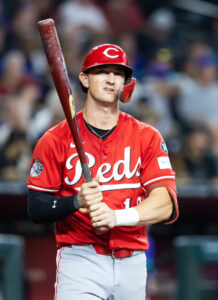 Hays has held his own defensively over 483 career MLB innings as a center fielder, though he hasn’t played the position since 2023. With both glovework and health in mind, Hays is probably better suited for a corner outfield slot, and some DH at-bats are probably also a consideration for a player who has taken six separate trips to the injured list over the last two seasons. Four of those six IL stints were due to left calf and hamstring strains, and Hays also missed a few weeks last season due to a left foot contusion.
It was almost exactly one year ago that the Reds signed Hays to a one-year, $5MM guarantee, which broke down as $4MM in salary and a $1MM buyout of a $12MM mutual option for the 2026 season. As with virtually all mutual options, Hays was cut loose following the 2025 campaign, though he had a respectable .266/.315/.453 slash line and 15 homers over 416 plate appearances for Cincinnati.
On a team that struggled to generate consistent offense, Hays’ 105 wRC+ was the third-highest of any Reds player who had at least 111 trips to the plate. Though Hays was again hampered by injuries, it was least a step upwards from the uncertainty of the kidney infection that plagued him for much of the 2024 campaign, and cratered his numbers altogether after a deadline trade to the Phillies.
Since Opening Day 2021, Hays has a 106 wRC+ over 2348 PA, and he played in basically an everyday role with the Orioles from 2021-23. Despite the decent production, Hays has never walked much or made a lot of hard contact, and his strikeout rates have shot upwards over the last three seasons. Hays’ viability for an everyday role will probably hinge on how much he can hit right-handed pitching, as his splits have made him look like most of a lefty-masher in recent years.
The Reds hung onto Hays last summer both because they needed him for their own playoff push and probably in part because his injuries hurt his trade market, but it certainly seems possible the Sox could shop Hays at the upcoming deadline. The focus remains on the future for the rebuilding White Sox, and plenty of teams would figure to have trade interest in a veteran bat who has a 160 wRC+ against left-handed pitching over the last two seasons.
The Hays signing is the latest intriguing move for a White Sox team that is planning to be more competitive in 2026, even if a full-fledged run at a playoff berth remains at least a year away. Trading Luis Robert Jr. to the Mets freed up $20MM in payroll space, and the Sox reinvested that money into a two-year, $20MM deal for Seranthony Dominguez to become Chicago’s next closer.
Since Dominguez is only getting $8MM of that money in 2026, the White Sox have now been able to sign Hays and ostensibly still have $6MM more to spend from the $20MM hole Robert left in the team’s budget. A pitching addition may be more likely than another position-player add given Chicago’s needs in the rotation and bullpen.
Inset photograph courtesy of Mark J. Rebilas — Imagn Images
Reds Sign Eugenio Suarez
February 3rd: The Reds made the Suarez deal official today. Catcher Ben Rortvedt was designated for assignment as the corresponding move.
February 1st: Eugenio Suarez is returning to Cincinnati, as ESPN’s Jeff Passan reports that the slugger has signed a one-year, $15MM deal with the Reds that includes a mutual option for the 2027 season. Jon Heyman of the New York Post reports that the option is worth $16MM, though mutual options are rarely triggered by both sides. The deal will become official once the Reds clear a spot on their 40-man roster, and presumably when Suarez passes a physical. Suarez is represented by Octagon.
Reports emerged last week that the Reds had interest in a reunion with the third baseman, who hit .253/.335/.476 with 189 homers over 3730 plate appearances during the 2015-21 seasons. The continued uncertainty over the Reds’ broadcast deal with Main Street Sports was said to be a holdup for the team in how much money they had available to pursue Suarez or other targets like Austin Hays (who signed with the White Sox yesterday).
With an agreement now in place with Suarez, it could be that the Reds have gotten some clarity about how they’ll proceed with MSS or perhaps a new broadcasting agreement with Major League Baseball itself. Alternatively, Suarez’s acceptance of just a one-year deal and arguably a discount price may be another reason why the two sides were able to line up on a contract.
 MLB Trade Rumors ranked Suarez 20th on our list of the winter’s top 50 free agents, and projected him for a three-year, $63MM deal. The one-year, $15MM pact falls well short of that prediction in both years and average annual value, as it could be teams were wary of making a larger commitment to a strikeout-prone player who turns 35 in July. Suarez’s third base glovework also dropped in 2025, as he posted -6 Defensive Runs Saved and -3 Outs Above Average.
With the bat, however, Suarez hit 49 home runs in 2025, matching his career high set with the Reds in 2019. Suarez’s overall slash line of .228/.298/.526 reflects his power-heavy output, as he delivered a below-average walk rate for the second consecutive season. Though Suarez’s 29.8% strikeout rate put him in the fifth percentile of all batters, he maxed out when he did make contact, with strong hard-contact and barrel rates.
It has been a strange two-season run for Suarez, who sandwiched a superstar-level campaign in between two mediocre half-seasons. Suarez had only a .591 OPS over his first 315 PA of the 2024 season with the Diamondbacks, before he caught fire and hit .276/.336/.593 with 60 homers over 766 PA from July 1, 2024 to July 31, 2025. Unfortunately, Suarez then drastically cooled off after he was dealt to the Mariners at the trade deadline, but he somewhat rebounded to get some key hits during Seattle’s postseason run to Game 7 of the ALCS.
This rather extreme streakiness could be another reason Suarez’s market never really took off this winter, as teams were justifiably not sure exactly which version of Suarez they’d get in his 13th big league season. The Mariners had some interest in a reunion, and other teams like the Cubs, Red Sox, and Pirates were also linked to the slugger.
Pittsburgh was the other finalist for Suarez’s services, according to MassLive.com’s Chris Cotillo. As per MLB.com’s Alex Stumpf and Jason Mackey of the Pittsburgh Post-Gazette, the Pirates were willing to offer a $15MM average annual salary to Suarez and also offered him a second guaranteed year. In taking just a one-year contract, Suarez seems to be hoping to fully re-establish his market by having a big season in 2026 and then re-entering free agency next winter. It was also very likely to Cincinnati’s benefit that Suarez is already very familiar with the organization from his previous seven-year run in the Queen City.
While the Pirates are on the way up, Suarez may have been more interested in joining a Reds team that actually did make the playoffs in 2025. Cincinnati reached the postseason on the strength of its rotation, as the lineup was average at best in most offensive categories, and 21st of 30 teams in home runs. Elly De La Cruz and Spencer Steer combined for 43 homers as the Reds’ top two home-run hitters in 2025, so Suarez alone tops that total.
Suarez steps right into an everyday role in the Reds’ lineup, though it will be interesting to see where exactly Suarez is deployed. Ke’Bryan Hayes is arguably the best defensive third baseman in the game, so Suarez is more likely to see a lot of action as a DH and possibly at first base. Suarez’s MLB history as a first baseman consists of just three late-game appearances, all of which came last year. The Reds will surely give Suarez plenty of time at the position this spring to see how Suarez fares at the cold corner, and Steer and Sal Stewart will also receive at-bats in the first base/DH mix. Stewart can also play some second base and Steer could play left field, with Steer’s right-handed bat complementing the left-handed hitting JJ Bleday on the grass.
Bleday and Dane Myers were the only notable offensive adds the Reds made prior to today, with the two outfielders more or less replacing Hays and Gavin Lux (who was dealt to the Rays as part of the three-team deal with the Angels that brought reliever Brock Burke to Cincinnati). Suarez now represents a major boost to the Reds’ lineup, and a source of stability on a team that is still waiting to see what it has in players like Steer, Stewart, Matt McLain, or Noelvi Marte. Even De La Cruz was more good than great in 2025, but EDLC figures to benefit with Suarez providing protection behind him in the lineup.
RosterResource estimates a $126.1MM payroll for the Reds at the moment, which is a minor increase over their $118.7MM figure from the 2025 season. President of baseball operations Nick Krall said in early November that the Reds would be spending at “around the same” levels as 2025, so it could be that the team is essentially done with significant offseason moves unless they can unload some salary.
This could again change depending on what happens with the Reds’ broadcast deal, or ownership might potentially green-light some more spending either now or during the season (perhaps once some ticket revenue starts rolling in). The Reds seem to be well-positioned to make another run at a postseason berth in 2026, even though within the NL Central alone, the Pirates will be better and the Brewers and Cubs each figure to keep battling for the division crown.
Inset photo courtesy of Stephen Brashear — Imagn Images
White Sox Notes: Hicks, Sandlin, Leasure
The White Sox pulled off another significant transaction yesterday, acquiring right-handers Jordan Hicks and David Sandlin, two players to be named later, and $8MM in cash (to help cover Hicks’ $24MM salary) for pitching prospect Gage Ziehl and a player to be named later. It is the third notable move in four days for Chicago, after the Pale Hose signed Seranthony Dominguez and Austin Hays to free agent contracts.
Between the $12MM owed to Hicks in 2026, Hays’ $6MM guarantee in a one-year deal, and the $8MM allotted for Dominguez in the first season of his two-year, $20MM contract, it adds up to a $26MM outlay for the White Sox on this trio for the upcoming season. It’s a pretty close match for the $20MM Chicago had committed to Luis Robert Jr. before the outfielder and his contract were dealt to the Mets on January 20.
“With the payroll flexibility that we gained through that move, we wanted to utilize that money toward players that could help us for the long term as we continue to take the next step. There are different avenues to do that,” White Sox GM Chris Getz told reporters (including SoxMachine’s James Fegan and MLB.com’s Scott Merkin), further noting that “adding a Sandlin is essentially part of a Luis Robert return.”
That’s a bit of a eyebrow-raising comment, given that Chicago’s payroll currently sits at a paltry $85.5MM, per RosterResource. To suggest that Sandlin’s acquisition was only possible in conjunction with a Robert trade would imply that the Chicago-based club can’t support a payroll that includes Robert, Dominguez, Hays and Hicks — but that would’ve only pushed the payroll to around $105MM. Perhaps owner Jerry Reinsdorf truly won’t green-light a payroll north of $100MM at present, but the South Siders trotted out a $181MM Opening Day payroll as recently as 2023 (and $193MM in 2022). Getz’s assertion that Sandlin is indirectly part of the Robert return is either a case of some serious spin or an eye-opening acknowledgement of severe budget restrictions put in place by Reinsdorf.
Regardless, it seems that Sandlin has been on Chicago’s radar for a good while now, and Getz views the hard-throwing right-hander as someone who’s “going to come into Spring Training and compete for a spot” in the team’s rotation. Sandlin has only 23 2/3 Triple-A innings to his name, and he struggled to a 7.61 ERA during that brief stint with Triple-A Worcester in 2025. Even if he doesn’t crack the club’s Opening Day rotation, it’s perfectly plausible that he’ll be an option to join the staff later in the season as he gets more experience at the top minor league level.
Beyond this young arm in Sandlin, Hicks brings some experience to the pitching staff, though he’s a pure rebound candidate. The righty posted a 6.95 ERA across 67 1/3 innings with the Giants and Red Sox in 2025, with subpar strikeout (18.5%) and walk (10.2%) rates. Hicks’ 4.41 SIERA also wasn’t great but is a better reflection of his performance, since it factored in some bad batted-ball luck, as the grounder specialist was hurt by a .352 average on balls in play.
Health was also a factor. Hicks spent a little under two months on the injured list dealing with toe inflammation and then tendinitis in his throwing shoulder. On this front, Hicks told media that he has recovered well, and is up to throwing 99.5mph in a recent bullpen session. “My body’s in a great place, probably the best it’s been since 2023,” Hicks said. “I’m fit for whatever role that the team needs me in. I think that I can do very well in both [starting and relieving]. I’m just excited for the opportunity mostly, and ready to get back on the field.”
For now, the White Sox plan to use Hicks as a relief pitcher, Getz stated. This isn’t surprising given how Hicks struggled as a starter with the Giants and was converted back to relief work partway through each of the last two seasons. Hicks has spent the bulk of his career in the ‘pen and had better results as a reliever than as a starter.
Speaking of relief pitchers, the White Sox discussed another reliever during their negotiations with the Red Sox. MassLive.com’s Chris Cotillo reports that the two sides “had serious discussions” about including Jordan Leasure in the deal before the Red Sox instead went with Ziehl as the named player in the two-player return.
Whereas Ziehl has yet to reach Triple-A, the 27-year-old Leasure has two seasons of MLB experience, with 101 games for Chicago. Leasure made his debut in 2024 and posted a 6.32 ERA over 31 1/3 innings, but improved on that mark significantly with a 3.92 ERA and 30.1% strikeout rate over 64 1/3 frames in 2025. The right-hander’s 11.2% walk rate was still on the high side, but a step up from Leasure’s 12.7 BB% in 2024.
There’s no real reason to think Chicago is actively shopping Leasure, but it’s of some note that they at least considered it — particularly with how many clubs around the league are looking for affordable bullpen help. Leasure will pitch the bulk of the upcoming season at 27 (28 in mid-August), has a pair of minor league options remaining, and won’t be arbitration-eligible until next offseason, when he’ll likely be a Super Two player.
Multiple Teams Interested In Ty France
The Diamondbacks, Mets, Padres, and Yankees are among the teams who have shown interest in Ty France, according to MassLive.com’s Chris Cotillo. The free agent first baseman won the AL Gold Glove Award last season, though he hit only .257/.320/.360 with seven homers over 490 plate appearances with the Twins and Blue Jays.
After batting .285/.355/.443 over 1418 PA during the 2020-22 seasons, France went from a 129 wRC+ over those three years to a 106 wRC+ in 2023, and a 93 wRC+ over the last two seasons. France has still been making contact at an above-average rate, but his hard-contact rates are middling at best and he has never taken many walks. Defensively, France’s glovework had cratered in the view of public metrics before he rebounded out of nowhere to post +10 Outs Above Average and +9 Defensive Runs Saved over 976 2/3 innings at first base in 2025, resulting in his first Gold Glove.
France is a right-handed hitter without a platoon split, as his numbers against right-handed and left-handed pitching are basically identical over his career. Teams in the market for a right-handed hitting first base complement might prefer more of a clear-cut righty masher, though France’s newfound defensive capability is a bonus.
The Yankees have Ben Rice (a lefty bat) lined up as the starting first baseman and Giancarlo Stanton is locked into the DH role. Some more at-bats could be available on the days when Rice is playing catcher, but France would be used in a strict part-time capacity if he went to the Bronx. The same would be true in Queens, as the Mets plan to use Jorge Polanco as the starting first baseman, plus Mark Vientos and Brett Baty will be either at DH, or in the field when Polanco or any of the other Mets veterans are getting a DH day. Having an experienced first baseman like France would be helpful for the Mets, considering that Polanco has played only one MLB game at first base.
The left-handed hitting Pavin Smith will get the bulk of Arizona’s first base work, but between a platoon first base role and an open DH spot, France would have more opportunity for playing time with the Diamondbacks. Such names as Paul Goldschmidt and Carlos Santana have also been linked to the D’Backs this winter as part of the team’s ongoing search for first base help.
Signing with the Padres would be a homecoming moment for France, a SoCal product who played college ball at San Diego State. France began his pro career as a 34th-round pick for the Padres in the 2015 draft, and he spent parts of his first two MLB seasons with the Friars before he was dealt to the Mariners as part of a seven-player trade at the 2020 deadline.
Returning to San Diego at age 31 would line France up as a right-handed complement within a surplus of left-handed bats vying for time on the right side of the Padres’ infield. Jake Cronenworth, Sung Mun Song, Will Wagner, and Gavin Sheets are all lefty swingers, and the Padres have no set DH. Sheets is projected to be the starting first baseman with Cronenworth perhaps being the favorite for DH duty and Song bouncing around to multiple positions, but there’s plenty in flux as the Padres figure things out. Song is getting his first taste of Major League action after nine seasons in the KBO League, and an oblique injury could delay the start of his inaugural MLB campaign.
Orioles Acquire Bryan Ramos, Designate Weston Wilson
The Orioles have acquired infielder Bryan Ramos from the White Sox, according to reporter Francys Romero. Baltimore has officially announced the trade, and the Sox will get cash considerations in return. To open up a 40-man spot for Ramos, the Orioles designated Weston Wilson for assignment.
Ramos was designated for assignment three days ago when the Sox themselves needed to create 40-man space for the newly-signed Seranthony Dominguez. Ramos’ stint in DFA limbo didn’t last long, and he’ll now change organizations for the first time in his career, as the infielder was an international signing for the White Sox back in 2018. He started to make waves as a prospect during the 2022-23 seasons, and he made his MLB debut in 2024, posting a .586 OPS over 108 plate appearances for Chicago.
This uninspiring performance seemed to drop Ramos down the depth chart, even on a rebuilding White Sox team. He appeared in just four big league games in 2025, bringing his overall slash line to .198/.244/.333 in 120 PA against Major League pitching. While Ramos’ numbers (.235/.321/.404 in 705 PA) at Triple-A Charlotte are more respectable, they’re underwhelming considering that Charlotte plays in one of the most hitter-friendly ballparks in the minors.
Ramos has played only third base in the majors, and the hot corner has also been his primary position during his minor league career. However, Ramos has increased his versatility by playing some second base and a handful of games as a first baseman and left fielder, as becoming more of a utilityman will help Ramos in his attempts to return to the majors.
Wilson is a more established utilityman who has seen some time at first base, second base, third base, and all three outfield positions over his 100 career Major League games, all with the Phillies from 2023-25. Wilson has also shown more at the plate, with a .242/.328/.428 and nine homers over 245 PA. Most of that production came in Wilson’s first two seasons, and since he had only a .652 OPS over 125 PA in 2025, the Phils decided to move on by DFA’ing Wilson in late January.
The Orioles made a claim a few days later, but have now sent Wilson back to the waiver wire in relatively short order. This is something of the way of life for players like Wilson or Ramos who are out of minor league options, and Baltimore is particularly aggressive in constantly churning the back end of its 40-man roster, with the idea that the O’s can add minor league depth by sneaking enough players through the outright process. Assuming Wilson isn’t claimed again, the Orioles can outright him to Triple-A since Wilson doesn’t have enough service time to reject an outright assignment.
Diamondbacks Interested In Carlos Santana
As the Diamondbacks continue to look for first base help, the club has shown interest in Carlos Santana, MassLive.com’s Chris Cotillo reports. John Gambadoro of 98.7FM Arizona Sports adds more detail, saying that Santana is just one of multiple first basemen the Snakes are exploring, and no deal appears to be close.
A veteran of 16 MLB seasons, Santana has a reputation as a clubhouse leader, which Gambadoro says adds extra appeal for the D’Backs on top of Santana’s contributions on the field. Santana is a strong defensive first baseman who finally won his first career Gold Glove in 2024, and that same season saw him hit .238/.328/.420 with 23 homers over 594 plate appearances for the Twins.
That solid 113 wRC+ campaign was followed, however, by an 82 wRC+ performance over 474 PA with the Guardians and Cubs in 2025. Santana inked a one-year, $12MM free agent contract to return to his old stomping grounds, but this third stint in Cleveland didn’t work out, as Santana was released in late August. The Cubs signed Santana as bench depth heading into the playoff stretch, but he had just two hits over 19 PA in a Chicago uniform and wasn’t part of the postseason roster.
Over 474 total PA in 2025, Santana hit .219/.308/.325, with his OBP and slugging percentage each representing new career lows. His 11% walk rate was still very good and he avoided strikeouts at an above-average rate, yet the near-total evaporation of Santana’s power was hard to ignore, especially for a player in his age-39 season.
The switch-hitting Santana had a big dropoff against left-handed pitching, which was noteworthy since Santana has been much more productive hitting from the right side of the plate than the left side in recent years. Since the left-handed hitting Pavin Smith would be Santana’s platoon partner in Arizona, Santana would almost exclusively be facing southpaws, which might help him get back on track.
The D’Backs are the first team publicly linked to Santana’s market this winter, which isn’t surprising as he enters his age-40 season looking for a bounce-back performance. Santana previously rebounded from down years in 2020-21 to deliver more respectable numbers in 2022-23, but the question is naturally how much longer than the first baseman keep avoiding Father Time. Beyond his career track record, Santana’s strong glove does give him some advantage over other first basemen still on the market, which might help him with a team like Arizona that only needs a part-time first base bat.
MLBTR Chat Transcript
Mark P
- The Weekend Chat is here! /trumpet sounds
We’ll start taking questions once a few file into the queue…
AstrosFAN
- How big of a left handed bat do you think the Astros will get? Abreu tier? Tauchman tier? What do you think?
Mark P
- Tauchman tier seems more likely. It feels like (gamesmanship notwithstanding) that the Sox are viewing Abreu more as an everyday player than as trade bait, so something like a trade package centered around Abreu and Paredes may be less likely, if not impossible.
Ben
- Did the Giants materially improve with Bader and Arreaz?
Mark P
- Yes, since there’s a ton of value in putting Bader in CF and (just as importantly) getting Lee out of CF. The outfield defense should be enormously improved by having Bader in CF and Lee in RF, which in turns makes the rotation better. If Bader hits anything like he did in Philadelphia, that’s just icing on the cake.
Arraez I’m not really sure brings more to the table overall than Schmitt, but Arraez does have more of a track record.
Jason
- The Cardinals need a veteran starter, no question, is a 1 year Scherzer worth the price to them since they are shedding money?
Mark P
- Scherzer’s not going to sign with a rebuilding team.
Rick
- Snell’s injury doesn’t really affect the dodgers right? Just an improved role for wrobleski?
Mark P
- Snell at this point isn’t a realistic candidate to throw a full season. The Dodgers probably knew this before they acquired him in the first place, and are trying to manage his health and innings so he’ll be good to go for the end of the season and the playoff stretch.
Sam
- Eugenio is confirmed as going to Cincinnati, why did the Mariner’s allow him to sign elsewhere, leaving them with Williamson whom I think is not ready to play 3B everyday?
Mark P
- Williamson is an everyday player in terms of defense, though I agree that his bat is very much a work in progress at best. The M’s may feel Suarez’s best days are behind him, or is just too inconsistent a player for a big financial commitment.
That said, I wonder if Suarez’s willingness to take one year and $15MM was limited to just the Reds due to his past familiarity, because if that offer was also a possibility for Seattle, the M’s should’ve jumped
Dan
- Verlander to Detroit at 1 year 10 million?
Mark P
- His deal with the Giants was one year and $15MM, and I’m sure he doesn’t feel the need to take a $5MM paycut after delivering a quality season
Oldgfan
- Will the Twins rethink trading Ryan now that the PBO left ?
Mark P
- It is anyone’s guess as to how the Twins might process in the wake of Falvey’s surprising departure. But, the fact that the team wants to make some effort at competing in 2026 probably means Ryan stays put. Ryan, after all, is still inexpensive and in his arb years.
Prince
- I am disappointed that the Dbacks didn’t add Suarez for such a good price, Their offense seems very light to me, Does this make the Dbacks a longer shot to make playoffs?
Mark P
- Now this would’ve been a creative way for Arizona to add a RHH first baseman. Re-sign Suarez and use him primarily as a DH, but also in a platoon at 1B. Again, however, not sure if the price was right for the D’Backs or any other team besides the Reds, especially if Suarez was turning down a larger offer from the Pirates
Angels Sign Jose Siri To Minors Deal
The Angels have signed outfielder Jose Siri to a minor league contract, The Athletic’s Will Sammon reports. Siri will be invited to the Halos’ big league spring camp, according to the New York Post’s Jon Heyman, and he’ll earn $1.6MM if he makes Los Angeles’ 26-man roster. Siri has opt-out dates at the end of Spring Training and on June 1 if the Angels haven’t already selected his contract, as per Ari Alexander of 7 News.
The Mets designed Siri for assignment in late September and then outrighted him off their 40-man roster, and Siri opted for minor league free agency following the season. He’ll now head to Anaheim in search of a rebound following a disastrous and injury-plagued year in New York.
Siri fouled a ball off his left leg in April, fracturing his left tibia and keeping him out of any Major League action until September 9. Initially projected to miss 8-10 weeks in recovery, Siri’s leg soreness lingered to the point that he played in only 16 games in a Mets uniform (and had just a .292 OPS over 36 plate appearances). It was a brutal turn of events for a player who was acquired in a trade from the Rays in November 2024 with the idea that Siri could bolster the Mets’ center field position at least from a defensive standpoint.
Public defensive metrics loved Siri’s glovework in center field from 2022-24, when Siri played for the Astros and Rays. He also has excellent speed (which has translated to 45 career steals in 58 attempts), though it remains to be seen how the broken leg may impact Siri’s speed going forward. Siri was a good source of power in hitting 43 homers over the 2023-24 seasons, but his overall production at the plate was limited by a lack of walks and a preponderance of strikeouts. Over 1222 PA at the MLB level, Siri has struck out 442 times, while hitting .206/.263/.400.
Whatever Siri can provide on offense might be a bonus for the Angels, who are surely looking at Siri as a glove-first option within an outfield that has lot of defensive question marks. Jo Adell projects as Los Angeles’ regular center fielder even though he posted -13 Defensive Runs Saved and -8 Outs Above Average up the middle in 2025. Josh Lowe (acquired in a trade from Tampa) has respectable defensive metrics over the small sample of 156 career innings as a center fielder, but is better suited for a corner outfield slot. Jorge Soler and Mike Trout will split time between left field and DH, with the defensively-challenged Soler somewhat forced into the field due to the Angels’ need to keep Trout healthy with plenty of DH work.
Bryce Teodosio is the Angels’ current fourth outfielder, and while Teodosio is a strong defender, he also has only 55 MLB games on his resume. Kyren Paris and Matthew Lugo also doesn’t have much big league experience and Paris is more of a middle infielder anyway, so the Siri signing gives the Halos a veteran depth option to compete for a bench job in Spring Training.
Dodgers Sign Cole Irvin To Minor League Deal
The Dodgers have signed left-hander Cole Irvin to a minor league contract, Just Baseball Media’s Aram Leighton reports. Jon Heyman of the New York Post adds that Irvin’s deal includes an invitation to the Dodgers’ big league spring camp. It’s a late birthday present for Irvin, who just celebrated his 32nd birthday yesterday.
Irvin makes his return to North American ball after spending the 2025 season in Seoul with the Doosan Bears of the KBO League. Over 28 starts and 144 2/3 innings with the Bears, Irvin posted a 4.48 ERA, 19.7% strikeout rate, and 12.2% walk rate. For comparison’s sake, Irvin had a 4.54 ERA, 17.1 K% and 5.6 BB% over 593 innings at the Major League level from 2019-24, so the lack of control is a sudden red flag. Irvin did display a severe lack of control over a handful of games with the Twins in 2024 and with the Orioles’ Triple-A affiliate, but over a small sample size.
The southpaw had his usual strong command over the bulk of the 2024 season, though that was pretty much the only high point of a year that saw Irvin post a 5.11 ERA across 111 innings with Baltimore and Minnesota. The O’s designated Irvin for assignment in September 2024, and he finished the season with a few outings for the Twins following a waiver claim.
Back in 2021-22, Irvin posted a 4.11 ERA over 359 1/3 innings for the Athletics, seemingly establishing himself as a durable starter who could eat innings and deliver quality results. Irvin’s lack of strikeouts or high velocity made his production perhaps a bit of a high-wire act, however, and a trade to the Orioles prior to the 2023 resulted in some struggles as a starter before he righted the ship and became an effective reliever out of the O’s pen.
It is fair to guess that the Dodgers could use Irvin in any variety of roles as the club continues to stockpile as much pitching depth as possible. After two World Series runs and with every expectation of another championship in 2026, Los Angeles is building a pitching staff built for seven months of baseball, not six. If Irvin is able to recapture any of his old form, he could be a useful source of innings as a long man or spot starter to help L.A. manage its arms over the regular-season grind. Given the Dodgers’ track record at pitching development, it is also possible that Irvin can unlock something and achieve a new level of consistent success at the MLB level.
Mariners Sign Michael Rucker To Minors Contract
The Mariners signed right-hander Michael Rucker to a minor league deal earlier this month, according to Rucker’s MLB.com profile page. Rucker’s contract included an invitation to the Mariners’ big league spring camp, as per the list of non-roster invites Seattle released yesterday.
Rucker began his college career at Gonzaga, so this deal with the M’s could represent a return to the Pacific Northwest if the righty is able to break camp with the team. After transferring to BYU later in his NCAA days, Rucker was an 11th-round selection by the Cubs in the 2016 draft, and he broke into the bigs with Chicago in 2021. Over 123 1/3 MLB innings from 2021-23, Rucker posted a 4.96 ERA, 22.6% strikeout rate, 46.6% grounder rate, and 9.4% walk rate out of the Cubs’ bullpen.
These uninspiring numbers weren’t enough to keep Rucker on the roster, as Chicago designated him for assignment in February 2024 and soon traded him to the Phillies in a cash deal. He was limited to 30 2/3 minor league innings for the Phillies and Nationals in 2024 due to an arterial vasospasm in his pitching hand. The Nats outrighted Rucker off their 40-man roster following the 2024 campaign, and he then didn’t pitch at all in 2025.
As he enters his age-32 season, Rucker is looking to revive his career and show what he can do in the Mariners’ Spring Training camp. Rucker is probably more of a candidate to pitch at Triple-A Tacoma than he is to win a spot on Seattle’s Opening Day roster, but he can provide the M’s with some experienced bullpen depth. The righty has a 4.01 ERA, 25.64K%, and 7.54% walk rate over 107 2/3 career innings at the Triple-A level.